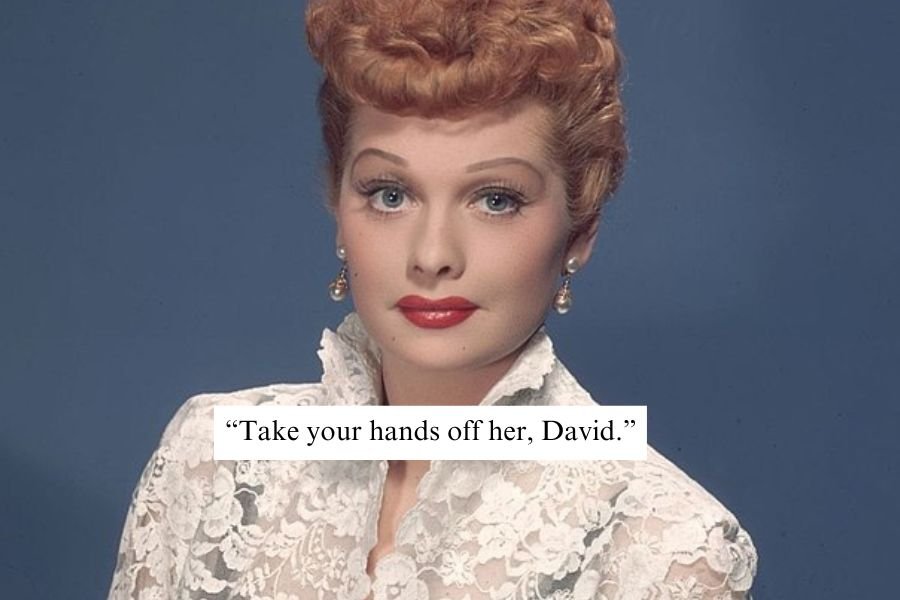
Watch Lucille Ball repeatedly tell a host to take his hands off female audience members

People laughed every time she told him ‘hands off,’ but she was stone cold serious.

Lucille Ball
Photo credit: CBS Television (Public Domain)Lucille Ball was a powerhouse both on screen and off.

According to her daughter, Lucille Ball never considered herself a feminist, but there’s no question she blazed many a trail for women. A working mother in real life, she depicted issues facing housewives with her brilliant television comedy and became the first female studio head in Hollywood. She broke glass ceilings but wasn’t particularly outspoken about women’s rights. In fact, in a 1980 interview with “People,” she said, “They can use my name for equal rights, but I don’t get out there and raise hell because I’ve been so liberated, I have nothing to squawk about.”

Ball empowered women by example—and by speaking her mind. Carol Burnett shared a story on PBS about how Ball was unhappy with a script for her new show, but women at that time didn’t raise concerns about such things. Men could express criticism and demand changes, but women simply didn’t. Ball did—and firmly—despite being non-confrontational by nature. Later she told Burnett, “Kid, that’s when they put the ‘s’ at the end of my name.”

A video has been circulating on social media showing Ball’s no-nonsense way of speaking up when she felt the need to, and people are gushing over it.

In 1978, Ball participated in a Q & A session with UCLA theater arts students on the television program “America Alive!” The viral clip shows Ball repeatedly telling one of the hosts, David Sheehan, to take his hands off of female audience members when they were asking a question.

Watch:

People laughed every time, but Ball didn’t so much as crack a smile during her clear, simple, repeated “hands off” admonitions. For 1978 especially, her advocacy for the women in the audience was extraordinary. Sheehan wasn’t touching these women in a lewd or sexual manner, but he was touching them in a way that he wouldn’t have touched a man who was asking a question. Most people wouldn’t have thought much of it at the time, but Lucille Ball immediately noted it and didn’t let it stand.

“I love that she didn’t even laugh when the room was,” shared one commenter. “She was not joking.”

“‘Take your hands off her, David,’ should be a sound AND a t-shirt,” wrote another.

“He kept trying. She kept telling him. Love her,” shared another.

“Lucille Ball always reminds me of my grandma,” offered another. “She hated to be seen as delicate, and she hated men that would touch her even more. She would say, stone-faced, ‘Get your paws off.’”

Even if Sheehan was casually touching those women out of habit and not ill intent, it’s laudable that Ball made a point of making him aware of it. Unfortunately, women are still having to deal with men touching them without being invited to, but seeing Lucille Ball’s serious face while calling it out is a good reminder that women have been fighting this battle for a long time. Good for her for using her microphone and the respect afforded her to speak up for the young women in her audience.


This article originally appeared last year.

  • A two-word request on set led Jodie Foster to rethink everything about Hollywood. The request was for a cappuccino.
    Photo credit: Alan LightJodie Foster at the 61st Academy Awards March 29, 1989
    ,

    A two-word request on set led Jodie Foster to rethink everything about Hollywood. The request was for a cappuccino.

    The two-time Oscar winner opened up about the moment she realized celebrity culture was changing her…and not for the better.

    Jodie Foster has won two Oscars, been famous since she was 12, and has been working in the industry since she was barely 3. By her own account, all of that success had started to do something to her she didn’t like.

    The cappuccino that changed everything

    She described the moment of recognition in a January 2026 interview with Variety, timed to the release of her new film “A Private Life.” It came down to a cappuccino.

    “I asked someone for a cappuccino?” she recalled, with what Variety described as barely restrained horror. “I did what? I thought I knew what I was talking about and ranted on for 45 minutes? I didn’t send that person a condolence letter when their mom died? I wasn’t at their wedding? I disappeared for four months and expected everybody to be my friend when I came back?”

    Foster, now 63, said she feared she was becoming what she called “a creature of Hollywood,” a politer way of putting something less polite. Famous since her breakout in “Taxi Driver” at 12 and a two-time Best Actress winner before she was 30, for “The Accused” in 1988 and “The Silence of the Lambs” in 1991, she’d spent decades in an environment that tells you your needs come first. The cappuccino moment was when she realized she’d started to believe it.

    The science behind her self-awareness

    That discomfort is backed by research. Columbia University psychologist Adam Galinsky has studied the relationship between power and empathy, finding that people who feel powerful are demonstrably less able to read others’ emotional states accurately. In one experiment, participants who’d been primed to feel powerful made significantly more errors identifying emotions in facial expressions than those who hadn’t. Power, it turns out, reduces emotional sensitivity, not because powerful people are inherently worse, but because the environment trains them to stop paying attention.

    Foster paid attention when she noticed it happening to her, and she stepped back. She told NPR in a separate interview that she wanted to make movies she loved and give everything to her performances without getting caught up in celebrity culture, and that meant keeping her personal life tightly guarded. “I wanted to give everything of myself on screen, and I wanted to survive intact by having a life and not handing that life over to the media,” she said.

    Hollywood on her terms

    She has since returned to work, including “A Private Life,” which premiered at Cannes and opened in January 2026. She told Variety she believes it may be the best work of her career, and the secret, she said, is that she’s never worked less hard in terms of energy output. “I just do what I think, and then I drink a coffee.”

    This time around she gets the coffee herself.

  • American woman moves to Australia and discovers embarrassing double-meaning of her name
    Photo credit: via Andrea Piacquadio/Pexels and Ethan Brooke/PexelsA woman is shocked to learn that her name means something totally different in Australia.
    ,

    American woman moves to Australia and discovers embarrassing double-meaning of her name

    Devyn introduced herself to a group of people and they immediately bust out laughing.

    When people move abroad, it’s normal to experience serious culture shock. Culture shock is a feeling of being disoriented or confused by a different way of life and set of norms than you’re used to. You’d think moving from America to another English speaking country wouldn’t be so jarring, but you might actually be surprised at how different things can really be even when the bulk of the language and customs overlap nicely.

    Devyn Hales, 22, from California, recently moved to Sydney, Australia, on a one-year working visa and quickly found out that she had a lot to learn about her new home.

    The first thing that made her feel out of place? Believe it or not, her name. It wasn’t going to work Down Under. It all started when a group of men made fun of her on St. Patrick’s Day.

    Why her name became a problem the moment she landed

    After she introduced herself as Devyn, the men laughed at her. “They burst out laughing, and when I asked them why, they told me devon is processed lunch meat,” she told The Daily Mail. It’s similar to baloney, so I introduce myself as Dev now,” she said in a viral TikTok video with over 1.7 million views.

    For those who have never been to Australia, Devon is a processed meat product usually cut into slices and served on sandwiches. It is usually made up of pork, basic spices, and a binder. Devon is affordable because people buy it in bulk and it’s often fed to children. Australians also enjoy eating it fried, like spam. It is also known by other names such as fritz, circle meat, Berlina and polony, depending on where one lives on the continent. It’s like in America, where people refer to cola as pop, soda, or Coke, depending on where they live in the country.

    So, one can easily see why a young woman wouldn’t want to refer to herself as a processed meat product that can be likened to baloney or spam.

    “Wow, love that for us,” another woman named Devyn wrote in the comments. “Tell me the name thing isn’t true,” a woman called Devon added.

    For Devyn, it could have been worse, as her name was easily shortened to Dev. She could have been named Sheila, which is a slang term for women or girls that also carries slightly derogatory undertones.

    The other differences that caught her off guard

    Besides changing her name, Dev shared some other differences between living in Australia and her home country.

    “So everyone wears slides. I feel like I’m the only one with ‘thongs’—flip-flops—that have the little thing in the middle of your big toe. Everyone wears slides,” she said. “Everyone wears shorts that go down to your knees and that’s a big thing here.”

    Dev also noted that there are a lot of guys in Australia named Lachlan, Felix and Jack. (Oliver, Noah, and Henry have topped the charts in recent years, with Leo and William also consistently near the top.)

    She was also thrown off by the sound of the plentiful magpies in Australia. According to Dev, they sound a lot like crying children with throat infections. “The birds threw me off,” she said before making an impression that many people in the comments thought was close to perfect.

    “The birds is so spot on,” a user named Jess wrote. “The birds, I will truly never get used to it,” Marissa added.

    The upsides she didn’t expect

    One issue that many Americans face when moving to Australia is that it is more expensive than the United States. However, many Americans who move to Australia love the work-life balance. Brooke Laven, a brand strategist in the fitness industry who moved there from the U.S., says that Aussies have the “perfect work-life balance” and that they are “hard-working” but “know where to draw the line.”

    Despite the initial cultural shocks, Devyn is embracing her new life in Australia with a positive outlook. In a follow-up video, she mentions she hasn’t even had many run-ins with Australia’s infamous and dangerous creatures like giant spiders and man-eating sharks. There are other perks to living there, as well.

    “The coffee is a lot better in Australia, too,” she added with a smile, inspiring others to see the bright side of cultural differences.

    This article originally appeared two years ago. It has been updated.

    This article originally appeared 7 months ago. It has been updated.

  • At 19, Jewel turned down a million-dollar record deal. Decades later, she says it was the best decision she ever made.
    Photo credit: Jennifer StoddartJewel performing at The Theatre in Coquitlam, British Columbia in 2008.
    ,

    At 19, Jewel turned down a million-dollar record deal. Decades later, she says it was the best decision she ever made.

    Jewel turned down a million-dollar signing bonus while living out of her car. She went to the library first to understand why she had to.

    Before Jewel sold 30 million albums and earned four Grammy nominations, she was sleeping in her car in San Diego. She hadn’t chosen the situation romantically — she’d been fired after refusing her boss’s sexual advances, lost her paycheck, and couldn’t make rent. Then the car was stolen, leaving her fully homeless. She was 19.

    It was in the middle of all of this that the music industry came looking for her.

    Jewel had found a coffee shop that was going out of business and struck a deal with the owner: she’d bring people in, and she’d keep the door money. She started playing five-hour sets of original material on Thursday nights. Four people became twelve, became twenty, became fifty. A bootleg recording ended up on the radio. Record labels started showing up.

    A bidding war broke out. The biggest offer on the table included a $1 million signing bonus.

    She said no.

    Before making that decision, she did something practical and slightly remarkable: she went to the library and read a book about the music business. What she learned changed everything. “I learned that you owe that money back,” she explained in an interview on ABC’s No Limits with Rebecca Jarvis. “If my record wasn’t successful within a year, I would have been dropped. I would have ended up homeless again. I would have had to make a record that was guaranteed to be a hit, which I didn’t know how to do. I was a folk singer at the height of grunge.”

    In other words: the million dollars wasn’t a gift. It was a loan with conditions attached, and the conditions were essentially designed for her to fail.

    She recently revisited the decision in a conversation with entrepreneur Blake Mycoskie, posted March 30. In it she described the guiding principle she had formed for herself, even without words for it at the time. “I made myself a promise that my number one job in life would be to learn. I called it being a ‘happy whole human,’ not a human full of holes.” She wanted to be an artist more than she wanted to be famous — and she’d learned enough about the industry to know those weren’t the same thing.

    “Do I want to be famous and rich, or do I want to be an artist?” she told ABC. “I used that as my road map.”

    Instead of taking the advance, she negotiated a deal structured around the back end — one that gave her room to build a fan base slowly and stay true to her music. Her debut album, Pieces of You, came out in 1995. It eventually sold more than 12 million copies in the United States alone.

    She has since become a bestselling author, a producer, and an advocate for mental health and emotional resilience. Her motto, which she’s repeated across decades of interviews: “Hardwood grows slowly.”

    “If you can emotionally connect with a human being and cause them to emotionally invest with you, you have something,” she said. “Then you just have to go about it the old-fashioned way.”

  • Investigative journalist reveals the simple way you can protect your  phone from getting hacked
    Photo credit: Daily Show/Youtube, CanvaJournalist Ronan Farrow explains how turning off your phone each night can protect you from getting hacked
    , , ,

    Investigative journalist reveals the simple way you can protect your  phone from getting hacked

    His simple tip can offer protection in a time of less-than-stellar privacy regulations.

    There are just so many ways for important information held on your phone to be swiped—from subscription based apps that secretly send private customer data to Facebook to fake accounts that get your friends to invest in some kind of fake crypto.

    And of course—this is more than a modern day inconvenience. It poses real threats to democracy and global human rights, which is why so many are calling for more regulations and safeguards. Of course, as with most regulations, change isn’t coming fast. Which isn’t good news, considering how rapidly technology evolves.

    However, Pulitzer Prize winning investigative journalist Ronan Farrow has an incredibly simple tip for preventing our phones from being hacked: Turn them off more often.

    Why Ronan Farrow says we should all be ‘freaking out’

    While appearing on the Daily Show to promote his new documentary, Surveilled, Farrow told host Desi Lydic that we as a society should be “freaking out” more about the lack of government restraints about spyware technology, saying that it could turn the country “into an Orwellian surveillance state,” affecting anyone who uses a device, essentially—not just political dissidents.

    But, as Farrow noted, turning your phone off and on every day is an easy way to protect yourself, since most current forms of spyware “will be foiled by a reboot.” And even if you aren’t, say, a journalist or a political activist (i.e. common targets for malware), you’re thwarting apps from monitoring your activity or collecting your data. And better still, you’re making it more difficult for hackers to steal information from your phone. Privacy protection aside, it’s a great way of just keeping your device healthy. Basically, it seems like the age-old solution for virtually all tech issues still holds up.

    More easy steps you can take right now

    ronan farrow, surveilled max, documentary, privacy, journalism, daily show, spyware, malware
    Remembering to turn it off…that’s a different challenge altogether. Photo credit: Canva

    There are a few other things worth turning off now and then, such as bluetooth and location devices when you’re not using them, according to the NSA. In addition, Farrow also suggested keeping devices updated, and perhaps most important of all, actually writing to your representative about the issue.

    However, when it comes to wrapping devices in tinfoil as a makeshift Faraday cage…that might not be the best use of one’s aluminum.

    “Experts vary on exactly how effective that approach is,” Farrow told Lydic, just before quipping, “we need better policies. Not just better tinfoil.”

    The documentary that started it all

    Expanding on Farrow’s 2022 New Yorker investagative exposé on the notorious spyware Pegasus, Surveilled, which is available to stream on Max, delves into the multibillion-dollar industry of commercial spyware and its potential threats, making it evidently clear that this is not an issue for the elite few, or one to ignore until the future.

    On a (slightly) brighter note, Farrow debuted another new work in 2025, this time a true crime investigative podcast, titled Not a Very Good Murderer, which he himself narrates. Find it on Audible.

    This article originally appeared two years ago. It has been updated.

  • Passenger on 274-day cruise is surprised to learn the one word you can’t say on the ship
    Photo credit: via Mattew Barra/PexelsThere's one word you can't say on a cruise ship.

    There are some things you just don’t say. You don’t yell out “bomb!” on an airplane, make jokes about carrying weapons while going through security, or, as Michael Scott from The Office knows, loudly proclaim that a boat you’re currently on is sinking.

    Those are all pretty obvious examples, but sometimes etiquette and decorum are a little more subtle. If you’re not experienced in the ways of the venue you’re in, you might not know all the unspoken rules. And you might find out the hard way. Cruise ships, for example, have their own very specific set of rules and regulations that guests should abide by.

    On December 10, 2023, Royal Caribbean’s Serenade to the Seas set sail on the Ultimate World Cruise—a 274-day global trek that visited 11 world wonders and over 60 countries.

    This incredible trip covered the Americas, Asia Pacific, Middle East, Mediterranean and Europe with a ticket price that ranged from $53,999 to $117,599 per passenger.

    With such a unique and incredible offering, it’s understandable that Royal Caribbean wanted to invite plenty of influencers to help them get the word out.

    The TikToker who accidentally broke the biggest rule at sea

    Aboard the Serenade to the Seas was TikToker Marc Sebastian, who has amassed over 2.5 million followers, documented his experience throughout the journey. In one video with over 5 million views, he revealed what he’s learned over his first few weeks aboard the ship; the biggest was the one word you’re not allowed to say.

    “So here’s [what] I’ve learned about cruising since I’ve spent 18 nights on this floating retirement home with a Cheesecake Factory attached. First, number one, you’re not supposed to talk about the Titanic,” he says in the clip.

    Titanic! It’s the ultimate taboo when you’re on a giant ship traversing the ocean. Even after all these years, it’s still too soon to make even lighthearted comparisons or jokes.

    “Who knew that? I didn’t,” Sebastian said. “I brought it up to an entire room of people having lunch that our ship is only 100 feet longer than the Titanic – when I tell you that utensils dropped. Waiters gasped. It’s dead silent.”

    The room went completely silent

    Sebastian was flabbergasted. “It wasn’t in the… handbook,” he joked. “Not that I read the handbook, clearly.”

    After the unexpected reaction, his cruise friend told him, “You’re not allowed to talk about the Titanic.” It makes sense.

    Who wants to be reminded of the tragedy that killed around 1,500 people while sinking one of the most impressive engineering feats of the era? More experienced cruisers chimed in that they were familiar with the unique piece of etiquette.

    “When I went on a cruise, my mom told me saying Titanic was equivalent to screaming ‘bomb’ at an airport,” Mikayla wrote in the comments.

    “It’s like saying Macbeth in a theatre, it’s an unspoken rule” another commenter added.

    “I’m sorry you’re telling me you had a Harry Potter like experience saying Voldemort at Hogwarts but it was the titanic on a modern day cruise I’m cryingggg” joked another.

    Later in the video covering little known cruise facts, Sebastian admits he was surprised to learn that cruise ships have godmothers and that the pools are filled with seawater.

    So, did he end up staying for all 274 days?

    In an update from June of 2024, Sebastian explains that he only stayed on the cruise for 18 nights. He was not booked to stay throughout the entire voyage, and for him, that was a relief.

    He initially jokes that he was kicked off the boat for saving a penguin that had jumped aboard. But in the end, he admits he was more than happy to deboard early.

    “I walked off that ship not a happy man,” he said, saying the ship was overstimulating and stressful. In another video, he films as the ship navigates the Drake Passage, one of the most notoriously dangerous and choppy stretches of water in the world. It looks stressful indeed, to say the least.

    Cruising isn’t for everyone, let alone for 274 days straight! But now Sebastian knows the golden rule for his next cruise.

    This article originally appeared two years ago. It has been updated.

  • ‘Wicked’ author reveals subtle clue in ‘The Wizard of Oz’ that Glinda and Elphaba were friends
    Photo credit: Public domainGregory Maguire was inspired by a line in the original 1939 film "The Wizard of Oz."
    ,

    ‘Wicked’ author reveals subtle clue in ‘The Wizard of Oz’ that Glinda and Elphaba were friends

    “I fell down onto the ground laughing at the thought that they had gone to college together.”

    Have you ever watched a movie or read a book or listened to a piece of music and wondered, “How did they come up with that idea?” The creative process is so enigmatic even artists themselves don’t always know where their ideas come from, so It’s a treat when we get to hear the genesis of a brilliant idea straight from the horse’s mouth. It’s often not what you would expect!

    If you’ve watched Wicked and wondered where the idea for the friendship between Elphaba (the Wicked Witch) and Glinda (the Good Witch) came from, the author of the book has shared the precise moment it came to him.

    The many iterations of Wicked

    The hit movie Wicked is based on the 20-year-old hit stage musical, which is based on the novel Wicked: The Life and Times of the Wicked Witch of the West written by Gregory Maguire. It says a lot about how powerful the story is that it has succeeded in so many different mediums and continued to find new audiences that connect with it.

    While the musical is a simplified version of the 1995 book, the basic storyline—the origins of the two witches from “The Wizard of Oz”—lies at the heart of both. In an interview with BBC, Maguire explained how Elphaba and Glinda’s friendship popped into his head.

    The moment of inspiration that started it all

    Maguire was visiting Beatrix Potter’s farm in Cumbria, England (Potter was an author and illustrator who created Peter Rabbit) and thinking about “The Wizard of Oz,” which he had loved as a child and thought could be an interesting basis for a story about evil.

    “I thought ‘alright, what do we know about ‘The Wizard of Oz’ from our memories,’” he said. “We have the house falling on the witch. What do we know about that witch? All we know about that witch is that she has feet. So I began to think about Glinda and the Wicked Witch of the West…

    “There is one scene in the 1939 film where Billie Burke [Glinda] comes down looking all pink and fluffy, and Margaret Hamilton [The Wicked Witch] is all crawed and crabbed and she says something like, ‘I might have known you’d be behind this, Glinda!’ This was my memory, and I thought, now why is she using Glinda’s first name? They have known each other. Maybe they’ve known each other for a long time. Maybe they went to college together. And I fell down onto the ground in the Lake District laughing at the thought that they had gone to college together.”

    Sometimes it’s the crazy idea that works the best

    Maguire must have thought the idea of Glinda and The Wicked Witch attending college together was absurd at the time. What a kooky idea! But he pursued it nonetheless and, well, the rest is history.

    In “Wicked,” Glinda and the Wicked Witch, Elphaba, meet as students at Shiz University, a school of wizardry. They get placed as roommates, loathe each other at first, but eventually become best friends. The story grows a lot more complicated from there (and the novel goes darker than the stage play), but it’s the character development of the two witches and their relationship with one another that force us to examine our ideas about good and evil.

    Watch his explanation and inspiration here:

    Why the Wicked Witch specifically?

    Maguire also shared with the Denver Center for Performing Arts what had inspired him to use the “Wizard of Oz” characters in the first place.

    “I was living in London in the early 1990’s during the start of the Gulf War. I was interested to see how my own blood temperature chilled at reading a headline in the usually cautious British newspaper, the Times of London: ‘Sadaam Hussein: The New Hitler?’ I caught myself ready to have a fully formed political opinion about the Gulf War and the necessity of action against Sadaam Hussein on the basis of how that headline made me feel. The use of the word Hitler – what a word! What it evokes! When a few months later several young schoolboys kidnapped and killed a toddler, the British press paid much attention to the nature of the crime. I became interested in the nature of evil, and whether one really could be born bad,” he said.

    “I considered briefly writing a novel about Hitler but discarded the notion due to my general discomfort with the reality of those times,” he continued. “But when I realized that nobody had ever written about the second most evil character in our collective American subconscious, the Wicked Witch of the West, I thought I had experienced a small moment of inspiration. Everybody in America knows who the Wicked Witch of the West is, but nobody really knows anything about her. There is more to her than meets the eye.”

    What the story is really about

    Authors and artists, and their ideas, help hold a mirror up to humanity for us to see and reflect on who we are, and “Wicked” is one of those stories that makes us take a hard look at what we’re seeing in that mirror. Thanks, Gregory Maguire, for launching us on a collective journey that not only entertains but has the potential to change how we see one another.

    The second Wicked film, For Good, hit theaters in November 2025 and is now streaming on Peacock.

    This article originally appeared two years ago. It has been updated.

  • Retired teachers in their 30s live on cruise ships full-time for a little over $10K a year
    Photo credit: via Matthew Barra/PexelsA cruise ship could be your home for a way lower price than you'd expect.

    You know that feeling toward the end of a great vacation when you stop and think: I wish I could stay here forever. It might be an all-inclusive resort, a secluded beach, or a fun-filled cruise on the high seas that you just don’t want to leave. Of course, for most people, it’s a fantasy. You can’t just quit your job and live a permanent vacation. But what if you could?

    Giving it all up and retiring to live on a cruise ship at 32 seems like a lifestyle choice only available to the ultra-wealthy. However, two financially savvy retired school teachers from Tennessee have managed to do just that, spending under $10,000 for the first eight months at sea.

    Falling in love with cruises

    Monica Brzoska, 32, and Jorell Conley, 36, met in 2015 while teaching in Memphis, Tennessee. The following year, they booked a week-long cruise to Mexico, Belize, and Grand Cayman. After that, they were hooked on cruising together.

    Eight years later, in March 2023, they booked a week-long Caribbean cruise and had the time of their lives. When it was over, instead of returning home to Memphis, they had a wild idea: Why not continue to book consecutive cruises? So, they did just that.

    Monica was inspired to start living the life she always wanted after her father fell ill and her mother told her: “Don’t wait for retirement. Follow your dreams.”

    How They Made the Numbers Work

    The couple crunched the numbers and found that if they chose the cheapest cabins and used the deals and promotions they’d received from Carnival Cruises, they could book the first 8 months for just under $10,000.

    That’s not per month. That’s the total, coming out to around $1250 per month. Not a bad deal whatsoever. Plus, the more cruises they book, the more perks and deals they get.

    “It sounds mad, but the numbers made sense. Accommodation, food and entertainment would be included – we’d only need spending money,” Brzoska “And because we’d been on so many Carnival cruises, we’d earned access to some amazing offers.”

    Hopping from ship to ship isn’t difficult for the couple because many disembark from the same ports. But they sometimes have to fly when they can’t walk to the next ocean liner.

    Cruising toward retirement

    The couple then quit their jobs, sold their possessions, and started a new life on the high seas. They rent out their 3-bedroom home in Memphis to maintain steady cash flow. The average 3-bedroom home in the area rents somewhere between $1200 to $1900 a month.

    Over the first year of their new life, the couple completed 36 consecutive cruises.

    They have already visited countless destinations across the globe, but they can’t choose a favorite. “For a cultural experience, we loved Japan,” Brzoska told a Carnival Cruise director on Instagram. The couple also loved Greece for its “history” and Iceland because it was the “closest to being on Mars.”

    More recently, they’ve spent time in Amsterdam, the UK, Germany, Belgium, and more. What an amazing adventure.

    One of the most incredible benefits of living on a cruise ship is that so many things are taken care of for you. The couple never has to cook any meals, do any laundry, or drive. Every night, there is something to do, whether it’s checking out a comedy show or enjoying drinks and dancing in the nightclub. Plus, there are always new friends to meet on board with every new cruise.

    Plus, on cruises, just about all the costs are covered, so you rarely have to open your wallet. It’s a stress-free, all-inclusive lifestyle. Brzoska says that when you remove the everyday stresses from life, it’s great for your marriage. “Without the daily stresses of life, we rarely argued, but always told each other if we needed space or more time together,” she said.

    They are not the only ones

    Brzoska and Conley were one of the first high-profile couples to get attention, followers, and media coverage for the permanent cruising lifestyle, but they’re definitely not the only ones. It’s an especially popular choice for retired adults and seniors, who find it cheaper and way more fun than living in a retirement community or nursing home. It’s also a great choice for people who can work remotely and flexibly, or who own their own digital-nomad-friendly businesses.

    The couple also makes sure to have one date night a week, during which they dress up and have a nice meal together.

    The couple has been cruising full-time for more than two years, logging 106+ cruises and visiting over 45 countries as of this and counting. Absolutely unreal.

    Most people may be unable to give it all up and live their lives hopping from ocean liner to ocean liner. But there’s a great lesson in the story of Brzoska and Conley: You never know how much time you have left, so don’t wait for retirement to live the life of your dreams.

    This article originally appeared two years ago. It has been updated.

  • 15 pop song ‘oopsies’ that were kept in recordings, turning mistakes into iconic moments
    Photo credit: Public domain imagesThe Beatles and David Bowie

    “There are no mistakes, only happy accidents,” Bob Ross assured us. In the case of over a dozen popular songs, mistakes didn’t just turn out to be happy accidents, but ultimately became iconic moments in music.

    Musician and teacher David Hartley compiled 15 examples of mistakes in well-known songs that you can’t unhear once you know about them. Most will be familiar to pop music fans, who may or may not know that they were actually unintentional.

    Hartley’s video goes into the details of these 15 song elements that weren’t supposed to be there:

    1. The alarm clock ringing in The Beatles’ ‘A Day in the Life’

    Hartley shares that The Beatles had an alarm clock placed on the piano to keep track of time in the studio. It just happened to go off while they were recording the bars that separate the two sections of the song, and the ringing couldn’t be removed afterward. It fit perfectly with the “Woke up, fell out of bed” lyrics, however, so it seemed intentional.

    2. Elvis Presley laughing while singing “Are You Lonesome Tonight”

    While performing his hit “Are You Lonesome Tonight” live in Las Vegas in 1969, Elvis saw a bald man in the audience lose his toupee. The singer spontaneously changed the line “Do you gaze at your doorstep and wish I was there?” to “Do you gaze at your bald head and wish you had hair?” He laughed at his own hilarity and kept chuckling through the rest of the song. The recording made it onto one of his live albums.

    3. The ‘I know, I know, I know, I know…’ section of ‘Ain’t No Sunshine’

    “In 1971, Bill Withers was recording his debut album, which included the song ‘Ain’t No Sunshine,’” says Hartley. “When he got to the bridge section in the middle, he realized that he hadn’t written any lyrics, so he just repeated ‘I know’ 26 times.” Other musicians encouraged him to keep it, and the song became a huge hit.

    4. The phone ringing at the end of David Bowie’s ‘Life on Mars’

    “Unfortunately, right by the side of the piano, there was a toilet, and in that toilet was a public phone,” explained sound engineer Ken Scott. “Someone got a wrong number and called in halfway through that great take, and we had to stop it, and Ronaldo was cursing and swearing about it.” They didn’t realize until they put the whole song together that the ring and Ronaldo’s voice had made it in.

    5. That one-off piano chord that kicks off Elton John’s ‘Bennie and the Jets’

    When Elton sat down to record the song, he played the opening chord on its own on a whim. Producer Gus Dudgeon thought it sounded like something a pianist would do warming up for a live performance, so they decided to make the song sound like a live performance, even though it wasn’t, adding in crowd sound recordings.

    6. Two unintentional sounds in the segue into Pink Floyd’s ‘Wish You Were Here’

    Pink Floyd did something unusual in between songs on the album Wish You Were Here. In the segue into the title track, they inserted radio sounds that were actually recorded while the band was scrolling through stations in lead guitarist David Gilmour’s car.

    “We can hear a brief section from Tchaikovsky’s fourth symphony and an extract from a radio play that to this day nobody knows what it is,” says Hartley. A cough from Gilmour also slipped in, which resulted in an urban legend that the recording prompted him to quit smoking. (He has said he was never a smoker.)

    7. Steely Dan’s drummer’s uncharacteristic mistake with the sticks that fit the song perfectly

    Steely Dan is apparently known for being meticulous about their recordings, so the fact that an unintentional click of drummer Steve Gadd’s drumsticks made it into the studio recording of “Aja” is quite remarkable. The timing of the click made it sound seamless, though, so why redo it?

    8. A bad piano chord in the intro to ‘Roxanne’ and the laughter that followed

    “The timing and the way it resolves to the G minor chord that they’re playing makes it sound like it was intentional,” says Hartley. “But as Sting explains, it happened by pure accident.” There was an open piano next to him and he leaned on it to rest and accidentally played that chord, which made him laugh.

    9. The gated reverb drum sound that was accidentally created on Peter Gabriel’s song, ‘Intruder’

    Hartley says the iconic ’80s drum sound, where the drumbeat sounds big and echoey and then cuts off abruptly, was created accidentally by Steve Lillywhite, Hugh Padgham, and Phil Collins when recording “Intruder.” Phil Collins ended up showcasing the gated reverb drum in “In the Air Tonight” the following year.

    10. Two different lyrics sung at the same time in The Who’s ‘Eminence’

    “For the first line of the first chorus, Pete Townsend and Roger Daltry sing something slightly different,” Hartley shares. “One of them sings ‘behind an eminence front’ and the other sings ‘it’s an eminence front,’ meaning they are one syllable out from each other.” The mistake was initially left in the recording, but was corrected years later.

    11. Billy Joel fumbling a lyric and laughing in ‘You’re Only Human’

    People familiar with the song may remember when Joel seems to stutter, “S-s-sometimes that’s all it takes” and then laughs. That was a genuine stumbling mistake, but it fit so well with the song’s theme and other lines (like “it’s alright, you’re supposed to make mistakes”) he was convinced to leave it in.

    12. Perfectionist Prince allowing a track recording oopsie to remain

    During the recording of the song “Forever in My Life,” the tape was misaligned by one bar while recording the final track, which made the backing vocal preempt the lead vocal. Prince ultimately liked the effect, so he left it that way.

    13. The ‘Where do we go now’ lyrics at the end of ‘Sweet Child O’ Mine’

    “It was suggested that at the end of the song, after the guitar solo, they add a breakdown to finish the song,” Hartley explains. “But when it came to recording, lead singer Axel Rose didn’t have any lyrics, and he didn’t know where the song would end up. So the line, ‘Where do we go now?’ is a genuine question to his bandmates.”

    14. Christina Aguilera’s ‘Don’t look at me’ line in ‘Beautiful’

    Hartley shares that the recording of “Beautiful” was actually just supposed to be a demo vocal, and you can hear various imperfections in it if you listen closely with headphones. And the spoken line, “Don’t look at me,” was a real instruction to her friend just before she started singing.

    15. The extra ‘My life is brilliant’ at the beginning of James Blunt’s ‘You’re Beautiful’

    Blunt simply came in too early with the opening lyric, so he ended up repeating the line. They could have easily taken it out, but decided to leave it.

    Mistakes or happy accidents, it’s fun to see how unintentional oopsies can turn into iconic moments when you decide to roll with it.

    You can follow David Hartley on YouTube for more interesting music content.

Culture

Older people agree that no one is ‘prepared’ for these 17 harsh truths about aging

Culture

American woman moves to Australia and discovers embarrassing double-meaning of her name

Culture

Gen Xers and Boomers share outrageous behaviors that used to be considered ‘normal’

Communication

Hostage negotiator shares her 5 keys to resolving conflict in our everyday lives