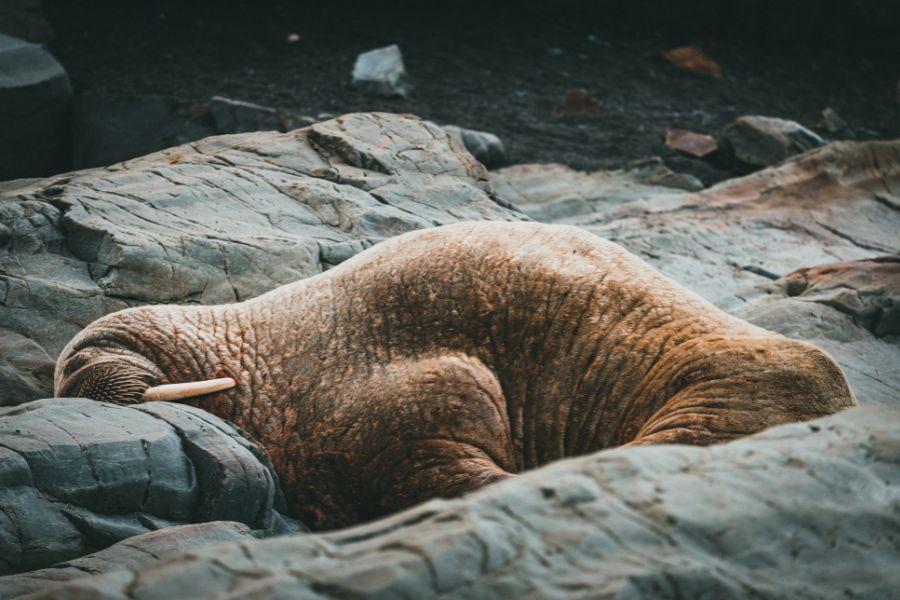
British town canceled its New Year’s Eve fireworks to let Thor the walrus sleep

Scarborough residents rallied to protect their unexpected visitor.

walrus, wildlife, U.K.
Photo credit: Photo by Jonathan Cooper on UnsplashA walrus decided to park it for a while in the town of Scarborough.

There are plenty of predictable reasons a New Year’s Eve fireworks show might get canceled, but “let’s let the walrus sleep” isn’t one of them.

That’s exactly what happened in the U.K. town of Scarborough, however, as residents rang in 2023.

According to British Divers Marine Life Rescue, a walrus was sighted on a boat ramp in Scarborough around 11:30 p.m. on December 30. The wildlife rescuers had hoped that the male walrus—nicknamed Thor—would rest for a bit and then slip back into the harbor by the time the public woke up the next morning. Instead, he got comfy and decided to park it for a while.

Authorities cordoned off the area to prevent anyone from messing with Thor, and as news spread of the walrus’s presence, thousands of people came to see him. It’s not every day that an Arctic walrus shows up in the middle of a British town.


“Kind public asked many questions, offered and bought hot drinks and food, and expressed their appreciation of Thor being protected, with the overwhelming majority being immeasurably respectful to our visitor,” shared British Divers Marine Life Rescue.

During the night, Thor appeared to be agitated by some passing cars and lights, which led wildlife rescuers and local council members to reconsider the town’s New Year’s Eve fireworks show. Not wanting to cause stress to the walrus, they agreed to cancel the fireworks display “without hesitation.”

The Sea Life Scarborough aquarium shared a photo of Thor resting near the water along with a request to the public.

“Please be respectful of his rest and try not to disturb him. While it is a very exciting opportunity for us, naturally they do not like lots of noise and are not familiar with domestic animals so please keep pets on leads and remain a safe distance for your own welfare and his. Hopefully within a few days he will have got enough rest to move on and continue his adventures North!”

As it turns out, Thor did return to the sea after his respite in Scarborough and showed up in Blyth, another British town 70 miles north of Scarborough, a couple of days later.

Dan Jarvis, director of welfare and conservation at the British Divers Marine Life Rescue, told the BBC that Thor was “heading in the right direction,” which is good, but that walruses increasingly being seen in European waters could be a sign of climate change causing a loss of sea ice. Walruses feed mainly on cockles, clams and mussels on the seafloor, but they use sea ice to rest and to digest their meals. With less sea ice in their habitat, they may wander to find land on which to rest.

Having a walrus interacting with humans can also lead to tragedy for either people or the walrus. Freya, a wandering walrus who kept hoisting herself onto boats around Northern Europe in the summer of 2022, was euthanized by Norwegian authorities who deemed her a danger to the public.

As climate change creates more and more unexpected wildlife encounters, people will have to defer to experts on how to handle them. But when it comes to fireworks, even local wildlife and pets can find them stressful. Fireworks displays have been shown to cause panic responses in birds and can result in pets trying to flee otherwise familiar environments out of fear. And according to The Humane Society, “Wildlife rehabilitation centers are often flooded with traumatized, injured and orphaned wild animals after the holiday.” As an alternative, many cities are exploring replacing fireworks with drone light displays.

Kudos to the town of Scarborough for putting the well-being of Thor ahead of its traditional New Year’s Eve celebration, and kudos to the public as well for heeding the call to not disturb the walrus during his respite. Here’s hoping Thor continues his way north and makes it back to his Arctic home safe and sound.


  • Firefighters broke out their hoses to save 25 million bees from an overheating truck

    Photo credit: Canva Photos

    A firefighter using a hose, left, and bees, right.

    Bees can fly, but that doesn’t mean they don’t sometimes need a ride. In fact, massive colonies of bees and their beehives are often shipped around the country by truck to help pollinate crops. They’re a crucial cog in our food supply chain, and these commutes are critically important.

    The rides, however, don’t come without their risks.

    Truck carrying 480 beehives breaks down and begins to overheat

    One such shipment was on its way through Utah, navigating a mountain pass near Salt Lake City, when the truck carrying hundreds of hives broke down.

    The weather was hot, and without a running engine or airflow from the movement of the vehicle, the inside of the trailer was rapidly heating up.

    Twenty-five million bees—tens of thousands per hive—were inside and were minutes away from dying.

    A mechanic arrived to work on the truck, but there was no telling how long it would take to get things moving again. Luckily, the Millcreek Fire Department and the Unified Fire Authority also happened to arrive. While they weren’t going to be much help getting the engine going again, they had a brilliant idea to help keep the bees safe in the meantime.

    Firefighters drench the trailer with hoses to keep the bees inside cool

    Quick-thinking fire authorities used their equipment to mist and spray the truck, keeping it cool in the hot sun.

    One neat cooperative detail: no firefighters were stung during the operation. In the photos and footage provided by Unified Fire Authority, bees are clearly seen flying around outside the trailer. That’s because the breathable mesh keeps the hives and most of the colony inside, but the bees need airflow while the truck is moving, so many of them slip in and out during the journey.

    In the end, the truck got moving again, and not a single bee—nor firefighter—was harmed.

    Heartwarming story was almost a devastating loss

    Pesticides and habitat loss have wreaked havoc on wild bee populations. Fair Planet notes that about 80% of flowering plants, including many fruits and vegetables, depend on pollinators like bees to reproduce. So while bees can sometimes be viewed as a nuisance or pest by humans, their presence is critical to the natural world around us—and our food supply.

    Managed honeybee populations are doing better than wild ones, but the death of 25 million bees would still have been a significant loss. Not only would it represent a six-figure cost and be tragic in its own right, it would put the crops they were on their way to pollinate at risk.

    Kudos to the quick thinking of the Unified Fire Authority and the Millcreek Fire Department, and to their willingness to help, even in unusual ways.

  • Shocked woman learns bookworms are real insects. Now everyone is horrified.
    Photo credit: Domonic Mason/Wikimedia CommonsA woman reading a book, left, and a bookworm on a book, right.

    “Bookworm” is a phrase often used to describe someone who enjoys reading books. While the term is endearing, people may not realize that a bookworm is also an actual insect. No, not the cute cartoon inchworm wearing glasses and a bow tie. A literal bug that is anything but cute—and one woman is horrified by the discovery.

    Taryn Delanie Smith took to social media to share that she recently discovered that “bookworm” was more than a term of endearment. The shocked woman explained that after showing off her antique book collection online, comments poured in. People were telling her to be careful and look out for bookworms.

    bookworms, books, reading, real bookworms, bookworm insects
    Bookworm and bookworm damage. Photo credit: Dominic Mason/Wikimedia Commons

    This warning prompted Smith to look into what people were saying, since she was unaware that an insect by that name existed. What she discovered in her research scarred both her and unsuspecting viewers alike.

    “I love collecting old, dusty, smelly books, and I just think it’s really cool. It’s like a random, stupid, niche thing about me,” Smith says in an Instagram Reel while resting her hand on a stack of old books. That’s when she reveals that someone told her to check her thrifted books for bookworms, before adding, “because I thought that was just a term of endearment for people that liked books.”

    bookworms, books, reading, real bookworms, bookworm insects
    Old books. Photo credit: Canva

    Smith grows animated, loudly saying, “You mean to tell me there’s an actual insect called a bookworm?” She covers her mouth with her hand as she looks on in horror at pictures of the small, yellowish, clear bugs eating holes through a book’s pages. The now-grossed-out woman looks at her dusty books with disgust as she wonders aloud whether they’re harboring the small insects.

    She demands to know if she was the only person unaware that bookworms are actual insects. She was not. Bookworms are not common knowledge, according to commenters:

    “Literally have a degree in literature and this is news to me”

    “You know what sometimes I think we have enough information”

    “nah because what do you mean i now have to go through the hundreds of books i own?”

    “OMG TARYN NO 😭 I could have gone my whole life without knowing this but now that I know, I’m equal parts grateful and HORRIFIED 😭😭😭”

    “Say what now?!?! How big/ small are these buggers?? Is a magnified glass needed or can the naked eye spot them?!?! Ay dios mío 📚 🔍👀 💭 🐛 😬”

    “Omg omg omg i must burn all of my books with fire I fear 😭”

    bookworms, books, reading, real bookworms, bookworm insects
    Old book with bookworm damage. Photo credit: Ragesoss/Wikimedia Commons

    Bookworms don’t actually refer to just one insect, though. According to The Metropolitan Museum of Art, the term “bookworm” is used to describe hundreds of different insects that feed on books:

    “[The insects include] booklouse, silverfish, powderpost beetle, spider beetle, common furniture beetle, Mexican book beetle, paper worm (larvae of the paper beetle or moth), and larder beetle. These insects are not necessarily interested in eating paper, but they can damage paper in their attempts to reach other materials. They actively feed on leather and cloth bindings, starch paste, animal glues, paper, and cardboard, creating tunnels and holes through these materials.”

    bookworms, books, reading, real bookworms, bookworm insects
    A woman reading an old book. Photo credit: Canva

    One librarian who viewed Smith’s Reel offered advice for buying old books:

    “Librarian here. We have a whole machine we ‘cook’ the books for days if any sign of a bug is found. I would not trust freezing them. Actually I would call your local Library and ask for advice! Hopefully you are all good though. The first step is to flip through and if you see any bugs or little bits of flecks all over that kind of look like dirt, put that book outside in the garage.”

  • An old male bald eagle who adopted a rock as an egg finally got his own real foster baby
    Murphy meets a rescued eaglet—his new foster baby.
    ,

    An old male bald eagle who adopted a rock as an egg finally got his own real foster baby

    Murphy became a real dad after he spent weeks nurturing his “RockBaby.”

    On March 8, 2023, a keeper at World Bird Sanctuary in St. Louis County, Missouri, noticed something odd. A male bald eagle named Murphy was guarding what appeared to be a large depression in the ground. “The spot was sparsely but carefully decorated with leaves and branches, and featured a simple rock right in the center,” the nature preserve shared on its Facebook page.

    Murphy began sitting on the rock, nudging it and becoming fiercely protective of it, as if it were an egg. People visiting the sanctuary would inquire about the bald eagle just sitting there, wondering if he was okay. The keepers finally put up a sign that read:

    “If you see an eagle lying down in the back left corner under a perch, that’s Murphy! Murphy is not hurt, sick, or otherwise in distress. He has built a nest on the ground, and is very carefully incubating a rock! We wish him the best of luck!”

    Murphy took his rock duties very seriously

    In case you’re wondering if this is unusual behavior for a 31-year-old male bald eagle, the answer is “not really, but….” Male bald eagles do share equally in nesting and baby-raising, so the paternal instinct part is normal. Murphy’s channeling of that instinct onto a rock…maybe not so much. And at 31, he’s more like a great-granddad than dad, as bald eagles usually live 20 to 30 years in the wild (though they do live longer in captivity).

    Murphy takes fatherhood seriously, though. Soon he began screaming and charging at the four other eagles in the aviary if they came anywhere near RockBaby. (That’s the official name the keepers gave Murphy’s…well, rock baby.) Naturally, the screaming and charging caused a fair amount of stress for all involved, so Murphy and RockBaby were moved to their own enclosure for everyone’s protection.

    People who saw this unfold started suggesting sanctuary staff replace Murphy’s rock with a real egg or get him a mate, but 1) Eagle eggs aren’t just lying around waiting to be given to wanna-be dads, 2) hatching a different kind of bird’s egg would be potentially dangerous for it, and 3) Murphy had two females right there in the aviary, and none of them were interested in each other. Alas, the heart cannot be forced.

    Then a real eaglet needed a dad

    However, a different opportunity presented itself in late March when an aerie with two chicks in it was blown down by high winds. One chick didn’t survive the fall, but the other was brought to World Bird Sanctuary’s Wildlife Hospital.

    A bit bruised, but otherwise healthy, the chick was given a good prognosis. Staff began feeding it while wearing a camouflage suit and holding an eagle stuffy to prevent the eaglet from imprinting on humans. What the baby really needed was a foster parent: an adult eagle who would feed and care for it.

    Murphy’s dad instincts were already in high gear,” the sanctuary wrote on April 11, “but at 31 years old, he had never raised a chick before. It’s definitely a gamble, but also the chick’s best chance.”

    Introducing an eaglet to an adult eagle isn’t as simple as dropping it in the enclosure. First, the eaglet is put into what the sanctuary refers to as a “baby jail,” which is a heated, comfy cage made of wood and wire that protects the eaglet but still allows some interaction between the birds so they can get used to one another. Once the desired bonding behavior is observed, then they try out some direct one-on-one interaction without the cage.

    On April 12, World Bird Sanctuary announced, “IT’S HAPPENING!!!!”

    The eaglet (referred to as Bald Eaglet 23-126, they don’t name foster babies at the sanctuary for superstitious reasons) was released from baby jail, and after an hour or so Murphy approached it with curiosity. Was he wondering if his RockBaby had hatched? Maybe. Would he be the nurturing dad everyone hoped he would be? It appears so.

    As the sanctuary shared:

    “This morning, Murphy got his chance to be a full parent as 23-126 left the nest to go be closer to Murphy. The food is being dropped through a blind drop tube into the nest and baby appears unable to be able to get over the lip to get back into the nest to get the chopped food. When we checked back, we found that baby was still out of the nest and all the chopped food was still in the nest. However, Murphy’s whole fish had been removed from the nest and baby had a full crop. 23-126 is not yet old enough to tear food which means MURPHY FED THE BABY!!!!”

    Murphy’s second eaglet, 24-159, was successfully released into the wild on January 31, 2026, at Audubon Center at Riverlands in West Alton, Missouri: a fitting final chapter to Murphy’s legacy.

    The comments on the update, of course, were pure gold as people became fully invested in this story and even gave the eaglet a real name—Dwayne, as in The Rock:

    “I can’t believe I’m crying over eagles!”

    “Murphy’s going to be giving a TedTalk: Manifest The Eaglet You Need In Your Life.”

    “So happy for Murphy & eaglet Dwayne (the rock Johnson).”

    “‘Rock, I am your Father.’”

    “Omg I’m crying! Murphy never gave up on his rock and now has a baby of his very own ❤️ The wonders of nature never cease. Ty, WBS, for making this possible. These two are saving each other ❤️ ❤️   .”

    Many people lamented that there is not a live cam at the facility so people could watch this pair as their relationship developed, but staff reminded everyone that the sanctuary is out in the middle of the woods and they don’t have a strong enough signal for a live stream. But WBS staff posted regular updates on social media on how Papa Murphy and “Dwayne” were doing.

    Murphy was honored on Father’s Day for his stellar fostering skills as he returned to the aviary:


    “We’d like to thank Murphy for his service and applaud his outstanding job in raising 23-126,” the sanctuary wrote. “Murphy may have had a few moments in his parenting duties where he regretted choosing to sit on that rock, but we believe that the overall experience has been very enriching for him. We know that Murphy has enriched 126’s life. Thanks to Murphy, 23-126 has grown up knowing that he is a Bald Eagle! 126 has learned so much from Murphy and, thanks to his efforts, will have a much greater chance of thriving in the wild after he is released. Happy Father’s Day Murphy, and thank you, we couldn’t have done this without you.”

    Rest in peace, Papa Murphy

    Sadly, Murphy passed away at age 33 on March 15, 2025, after suffering head trauma during a severe storm, having fostered two eaglets in his final years. He lived a long life for a bald eagle and the World Bird Sanctuary offered a beautiful tribute to this extraordinary bird.

    “His resilience, spirit, and dedication as a foster dad touched the hearts of millions of people throughout the world, leaving an especially profound impact on those fortunate enough to have worked with him. While Murphy has delighted guests along Avian Avenue for years with his distinct vocalizations and charismatic personality, it wasn’t until 2023 when he decided to incubate a rock that he gained an international following. Murphy’s transition from rock incubating to rockstar foster dad of an injured eaglet brought daily joy to thousands as we watched their journey together. As Murphy’s eaglet grew so did our love of him. Their journey together taught thousands about eagle growth and development, the bonds between eagle parents and their young, and the critical work that goes into wildlife rehabilitation. Murphy’s eaglet continued to grow strong under his watchful gaze and went on to be released back to the wild. The following year, Murphy fostered a second eaglet in need with the same dedication he gave the first. His second eaglet is still in our care, but is making good progress toward release and we expect he will be ready by mid summer.

    We could not have asked for a better ambassador and role model. We are incredibly grateful for the community that came together as a result of his heartwarming story. We are devastated by this loss and know that the community mourns with us. Murphy’s foster eaglets were the first ones our hospital received in over a decade and we learned a lot about their care and space needs from observing Murphy with them. With what we learned from this, we’ve designed a series of special aviaries to serve the specific needs of injured and orphaned raptors, including an aviary specialized for eaglets. In honor of Murphy’s legacy, we plan to name the eventual eagle fostering aviary Murphy’s Manor, so that we can continue to remember him for decades to come. Murphy will be deeply missed, but his legacy will live on in the memories of those who loved him.”

    Murphy’s second eaglet, 24-159, was successfully released into the wild on January 31, 2026, at Audubon Center at Riverlands in West Alton, Missouri: a fitting final chapter to Murphy’s legacy.

    This article originally appeared three years ago. It has been updated.

  • Crows are incredibly smart. Here’s how to make friends with one in four easy steps.
    Photo credit: via Krari The Crow/YouTubeHow to befriend a crow.
    ,

    Crows are incredibly smart. Here’s how to make friends with one in four easy steps.

    “They are loyal friends and have brought much joy into my life.”

    When it comes to keeping birds as pets, people usually think about parrots or canaries. Nobody ever considers having a crow. But research has shown that crows are incredibly clever, curious, and self-aware. They recognize the faces of people they like or don’t like, have the ability to use tools, and can even mimic human speech. Looking to experience the magic of crows yourself? A YouTube user named Alexandra from Germany made a video on how you can befriend the crows in your neighborhood in four easy steps. All it takes is “some food and some patience.”

    Over a decade ago, Alexandra made friends with a crow named Krari. Krari and her friends visit her regularly and are considered part of the family. They also bring their “little ones” to Alexandra’s house to chill as well. “They come here to get food, to play, or just hang out with me and relax,” Alexandra says in an introductory video on her YouTube page.

    How to make friends with a crow in four steps

    1. Find a pair of crows

    Crows tend to live in areas populated by humans, so chances are there are crows in your neighborhood. The best place to start is to find a pair with a fixed territory that you see on a regular basis. That way, you’re cultivating a relationship with the same animal day after day, and you can “slowly get to know each other.”

    2. Offer food

    Crows will eat just about anything, from insects to invertebrates to meat. They also enjoy nuts, worms, and vegetables. If you offer the food in the same place at the same time of day, you’ll establish a routine. Then, the crow may come by regularly to see if you have anything tasty to eat.

    3. Be mindful

    When interacting with the crow, make sure they aren’t anxious or displaying signs that they are prepared to fly away at any moment. Approach the birds with an open, indirect gaze so as not to cause alarm. Sit quietly while you wait for the bird to approach and avoid quick movements.

    4. Let the birds come to you

    This requires patience. The crow will be shy at first, but they know you better than you think. They will remember your face and your kindness. Give them a chance to observe you and earn your trust.

    One important reminder before you start

    At the end of the video, Alexandra reminds everyone that while we should make friends with crows, they are supposed to live free in the skies and not be stuck in a cage. “I hope this helps you build a relationship with these fascinating birds,” Alexandra concludes her video. “They are loyal friends and have brought much joy into my life. Please let birds have their freedom. They do not belong in homes or other forms of captivity. Thank you.”

    If you succeeded in befriending a feathered genius, tell your new crow friend we say hi!

    This article originally appeared five years ago. It has been updated.

  • Three lions have the most beautiful reaction to a man singing a Guns N’ Roses song to them
    Photo credit: @Plumesmusic/YouTube"November Rain" can relax darn near anybody.

    There are several stories written about music taming the savage beast, but this is no fairy tale. A video shows a small pride of lions in an enclosure hear the acoustic guitar and soothing singing of a French singer-songwriter covering Guns N’ Roses’ “November Rain.” One would think that the animals would be annoyed or ignore the music period. Instead, something heartwarming happened.

    One by one, the lions approached the musician known as Plumes as he performed. They calmly laid down and started yawn-singing to the tunes while nuzzling one another, with two lions cuddling less than a yard from where Plumes sat and played. The lions were relaxing and enjoying the concert along with their afternoon nap, showing off the gentler side of the predatory wild cats.

    People remarked upon the lion’s reaction to Plumes’ tunes:

    “Wow! That is truly an incredible interaction with them. They really enjoyed your singing to them.”

    “Omg, the way they cuddle.”

    “What a beautiful interaction to witness.”

    “Music is the universal language!”

    “That was so magical! Music speaks to the soul. Human, animal, all relate to the feelings music evokes.”

    This isn’t the only time Plumes has performed for an animal audience. In fact, his social media and YouTube channel show videos of multiple concerts for humans and creatures alike. He not only has played his guitar and sang for lions, but for tigers and bears (oh my!) among many other animals at wildlife refuges, enclosures, and zoos.

    While Plumes performs his music for a wide variety of animals today, he started at home, playing for a herd of cows in the French countryside while living with his grandmother.

    “I read somewhere that cows like music, that it’s soothing to them,” Plumes shared with AMFM Magazine. “They were super receptive. They gathered around, some even rubbed against me. It was magical.”

    Since then, Plumes had been taking the opportunity to warm up his vocal chords and provide various animals a free mini-concert throughout his tours and travels, recording video of their reactions to his music.

    “Animals inspire me to be kinder, more patient,” he added. “They remind us to reconnect with nature. Maybe we’ve lost touch with nature, and these videos help people feel that connection again.”

    Understandably, most people believe music and music appreciation are uniquely human traits, but there are studies that music isn’t exclusively for homosapiens’ enjoyment. Some studies show different species reacting positively to music in different ways. Chimpanzees sway to music, dogs tend to show calmer behaviors when listening to classical music, and sea lions synchronize their head movements to a song’s beat, just to name a few. There are veterinarians that suggest creating a music playlist for your dog to play when leaving the house so it helps reduce their separation anxiety.

    It’s interesting to see how music impacts different animals in different ways, especially if music helps them. Over time, who knows how much music will bring man and animal closer together. If a lion can enjoy Guns N’ Roses, the possibilities are nearly endless.

    This article originally appeared last year. It has been updated.

  • Goth woman rescues a flightless carpenter bee and gives it the most heartwarmingly wonderful life
    Photo credit: Canva Photos(left) woman in a dark forest, (right) a carpenter bee

    Nadia Dubceac is known to many in social media circles as a fitness guru with an edgy twist. Her dark hair, Gothic eye makeup, black fingernails, and often dark attire (even while working out) exemplify a traditional “goth chick,” with extra impressive muscles.

    But don’t let her tough-looking exterior fool you. On a recent social media post, she shared a clip of herself with a tiny bee resting gently on her finger. “If you’ve been following my stories, you know I have a pet bee. Her name is Beebee. I call her Bee Bug.”

    She explains how they met. “I found her almost exactly two months ago, lying on her back outside, probably dying. And I’ve seen a lot of videos of people reviving bees by giving them sugar and water. And I was like, ‘ya know what? Maybe she just needs a little sugar.’” She then adds, perhaps referring to a slight buzzing from the bee, “She’s getting zoomies.”

    Dubceac then shares the story of how the two become fast friends. “So, long story short, I bring her inside. I had a bouquet of flowers that I put her in. I kind of just gave her sugar and water, thinking I’ll help replenish her, and she can go about her day and live a long, happy life.”

    This whole time, the bee has been walking around her hand. We then see Beebee crawling into the circle made between her fingers and her thumb. “She’s doing her favorite activity right now,” Dubceac explains. “I make a little cave for her to burrow in and she loves it in here. She can be in here all day.”

    Dubceac’s love of creatures made it feel impossible to leave Beebee to fend for herself. “Obviously, as an empath, there was no way I could put her back outside, knowing she’s unable to fly. So here we are. It’s been two months and she has been spoiled rotten.” We then get a shot of Beebee prancing through white flowers with bright yellow pollen at their centers. “She gets everything she wants. It has been really fun getting to know her little personality. I know it’s crazy, but I swear she has one!”

    As for the logistics, they have a firm routine. “I feed her around 12 and then again once I come home from the gym. And then again while I’m having dinner. So she does have an internal clock. She knows.”

    We then see her buzzing around a small habitat, not unlike a playpen. “She is a carpenter bee, so she obviously loves wood. I bought her a little wood house. She has a bonsai tree. She has this little mushroom that her godmother has given to her. And yes, she has a godmother.”

    In a scary moment, Beebee jumps off Dubceac’s hand, but she finds her safely on the ground. “Please,” she says directly to her. “You’re so little and fragile. Stop doing that!” The video cuts to Dubceac’s cat, so she adds, “I obviously do buy her flowers, as long as they’re cat safe. And yes, I do have a cat. He knows not to mess with her and obviously they’re separated.”

    She then addresses a thought many viewers might have, saying, “Now you may be wondering, what do I feed her?” She pulls out a square of pollen. “She eats a big, fat block of pollen. All of this just for her. I just wet a little piece so it can be nice and soft for her. And bees also need water, so that’s my way of keeping her hydrated.”

    Having spent the last couple of months with Beebee, she notes, “I think bees are a lot more intelligent than we give them credit for. They recognize faces. She will reach for me when she wants to be held. Oftentimes, I’ll find her running around in panic until I pick her up. And she finds a nice, little cozy spot on my hand to take a little nap. And it’s the cutest thing ever. I think she’s actually pretty cozy right now.

    My favorite thing she does? When she naps, she will put her little antennas go down. And it’s the cutest f—ing thing ever. She also loves a good nap on this window sill, especially when I lay the blanket down for her. Watching her groom is so fascinating. I have studied her entire routine. So yeah, that’s my little Beebee. She’s sending you the best energy ever.”

    There were tens of thousands of supporters in the comment section on Instagram. One person writes, “Dear universe, when I die, please let me come back as an alt girl’s pet bee.”

    Another shares their personal experience, writing, “During Covid lockdown, there was a carpenter bee that visited me every day for months. He would hang outside with me for hours! And when I went inside, he would hover in the windows, following me around the house. One day, he came by with a girlfriend and I hope they lived happily ever after!”

    A few had understandable questions. One asked, “They have a four-week lifespan. How is it 2 months?” Dubceac answered, “Female carpenter bees live up to 3 years.” To this, another commenter answers, in part: “Thank you for taking such care of her!”

    In a ThoughtCo “profile” piece on carpenter bees, entomology expert Debbie Hadley writes that they are “quite harmless and excellent pollinators.” She also adds this tidbit: “Carpenter bees practice buzz pollination, an active method of collecting pollen grains. When it lands on a flower, the bee uses its thoracic muscles to produce sound waves that shake the pollen loose.”

    As to whether sugar, water, or sugar water is safe to give to bees, some experts claim it depends on the situation. Beevive.com suggests first checking to see if the bee can fly, as Dubceac did. Then, if possible, offer a flower solution first. “If the flower method fails, sugar water is needed. The RSPB (a conservation charity) suggests getting a small container or spoon and offering two tablespoons of granulated white sugar to one tablespoon of water.”

    She wouldn’t be the first to keep a bee as a pet. According to Apis Cera, a company that makes beeswax candles, a woman from the United Kingdom once had a special bee friendship. On their website, they shared, “Fiona Presly, a library assistant from Inverness, rescued a buff-tailed, or large earth, bumblebee queen that had been born without wings and was struggling to survive.

    Over the next few months, the two appeared to develop a special bond. Bee, as Presly named the insect, would even ‘cuddle’ and seemed to be ‘house-trained.’ Indeed, caring for the bumblebee has had a profound impact on how Presly thinks of insects.”

    Bees are a vital part of our ecosystem. It probably goes without saying that we shouldn’t just capture them or remove them from their natural habitat. But should a bee get hurt, as Beebee did, providing them a safe place to live out their time can be a wonderfully kind and rewarding thing to do for the bee and their human.

  • A pregnant diver jumped in to help a bleeding dolphin. The dolphin rolled over and held still.
    Photo credit: CanvaAn underwater diver takes photos of dolphins.

    Nicole Isaacs was out on the ocean off Los Angeles when a dolphin surfaced next to the boat and didn’t leave.

    Something was clearly wrong. Isaacs, an avid diver, looked closer and saw deep red gashes in the dolphin’s skin. Then she and her companion spotted the cause: two remoras, also called suckerfish, had latched directly into the dolphin’s flesh and were feeding on it. Remoras typically hitchhike harmlessly on larger marine animals, but in this case they had attached to wounds and the dolphin was convulsing from the pain.

    Isaacs was pregnant at the time. She looked at the other woman. “Should I get in with him?”

    She got in.

    @nicoleisaacsofficial

    the most insane day of my life on the ocean. I trusted my instincts and did what I thought was right, and I’m glad I did. I don’t advocate to touch wild animals but I do think some circumstances are necessary and ok. It was very clear this dolphin was struggling and in a lot of pain, and based on her reaction afterwards as well as the entire pod, I know I made the right decision. Dolphins are incredible animals and so intelligent—the fact that this also happened while pregnant was once in a lifetime 🩵🙏🏽✨🥹🐬 #dolphins #wilddolphins #wildliferescue #dolphin #fyp

    ♬ You Make Me Feel Good – Original Mix – Satin Jackets

    What followed over the next several minutes was equal parts chaotic, heartbreaking, and extraordinary, all of it captured on video and posted to her TikTok account @nicoleisaacsofficial on January 28, 2026, where it has since been viewed 13 million times.

    The dolphin, to Isaacs’s astonishment, seemed to understand what was happening. When the women entered the water and approached, she rolled over and held still. “She began to fully cooperate and turn over for us to make it easy to grab the remoras,” Isaacs wrote in the video overlay. The rest of the pod circled at a distance while they worked.

    A woman swims with two dolphins. Photo credit: Canva

    Getting the remoras off was harder than expected. They moved quickly and reattached easily. At one point Isaacs caught one and swam it back toward the boat to hand off to the captain — and it slipped out of his hands and latched onto her instead. “I was pregnant and freaking out,” she says in the video. It eventually released her, swam back, and reattached to the same dolphin. It took multiple attempts before both were finally removed for good.

    The dolphin’s response was immediate. She leapt out of the water. Then the rest of the pod, which had been circling at a distance throughout, suddenly reappeared all at once and began swimming in loops around the boat.

    “All of the dolphins reappeared out of nowhere and swam around us to celebrate,” Isaacs wrote.

    In her caption she was careful to note that she doesn’t generally advocate touching wild animals, but that the circumstances made intervention feel necessary and that the pod’s response confirmed for her that it was the right call. “The most insane day of my life on the ocean,” she wrote. “I trusted my instincts and did what I thought was right.”

    One viewer put it simply: “A totally untrained dolphin cooperating and letting you tend to her just out of sheer trust and desperation — I’m just shook.”

    You can follow @nicoleisaacsofficial on TikTok for more entertaining content. 

  • Spanish nuns are fighting to preserve a giant rabbit breed in danger of extinction
    Photo credit: CanvaNuns in Spain are trying to save a rare breed of giant rabbit from extinction.

    Nuns at the Convent of St. Anthony of Padua in Central Spain are on a mission beyond their spiritual calling: to save a rare breed of giant rabbit from extinction. The eleven Franciscan sisters are currently caring for 35 giant rabbits at the convent, which weigh up to 20 pounds each.

    Sister Consuelo Peset Laudeña told Global Sisters Report that the rabbits hold historical significance in Spain. During the Spanish War, the rabbits were a crucial source of food for families and orphanages during food shortages.

    “Many families have managed to get by thanks to this animal, and now it seems we are forgetting that part of our history,” she told the publication.

    The journey to save giant rabbits

    The sisters at the Convent of St. Anthony of Padua have worked to preserve the rabbits for over 30 years. But ten years ago, they learned the rabbits were going extinct.

    “We contacted an association, I sent some photos, and they told me, ‘You have a spectacular animal, and it’s endangered,’” Peset explained.

    Their focus shifted into helping the rabbits breed, so the sisters worked with local Spanish authorities to establish a farm. They raised $5,700 to initially invest in the farm.

    Caring for the rabbits

    The sisters are tasked with feeding, cleaning, and maintaining the rabbits and their quarters. The rabbits are fed a combination of barley, hay, and corn. At the end of March 2026, a total of 90 births were recorded.

    “I do a visual check. I take a walk around and see which animals are listless or lethargic, and if any have died in the nests, they must be removed immediately,” Peset said.

    The rabbits live in temperature-controlled cages with proper ventilation.

    “Rabbits start to suffer at 26 degrees [Celsius; which is about 79 degrees Fahrenheit]; they tolerate the cold well, but not the heat,” Peset also added.

    The nuns feel called to protect the rabbits thanks to a encyclical given by Pope Francis titled Laudato Si’ in 2015. In that message, he called Catholics to care for nature and the environment.

    “We have to protect creation,” she said. “We are Franciscans. St. Francis is the patron saint of veterinarians, and that is the source of the love and admiration we feel for the Spanish giant rabbit.”

    What are Spanish giant rabbits?

    Spanish Giant Rabbits are a cross between the Flemish Giant and Spanish brown-type female rabbits. The rabbits weight up to 20 pounds, and each female rabbit can give birth to 22 pups each month.

    According to Farm Show Magazine in 2014, the rabbits are comparable in size to a small lamb. They were first bred in the early 1900s.

    The giant rabbits are not for sale. To further conservation efforts, the sisters have chosen to donate the rabbits to local schools, a nearby theme park, and to registered private rabbit breeders.

Uncategorized

People are applauding newlyweds for their beautiful $500 wedding. Here’s how they did it.

Pop Culture

A doctor says there’s finally a clear winner in the morning or night shower debate

Pop Culture

Iconic writer Kurt Vonnegut’s simple graphs show how to write the 3 stories everyone loves

Culture

The surprisingly mysterious reason we use the $ symbol for the U.S. dollar