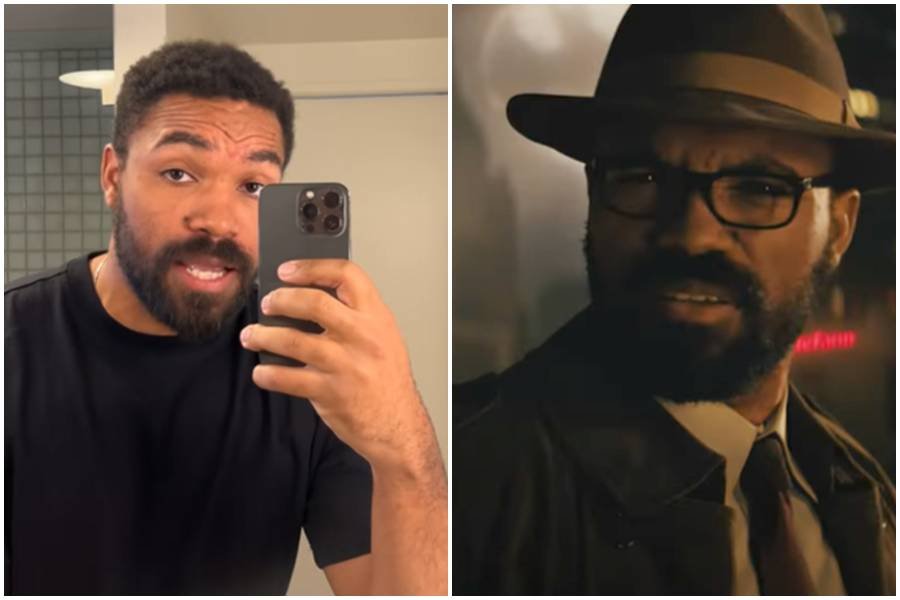
Photo credit: via Jordan the Stallion/TikTok (used with permission) and State Farm Insurance (used with permission) – Jordan Howlett (aka Jordan the Stallion) in his new role as Chief Gordon.
Jordan Howlett, 27, is known by his 26 million-plus followers on TikTok and Instagram as Jordan the Stallion (a play on singer Megan Thee Stallion). He’s attracted a massive following for his fast food recipes, life hacks, smooth voice, deep research, kind heart, and iconic “come here” camera zoom. Not bad for a guy who shoots most of his work staring into his bathroom mirror.
Now that he’s reached the pinnacle of TikTok popularity, he’s branching out as an actor. Specifically, he’s taken a role as Commissioner Gordon in State Farm Insurance’s new Batman-inspired commercial. Upworthy talked to Howlett about his new role and how he creates his incredibly popular videos.
The new State Farm commercials feature actor Jason Bateman as “Bateman,” the last person you want at a crime scene when you could have had the real thing, Batman, show up. In the spot’s opening, Bateman meets Commissioner Gordon, played by Howlett, who closely resembles Jeffery Wright, who played the role in 2022’s The Batman.
“As I began to fill out, I started to resemble Jeffrey Wright, and I think it was just a perfect pairing. I love the work that Jeffrey does,” he told Upworthy. He also channeled Wright’s gritty performance for the State Farm spot. “My mind immediately went to Jeffrey Wright’s version of Commissioner Gordon, where he talked with a grungy whisper.”
Even though TikTok videos made him famous, Howlett couldn’t avoid catching the acting bug after this role. “I have been fully immersed and infected with the acting bug,” he told Upworthy. “I’m the embodiment of a fan and a student of acting and film and TV, and I have such tremendous respect for that art. And as much as I love having these opportunities, they’re due to the work I’ve done in the bathroom. I’m happy that those created these opportunities, and I don’t take them lightly.”
Howlett felt the “aura” surrounding his co-star Jason Bateman and tried to define that type of rare charisma. “I think it stems from people feeling as though they’re represented by that person on screen,” he said. “If you watch people that you really admire, it’s like they speak to you in a certain way, right? Their art embodies something that really speaks to me. It’s almost surreal because it’s like you feel you know them on a molecular level.”
In his videos, Howlett just tries to be himself. “It really is me,” he shared. “I don’t have the bandwidth to try to put a mask on in any way. It really just is authentically myself. And I’m just happy that people can relate to that.” He also works quickly so that his videos feel natural. He records most of them in one take, but spontaneity has drawbacks. “The one downside is, after you posted, you think, like, ‘Oh, would have been funny if I said this.’ But, sorry, it’s too late because I was just doing it one time,” he said. That authenticity comes from a life where he has battled homelessness and depression and started a new life after being a Division 1 college baseball player.
Because of his ability to overcome his struggles, Jordan is seen as a role model or big-brother figure by some of his Gen Z followers. It’s a big responsibility that he takes seriously. ”I feel like there’s a responsibility to people who see me in that way, to make sure that I do the best I possibly can to make them proud,” he told Upworthy. “I don’t tell people to do something or use something that I wouldn’t do or use myself, and make sure that I stay true to who I am and continue to do that out of respect for them. I’m honored.”

From Pakistan to Tanzania, the most effective education solutions are community-led. Here’s how local leaders, in partnership with Malala Fund and supported by Pura, are mobilizing entire communities.
When asked to describe what Tanzania smells like, Grace Isekore closes her eyes and breathes in deep. For a moment, she’s somewhere else entirely. Tanzania is a rich tapestry of sights and scents, from the smell of sea mist that permeates the coastline to the earthy cardamom and cloves she cooks with in her kitchen. But when Grace emerges from her reverie, her answer is unexpected.
“Tanzania smells like peace,” she says, her eyes still closed. “I see a beautiful country where we are free to move, free to speak. And there is peace within the community.”
For Grace, that sense of peace isn’t just something she smells; it’s something she works toward every day. As a project coordinator with Pastoral Women’s Council (PWC), a women-led organization that empowers pastoralist communities in northern Tanzania, she has seen firsthand how girls flourish when they have the opportunity to attend school. Like scent, education not only connects girls to their own culture, but also helps broaden their horizons, realizing new possibilities for themselves and others. That transformation reshapes entire communities and ripples outward, with the potential to change countries and transform the world for the better.
Different scents, different approaches, and communities driving change
Spices in Tanzania. Captured by James Roh for Pura
For Grace and others around the world, education is freedom, as well as a pathway to a stronger community. Rooted in that shared belief, Pura, a home fragrance company, was inspired to build on their four-year partnership with Malala Fund to create something truly unique: a fragrance collection that connects people through scent to communities in Tanzania, Nigeria, Pakistan, and Brazil, where barriers to girls’ education are among the highest.
Using ingredients from each region, the new Pura x Malala Fund Collection uses scent to transport people to these regions directly. “Future in Bloom,” for example, invokes Pakistan’s lush valleys through notes of jasmine, cedarwood, and mango; while Tanzania’s fragrance, “Heart on Fire,” evokes the spirit and joyfulness of the girls who live there through cardamom, lemon, and green tea.
The new Collection honors the work Malala Fund does every day, partnering with locally-led organizations in these four countries to ensure every girl can access and complete 12 years of education. Each scent celebrates the joy, tenacity, and courage of the women and girls driving change on the ground, while also augmenting Pura’s annual grant to Malala Fund by donating eight percent of net revenue from the Pura x Malala Fund Collection to Malala Fund directly.
Just as each country’s scent is unique, so too are their needs related to education. But with support from Malala Fund and Pura, local leaders are coming up with creative ways to mobilize entire communities (parents, teachers, elders, and the students themselves, in their pursuit of solutions, understanding that educating girls helps everyone thrive. Here’s how their efforts are creating real, durable impact in Tanzania and Pakistan, and creating a ripple effect that changes the world for the better.
Parent-teacher associations help Maasai girls and their communities in Tanzania problem-solve
A girl’s school in Tanzania. Captured by James Roh for Pura
Northern Tanzania, Grace’s home, is home to pastoralist communities like the Maasai, a nomadic people who have moved with the seasons to nurture the land and care for their livestock for centuries. The nomadic nature of this lifestyle creates significant and unique barriers to girls’ education. Longstanding gender roles have enabled Maasai to survive in the harsh environment and have placed great value on both women and men. Over time, as nomadic life has been threatened by the privatization of land and stationary education models have been implemented, the reality of pastoralist livelihood has shifted and introduced new complexities. Now, the sheer distance to schools is both a practical challenge and one that often comes with danger from the landscape, predators, and potential exposure to assault along the journey. Girls shoulder the responsibility of household chores and there is often cultural pressure around early marriage – both leading to boys’ education being prioritized over girls’.
“There are very, very good [pastoralist] cultural practices, which are passed from generation to generation,” says Janet Kimori, an English teacher at Lekule Girls Secondary School in Longido, Tanzania. But when cultural practices act as educational barriers, “you have to sit down and look for where you are going to assist. As a school, as an individual, the school administration—all of us will chip in and know how we are going to deal with this problem.”
PWC works to ensure girls are able to exercise their right to an education while also preserving pastoralist culture. One successful approach, the organization found, has been the formation of Parent Teacher Associations (PTAs), created with help from Malala Fund. In PTA meetings, students, parents, teachers, elders, and government officials meet, discuss educational barriers, and come up with community-led solutions that preserve and honor their culture while advancing educational outcomes.
PTA meeting in Tanzania. Captured by James Roh for Pura
One recent PTA meeting highlights how these community-led solutions are often the most effective. At Lekule Girls Secondary School, the lack of fresh water forces girls to walk long distances to collect water for the school’s kitchen during the school day, and these long journeys not only disrupt class time but can leave girls vulnerable to sexual assault in isolated areas. Through facilitated discussion, PTA members landed on a solution: installing a borehole to pipe in fresh water to the school. Reliable access to water creates a better learning environment for the girls, but it also benefits the community at large, as local governments are then more likely to invest in health clinics and other community resources nearby.
With a solution in place, the PTA was then able to discuss ideas and map out a course of action. The women would raise money for the cost of the borehole, while the men would recruit workers to dig the hole and lay the pipe. Together, they would ask government officials to match their investment.
The benefits of PTA meetings within the pastoralist communities are undeniable. “The girls are talking and addressing issues in a confident way, and parents feel they are part of the resource team to solve challenges happening at school,” Grace says. One unexpected benefit: The larger cultural impact these PTA meetings have created. Thanks to the success of PTAs within pastoralist communities, the models are now being endorsed on a national level, and schools across Tanzania are starting to use them to solve problems in their own communities. When a community creates opportunities for girls to learn, everyone benefits.
Safe spaces in rural Pakistan help students and their parents connect, then drive change
Safe space for girls meeting in Pakistan. Captured by Insiya Syed.
A continent away in Pakistan, the country’s northernmost region of Gilgit-Baltistan seems like a land untouched by time. The region’s looming mountains, snow-capped peaks, lush valleys and crystalline lakes draw nature lovers and landscape photographers from around the world, but living among this kind of breathtaking scenery has its drawbacks. Schools in the region are few and far between, and the area’s harsh climate often makes roads inaccessible for travel. Poverty and gender-based discrimination are additional obstacles, making school even further out of reach, and girls are affected disproportionately. Going up against these barriers requires a persistent, quiet strength that’s found in the women who live there and reflected in Pakistan’s signature scent.
Saheli Circles are how local leaders in Gilgit-Baltistan are bridging the gap between girls and education. An Urdu term for “female friend,” Saheli Circles are after-school safe spaces where girls explore subjects like art and climate change, while also developing skills that help them manage emotions, set goals, and build positive relationships. Girls study in groups, visit the library, play sports, and tackle filmmaking and photography projects, all designed to develop self confidence and teach the girls how to advocate for issues that matter to them. But the work doesn’t stop there.
“What we’re trying to achieve here will only be impactful if it trickles down to the home environment and the school environment,” says Marvi Sumro, founder and program director of Innovate, Educate, and Inspire Pakistan (IEI), the local organization that developed the Saheli Circles model and partnered with Malala Fund in 2021 to make it a reality. Ever since, Saheli Circles have grown to involve teachers, elders, and parents to encourage relationship building that’s essential for young girls and adolescents. “Our spaces can give mothers and daughters an opportunity to interact a little differently—do an art activity, or have a cup of tea together, or some good conversation,” Marvi says.
The relationship building is what makes the biggest positive impact throughout the community. Recently, one Saheli Circle was able to bring together parents, teachers, and administrators to advocate for better education at their local school, and together they convinced the department of education to hire a science teacher. Another Saheli Circle organized a fund where members of the community can contribute monthly to pay for uniforms, books, and other school expenses for the girls in their village, eliminating those small, hidden costs that are often a barrier to education for many. A third Saheli Circle was able to produce a short film about how gender-based household chores can take away valuable study time from girls, leaving them at a disadvantage. “The girls put the film together and showed it to the mothers, and the response from the mothers was just beautiful,” Marvi says.
Girls smiling in Pakistan. Captured by Insiya Syed.
The education and relationship building that the girls receive in Saheli Circles connects them to larger opportunities and economic freedom that are not possible in their hometown. “For girls in Gilgit-Baltistan, education is extremely important because of the fact that we’re so far away from where the economy is, where the opportunity is. Education becomes this bridge for us, for our girls, to access all the opportunity and economy that exists in [larger cities].”
From rural Tanzania to remote Pakistan, local organizations prove every day that prioritizing girls’ education benefits everyone. Communities that lift up girls are able to secure resources like clean water and well-staffed schools, as well as build stronger relationships.
These outcomes are only possible because of the women and girls who work tirelessly in these regions to overcome barriers and drive progress. The Pura x Malala Fund Collection is a way to honor them, celebrate their achievements, and unite people the world over around a shared belief that education is freedom. Like scent, that belief can build, travel, and has the possibility to transform the world.
Experience the Pura x Malala Fund Collection here, and connect with the stories of real girls leading change across the globe.
The Bee Gees were one of the most popular pop groups in the world from the late ‘60s to the late ‘70s. In the early years, they had big hits such as “How Can You Mend a Broken Heart,” “I Started a Joke,” and “To Love Somebody.” In the late ‘70s, they found a new sound, disco music and made massive hits for the dance floor, including “Staying Alive” and “More Than a Woman.”
However, between those booming Bee Gee eras, their career seemed to be on the way down. By 1973, their most recent album, “Life in a Tin Can,” and single, “Saw a New Morning,” had flopped, and they began to play smaller clubs. But that didn’t mean they couldn’t win people over with their incredible harmonies. Case in point was their March 23, 1973 performance on “The Tonight Show Starring Johnny Carson.”
Carson introduced the band by touting its history as songwriters. “My next guests have had quite a career. Their compositions have been recorded by people like Frank Sinatra, Elvis Presley, Andy Williams, Glen Campbell, Tom Jones and hundreds of others,” Carson said.
The band opened their set on stage performing “Wouldn’t I Be Someone” and “Saw A New Morning” and then sat down for a chat with Carson, discussing why they don’t like playing large arenas and how they got started performing together as children. After the break, they returned with an acoustic guitar and performed their first number 1 hit, “Massachusetts,” from 1967, with Robin Gibb on lead with his brothers Barry and Maurice chiming in perfect harmony.
If you look closely in the background, Maurice is having fun goofing off when he’s not on vocal duties. At the end of the performance, Carson appears to be a bit choked up as he adjusts his tie.
“Massachusetts” was written about the great migration of young people to San Franciso in 1967, as the hippie movement began to take off in the mid-to-late ‘60s. Interestingly, the Bee Gees had never been to the state.
Tried to hitch a ride to San Francisco
Gotta do the things I wanna do
And the lights all went out in Massachusetts
They brought me back to see my way with you
“There are two different memories, Robin remembers us doing it in a boat going around New York City. And I remember us checking in at the St. Regis with Robert, going to the suite, and while the bags were being brought in we were so high on being in New York, that’s how ‘Massachusetts’ began,” Barry recalled the song’s creation in the “Horizontal” liner notes. “I think we were strumming basically the whole thing, and then I think we went on a boat round New York. I don’t know if we finished it, but I think that’s where the memories collide. Everybody wrote it. All three of us were there when the song was born.”
The song was initially written by the band for The Seekers, but they were unsuccessful in getting it to the band, so they recorded it themselves.
The Bee Gees would have a career turnaround in 1975 when they experimented with a new, more soulful sound with the song “Jive Talkin.” This became a big hit and propelled them into the world of disco, where they would become one of the era’s most popular acts.
The Bee Gees’ historic career ended when Maurice passed away in 2003 at age 53. Robin followed in 2009 at age 62. Barry, 79, is the final surviving member of the band.
This article originally appeared two years ago. It has been updated.
Back in 2017, Māori singer Ora Taukamo, known as “Aunty Ora,” wowed judges on The Voice: Australia with her rendition of Adele’s “One and Only,” somehow making it even more soulful than the original.
It was then that judge Delta Goodrem asked Taukamo what she did outside of singing.
Taukamo answered, “I teach the haka.”
Intrigued, judge Kelly Rowland asked, “Can I learn the haka?” Taukamo giggled while saying, “Sure!” Then, Rowland, Goodrem, and the two other Voice judges, Boy George and Joe Jonas, stepped up on stage for an impromptu lesson.
The group put their hands on their hips, bent their legs into a squat position, and began stomping on their right foot in unison while hitting both hands on their thighs. As their percussion began setting, Taukamo began leading them through a chant.
The moment was cool enough on its own, but made even more heartening by the way it instilled pride among fellow New Zealanders.
“You make me feel proud to be a Kiwi you lovely woman!”
“I aroha ahau ki taua haka. (I loved that haka.) Really nice how the panel joined in. Beautiful voice.”
“Taahua… making Aotearoa proud.”
“Adore you !!! Aroha (Luv) your whanau (family- all of the 5 million) in Aotearoa New Zealand.”
Taukamo would eventually end up going home on the show after singing these showstoppers: “Circle of Life” from The Lion King, “One Moment in Time” by Whitney Houston, a ”Love Me Tender” cover by Norah Jones, “Open Arms” by Journey, “All of Me” by John Legend, “I Believe I Can Fly” by R. Kelly, a “With A Little Help From My Friends” cover by Joe Cocker, “Goodbye Yellow Brick Road” by Elton John, and “Total Eclipse Of The Heart” by Bonnie Tyler.
Aside from her powerhouse vocals and her impressive haka teaching abilities, Taukamo is remembered for her infectiously positive energy, which che clearly infuses into her craft in order to lift others’ spirits up. This can clearly be seen on her Facebook bio, where she writes, “Your voice is a tool to help heal others.🎙️Sing from your heart at all times and just be yourself, most of all be natural.”
That philosophy came through in that brief, joyful exchange on stage.
The haka is more than choreography. It carries history, identity, and connection, and Taukamo shared it in a way that welcomed others while honoring where it comes from. Watching the judges laugh while trying to follow her lead created a sense of togetherness that reached far beyond the studio audience.
Moments like this show how culture can be shared with care and enthusiasm. A few minutes of music and movement turned into something people across the world could feel a part of. Taukamo may not have taken home the top prize, but in this way, her impact was all the more meaningful. She left behind a performance that people still talk about, one that celebrates voice in every sense of the word.
The 2003 film Love Actually is probably best known for its controversial-ish cue card scene, where Andrew Lincoln’s character professes his love for Keira Knightley by silently showing her cue cards, including the famous (or infamous) line, “To me, you are perfect.”
But there’s another scene in the film that doesn’t get nearly the recognition it deserves. It’s well-regarded, but not nearly well-regarded enough.
It’s been over 20 years since the late Alan Rickman broke Emma Thompson’s heart by buying that little office tart a necklace in Love Actually, and some of us still haven’t forgiven him.
With its overlapping love stories set during Christmastime, the film has become a holiday classic, despite some controversy over whether it’s actually any good. Some people love it, some people hate it, but no one can deny that Thompson gives an Oscar-worthy performance in one utterly heart-wrenching scene.
Of the eight “Love Actually” relationships, Harry and Karen (Rickman and Thompson, respectively) is the one that gives the film some serious gravitas. While other characters are pining or shooting their shot with varying levels of success, Harry is having a midlife-crisis affair with a modelesque coworker, while Karen shuffles their children to and fro and keeps Harry’s life running smoothly. We see him lie, we see her start to suspect, but the scene where she opens her Christmas present from Harry (a Joni Mitchell CD, not the necklace she had found hidden in his coat and thought was for her) is when we see Thompson’s acting strengths in full view.
Like, phew.
What’s so striking about the scene, however, is that it’s not dramatic in a typical way. There’s no external conflict—it’s just Thompson excusing herself from the family to process, in secret, what she’s just discovered. We see and feel her heartbreak—it’s so visceral—but that’s not what makes the scene so powerful. Heartbreak happens all the time in movies.
As Thompson explains in a BBC Radio 1 interview, it’s the fact that she can’t react the way she wants that pulls at people’s heartstrings so hard.
“I think it’s just because everybody’s been through something like it,” Thompson says. “What I think really gets to them, though, is that she has to pull herself together. It’s not that she’s upset. That’s, you know, ten a penny. But it’s that she has to pull herself together.”
It’s true. The conflict in the scene is between her wanting to break down and her wanting to keep her family’s Christmas memories happy and intact. She is a devastated wife, but she’s also a devoted mother who doesn’t want to devastate her kids. We feel the tension between those two roles and the way she swallows up her grief in order to get her kids to their holiday concert right after finding out her marriage isn’t what she thought it was.
When you think about it, it’s incredibly poignant. And though not everyone loves the film, it’s moments like this one that have helped it stand the test of time and stay on many people’s holiday watch-list.
“I think it’s to do with the fact that we’re required in our lives to repress the things that we’re feeling,” Thompson explained on TODAY. “So, you can be hit right between the eyes with some terrible piece of news, but you can’t react immediately because you’ve got your children there. It’s that thing of not showing — that’s why it hurts. That’s why it moves us.”
“If she went, ‘Oh my God! I thought you were going to give me a necklace! And now you’ve given it to somebody else,’ we would not be moved, you know?” she continued. “We’re moved because she just goes, ‘I’m not gonna do it.’ And then she makes the bed, the bed that sort of suddenly feels so empty of meaning. And then she goes down and goes, ‘Hello, everyone! Let’s go.’ That’s why people identify.”
And the way she plays it is perfect. Any actor can cry, but it’s her crying while trying not to cry, and the way she shows us her inner emotional turmoil without ever saying a single word is impressive.
If you’ve never seen “Love Actually” and want to see the Harry and Karen story, here are just their scenes:
Some people have asked whether Harry actually physically cheated or not, but “Love Actually” script editor Emma Freud clarified that he did. “DEFINITELY had an affair,” she wrote on X in 2015. “I begged Richard just to make it a flirtation, but no. The whole way.”
And did Harry and Karen stay together in the end? The film doesn’t really make it clear, but at the screening Freud answered the question: “They stay together but home isn’t as happy as it once was.” Oof. There’s just no non-heartbreaking answer to that question.
This is why we watch films, though, isn’t it? To see our humanity reflected back to us? To feel what the characters feel? To have our hearts broken vicariously so we can have a good cry without going through the actual pain ourselves?
People usually watch rom-coms for the romance, the comedy, and the happy endings, though. So here’s to Emma Thompson and Alan Rickman for giving us one of cinema’s most poignant scenes in one of its most unexpected places.
This article originally appeared two years ago. It has been updated.
“JAW.” Cute, simple, straightforward. You can take any movie with a plural “s” and just remove it for a tiny chuckle. “The Avenger.” “Star War.” “Heather.” But the best responses make you think for a minute before the light bulb goes on and the belly laugh hits:
“The Postman Rang Once The One Time He Stopped By.”
“I for Vendetta”
“Malcom I”
“Jumanjus.”
That last one is a perfect example of why people are loving the responses to this prompt. “Jumanji” isn’t even plural, but applying the rule that gives us cactus/cacti and octopus/octopi, we get “Jumanjus.” Cleverly hilarious.
Some adjustments are just so silly, you can’t help but laugh, like “Indiana Jone.” Many of them use animal groups (pride of lions, murder of crows, school of fish) that you have to decipher or stretch your logic to break down things we don’t think of as plural (wall to brick, wind to air molecule, corporation to sole proprietor). And “I for Vendetta” and “Malcolm I”? Perfect. (As one person said, we don’t have enough Roman numeral humor in the world.)
People loved seeing how creative others were in their responses:
“This thread is for the ‘pleasure to have in class’ kids only and I love it. 😂”
“Gods everyone is so much smarter than me. I’m just over here trying to think of titles ending in S.”
“I’ve never been more ok with everyone been smarter than me. 😂”
“I cannot read this thread while my partner is trying to sleep beside me. I am SHAKING the bed, laughing.”
Why do people find these depluralized titles so funny, though? Likely the same reason we delight in puns and spoonerisms. Wordplay tickles our brains and our funny bones.
As neuroscientist Dean Burnett shared with BBC Science Focus, “Humor is essentially our brain going ‘This isn’t how things usually work… but I’m okay with it!’”
Burnett explains that humor happens in our brains when there’s incongruity between what we expect to happen and what actually happens and we resolve that incongruity.
“Basically, thanks to these complex systems in our brains, humour can be derived from things being surprising, unexpected or wrong in some form, as long at it’s resolved, without negative consequences,” he writes.
That’s essentially what’s happening when we see a familiar movie title altered in a way that we don’t expect but that ultimately makes sense. Whatever the humor trigger, it’s so fun to have so many people enjoy some wordplay together.
In 1969, the Juggy Sound Studio in New York City was forever changed. It was that year and place that Led Zeppelin recorded (at least part of) their album Led Zeppelin II, with the song “Ramble On” its 7th track. The song, co-written by front man Robert Plant and guitarist Jimmy Page (who also produced the track), has remained a staple in their extraordinarily rocking catalogue for over half a century.
So when Robert Plant, at the ripe young age of 77, casually strolled onto the set of The Late show with Stephen Colbert and flawlessly belted out the song, fans sure noticed. Yes, his face has more wrinkles – time will do that to a person. But it’s time itself that made the lyrics to this particular song all the more meaningful.
“Like he wrote it this morning”
Guitar Gods Unleashed took to X to share the video, writing “’Ramble On’ is 56 years old, and Robert Plant just walked onto The Late Show and made it sound like he wrote it this morning.”
The comments are so fitting for such a powerhouse performance. One X-er notes that some rock stars age. But Robert Plant? “You see the aging rock star trying to replay their youth, then you have Robert Plant being Robert Plant, and it rivals the original from a half century ago. Just incredible.”
Lord of the Rings
Another points out the lyrics, which reference J.R.R. Tolkien’s popular book series turned movies, Lord of the Rings. “I like that ‘Ramble On’ has Lord of the Rings references from back when Robert was reading the book series. I had no idea what Lord of the Rings was back when I first became a fan of the song, but eventually I said, “wait…did he mention Gollum and Mordor?”
In a piece for Far Out Magazine, Jack Whatley discussed the fact that many bands are influenced by authors. “The singer used moments throughout the lyrics to express his connection; lines like ‘the darkest depths of Mordor’ and ‘Gollum and the evil one’ are both doffs of the caps to the writer. Many artists have made references to great literature in their time; whether it is The Beatles and C.S. Lewis’ influence on ‘I Am The Walrus’ or The Cure’s nod to Albert Camus.”
The lyrics
The lyrics are so hauntingly beautiful and even more impactful now that Plant is older.
“Leaves are fallin’ all around It’s time I was on my way Thanks to you, I’m much obliged For such a pleasant stay
But now it’s time for me to go The autumn moon lights my way For now, I smell the rain, and with it, pain And it’s headed my way
Ah, sometimes I grow so tired But I know I’ve got one thing I’ve got to do
Ramble on And now’s the time, the time is now Sing my song I’m goin’ ’round the world, I gotta find my girl
On my way I’ve been this way ten years to the day I’m gonna ramble on Gotta find the queen of all my dreams
Got no time for spreadin’ roots The time has come to be gone Though our health, we drank a thousand times It’s time to ramble on
Ramble on And now’s the time, the time is now Sing my song I’m goin’ ’round the world, I gotta find my girl
On my way I’ve been this way ten years to the day I’m gonna ramble on Gotta find the queen of all my dreams
I ain’t tellin’ no lie
Mine’s a tale that can’t be told My freedom I hold dear How years ago in days of old When magic filled the air
‘Twas in the darkest depths of Mordor I met a girl so fair But Gollum and the evil one Crept up and slipped away with her, her, her, her, her, yeah
And ain’t nothin’ I can do, no I guess I’ll keep on
Ramblin’, I’m gonna say Sing my song, I’ve gotta find my baby I’m gonna ramble on, sing my song Gonna work my way, gonna ramble on Gonna ramble on, yeah-yeah”
Another fan shares their thoughts on just how brilliant the performance was. “To craft a new arrangement of a rock classic – a completely new composition – centered around the limitations your aging 80-year-old voice… and create something still so artistic and beautiful… it’s why this man is on the shortest of short lists of the best front men of all time.”
CNN had created a remembrance video for the Back to the Future star, titled “Remembering the life of Michael J. Fox.” Now, it’s fairly standard practice for news outlets to make these sorts of posthumous tributes in advance. But publishing them before the celebrity actually passes away? Not so much.
And yet, on Tuesday, April 7, that’s what happened. But when Fox saw the accidental announcement of his death, he met it with a bit of philosophical humor.
On Threads, Fox wrote, “How do you react when you turn on the TV and CNN is reporting your death? Do you…A) switch to MNSBC, or whatever they are calling themselves these days, (B) Pour scolding hot water on your lap, if it hurts your fine, (C) Call your wife, hopefully she’s concerned but reassuring, (D) Relax, they do this once every year, (E) Ask yourself wtf ?”
@realmikejfox Threads
Ending with just a dash of self-deprecation, he concluded, “I thought the world was ending, but apparently it’s just me and I’m ok. Love, Mike.”
As to be expected, fans were quick to “yes and” Fox’s sense of humor.
“Go outside and ask the first person you come across: ‘Can you see me?’ Glad you’re ok btw!” wrote one person.
Meanwhile, actor Kathy Griffin quipped, “You’re a helluva ghost.”
In CNN’s defense, the tribute, however premature, did respectfully honor Fox’s legacy not only as a beloved actor, but also as an active Parkinson’s advocate.
According to Entertainment Weekly, the narrator in the now-deleted video said of Fox: “He came into our living rooms on the small screen each week as Alex P. Keaton [on Family Ties] and eventually onto the big screen as Marty McFly in [Back to the Future]. But Michael J. Fox had a compelling third act as a Parkinson’s sufferer and stem cell research advocate.”
“His most lasting role may have been as a tireless voice against Parkinson’s, a performance the Academy of Motion Pictures Arts and Sciences honored with the Jean Hersholt Humanitarian Award in 2022,” the clip went on. “In the end, Fox came to understand that his battle against the disease brought out the best in him.”
A CNN spokesperson also stated: “The package was published in error; we have removed it from our platforms and send our apologies to Michael J. Fox and his family.”
On Wednesday, Fox’s rep assured TMZ that “Michael is doing great.”
So great, in fact, that he was out and about in Los Angeles speaking on a panel for the Apple TV series Shrinking, in which he filmed a three-episode guest arc playing a character who also deals with Parkinson’s disease. The guest spot marked his first on-screen appearance since 2020. Harrison Ford, who also plays a character with Parkinson’s on the show, regarded Fox as “an extraordinarily powerful person” after meeting and working with him on set.
So, Michael J. Fox is still kickin’. And he’s still meeting each moment with a tremendous amount of humility and humor, lifting our spirits as he does it.
As the music began, no one knew what the apparatus made of poles and bars surrounding the dancers was for. But it soon became apparent that they would use it to lift themselves off the ground. What started with a simple pull-up, however, turned into an incredible synchronized dance to Justin Bieber’s “Where Are U Now” in which the dancers synchronized their movements without their feet even touching the ground.
AIRFOOTWORKS dancing to Justin Bieber on AGT
The dancers, who hail from Japan, were mentored by Kenichi Ebina, who won AGT Season 8 in 2013. Their performance earned them a standing ovation from all four judges and the audience.
“Everything about the performance was perfect,” said judge Sofia Vergara.
“It was so creative and so different—and so difficult, by the way,” said judge Simon Cowell. “So you have a great mentor. However, even if you’ve got a great mentor, you’ve still got to be able to do what your mentor helps you to do. And you did it immaculately.”
AGT fans agree with the judges
People in the comments were equally blown away.
“How do people find out they have talents like this??? ✋ “
“My toxic trait is thinking I can do this without any difficulty .”
“Insane core strength.”
“OBSESSED with this audition.”
“What kind of core strength is this… flawless, “
Many people were disappointed that none of the judges hit the Golden Buzzer.
“Why no Golden Buzzer?!?!?! If I’ve seen any act more deserving of it, I can’t recall. These guys were AWESOME!!!!!!!”
“Did they run out of golden buzzers? This is worthy.”
“THEY DESERVED THE GOLDEN BUZZER!”
“This performance absolutely deserved a golden buzzer. It was just spectacular.”
“Can only assume all the judges were so enthralled and mesmerized by this performance they forgot there was a golden buzzer.”
The ‘Golden’ performance
AIRFOOTWORKS did, in fact, earn a Golden Buzzer from Howie Mandel during the Quarterfinals sending them directly to the finale, where the group performed to an EDM mix by Steve Aoki. While they didn’t receive enough votes to win the entire competition, they have certainly earned AGT royalty status.
Since their AGT run, AIRFOOTWORKS have continued to take the world stage – reaching the finals of talent competitions in France and Italy, and performing at the Royal Variety Performance in the UK.
For more talent auditions, you can follow America’s Got Talent on YouTube and TikTok.
This article originally appeared 2 years ago. It has been updated.
Odds are you’ve heard Wally de Backer, aka Gotye, and his song “Somebody That I Used to Know.” It’s the Australian musician’s biggest commercial hit, selling more than 20 million copies since its release in 2011, making it one of the best-selling digital singles of all time. Not to mention it inspired several amazing covers, which you might have also stumbled upon.
The music video, in its poignant simplicity, is every bit as iconic. Gotye stands naked facing the camera, as featured singer Kimbra faces him. As they sing, they are slowly “painted” into and out of the background of geometric shapes using stop motion animation. There’s a very Wes Anderson feel to it that adds so much to the story told in the song, making it all the more memorable.
This dance troupe was up to the task
All this to say…it would be a challenge to recreate the magic that’s so inherent in the original. And yet, Netherland-based dance troupe CDK clearly understood the assignment with their highly stylized movement performance set to the well-known art pop ballad.
As thousands of viewers were quick to note, it’s not just the incredible dance moves that made this performance so captivating. It’s the killer combination of choreography, camerawork and costumes that make the piece impossible to turn away from.
“This is pure art,” one person wrote. While another added, “I think I’m going to watch it everyday for the rest of my life.”
Watch CDK’s Stunning Performance Here
This group is clearly at the top of their game, simply by how easy they make it all look (like, I’ve already convinced myself that I can pull off those moves). But what’s more evident is that they enjoy what they’re doing to the nth degree. Over on their Instagram page, you’ll find equally mesmerizing routines set to Billie Eilish, Nicki Minaj, and more.
1: Gotye allows small independent projects, like student films—and probably this dance piece—to use his music free of charge. “If someone wants to use it commercially I look at what the budget is and the creativity of the project,” he said, according to News.com.
2: CDK isn’t the only group to have recently breathed new life into the song. Also in 2024, an electronic remix of the song titled “Somebody (2024),” created by electronic music producers Chris Lake, Fisher, and Sante Sansone, debuted. Much like its predecessor, “Somebody (2024) topped the charts.
This article originally appeared two years ago. It has been updated.