upworthy
Add Upworthy to your Google News feed.
Google News Button
Family

A mom describes her tween son's brain. It's a must-read for all parents

"Sometimes I just feel really angry and I don’t know why."
A mom describes her tween son's brain. It's a must-read for all parents


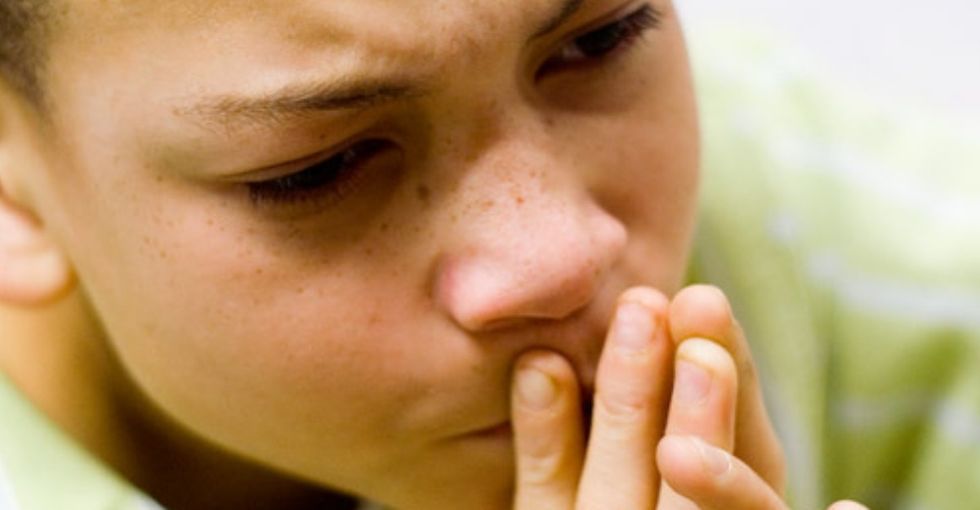
It started with a simple, sincere question from a mother of an 11-year-old boy.

An anonymous mother posted a question to Quora, a website where people can ask questions and other people can answer them. This mother wrote:

How do I tell my wonderful 11 year old son, (in a way that won't tear him down), that the way he has started talking to me (disrespectfully) makes me not want to be around him (I've already told him the bad attitude is unacceptable)?

It's a familiar scenario for those of us who have raised kids into the teen years. Our sweet, snuggly little kids turn into moody middle schoolers seemingly overnight, and sometimes we're left reeling trying to figure out how to handle their sensitive-yet-insensitive selves.


Jo Eberhardt, a fantasy writer and mother of two from Australia, penned a reply that is so spot on that it keeps repeatedly popping up on social media. When you nail it, you nail it—and this mother nails it.

"Ah, puberty," she wrote, "It changes our sweet, wonderful little boys into sweet, eye-rolling, angsty, accidentally disrespectful, but still wonderful young proto-men." Yup.

Eberhardt then described a discussion she had with her 11 1/2 -year-old son when he started going through this stage—a conversation they had in the car, which is usually the best place to have potentially uncomfortable discussions with kids.

She told her son that she'd messed up in the way she'd talked to him about puberty, then explained exactly what was happening in his brain.

I've spent all this time talking to you about the way puberty changes your body," Eberhardt told her son, "and what to expect as you go through the changes, but I completely forgot to talk to you about what's going on in your brain right now. Puberty is the time when your brain grows and changes more than at any other time in your life — well, except for when you're a baby, perhaps. So I really let you down by not preparing you for that. I'm so sorry."

Her son accepted her apology, then asked why is his brain was changing.

“That's the amazing thing," she told him. "Did you know that your brain grew and developed so quickly when you were little that by the time you were about five or six, your brain was almost as big and powerful as an adult's brain?"

"But here's the thing," she continued, "Even though your brain was super powerful, the instructions were for a child's brain. And all the information about building an adult's brain was a bit… let's say fuzzy. So your brain did the best it could, but it didn't really know what kind of person you were going to be back then, or what shape brain you were going to need."

“Now we come to puberty," she went on. "See, puberty is amazing. Not only is your body being transformed from a child's body to an adult's body, your brain has to be completely rewritten from a child's brain to an adult's brain."

“That sounds hard," her son responded.

“Yeah, it is," Eberhardt replied. “That's why I wish I'd warned you first. See, it takes a lot of energy to completely rewrite a brain. That's one of the reasons you get tired quicker at the moment — and that, of course, manifests in you being crankier and less patient than normal."

Eberhardt paused, then added, “That must be really frustrating for you."

Her son looked over at her, wiping his eyes. “It is," he responded. Sometimes I just feel really angry and I don't know why."

It's amazing what happens when we explain to kids the physiological reasons for what they're going through.

Eberhardt continued, “The other thing is that one of the first parts of your brain that gets super-sized to be like an adult is the amygdala. That's the part that controls your emotions and your survival instincts. You know how we've talked about fight/flight/freeze before, and how sometimes our brains think that being asked to speak in public is the same level of threat as being attacked by a sabre tooth tiger?"

Her son laughed. “Yes. So you have to tell your brain that there's no sabre tooth tiger to help you calm down."

“That's right," Eberhardt replied. "Well, that's what the amygdala looks after: sabre tooth tiger warnings and big emotions. So, the thing with puberty is that all of a sudden you've got an adult-sized amygdala hitting all your emotion buttons and your sabre-tooth tiger buttons. That must be really hard for you to manage."

Her son nodded and said, “Sometimes I don't know why I say the things I do. They just come out, and then I feel bad."

This is the moment where what a parent says can make or break a kid's spirit. But Eberhardt handled it with empathy and expertise.

“I know, Sweetheart," she said before explaining:

“See, the last part of your brain that gets rewritten is right at the front of your head. It's called the frontal cortex. And that's the part of your brain that's good at decision making and understanding consequences. So you've got this powerful adult amygdala hitting you with massive emotions, but you've still got a fuzzy child frontal cortex that can't make decisions or understand consequences as quickly as the amygdala wants you to. It pretty much sucks."

“So it's not my fault?" her son asked.

“No, it's puberty's fault your brain works the way it does," Eberhardt answered. "But that doesn't mean it's not your responsibility to recognise what's going on and change your actions. It's not easy, but it's not impossible, either. Your feelings are your feelings, and they're always okay. But you get to choose your actions. You get to choose what you do with your feelings. And, when you make a mistake, you get to choose to apologise for that mistake and make amends."

Eberhardt said she then paused for dramatic effect. “That's how you prove that you're becoming an adult."

It's also remarkable what happens when we empathize and communicate with our kids instead of simply chastising them.

Her son responded with a perfectly understandable and relatable, “Puberty sucks."

“Puberty absolutely sucks," Eberhardt responded. “I'm not in your head, but I can only imagine that it's a mess of confusion and chaos, and you don't know from one minute to the next how you feel about things."

Her son looked at her in surprise. “Yes! Exactly!"

“If it's confusing for you living inside there," Eberhardt continued, "imagine how confusing it is for me, when I only see your actions."

“That must be really confusing," her son agreed.

She nodded. “Do you know what that means?"

“What?"

“It means sometimes I'm going to make mistakes. Sometimes I'm going to get upset at things you do because I don't understand what's going on in your head. Sometimes I'm going to forget that you're halfway to being a man, and accidentally treat you like a child. Sometimes I'm going to expect more from you than you're able to give. This is my first time parenting someone through puberty, and I'm going to make mistakes. So can I ask you a favour?"

“What is it?"

“Can you just keep telling me what's going on in your head? The more we talk, the easier it will be for both of us to get through this puberty thing unscathed. Yeah?"

“Yeah," her son said.

When we let our kids know that we're going through these various phases together, it's easier to work with them instead of against them.

Eberhardt said they "had a cuddle" before they got out of the car. She also said this conversation didn't magically make her son always speak respectfully or make her remember that he's not a little boy anymore. However, it did open up lines of communication and gave them a shared language to use.

For example, she wrote, "He knows what I mean when I say, 'Sweetheart, I'm not a sabre tooth tiger.'"

Ebehardt wrapped up her excellent answer by saying that she and her son are "muddling through this crazy puberty thing" together, and that she's "completely confident that he'll come out the other end a sweet, wonderful young man."

It's always so helpful to see examples of good parenting in action. Ms. Eberhardt's response is something all parents can tuck away for the appropriate time. It's also a great reminder that our tweens aren't trying to try us—they're just trying to get used to their new and improved brains.


This story originally appeared on 1.05.19


black lab, dog walker, dog walker near me, dog walker ap, neighbors, good news, pets, feel good news

black lab (left. Handwritten letter (right)

If you've lived your whole life with a dog, a home has to feel pretty empty without one. Your heart has to feel like there's something missing as well. When Jack McCrossan, originally from Scotland, moved to Bristol, England with his three friends, they were bummed out to learn that their landlord didn't allow dogs.

So when they saw a beautiful black Sheprador (a German Sheppard Lab mix) in their neighbor's window, they knew that had to become buddies with her. They wrote the dog's owner, Sarah Tolman, a letter asking to arrange a play date with the dog. "If you ever need someone to walk him/her, we will gladly do so," they wrote.


"If you ever get bored (we know you never will, but we can dream), we are more than happy to look after him/her. If you want to come over and bring him/her to brighten our day, you are more than welcome. If you want to walk past our balcony windows so we can see him/her, please do," the letter continued.

"We hope this doesn't come too strong, but our landlord won't allow pets, and we've all grown up with animals. The adult life is a struggle without one," they wrote. "Yours sincerely, The boys from number 23," the letter concluded.

Soon after, the boys in 23 received a response from the dog herself, Stevie Ticks, accepting the offer. However, it may have been written by her human, Sarah Tolman. In the letter, Stevie shares a bit about herself, saying she's two years and four months old, was adopted in Cyprus, and that she's "very friendly and full of beans." (The boys shouldn't worry about a gassy hound, in England, "full of beans" means lively.)

"I love meeting new people and it would be great if we can be friends. I must warn you that the price of my friendship is 5 x ball throws a day and belly scratches whenever I demand them," the letter continued. A few days later, the boys got to meet Stevie.

"Meeting Stevie was great!" McCrossan told Buzzfeed. "She was definitely as energetic as described. We got to take her for a walk and she wouldn't stop running!"

Tolman thought the boys' letter was a fantastic gesture in an era where, quote often, neighbors are strangers. "In a day and age where people don't really know or speak to their neighbors, it was really nice for them to break down that barrier," she said. After the story went viral, she saw it as an opportunity for people to share their love of dogs with the world. "My mother and I are amazed at all the love we've received from around the world these past few days," Tolman wrote as Stevie. "If you have a doggo in your life, share that love with those around you."

A lot has changed since this story first warmed hearts around the globe. The boys have since moved away, but as of September 2024, Stevie is around 8 years old and still living her best life. Recently, she even made it to the doggie wall of fame at her local coffee shop.

In the years since this story first went viral, pet-sharing and neighbor dog borrowing have actually become more common, especially in cities where landlords restrict pets. Several platforms (like BorrowMyDoggy) and community groups now exist to pair dog owners with trusted neighbors who want occasional playtime, walks, or dog-sitting without having to own a pet. It’s a small but growing trend that reflects how deeply animal companionship is needed—even for people who can’t adopt a dog full-time. In many apartment buildings, these kinds of informal arrangements help reduce loneliness, build community, and give non-owners the emotional benefits of living with pets.

Just goes to show the power of a dog's love…even if that dog isn't your own.

This article originally appeared six years ago.

target, girl's clothes, meghan mayer, modesty, age-appropriate clothes
via Target and Mike Mozart/Flickr

A controversial dress being sold at Target.

Everywhere you go, there seems to be a constant war between children’s clothing retailers who want to push the boundaries of modesty and parents who push back, saying they are sexualizing children. On top of that, when young girls believe they are supposed to wear clothes that are tight-fitting and revealing, it's very damaging to their self-esteem and body image. So what is a parent to do?

“I think it’s one thing that the girls’ clothes are very fitted and small, and it’s another that they’re in such direct contrast to what you find on the boys’ side, and those two things send a pretty strong message about what they’re supposed to look like, dressed to be slim and to be fit,” Sharon Choksi, a mom of two and founder of the clothing line, Girls Will Be, told CNN.


The topic came up again recently when Meghan Mayer, a mother of 2 and a 7th-grade school teacher, posted a video on TikTok about a dress she saw at Target that received over 1.6 million views. Meghan was reacting to a smock-style patterned dress with balloon sleeves that appeared modest at first glance. But after closer examination, it has holes on the waist on both sides, revealing the girl’s midriff and possibly more.


“My oldest daughter and I are at Target, and there’s some cute spring stuff,” Mayer started the video. "I am a little bit more conservative when it comes to my kids’ clothing, so maybe I’m overreacting, but let me know what you think of these dresses.”

She added that the dress may be okay for a 12-year-old but was inappropriate for a 6- or 7-year-old. Mayer asked her followers what they thought of the dress. “Like I said, I know I’m a little bit more conservative. I don’t usually even let my girls wear bikinis, but maybe I’m overreacting, I don’t know. Thoughts?”

For reference, she then showed the sizes of the dresses to show they were for kids, and then revealed the holes in the sides. “Look at these little slits on the sides of these dresses, right at the hips on all these dresses,” she said.

Most people commenting on the video thought the dress was a bit much for such a young girl to wear and that it was inappropriate for someone that age to expose themselves.

target, target aisle, big box retail, target pov, shopping Walking down the aisle in a target.via Mike Mozart/Flickr

"You're not overreacting. You're parenting properly," Paper Bound Greetings wrote. "No, no. There is no reason for those holes to be there. They should have pockets! Not holes!" Anna wrote. "I think retailers are trying to mature our kids too fast. I agree with mom!" HollyMoore730 commented.

But some people thought that that dress was acceptable and Mayer was overreacting.

"Unpopular opinion, I think they’re cute," Dr. Robinson wrote. "When I was a kid in the ‘70s I wore halter tops and tube tops; they were not seen as big deals. I don’t think this is scandalous," Kimberly Falkowsi added. "Overreacting. Both my girls have the blue and white, you can’t even tell much. It’s not that big of a hole. The dresses are so cute," LolitaKHalessi commented.

"Fun fact… you don’t have to buy it, Bethany wrote. "Idk I think it’s cute and that everyone just making it weird when it really isn’t," Wisdomdeals added. "Nothing wrong with the dress. It’s sold out in my area. Luckily if you don’t like it or think it’s inappropriate, you don’t buy it for your child," Maddison commented.


target, retail store, target front, target doors, target location The front of a Target.via Mike Mozart/Flickr

Some commenters told Mayer that she should buy the dress and have her daughter wear a shirt beneath it so it doesn’t show skin. However, Mayer believes that it would support Target in making questionable kids' clothing.

"No, I'm not going to buy it and have them wear a tank top with it, because then that's showing Target that it's OK," she told Today.com. "And over time, the cutout will get bigger and bigger."

This article originally appeared last year. It has been updated.

predators, forensics, crime, women, awareness
via Екатерина Шумских/Pexels, Vladimir Konoplev/Pexels and Teona Swift/Pexels

Three women walking down city streets.

A forensics student named Alexandria recently shared vital information on TikTok that all women should know. She detailed the specific signs male predators are looking for when they choose a victim.

Her video is based on a 2013 study entitled “Psychopathy and Victim Selection: The Use of Gait as a Cue to Vulnerability.” For the study, researchers interviewed violent criminals in prison and asked them the type of women they’d be most likely to victimize.


The study found that the criminals all agreed that how the woman walked was a deciding factor.

“What the selected women all had in common was the way that they walked and how they generally held themselves in public,” Alexandria says in the video she later deleted but has been shared broadly across the platform.

@_alf_90_

How to walk for your safety! #women #safety #tips #walking #kidnapping #murder #attacks #fyp

“The selected women all had a similar ‘awkwardness’ to the way that they walked and carried themselves,” she continued. “The first part of the woman had a gait that was a little bit too small for their body, which resulted in smaller steps, slower speed and their arms more typically to their sides, or crossed, as well as their heads being down and not really taking in their general surroundings, which indicated three different things to these potential attackers.”

The woman’s body language signaled to attackers that she was fearful and anxious and because her head was down, she'd be easier to surprise. Alex then described the second type of woman the criminals said they’d target.

“On the other hand, the other part of the women that were selected had a gait that seemed a bit too big for their body and their arms tended to flail to the sides and seemed just overly awkward,” Alexandria continued.

The woman with the bigger gait signaled to potential attackers that she may be clumsy and won’t put up a good fight. “Because their arms were out and flailing to the side, it left the lower body open to, again, come around and grab them,” she said.

women, walking, predators, crime, body language Women walking down a street.Image via Canva Photos.

The video was helpful because Alexandria also discussed the types of women the attackers wouldn’t pursue. Alex says these women “walked with a gait that tended to be more natural to their body.” She adds they moved at the same pace as those in the immediate area, with their shoulders back and chins up and asserting a general sense of confidence.

“Essentially, the women that were not selected gave off an energy that said, ‘Don’t mess with me. I will put up a good fight.’ And that’s why they weren’t selected,” Alex said. “I know that it sounds silly, but something as simple as the way you walk or the way that you carry yourself in public could determine the likelihood that you become a target of a predator.”

According to the Center for Violence Prevention and Self Defense Training, detecting vulnerability is the biggest factor in who predators choose to victimize. Confusion, isolation, appearing insecure, unaware, unassertive, or distracted all play a part in who predators target, but being aware of these factors can increase safety considerably. They also note that access plays a part in being targeted, stating that, "Attackers tend to target people positioned near entrances, exits, or secluded areas where they can quickly grab and escape without arousing suspicion."

woman, crime, predator, safety, awareness Woman aware of her surroundings in a parking garage. Image via Canva Photos.

Alexandria concluded her video by sharing an acronym that can help prevent women from being victimized while in public: STAAR.

S(tride): Walk with a natural stride to your body with steps that are not too far apart or short.

T(all): Stand tall. Keep your shoulders back and your chin up. Assert a natural confidence and dominance to those around you.

A(rms): Swing your arms naturally by your sides, avoiding keeping them too close to your body or flailing out of your natural range of motion.

A(wareness): Stay aware of your surroundings. Take notice if something feels or looks off.

R(elax): Stay cool, calm, and collected and don’t indicate to a potential attacker that you feel or see something is wrong.


This article originally appeared last year. It has been updated.

Community

21 encouraging quotes from famous people about persevering through hard times

From Mother Teresa to Eleanor Roosevelt to Helen Keller, get inspired by their wise words.

Mother Teresa, Eleanor Roosevelt, inspiring quotes, encouraging quotes, famous people quotes
Images via Wikipedia

Encouraging quotes for inspiration from famous people like Mother Teresa and Eleanor Roosevelt.

The holiday season can be a difficult time of year. According to the American Psychological Association, 89% of people say this joyful time of year also brings major stress. It's safe to say that with all the running around, most of us are persevering through the end of the year.

Getting through these tough times can require some extra inspiration. If you are going through a period of difficulty, garnering wisdom from people who have lived through hardship can help you come out on the other side still standing with a renewed mindset


These are 21 encouraging quotes by famous people to help you persevere through challenging times.

- YouTube www.youtube.com

"Not all of us can do great things. But we can do small things with great love." – Mother Teresa

"Do not stop thinking of life as an adventure. You have no security unless you can live bravely, excitingly, imaginatively; unless you can choose a challenge instead of competence." – Eleanor Roosevelt

"When one door of happiness closes, another opens, but often we look so long at the closed door that we do not see the one that has been opened for us." – Helen Keller

"It always seems impossible until it's done." – Nelson Mandela

"Success is stumbling from failure to failure with no loss of enthusiasm." – Winston Churchill

"The best way out is always through." – Robert Frost

"I am a slow walker, but I never walk back." – Abraham Lincoln

- YouTube www.youtube.com

"If you can't fly, then run. If you can't run, then walk. If you can't walk, then crawl. But whatever you do, you have to keep moving forward." – Martin Luther King Jr.

"When you get into a tight place and everything goes against you…never give up then, for that is just the place and time that the tide will turn." – Harriet Beecher Stowe

"It's not that I'm so smart; it's just that I stay with problems longer." – Albert Einstein

"Never confuse a single defeat with a final defeat." – F. Scott Fitzgerald

"Strength does not come from physical capacity. It comes from an indomitable will." – Mahatma Gandhi

"You may encounter many defeats, but you must not be defeated." – Maya Angelou

"Energy and persistence conquer all things." – Benjamin Franklin

- YouTube www.youtube.com

"Develop success from failures. Discouragement and failure are two of the surest stepping stones to success." – Dale Carnegie

"Patience and perseverance have a magical effect before which difficulties disappear and obstacles vanish. – John Quincy Adams

"Believe you can and you're halfway there." – Theodore Roosevelt

"Failure is only the opportunity to begin again, this time more intelligently." – Henry Ford

"Life is not easy for any of us. But what of that? We must have perseverance and above all confidence in ourselves. We must believe that we are gifted for something and that this thing must be attained." – Marie Curie

"I shall either find a way or make one." – Hannibal

"Nothing in this world can take the place of persistence. Talent will not; nothing is more common than unsuccessful men with talent. Genius will not; unrewarded genius is almost a proverb. Education will not; the world is full of educated derelicts. Persistence and determination alone are omnipotent. The slogan 'Press On!' has solved and always will solve the problems of the human race." – Calvin Coolidge

Joy

After these plumbers learned their client was a Holocaust survivor, they handed her a ridiculous bill

The service should have cost about $285 before the brothers made a small adjustment.

After these plumbers learned their client was a Holocaust survivor, they handed her a ridiculous bill
Via Good Deeds Day / Facebook
After Arab plumbers learned their client was a Holocaust survivor, they gave her a ridiculous bill: nothing

It's estimated that only about 220,000 Holocaust survivors are still living. It's a number that's dwindling fast, rapidly accelerating every year. Sadly, in the coming years that number will eventually make its way to zero. When that day comes, it will be quite a loss for humanity. The stories and voices of those who lived through one of the worst atrocities imaginable are so important to our understanding of history. In fact, they've never been more important.

Nazi concentration caps were liberated 74 years ago, so a twenty year old who made it through the atrocity is now 94. Elihu Kover of Nazi Victim Services for Self-help Community Service spoke of the conditions many of these elderly survivors face as they advance in age at a Senate hearing in 2013.


"Holocaust survivors are growing older and frailer. … She may be coping with the loss of her spouse and have no family to speak of. In addition to the myriad problems associated with so-called 'normal aging,' many survivors have numerous physical and psychological problems directly attributable to their experiences during the Holocaust. … And many of these problems only surface in old age, having been hidden during their working years when the survivors struggled and made a new life for themselves as productive citizens of this country."

holocaust, holocaust survivors, holocaust memorial, holocaust remembrance, jewish The Memorial to the Murdered Jews of EuropeBy Alexander Blum - Own work, CC BY-SA 4.0

This sympathetic view of the tragedy isn't as popular in the Arab world where Holocaust denial is rampant and many cynically accuse the Jewish people of exploiting Western sympathy surrounding the tragedy to establish the State of Israel.

However, in 2019 two Arab men in Haifa, Israel made a beautiful show of respect to a Holocaust survivor who found their gesture "uplifting." And with the ongoing conflict in the Middle East, it's a powerful reminder that good people are everywhere.

Arab citizens make up about 20% of the population of Israel. The recent escalation of the Israel-Palestine conflict has put added strain on the relationship between Jewish and Arab citizens. Some politicians have painted Arabs as enemies of Israel, or as terrorists or security threats. In turn, it's easy to see why some Arab citizens would be distrustful and guarded.

But not these men, who chose to see the humanity in their customer.


Simon and Salim Matari, who are brothers, were recently called to the home of Rosa Meir, 95, to fix a leak.

(Also, how cool is it to see another pair of brother plumbers getting some headlines?!)

mario, luigi, mario brothers, plumbers, kindness, humanity Move over, Mario Brothers. Giphy

"When we got there, we saw there was a large blast of water and we started fixing it," Simon told the Times of Israel. "At some stage, while working, my brother Salim started to talk to Rosa about her life. She told us she's 95, a Holocaust survivor, and that she has a daughter."

"Her life story touched my heart," Simon continued. "At that moment, I decided I won't take a cent from her."

After the brothers finished their work, they gave Meir a bill that read: "Holocaust survivor, may you have health until 120, from Matari Simon and Matari Salim," adding that the cost of the service was "0 shekels." The service would have normally cost about $285 US.

"May you live until 120" is a Jewish blessing that carries the implication that the receiver live a happy and healthy life until the age of 120, which was when Moses is said to have died, his life "deemed perfect and complete."

When asked why he refused the payment, Simon said, "Money is important, but it’s not the most important. It’s important to be a human being.”

The gesture brought Meir to tears. "The brothers really surprised me," she said. "It was so moving and uplifting, and I thanked them a lot."

The brothers also told the woman that if she needed anything else they would be by to fix it for free.

If nothing else, Rosa Meir will be able to live out the rest of her days free of worry from leaks, drips, and broken faucets in her home. A small consolation, but the gesture touched the hearts of people far and wide. It's not the first time a big-hearted plumber has decided to waive his bill. A British plumber went viral several years back after fixing a 91-year-old's boiler for free. It just goes to show the power of a simple gesture for people who deserve our respect, admiration, and all the help we can give.

This article originally appeared six years ago. It has been updated.