19 super-specific memories that are giving people instant childhood nostalgia

Certain sensations bring up incredible memories.

1980s kids, 1980s nostalgia, 1990s nostalgia
Memories of childhood get lodged in the brain, emerging when you least expect.Photo credit: via Seattle Municipal Archives/Flickr

There are certain pleasurable sights, smells, sounds and tastes that fade into the rear-view mirror as we grow from being children to adults. But on a rare occasion, we’ll come across them again and it’s like a portion of our brain that’s been hidden for years expresses itself, creating a huge jolt of joy.

It’s wonderful to experience this type of nostalgia but it often leaves a bittersweet feeling because we know there are countless more sensations that may never come into our consciousness again.

Nostalgia is fleeting and that’s a good thing because it’s best not to live in the past. But it does remind us that the wonderful feeling of freedom, creativity and fun from our childhood can still be experienced as we age.

A Reddit user by the name of agentMICHAELscarnTLM posed a question to the online forum that dredged up countless memories and experiences that many had long forgotten. He asked a simple question, “What’s something you can bring up right now to unlock some childhood nostalgia for the rest of us?”

It was a call for people to tap into the collective subconscious and bond over the shared experiences of youth. The most popular responses were the specific sensory experiences of childhood as well as memories of pop culture and businesses that are long gone.

Ready to take a trip down memory lane? Don’t stay too long, but it’s great to consider why these experiences are so memorable and still muster up warm feelings to this day.

Here are 19 of the best responses.

1. 

“An eraser that looks and smells like a very fake strawberry.” — zazzlekdazzle

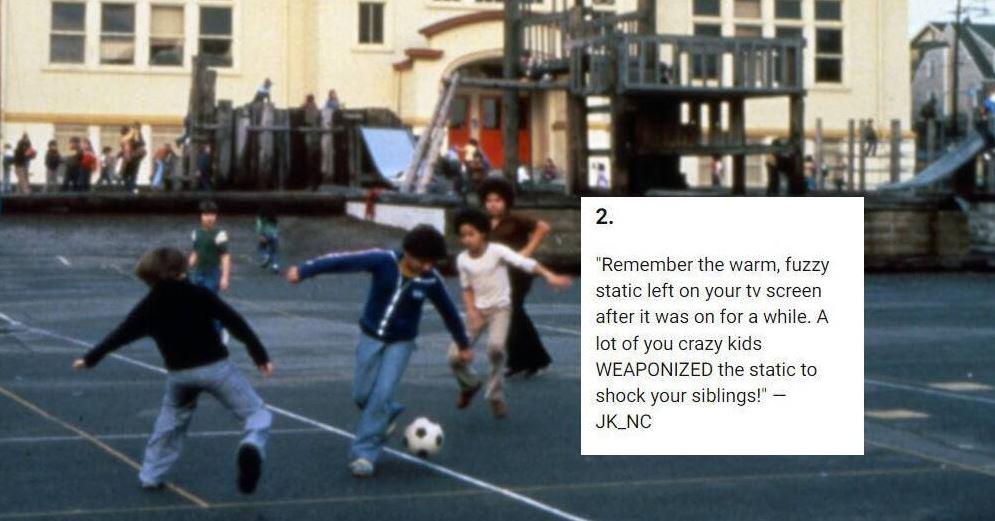
2. 

“Remember the warm, fuzzy static left on your tv screen after it was on for a while. A lot of you crazy kids WEAPONIZED the static to shock your siblings!” — JK_NC

3. 

“Waking up super early on Saturday morning before the rest of the family to watch cartoons.” — helltothenoyo

4. 

“When you’d watch a vhs and it would say ‘and now your feature presentation.’” — Mickthemmouse

5. 

“Eating one of those plastic-wrapped ice pop things after a long day of playing outside in your backyard with your friends.” — onyourleft___

6. 

“Scholastic book fairs.” — zazzlekdazzle

“The distinctive newspaper-y feel of those catalogues, the smell of them. Heaven. I would agonize over what books to get, lying on my living room floor, circling my options in different colored gel pens, narrowing it down to 2-4 from a dozen in an intense battle royale between slightly blurry one-line summaries. I know my mom’s secret now. She would’ve bought me the whole damn catalogue. But she made me make my choices so that I really valued the books. I’d read them all immediately, reading all night if I had to, hiding in a tent under my covers with a flashlight I stole from the kitchen. I thought I was getting away with something. As an adult, I notice, now, that the flashlight never ran out of batteries.” — IAlbatross

7. 

“Watching ‘The Price Is Right’ when you were sick at home.” — mayhemy11

8. 

“That feeling of limitless freedom on the first day of summer vacation. That feeling of dreaded anticipation on the last day of summer vacation.” —_my_poor_brain_

9. 

“Blockbuster.” — justabll71

10. 

“The noise when picking up the phone when someone was surfing the web.” — OhAce

11. 

“The TV Guide channel. You had to sit through and watch as the channels slowly went by so we could see what was on. It blew getting distracted by the infomercial in the corner and then realizing you barely just missed what you were waiting for so had to wait for it to start all over.” — GroundbreakingOil

12. 


“Light Bright. I barely remember it myself but you’d take a charcoal-black board and poke different colored pegs through it. You plug it in to the electrical outlet and all the pegs light up creating whatever shape you made in lights.” — 90sTrapperKeeper

13. 

“You knew it was gonna be a good day when you walk into PE class and see that huge colorful parachute.” — brunettemountainlion

14. 

“Ripping handfuls of grass at recess and putting them on your friend.” — boo_boo_technician

15. 

“In 1972, a crack commando unit was sent to prison by a military court for a crime they didn’t commit. These men promptly escaped from a maximum-security stockade to the Los Angeles underground. Today, still wanted by the government they survive as soldiers of fortune. If you have a problem if no one else can help, and if you can find them….maybe you can hire The A-Team.” — Azuras_Star8

16. 

“Watching ‘Mister Rogers’ Neighborhood.’ There was something so special about the intro where he would sing Won’t You Be My Neighbor while he changed his jacket and shoes. I loved every second of it, and would watch in utter content and fascination each time as if I’d never before seen him zip his cardigan up and back down to the right spot and change his shoes with the little toss of a shoe from one hand to the other.” — Avendashar

17. 

“Somewhere between blowing on some cartridges and pressing the cartridge down and up in the NES to get it to play.” — autovices

18. 

“That feeling when you are going as high as you can go on the swings. Power? Freedom? Hard to describe.” — zazzlekadazzle

19. 

“Cap guns. But smashing the entire roll of caps at once with a hammer.” — SoulKahn90


This article originally appeared three years ago.

  • In 1997, Beatles producer George Martin was stunned by this Brazilian all-girls choir rendition of ‘Because’
    In 1997, George Martin was visibly moved by a choir performing The Beatles' "Because."Photo credit: Screenshots via the_beatlesrevolution on Instagram

    Who deserves the honorary title of “fifth Beatle“? You could make a case for several people: guest keyboardist Billy Preston, early drummer Pete Best, even manager Brian Epstein. But on a musical level, no one was more crucial to The Fab Four than producer George Martin, who worked on all of their albums.

    That close connection only highlights the beauty of a recently unearthed video: In 1997, an all-girls choir surprised a visibly emotional Martin by singing The Beatles’ “Because” at a Brazilian airport

    It’s unclear exactly where the clip originated, but a Brazilian TV network appears to have shared it during a broadcast. Multiple social media profiles have also posted the footage, including Instagram account the_beatlesrevolution, who offered some additional context. The video, they write, shows Martin arriving at the Rio de Janeiro airport to find the Meninas Cantoras de Petrópolis choir sweetly singing “Because.”

    “What a beautiful, brilliant human he was”

    The video opens with Martin approaching the choir, his eyes welling. (It’s a fitting response for a song with the lyric, “Because the sky is blue, it makes me cry.”) He smiles, vigorously applauds, and even wipes the tears from his face. Beatles fans reacted in the comments with a similar warmth, including these top replies: 

    “A genius & a gentleman!! ❤️”

    “My god, the beauty of this moment… I’m weeping.”

    “George Martin – he had one of the most amazing ‘jobs’ ever, the musical history he helped shape was astounding. 🙌”

    “This guy wrote a history! There’s no musician or a Beatles fan that wouldn’t cry to this. Tears with goosebumps!”

    “Wonderful legacy❤️”

    “When you realize that what you’ve achieved with your friends (and what friends!) is truly remarkable”

    “Just a beautiful video. Thank you so much for posting it. Sir George played a huge part in the Beatles story and here we see the joy he had, many years after they broke up, still being loved for his contribution to the Fab Four’s legacy ❤️”

    “I am moved by the performance as well. What a beautiful brilliant human he was. I am grateful he existed in my lifetime.”

    “Because” exemplifies George Martin’s connection with The Beatles

    “Because,” a highlight from 1969’s Abbey Road, was an ideal choice as a Martin tribute. The recorded version, built on lush vocal harmonies, opens with one of his signature instrumental contributions: a chiming electric harpsichord.

    The song also symbolizes his deep relationship with The Beatles: While he was less involved in recording 1970’s Let It Be, which featured final production by Phil Spector, Martin resumed his usual role on their studio swan-song Abbey Road. (For clarity’s sake, The Beatles didn’t complete and release Let It Be until after Abbey Road, even though they recorded it before.) 

    In an archival interview, Martin explained that “Because” features triple-layered three-part harmonies from John Lennon, Paul McCartney, and George Harrison. (While drummer Ringo Starr doesn’t appear on the recording, he did provide a metronomic hi-hat pulse in the others’ headphones.)

    For the song’s arpeggiated riff, Lennon was inspired by Beethoven’s “Moonlight Sonata,” after hearing Yoko Ono play it on piano. In multiple interviews, he recalled telling her to play the chords “backward,” using the result as a springboard into something new. 

  • If you see a person and two dogs in this photo, look again. It’s an optical illusion.
    If you see a man and two dogs, look again.Photo credit: @Rainmaker1973/X, @farhadge/X

    Optical illusions are wild. The way our brains perceive what our eyes see can be way off base, even when we’re sure about what we’re looking at. Plenty of famous optical illusions have been created purposefully, from the Ames window that appears to be moving back and forth when it’s actually rotating 360 degrees, to the spiral image that makes Van Gogh’s “Starry Night” look like it’s moving.

    But sometimes optical illusions happen by accident. Those ones are even more fun because we know they aren’t a result of someone trying to trick our brains. Our brains do the tricking all by themselves.

    The popular Massimo account on X shared a photo that appears to be a person and two dogs in the snow. The more you look at it, the more you see just that—two dogs and someone who is presumably their owner. Turn the photo every which way and it’s still the same conclusion.

    That’s a person and two dogs, right?

    But there are not two dogs in the photo. There are actually three dogs in this picture. Can you see the third?

    Full confession time: I didn’t see it at first. Not even when someone explained that the “human” is actually a dog. My brain couldn’t see anything but a person with two legs, dressed all in black, with a furry hat and some kind of furry stole or jacket. My brain definitely did not see a black poodle, which is what the “person” actually is.

    Are you looking at the photo and trying to see it, totally frustrated? The big hint is that the poodle is looking toward the camera. The “hat” on the “person” is the poodle’s poofy tail, and the “scarf/stole” is the poodle’s head.

    Once you see it, it fairly clear, but for many of us, our brains did not process it until it was explicitly drawn out. This outline helps somewhat:

    As one person explained, the black fur hides the contours and shadows, so all our brains take in is the outline, which looks very much like a person facing away from us.

    People’s reactions to the optical illusion were hilarious.

    One person wrote, “10 years later: I still see two dogs and a man.”

    Another person wrote, “I agree with ChatGPT :)” and shared a screenshot of the infamous AI chatbot describing the photo as having a person in the foreground. Even when asked, “Could the ‘person’ be another dog?” ChatGPT said it’s possible, but not likely. Ha.

    One reason we love optical illusions is that they remind us just how very human we are. Unlike a machine that takes in and spits out data, our brains perceive and interpret what our senses bring in—a quality that has helped us through our evolution. But the way our brains piece things together isn’t perfect. Even ChatGPT’s response is merely a reflection of our human imperfections at perception being mirrored back at us. They say seeing is believing, but when what we interpret what we’re seeing incorrectly, we end up believing things that might not be real.

    Sure is fun to play with how our brains work, though. Also a good reminder that what we think we see, even with our own eyes, may not be an accurate picture of reality.

    This article originally appeared two years ago. It has been updated.

  • Why the iconic Boston accent is disappearing as the pronunciation of ‘R’ makes a comeback
    Why the infamous Boston accent is disappearing as the pronunciation of "R" makes a comeback.Photo credit: Canva

    Accents are regional in America. Two people can be from the same state but live hours apart, resulting in wildly different accents. The same is true for Massachusetts. People living in Cambridge don’t have the same accent as those living in Boston.

    The South Boston accent is so iconic that it has captured the hearts of people who have never even been there. This is likely due to a few famous Bostonians. Mark Wahlberg and his brothers, as well as the best-friend duo of Matt Damon and Ben Affleck, are all from Boston. They’ve let their native Boston accent shine on the big screen more than once, helping cement the accent’s popularity.

    Boston, South Boston, Boston accent, regional accent decline, losing Boston accent
    Boston, Massachusetts. Photo credit: Canva

    But sadly, the endearing way Bostonians drop their “R” for the “ah” sound is fading, and fast. In a few short decades, people may not understand why someone would teasingly ask a Bostonian to say “car keys.” The famous “park the car in the Harvard Yard” line won’t hit the same. All Rs will be present and accounted for.

    Where’s the Boston accent going?

    So what’s happening with the accent that many Americans like attempting to mimic? The simple answer: humans migrate. We’ve been migrating since standing upright became a thing. Sure, we don’t migrate to follow food sources anymore, but we do follow jobs, social safety-net programs, and educational opportunities. As people from other states and countries move into Boston, and Bostonians move out, the accent becomes a casualty.

    Boston, South Boston, Boston accent, regional accent decline, losing Boston accent
    A group of people take a selfie. Photo credit: Canva

    Katherine Loftus, a native Bostonian and mom of two school-aged children, is a little sad about the accent disappearing. Her young children don’t have the iconic accent and tease her a bit for not pronouncing her Rs.

    “It might sound funny because it’s almost sort of this surface level, like, ‘what’s the big deal if your kids don’t have the accent that you have,’ but I have to admit that there’s a real sadness to the fact that they don’t have it at all,” she tells The Boston Globe. “There’s something for me that I’m very proud of that I sound like my dad, that I sound like my grandparents, that I sound like when you hear me, you know who I am.”

    According to linguist Ezra Wyschogrod, the mesmerizing South Boston accent has already reached its peak. He explains that there’s a trend toward the homogenization of American speech as people move more frequently. The City of Boston Planning Department reports that there are currently more than 100 different languages spoken in Boston. Additionally, more than 285,000 Boston residents are multilingual.

    “A lot of one’s dialect, and even one’s language, gets codified at very young ages amongst peer groups, and there are much less peer groups in Boston where you have all the kids that are all Boston kids,” Wyschogrod tells The Boston Globe. “New accents form all the time, and for all we know, whatever new mix that Boston is, there could be some new accent that everyone just starts noticing.”

    Bostonians didn’t always have the iconic accent

    It turns out the missing R is something that only started around 100 years ago. Now, that pesky consonant is returning after a brief centennial hiatus. Wyschogrod doesn’t want people to worry. No one is revoking anyone’s Boston card if they don’t drop their Rs.

    “There was this interesting period where we were R-less, and now we’re back to this R-full speech,” Wyschogrod reveals. “We were distinctly New England before that. We were distinctly New England during this R-less period, and we’re going to be distinctly New England after.”

    The South Boston accent isn’t the only one getting the boot. As people do what they’ve been doing since the dawn of time—move—dialect is evolving. Today reports that multiple studies have shown that the “Southern twang, the Texas drawl, and even the beloved Brooklynese are all slowly changing.”

    Marjorie Feinstein-Whittaker, a speech and communications consultant, explains to Today that while the Boston accent might fade, it isn’t going to disappear completely.

    “I don’t think the accent is ever going away, honestly, but I do think it’s changing,” she says. “Our lives are much more varied than they used to be.”

  • Brazilian pianist covers Guns N’ Roses with the weirdest instrument of all: rubber chickens
    Rubber chickens are an underrated instrument.Photo credit: @lordvinheteiro on TikTok

    There are many ways to pay tribute to a music artist through a cover of one of their songs. Some honor their inspiration by playing their hit song in a different genre of music. Others cover the song through different instrumentation or key changes. Then there’s the guy who performs his cover with rubber chickens.

    The professional pianist known as Lord Vinheteiro has gotten attention on TikTok by performing Guns N’ Roses’ song “Sweet Child O’ Mine.” Only, instead of the vocal stylings of Axl Rose, Vinheteiro sings the song through the squeaky voices of rubber chickens of varying sizes. And he nails it.

    @lordvinheteiro

    Sweet Child O’ Mine – Guns N’Roses sweetchildomine gunsnroses rubberchickens chickens chicken vinheteiro lordvinheteiro

    ♬ som original – Lord Vinheteiro – Lord Vinheteiro

    Commenters were equal parts impressed and amused:

    “How does one tune a rubber chicken?”

    “Next year’s Super Bowl show! UNRIVALED!!!”

    “If you close your eyes, it sounds just like Axl Rose.”

    “This is what the internet was invented for.”

    “I don’t care what y’all say… THIS IS TALENT.”

    “Simply awesome, Maestro!”

    “As a middle school science teacher would you mind if I showed this video to my students? We’re studying sound waves and this is a perfect example of frequency and pitch.”

    “Needed this smile. Thank you.”

    “Clucking brilliant.”

    Who is this rubber chicken maestro?

    Lord Vinheteiro, the professional name of Brazilian musician Fabrício André Bernard Di Paolo, has entertained the Internet since 2008. He gained attention through his expert piano skills—where he’s playing theme songs from cartoons or playing the piano at a distance with strings. All the while, Vinheteiro adds to the absurdity by looking directly into the camera with an expressionless face.

    Prior to his career as a YouTube content creator and music teacher, Paolo worked in construction. His videos grew in popularity in his native Brazil before gaining traction worldwide. Until recently, he showcased his classical music prowess by playing video game themes and other pop-culture favorites. In 2025, he began expanding his musical talent by incorporating rubber chickens into his content.

    While still showcasing his impressive piano skills, he frequently shows off his rubber chicken singing abilities using chickens of various sizes. Impressively, Paolo is able to hit the proper tone and pitch with expert grip and timing. This feat has earned him millions of views on rubber chicken versions of a wide variety of songs, from System of a Down’s “Chop Suey!” to Queen’s “Bohemian Rhapsody,” and even the “Imperial March” theme from Star Wars.

    If you are amused and fascinated by Lord Vinheteiro’s work, check out his social media for more. It may be piano and rubber chickens for now, but it’ll be interesting to see which instrument he masters next.

  • Drummer creates amazing cover videos from wheelchair with innovative mouth-trigger kick pedal
    A drummer creates inspiring cover videos from his wheelchair with help from a mouth-trigger kick pedal.Photo credit: Screenshots via Jesse Avi on Instagram

    Drummer Jesse Avi has racked up millions of social media views with his precise, tasteful cover videos. But these clips are also fascinating and motivational on a deeper level: Avi, who uses the handle “The Slightly Different Drummer,” performs them all from his wheelchair, operating the kick drum with a pedal triggered by his mouth. 

    Avi has been posting his covers—everything from modern soul music (Silk Sonic’s “Smokin Out the Window”) to early ’80s power pop (Rick Springfield’s “Jessie’s Girl”)—since December 2025. But he truly reached social media virality the following month by tackling Incubus’ 1999 alt-metal classic “Pardon Me.” It’s a killer rendition, nailing José Pasillas’ deft snare rolls, cathartic crash cymbals, and powerful kick grooves. Both drummers and non-musicians responded, with the clip reaching over a million views on Instagram alone. 

    “This is inspiring”

    Here are some of the top comments: 

    “Dude you are LOCKED IN 🤘”

    “Is the trigger for the kick in your mouth this is AMAZING 💪🏻

    “Hell yeah button 👉🏻”

    “For any non drummers, please know this is incredibly tight playing”

    “Pardon me sir but this is amazing !!!!”

    “Nothing stopping you!!! 🔥🔥🔥”

    “Im about to have a major spine surgery and i have a fear of losing mobility in my legs after and nor being able to drum. This gave me hope even if the worst comes to pass. This is inspiring”

    “Obsessed with rhythm”

    Avi tells Upworthy he started playing drums around age 10, “obsessed with rhythm.” When he first saw the video for Hanson’s 1997 pop hit “MMMBop” on MTV, he found himself locking in on the drummer, Zac Hanson. “Something about the power and control behind the kit pulled me in, and the fact that it was just kids playing blew my mind,” he says.

    Soon enough, he was “banging on pillows” and quickly found himself behind an actual kit. But after a spinal cord injury at age 13, he stopped playing for several years—and when he started back, he couldn’t continue with the traditional drum setup.

    “At first, that was frustrating—because muscle memory and habit are huge parts of drumming,” he recalls. “But I also realized that if I wanted to keep playing at the level I expected from myself, I’d have to rethink things instead of resisting the change. In a lot of ways, it made me more creative. I had to analyze my playing from the ground up—literally. It forced me to become more intentional, more disciplined, and more technical about how I move around the kit. What could’ve been a limitation ended up reshaping my style and making me a more thoughtful drummer.”

    “I needed to retrain my brain”

    A major breakthrough came on July 5, 2005, after glimpsing a Def Leppard show at New Jersey’s FirstEnergy Park, where he worked as a dishwasher.

    “I’ll never forget it,” he says. “On my break, I was able to watch the band perform a few songs, and I was amazed at how Rick Allen, their drummer with one arm, could play so smoothy and perfectly. I drove home that night thinking to myself, ‘If he can do it, I can do it.’ Keep in mind, no YouTube or online videos were around for me to really watch him perform. So I spent the next few days [experimenting] with this pedal that I took from an electronic drum set I got for Christmas a few years earlier.”

    At first, Avi tried sticking the pedal under his arm, but it would fall right out. He tried sitting on it, but that proved too uncomfortable. After putting the device in his mouth, he found he could play simple beats.

    “It was hard, and I needed to retrain my brain that biting down is the kick drum now, not my leg,” he says. “Within a week, I was playing daily, and it never really stopped from there. I always continued to play on and off—sometimes I wouldn’t play for a year or so, and then I’d play for three years straight. As of recently I have been playing more, and it’s been a great feeling.”

    The technical side of his playing is pretty inventive: Avi bites down on the trigger every time he wants to hear a kick drum, which sends a signal to his “drum brain”—a Roland TD-3—and then into the Yamaha EAD10 drum module to create the kick sound.

    His videos have sparked a range of responses: both pro and casual musicians sharing their feedback, drummers asking technical questions, and people sharing how the videos inspired them.

    “I can tell you this: There are plenty of good people on this Earth,” Avi says. “I have really had some amazing comments and DMs from people all over the world. It’s incredible. The response has honestly been one of the most meaningful parts of sharing my videos. I’ve had everyday drummers reach out, and even a few professional players, letting me know they connected with what I’m doing. That’s something I don’t take lightly.” 

    “It’s been especially powerful hearing that something as simple as me playing and being consistent has inspired other people—whether that’s pushing through their own challenges or just picking up the sticks again,” he adds. “At the end of the day, drumming is such a tight-knit community. It doesn’t matter if you’re playing arenas or in your garage—we all understand the language of rhythm. Being able to connect with other musicians through that has been one of the biggest unexpected rewards.” 

    “I almost melted into the floor”

    So what makes the Incubus video so special? Even Avi isn’t sure, but maybe it’s due to the power of the song itself.

    “When I recorded that video, I honestly didn’t think it would do what it did,” he says with a laugh. “With everything going on in the world right now, the song has its own identity, right? Like, it starts tight. Then it gradually expands—more energy, more intensity, more space. When it hits the chorus, it feels like release. Not chaos but a release. It doesn’t say ‘I’m mad at the world.’ It’s more like ‘I’m overwhelmed, and I’m trying to understand it.’ I think people really connect with that.”

    “I could also be totally wrong,” he adds. “I don’t know what the algorithm was doing that day, but it sure reached a lot of people. It was crazy. I went from 12 Instagram followers to four thousand the next day. José Pasillas and [Incubus singer] Brandon Boyd both liked the video on Instagram, and I almost melted into the floor. I couldn’t believe it.”

    It’s one powerful moment of many for The Slightly Different Drummer, who’s inspired to keep pushing himself. 

    “I’ve been playing for over 20 years now, and what’s kept me going is that there’s always another level to reach,” he says. “Drumming isn’t just something I do—it’s part of who I am. It’s how I express myself, how I challenge myself, and honestly, how I connect with people.”

  • Reese Witherspoon’s blunt advice for young fan’s career change: ‘Don’t chase your dreams’
    A young woman looking stressed and Reese Witherspoon.Photo credit: Jenn Deering Davis/Wikimedia Commons and Canva
    ,

    Reese Witherspoon’s blunt advice for young fan’s career change: ‘Don’t chase your dreams’

    “Everybody has dreams. Doesn’t mean you’re going to be that thing.”

    There is no expiration date for finding success in life, but knowing what you want to do at a young age can give you a significant advantage in a competitive world. The problem is that many folks aren’t sure which path to pursue. Do you follow your dreams or take the safer route to success?

    Actress Reese Witherspoon, who’s also had massive success as a producer and entrepreneur, says the answer is easy: follow your talents.

    A young woman unhappy in her career asked Witherspoon for advice on starting a new one, and the Legally Blonde star shared her thoughts on Instagram.

    Witherspoon’s career advice

    “Okay, well, what are your talents?” Witherspoon asked the woman. “And she had a hard time telling me what her specific talents were. And I thought to myself, this is very, very important. You don’t chase your dreams, you chase your talent.”

    “Everybody has dreams. Doesn’t mean you’re going to be that thing. You are supposed to do what you’re talented at,” Witherspoon said. “It’s your job in life to figure out what your specific, unique talents are and go chase them. That’s what you’re going to do. Chase your talents. Not your dreams.”

    Witherspoon’s advice is practical but also leaves the door open for some magic. If you are an incredible painter and an average singer, it’s best to focus on improving your painting skills. Focusing on your talents can also help you fulfill your dreams, but you have to hone your talent first.

    “It’s magic when your talents align with your dreams or when you recognize your talents can support your dreams,” one person wrote in the comments on Witherspoon’s video.

    reese witherspoon, actress, red carpet, legally blonde, black dress
    Reese Witherspoon in 2011. Photo credit: Eva Rinaldi/Wikimedia Commons.

    Career coaches chime in on Witherspoon’s advice

    Upworthy reached out to professional career coaches to see what they had to say about Witherspoon’s advice.

    “From a research standpoint, Witherspoon is right to push back on the blanket (and all too popular) advice to follow your dreams,” said Dr. Heather Maietta, the owner of Career In Progress, a global private practice that develops career professionals. “Strengths (or talent) alignment is strongly associated with engagement and performance.”

    happy employee, career, briefcase, success, leaping, shadow man
    A man leaping with a briefcase. Photo credit: Canva

    “However, decades of career development research suggest that sustainable career decisions sit at the intersection of three factors: demonstrated strengths (talents), genuine interest and motivation, and market demand and role economics,” she added.

    Karol Ward, a licensed psychotherapist who coaches corporate clients in professional growth, said that once someone has identified the talents they wish to cultivate, they should reach out to successful people in their network to create a roadmap for success. She shared some questions people should ask their connections:

    • Did they have clear intentions or a vision about what they wanted?

    • Did they create a specific plan, and if so, what did that look like?

    • Did they hire support people such as coaches, therapists, or financial planners?

    • Did they take classes, join organizations, or find mentors?

    • What resources do they recommend?

    • How did they choose who or what to spend their time on to reach their goals?

    Witherspoon has achieved her dreams by succeeding as an A-list actress, an incredibly difficult career to break into that takes skill, perseverance, and a lot of luck. So, one would think she’d tell everyone to follow their dreams, too. However, she believes the best way to find success is for people to be the best versions of themselves, and that’s an opportunity available to everyone.

  • Drumming mom brings down the house at daughter’s wedding with family take on Weezer classic
    A drumming mom brought down the house at her daughter's wedding.Photo credit: Instagram screenshots via juinsommer

    There are lots of cool moms out there. You may even have one yourself. But has anyone ever been cooler than this lady? In February, Juin Sommer went viral with an Instagram video showing his mom learning the drum part to Weezer’s 1994 alt-rock classic “Say It Ain’t So,” then playing it at her daughter’s wedding.

    The clip is wonderful on many levels, but it deserves a little context. Starting in November 2025, Sommer posted a series of videos showing his mom, Elly, practicing on an electronic drum kit. He captioned the first one, “My mom learning the drums for her midlife crisis.”

    Drummer mom’s viral first gig

    Motivation aside, the final product was more than worth it. Sommer captioned the big reveal post “How it started” and “How it went,” contrasting his mom’s practice session with the actual wedding performance. The latter is a family-band affair: Sommer sings and plays the guitar solo, the bride Hanna is on rhythm guitar, longtime friend RJ is on bass, and mom lays down thunder behind the kit. She nails every moment, from the syncopated kick and splashy ride cymbals to the pre-chorus snare rolls. All in all, an excellent first gig.

    After the clip went viral, it made its way to Weezer themselves.

    “Nothing says happily ever after quite like some =w= at your wedding,” the band wrote on Instagram. “Congrats to mom on nailing the drums and congrats to the happy couple!”

    Both Sommer and Hanna responded with amazement. “Wow crazy that one my favorite bands was able to see this,” the former enthused. “AHHHHHH OMG THIS IS SO AMAZING!!!!! I LOVE YOU GUYS SOOO MUCH THANK YOU FOR THE LOVE!!!!!!” added the latter. 

    “Epic on so many levels”

    Of course, lots of other admirers shared their kind words. Here are some of the top comments:

    “who needs a DJ when you have mom??”

    “Coolest mum ever”

    “WE LOVE YOU WEEZER MOM”

    “This is wedding goals right here =w=”

    “This is the first wedding video I’ve seen that actually makes me want to get married someday, and then become the Korean mom playing at her kid’s wedding with sunglasses on like an absolute legend 😭😭😭 also amazing work on the noodly guitar solo!

    “I’ve filmed like 170 weddings as a videographer and this would have made me lose my mind. So good 👏👏”

    “This is probably one of the best things I’ve seen”

    “This is so outrageously cool omg

    “Imagine having a mom and sister that cool.

    “Why is her timing so good? Also brother crushed those vocals”

    “Help why did this make me emotional 😭 her rocking out in the hanbok omg 👏

    “Epic on so many levels”

    “Feel like your sister rocking out in her wedding dress needs to be highlighted as well”

    It all started with a joke

    Sommer tells Upworthy that the road to virality began with a joking Snapchat about his mom’s “midlife crisis” moment. “I found that snap more recently and posted it, and it got a lot of attention, which I was surprised to see,” he says with a laugh.

    Elly had already been learning drums, but she cranked up her practice time after brainstorming the friends-and-family wedding performance. “She won’t admit it, but she was so nervous,” Sommer adds, “especially since it was her first time playing in front of a crowd.”

    This was a special moment for a lot of reasons, and the song choice was meaningful, too. Sommer, Hanna, and RJ used to play together in a high school band, often covering “Say It Ain’t So.”

    “I think I covered that song at least 50 times over the years with different bands,” Sommer notes. “So we all already knew it, except my mom.”

    Given his longtime love of emo, pop-punk, and alt-rock, seeing Weezer’s reaction was definitely a trip.

    “We were all in awe,” he says. “I didn’t even notice until my other younger sister, Zoë, sent it to me on Instagram. We all were so excited that one of our favorite bands was able to actually see us play.”

    In summary, the bar has officially been raised for cool moms, wedding music, viral drummers, and family bands.

  • Ethan Hawke shares why he didn’t get along with Robin Williams filming ‘Dead Poets Society’
    Ethan Hawke and Robin Williams acted together in "Dead Poets Society."Photo credit: Nicolas Genin (left), John Mathew Smith (right)

    Dead Poets Society was one of the most popular coming-of-age films of the late ’80s, showcasing Robin Williams’ acting range and launching several young actors into their Hollywood careers. But according to Ethan Hawke, who played the timid Todd Anderson (the student who stands on his desk first) in the film, the famous comedian didn’t make his own job easy.

    Hawke shared on The Graham Norton Show what working with Williams was like after Norton said he understood their on-set relationship to be “a bit fractious.”

    “Well, he was incredibly funny, right?” said Hawke. “And he was very relaxed and very inventive…and he would just improv constantly, all day long, and the more the crew laughed, the more he would go.”

    Despite Williams’ hilarious antics, the film wasn’t a comedy. Hawke struggled with the constant improv in light of his own acting work.

    “I really wanted to be a serious actor,” he said. “You know, I had read Stanislavski, and I had what was supposed to be in my pockets, and I really, really wanted to be in character, and I really didn’t want to laugh. And the more I didn’t laugh, the more insane he got. And he’d make fun, ‘Oh, this one doesn’t want to laugh,’ and the more smoke would come out of my ears. He didn’t understand I was trying to do a good job…so I thought he hated me, because he just constantly would lay into me.”

    After filming, Hawke went back to school thinking Williams “hated” him. Then one day, he got a phone call.

    “It was from a big Hollywood agent. This guy says, ‘I’m Robin Williams’ agent, and he says that you’re gonna be somebody, and that I should sign you.’ And I was like, really? And so he got me my first agent, who’s still my agent now.”

    Many stories of Williams’ behind-the-scenes acts of kindness have come to light after his passing, so the fact he recommended Hawke unasked isn’t too surprising. Knowing the context from Hawke’s perspective, however, makes it all the more delightful.

    Hawke spoke to Vanity Fair about his experience observing Williams and director Peter Weir interact on the Dead Poets Society set:

    “I’m watching [Weir] direct Robin Williams, not an easy thing to do, ’cause Robin was a comic genius,” Hawke said. “But dramatic acting was still new to Robin at that time. And watching that relationship like, in the room—I was four feet away while they’re talking about performance—and that was something you don’t unsee.”

    Williams taught Hawke that a script isn’t always set in stone.

    “Robin Williams didn’t do the script, and I didn’t know you could do that,” Hawke recalled. “If he had an idea, he just did it. He didn’t ask permission. And that was a new door that was opened to my brain, that you could play like that. And Peter liked it, as long as we still achieved the same goals that the script had.”

    “They had a very different way of working, but they didn’t judge one another or resist one another,” Hawke continued. “They worked with each other. That’s exciting. That’s when you get at the stuff of what great collaboration can do. You don’t have to be the same, but you don’t have to hate somebody for being different than you are. And then the collective imagination can become very, very powerful, because the movie becomes bigger than one person’s point of view. It’s containing multiple perspectives.”

    The lessons Hawke learned from watching and working with Robin Williams have followed him through more than three decades in film. It’s delightful to see how Williams’ influence lives on in many small ways the world may not be aware of. His is an incredible legacy.

Finance

Frugal people share exactly how much money they saved on their best thrifty lifestyle changes

Culture

A man at a bar bought a rude stranger a drink and used it as a brilliant lesson about consent

Culture

Why the iconic Boston accent is disappearing as the pronunciation of ‘R’ makes a comeback

Animals

A baby monkey rejected by his mom carries a stuffed animal for comfort. People can’t look away.