upworthy
Add Upworthy to your Google News feed.
Google News Button
Democracy

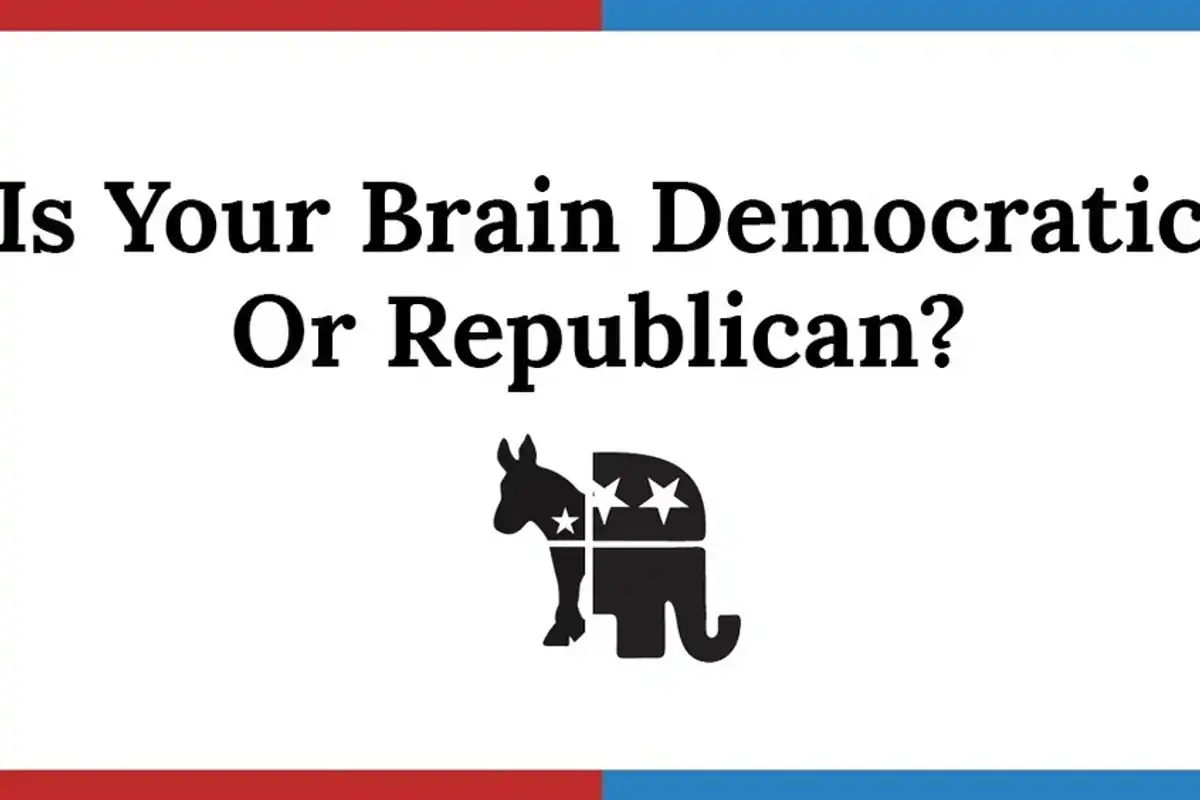
These 27 non-political questions can predict whether you’re a Republican or Democrat

This quiz is fascinating.

Democratic donkey and Republican elephant morphed together against white background

Do you agree with your results?

Recent polls suggest that Republicans and Democrats have slightly different tastes that have nothing to do with politics.

Americans tend to choose their political party based on a number of factors: family, gender, religion, race and ethnicity, and even region all have a hand in shaping a person's political ideology. Famously, George Washington warned the country against a two-party system in his Farewell Address on September 17, 1796. Our first president cited fears that "partisanship would lead to a 'spirit of revenge' in which party members would not govern for the good of the people, but for power."

Over 220 years later, Washington may have been right, but things aren't as dire as they seem. As reported by CBS News, a recent study by the Pew Research Group found that while a lot does divide us, there's much more that we have in common on average.

In short, a lot goes into where we fall on the political spectrum, but an interesting new quiz from ChartsMe has taken things to the next level. It claims to be 98% effective in determining people's political affiliations by asking questions that—get this—have nothing to do with politics.


Take the quiz here.

So, how does it work? (I recommend you take the quiz before we break down what's going on!)

The quiz uses Jonathan Haidt's Disgust Scale and takes you through a series of questions and scenarios to determine how disgusted certain situations make you. According to ChartsMe, a 2014 study published with the National Library of Medicine (NLM) found that people who were more prone to disgust are more conservative. This leads them to more closely align with the Republican Party. Further research conducted in 2022 bolstered this finding by investigating the "Conservative-Disgust Paradox" in reactions to the COVID-19 pandemic.

Some research disputes this though.

In 2019, the British Psychological Society cited a study that found that levels of disgust between conservatives and liberals are generally the same but highly "context-dependent." In other words, some liberals have higher disgust sensitivity than conservatives and vice versa depending on the topic, image, or idea.

woman looking disgusted

Does what disgusts you define you?

Photo by OSPAN ALI on Unsplash

Overall, it's human to feel disgust. Some scientists believe it's ancestral and that the adverse reactions to conditions we'd label “disgusting" were used to protect primitive ancestors from contamination and disease. According to National Geographic, Charles Darwin proposed that disgust served an evolutionary purpose in the late 1860s. It evolved, he noted, to "prevent our ancestors from eating spoiled food that might kill them." Helpful!

So, maybe being grossed out isn't inherently a conservative or liberal emotion, but the science tells us that what grosses us out and how deeply we're grossed out by it just might indicate our political leanings.

Do you agree with your ChartsMe results? Did they get it right? Either way, I think we can all agree this stuff is pretty neat.


This article originally appeared six years ago.

Once a refugee seeking safety in the U.S., Anita Omary is using what she learned to help others thrive.
Pictured here: Anita Omary; her son, Osman; and Omary’s close friends
True

In March 2023, after months of preparation and paperwork, Anita Omary arrived in the United States from her native Afghanistan to build a better life. Once she arrived in Connecticut, however, the experience was anything but easy.

“When I first arrived, everything felt so strange—the weather, the environment, the people,” Omary recalled. Omary had not only left behind her extended family and friends in Afghanistan, she left her career managing child protective cases and supporting refugee communities behind as well. Even more challenging, Anita was five months pregnant at the time, and because her husband was unable to obtain a travel visa, she found herself having to navigate a new language, a different culture, and an unfamiliar country entirely on her own.


“I went through a period of deep disappointment and depression, where I wasn’t able to do much for myself,” Omary said.

Then something incredible happened: Omary met a woman who would become her close friend, offering support that would change her experience as a refugee—and ultimately the trajectory of her entire life.

Understanding the journey

Like Anita Omary, tens of thousands of people come to the United States each year seeking safety from war, political violence, religious persecution, and other threats. Yet escaping danger, unfortunately, is only the first challenge. Once here, immigrant and refugee families must deal with the loss of displacement, while at the same time facing language barriers, adapting to a new culture, and sometimes even facing social stigma and anti-immigrant biases.

Welcoming immigrant and refugee neighbors strengthens the nation and benefits everyone—and according to Anita Omary, small, simple acts of human kindness can make the greatest difference in helping them feel safe, valued, and truly at home.

A warm welcome

Dee and Omary's son, Osman

Anita Omary was receiving prenatal checkups at a woman’s health center in West Haven when she met Dee, a nurse.

“She immediately recognized that I was new, and that I was struggling,” Omary said. “From that moment on, she became my support system.”

Dee started checking in on Omary throughout her pregnancy, both inside the clinic and out.

“She would call me and ask am I okay, am I eating, am I healthy,” Omary said. “She helped me with things I didn’t even realize I needed, like getting an air conditioner for my small, hot room.”

Soon, Dee was helping Omary apply for jobs and taking her on driving lessons every weekend. With her help, Omary landed a job, passed her road test on the first attempt, and even enrolled at the University of New Haven to pursue her master’s degree. Dee and Omary became like family. After Omary’s son, Osman, was born, Dee spent five days in the hospital at her side, bringing her halal food and brushing her hair in the same way Omary’s mother used to. When Omary’s postpartum pain became too great for her to lift Osman’s car seat, Dee accompanied her to his doctor’s appointments and carried the baby for her.

“Her support truly changed my life,” Omary said. “Her motivation, compassion, and support gave me hope. It gave me a sense of stability and confidence. I didn’t feel alone, because of her.”

More than that, the experience gave Omary a new resolve to help other people.

“That experience has deeply shaped the way I give back,” she said. “I want to be that source of encouragement and support for others that my friend was for me.”

Extending the welcome

Omary and Dee at the Martin Luther King, Jr. Vision Awards ceremony at the University of New Haven.

Omary is now flourishing. She currently works as a career development specialist as she continues her Master’s degree. She also, as a member of the Refugee Storytellers Collective, helps advocate for refugee and immigrant families by connecting them with resources—and teaches local communities how to best welcome newcomers.

“Welcoming new families today has many challenges,” Omary said. “One major barrier is access to English classes. Many newcomers, especially those who have just arrived, often put their names on long wait lists and for months there are no available spots.” For women with children, the lack of available childcare makes attending English classes, or working outside the home, especially difficult.

Omary stresses that sometimes small, everyday acts of kindness can make the biggest difference to immigrant and refugee families.

“Welcome is not about big gestures, but about small, consistent acts of care that remind you that you belong,” Omary said. Receiving a compliment on her dress or her son from a stranger in the grocery store was incredibly uplifting during her early days as a newcomer, and Omary remembers how even the smallest gestures of kindness gave her hope that she could thrive and build a new life here.

“I built my new life, but I didn’t do it alone,” Omary said. “Community and kindness were my greatest strengths.”

Are you in? Click here to join the Refugee Advocacy Lab and sign the #WeWillWelcome pledge and complete one small act of welcome in your community. Together, with small, meaningful steps, we can build communities where everyone feels safe.

This article is part of Upworthy’s “The Threads Between U.S.” series that highlights what we have in common thanks to the generous support from the Levi Strauss Foundation, whose grantmaking is committed to creating a culture of belonging.

sleep, sleep tricks, sleeping techniques, science, scientific research, placebo effect, placebo

Tired man (left); energized man (right)

The benefits of getting a good night's sleep are too vast to name. Sleep is as essential for our brains as food and water are for our bodies. If you're not getting enough, sleeping better has been shown to elevate your mood, improve your memory, and even boost your physical health. And then there's the obvious: when you don't sleep well, you'll have less energy and generally perform worse on tasks that require any kind of effort or thought.

However, we're all human, and, sometimes, humans sleep terribly. Your infant might wake you up, or a car alarm might go off outside, interrupting your regularly-scheduled REM. It's not always our fault when we don't sleep well, but there might be an interesting way to fix it.


A study from 2014 may have demonstrated the existence of something called "placebo sleep," or tricking your brain into believing you slept better than you did.

sleep, sleep tricks, sleeping techniques, science, scientific research, placebo effect, placebo a man sitting at a desk with his head on his arms Photo by Vitaly Gariev on Unsplash

The placebo effect, of course, has been studied relentlessly over the years and has shown that the human body can do amazing, almost impossible things, when the brain gets on board. The classic example is when symptoms of disease get measurably better after a patient takes a "fake" pill. Another study out of Harvard showed that people who were told their jobs qualified as exercise showed improved health and fitness markers compared to people who did the same job. Placebos even work when the person knows they're taking a placebo. It's called an "honest placebo" and is considered a legitimate, ethical treatment method for many ailments.

The researchers in 2014 wanted to find out if the placebo effect could also apply to sleep. So, they lectured a group of participants about the importance of REM sleep and how it can effect cognitive functioning. The participants were then split into two groups and monitored overnight while they slept. The next morning, one group was told they achieved 28.7% REM sleep, which is terrific, and the other group was told they only spent 16.2% of their sleep time in REM, which is below average. The numbers, however, were complete fiction.

Stunningly, the participants who believed they achieved top quality sleep performed better the next day on a series of arithmetic and word association tests compared to the other groups.

In their conclusion, the authors wrote, "These findings supported the hypothesis that mindset can influence cognitive states in both positive and negative directions, suggesting a means of controlling one's health and cognition."

According to Smithsonian Magazine, follow up experiments confirmed the findings.

The key to feeling great and performing as if you had a great night's sleep may lie in simply believing that you did.

There are a lot of ways to "placebo your sleep" in order to generate that belief. For starters, you can adopt a new routine or technique or even supplement in order to prime your brain.

John Cline Ph.D. asserts for Psychology Today that the popularity of sleeping aids like melatonin may be tied less to the fact that they work, and more to the fact that people believe they work. But you don't need to take any supplements or medications. Having a slow evening wind down with a book and an herbal tea, trying a new sleeping position, or practicing some measured breathing might work just as well. Or, rather, they might work precisely because you believe they will.

sleep, sleep tricks, sleeping techniques, science, scientific research, placebo effect, placebo Can a warm cup of tea help you sleep better? If you believe it, then yes. Photo by Dana Ciurumelea on Unsplash

You could take the concept a step further and alter your morning routine on nights you know for a fact you didn't sleep well. Perhaps it's by using a new coffee brand, doing some stretches before getting out of bed, or meditating before starting your day. Anything that you truly believe might help make you more alert and focused may just work.

One viral social media sleep trend capitalizes on this research perfectly. Researchers have shown that forcing your mouth into a smile has been shown to improve your mood. Turns out, similarly, you may be able to get sleepy by pretending to be super tired. Psychologist Erica Terblanche calls it the "alpha bridge," and it involves gently closing your eyes, fluttering them open just a tad, and then closing them again as you relax and breath. It simulates the feeling of "nodding off" and is said to create the alpha brainwaves that transition your brain from wakefulness to sleep. It's another clever way of tricking your own brain.


@erica.terblanche

Here's a skill to help you fall asleep on an airplane or anywhere else for that matter. . Its called going over the Alpha Bridge. #EricaTerblanche #ThriveGuru #motivation #sleeping

It sounds cheesy, but the power of mindset and positive thinking is truly tremendous. Our beliefs and thought patterns can greatly influence our body, our behavior, and our mood. Sometimes, our mindset can even be stronger than actual reality. Now we have the data to prove that it applies to our precious sleep, too.

fake smile, behavioral science, body language, social situations, social tips

Can you tell if a smile is real or fake?

Though we’ve all had to fake a smile at times, it doesn't feel good to receive or give one. Some have gotten so good at offering fake smiles that others may begin to wonder if a person’s smile is ever genuine. To put this worry to bed, a body language expert explains the tell that can separate the genuinely happy from the passively polite.

Vanessa Van Edwards went on TikTok to share how to tell if someone is faking their smile. Van Edwards recommends not looking at a person’s mouth when they’re smiling, but to look at the top half of their face. In the video, she explains that a genuine smile doesn’t just reveal itself in the mouth, but in the upper cheeks and eyes. A person who is genuinely smiling has a noticeable “lift” in both their upper cheeks and the outward corners of their eyes, as if those parts of the face are also smiling alongside the mouth. A fake smile is very much concentrated on moving the mouth upward with little to no change in the upper half of the face.


@vvanedwards

This Is How You Know A Smile Is Real!

“If you can’t see a real smile on the top half of the face, it’s not a real smile,” said Van Edwards.

Van Edwards then notes that if you spot a fake smile it could be an opportunity to “dig a little deeper.”

How should you respond to a fake smile?

There are many reasons someone might fake a smile. While the fake is meant for deception, it’s not necessarily for malicious reasons. Maybe they want to hide their disappointment that you got the promotion and they didn’t. Maybe they don’t like the food you brought to the potluck, but they like you and want to spare your feelings. Maybe they just had a terrible day but don’t want to ruin the mood. Maybe it has nothing to do with you at all. Even with all that considered there are some folks who can still convincingly fake a smile anyway.

@2000sindie

the killers (2004)

“The challenge with fake smiles is the cause can be from a variety of things,” facial analysis expert Brian Galke told Upworthy. “Some people were raised in environments where they were told to have a smile on their face no matter what was going on.”

So, how should you respond to a fake smile? There’s no true one and done answer. Everything depends on the situation and how well you know the fake smiler. If you are good friends with them, you may want to privately ask them if there's something wrong. If there is or was, you have an opportunity to turn that fake smile into a real one. That’s not always necessary or recommended though.

“If you do feel that someone is outright faking their smile for protection and it's not a sales situation, then it's okay to mention the observation,” said Galke. “Make it non-judgmental by saying things like ‘It seems like _____’ and stay away from ‘why’ questions which sound judgmental. The key is to simply mention the observation to crack the door open in case they are ready to talk.”

A fake smile usually isn’t an intentional insult or harmful deception in most cases. It could be best to just take the fake smile as you would a regular one even if you clock it. After all, while they’re hiding something, it’s usually in the name of being polite, defusing potential tension, and overall wanting you to like them.

if you receive a fake smile, remember it has nothing at all to do with you and everything to do with them and their mood. There have been studies, articles, and reports that say that the act of smiling, even if it’s fake, can help a person boost their mood over time. In short, the phrase “fake it ‘til you make it” applies to smiling. So, if a person throws a fake smile in your direction, it could be in the hope for it to turn into a real one the next time you see them.

@mydaily.krystal

Sometimes when feeling low, I like to smile to help me boost my mood 🫶🏻 A #sahm #sahmlife #lowmood #depression #mentalhealthmatters

“Studies show that when we smile we are seen as more confident, attractive. Smiling also releases endorphins that reduce stress and due to mirror neurons when someone else smiles we want to smile which releases our own endorphins,” said Galke.

While knowing how to spot a fake smile can be a great tool to have, consideration is recommended with what you do with that information.

Mental Health

Happiness expert explains why 'imposter syndrome' is a good thing and how to lean into it

"If you feel imposter syndrome, that's great," says Dr. Arthur C. Brooks. "That means all kinds of good things about you."

imposter syndrome, psychology, human behavior, arthur c. brooks, harvard researcher

If you feel like an imposter sometimes, that says something positive about you.

Have you ever created something, or been asked to give a presentation, or gotten an opportunity at work and felt like you weren't good enough for it? Have you ever thought to yourself, "I'm not as capable as they think I am," and had a deep fear that you were going to be outed as a fraud (despite the fact that you do actually have at least some level of skill and competence)?

Chances are, you have. This wave of self-doubt and fear is called "imposter syndrome," and it's quite common. Not only that, but as much as the feeling sucks, it's actually not a bad thing, according to Harvard behavioral social scientist Arthur C. Brooks.


- YouTube www.youtube.com

Why having imposter syndrome is a good sign

As a specialist in happiness and author of The Happiness Files: Insights on Work and Life, Brooks says he works a lot with "strivers" in his research, people who are ambitious and want to do great things with their lives.

"What all strivers I've ever met have in common is that the higher they climb, and the more success that they have, the more insecure they feel in their own success because they're not quite sure that they've earned it or deserve it," Brooks shares. "That's called impostor syndrome. It's completely natural."

In fact, Brooks says, there's only one group of people that imposter syndrome doesn't really affect, and that's the people who actually are imposters.

"It's one of the great ironies I've found is that people who deserve success through hard work and merit and personal responsibility are not quite sure they deserve it. And the people who don't deserve it are often the people who actually are most sure that they do."

strengths, weaknesses,  imposter syndrome, psychology, self-doubt, Imposter syndrome is very common. Photo credit: Canva

People who don't experience imposter syndrome trigger Brooks' "spider sense," putting him on alert, because it is often a sign of what's known as the "dark triad."

Dark triads, in business or in personal life, are people who are above average in three characteristics: Narcissism (It's all about me). Machiavellianism (I'm willing to do what it takes, including hurting you to get my way.) And psychopathy (to be psychopathic, which is to say, I'm going to hurt you and feel no remorse.) You might think that that's super rare. It's not. One in 14 people in the population is above average on those three characteristics. Dark triads are 7% of the population. You know them. They've broken your heart. They've been disloyal to you. They've taken credit for your work. They've made life miserable, and you try to avoid them."

Brooks says that "good, normal, healthy" people will almost assuredly experience imposter syndrome from time to time, wondering if they have really earned and deserve their success and if they're really up to the task.

 imposter syndrome, psychology, self-doubt, strengths, weaknesses, Self-doubt is normal. Photo credit: Canva

"What you're doing here, as a healthy person, is that you know what you're good at, and you know what you're not good at," he says. But other people only see what you're good at. You see your full internal landscape, and you can see what you're still trying to get better at. But that's not what the world sees.

"They're looking at the ways that you're creating value," Brooks says. "You're looking at the ways that you can't create value yet. And you tend to focus, because of what psychologists call negativity bias, on what you don't have as opposed to what you have. When you focus as a striving, hard-working, ambitious, and upwardly mobile person on what you don't have, you're going to feel like an imposter. That's just the way it is, unless you're a dark triad."

No one wants to be a dark triad, so having imposter syndrome is actually a positive sign. But that doesn't make it easier to deal with.

How to make imposter syndrome work in your favor

Brooks says understanding your impostor syndrome and trying to get better at the things you see you're not good at yet is the key to using it as an opportunity for growth.

"If you feel imposter syndrome, that's great," he says. "That means all kinds of good things about you. But don't miss the opportunity. Don't miss the opportunity to focus on the ways that you actually can get better and keep striving more for it. Lean into the imposter syndrome without giving in to it. Lean in without giving in. When you're an accomplished professional, and you're upwardly mobile, and you're being successful, what that means is that people are focusing more on your strengths than your weaknesses. And it also says you have more manifest strengths than you do weaknesses."

That's a helpful reminder. If things are going in the opposite direction, your weaknesses may be taking center stage, but Brooks also reminds us that we're not all weaknesses and not all strengths.

strengths, weaknesses, imposter syndrome, psychology, self-doubt Use imposter syndrome to assess your strengths and weaknesses. Photo credit: Canva

"Here's the problem: If you're a well-adjusted person with a modicum of humility, you're going to feel like a loser when everybody else sees you as a winner, " he says. "But rest assured that when things are going well for you, that means that people are more focused on your strengths than they are on your weaknesses. Don't focus more on your weaknesses than your strengths, but recognize them, because that's your opportunity for growth and change and improvement."

Self-doubt is evidence of a healthy sense of humility, which is good. If we can reframe imposter syndrome, seeing it as a positive sign and an opportunity to determine which areas we can focus on to improve, perhaps it will feel less scary and more like a catalyst for growth.

You can see more from Dr. Brooks at https://arthurbrooks.com/.

woman running, running shorts, skirt, dress, joy

Running in skirts and dresses changed everything for Deb Voisin.

Activewear is a $400 billion industry, with no shortage of brands selling moisture-wicking tops, running shorts, yoga pants, and all manner of athletic clothing designed for exercise. In fact, we've become so accustomed to "workout gear" that the idea of exercising without it feels almost wrong.

Enter Deb Voisin, who not only challenges the notion that people need to run in any particular clothing, but runs herself barefoot and in skirts or dresses, like a preschooler—one with a keen understanding of biomechanics, that is.


running, sprinting, barefoot, child, joy A young girl runs on the sand. Photo credit: Canva

Voisin says she could "barely walk" due to an injury caused by overstretching, and she hadn't been able to find a healing method that worked. Not wanting surgery, she studied biomechanics and natural movement and made an interesting discovery about sprinting.

"Once I realized that a sprint is an amplified walking pattern, I knew that if I could learn how to sprint beautifully, I could walk pain-free," she shares.

To hone her form, she filmed herself sprinting on a curved treadmill. But there was a problem: she hated looking at herself.

"So I wore skirts and played dress up like a little girl," she says. "It worked!"

Watch:

- YouTube www.youtube.com

Voisin tells Upworthy it worked on multiple levels.

"I started wearing skirts because they helped me stop hating looking at myself—and I realized they also make healthy movement visible," she says. "Aligned movement is wavy and alive, not rigid. Running is timeless and human, and the fabric lets you actually see that flow."

She says she always hated running, but sprinting in skirts shifted her perspective.

"Once I realized that sprinting is the ultimate expression of a naturally aligned body, I aimed high and shot past pain into ease and power I don't think I ever felt growing up," she explains. "Now I help others find their way back to that feeling."

Voisin also says the comments on her video, which has been viewed more than 4 million times, made her weep.

"I had no idea how healing it would feel to be so openly accepted for something that even people close to me didn't understand," she says. "I just knew there was beauty and healing in it."

- YouTube www.youtube.com

Here are some of the viewer comments that made Voisin cry:

"Something about a running, whimsical lady in a skirt and no shoes is so magical."

"Every time a human loves herself, is a win for all the universe."

"Who noticed, the more she practices, the more she looks younger just like a little girl happy running and discovering the world that she sees as a beautiful and happy place? Beautiful lady, am glad seeing you running, run run run.."

"You literally look like you aged in reverse in the process! Amazing how healing joy can be for our bodies."

"Every single shot of you running in a skirt looks like it comes from a movie I'd love to watch."

"People forget, we often don't like doing things that are good for us, because we copy how everyone else is doing it. Make it fun for you, do it the way you want to do it. Find those joys in your life. It's your first time living."

running, sprinting, barefoot, child, joy Running with joy might require a different outfit.Photo credit: Canva

"I also just love the kick in the face to traditional 'workout' clothes. It's just more consumerism, you don't need special clothes to workout. Just use what you have!"

"I loved the reel, the fabric movement, the timelapse, the self love, the deep desire to heal, fit body at later ages… all of it made me smile at how we all creatively approach our problems."

"I've been an avid runner in my life, but haven't run much for a few years now. This brought tears to my eyes, your beauty and grace and commitment. I am inspired to run again, for the sheer joy of it!"

It's amazing what can happen when you infuse joy into physical activity. Maybe joy for you isn't running in a skirt and watching it flow in slo-mo, but something else entirely. Whatever joy looks like, leaning into it may help you reclaim the motivation you lost somewhere along the way and empower you to keep your body moving and healthy.

You can find more from Deb Voisin on her website.

gen z, aaron dinan, failure, chatgpt, college, entrepreneurship, library, research, learning how to research, books

Remember when we didn't have infinite information at our fingertips?

Technically speaking, Duke University professor Aaron Dinin teaches entrepreneurship. But more accurately, he teaches young people to have a healthier relationship with failure, and he does this through various oddball challenges—everything from solving a 1000-piece puzzle in six minutes to trying to beat a nine-year-old at selling cookies.

In one recent video, Dinin's students were tasked with answering as many obscure questions as possible using nothing but the books in their library. Yes, just like back in the day.


After tossing their phones into a box, students were given a printed-out catalog of books to help them find the answers to questions like "When was Kentucky founded?" and "What makes Pickett's Charge important?"

Many Gen Zers admitted this was the first time they had ever looked something like this up in a book. Dinin quipped that, to them, the whole experience must have felt like "time travel." He also clearly enjoyed watching students come up exhausted, saying, "This is what research used to look like. This is why my PhD was so hard!"

And yet, the students managed. One even learned how to use an index, aka an "underrated piece of technology."

Watch:

As Dinin pointed out, anyone these days, not just Gen Zers, would almost certainly just Google this kind of information. And because of that, "being able to answer questions isn't nearly as valuable in the modern world as knowing which questions are worth chasing in the first place," which is perhaps an even bigger takeaway for students than learning how to use a library.

Down in the comments, parents and fellow teachers alike couldn't wait to try the exercise out on their own kiddos.

"This is awesome and I will be showing this to my 11 year old who was beside himself when I took away his iPad and gave him a physical dictionary to double check his ELA homework."

gen z, aaron dinan, failure, chatgpt, college, entrepreneurship, library, research, learning how to research, books A boy drawing on an iPad. Photo credit: Canva

"This is brilliant! I need to do this with my middle schoolers!"

"What a GREAT experience! It's like Escape Room, library edition!"

Others were simply grateful for the trip down memory lane.

"Thank you for sharing this! I remember to actually looking for info for any research paper in like an encyclopedia Britannica🥴😂🤫"

"Is it nerdy to say that I actually had fun researching this way back in college (even though it was laborious)?!? Gen Xer here…"

On his website, Dinin shared that he was inspired to create learning opportunities like this after spending two decades "watching brilliant students sabotage their futures because they were scared to be wrong." He knew that, in order to combat that, he'd need to design classes that "make failure survivable (and maybe even a little bit fun)," rather than "chase success."

- YouTube www.youtube.com

And this is truly a great example of that. In our fear of failure, our enmeshment with experience, and our reliance on having knowledge at our fingertips, we run the risk of forfeiting autonomy and resilience. There is always a balance to strike, but doing so requires the willpower to ignore the alluring siren song of convenience. Perhaps in this day and age, that kind of willpower is one of the most valuable skills teachers can bestow on their students.

Follow along for even more of Dinin's fun videos here.