

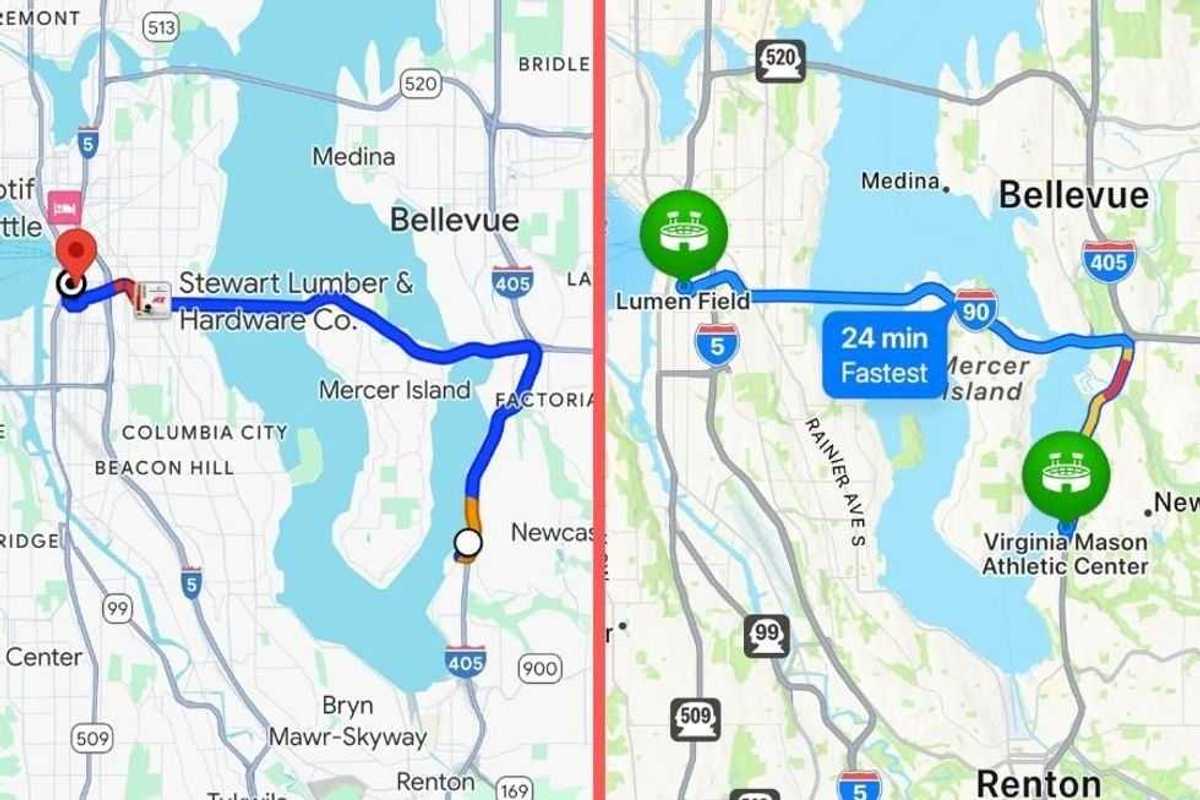
Google maps and Apple maps screenshots
The evolution of human navigation has come so far since the era of global exploration, it's mindblowing. We've gone from hand-drawn maps, to printed road atlases, to MapQuest and GPS systems, to smartphone apps that not only tell us step-by-step how to get from point A to point B, but can also tell us what traffic is like and where to stop for gas and lunch along the way. That is a wild trajectory.
Kids today have no idea, and even those of us who grew up with paper maps struggle to recall how we ever got anywhere before Google Maps. Now we're so deep into the map app era that we're past the "wow" stage and into the nit-picky stage. It's no longer good enough to have a handheld computer tell us how to get someplace in real time. Now we have expectations, preferences, opinions, and complaints. We also have data and anecdotes with which to compare different apps and discuss which ones do what best.
 Which map app is best?Photo credit: Canva
And hoo boy do people have thoughts on that front.
In 2024, former Uber employee Flo Crivello shared some info on X about the analysis they did with three of the most popular map apps—Google Maps, Apple Maps, and Waze—using a dataset from millions of trips.
The big surprise winner? Apple Maps.
Google came in second, and Waze was a distant third (worst "by far").
"The research also included which apps people *thought* was worse, and the order came in the exact opposite order," Crivello shared. "We understood why Apple Maps got a bad rap given how bad it was at launch — it rapidly got better, but the brand stuck. Waze was more of a mystery, and we ended up realizing that people thought its routes were best because it was exposing them to so much info on traffic, construction, police presence etc… Everyone thinks they want a minimalist UI, but in practice, when they see all this info, they subconsciously conclude 'wow, these guys really have their sh*t together' — even when the routes were actually the worst ones."
Crivello said the results "may be shocking," presumably because Apple Maps started with the worst reputation. In fact, Apple CEO Tim Cook famously apologized for Apple Maps in 2012 and recommended people use Google Maps instead.
However, in the years since, Apple Maps has redeemed itself while Google Maps has lost a bit of its initial luster.
Then Waze came along, which people in cities with variable traffic touted as more accurate for timing and real-time updates, becoming some people's favorite. But according to his data eight years ago, Apple was the winner.
Do those results still hold? Some people in the replies said Google Maps was the best, hands down, while others said they preferred Apple or Waze.
It might depend on where you live and what you look for in a map app (and whether you even have access to Apple Maps). Discussions about these apps abound, with some common threads throughout. Many people agree that the U.S. is where Apple Maps shines, but Google Maps works better abroad. Apple Maps offers more natural navigation directions, such as "Not at this stop sign, but at the next one, turn right," instead of Google Maps' assumption that everyone knows how far 300 feet is. Google Maps has great searchability and is easier to check reviews of places compared to Apple Maps. So opinions might vary on "best" depending on what you're using it for.
 We've become pretty finicky about our map apps in the modern age.Photo credit: Canva
Waze has loyal users and people who love to joke about where it reroutes you when there's traffic.
These are not the only three map apps available, either. People who travel internationally and use public transportation seem partial to the CityMapper app, which makes finding train and bus routes simple with a user-friendly interface, so again, a lot depends on why you're using the app in the first place.
As far as popularity goes, Google Maps boasts a whopping 1 billion monthly users. In a recent MarketWatch study, 70% of respondents said they use Google Maps, particularly to avoid speed traps. In that study, both Apple Maps and Waze tied for second place. However, there is data that shows younger generations are partial to iPhones, on which Apple Maps is a native app, so it might have a bit of an advantage there.
And, of course, analyses will differ as the apps make updates and improvements. In 2026, PC Magazine ranked the three big navigation apps and put Google Maps at the top, followed by Apple Maps second, and Waze third.
At the end of the day, as long as you get where you're going, use whatever map app you like best.
This article originally appeared two years ago.

 A Generation Jones teenager poses in her room.Image via Wikmedia Commons
 A Target store at night.via
  An aisle at a Target.via

Person says they're more productive and excited when pretending their life is a TV show
"This is the one time that being delusional actually helped me."
Be the main character in your life.
A lot of the time, life can be boring. There's lots of waiting and wondering, and the mundane every-day chores can demotivate you, making you really feel the drudgery of it all. If only life were as interesting as a TV show. Wouldn't that make a big difference? For one person, doing just that changed their attitude and outlook on life for the better.
On Reddit, a poster shared that once they started treating life as if they were on a television show, they started feeling more excited to participate in the everyday and even began accomplishing more. They start each day with an episode title and end the "episode" by going to sleep. They claimed to be more excited each day to "unfold the cliffhanger I had of yesterday's episode," and would look back on their "season" (week) feeling prouder and "cooler" about their life. "This is the one time that being delusional actually helped me."
Many commenters brought up how this reframing of life and other similar tricks worked out for them, too:
“Honestly, same! Sometimes when I’m stuck, I imagine I’m in a movie and the audience is screaming at the screen and I think, what are they yelling at me to do that’s so obvious to them? Helps with indecision or hard decisions.”
“I did this a lot as a kid. It made life feel exciting for sure.”
"Framing your day as an episode is genius because it turns the boring parts into plot development instead of just stuff you have to get through…My show would be a lot of filler episodes where the main character is on the couch with his dog but honestly those are the best episodes of any series anyway.”
“Sometimes, when I need to really lock in at work. I'll put earbuds in, put on some music, and imagine watching myself work like it's a dramatic montage in a movie. I don’t know why but it helps.”
“I started treating cooking like I was hosting a show.”
“I actually love this. It is a clean trick to beat boredom and procrastination. Giving the day a title and a clean ending makes you act like the main character instead of a background extra. I might steal it.”
“I kinda do this, I try to romanticize my life by saying oh I’m just the main character of my movie. I go through the struggles I’m going through only because it's the climax of the movie, and it’ll resolve eventually.”
This isn't the first time someone stumbled upon this type of mind hack. Licensed therapists who spoke to Upworthy weighed in on the mental reframing and discussed its effectiveness.
- YouTube youtube.com
"In many ways, viewing your life as a T.V. show is just a cognitive reframe, which can be helpful when overcoming hurdles," said therapist Jerred England. "On T.V., we expect the main character to face challenges and then overcome them as they reach their goal. In many ways, that's life, too. We don't watch programs where the main character has a victim mentality, is defeated, and then lies around at home for a week. Having a mindset that expects and overcomes challenges can be truly helpful—after all, life hands us plenty of them!"
"Thinking this way can give someone a nudge out of passivity," said narrative therapist Claudia Johnson. "Rather than waiting to feel motivated, they start living 'as if' their choices matter to a bigger arc. That can foster curiosity, openness to new experiences, and tolerance of short-term discomfort."
"It can also provide some psychic distance," Johnson added. "By thinking of your life as a movie during anxious times, rejection or failure feels like part of a plot rather than evidence against your self-worth."
While both therapists said that this reframing can be helpful, it can become harmful if taken too literally.
"Believing you are the main character can lead to performing life instead of being present in it. You start going through life instead of living it by curating experiences that look meaningful on the surface," said Johnson.
"One of the dangers is that you'll start basing your worth on whether you're excited or productive. Real life isn't a movie—it's full of mundane stretches where you're just maintaining the pace," she explained. "These 'everyday' chapters are vital but never make it into the highlight reel."
"I would caution that in T.V., we like to have drama, enemies, and constant challenges. If you find too much of that in your life, you might stay in a bad situation too long," concluded England. "If your friends tell you that your life is a T.V. show, you might consider changing your work or relationships. After all, most of us wouldn't actually like to live in The Truman Show."