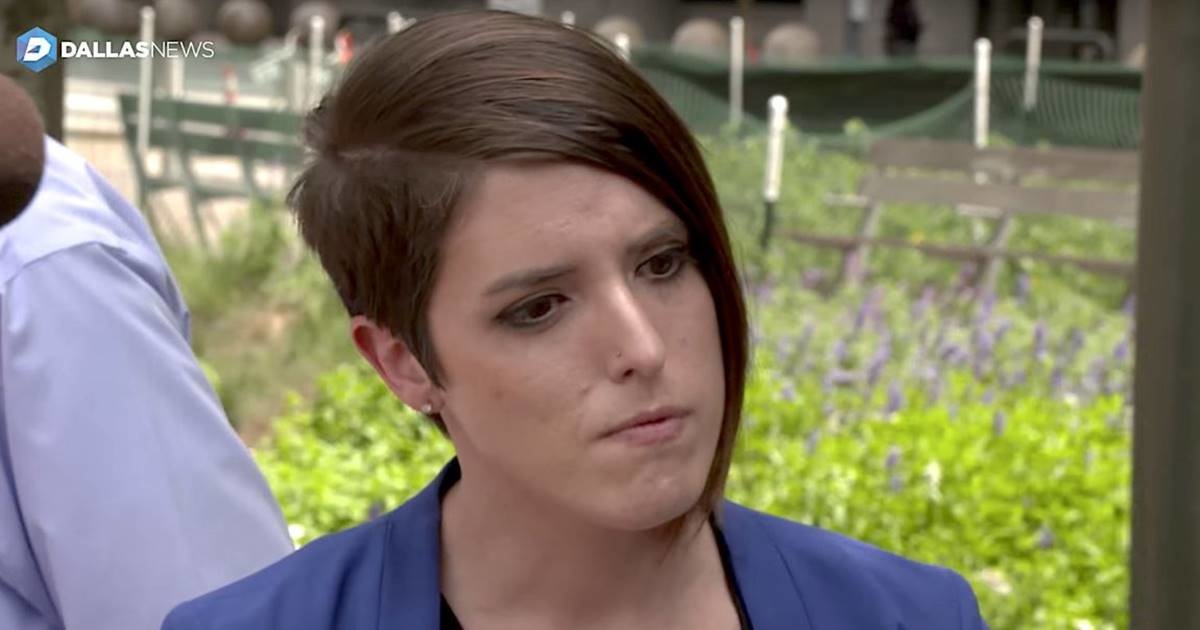
Texas teacher suspended for being openly gay receives a huge payout
via Women in the World / Twitter

In the beginning of the 2017 school year, elementary teacher Stacy Bailey showed a get-to-know-your-teacher slideshow to her new students. Among the slides was a photo of her then-fiancé Julie Vazquez who she described as her "future wife."

A parent of one of her students complained to the Mansfield Independent School District (MISD) in Arlington, Texas, saying that Bailey promoted a "homosexual agenda."

Bailey, 33, is a two-time Teacher of the Year award-winner at Charlotte Anderson Elementary School.


Bailey was suspended after the incident because the district "received complaints from parents about Ms. Bailey discussing her sexual orientation with elementary-aged students."

"When a straight teacher happily announces that she and her husband are expecting a baby to her elementary class, is she saying something inappropriate to very young and impressionable students?" Bailey said in a recent statement.

"Is she announcing her sexual orientation? Is she presenting her life in a way that promotes her political beliefs?" Bailey continued. "Of course not. She's simply sharing facts about her life."

In 2018, Bailey filed a discrimination lawsuit against MISD claiming discrimination and a breach of her constitutional rights. Later that year, a federal judge decided the lawsuit could go ahead.

"If the community's perception is based on nothing more than unsupported assumptions, outdated stereotypes, and animosity, it is necessarily irrational and […] provides no legitimate support for Mansfield ISD's decisions," wrote Judge Sam Lindsay. "The private antipathy of some members of a community cannot validate state discrimination."

Eight months after her suspension, Bailey was reinstated by the district and reassigned to a local high school.

On Tuesday, Bailey's attorney announced they had reached a settlement with the school district.

MISDA agreed to pay Bailey and her attorney $100,000 of which Bailey will donate $10,000 to a charity helping LGBT youth. Her attorney, Jason Smith, has agreed to donate $10,000 from her settlement to the Human Rights Campaign.

"If you are a school district that thinks you can bully a gay teacher out of their job, I hope you remember my name and I hope you think twice," said Bailey during a press conference on Tuesday.

After all of the drama with the school district over her sexuality, Bailey was a little scared to start her new job at the high school, but her fears were quickly assuaged when 15 LGBT students greeted her in her new classroom with baskets and candy.

"I don't think they'd ever seen a teacher out loud say they were gay. To see a grown-up who was successful and educated and not afraid? I don't think they had ever seen that before," Bailey told BuzzFeed News.

"I've seen my classroom turn into a safe space for all kinds of kids who feel marginalized," she continued.

On the first day with her new class, she showed the same exact slideshow presentation, but this time the woman in the picture with her was her wife.


via Amber Jamieson / Twitter

True

When Sue Hoppin was in college, she met the man she was going to marry. "I was attending the University of Denver, and he was at the Air Force Academy," she says. "My dad had also attended the University of Denver and warned me not to date those flyboys from the Springs."

"He didn't say anything about marrying one of them," she says. And so began her life as a military spouse.

The life brings some real advantages, like opportunities to live abroad — her family got to live all around the US, Japan, and Germany — but it also comes with some downsides, like having to put your spouse's career over your own goals.

"Though we choose to marry someone in the military, we had career goals before we got married, and those didn't just disappear."

Career aspirations become more difficult to achieve, and progress comes with lots of starts and stops. After experiencing these unique challenges firsthand, Sue founded an organization to help other military spouses in similar situations.

Sue had gotten a degree in international relations because she wanted to pursue a career in diplomacy, but for fourteen years she wasn't able to make any headway — not until they moved back to the DC area. "Eighteen months later, many rejections later, it became apparent that this was going to be more challenging than I could ever imagine," she says.

Eighteen months is halfway through a typical assignment, and by then, most spouses are looking for their next assignment. "If I couldn't find a job in my own 'hometown' with multiple degrees and a great network, this didn't bode well for other military spouses," she says.

She's not wrong. Military spouses spend most of their lives moving with their partners, which means they're often far from family and other support networks. When they do find a job, they often make less than their civilian counterparts — and they're more likely to experience underemployment or unemployment. In fact, on some deployments, spouses are not even allowed to work.

Before the pandemic, military spouse unemployment was 22%. Since the pandemic, it's expected to rise to 35%.

Sue eventually found a job working at a military-focused nonprofit, and it helped her get the experience she needed to create her own dedicated military spouse program. She wrote a book and started saving up enough money to start the National Military Spouse Network (NMSN), which she founded in 2010 as the first organization of its kind.

"I founded the NMSN to help professional military spouses develop flexible careers they could perform from any location."

"Over the years, the program has expanded to include a free digital magazine, professional development events, drafting annual White Papers and organizing national and local advocacy to address the issues of most concern to the professional military spouse community," she says.

Not only was NMSN's mission important to Sue on a personal level she also saw it as part of something bigger than herself.

"Gone are the days when families can thrive on one salary. Like everyone else, most military families rely on two salaries to make ends meet. If a military spouse wants or needs to work, they should be able to," she says.

"When less than one percent of our population serves in the military," she continues, "we need to be able to not only recruit the best and the brightest but also retain them."

"We lose out as a nation when service members leave the force because their spouse is unable to find employment. We see it as a national security issue."

"The NMSN team has worked tirelessly to jumpstart the discussion and keep the challenges affecting military spouses top of mind. We have elevated the conversation to Congress and the White House," she continues. "I'm so proud of the fact that corporations, the government, and the general public are increasingly interested in the issues affecting military spouses and recognizing the employment roadblocks they unfairly have faced."

"We have collectively made other people care, and in doing so, we elevated the issues of military spouse unemployment to a national and global level," she adds. "In the process, we've also empowered military spouses to advocate for themselves and our community so that military spouse employment issues can continue to remain at the forefront."

Not only has NMSN become a sought-after leader in the military spouse employment space, but Sue has also seen the career she dreamed of materializing for herself. She was recently invited to participate in the public re-launch of Joining Forces, a White House initiative supporting military and veteran families, with First Lady Dr. Jill Biden.

She has also had two of her recommendations for practical solutions introduced into legislation just this year. She was the first in the Air Force community to show leadership the power of social media to reach both their airmen and their military families.

That is why Sue is one of Tory Burch's "Empowered Women" this year. The $5,000 donation will be going to The Madeira School, a school that Sue herself attended when she was in high school because, she says, "the lessons I learned there as a student pretty much set the tone for my personal and professional life. It's so meaningful to know that the donation will go towards making a Madeira education more accessible to those who may not otherwise be able to afford it and providing them with a life-changing opportunity."

Most military children will move one to three times during high school so having a continuous four-year experience at one high school can be an important gift. After traveling for much of her formative years, Sue attended Madeira and found herself "in an environment that fostered confidence and empowerment. As young women, we were expected to have a voice and advocate not just for ourselves, but for those around us."

To learn more about Tory Burch and Upworthy's Empowered Women program visit https://www.toryburch.com/empoweredwomen/. Nominate an inspiring woman in your community today!

True
Microsoft Office

This article originally appeared on 03.19.15


Last Christmas, Alex got exactly what he always wanted: a new "robo" arm.

Sure, it's basically like having a second hand, but it also does something equally important: It totally reflects his personality. How? It's a "Transformers"-themed arm.

Keep Reading Show less