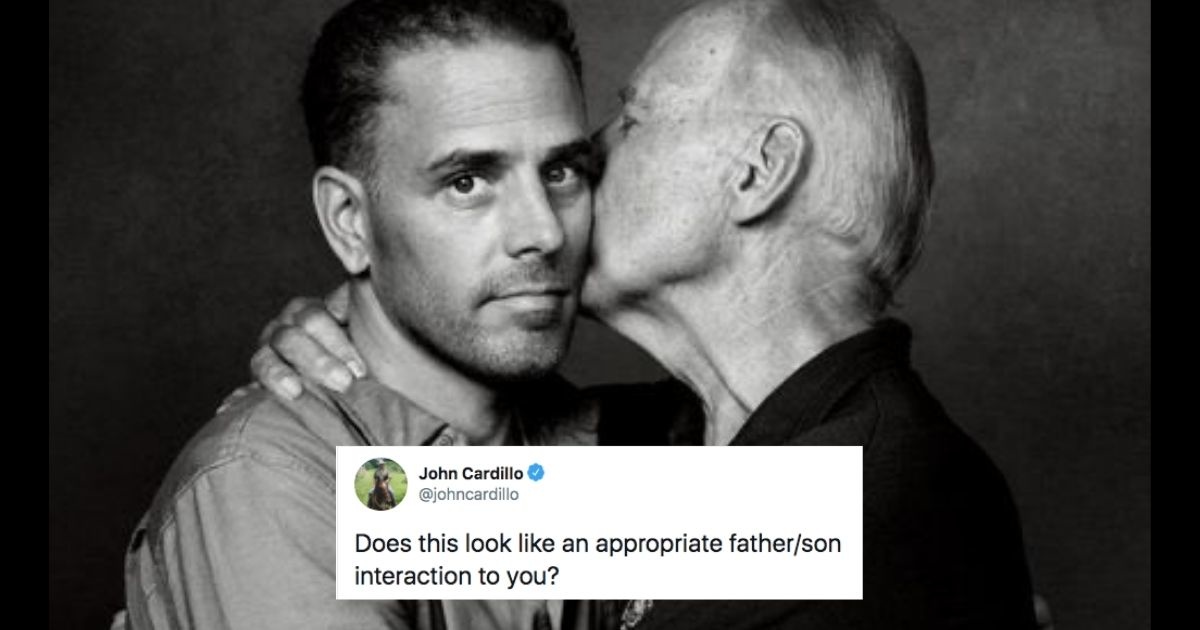
People are debating what ‘appropriate’ fatherly love looks like, and frankly, it’s just sad

A photo of Joe Biden hugging and kissing his only living son, Hunter, is circulating after Newsmax TV host John Cardillo shared it on Twitter with the caption, “Does this look like an appropriate father/son interaction to you?” The question is clearly meant to be a dig at Biden, whose well-documented life in politics includes…

Array
ArrayPhoto credit: John Cardillo/Twitter

A photo of Joe Biden hugging and kissing his only living son, Hunter, is circulating after Newsmax TV host John Cardillo shared it on Twitter with the caption, “Does this look like an appropriate father/son interaction to you?”

The question is clearly meant to be a dig at Biden, whose well-documented life in politics includes many examples of both his deep love for his family and his physical expressions of affection. While his opponents have cherry-picked photos to try to paint him as “creepy,” those who know him well—and who are in some of those viral images—defend Biden’s expressions of affection as those of a close friend and grandfatherly figure. (And in fact, at least one photo of Biden holding and kissing a child’s face was of him and his grandson at his son Beau’s funeral, taken as a still shot from this video.)

Everyone has their own level of comfort with physical space and everyone’s line of what’s appropriate when it comes to physical affection are different, but some accusations of inappropriateness are just…sad. And this photo with this caption is one of those cases.


What people see when they look at this photo says a lot more about them than it does about the father and son in it. And the reactions on Twitter made that point crystal clear.

A therapist weighed in, saying “if anyone looks at this photo and sees anything other than father + son love, I’d recommend therapy until the person knows [the difference between] healthy + unhealthy touching.”

https://www.twitter.com/kimcdickerson/status/1319106109911764992

Some people pointed out that this kind of affection from a father to a son is something the world needs more of, not less.

Others just matter-of-factly said, “Umm, yes.” Like, what is he seeing that he things isn’t appropriate?

https://www.twitter.com/BeerMileRepeats/status/1319192736298201092

Not that it wouldn’t be appropriate if this weren’t the case, but knowing the tragedy this father and son have been through adds greater context to this photo. Biden lost his wife and Hunter lost his mother in a car accident when Hunter was little. And Biden lost a son and Hunter lost his only brother in 2015 when Beau Biden died of brain cancer.

This is a father-son affection that includes a bond that only those who have shared severe loss can know.

https://www.twitter.com/4everNeverTrump/status/1319100425161691138

Many people shared how the photo made them miss their own fathers and wish they could have one more hug or kiss from their dad.


https://www.twitter.com/JamesGunn/status/1319131898791129093


https://www.twitter.com/CarlosEscondido/status/1319091344565030914


https://www.twitter.com/JustSchmeltzer/status/1319096963531505667

In addition to pointing out the hypocrisy of Trump supporters trying to paint Biden as inappropriate when there is no shortage of photos of Trump in eyebrow-raising photos with his kids—including one with Ivanka and Eric as kids standing next to Jeffrey Epstein—some people shared how a lack of fatherly affection might explain how people see Trump.

Several people suggested that Cardillo sees the photo the way he does because he himself has daddy issues.

https://www.twitter.com/TeeBall77/status/1319095428936290306

And in one response, Cardillo almost appeared to confirm it, only denying a small, unrelated part of a tweet suggesting he’d been mistreated by his own father.

The fact that anyone would look a photo of a loving father embracing his son and kissing him on his cheek and think “Ew,” is truly sad.

Unfortunately, we live in a society where men showing affection is viewed negatively by some people, whether due to toxic ideas of masculinity or homophobia or both. We also live in an era of poisonous partisanship that pushes people to view those on the other side of the political spectrum as evil. Combine that with the QAnon conspiracy theorists obsession with pedophilia, and we’ve ended up with one of the nicest and most decent men in politics being smeared with posts like this.

Clearly, some people need more parental love in their lives.

  • People share the one thing that makes them laugh without fail. Here are some of the funniest responses.
    A group of people laughing. Photo credit: Canva

    Arielle Nissenblatt has many questions for her followers on Threads. But one in particular stood out last week, and it led to days of laughter. She asked, quite simply, “Please share exactly one (1) thing that makes you laugh without fail every time.”

    Arielle is a podcast strategist, writer, and founder of the EarBuds Podcast Collective.

    In less than a week, the question inspired more than 8,000 responses. The Arielle was so pleased that she wrote, “Going through this thread as I fall asleep and am crying laughing snorting. What a joy!”

    That’s a lot of funny things. Here are just a handful:

    Funny stories

    User @loreleiarmstrong shared a hilarious story from a woman named Barbara, who went through quite the ordeal with a brilliantly satisfying ending:

    funny, kitchen, fire
    Screenshot

    Flatulence

    More than one Threader mentioned how hilarious they find flatulence. @johnpark quoted writer Emily Heller, who wrote, “If you don’t find farts funny, then you’re a loser because you’re choosing to have less joy in your life but the exact same amount of farts.”

    Another commenter agreed with just one word: “Farts.”

    This, of course, also included texting mishaps involving, you guessed it, farts:

    autocorrect, funny, fart
    Screenshot

    Animals

    The daughter of Martin Scorsese, @francesca.scorsese (and yes, she has a blue checkmark, so it’s likely really her), chimed in with “Funny animal videos.” The OP agreed, adding, “Unlikely animals getting along.”

    Sweetness

    A few people said that simply hearing someone else laugh makes them laugh. @lima_sierra wrote, “Anyone 5 or younger laughing.”

    Another user added that “the rubber duckies on a Jeep’s dashboard” always make them happy.

    Silly conversations

    In one exchange shared by @dolphin_dom, a fun fact quickly goes off the rails:

    funny, blueberries, confusion
    Screenshot

    TV moments

    @catscoffeebookslove recalled the time Tim Conway played a dentist on The Carol Burnett Show:

    @jazaaiekj shared, “Tim Conway talking about the elephant. Cry laughing every single time.”

    @cheesee_lizee shared her favorite moment from Parks and Recreation: “The ‘Get on Your Feet’ music scene from Parks and Rec.”

    Quite a few people mentioned their favorite Saturday Night Live sketches. One in particular kept popping up, featuring Beavis and Butt-Head lookalikes:

    @jodicelesteee wrote that one particular blooper from The Office cracks her up:

    funny, The Office, bloopers
    Screenshot

    Memories

    One Threader reminded fellow Brits about a guy trying to make limoncello during lockdown:

    A reminder of a YouTube video gone wrong.
    Screenshot

    Another fun memory? The man whose kids kept interrupting him during a BBC News interview.

    @jennknapp reminded readers, “The video of the guy on a zoom call and his toddler marches into his home office, followed by a baby in a walker, and then the mom absolutely driving the struggle bus, trying to remove them with her pants half mast. Hilarious. Every. Single. Time.”

    And of course, perhaps the most wonderful moment to come out of a strange time was “lawyer cat.” People from all around the world mentioned the image of a lawyer accidentally using a cat filter during a Zoom hearing. That one is a gift that keeps on giving:

    lawyer, cat, zoom, funny
    Screenshot
  • ‘The one who’s in love always wins’: Ethan Hawke’s poetic advice on unrequited love touches millions
    Image of a sunrise (left) and Ethan Hawke (right).Photo credit: Canva & Raph_PH/Wikipedia

    During a red carpet interview leading up to the 2026 Oscars ceremony, actor Ethan Hawke was asked to speak about unrequited love, as Blue Moon, the film that earned him a Best Supporting Actor nomination, centers heavily on the theme. 

    As Hawke often does, he left viewers stunned and inspired with his thoughtful, poetic answer in a now-viral clip.  

    According to Hawke, one needn’t feel as though they’ve lost anything when romantic feelings aren’t returned, because the act of feeling itself is the true gift of being alive.

    @ameliadimz

    The one who’s in love always wins !!

    ♬ original sound – ameliadimz

    Hawke’s thoughts on unrequited love

    “The one who’s in love always wins,” the Dead Poets Society star explained. “It doesn’t matter if you get your heart broken; you’re living. When you’re feeling, you’re alive.”

    He added, “The sun doesn’t care whether the grass appreciates its rays, right? It just keeps on shining. That’s you.”

    And to top it all off, when the interviewer, Amelia Dimoldenberg, said “I love you” in response to Hawke’s inspiring words, the actor didn’t skip a beat, replying, “I love you too,” with genuine affection.

    Reactions

    The message, now seen more than 13 million times, left many marveling at how Hawke was able to deliver such “insanely beautiful” and “absolutely brilliant” words off the cuff.

    “That was just off the dome??”

    “​​He freestyled that???? no script, nothing…. such heavenly Shakespearean poetic words off the top of his head?? Wow.”

    “This man is always spitting pure poetry.”

    “Ethan Hawke is my fave modern philosopher.”

    Others couldn’t help but share that it instantly changed their mindset for the better.

    “This switched something in my brain like a full factory reset.”

    “It’s the most profound thing I’ve literally ever heard.”

    ethan hawke, love, relationships
    Two hands exchanging a paper heart Photo credit: Canva

    It’s not hard to see why the clip resonated so deeply

    Unrequited love is often framed in pop culture as something embarrassing or tragic. But here, Hawke reframed it as something beautiful and life-affirming. Loving someone, even without those feelings being reciprocated, becomes proof of openness, courage, and emotional vitality. Not a failure.

    That perspective can feel especially radical, since we are often taught to measure success by what we receive in return, whether through affection, validation, or monetary gain. But Hawke’s words gently push against that idea, suggesting that the experience of loving itself holds inherent value, regardless of the result. His take echoes a quote by C.S. Lewis that many referenced in the comments: “Love is never wasted, for its value is not based on reciprocity.”

    Moments like this are part of why Hawke has built a reputation not just as an actor, but as a thoughtful observer of the human experience. Whether through interviews, writing, or performances, he often taps into something both deeply personal and universally relatable.

    If the reaction online is any indication, this brief red carpet exchange did more than promote a film. It offered millions of viewers a small but meaningful shift in perspective, reminding them that feeling deeply is not a weakness, but a sign of being fully alive. And isn’t that, in a way, the point of it all?

  • NY superintendent flies to Guatemala to give diploma to graduate detained by ICE
    An airplane and a graduate. Photo credit: Canva
    ,

    NY superintendent flies to Guatemala to give diploma to graduate detained by ICE

    The student, who self-deported, was supposed to graduate in May.

    Roosevelt Schools Superintendent Dr. Shawn Wightman set out on an unusual journey to give his student, Alvaro Castro Velasquez, the graduation he earned.

    The senior was looking forward to walking across the stage with his friends at Roosevelt High School this May. But just weeks before graduation, Immigration and Customs Enforcement (ICE) detained him during a random encounter. Soon after, ICE transferred Castro Velasquez to a facility in Texas. When school officials found out, it sparked a response that brought the immigration crackdown right to their doorstep.

    immigration, ICE, graduation, deported, NY Superintendent
    Students in their caps and gowns. Photo credit: Canva

    “He wasn’t a hardened criminal or anything like that. Didn’t have any type of record. That was the moment everybody realized that this is a real thing,” Wightman told ABC 7 New York.

    Wightman didn’t give up on the senior. The superintendent boarded a flight to Texas with his regalia and Castro Velasquez’s diploma in hand. It was then that he realized the task wouldn’t be so simple. He was denied a meeting with the student who had reportedly come to the United States alone when he was 16. The flight, paid for out of his own pocket, turned out to be an expensive dead end.

    immigration, ICE, graduation, deported, NY Superintendent
    A man on a plane. Photo credit: Canva

    “It’s very difficult as a superintendent, a father, to think about if something like that were to have happened to any of my kids,” Wightman told ABC 7 New York.

    But where a seed of determination is planted, setbacks can sometimes act as water, leading to a bloom. After Wightman’s unsuccessful attempt to deliver the teen his diploma, Castro Velasquez opted for self-deportation to Guatemala. Navigating the immigration system alone as a teen is likely overwhelming, which may have contributed to the senior’s decision to leave.

    Wightman, however, became more determined than ever to ensure the teen received the diploma he earned. The educator took two flights and drove five and a half hours through the foothills of Guatemala to reach his former student. The pair reunited after Wightman’s long journey to the Central American country.

    The unwavering superintendent didn’t just arrive with a diploma in hand. He brought his own graduation robe and hood, along with the student’s cap and gown. In doing so, Wightman brought the graduation ceremony to Castro Velasquez.

    immigration, ICE, graduation, deported, NY Superintendent
    An airplane. Photo credit: Canva

    “This is amazing for me. He helped me. And he supported me, for all this time,” Castro Velasquez told ABC 7 New York. “I’m not feeling I’m alone. I know I have him and my family.”

    The TV station shared the video on Instagram, and people can’t get over the lengths the superintendent went to to mark the special occasion for his student.

    One person said, “Thank you sir, for demonstrating humanity.”

    Another wrote, “On his own dime. He should sleep peacefully at night knowing he did something extraordinarily kind!!”

    Someone else shared, “My heart is so moved by the sheer humanity and compassion of this man. He is a true educator! I pray that this young man will be inspired to keep fighting for his dreams. I pray that he be protected so that one day he can pay it forward.”

    For those wondering why he went to such lengths at his own expense, Wightman’s answer is simple: “You don’t abandon people who you care about.”

  • Why those epic ’80s wooden playgrounds suddenly disappeared
    Phil Edwards explains the history of wooden playgrounds.Photo credit: @phildedwardsinc/Instagram (used with permission)
    ,

    Why those epic ’80s wooden playgrounds suddenly disappeared

    Why did we trade those wooden beauties for brightly colored plastic?

    If you grew up in the ’80s or ’90s, you’re likely all too familiar with those all-wooden, castle-like playgrounds complete with drawbridges, child-sized tunnels, rope mazes, PVC pipe “walkie-talkies,” cool hideaway spaces, airport towers, and tire walls.

    They were the perfect place to let your imagination run wild, whether you pretended to be knights, wizards, Vikings, or simply played freeze tag without ever touching the ground.

    Nowadays, those castles are like a modern-day fairy tale: no longer made, rarely seen, and mostly remembered as relics of a bygone era. What happened?

    History of wooden playgrounds

    As a fun Instagram video by content creator Phil Edwards explains, part of what made wooden playgrounds special was that children had a major role in how they were created.

    According to Edwards, Robert “Bob” Leathers, founder of Leathers and Associates, and his partner, Tom Rockwell, consulted children during the design process. Those playgrounds were then built by volunteer community members, such as parents, in a matter of days.

    Personal memories

    Interestingly, quite a few viewers shared personal memories of helping design their wooden playgrounds as children.

    “My parents helped built the one for my elementary school…it was pure magic.”

    “I participated as a child, and I clearly remember standing up as a kindergartener and saying, what if a slide came out of a dragon’s mouth. Years later, playing in the Orange CT playground, I realized the slide came out of a dragon’s mouth, rendered in wood. I almost didn’t believe my earlier memory. Could that wild idea from the mouth of a kindergartner have become a major feature of an actual playground?? What an amazing program. ❤️”

    Castle Parks?
    by u/Comfortable_Weight82 in grandrapids

    “I remember being at planning meeting at the Waverly community house. I remember my dad building. I remember sanding wood. And I have so many memories of playing on this playground for hours a day while my mom taught dance…It was the greatest sense of community.”

    “​​Our very small southern NJ town had one of these – Pine Cone Zone. I still remember the planning team coming to our school. We all submitted our ideas and designs. They also had a naming contest. People could donate money and their names would be engraved on the fence posts. Still remember spending the day at the rec fields while our parents built it. Was such a big deal for our little community ❤️”

    Why they stopped making wooden playgrounds

    Unfortunately, a study in the early 2000s found that the type of wood used in these structures contained arsenic, and that children who played on them had significantly higher levels of the toxin on their skin. The findings raised concerns about the structures’ overall safety, and major playground manufacturers eventually stopped using this type of wood in favor of other materials.

    And while this didn’t seem to influence their decline, several folks recalled the wooden playgrounds as having merciless splinters.

    “The splinters were ruthless,” quipped one commenter. 

    Still, there weren’t any documented cases of “anything going wrong from these playgrounds,” Edwards noted. That’s why they weren’t forcibly torn down, and why you might still find some of the 1,600 that were built scattered across the country.

    While their reign has ended, wooden playgrounds leave behind a wonderful legacy. As Edwards put it, they were built “by parents who wanted to share their love with their children” and make something “amazing.” Imagine what could be possible if there were more opportunities for that kind of thing.

  • 101-year-old woman answers kids’ questions about the old days in this delightful clip
    An elderly woman walks on the beach. Another older woman holds a child.Photo credit: Canva

    In a compilation that has resurfaced and gone viral (yet again) on social media, a 101-year-old woman named Alice is seen meeting a gaggle of young children, all eager to see the world through the lens of her long life.

    The group is called HiHo Kids, and they’re part of an online content platform that features children learning and playing. Their Facebook page emphasizes the importance of embracing youth: “Every kid – including the one inside each of us – needs imagination and curiosity about the world. HiHo promotes empathy through play.”

    No question is too big, too silly, or too small for Alice. The young tikes are, as children tend to be, truly earnest, and Alice seems happy to share what her life has been like for more than a century. In a montage, various children sit across from her. One asks, “What are we here to talk about?” Alice answers with honesty and humor: “Well, I think it might be how old I am.”

    This is, of course, followed by the question, “How old are you?” Alice replies, “I’m in my 101st year.”

    After a brief discussion about where Alice grew up, a boy named Micah asks about life back in the old days. Alice answers, “We didn’t have radio. No television. We didn’t have telephones when I was a little girl. There were not any trucks. They had wagons, and horses pulled them.”

    What was the world like?

    One young girl asked whether the world was in such turmoil. “Back then, did you see any wars?” Alice maintained her honest approach. “I did, and I was in a war. I was in the Second World War. We worked on decoding and encoding machines. Very secret work. The officers had guns, and they said if you told any of the secrets, they would shoot you dead.”

    Micah looks a bit nervous, so Alice reassures him. “But nobody got shot.” He seems relieved. “Good,” he says, smiling and nodding.

    To lighten things up a bit, a young girl asks, “What did you do for fun?” Alice fondly recalls, “I had dolls and blocks. But I really liked ‘boys’ things.’ Marbles and tops. And I thought boys were much luckier than girls. We had to wear skirts and stockings, even in the coldest weather.”

    Clara questions this: “Girls couldn’t wear pants?” Alice affirms, “That’s right.” Clara concludes that it’s simply not fair.

    Favorite insect

    Though Alice is now retired, she lights up when talking about her past work as a biology professor. “If you look at my shirt, you’ll see some of the things I taught about.” She points to a few insect brooches on her pale blue button-down, including a spider. When asked about her favorite insect, Alice doesn’t hesitate: “Ants. I did research on ants.”

    Clara could talk about ants all day. She explains that although they’re tiny, they’re incredibly strong. “They can carry something big, like a banana. Even three of them can, even though they’re this tiny.” Alice is impressed by her knowledge. “You’re very good—and you’re only six years old!”

    Micah asks what Alice likes to do for fun. “Well, right now I’m watching the Olympics. I write books, and I do puzzles. I enjoy email. I write to a lot of my friends. I even play Scrabble. Also, I try to get exercise every day.”

    She tells the kids she’s grateful to still have a working mind and body. “Some old people aren’t very well anymore. Some of them can’t remember things. Some of them have to have somebody help them. But I can do everything myself.” Micah exclaims, “That’s good! That means you’re really old, but you’re really good at it.”

    The rest of the conversation is quite moving. Alice is asked what the hardest part of getting older is. “You miss people. And especially when you live over 100 years. Most of the people I ever knew, and in my family, are dead.”

    Not afraid of dying

    This leads to a beautiful question: “Are you afraid of dying?” Alice is most certainly not. “No, I’m not afraid of dying. I feel very healthy and happy. My doctor said, ‘Maybe you’ll just die in your sleep.’ So I’m not afraid, because I have a good life.”

    Finally, quite possibly the most important question of the session: “What is the secret to living a long life?” Alice answers, “Being happy, working hard, getting exercise, doing things for yourself, not expecting other people to do everything for you. Those things help you live a long time.”

    The comments under the Facebook reel, where this was also posted, are full of praise.

    One commenter wrote, “As a geriatric nurse, Alice’s brain is freaking amazing for 101. Shoot, it’s amazing for most of my 70-80 year olds. Amazing.”

    Another agreed with Alice’s life: “She was a freaking decoder! These kids don’t even know the titan they’re sitting across from them. This is so cool!”

    And of course, people loved Alice’s interactions with the sweet children. “You can tell she loves to teach,” a commenter wrote. “She’s absolutely magical with the children. What a gift to introduce these kids to Alice.”

  • Why didn’t people smile in old-timey photographs? Smiling meant something different back then.
    Photos of a man and woman from the 1800sPhoto credit: Public Domain

    If you’ve ever perused photographs from the 19th and early 20th century, you’ve likely noticed how serious everyone looked. If there’s a hint of a smile at all, it’s oh-so-slight. But more often than not, our ancestors looked like they were sitting for a sepia-toned mug shot or being held for ransom or something. Why didn’t people smile in photographs? Was life just so hard back then that nobody smiled? Were dour, sour expressions just the norm?

    Most often, people’s serious faces in old photographs are blamed on the long exposure time of early cameras, and that’s true. Taking a photo was not an instant event like it is now; people had to sit still for many minutes in the 1800s to have their photo taken.

    Ever try holding a smile for only one full minute? It’s surprisingly difficult and very quickly becomes unnatural. A smile is a quick reaction, not a constant state of expression. Even people we think of as “smiley” aren’t toting around full-toothed smiles for minutes on end. When you had to be still for several minutes to get your photo taken, there was just no way you were going to hold a smile for that long.

    But there are other reasons besides long exposure times that people didn’t smile in early photographs.

    mona lisa, leonardo da vinci, classic paintings, famous smiles, art
    Mona LisaPhoto credit: Public domain

    The non-smiling precedent had already been set by centuries of painted portraits

    The long exposure times for early photos may have contributed to serious facial expressions, but so did the painted portraits that came before them. Look at all of the portraits of famous people throughout history prior to cameras. Sitting to be painted took hours, so smiling was out of the question. Other than the smallest of lip curls like the Mona Lisa, people didn’t smile for painted portraits, so why would people suddenly think it normal to flash their pearly whites (which were not at all pearly white back then) for a photographed one? It simply wasn’t how it was done.

    A smirk? Sometimes. A full-on smile? Practically never.

    old photos, black and white photos, 1800s photos, no-smile photos, no smiles in photo
    Algerian immigrant to the United States. Photographed on Ellis Island. Photo credit: Augustus F. Sherman via William Williams/Wikimedia Commons

    Smiling usually indicated that you were a fool or a drunkard

    Our perceptions of smiling have changed dramatically since the 1800s. In explaining why smiling was considered taboo in portraits and early photos, art historian Nicholas Jeeves wrote in Public Domain Review:

    “Smiling also has a large number of discrete cultural and historical significances, few of them in line with our modern perceptions of it being a physical signal of warmth, enjoyment, or indeed of happiness. By the 17th century in Europe it was a well-established fact that the only people who smiled broadly, in life and in art, were the poor, the lewd, the drunk, the innocent, and the entertainment […] Showing the teeth was for the upper classes a more-or-less formal breach of etiquette.”

    drunks, classic painting, owls, malle babbe, paintings
    "Malle Babbe" by Frans HalsPhoto credit: Frans Hals via Public domain

    In other words, to the Western sensibility, smiling was seen as undignified. If a painter did put a smile on the subject of a portrait, it was a notable departure from the norm, a deliberate stylistic choice that conveyed something about the artist or the subject.

    Smiling simply didn’t work well in old portraits

    Even the artists who attempted it had less-than-ideal results. It turns out that smiling is such a lively, fleeting expression that the artistically static nature of painted portraits didn’t lend itself well to showcasing it. Paintings that did have subjects smiling made them look weird or disturbing or drunk. Simply put, painting a genuine, natural smile didn’t work well in portraits of old.

    As a result, the perception that smiling was an indication of lewdness or impropriety stuck for quite a while, even after Kodak created snapshot cameras that didn’t have the long exposure time problem. Even happy occasions had people nary a hint of joy in the photographs that documented them.

    Another reason why people didn’t smile in old photos is that dental hygiene wasn’t the same as it is today, and people may have been self-conscious about their teeth. “People had lousy teeth, if they had teeth at all, which militated against opening your mouth in social settings,” Angus Trumble, the director of the National Portrait Gallery in Canberra, Australia, and author of A Brief History of the Smile, said, according to Time.

    old photos, black and white photos, 1800s photos, no-smile photos, no smiles in photo
    Even wedding party photos didn’t appear to be joyful occasions. Photo credit: Wikimedia Commons

    Then along came movies, which may have changed the whole picture

    So how did we end up coming around to grinning ear to ear for photos? Interestingly enough, it may have been the advent of motion pictures that pushed us towards smiling being the norm.

    Photos could have captured people’s natural smiles earlier—we had the technology for taking instant photos—but culturally, smiling wasn’t widely favored for photos until the 1920s. One theory about that timing is that the explosion of movies enabled us to see emotions of all kinds playing out on screen, documenting the fleeting expressions that portraits had failed to capture. Culturally, it became normalized to capture, display and see all kinds of emotions on people’s faces. As we got more used to that, photo portraits began portraying people in a range of expression rather than trying to create a neutral image of a person’s face.

    Changing our own perceptions of old photo portraits to view them as neutral rather than grumpy or serious can help us remember that people back then were not a bunch of sourpusses, but people who experienced as wide a range of emotion as we do, including joy and mirth. Unfortunately, we just rarely get to see them in that state before the 1920s.

    This article originally appeared last year.

  • ‘You better than that’: Door camera shows woman stopping package thief with tough love
    A Black woman (left) and packages on a stoop (right).Photo credit: Canva
    ,

    ‘You better than that’: Door camera shows woman stopping package thief with tough love

    She turned a tense moment into an unforgettable display of empathy.

    In a moment when most people might respond with anger and discipline, one Philadelphia woman chose instead to lead with compassion.

    On March 6, Bernadette Williams noticed a stranger across the street near a neighbor’s porch. As seen on Williams’ doorbell camera, a woman with a partial face covering appeared to reach for a delivered package. It was the kind of scene that immediately raises alarm, and Williams responded without hesitation.

    ‘What are you doing? Put that back! Put that back!’

    The woman quickly dropped the package. For a brief moment, the situation hung in the balance. It could have turned into a confrontation, a threat, or a call to the police. But then Williams made a choice that shifted the entire tone of the encounter.

    “I said, ‘She’s in trouble. How can I make a bad situation better?’ You have to be a part of the solution,” she later told WPVI

    Rather than continuing to call out the woman, Williams began speaking to her in a completely different way. As her voice softened, her message changed from warning to encouragement.

    “You better than that. Get some help. I love you. God loves you,” she told the woman.

    Then came the offer that has stayed with so many people who have heard the story. Reaching into her pocket, Williams told the stranger, “I’ll give you some money. Here’s $7, here’s $7.” It was all she had, and she gave it up willingly. 

    package thief, kindness, Philadelphia
    Close-up of hands offering money. Photo credit: Canva

    The exchange was brief, but its impact was clear

    As WPVI reported, the woman apologized and thanked her before leaving. Williams said she could see something had shifted in her expression.

    “Her eyes of ‘I’m sorry.’ That was in her heart, and that’s what I read. I hope that she will be fine, and I have faith that she will be fine.”

    For Williams, the decision was not about ignoring wrongdoing, but about recognizing what might be underneath it. Instead of seeing a thief, she saw someone who might be struggling.

    “She started realizing ‘I am somebody,’” Williams said. “She started realizing that ‘There is somebody out here that cares.’”

    package thief, kindness, Philadelphia
    A close-up of eyes. Photo credit: Canva

    That perspective comes from years of living in the same neighborhood and feeling connected to the people in it. Williams believes that communities are shaped by how people choose to respond to one another, especially in difficult moments.

    “We are a part of this community, and we can make our community better,” she told WPVI.

    The big takeaway

    There’s a common assumption that accountability must come with harshness. This story shows that it doesn’t always have to. The would-be thief is held accountable while maintaining everyone’s dignity, making a different choice in the future far more likely.

    While it’s impossible to know what happens next for the woman in the video, what remains is the example Williams set by actively choosing humanity when most would not.

Travel

United’s new ‘Relax Row’ will allow coach passengers to stretch out and sleep with their families

Wholesome

NY superintendent flies to Guatemala to give diploma to graduate detained by ICE

Family

Father and son to cycle 9,600 miles to visit all 30 MLB parks and raise $1M for a children’s hospital

Family

Dad remakes AC/DC’s ‘Thunderstruck’ using only a year’s worth of baby’s recorded sounds