upworthy
Add Upworthy to your Google News feed.
Google News Button
Culture

Patton Oswalt fans were upset he performed with Dave Chappelle. His response? Perfection.

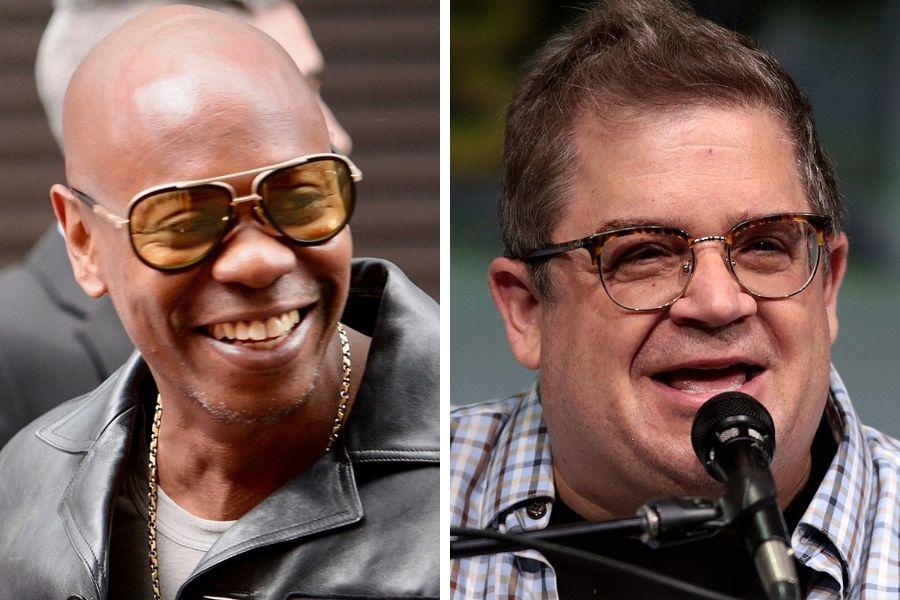
Dave Chappelle, Patton Oswalt

Dave Chappelle and Patton Oswalt have been friends for 34 years.

The first two decades of the 21st century have been a reckoning of sorts for humanity. Technology has shrunk our global community and broadened our connections with one another, forcing us to grapple with how prejudice, inequality and oppression of all kinds have influenced us all.

Some of that has been great. Some of it not so much. Social media has proven to be a double-edged sword, expanding our exposure to diversity on the one hand, and limiting our ability to have nuanced conversations on the other. Platforms such as Twitter allow people to make clear, concise statements about where they stand, which can be good and necessary at times. They also create an environment where a stance that doesn't fit neatly into 240 characters is ostracized as being wishy-washy at best and highly problematic at worst.

All of this combined has resulted in a weird paradox of people pushing for complex social discourse while also insisting on removing all complexity from that discourse.


Case in point: Patton Oswalt's last two Instagram posts about Dave Chappelle.

The comedian shared a series of photos with Dave Chappelle in Seattle on New Year's Eve. Oswalt had been performing in downtown Seattle when he got a text from Chappelle to come join him at his show just a block away.

Oswalt wrote:

"Finished me set at @mccawhall and got a text from @davechappelle. Come over to the arena he’s performing in next door and do a guest set. Why not? I waved good-bye to this hell-year with a genius I started comedy with 34 years ago. He works an arena like he’s talking to one person and charming their skin off. Anyway, I ended the year with a real friend and a deep laugh. Can’t ask for much more."

Chappelle has long been known for pushing the social envelope with his comedy and has created some controversy for himself, especially with his recent Netflix special in which he tackled the issue of transgender rights in a way that felt harmful to many trans people and allies. (Full disclosure: I have not watched his special myself, so I am only sharing the reactions I have seen to it, not commenting on the content itself.) Some people accused Chappelle of being anti-trans, others accused him of "punching down," while others were more offended by how old and tired his LGBTQ-oriented jokes were than by the jokes themselves.

Patton Oswalt has been an outspoken ally of the LGBTQ community, so seeing him celebrate sharing the stage with Chappelle was jarring for some fans. They made their feelings known, which prompted this response from Oswalt:

"I saw a friend I hadn’t seen in a long time this New Year’s Eve. We’ve known each other since we’re teens. He’s a fellow comedian, the funniest I’ve ever met. I wanted to post a pic & an IG story about it — so I did. The friend is Dave Chappelle. Thirty four YEARS we’ve been friends. He’s refocused and refined ideas a lot of us took as settled about race & history & Life On Planet Earth and spun them around with a phrase or punchline. We’ve done bad & good gigs, open mikes & TV tapings. But we also 100% disagree about transgender rights & representation. I support trans peoples’ rights — ANYONE’S rights — to live safely in the world as their fullest selves. For all the things he’s helped ME evolve on, I’ll always disagree with where he stands NOW on transgender issues. But I also don’t believe a seeker like him is done evolving, learning. You know someone that long, see the struggles and changes, it’s impossible to cut them off. Impossible not to be hopeful and open and cheer them on. Also, I’ve been carrying a LOT of guilt about friends I’ve cut off, who had views with which I couldn’t agree, or changed in ways I couldn’t live with. Sometimes I wonder — did I and others cutting them off make them dig their heels in deeper, fuel their ignorance with a nitro-boost of resentment and spite? I’m an LGBTQ ally. I’m a loyal friend. There’s friction in those traits that I need to reconcile myself, and not let cause feels of betrayal in ANYONE else. And I’m sorry, truly sorry, that I didn’t consider the hurt this would cause. Or the DEPTH of that hurt. I’ve been messaging a lot on IG today, and the back and forth has really helped guide me in the writing of this. I (naively) deleted a lot of posts in the comment thread — critical ones from LGBTQ writers AND shit-posts by TERF/anti-trans orcs looking for clicks & giggles. I wanted a 'nice comment thread' about the pic with my friend. Ugh. So easy to think someone ELSE needs growth and miss the need in yourself. Gonna keep trying."

Right here is where I, as a writer, feel the need to choose my words carefully. That's fine—I'm a firm believer that people should choose their words carefully. However, I'm also fully aware that no matter what I say from this point on, some people in the comments are going to complain. That's why I wanted to share Patton Oswalt's posts and write this article—because while so many people have a desperate desire to remove complexity and nuance from our discourse, I have a desperate desire to insert it.

Here's my TL;DR stance on that topic: Relationships are complicated. Perspectives are complicated. Practically nothing in this world is black-and-white, and if we refuse to acknowledge that seemingly conflicting things can be true at the same time, we will never be able to work through the things that divide us.

I'm not here to defend Dave Chappelle, nor am I here to defend Patton Oswalt. I'm here to defend the idea that people who consider themselves friends can have wildly different beliefs, can disagree vehemently with one another on really important issues, can debate and fight over such things and still see value in one another and in their relationship. Everyone makes different choices about what and who they support, as well as why and how, but those choices are rarely as simple as some make them out to be.

Let's say someone decides, "I flat-out refuse to be friends with someone with racist/sexist/anti-LGBTQ views." Great, so where do you draw the line? Because the vast majority of people have shades of those views, even those who purport not to, simply by living in and being groomed by the world we were born into. If you cut out all people with any hint of those views, you're basically cutting out most of humanity.

"Well, we can be friends as long as they are educating themselves and making an effort," one might say. Great, so how do you assess that? What criteria do you use? What if they aren't learning what you want them to or at a pace you deem acceptable? How do you measure those things? And even if you do decide that someone is too problematic for you to associate with, what is your purpose in cutting them off? Is it to change their mind? (Unlikely.) Is it to punish? (Understandable impulse, but is that actually solving the problem?) Is it to reduce harm? (If the person is causing you harm, disassociation makes sense. If the person is causing other people harm, is your disassociation going to stop that harm? Could you do more good in the world by maintaining the friendship?)

This is where nuance and complexity come in. The answers to all of those questions are going to be different for every single person and every single relationship, and that's okay. Some people don't even feel the need to ask and answer those questions because they view the nature and purpose of relationships differently, and that's okay, too.

I'm not saying we should tolerate or befriend Nazis; what I'm saying is that there's an ocean of gray between befriending Nazis and piling onto or disassociating with anyone who hasn't reached a perfect stage of social enlightenment. While we all can decide where on that spectrum we want to be, we cannot—and should not—decide that for anyone else. Every person is different, every relationship is unique and I don't think any one of us should be in the business of judging who should be friends with whom.

We need fewer black-and-white hot takes and more acknowledgment that living with other human beings in this world is complicated. Oswalt's post was the response of a complex human with complex relationships who is trying to navigate a world that doesn't embrace complexity. Perhaps it's imperfect, but really, when did we start to demand perfection from people?

Call out harm when it happens, absolutely, but let's move away from the idea that one person's problematic words or behavior mean that everyone associated with that person must be called to account for their sins. There's just no way that ends well for anyone, and it definitely won't get us anywhere near where we want to be.

ideas, homelessness, prodigy, social work, solutions
Photo credit: @ribalzebian on Instagram

Ribal Zebian is going to test a house he designed by living in it for a year.

Ribal Zebian, a student from the city of London in Ontario, Canada, already made headlines last year when he built an electric car out of wood and earned a $120,000 scholarship from it. Now, he's in the news again for something a little different. Concerned with homelessness in his hometown, Zebian got to work creating a different kind of affordable housing made from fiberglass material. In fact, he’s so confident in his idea that the 18-year-old plans on living in it for a year to test it out himself.

Currently an engineering student at Western University, Zebian was concerned by both the rising population of the unhoused in his community and the rising cost of housing overall. With that in mind, he conjured up a blueprint for a modular home that would help address both problems.


Zebian’s version of a modular home would be made of fiberglass panels and thermoplastic polyethylene terephthalate (PET) foam. He chose those materials because he believes they can make a sturdy dwelling in a short amount of time—specifically in just a single day.

“With fiberglass you can make extravagant molds, and you can replicate those,” Zebian told CTV News. “It can be duplicated. And for our roofing system, we’re not using the traditional truss method. We’re using actually an insulated core PET foam that supports the structure and structural integrity of the roof.”

Zebian also believes these homes don’t have to be purely utilitarian—they can also offer attractive design and customizable features to make them personal and appealing.

“Essentially, what I’m trying to do is bring a home to the public that could be built in one day, is affordable, and still carries some architecturally striking features,” he said to the London Free Press. “We don’t want to be bringing a house to Canadians that is just boxy and that not much thought was put into it.”

Beginning in May 2026, Zebian is putting his modular home prototype to the test by living inside of a unit for a full year with the hope of working out any and all kinks before approaching manufacturers.

“We want to see if we can make it through all four seasons- summer, winter, spring, and fall,” said Zebian. “But that’s not the only thing. When you live in something that long and use it, you can notice every single mistake and error, and you can optimize for the best experience.”

While Zebian knows that his modular homes aren't a long-term solution to either the homeless or housing crisis, he believes they could provide an inexpensive option to help people get the shelter they need until certain policies are reformed so the unhoused can find affordable permanent dwellings.

@hard.knock.gospel

What to buy for the homeless at the grocery store. 🛒 Most people get it wrong. After being there myself, these are the survival items that actually matter 💯 The 2nd to last one is about more than survival—it’s about DIGNITY. We are all one circumstance away from the same shoes 🙏 SAVE this for your next grocery run. 📌 IG@hardknockgospel Substack@ Outsiders_Anonymous #homelessness #helpingothers #kindness #payitforward #learnontiktok

Zebian’s proposal and experiment definitely inspires others to try to help, too. If you wish to lend a hand to the unhoused community in your area in the United States, but don’t know where to look, you can find a homeless shelter or charity near you through here. Whether it’s through volunteering or through a donation, you can help make a difference.

communication, public speaking, speaking skills, speaker, presentation

Analyzing a recording of yourself in three steps can help you be a better speaker.

Public speaking often tops people's lists of biggest fears, probably because they imagine it means giving a speech on stage in front of thousands of people. While it can mean that, public speaking can also mean giving a presentation in front of your coworkers, sharing your thoughts and opinions in a meeting, or even just telling a story to a small group of people. Public speaking is just communicating to an audience, and it's something most of us do more often than we might think.

It's also a skill we can improve, as communication expert Vinh Giang helps people do. Someone asked Giang what three tips he would give to become a "brilliant" public speaker, and he responded with super-specific advice.


"One of the most powerful things you can do is a process called 'record and review,'" he said in a YouTube video. "Simply record a 5-minute video of yourself. And you need to speak improvised. Don't look at it straightaway; you are too damn self-critical."

It's not the video itself, but how you review it the next day, that really matters.

- YouTube www.youtube.com

Giang says you should review the video in three stages, each focused on a different element of speaking:

Step 1: Analyze how you sound

Turn the volume up, press play, then set your phone face down so you don't see yourself. "Just listen," Giang said. "Audit the auditory component of your voice, known as your 'vocal image.' What do you like about it? What don't you like about it?"

Step 2: Analyze how you look

Now do the opposite. Turn the volume all the way down, press play, and watch the video. "Just look at yourself," said Giang. "How's your body language? What are your facial expressions like? Do a visual audit of your visual image."

Step 3: Analyze what you say

Lastly, transcribe your video. Make sure you leave in all of the fillers like "um" and "uh" and "like." "Bring all your non-words and filler words to the forefront of your mind," Giang said. "That's robbing you of clarity every time you talk."

communication, public speaking, speaking skills, speaker, presentation Most of us can improve our speaking skills.Photo credit: Canva

Doing those three things allows you to see the specific places where your speaking skills have room for improvement. "You basically have a mirror in front of you," said Giang. Part of what makes it hard to improve as a speaker is that we can't see ourselves doing it, and we're so inside our own heads when we speak that we have trouble even hearing ourselves. In less than one minute, Giang offered an actionable, step-by-step way to overcome those problems.

According to comments on the video, people appreciated his clear, concise advice:

"Really good advice. At root he's talking about self-awareness: Being aware of what works and what doesn't work when speaking in public. The more you are self-aware, the more control you have, and the more control you have the more confident you become, which in turn means the more impact your speaking will have on others."

"Facial expressions can be a significant impediment. I was reviewing a knowledge transfer video call with a colleague that I recorded and realized my resting face is an angry face. I'm determined to make an effort to relax my scowl and smile more."

communication, public speaking, speaking skills, speaker, facial expressions Facial expressions make a difference in how an audience feels about your speaking.Photo credit: Canva

"Also if you do this with this video its all on point - listen no video, he sounds great, good vocal image watch no video, he looks great, good visual image captions have no filler, good use of every utterance good to know that he himself uses these teachings."

"Pretty solid advice. Most of the time we fail to perceive how we look in front of people. What we think and what people actually see are often vastly different. This not only solves that but also makes you practice for more clarity."

"Such a humbling experience to watch and listen to yourself, especially if public speaking is not your strength."

Most of us have some room for improvement in our speaking skills, so this advice is helpful for a wide range of people.

You can follow Vinh Giang on YouTube for more communication tips.

kids, school, school days, school week, schedule, 4 day week
Unsplash

Many school districts are moving to a 4-day week, but there are pros and cons to the approach.

American kids have fewer school days than most other major countries as it is, which poses a big challenge for families with two working parents. In a system designed for the "classic" stay-at-home mom model, it's difficult for many modern families to cover childcare and fulfill their work obligations during the many, many holidays and extra days off American children receive in school.

Some school districts, in fact, are ready to take things one step further with even fewer instructional days: for better or for worse.


Whitney Independent School District in Texas recently made news when it decided to enact a four-day week heading into the 2025 school year. That makes it one of dozens of school districts in Texas to make the change and over 900 nationally.

The thought of having the kids home from school EVERY Friday or Monday makes many parents break out in stress hives, but this four-day school week movement isn't designed to give parents a headache. It's meant to lure teachers back to work.

Yes, teachers are leaving the profession in droves and young graduates don't seem eager to replace them. Why? For starters, the pay is bad—but that's just the beginning. Teachers are burnt out, undermined and criticized relentlessly, held hostage by standardized testing, and more. It can be a grueling, demoralizing, and thankless job. The love and passion they have for shaping the youth of tomorrow can only take you so far when you feel like you're constantly getting the short end of the stick.

School districts want to pay their teachers more, in theory, but their hands are often tied. So, they're getting creative to recruit the next generation of teachers into their schools—starting with an extra day off for planning, catch-up, or family time every week.

Teachers in four-day districts often love the new schedule. Kids love it (obviously). It's the parents who, as a whole, aren't super thrilled.

- YouTube www.youtube.com

So far, the data shows that the truncated schedule perk is working. In these districts, job applications for teachers are up, retirements are down, and teachers are reporting better mental well-being. That's great news!

But these positive developments may be coming at the price of the working parents in the communities. Most early adopters of the four-day week have been rural communities with a high prevalence of stay-at-home parents. As the idea starts to take hold in other parts of the country, it's getting more pushback. Discussions on Reddit, Facebook, and other social media platforms are overrun with debate on how this is all going to shake up. Some parents, to be fair, like the idea! If they stay-at-home or have a lot of flexibility, they see it as an opportunity for more family time. But many are feeling anxious. Here's what's got those parents worried:

The effect on students' achievement is still unclear.

The execution of the four-day week varies from district to district. Some schools extend the length of each of the four days, making the total instructional time the same. That makes for a really long day, and some teachers say the students are tired and more unruly by the late afternoon. Some districts are just going with less instruction time overall, which has parents concerned that their kids might fall behind.

A study of schools in Iowa that had reduced instructional days found that five-days-a-week students performed better, on average.

Four-day school weeks put parents in a childcare bind.

Having two working parents is becoming more common and necessary with the high cost of living. Of course—"school isn't daycare!" But it is the safe, reliable, and educational place we send our kids while we we work.

Families with money and resources may be able to enroll their kids in more academics, extracurriculars, sports, or childcare, but a lot of normal families won't be able to afford that cost. Some schools running a four-day week offer a paid childcare option for the day off, but that's an added expense and for families with multiple kids in the school system, it's just not possible.

kids, school, school days, school week, schedule, 4 day week In a 4-day model, kids often (but not always) receive less instructional time. Photo by Ivan Aleksic on Unsplash

This will inevitably end with some kids getting way more screentime.

With most parents still working five-day weeks, and the cost of extra activities or childcare too high, a lot of kids are going to end up sitting around on the couch with their iPad on those days off. Adding another several hours of it to a child's week seems less than ideal according to expert recommendations.

Of course there are other options other than paid childcare and iPads. There are play dates, there's getting help from family and friends. All of these options are an enormous amount of work to arrange for parents who are already at capacity.

Working four days is definitely a win for teachers that makes the job more appealing. But it doesn't address the systemic issues that are driving them to quit, retire early, or give up their dreams of teaching all together.

@5th_with_ms.y

Replying to @emory here are my thoughts on my 4day work week as a teacher✨ #foryou #fyp #fypシ #foryoupage #foryoupageofficiall #teachersoftiktokfyp #teachersoftiktok #teachertok #teachersbelike #teachertiktok #tik #tiktok #viralllllll #teachertoks #teaching #teacher #tok #viralvideo #teacherlife #viral #trendy #teacher #teaching #worklifebalance #worklife #publicschool #publiceducation #school #student

A Commissioner of Education from Missouri calls truncated schedules a "band-aid solution with diminishing returns." Having an extra planning day won't stop teachers from getting scapegoated by politicians or held to impossible curriculum standards, it won't keep them from having to buy their own supplies or deal with ever-worsening student behavior.

Some teachers and other experts have suggested having a modified five-day school week, where one of the days gets set aside as a teacher planning day while students are still on-site participating in clubs, music, art—you know, all the stuff that's been getting cut in recent years. Something like that could work in some places.

In any case, the debate over a shortened school week is not going away any time soon. More districts across the country are doing their research in preparation for potentially making the switch.

Many parents don't theoretically mind the idea of their busy kids having an extra day off to unwind, pursue hobbies, see friends, catch up on projects, or spend time as a family. They're also usually in favor of anything that takes pressure off of overworked teachers. But until we adopt a four-day work week as the standard, the four-day school week is always going to feel a little out of place.

This article originally appeared in February. It has been updated.

Justice

Ex-convict buys North Carolina prison and turns it into housing for other former inmates

It could solve one of the biggest challenges facing people who have served time.

second chance, prison, ex-convict, jobs, feel good story

Kerwin Pittman wants to give ex-convicts like him a better chance at a new life.

When Kerwin Pittman was 18 years old, he was convicted and served 11 years and six months in prison for conspiracy to commit murder. Now, eight years after his release, he returns to another prison, not to serve time, but to offer hope for other former inmates. Pittman purchased an abandoned correctional facility to create a campus that helps former inmates transition back into life outside prison.

Since his release, Pittman has founded and serves as the executive director of Recidivism Reduction Educational Program Services, Inc. (RREPS), a nonprofit organization committed to helping incarcerated people reintegrate into society after completing their sentences. Through a series of donations and grants, Pittman was able to purchase the former Wayne Correctional Center in Goldsboro, North Carolina. He is believed to be the first formerly incarcerated person in the United States to have purchased a prison.


- YouTube youtu.be

Pittman aims to transform the 400-bed correctional facility into a campus where former inmates in his program can live for six months while earning certifications in trades such as electrical work, plumbing, HVAC, and construction. Pittman's formation of RREPS and purchase of the abandoned prison were inspired by seeing too many former cellmates return to prison because of the stigma attached to incarceration.

"I had family support, so I had housing. But a lot of my friends didn't have any place to go. Or if they did, there was a time limit on how long they could stay," Pittman told NC Newsline. "The campus would be like a stabilization phase for guys coming out of jail or prison, to give them a six-month pause so they can get their life back on track."

@kerwin.pittman.activist

It’s A Blessing To Be A Blessing ~ over 250 plus lives touched, 100 plus records cleared, and countless new beginnings sparked. RREPS Wake County Expungement Clinic reminded us what it truly means to serve with purpose. Throughout the day, well over 200 people showed up, each one ready to take a step toward a fresh start. By the end, over 120 plus people had dismissed charges and convictions cleared from their records, giving them a real chance at new opportunities. We also helped folks obtain birth certificates, Social Security cards, and IDs, while connecting them to housing, jobs, food, and more! Heartfelt thanks to all the attorneys and law students who volunteered their time and expertise, and to our incredible partners: SouthLight, North Carolina Empowerment Organization, The Black Coalition of Forensic Peer Support Specialists, Wake LRC, Affluent Logistics and Transportation and Healing Transitions for standing alongside us in this work. Photos by:Glenn Alan #RREPS #ExpungementClinic #ReentryMatters #viral #fyp

Once the prison has been refurbished and looks less like a correctional facility, Pittman plans to have up to 300 residents live on the campus during a six-month training program designed to help them acclimate to life outside prison, learn a trade, and prepare to live and work independently. After that six-month period, a new group of 300 former inmates will be granted the same opportunity, and the cycle will continue.

"Normally, people will go to a halfway house or a reentry house, and those individuals will have to go outside for services," retired correctional officer Mario Davis told WITN. "But what he's done here is bringing formerly incarcerated people in, so they don't have to go out to get services."

In the U.S., a combination of stigma and lack of education makes it difficult for many former prisoners to find jobs. This often leaves former inmates desperate and unhoused, forcing some to return to crime to make ends meet or, in some cases, to be incarcerated again. For many, it's better to be in prison than to be homeless. By offering both shelter and what is essentially a trade school, Pittman can give former prisoners the chance not only to find jobs through trade certification, but also to work for themselves as independent contractors.

@brentcassity

The Shocking Truth About Recidivism: Employment as the Key Recidivism rates are alarmingly high, with 77% of former inmates returning to prison within a year due to joblessness. Richard Bronson on the NIghtmare Success Podcast explores how securing stable employment can drastically change lives and reduce reoffending—revealing the true silver bullet for lasting change. #Recidivism #EmploymentMatters #nightmaresuccess #JobOpportunities #PrisonReform #ReentrySuccess #SecondChances #SocialImpact #ReduceRecidivism #prison #resilience #fyp

"For me to be a beacon of light in somebody's life when they're in a dark place, I know how it feels," said Pittman. "I remember when I was in that dark place of having to transition and not knowing what the possibility of my life could become, so to be able to guide somebody into that next step is extremely important, and I'm grateful to be able to do it."

If Pittman's mission inspires you to support people who have served their time and are seeking a second chance, there are resources available to donate your time, skills, or money.

paul mccartney, mccartney acoustic, wings, linda mccartney, mccartney tv special, blackbird mccartney

Paul McCartney performing on the "James Paul McCartney" special.

In the aftermath of The Beatles' earth-shattering 1970 breakup, each member of the Fab 4 started solo careers in their own lane. John Lennon chose self-reflective, stripped-down songs about vulnerability and his love for Yoko Ono. George Harrison released the epic triple album All Things Must Pass, steeped in spirituality and warnings against the dark forces in life. Ringo Starr leveraged his affable personality by recording pop standards and country songs to surprising success.

Much was expected of Paul McCartney as a solo artist, but his early work, drawn heavily from his new life in the Scottish countryside with his wife, Linda, was often dismissed as superficial compared with that of his former bandmates, Lennon and Harrison. It also didn't help that, after the breakup, McCartney bore the brunt of the criticism for the band's demise because he was the first to go public with the news.


In 1973, he was given a TV special that aired in the U.S. and the UK, allowing him to showcase his full range of talents as an entertainer. The special featured a Busby Berkeley–style musical number, a segment introducing his new band, Wings, and a performance of "Mary Had a Little Lamb" in a bucolic country setting.

Critical reception to the James Paul McCartney TV special

Unfortunately, McCartney's special did little to change critics' minds. "McCartney has always had an eye and ear for full-blown romanticism, and nothing wrong with that, but here he too often lets it get out of hand, and it becomes over-blown and silly," Melody Maker wrote.

Nestled within the spectacle was a quiet acoustic performance in which McCartney played four songs from his Beatles and solo careers: "Blackbird," "Bluebird," "Michelle," and "Heart of the Country," showcasing his angelic voice and remarkable fingerpicking. He is also joined by his wife, Linda (a famous photographer), who sings a lovely harmony with him while she takes photos. The simple medley is a wonderful example of McCartney's musical skill, blending his past and present. It's also worth noting that in most of The Beatles' public performances, McCartney played bass guitar or piano. Here, he shows that he was a virtuoso on the acoustic guitar as well.

- YouTube www.youtube.com

McCartney's big comeback

History would prove McCartney's early critics wrong. Later that year, he released "Live and Let Die," the theme for the James Bond film of the same name, which became an international hit. By the end of the year, Wings released their third album, Band on the Run, which became McCartney's biggest-selling post-Beatles album and featured massive hits such as the title track, "Jet," and "Let Me Roll It."

McCartney and Wings would go on to have tremendous success throughout the decade, both on the charts and with audiences, including a 1975-76 tour that played 66 shows worldwide.


Over the years, critics would reevaluate McCartney's early releases, especially McCartney (1970) and Ram (1971).

"What's interesting to me is that Ram has now come to be heralded as a masterpiece, with younger generations recognizing its loose performances and off-handed charm as its own form of brilliance," Pop Matters notes.

James Paul McCartney was never released on home video, but was issued on DVD as part of the Red Rose Speedway super deluxe boxed set in 2018.

You can watch the entire special below:

- YouTube www.youtube.com