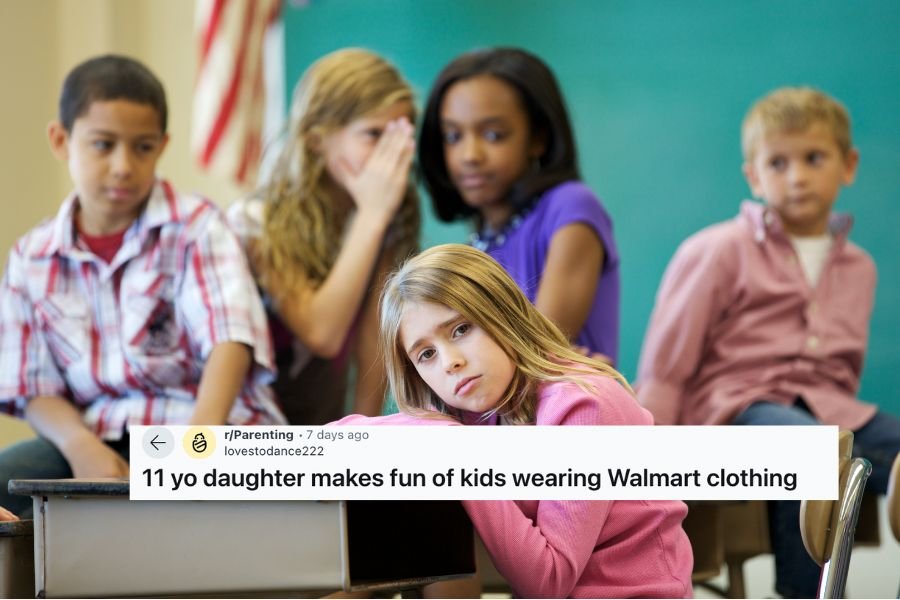
Bullying is a difficult territory for parents to navigate, even more so when it’s their own kid doing the bullying.
This can of course happen for a variety of reasons, but one really common reason is trying to fit in with a certain friend group. A kid sees one of their friends making fun of someone, and they follow suit in order to gain acceptance. And so, the nasty cycle continues, until this kid is now an adult with these terrible social habits.
Needless to say, that’s why it’s so important for parents to address any bullying activity head on, and immediately, as to prevent it from becoming a character trait.
And that is why one mom desperately sought the advice of folks on the Ask Reddit forum. As she shared in her post, her 11-year old daughter, who was about to enter 6th grade, had been apparently “making fun of kids for not wearing name brand clothing and shoes.”
Considering that their family doesn’t have a lot of money, the mom was floored by her daughter’s attitude. But in order to “impress” her friends, the daughter pretends their situation is otherwise. Just like 5 out of every 10 teen girl movies we ever saw as kids.
“Me and her dad have opposing views,” the mom explained. “I want to take her to Walmart for her back to school clothes and shoes. Her dad thinks it’s cruel.”
(She would later add that his view could be based on the fact that he too was “was often bullied for his clothing and doesn’t want to do that to our daughter.” Though one would think that would make him all the more behind the idea. But that’s neither here nor there.)
Hence why she came to Reddit—to see if maybe her idea for punishment was indeed too harsh.
However, an overwhelming amount of readers sided with the mom.
“It is not cruel,”one person replied. “What is cruel is making fun of people who cannot afford as much, or making fun of their sense of style. Bullying has real impacts on people, sometimes long-term, and I suggest the superficialness your daughter is displaying gets adjusted now before she becomes a teenager. Middle school can already be difficult for many students and I’m sure you don’t want your daughter to be the reason someone struggles with their self-confidence.”
Someone else simply quipped “100% decking her out in Walmart clothes entirely.” While another said “No question this is the solution. I would also make my child work to earn the money for it, if she was making fun of other children for wearing the clothes their family can afford.”
Another top comment suggested that mom first have a “serious discussion” with her daughter in a a neutral location. Then, if the bullying appears to continue, get her more Walmart clothes.
“At least until she understands why this is so inappropriate,” they said. “Give her the chance to mend her ways, but let her know what the consequence will be if she doesn’t. Now the ball is in her court. It’s not cruel as long as she has been forewarned and she understands why you would take this action.”
Another simply reiterated the importance of taking swift action, whatever that action may be.
“It’s not just the effects of bullying on others, I’d also argue that your child runs the risk of entering into the world at a deficit built upon these shallow and materialistic views she’s holding, not to mention the fact that surely bullies suffer psychological damage themselves all of which will need to be adjusted and repaired later in life. (Hopefully) Might as well try to help her see…that nice ‘things’ aren’t what matter most about people/life. Will rocking Walmart clothes help her realize that? Idk. I do think effort should be made to adjust her values and tune her into what being a good person is about,” they wrote.
How to have a conversation with your kid if you suspect they’re bullying

For parents who are in need of having that uncomfortable, but necessary conversation, The Child Mind Institute has these tips:
Be open and direct
Address the issue, how you heard about it, and then give the child time and space to explain what’s going on and how they feel about it. This can be a good time for assessing whether or not professional help might be needed.
Get specific about what you want to see instead
The site gives this example: “If your child excludes other kids, let them know that you expect them to say yes when others ask to play with them.” It also helps to demonstrate these values at home.
Set clear consequences
Seems like the OP might have been onto something. The Child Mind Institute suggest to have some form of punishment, like having their phone taken away, if behavior persist (note that this is AFTER having a conversation though). Alternatively, kids can try to “make amends” by offering a “written apology or doing something nice for the person they hurt.”
Bottom line: Kids who bully aren’t necessarily “bad.” It’s often a coping mechanism for new, intimidating emotional territory. But this is arguably when a kid needs parental guidance the most. So a little tough love is called for.