One of the hardest times in a child’s life is hitting that awkward phase around 10 that lasts ’til at least, 16. A hallmark of this time is when kids become obsessed with status symbols such as clothing, shoes, bikes, technology, and even what they bring in their lunches.
Kimberly Church, a Los Angeles stylist and mother of three boys, recently discovered that her 10-year-old was embarrassed by her packing his snacks in a Ziploc bag. “News today from my fourth grader that this kind of snack is embarrassing,” she said, holding up a Ziploc bag with chips inside. “So if I’m gonna send a snack, it needs to be in, like, one of those individual single-serving bags.”
It seems that the kids at his school will shame you for having your snacks in a Ziploc bag instead of individually wrapped, branded bags. Is it because it’s cheaper to buy a large bag of chips and then divvy them up, day by day, rather than buying individual bags? Who knows what goes on in the mind of a fourth-grader?
“My son told me yogurt is embarrassing, like what? Why,” one viewer asked in the comments. “I remember in 3rd grade we had $.25 popcorn Friday, and all my mom had was 2 dimes and 1 nickel, and I remember crying because I wanted a quarter because I was so embarrassed,” another added.
As a parent, dealing with your child’s embarrassment over their lunch is tricky. You don’t want the child to be picked on for something so trivial as the type of lunch they bring to school. Still, you also want to teach them resilience and to stick up for themselves in front of other kids.
Why do tweens and teens get embarrassed so easily?
Carl E Pickhardt, Ph.D., says that it’s crucial for parents to avoid minimizing their tween or teen’s sense of embarrassment and to think of it in adult terms. “Sometimes, to give adults an emotional reference for the teenager’s embarrassment, they can relate to I’ll ask if they ever have any performance fears, stage fright, interview anxiety, social jitters, party discomfort, or nervousness about public speaking,” Pickhardt writes for Psychology Today. “Although not exactly the same, such sensitivity to personal exposure and fear of public scrutiny may be comparable to the emotional distress that adolescent embarrassment can cause.”
Pickhardt adds that children of this age are easily embarrassed because they’re walking the tight rope between adulthood and childhood, and it’s easy for them to act too old or too young. In this young man’s case, eating chips out of a Ziploc bag may appear to be something a younger child would do.
Tweens and teenage kids are also very conscious about violating the norms of the group and feeling included because they are trying to find their place and assert their individuality outside of their family unit. Facing rejection from their “tribe” of peers can create extreme feelings of social isolation. This age of insecurity is easily taken advantage of by marketers who are working to make their brands an important part of youth culture.
“Branding is about finding a group or tribe to identify with,” Chris Hudson writes at Understanding Teenagers. “The message teens hear is ‘if you have the right brand, you belong to a family that share your identification with the brand and its lifestyle/values.’”
Parents may scoff at their child coming home and feeling embarrassed about their lunch, but there is much more at play if you dig a bit beneath the surface. Tweens and teens are going through a challenging phase where fitting in is paramount because the pain of rejection and bullying is terrible. So, it’s up to parents to have some sympathy by getting in touch with their feelings when they were younger and embarrassment made them want to disappear. Church may be surprised that her son is embarrassed about his school lunch, but in the end, it’s not really about snacks; it’s a request for belonging and evidence of the incredible importance that his peer group plays in his life.
A single door can open up a world of endless possibilities. For homeowners, the front door of their house is a gateway to financial stability, job security, and better health. Yet for many, that door remains closed. Due to the rising costs of housing, 1 in 3 people around the world wake up without the security of safe, affordable housing.
Since 1976, Habitat for Humanity has made it their mission to unlock and open the door to opportunity for families everywhere, and their efforts have paid off in a big way. Through their work over the past 50 years, more than 65 million people have gained access to new or improved housing, and the movement continues to gain momentum. Since 2011 alone, Habitat for Humanity has expanded access to affordable housing by a hundredfold.
A world where everyone has access to a decent home is becoming a reality, but there’s still much to do. As they celebrate 50 years of building, Habitat for Humanity is inviting people of all backgrounds and talents to be part of what comes next through Let’s Open the Door, a global campaign that builds on this momentum and encourages people everywhere to help expand access to safe, affordable housing for those who need it most. Here’s how the foundation to a better world starts with housing, and how everyone can pitch in to make it happen.
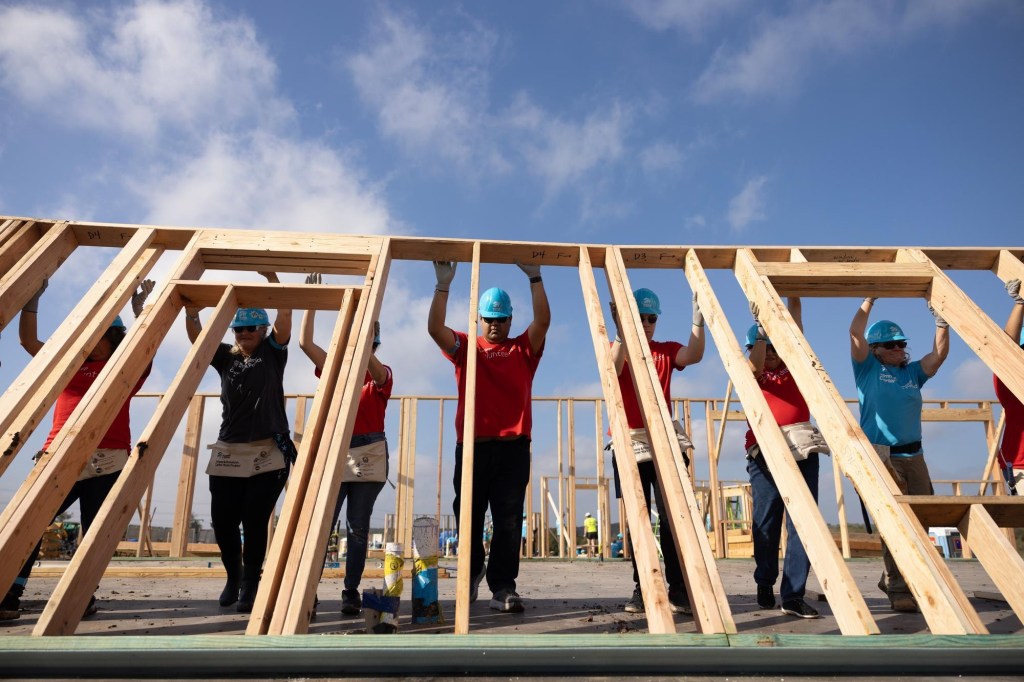
Volunteers raise a wall for the framework of a new home during the first day of building at Habitat for Humanity’s 2025 Carter Work Project.
Globally, almost 3 billion people, including 1 in 6 U.S. families, struggle with high costs and other challenges related to housing. A crisis in itself, this also creates larger problems that affect families and communities in unexpected ways. People who lack affordable, stable housing are also more likely to experience financial hardship in other areas of their lives, since a larger share of their income often goes toward rent, utilities, and frequent moves. They are also more likely to experience health problems due to chronic stress or environmental factors, such as mold. Housing insecurity also goes hand-in-hand with unstable employment, since people may need to move further from their jobs or switch jobs altogether to offset the cost of housing.
Affordable homeownership creates a stable foundation for families to thrive, reducing stress and increasing the likelihood for good health and stable employment. Habitat for Humanity builds and repairs homes with individual families, but it also strengthens entire communities as well. The MicroBuild® Initiative, for example, strengthens communities by increasing access to loans for low-income families seeking to build or repair their homes. Habitat ReStore locations provide affordable appliances and building materials to local communities, in addition to creating job and volunteer opportunities that support neighborhood growth.
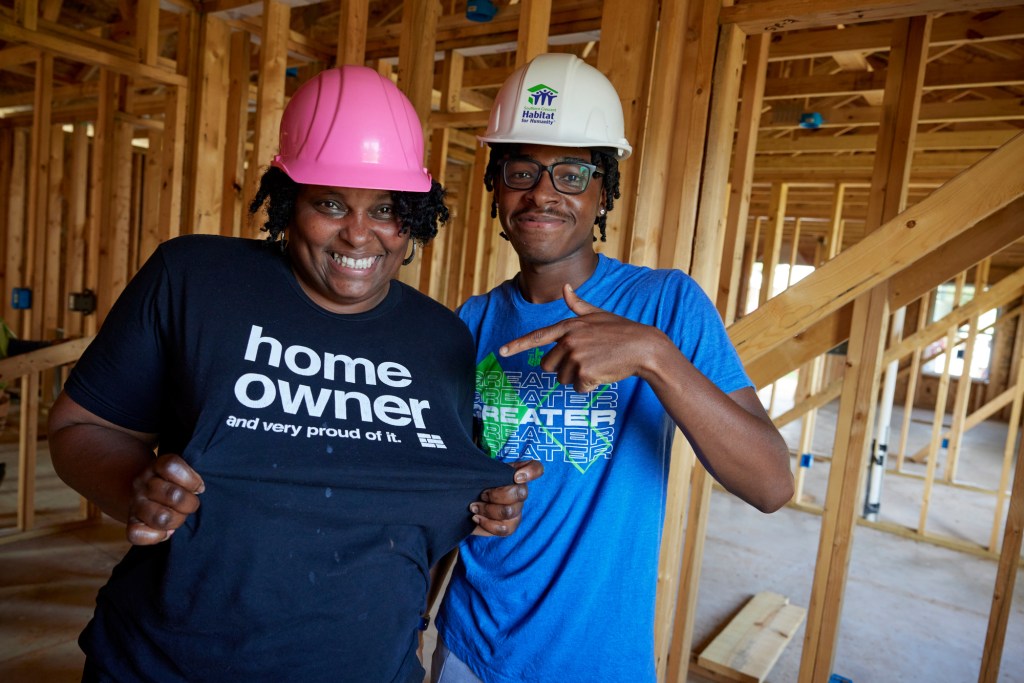
Marsha and her son pose for a photo while building their future home with Southern Crescent Habitat for Humanity in Georgia.
Everyone can play a part in the fight for housing equity and the pursuit of a better world. Over the past 50 years, Habitat for Humanity has become a leader in global housing thanks to an engaged network of volunteers—but you don’t need to be skilled with a hammer to make a meaningful impact. Building an equitable future means calling on a wide range of people and talents.
Here’s how you can get involved in the global housing movement:
Speaking up on social media about the growing housing crisis
Volunteering on a Habitat for Humanity build in your local community
Travel and build with Habitat in the U.S. or in one of 60+ countries where we work around the globe
Join the Let’s Open the Door movement and, when you donate, you can create your own personalized door
Every action, big and small, drives a global movement toward a better future. A safe home unlocks opportunity for families and communities alike, but it’s volunteers and other supporters, working together with a shared vision, who can open the door for everyone.
Confession: I am not a neat freak, but I’ve always aspired to be one. I love neat and tidy spaces and envy those who have a natural knack for keeping their homes perpetually guest-ready. Because I live in a normal-messy home, I appreciate it when people say “No one’s house is tidy all the time!” but I also know it’s not true. There are people with always-tidy houses. I personally know multiple people whose homes never, ever devolve into cluttered chaos, whose kitchen sinks are always free of dishes, whose tables are never cluttered with stuff and whose master bedrooms look like hotel rooms.
Knowing that it is possible, I’ve spent years observing my naturally neat friends and family to understand what gives them the seemingly superhuman ability to keep their homes clean 24/7. As one might assume, some of it comes down to a fastidiousness and rigid adherence to routines that some of us simply do not possess. Some of it has to do with how often people are home and how much their home actually gets used. However, those things aside, I’ve figured out a handful of “secrets” in the form of minor habits and mindsets that we messier folks who yearn to be neater can glean from the naturally tidy.
Messy people think of ‘cleaning up’ as a separate task
Neat people see it as an inherent part of every activity.
Though it’s largely unconscious, we all have ways of thinking through completing any activity, from the first step to the last step. Take eating, for example. For a naturally messier person, “eating” starts with preparing the food and ends with swallowing your last bite. Cleaning up is not an inherent part of the eating process—it’s seen as something separate, an activity that has its own beginning and end, its own time frame, its own energy expenditure, etc.
For a naturally neat person, however, eating means preparing the food, eating the food, and then cleaning up whatever mess you made. That’s the whole cycle of eating. When you see cleaning up as part of the eating process, eating doesn’t “end” until the dishes are finished and the kitchen is clean. Without cleaning up, the eating activity is simply incomplete.
For some people, this sounds like a “duh” revelation. For some of us, it’s a life-changing mindset shift.
Messy folks tend to overestimate how much time cleanup takes
Neat people don’t
Struggling to accurately estimate how much time a task will take is called “time blindness,” and it’s a common ADHD trait. But even those of us without ADHD can misjudge how long a task will take and form habits around our erroneous assumptions or perceptions.
For instance, I used to put off unloading the dishwasher because it seemed like a huge chore. All those dishes having to go to all those different cabinets—surely that was something that took a significant chunk of time to do. My brain had it labeled as a “big task” and therefore something I needed to carve out time for.
Then I timed myself doing it one day. Not rushing at all, just casually unloading a full dishwasher. It took less than 3 minutes, which was a fraction of the amount of time my brain had assigned to the task. Did I feel silly having subconsciously made a mountain out of a molehill? Yes. Did finding out it only took 3 minutes change how I viewed that chore and make it so I didn’t procrastinate it anymore? Also yes.
For someone who is a little messy, in the future, they can budget time for the entire task. It probably takes around an hour and 10 minutes to cook a meal for a family and eat it. Loading the dishwasher only takes about 10 minutes at most, so budget an hour and 20 minutes instead of an hour and ten.
Neat people don’t put off small cleaning/tidying tasks that they know only take a minute or two. Messy people can utilize timers to help them figure out what those are, because surprisingly, most tasks don’t take as long as you think they will.
Messy people think of cleaning as all or nothing
Neat people utilize tiny time chunks for mini maintenance
A messy person will pop something in the microwave for two minutes and then zone out or stare at it while it cooks. A neat person will pop something in the microwave and then use those two minutes to wipe down the counter, unload the dishwasher, or sweep the kitchen floor. They’ll fold laundry while watching a show and go put it away during a commercial break. They utilize small snippets of time to do little cleaning tasks, which all add up to maintaining a neat and tidy space without having to take big chunks of time to organize or clean.
Think of it as two minutes here and there, when there is nothing else to do, instead of taking up the entire morning on Saturday, when you could be out having fun.
Messier folks tend to overlook little messes here and there, so they build up until suddenly there’s an overwhelming mess to deal with. It helps to think of cleaning and tidying not as one big chore that is either done or not done, but rather as a conglomeration of tiny tasks that can be done any time you have a minute or two. Eventually, using tiny time chunks to mini-clean becomes habitual.
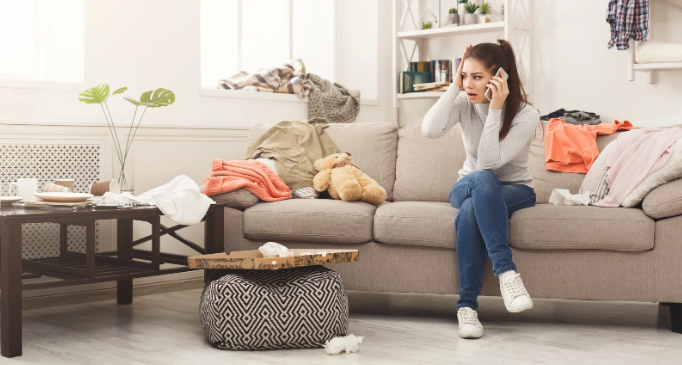
Woman in a messy room talking on the phone. Photo credit: Canva
Mess makers set things down
Neat people put things back
“Clean up as you go” is a mantra to internalize if you aspire to have a perpetually neat home. If a neat person is baking, they will take out an ingredient, measure what they need, then put that ingredient back where they got it. They do this every time, so when the baked good gets put in the oven, all that’s left to do is clean the dishes they used in prep (which is, of course, seen as an inherent part of the baking task). And this isn’t just in the kitchen. They do the same thing with their toiletries in the bathroom, their clothes when choosing an outfit, etc. Everything gets put back rather than put down, preventing a mess from the get go.
If a messy person is baking, they’ll take out an ingredient, measure what they need, and then set the ingredient down on the counter. Once the baked good gets put in the oven, there’s then a whole counter full of ingredients and dish mess to clean up. And because “cleaning up” is seen as a separate task, there’s a gearing up of energy that’s required as well as a separate time commitment, which makes procrastination more likely.
The key here is to recognize that putting things back where you got them really doesn’t take any more time than setting them down but saves tons of time and work later.
Messy people have more things than places
Neat people have more places than things
“A place for everything and everything in its place” is a mantra that neat people live by religiously and messy folks may not even realize is possible. If a neat person doesn’t have a place for something, they find one or make one by getting rid of something else. If a messy person doesn’t have a place for something, it sits on a table or countertop or entryway or some other placeholder for an indeterminate amount of time, often moving from surface to surface before eventually being shoved in a drawer or closet to be dealt with later.
Part of living like a neat person is being honest with yourself about the space you have and embracing inflow and outflow of things that enables you to live comfortably in that space. Messy people almost always have too much stuff for their space and therefore not enough places to put things. (This is true no matter how large or small your home is, sorry to say.) Neat people keep things pared down so that everything can have its own place. Regular purging of excess stuff and not holding onto things “just in case” is a huge key to staying neat and tidy.
I can’t say that I perfectly implement all of these things all the time, but I can say that being aware of these mindsets and habits and attempting to live more like my “neat freak” loved ones has made a big difference in my home and how I feel about living in it.
This article originally appeared two years ago. It has been updated.
A woman going out on an early morning run is showing everyone what being a good father looks like. Social media fitness influencer Orey shared a TikTok praising her father’s protection and motivation to achieve her goals.
“I have whatever the opposite of daddy issues are because my dad drives behind me during my 5 A.M. runs to make sure that I’m safe,” said Orey in the video’s caption. In the video, Orey gives her dad a fist bump through the open driver’s seat window before running off into the dark streets as her dad monitors her from his car.
Most outdoor joggers prefer to get their run in early in the morning to avoid traffic and pedestrians that would clog up city streets. It’s also a more comfortable time to run for people who live in warmer climates that get significantly hotter during the day, such as in Los Angeles where Orey resides. Unfortunately, though, such runs aren’t always safe.
Running outdoors when it’s dark can be risky, especially for women. There have been several news stories over the years about primarily female runners being harassed or assaulted while alone on the streets or in a park. While there should be a conversation on how to permanently ensure the safety of the public while they exercise, it’s currently necessary to actively find ways to protect yourself. Or, in Orey’s case, reflect upon how special it is that someone steps up for you.
What other people shared in the comments
The commenters on Orey’s TikTok shared similar stories from their parents:
“My dad finds parking in the Bronx for me and moves his car when I come home. ”
“I didn’t have my dad, but my mom would follow me to work when I would have to be there at 5 A.M. to open and stay until another employee showed up.”
“My dad would walk to the beach a block from our house at 2 A.M. after his night shift to check on me on my night ‘walk’ and walk me home…I was in my 30s. ”
Orey has built a following on TikTok by sharing relatable and accessible videos of her fitness journey, especially with running:
Parents often protect their children through limitations, even when they’re grown. They might say, “Don’t do that at night,” or “That’s too dangerous of a commute,” or “You could get hurt; best to forget about it.” While well-intentioned, that approach can create a boundary in the relationship and a lack of trust in an offspring’s ability to be independent. If Orey’s dad had that mentality, it could create resentment from Orey and he would still be worried for her if she decided to run before dawn.
Why participation beats protection
Instead, Orey’s dad did something great parents do—he participated. It’s special when anyone inconveniences themselves to support their loved one’s goals. If he was going to feel restless knowing that his daughter was going to run at 5 a.m., might as well go along with her, right?
Supportive and participatory phrases might sound like, “Let me drive you there and back,” “Let’s make a plan together in case the worst happens,” or “Can I do it with you?” This approach not only creates peace of mind for the parent but also strengthens the bond with the child as a wonderful side benefit. And it isn’t just applicable for parents and their kids, but also between spouses, partners, and friends, too. You not only help keep them safe as they pursue their goals but are actively there when they achieve them.
It’s an unfortunate reality that safety is never 100% guaranteed, but providing protection in tandem with support creates something special between loved ones. That alone is worth an early alarm each morning.
This article originally appeared two years ago. It has been updated.
Parent-teacher conferences are considered a crucial tool in a child’s education and development. They help both parents and teachers get on the same page about a student’s progress, strengths, and areas where improvement is needed. What’s more, it helps parent maintain a participating role in this aspect of their child’s life, making them hopefully feel supported and cared for.
That said, with all the mandatory activities that parents today have to manage on top of their work and other household responsibilities…not to mention all the various ways parents are constantly inundated with information from schools…it’s understandable why some parents might question whether or not these one-on-ones are actually necessary. Or at the very least…if it could be sent in an email.
The video that started the controversy
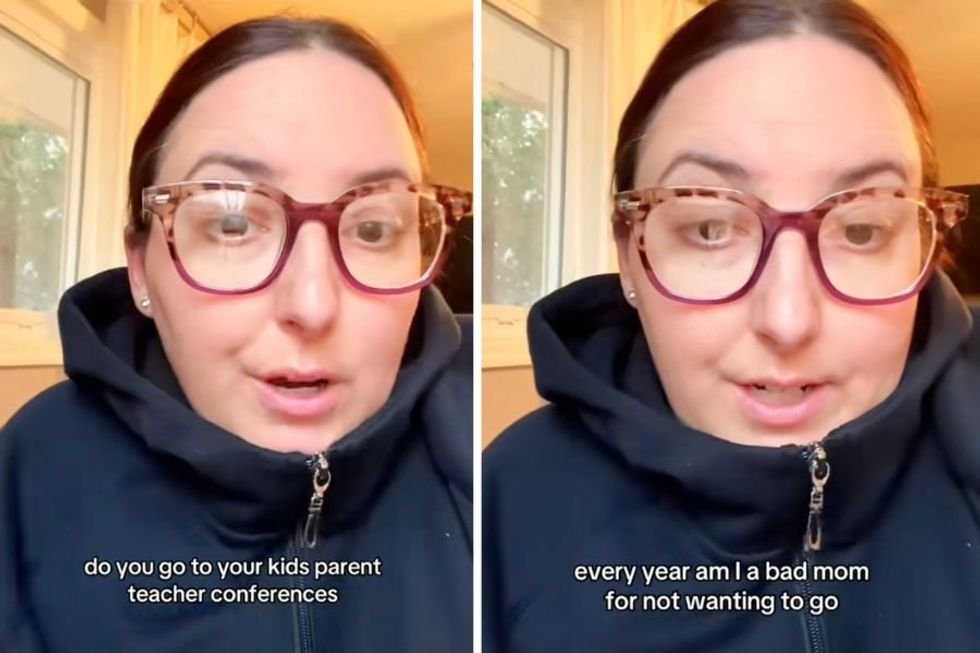
For mom Tatiana (@mamasreadingjournal), the dread of having to go to her kid’s parent–teacherconference was so strong that she posted a TikTok video asking if other moms and dads felt the same way. “Do you go to your kid’s parent-teacher conferences every year? Am I a bad mom for not wanting to go? Like I’m gonna go, but I really don’t wanna go, you know?” she asked in the clip, just before quipping, “sorry if his teacher finds this, it’s not you, I swear, it’s me, I’m lazy.”
Considering Tatiana is already in communication with her kid’s teacher through an app, she also couldn’t help but wonder why “this can’t be an email?” A very, very relatable thought for anyone in the 21st century. Tatiana’s confession was met with…a lot of concern. Clearly, people do, in fact, feel pretty strongly about this topic. And a common point brought up was how a child might feel if their parent doesn’t show an interest in their education in this particular way.
The comments did not hold back
“Your child is worth the effort, showing up to things like this is showing up for them,” one person wrote.
Another asked, “I guess the question is why aren’t you interested in learning from your child’s teacher about how their learning journey is going, if they’re a good friend to their classmates, etc? I see how it can be an inconvenience but being a parent means being involved in their life at school as well.”
A few teachers also weighed in, who admitted that even they didn’t exactly love parent-teacher conferences. Still, one advised, “always go. As a teacher it builds the connection we have with the parent, helps communication to overall support the child.”
Another teacher was a little more blunt, saying, “Girl, we don’t want to go! But you create so much work for us if you don’t go. We gotta document so many attempts of trying to get you in. Also, your kid wants you to go. I see HS kids sad that their parents don’t care to go. It’s important I swear.”
The conversation didn’t stop there
There was even a heated sidebar debate as to which parent, if only one, should be attending said parent-teacher conference: the stay-at-home-parent (SAHP), or the parent who works. Some argued that the SAHP should be the one to go as part of their at-home responsibilities. Others argued that SAHPs are the ones in regular correspondence with teachers, and therefore it’s the other parent that needs to get caught up.
But all moral judgments aside, this mom wasn’t necessarily saying she planned on skipping out. She was merely sharing a feeling that quite honestly a lot of folks can probably relate to. Even the most involved parent on the planet could get overwhelmed with the ever increasing amount of random school events that seem more or less mandatory. That goes double for parents who already have demanding schedules or social anxiety, which has to describe at least 99.9% of parents, right? It more so sounds like she was looking for commiseration than anything else.
To that point, Tatiana did make a follow-up video sharing that she “did not know” that not attending a parent-teacher conference results in more work for the teacher. She assumed it meant they’d “get to go home earlier if I didn’t go.” Honestly, fair assumption.
She also clarified that she did in fact go to the conference, and had always planned to go. However, she tells Upworthy that “outta my 15 minute slot we talked about my kid’s actual performance for maybe two minutes. Even my husband was shocked how much we chitchatted vs discussing actual grades and progress.”
But regardless, while she still feels that there’s “too much weight” put on this particular event, she will “go every year with bells on.”
“A mom who’s willing to accept feedback and adjust their attitude. We love to see it,” one astute viewer said.
This goes to show a few things. One, it’s a reminder of how so many aspects of education could stand for a revamp to fit with modern times. Two, productive conversations really can lead to better understanding. And three, parenting comes with going to a lot of things that you’d really rather not go to. Be it a parent-teacher conference or a Peppa Pig pop-up.
Not to mention, it can almost always be an email instead.
This article originally appeared two years ago. It has been updated.
Kids say a lot of hilarious things. It starts when they’re little and are just learning how to talk and string sentences together, and the unintentional comedy continues all the way into the overdramatic and angsty teen years.
As parents, we often wish we could remember these little nuggets of gold forever. Now, a new trend is turning teens’ most emotional and unhinged words into unforgettable earworms.
One mom turns texts into unbelievably catchy pop-punk song
Mandi Mansour, a hairstylist from San Diego, recently posted a Reel on Instagram of herself rocking out in the car while singing along to a song of her own creation.
The lyrics? Her own teenager’s frantic and melodramatic text messages.
It’s amazing to watch how messages like “Can I get Canes or Taco Bell? I know you said no, but I’m starving,” and “Can I have ten bucks? … Can I have seven dollars?” become such a catchy and convincing song. Of course, old early-2000s emo is the only musical style perfectly suited to capture the frantic angst, and the final product is honestly a banger. (The vocal run during “seven dollars” is absolutely priceless.)
A great detail from the video is how Mansour is driving and singing the lyrics without even looking at the screen. She’s clearly listened to her personalized song on repeat dozens of times and can’t seem to get enough of it.
Video is part of a trend making clever use of an AI music app
Mansour’s video isn’t the only one like it, not even close. These “emo songs” have become a huge viral trend over the last couple of weeks, with parents using the AI music app Suno (and similar ones) to turn these “lyrics” into full-blown songs, usually in the pop-punk genre.
It’s hard to say exactly where the trend originated, but Marcus Leshock, a reporter for WGN-TV, was one of the early prominent participants. Hundreds of thousands of parents followed suit shortly after.
Trend has parents asking: “Do we have the same kid?”
No matter how many clips you watch, all texts from the teenagers seem to fall into two buckets: wanting food and asking for money.
The series is an amazing glimpse inside the mind of the modern American Gen Z or Gen Alpha kid. It’s all Starbucks, açaí bowls, Raising Cane’s chicken—all fast food, really—e-bikes, and, of course, the classic requests for cash.
This is one of the first times we have such thoroughly documented evidence of how teens and preteens really think. About 85% of 11- to 13-year-olds have a cell phone capable of texting, with many getting their first phone under the age of 10.
Simply put, we’re in the frontier days of kids being able to text directly with their parents at all times. And the results are definitely something these moms and dads will want to remember when their kids are grown and self-sufficient.
Thanks to these infectious and unforgettable choruses, they most certainly will.
Turning texts into emo songs is really the best kind of AI trend. It draws humor from real-life experiences that connect all of us (well, all of us with moody teens), and uses a little assist from the technology to make it memorable and fun.
No one’s trying to top the Billboard charts here, but the commonalities between the songs really go to show that none of us are in it alone. Raising a teenager is tough, exhausting work—but it’s bringing parents all over social media a lot of comfort to know the challenges they’re dealing with are extremely common.
And those big feelings and dramatic outbursts just so happen to be perfect fodder for the type of songs many of us grew up loving.
Flying can test anyone’s patience, but Reddit user Safe_Ad_9314 may take the cake for having all their buttons pushed. They shared how a recent flight turned into a surprising lesson in setting boundaries, explaining that they had reserved a window seat, which was an intentional choice aimed at making their journey just a bit more enjoyable. But as soon as they settled in, a family boarded and a conflict began brewing.
After several attempts to calm her, the father turned to u/Safe_Ad_9314 and asked if they’d give up their seat for the child, adding, “She’s just a kid.” The OP gently stood their ground, explaining that the window seat was not a random perk, but something they had deliberately arranged, and even paid extra for.
Outbursts from children on airplanes can be extremely disruptive, sometimes even causing flights to be delayed.
The tantrum that sparked the conversation
The family’s six-year-old daughter quickly grew upset that she didn’t have the coveted window view. Her frustration was clear:
“I want the window! I want the window!” — the child
Eventually, the mother distracted the child with a tablet, and the flight continued. When everyone deboarded at their destination, the mother shot a lingering remark at u/Safe_Ad_9314:
“Some people just have no heart.” — the mother
That stung. It’s never easy to feel judged, especially when you’ve tried to be polite. Unsure if they’d done the right thing, u/Safe_Ad_9314 turned to the trusty Reddit subforum r/AITAH for feedback, asking, “AITA for not giving up my window seat on a plane to a kid just because she threw a tantrum?”
The response was overwhelmingly supportive, reframing the encounter into a conversation about how we teach children empathy, respect, and understanding of life’s little disappointments.
Boundaries matter – especially in public
Do we cave at the first sign of a tantrum, or do we help kids learn that not every wish can be granted? The community weighed in:
“You teach your kids how society works and that not everything is at their disposal all the time.” — u/hierosx
People pointed out that giving in to every demand might soothe tears in the moment, but can set unrealistic expectations for the future. If having a window seat was so important, some said, parents could plan ahead and book one. After all, this wasn’t about denying a child joy, but about showing them how to handle disappointment gracefully.
Why tantrums don’t work
Many commenters stood behind the idea that it’s kinder in the long run to help children learn healthy boundaries:
“I learned when my kids were toddlers that the best policy was ‘we do not negotiate with tantrumists.’” — u/BeBearAwareOK
At the core, many commenters reminded readers that random strangers aren’t responsible for resolving someone else’s poor planning or appeasing a meltdown:
“It’s not your responsibility to accommodate someone else’s poor planning or their child’s tantrum.” — u/experiment_ad_4
Others emphasized that saying “no” isn’t heartless—sometimes it’s a necessary act of kindness to the child, who learns that people have their own boundaries and can’t always bend.
“I am a mum of three. Kids get explained that they can’t have that seat as it’s already occupied, end of it.” — u/Sure_Freedom3
Instead of feeling guilty, u/Safe_Ad_9314 received a gentle reminder that upholding personal boundaries is part of living in a shared world. When we calmly stand our ground, we help create an environment where everyone learns that respect and empathy go both ways—even at 30,000 feet.
In the end, that’s what makes these moments matter. When we model healthy limits, we’re not just keeping a seat—we’re showing kids that there’s a bigger picture out there, one where kindness and fairness guide us all.
This article originally appeared two years ago. It has been updated.
At 21 weeks pregnant with twins, Leah McBride got news that no expectant mother wants to hear. Her daughters had twin-to-twin transfusion syndrome, a condition where blood flow between twins becomes dangerously imbalanced. One baby becomes the donor, passing nutrients to the other, while the other receives everything. The size difference between her girls had already reached 48 percent.
Doctors advised her to terminate the smaller twin, Poppy, to give her other daughter, Winnie, a better chance. They were worried Poppy would have a heart attack from giving away so many nutrients, and that Winnie might have a stroke.
Leah refused to choose.
Doctors were concerned about the smaller twin
She sought a second opinion at Memorial Hermann Hospital in Houston, where doctors recommended surgery to correct the blood flow imbalance. It worked. But at 27 weeks, her water broke, and the situation became urgent again. Doctors used steroids to try to delay delivery, knowing that earlier was riskier. “We needed to buy as much time as possible because 28 weeks was still too early to deliver them safely,” Leah said.
At 31 weeks, Poppy’s heart rate began dropping and wouldn’t stabilize. Doctors had no choice but to deliver both girls. Poppy and Winnie were born on May 24, 2019.
The twist that surprised everyone
What happened next surprised everyone. Poppy, the smaller twin at 1lb 11oz and the one whose monitor had been sounding alarms, was born perfectly healthy. Nothing was wrong with her heart.
It was Winnie who was in trouble. She weighed 3lb 8oz but had underdeveloped lungs and was rushed to the intensive care unit. At 14 days old, she needed brain surgery to relieve a buildup of fluid. She came through it.
A lifesaver of a sibling
Leah said the doctors told her plainly: “I think your tiny twin saved her sister’s life.” Poppy’s heart rate had been fluctuating on the monitors, triggering the early delivery. But there was nothing wrong with Poppy. The medical team’s belief is that she was sending distress signals because Winnie wouldn’t have survived much longer in the womb.
“Poppy’s heart rate had been all over the place, so they had to deliver,” Leah told reporters, “but when she was born, she was completely fine.”
The girls, now 6, are thriving. Winnie was reading books from memory by age 3. Poppy is still smaller than her twin, but according to Leah, she still keeps a close eye on her sister. When Leah tried to move their beds apart, they weren’t having it.
A lot of thought goes into choosing a baby’s name. Will other kids have the same name when they start kindergarten? Is the name too dull? Is the name too original? Will the name lead to bullying? Will the name look good on a job application? Could you run for president with this name?
Popular TikToker Emily Windham, 23, from Birmingham, Alabama, is adding another question that parents should ask themselves: What will their initials be? Windham has gone viral for her video in which she reveals how disheartening it is when she has to write her initials, especially when they appear multiple times on a document. To put it simply, they are pretty yucky.
“When you’re deciding what to name your kids, look at what their initials are going to be,” she says at the beginning of her video. “Every time I have to initial a document, I have to write ‘EW.’ All these little initial lines just say EW EW EW EW.” The situation is frustrating for Emily because her parents considered naming her Alexia, which would have been AW, which is sweet. “That’s so cute,” she said.
The post inspired other people with unfortunate initials to comment; some of them are much harder to live with than EW.
“Yea… mine is XL,” Xitlali wrote.
“Mine is ‘BLT’ because it was my dad’s favorite sandwich. Mom didn’t notice until it was too late I don’t even like blts,” Bryony Tally Art wrote.
“Mine is ‘PP’ elementary and middle school was a blast,” Pais wrote.
“I knew a girl in school whose name was Amy, and her initials were also AMY, and I’ll never forget because that’s so baller,” Charlie wrote.
“My son’s initials are BRB,” Ashleigh wrote.
“My initials are EGG,” El-Glory wrote.
“My initials spell EMO and I think that’s awesome,” Elle wrote.
“Mine is OG… now I’m getting married and it’ll be OJ. Can’t decide if I like an original gangster or Orange Juice more,” Olivia wrote.
“Mine is ME, and when I sign out on duties at work, someone goes, ‘Can someone please stop signing ME and sign your initials?’ I’m like, those are my initials,” a TikToker named Madison wrote.
Emily’s story is similar to that of Samantha Hart, a woman who went viral on TikTok in 2023 because her name doesn’t exactly work well with modern email conventions. Clearly, her parents hadn’t thought that her name would cause any trouble in the late ’90s when email was a new thing. So, she made a video warning parents to think of their children’s future email addresses before selecting a name.
“My name is Samantha Hart,” the 27-year-old said. “Most companies use the email designation of first initial, last name, meaning my email would be shart.” A shart is an accidental release when one assumes they only have gas, which is not exactly how one wants to be known in professional circles. Imagine sending an email to someone at another company and their name comes up as SHart. YOu might even think that someone is pranking you.
“At every single workplace, I have received an email from HR the week before I start letting me know that my name does not exactly fit the company email structure as they would intend and [asked] would I mind if they gave me a different structure for my email,” Hart said. That’s kind of the HR people to help Samantha save a bit of face when starting a new job, so the thing she’s most known for, before meeting anyone, is her questionable email address.
Sadly, Hart will probably have to deal with this whenever she gets a new job. Hopefully, she enjoys doing long stretches with her employers.
This article originally appeared two years ago. It has been updated.
For a while, the homeowner couldn’t figure out what was happening. His five-gallon gas can kept coming up nearly empty, even though his lawnmower had a one-quart tank. The math didn’t add up.
He had a suspicion about the neighbor but no proof. So before security cameras were cheap and ubiquitous, he did something resourceful: he set up an old laptop with a webcam pointed at his backyard and configured it with motion detection software. Within days he had his answer. The neighbor walked into his yard and took the gas — literally five minutes after the homeowner left the house. He had it on video.
He didn’t confront him. He had a different idea.
Revenge comes in many different forms
For the following week, every time he needed to use the bathroom, he used the gas can instead. He then placed the now full, convincingly odored container back on the patio. He made a visible show of preparing for a trip — packing bags, checking his car — somewhere the neighbor could see him. Then he left for about an hour.
When he came back, the neighbor was in his front yard in full crisis mode, furiously yanking the cord on his lawnmower, which would not start. Shortly after, the neighbor tried to drive somewhere and broke down within a few blocks. The gas can on the patio was empty.
The story could have ended there — satisfying enough on its own. But it didn’t.
This neighbor dispute was not over yet
The neighbor, apparently unaware of how badly he’d misread this particular relationship, later asked the homeowner to drop off a ride-along application he’d filled out with his personal details. Around the same time, the homeowner happened to remember a conversation with a friend at the sheriff’s department, who’d mentioned offhandedly that ride-along applicants get checked for outstanding warrants.
The homeowner submitted the application. Authorities found the warrants. The neighbor was arrested.
The full story was posted to Reddit’s r/ProRevenge by u/MarchCompetitive6235 in January 2026 and quickly accumulated a large and enthusiastic audience. The subreddit, true to its name, has a high bar for this kind of thing — readers expect the revenge to be proportional, well-executed, and complete. This one cleared all three.
It’s worth noting that using someone’s personal information to submit an application without their knowledge occupies legally murky territory depending on the state, and this approach isn’t something to replicate casually. But in this case the neighbor had outstanding warrants, which means the only thing the homeowner really did was provide law enforcement with information they were entitled to act on anyway.