I told a kid a riddle my dad told me when I was 7. His answer proves how far we've come.
This classic riddle takes on new meaning as our world changes for the better.

When I was 7, my dad told me a riddle.
"A man and his son are driving in their car when they are hit by a tractor-trailer.

(We were driving at the time, so of course this was the riddle he decided to tell.)
The father dies instantly.
The son is badly injured. Paramedics rush him to the hospital.

As he is being wheeled into the operating room, the surgeon takes one look the boy and says:
'I can't operate on him. He's my son.'
How is that possible?!"
Without missing a beat, I answered:
"The doctor is his mom!"

Photo via iStock.
My dad first heard the riddle when he was a child in the '60s.
Back then, most women didn't work outside of the home.
Few of those who did had college degrees, much less professional degrees.
Female doctors were few and far between.
Back then, it was a hard riddle. A very hard riddle.
By 1993, when I first heard it, the notion that women could be highly skilled, highly trained professionals wasn't so absurd.
To me, it was normal.
I knew women who were lawyers. Bankers. Politicians. My own doctor was a woman.
To be sure, women still faced challenges and discrimination in the workplace. And even 20 years later, they still do.
But at its core, the riddle is about how a family can work. And that had changed. Long-overdue progress had rendered the big, sexist assumption that underpinned the whole thing moot.
A very hard riddle was suddenly not a riddle at all.
I never forgot it.
Now, I'm 30 — almost as old as my dad was he first told me that riddle.
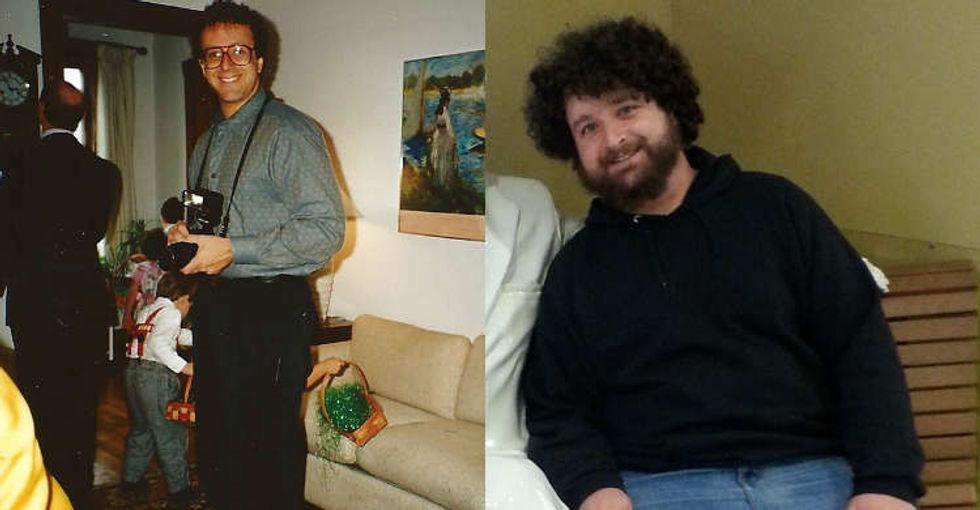
My dad at 30 (left) and me at 30. Photos by Eric March/Upworthy and Mary March, used with permission.
I don't have kids, but I mentor a child through a volunteer program.
Once a week, we get together and hang out for an hour. We play ping pong, do science experiments, and write songs. Neither of us like to go outside.
It's a good match.
One day, we decided to try to stump each other with riddles.
He rattled off about five or six.
I could only remember one: The one about the man, his son, and the surgeon.

Photo via iStock.
I thought it would be silly to tell it.
I was sure that, if it was easy in 1993, it would be even easier in 2014. Kind of ridiculous, even.
But a part of me was curious.
It had been 21 years — almost as long as it had been between when my dad first heard the riddle and when he shared it with me.
Maybe it wouldn't be so easy.
Maybe I was missing something obvious, making my own flawed assumptions about how a family could work.
Maybe the world had changed in ways that would be second nature to a 13-year-old but not to me.
So I began:
"A man and his son are driving in their car, when they are hit by a tractor-trailer. The father dies instantly. The son is badly injured and is rushed to the hospital by paramedics. As he is being wheeled into the operating room, the surgeon takes one look at the boy and says:
'I can't operate on him. He's my son.'
How is that possible?!"
Without missing a beat, he answered: "it's his other dad"

Photo via iStock.
Times change. Progress isn't perfect. But no matter what shape a family takes, at the end of the day, #LoveWins.
This article was written by Eric March and originally appeared on 06.21.16

- Teacher asks kindergartners where they would time travel - Upworthy ›
- Irish kiddo's 'trolley problem' joke has people in stitches - Upworthy ›
- Dad doesn't want to be called by his first name - Upworthy ›
- Why are public bathroom doors so frustratingly short? - Upworthy ›
- Waxers, nurses, and doctors share their unfiltered inner thoughts about your 'privates.' - Upworthy ›
- Woman shares the 3 things she could never get away with having a secret service father - Upworthy ›
- Boy breaks down crying after learning his new puppy was a gift from his late father - Upworthy ›
- Dad shares his struggle to connect with son, how he fixed it - Upworthy ›


Student smiling in a classroom, working on a laptop.
Students focused and ready to learn in the classroom.
Fish find shelter for spawning in the nooks and crannies of wood.
Many of these streams are now unreachable by road, which is why helicopters are used.
Tribal leaders gathered by the Little Naches River for a ceremony and prayer.

Communications expert shares the perfect way to gracefully shut down rude comments
Taking the high ground never felt so good.
A woman is insulted at her job.
It came out of nowhere. A coworker made a rude comment that caught you off guard. The hair on the back of your neck stands up, and you want to put them in their place, but you have to stay tactful because you're in a professional setting. Plus, you don't want to stoop to their level.
In situations like these, it helps to have a comeback ready so you can stand up for yourself while making making sure they don't disrespect you again.
Vince Xu, who goes by Lawyer Vince on TikTok, is a personal injury attorney based in Torrance, California, where he shares the communication tips he's learned with his followers. Xu says there are three questions you can ask someone who is being rude that will put them in their place and give you the high ground:
Question 1: "Sorry, can you say that again?"
"This will either make them have to awkwardly say the disrespectful remark one more time, or it'll actually help them clarify what they said and retract their statement," Xu shares.
Question 2: "Did you mean that to be hurtful?"
The next step is to determine if they will repeat the disrespectful comment. "This calls out their disrespect and allows you to learn whether they're trying to be disrespectful or if there's a misunderstanding," Xu continues.
Question 3: "Are you okay?"
"What this does, is actually put you on higher ground, and it's showing empathy for the other person," Xu adds. "It's showing that you care about them genuinely, and this is gonna diffuse any type of disrespect or negative energy coming from them."
The interesting thing about Xu's three-step strategy is that by gracefully handling the situation, it puts you in a better position than before the insult. The rude coworker is likely to feel diminished after owning up to what they said, and you get to show them confidence and strength, as well as empathy. This will go a lot further than insulting them back and making the situation even worse.
Xu's technique is similar to that of Amy Gallo, a Harvard University communications expert. She says that you should call out what they just said, but make sure it comes out of their mouth. "You might even ask the person to simply repeat what they said, which may prompt them to think through what they meant and how their words might sound to others," she writes in the Harvard Business Review.
More of Gallo's suggested comebacks:
“Did I hear you correctly? I think you said…”
“What was your intention when you said…?”
“What specifically did you mean by that? I'm not sure I understood.”
“Could you say more about what you mean by that?”
Ultimately, Xu and Gallo's advice is invaluable because it allows you to overcome a negative comment without stooping to the other person's level. Instead, it elevates you above them without having to resort to name-calling or admitting they got on your nerves. That's the mark of someone confident and composed, even when others are trying to take them down.