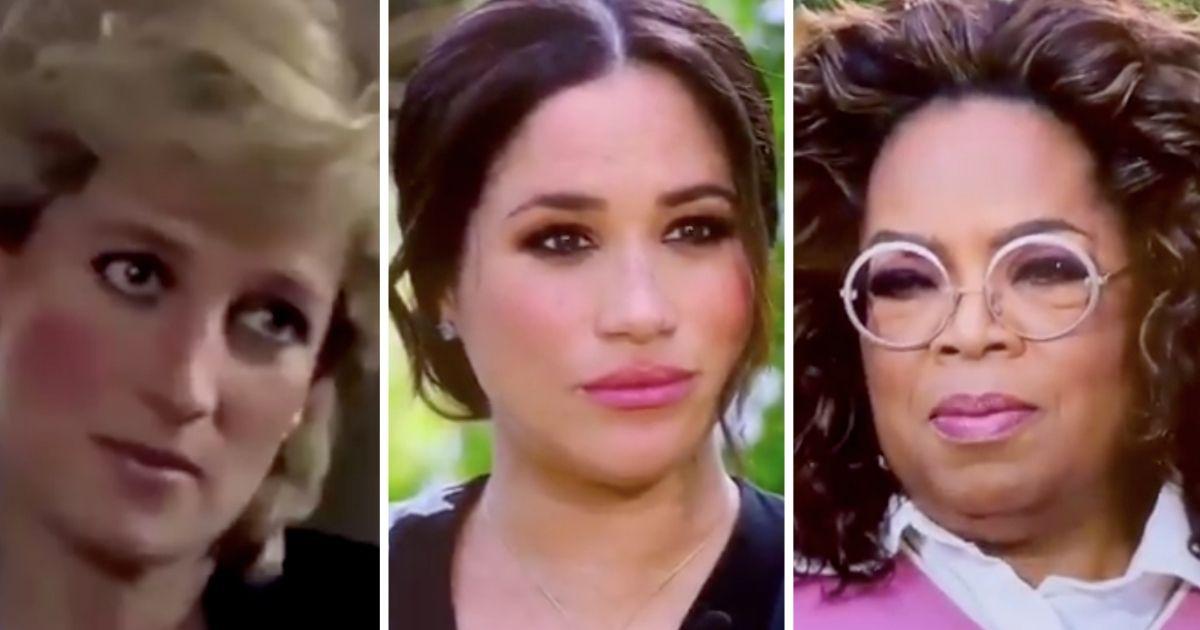
Princess Diana said strong women are seen as a threat. Meghan and Oprah prove they are.

Like millions of others, I tuned in last night to watch Oprah Winfrey's interview with (former) Prince Harry and Meghan Markle. Although watching "The Crown" has admittedly piqued my curiosity about the Royal Family, I've never had any particular interest in following the drama in real life. As inconsequential as the un-royaling of Harry and Meghan is to me personally, it's a historically and socially significant development.

The story touches so many hot buttons at once—power, wealth, tradition, sexism, racism, colonialism, family drama, freedom, security, and the media. But as I sat and watched the first hour of just Oprah and Meghan Markle talking, I was struck by the simple significance of what I was seeing.

Here were two Black women, one who had battled sexism and racism in her industry and broke countless barriers to create her own empire, and one who has battled racism and sexism to protect her babies, whose royal lineage can be traced back through 1,200 years of rule over the British Empire. And the conversation these women were having had the power to take down—or at least do real damage to—one of the longest-standing monarchies in the world.

Whoa.


It's not that I have some desire to take down the Queen—both Harry and Meghan were very clear that Queen Elizabeth has been good to them—but the institution of the monarchy and the various branches of that institution are steeped in colonialism, racism, and sexism that has long been glossed over in the name of reverence and respect for royalty. What force could possibly make a dent in such an institution?

Apparently, Meghan Markle. But she's not doing it alone.

As Oprah asked her about the things we're all curious about, I thought with awe about the generations of Black women who had fought and endured in order for these two women to be sitting there, alone in front of the cameras, with the wrapt attention of millions. That history was palpable throughout the interview.


When Harry joined in, backing up what Meghan said and sharing his own perspective as a lifelong member of the Royal Family, another woman entered the picture. One thing that came through most clearly in the joint interview was that Harry is so his mother's son.

Princess Diana rocked the royal boat by not conforming to what the palace wanted her to be when she was married to Prince Charles. She stood up for herself, and though much of the world loved her for it, the hounding of the paparazzi and the lack of support from the Royal Family was incredibly difficult.

"I think every strong woman in history has had to walk down a similar path," Diana said. "And I think it's the strength that causes the confusion and the fear. Why is she strong? Where does she get it from? Where is she taking it? Where is she going to use it?"

Diana's butler has pointed out how similar Meghan is to Diana in personality, going so far as to say he thinks the two would have clashed if Diana were still alive because they are both strong, independent women. He said that similarity is what drew Harry to Meghan. And now Harry has given Meghan the support and defense that his mother never got from the Royal Family.

Diana set the stage for that. She left money for each of her sons in her will—despite the fact that they were royals and would financially always be taken care of—which Harry says enabled the couple to pay for security for their family after the Royal Family cut off security following their stepping back from senior Royal Family member duties.

"I think she saw it coming." Harry said. "I certainly felt her presence throughout this whole process."

So we have a strong woman who isn't willing to put up with the constant attacks from the British press, who bravely asked for help when she became suicidal, and who walked away from the bullshit when it became clear that a long-standing institution wasn't going to change.

We have a strong woman who built her own platform and offered this couple the opportunity to share their story on the world stage.

We have a strong woman who raised a son to celebrate strong women and who had the wisdom to prepare him for something she sensed but couldn't exactly foresee.

What I saw in that interview was the power of three women calling one of the most powerful institutions in the world to account, and the entire world listening to them. That's exactly the disruption of the status quo that such institutions have always feared. That's the threat that strong women actually pose. And it's a glorious thing to witness.

The whole interview is worth watching. If you missed it, you can watch the whole thing for free on the CBS website here.
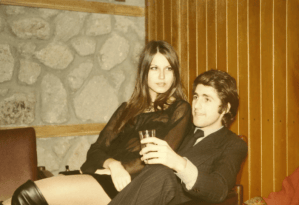
Images courtesy of John Scully, Walden University, Ingrid Scully
True

Since March of 2020, over 29 million Americans have been diagnosed with COVID-19, according to the CDC. Over 540,000 have died in the United States as this unprecedented pandemic has swept the globe. And yet, by the end of 2020, it looked like science was winning: vaccines had been developed.

In celebration of the power of science we spoke to three people: an individual, a medical provider, and a vaccine scientist about how vaccines have impacted them throughout their lives. Here are their answers:

John Scully, 79, resident of Florida

Photo courtesy of John Scully

When John Scully was born, America was in the midst of an epidemic: tens of thousands of children in the United States were falling ill with paralytic poliomyelitis — otherwise known as polio, a disease that attacks the central nervous system and often leaves its victims partially or fully paralyzed.

"As kids, we were all afraid of getting polio," he says, "because if you got polio, you could end up in the dreaded iron lung and we were all terrified of those." Iron lungs were respirators that enclosed most of a person's body; people with severe cases often would end up in these respirators as they fought for their lives.

John remembers going to see matinee showings of cowboy movies on Saturdays and, before the movie, shorts would run. "Usually they showed the news," he says, "but I just remember seeing this one clip warning us about polio and it just showed all these kids in iron lungs." If kids survived the iron lung, they'd often come back to school on crutches, in leg braces, or in wheelchairs.

"We all tried to be really careful in the summer — or, as we called it back then, 'polio season,''" John says. This was because every year around Memorial Day, major outbreaks would begin to emerge and they'd spike sometime around August. People weren't really sure how the disease spread at the time, but many believed it traveled through the water. There was no cure — and every child was susceptible to getting sick with it.

"We couldn't swim in hot weather," he remembers, "and the municipal outdoor pool would close down in August."

Then, in 1954 clinical trials began for Dr. Jonas Salk's vaccine against polio and within a year, his vaccine was announced safe. "I got that vaccine at school," John says. Within two years, U.S. polio cases had dropped 85-95 percent — even before a second vaccine was developed by Dr. Albert Sabin in the 1960s. "I remember how much better things got after the vaccines came out. They changed everything," John says.

Keep Reading Show less

Naomi Osaka was only 20 years old when she won the U.S. Open tournament, and she is the first Asian player to hold the highest singles ranking. The tennis star moved to the U.S. from Japan at age three and she has held both Japanese and American citizenship.

Her U.S. citizenship has been a topic of discussion as the Japanese exemption that allows her to hold both passports expired at age 22—which Osaka turned in 2019. At that time, she announced she would choose to give up her U.S. citizenship to keep her Japanese citizenship and compete for Japan in the 2020 Olympics. However, Osaka has said that she feels "more like a global citizen" than one particular nationality—a sentiment supported by her latest endeavor.

In partnership with Nike and Laureus Sport for Good, Osaka launched a program to support girls in sports in Japan last year. Her Play Academy is committed to leveling the playing field for girls through physical play and sports, giving girls opportunities and encouragement to get moving.

Now, she is expanding Play Academy to Los Angeles, where she currently lives and trains, as well as to Haiti, where her father is from.

Keep Reading Show less
Courtesy of CeraVe
True

"I love being a nurse because I have the honor of connecting with my patients during some of their best and some of their worst days and making a difference in their lives is among the most rewarding things that I can do in my own life" - Tenesia Richards, RN

From ushering new life into the world to holding the hand of a patient as they take their last breath, nurses are everyday heroes that deserve our respect and appreciation.

To give back to this community that is always giving so selflessly to others, CeraVe® put out a call to nurses to share their stories for a chance to be featured in Heroes Behind the Masks, a digital content series shining a light on nurses who go above and beyond to provide safe and quality care to patients and their communities.

First up: Tenesia Richards, a labor and delivery nurse working in New York City who, in addition to her regular job, started a community outreach program in a homeless shelter that houses expectant mothers for up to one year postpartum.

Tenesia | Heroes Behind the Masks presented by CeraVe www.youtube.com

Upon learning at a conference that black mothers in the U.S. die at three to four times the rate of white mothers, one of the widest of all racial disparities in women's health, Richards decided to take further action to help her community. She, along with a handful of fellow nurses, volunteered to provide antepartum, childbirth and postpartum education to the women living at the shelter. Additionally, they looked for other ways to boost the spirits of the residents, like throwing baby showers and bringing in guest speakers. When COVID-19 hit and in-person gatherings were no longer possible, Richards and her team found creative workarounds and created holiday care packages for the mothers instead.

Keep Reading Show less