Few celebrity interviews have drawn as much worldwide attention as Oprah’s recent sit-down with Harry and Meghan, which should come as no surprise. These people have a level of worldwide recognition and fame that far surpasses most world leaders and even most entertainers.
With fame comes critics, with criticism comes controversy, and with controversy comes conversations among the masses. And in those conversations, people often feel free to say things to or about famous people that they wouldn’t say to or about someone they know in real life. It’s easy to dehumanize celebrities who seem so different from the average person, and since they’re never going to see what we say, it doesn’t really matter anyway, right?
The problem is that others—people we actually care about—do see what we say. And it does matter to them.
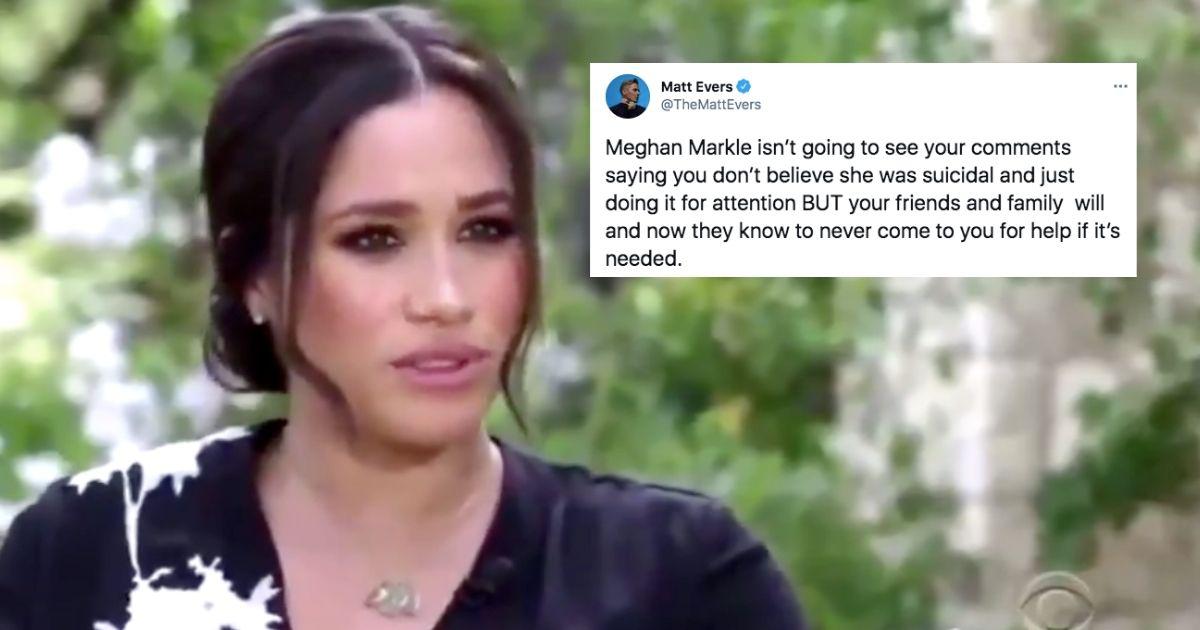
Social media is currently filled with reactions to Meghan Markle sharing how the abusive British tabloids and lack of support she had from the palace led to her having suicidal thoughts. While some celebrate her courage in speaking out, some have called her a “drama queen.” Some say she’s an attention-seeking narcissist. Some scoff at her claims, questioning how she could be suffering so much when she literally lived in a palace with a handsome prince, wanting for nothing.
Meghan will never see the vast majority of those comments. But other people who struggle with suicidal thoughts will. People who live economically privileged lives and those who don’t. People who have good marriages and those who don’t. If we call Meghan Markle a drama queen for sharing that she felt suicidal, what people who also struggle with those thoughts will see is that we can’t be counted on for support. They’ll see that we might judge and dismiss their feelings as undeserved at best or manufactured at worse. They’ll see that we can’t be trusted.
That doesn’t just apply to Meghan Markle and suicidal thoughts. People play fast and loose with celebrity commentary all the time, and when our comments involve things like mental health or other struggles that are common to the general population, what we say matters because it can impact people we truly care about.
Here are three questions we need to ask ourselves before we comment critically about a famous person.
1) Am I criticizing them for something they did/said, or something they’re going through?
There’s a big difference between calling out a problematic behavior or a harmful statement someone has made and criticizing someone for sharing a personal experience. When we have a dislike for someone famous, that line can get blurred, but it’s an important distinction.
When we criticize a famous person for something they’re going through—a mental health crisis, struggles with addiction, abuse, or loss—we’re making a judgment about something we aren’t in a position to judge. And our judgment has the potential to hurt everyone who’s going through something similar.
2) Is the thing they’re talking about a common struggle?
People often dismiss celebrity struggles because they seem to “have it all” and live above everything. But they don’t.
Famous people are people. Their life may look different than ours in many ways, but they are human beings first, prone to the same mental and emotional experiences as everyone else.
Mental health issues, addiction, racism, sexism, loss, grief, and other struggles don’t discriminate by class. Fame and privilege of wealth or status don’t shield people from any of those issues, and sometimes the reality of celebrity can make some of those issues worse.
Look at Anthony Bourdain, for example. He had plenty of money and the coolest job in the world, traveling the globe and exploring delicious food everywhere he went. But he died by suicide. And he’s certainly not alone.
If there’s one thing that connects us all, it’s these common human experiences that anyone—rich or poor, famous or not—can find themselves in.
3) If I have a loved one who has experienced the same or a similar struggle, how would they feel if I directed this comment to them?
When a loved one who struggles with suicidal thoughts sees us criticizing someone else’s struggles with suicidal thoughts, what does that say to them? Will they think of us as a safe, supportive person they can go to? Or will they be afraid we will dismiss their feelings as being “overly dramatic”?
When a loved one who has experienced racism sees us rolling our eyes at a famous person’s experiences with racism, what does it say to them? Will they see us as someone who has their back?
When a loved one who has found themselves in an abusive situation sees us tell a famous person, “What did you expect? You knew what you were getting into,” will they see us as a safe person to talk to?
Most of those struggles are endured silently, but they are definitely there and far more common than people think. Our loved ones are listening to our words, whether we’re talking directly to them or commenting on a public social media page. Rethinking the way we talk about these things can save a lot of hurt feelings and avoid damaging our own relationships. If it’s not something we’d say to or about someone we love, we’re probably better off not saying it at all.