They say cats have nine lives for good reason.
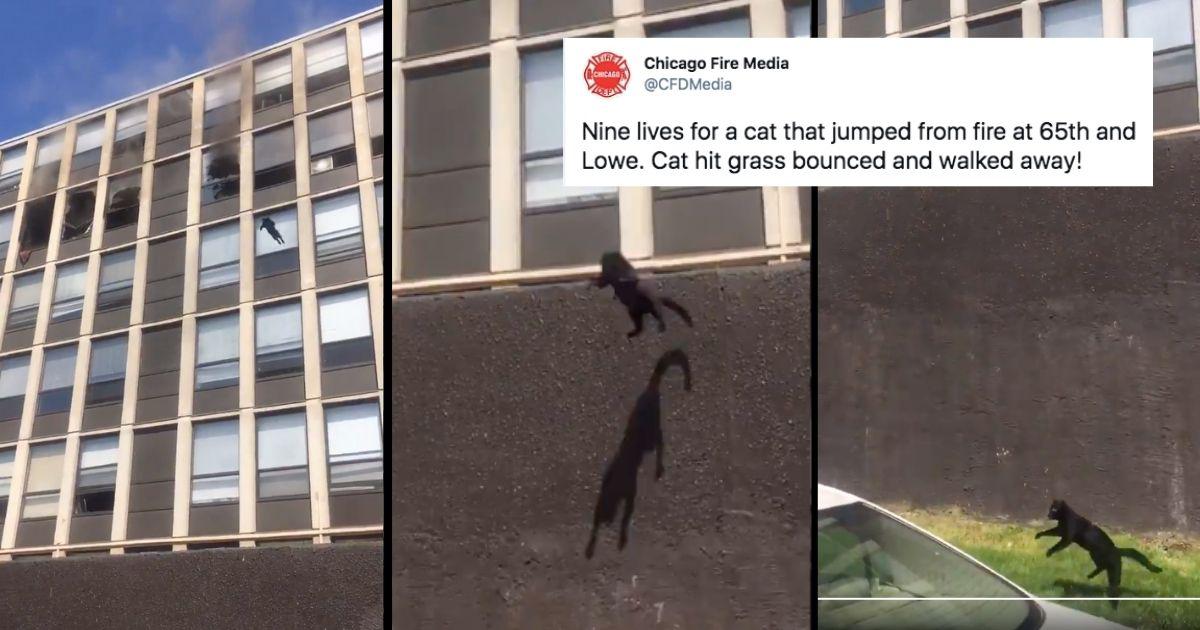
The Chicago Fire Department captured a cat’s miraculous plunge from the fifth floor of a burning building on video, and the fact that the cat came away from the jump uninjured is an incredible testament to feline physiology.
Someone from the fire department was filming the exterior of the building while firefighters fought the fire. Suddenly, a black paw reaches out a window of the fifth floor. Then it disappears for a bit—time for whatever spacial calculus cats do in their heads—and then a whole cat leaps out and sails downward, legs outstretched as onlookers gasp and scream.
Somehow, he manages to clear the concrete wall and land on a narrow patch of grass, bouncing once as he hit the ground on all fours. Then he ran off to hide under one of the firefighter’s cars.
Watch:
“It went under my car and hid until she felt better after a couple of minutes and came out and tried to scale the wall to get back in,” fire department spokesman Larry Langford told The Guardian. He said the cat was uninjured. (No other injuries were reported in the fire, either, thankfully.)
The “she” is actually a “he,” and he’s a housecat named Hennessy. The owner says he has not returned since the fire and neighbors are on the lookout for him in the Englewood neighborhood.
How do some cats perform such feats and walk away unscathed? It’s actually a fairly simple—though still super impressive—mix of physics and physiology.
For one, a cat’s terminal velocity is comparatively low, so they don’t hit the ground as fast as we would. They also have a relatively large surface area in comparison to their weight, which reduces the force with which they hit the ground.
Of course, cats can and do injure themselves falling or jumping from high heights. But their survival rate is pretty mind-blowing.
In 1987, researchers studied 132 cats brought to a New York City emergency veterinary clinic after falling from high-rise buildings. A whopping 90% of treated cats survived and only 37% needed emergency treatment. One cat even fell 32 stories onto concrete and only ended up with a chipped tooth and a collapsed lung. It was released after 48 hours.
“Being able to survive falls is a critical thing for animals that live in trees, and cats are one of them,” Dr. Jake Socha, a biomechanist at Virginia Tech, told the BBC. “The domestic cat still contains whatever suite of adaptations they have that have enable cats to be good up in trees.”
If cats fall, they are quickly able to rotate their bodies to land feet-down. If they jump like the black cat did from the burning building, they have even more control. Cats will splay out their legs to create more drag, like a parachute, and their powerful leg muscles act as shock absorbers (which explains the bounce when Hennessy hit the grass).
The way cats’ legs are built also help keep their bones from breaking.
“If the cat were to land with its legs directly under him in a column and hold him stiff, those bones would all break,” Dr. Socha told the BBC. “But they go off to the side and the joints then bend, and you’re now taking that energy and putting it into the joints and you’re getting less of a force at the bone itself.”
That doesn’t mean, of course, that it’s perfectly safe to let your cat hang out on your balcony. Cats being injured from falls from high heights is known as feline highrise syndrome. People assume that because cats can survive leaping from great heights that it’s not a problem if they do, and since cats do like high places, being careless about windows or balconies can put pet cats in danger. Falls put them at risk of serious injury, such as shattered jaws, broken teeth and limbs, or punctured lungs.
Our feline friend in Chicago gave us an impressive example of what cats are capable of, but he was lucky to walk away uninjured. Thanks to the firefighter who made sure Hennessy was okay, and hope he finds his way back home soon.