


The ten types of friends
When you're a kid, or in high school or college, you usually don't have to work too hard on your friendships. Friends just kind of happen.
For a bunch of years, you're in a certain life your parents chose for you, and so are other people, and none of you have that much on your plates, so friendships inevitably form. Then in college, you're in the perfect friend-making environment, one that hits all three ingredients sociologists consider necessary for close friendships to develop: “proximity; repeated, unplanned interactions; and a setting that encourages people to let their guard down and confide in each other." More friendships happen.
Maybe they're the right friends, maybe they're not really. But you don't put that much thought into any of it — you're still more of a passive observer.
But once student life ends, the people in your life start to shake themselves into more distinct tiers.
It looks something like this mountain:
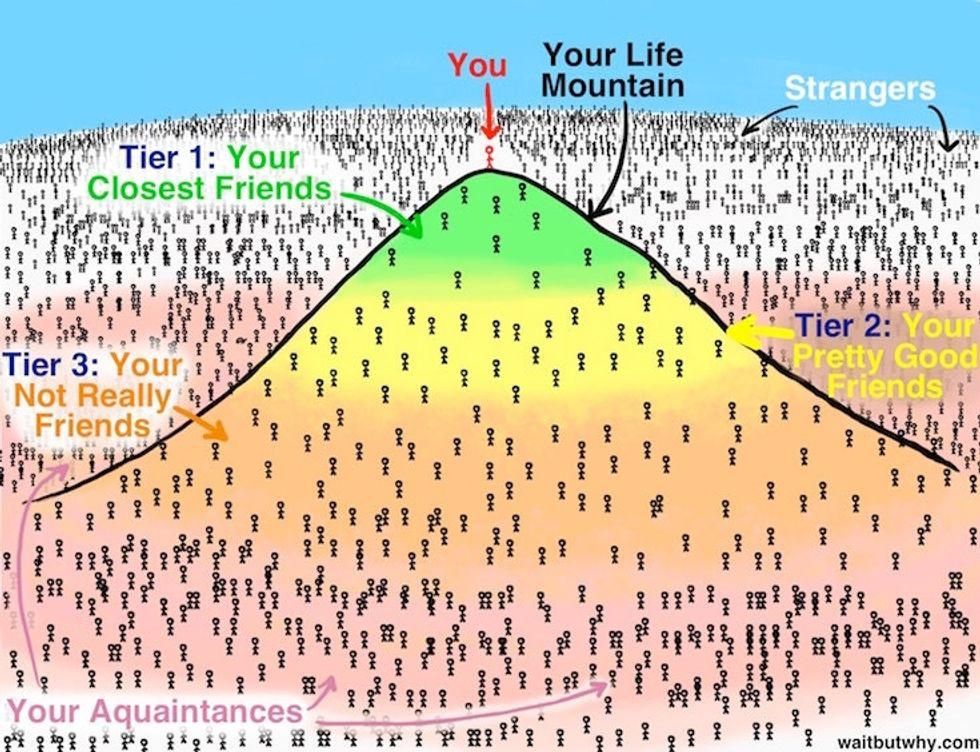
Visual interpretation of where friends fall on the mountain of “You."
via Wait But Why post and used with permission.
At the top of your life mountain, in the green zone, you have your Tier 1 friends—the people who feel like brothers and sisters.
These are the people closest to you, the ones you call first when something important happens, the ones you love even when they suck, who make speeches at your wedding, whose best and worst sides you know through and through, and whose relationship with you is eternal; even if you go months or years without hanging out, nothing has changed when you find yourself together again.
Unfortunately, depending on how things went down in your youth, Tier 1 can also contain your worst enemies, the people who can ruin your day with one subtle jab that only they could word so brilliantly hurtfully, the people you feel a burning resentment for, or jealousy of, or competition with. Tier 1 is high stakes.
Below, in the yellow zone, are your Tier 2 friends: your Pretty Good friends.
Pretty Good friends are a much calmer situation than your brothers and sisters on Tier 1. You might be invited to their wedding, but you won't have any responsibilities once you're there. If you live in the same city, you might see them every month or two for dinner and have a great time when you do, but if one of you moves, you might not speak for the next year or two. And if something huge happens in their life, there's a good chance you'll hear it first from someone else.
Toward the bottom of the mountain in the orange zone, you have your Tier 3 friends: your Not Really friends.
You might grab a one-on-one drink with one of them when you move to their city, but then it surprises neither of you when five years pass and drink #2 is still yet to happen. Your relationship tends to exist mostly as part of a bigger group or through the occasional Facebook Like, and it doesn't even really stress you out when you hear that one of them made $5 million last year. You may also try to sleep with one of these people at any given time.
The lowest part of Tier 3 begins to blend indistinguishably into your large group of acquaintances (the pink zone): those people you'd stop and talk to if you saw them on the street or would maybe email for professional purposes but whom you'd never hang out with one-on-one. When you hear that something bad happens to one of these people, you might be sad but not too affected.
Finally, acquaintances gradually blend into the endless world of strangers.
And depending on who you are and how things shook out in those first 25 years, the way your particular mountain looks will vary.
For example, there's Walled-Off Wally:
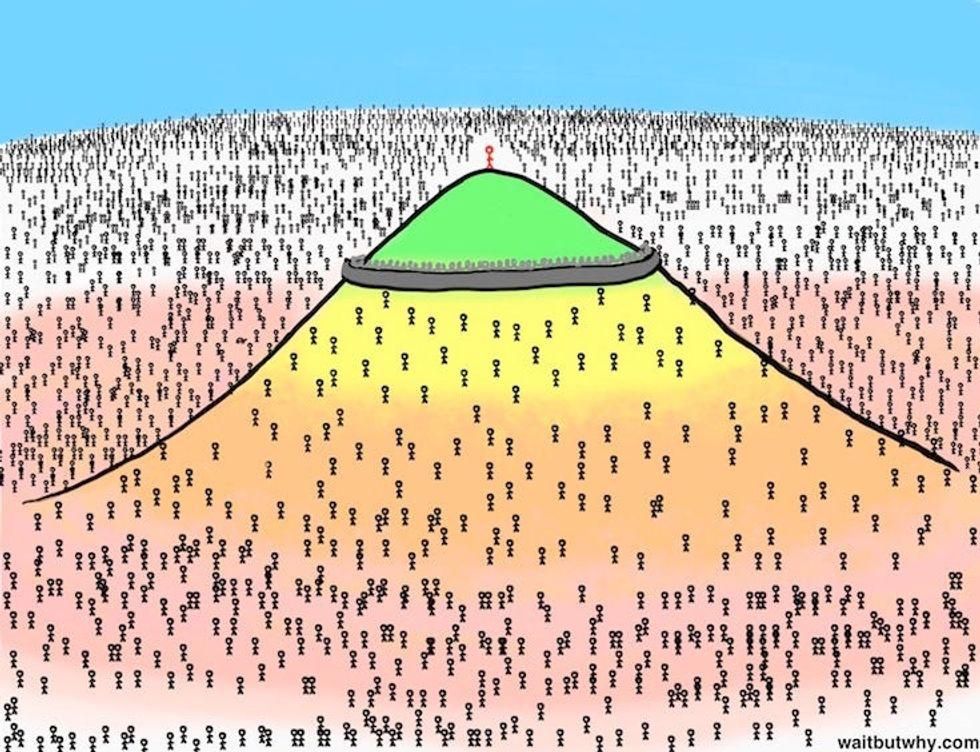
Some people keep a barrier up between acquaintances.
via Wait But Why post and used with permission.
And Phony Phoebe, who tries to be everyone's best friend and ends up with a lot of people mad at her:
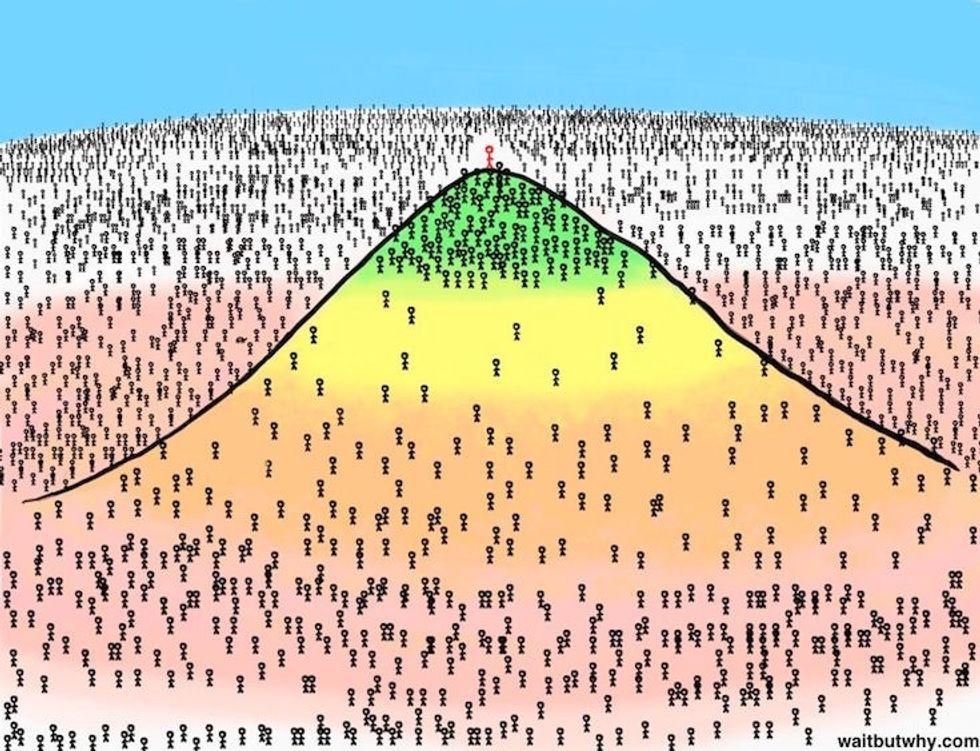
The life of the party.
via Wait But Why post and used with permission.
Even Unabomber Ulysses has a mountain:
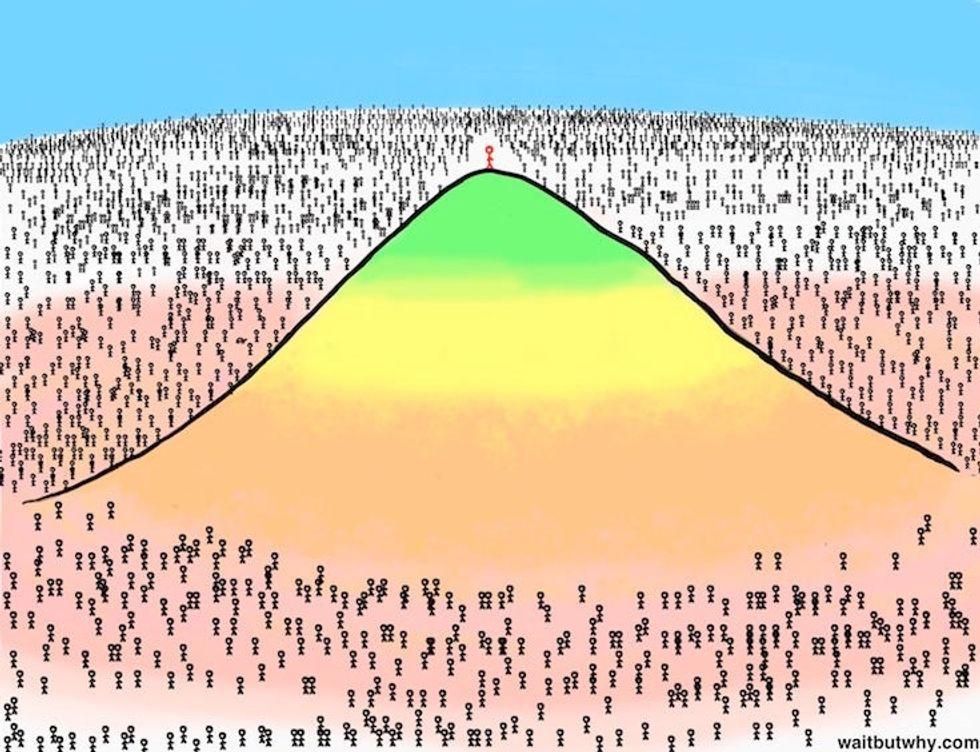
Hermits exist.
via Wait But Why post and used with permission.
Whatever your particular mountain looks like, eventually the blur of your youth is behind you, the dust has settled, and there you are living your life.
Then one day, usually around your mid or late 20s, it hits you: It's not that easy to make friends anymore.
Sure, you'll make new friends in the future—at work, through your spouse, through your kids—but you won't get to that Tier 1 brothers level, or even to Tier 2, with very many of them because people who meet as adults don't tend to get through the 100+ long, lazy hangouts needed to reach a bond of that strength. As time goes on, you start to realize that the 20-year frenzy of not-especially-thought-through haphazard friend-making you just did was the critical process of you making most of your lifelong friends.
And since you matched up with most of them A) by circumstance, and B) before you really knew yourself yet, the result is that your Tier 1 and Tier 2 friends—those closest to you—fall in a very scattered way on what I'll call the Does This Friendship Make Sense? Graph:
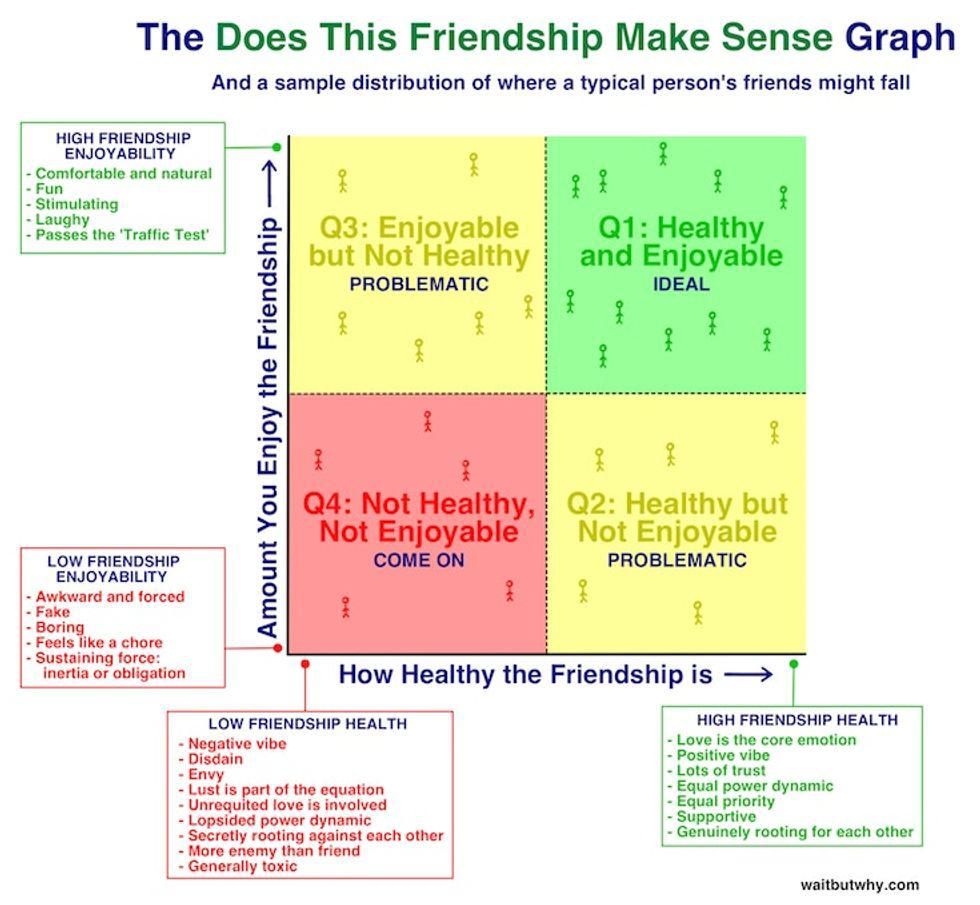
The friendship graph.
via Wait But Why post and used with permission.
So, who are all those close friends in the three non-ideal quadrants?
As time goes on, most of us tend to have fewer friends in Quadrants 2 through 4 because A) people mature, and B) people have more self-respect and higher standards for what they'll deal with as they get older. But the fact is, friendships made in the formative years often stick, whether they're ideal or not, leaving most of us with a portion of our Tier 1 and Tier 2 friendships that just don't make that much sense. We'll get to the great, Quadrant 1 friendships later in the post, but in order to treat those relationships properly, we need to take a thorough look at the odd ones first.
Here are 10 common ones:
1. The non-question-asking friend
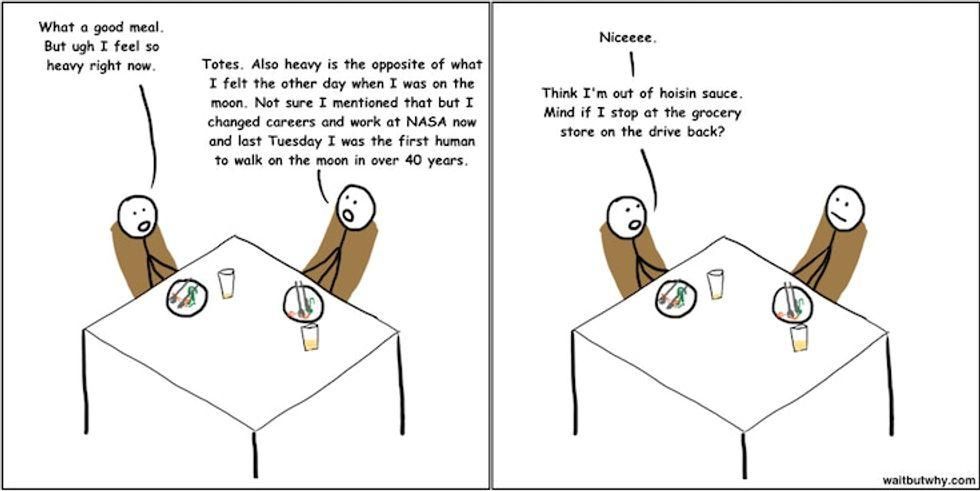
Odd moments that happen between friends.
via Wait But Why post and used with permission.
You'll be having a good day. You'll be having a bad day. You'll be happy at work. You'll quit your job. You'll fall in love. You'll catch your new love cheating on you and murder them both in an act of incredible passion. And it doesn't matter, because none of it will be discussed with The Non-Question-Asking Friend, who never, ever, ever asks you anything about your life. This friend can be explained in one of three ways:
- He's extremely self-absorbed and only wants to talk about himself.
- He avoids getting close to people and doesn't want to talk about either you or himself or anything personal, just third-party topics.
- He thinks you're insufferably self-absorbed and knows if he asks you about your life, you'll talk his ear off about it.
Giving you the benefit of the doubt here, we're left with two possibilities. Possibility #1 isn't fun at all and this person should not be allowed space on Tier 1. The green part of the mountain is sacred territory, and super self-absorbed people shouldn't be permitted to set foot up there. Put him on Tier 2 and just be happy you're not dating him.
Possibility #2 is a pretty dark situation for your friend, but it can actually be fun for you. I have a friend who I've hung out with one-on-one about four times in the last year, and he has no idea Wait But Why exists. I've known him for 14 years and I'm not sure he knows if I have siblings or not. But I actually enjoy the shit out of this friend—sure, there's a limit on how close we'll ever be, but without ever spending time talking about our lives, we actually end up in a lot of fun, interesting conversations.
2. The friend in the group you can't be alone with under any circumstances

Why have relationships when there is a phone around?
via Wait But Why post and used with permission.
In almost every group of friends, there's one pair who can't ever be alone together. It's not that they dislike each other—they might get along great—it's just that they have no individual friendship with each other whatsoever. This leaves both of them petrified of the lumbering elephant that appears in the room anytime they're alone together. They're way too on top of shit to ever end up in the car alone together if a group is going somewhere in multiple cars, but there are smaller dangers afoot—like being the first two to arrive at a restaurant or being in a group of three when the third member goes to the bathroom.
The thing is, sometimes it's not even that these people couldn't have an individual friendship—it's just that they don't, and neither one has the guts to try to make that leap when things have gone on for so long as is.
3. The non-character-breaking friend you have to be “on" with
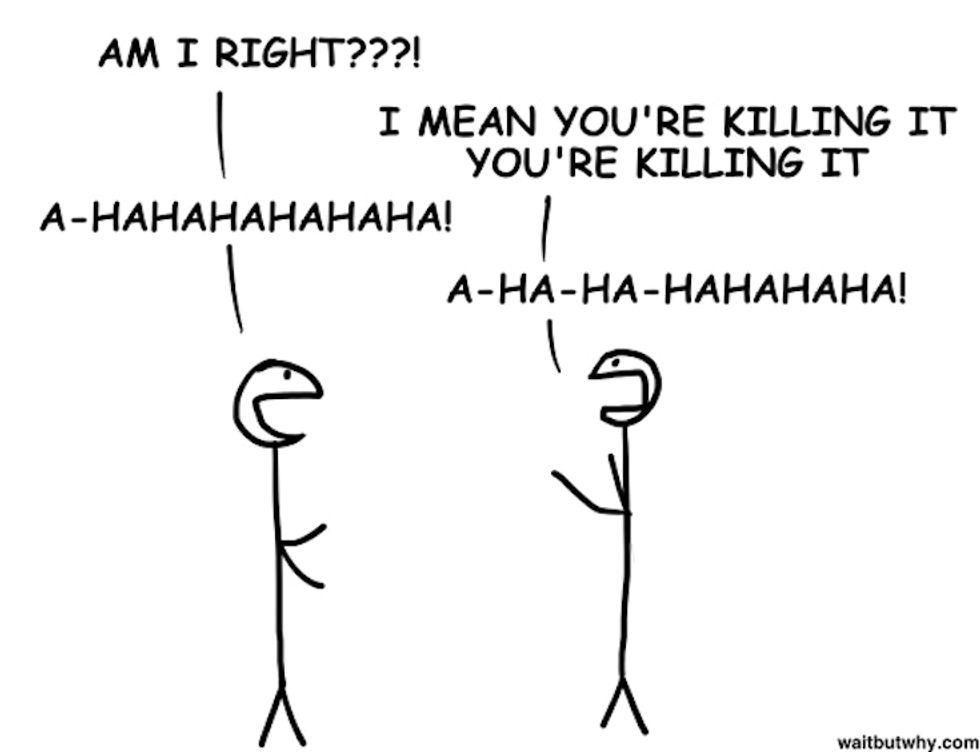
Controlled intimacy and distancing through language.
via Wait But Why post and used with permission.
This is a friend who's terrified of having an earnest interaction, and as such, your friendship with him is always in some kind of skit—you always have to be on when you're interacting.
Sometimes the skit is that you both burst out laughing at everything constantly. He can only exist with you in “This is so fucking hilarious, it's too much!" mode, so you have to be in some kind of joke-telling or sarcastic mode yourself at all times or he'll become socially horrified.
Another version of this is the “always and only ironic" friend, who you really bum out if you ever break that social shell and say something earnest. This type of person hates earnest people because someone being earnest dares him to come out from under his ironic safety blanket and let the sun touch his face, and no fucking thanks.
A third example is the “You're great, I'm great, ugh why is everyone else so terrible and not great like us" friend. Of course, she doesn't really think you're perfectly great at all—if she were with someone else, you'd be one of the voodoo dolls on the table to be dissected and scoffed at. The key here is that the two of you must be on a team at all times while interacting. The only comfortable mode for this person is bonding with you by building a little pedestal for you both to stand on while you criticize everyone else. You can either play along and everything will go smoothly, even though you'll both despise yourselves and each other the whole time, or you can commit the ultimate sin and have the integrity to disagree with the friend or defend a non-present party the friend criticizes. Doing this will shatter the fragile team vibe and make the friend recoil and say something quietly like, “Hm ... yeah ... I guess." The friend now respects you for the first time and will also criticize you extra hard next time she's playing her pedestal game with a different friend.
What these all have in common is the friend has tall walls up, at least toward you, and so she builds a little skit for you two to hang out in to make sure any authentic connection can be avoided. Sometimes that person only does this out of her own social anxiety and can become a great, authentic friend if you can just stomp through the ice. Other times, the person is just hopelessly scared and closed off and there's no hope and you have to get out.
In any case, I can't stand these interactions and am in a full panic the entire time they're happening.
4. The double-obligated friendship
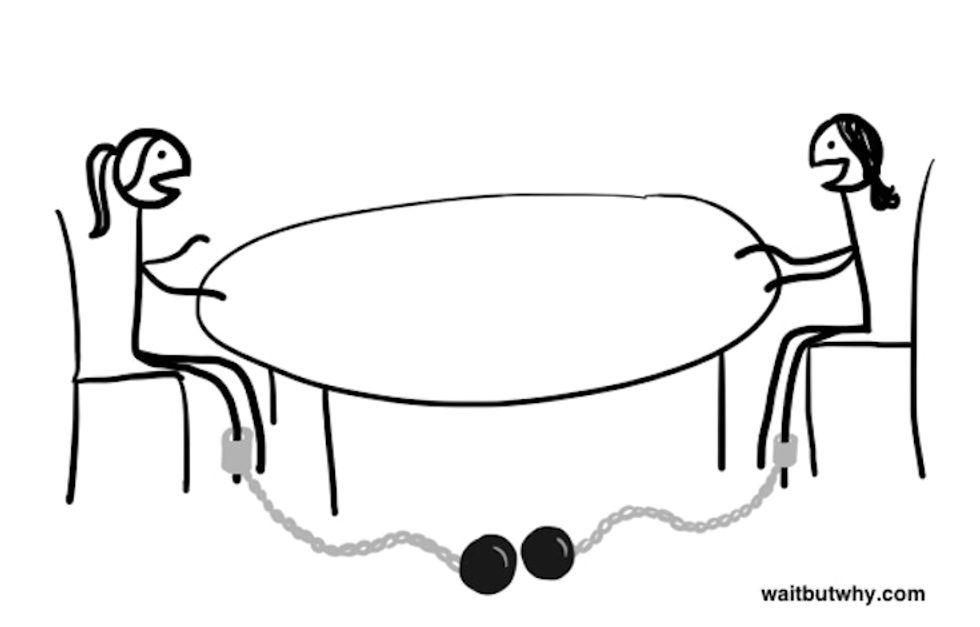
I think we need a bigger table.
via Wait But Why post and used with permission.
Think of a friend you get together with from time to time, which usually happens after a long and lackluster email or text exchange during which you just can't find a time that works for both of you — and you're never really happy when these plans are being made and not really psyched when you wake up and it's finally on your schedule for that day.
Maybe you're aware that you don't want to be friends with that person, or maybe you're delusional about it — but what you're most likely not aware of is that they probably don't want to see you either.
There are lopsided situations where one person is far more interested in hanging out than the other (we'll get to those later), but in the case we're talking about here, both parties often think it's a lopsided situation without realizing that the other person actually feels the same way — that's why it takes so long to schedule a time. When someone's excited about something, they figure out how to get it into their schedule; when they're not, they figure out ways to push it farther into the future.
Sometimes you don't think hard enough about it to even realize you don't like being friends with the person, and other times you really like the idea or the aesthetic of being friends with that particular person — being friends with them is part of your Story. But even in cases where you're perfectly lucid about your feelings, since neither of you knows the other feels the same way and neither has the guts to just cut things off or move it down a tier, this friendship usually just continues along for eternity.
5. The half-marriage

An ego boost through controlling the relationship.
via Wait But Why post and used with permission.
Somewhere in your life, you're probably part of a friendship that would be a marriage if only the other person weren't very, very, extremely not interested in that happening. 1 for 2 on yes votes — just one vote away — so close.
You might be on either side of this — and either way, it's one of the least healthy parts of your life. Fun!
If you're on the if only side of things, probably the right move is to get your fucking shit together? Ya know? This friendship is one long, continuous rejection of you as a human being, and you're just wallowing there in your yearning like a sobbing little seal. Plus, duh, if you gather your self-respect and move on with your life, it'll raise their perception of your value and they might actually become interested in you.
If you're on the Oh yeah, definitely not side of the situation, here's what's happening: There's this suffering human in the world, and you know they're suffering, and you fucking love it, because it gives your little ego a succulent sponge bath every time you hang out with them. You enjoy it so much you probably even lead them on intentionally, don't you — you make sure to keep just enough ambiguity in the situation that their bleeding heart continues to lather your ego from head to toe at your whim.
Both of you — go do something else.
6. The historical friend
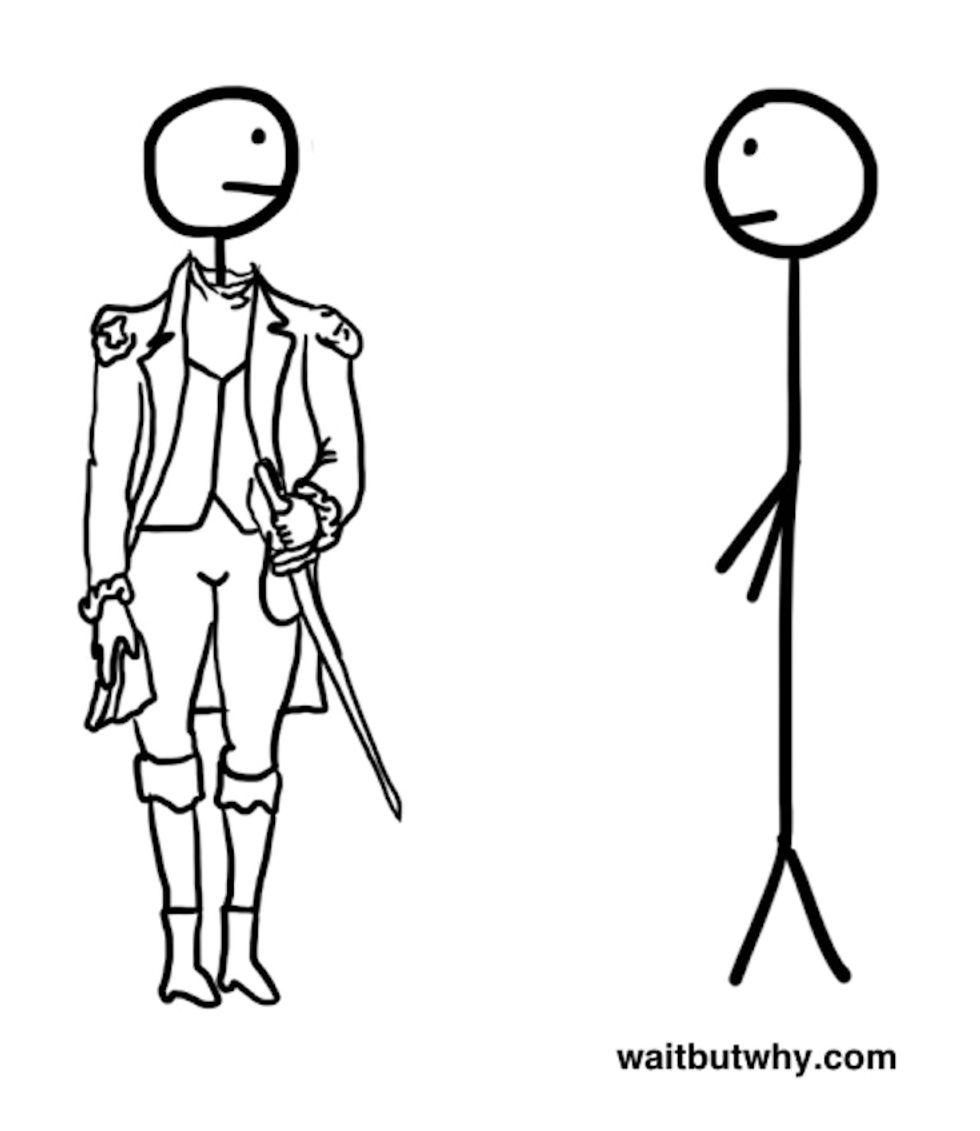
We met in kindergarten.
via Wait But Why post and used with permission.
A Historical Friend is someone you became friends with in the first place because you met when you were little and stayed friends through the years, even though you're a very weird match. Most old friends fall somewhat into this category, but a true Historical Friend is someone you absolutely would not be friends with if you met them today.
You're not especially pleased with who they are, and they feel the same way about you. You're not each other's type one bit. Unfortunately, you're also extremely close friends from when you were four, and you're both just a part of each other's situation forever, sorry.
7. The non-parallel life paths friendship
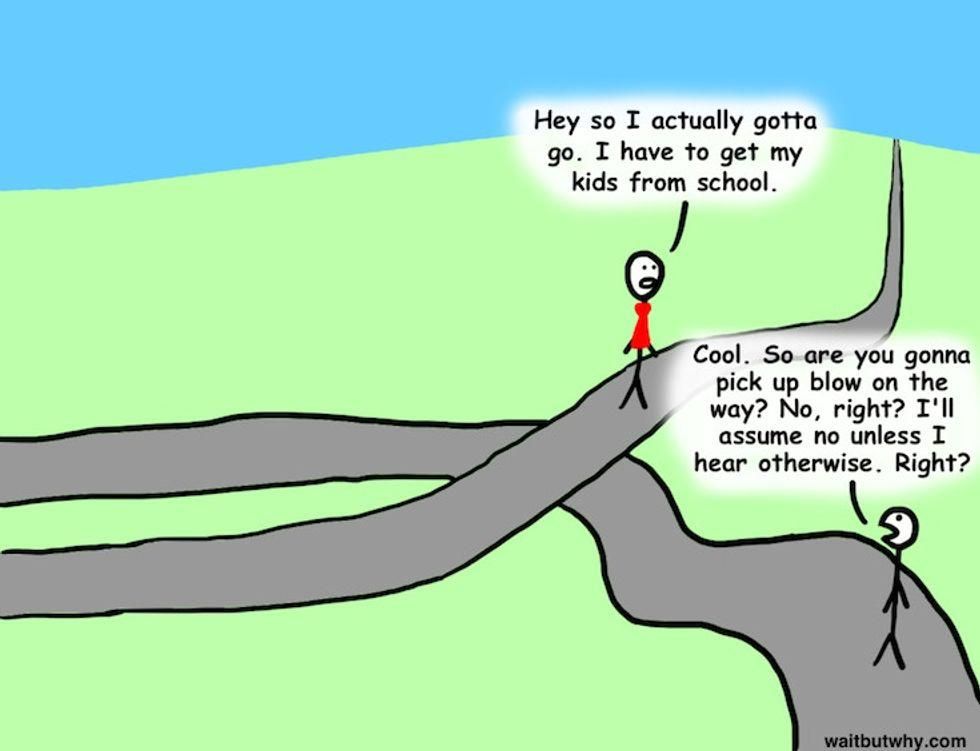
Looking for love in all the wrong places.
via Wait But Why post and used with permission.
Throughout childhood and much of young adulthood, most people your age are in the same life stage as you are. But when it comes to advancing into full adulthood, people do so at widely varying paces, which leads to certain friends suddenly having totally different existences from one another.
Anyone within three years of 30 has a bunch of these going on. It's just a weird time for everyone. Some people have become Future 52-year-olds, while others are super into being Previous 21-year-olds. At some point, things will start to meld together again, but being 30-ish is the friendship equivalent of a kid going through an awkward pubescent stage.
There are darker, more permanent Non-Parallel Life Path situations. Like when Person A starts to become a person who rejects material wealth, partially because she genuinely feels that pursuing an artistic path matters more and partially because she needs a defense mechanism against feeling envious of richer people, and Person B's path makes her scoff at people who pursue creative paths, partially because she genuinely thinks expressing yourself is an inherently narcissistic venture and partially because she needs a defense mechanism against feeling regretful that she never pursued her creative dreams — these two will have problems.
They may still like each other, but they can't be as close as they used to be — each of their lives is a bit of a middle finger at the other's choices, and that's jst awkward for everyone. It's not always that bad — but to survive an Off-Line Life Situation, friends need to be really different people who don't at all want the same things out of life.
8. The frenemy
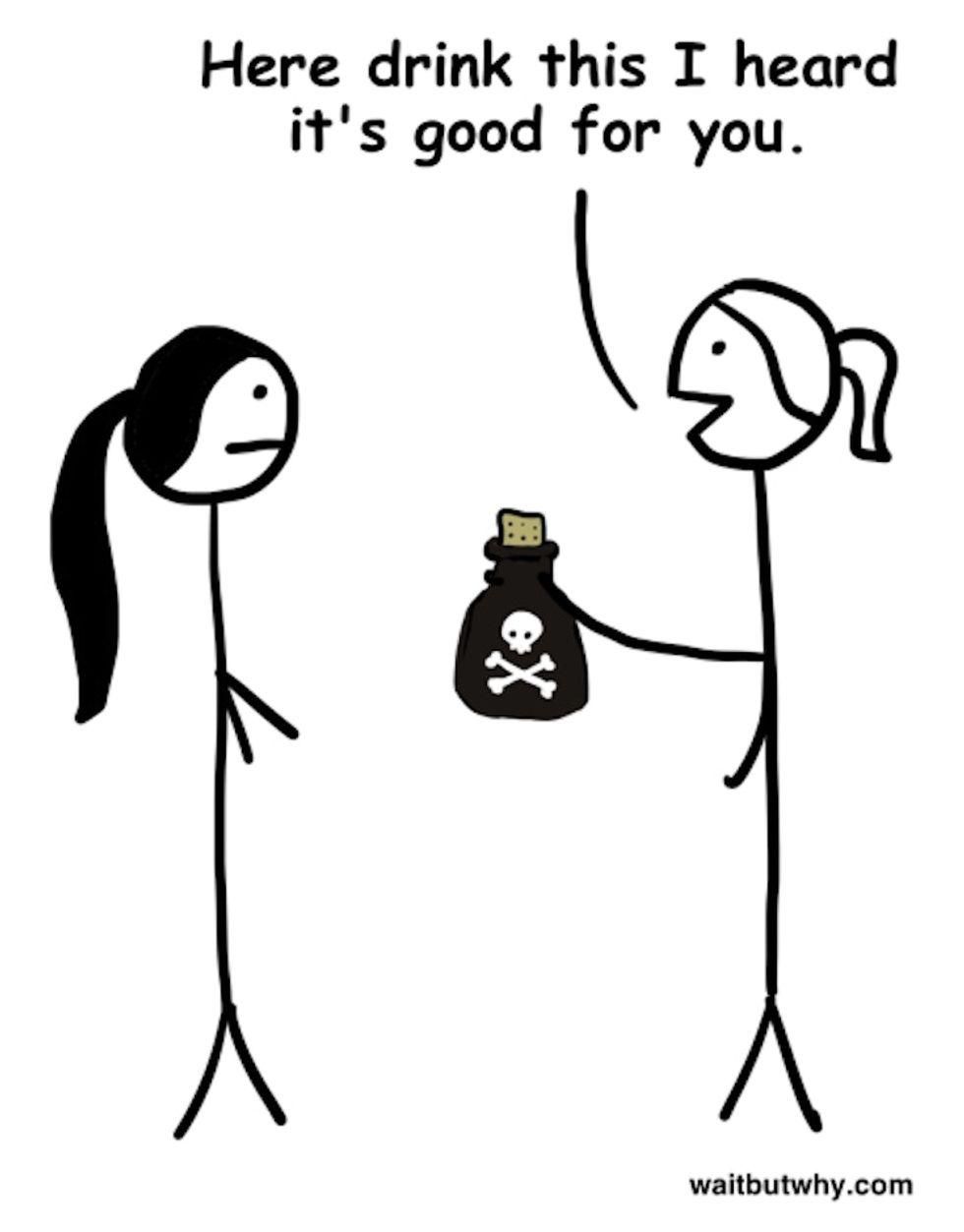
This is awful. Taste it.
via Wait But Why post and used with permission.
The Frenemy roots very hard against you. And I'm not talking about the friends that will feel a little twinge of pleasure when they hear your big break didn't pan out after all or that your relationship is in bad shape. I'm not even talking about someone who secretly roots against you when they're not doing so well at some area of life and it hurts them to see you do better. Those are bad emotions, but they can exist in people who are still good friends.
I'm talking about a real Frenemy — someone who really wants bad things for you. Because you're you.
You and the Frenemy usually go way back, have a very deep friendship, and the trouble probably started a long time ago. There's a lot of complex psychology going on in these situations that I don't fully understand, but my hunch is that a Frenemy's resentment is rooted in his own pain, or his own shortcomings, or his own regret — and for some reason, your existence stings them in these places hard.
A little less dark but no less harmful is a bully situation where a friend sees some weakness or vulnerability in you and she enjoys prodding you there either for sadistic reasons or to prop herself up.
A Frenemy knows how to hurt you better than anyone because you're deeply similar in some way and she knows how you're wired. She'll do whatever she can to bring you down any chance she gets, often in such a subtle way it's hard to see that it's happening.
Whatever the reason, if you have a Frenemy in your life, kick her toxic ass off your mountain, or at least kick her down the mountain — just get her off of Tier 1. A Frenemy has about a 10th of the power to hurt you from Tier 2 as she does from Tier 1.
9. The Facebook celebrity friend
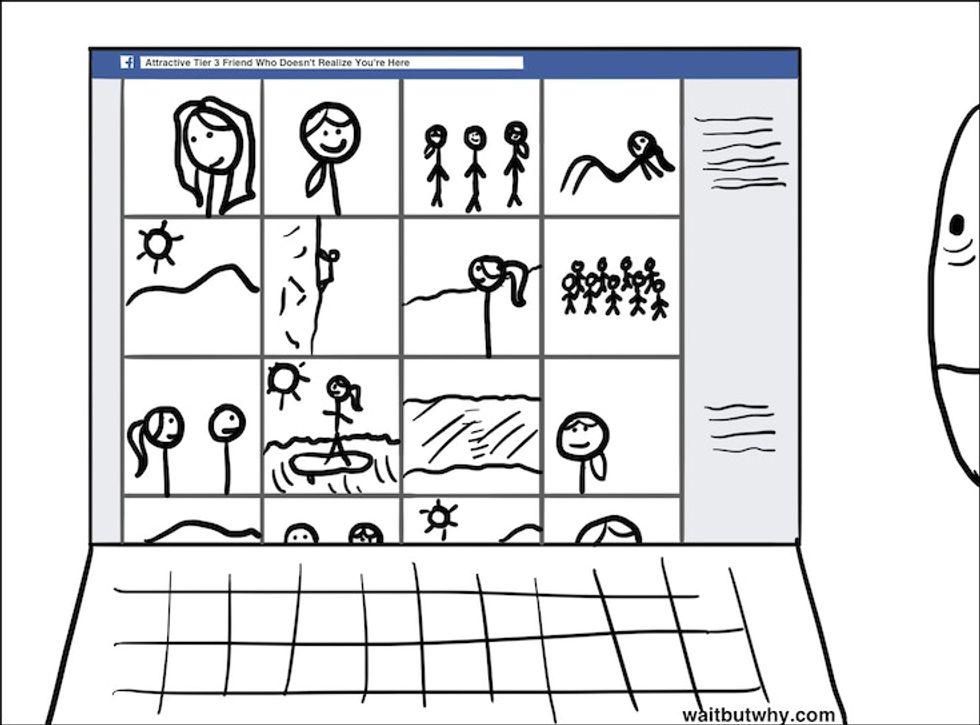
What’s happening on social media?
via Wait But Why post and used with permission.
This person isn't a celebrity to anyone other than you, you creep. You know exactly who I'm talking about — there are a small handful of people whose Facebook page you're uncomfortably well-acquainted with, and those people have no idea that this is happening. On the plus side, there are people out there you haven't spoken to in seven years who know all about the new thing you're trying with your hair, since it goes both ways.
This is a rare Tier 3 friend, or even an acquaintance, who qualifies as an odd friendship because you found a way to make it unhealthy even though you're not actually friends. Well done.
10. The lopsided friendship
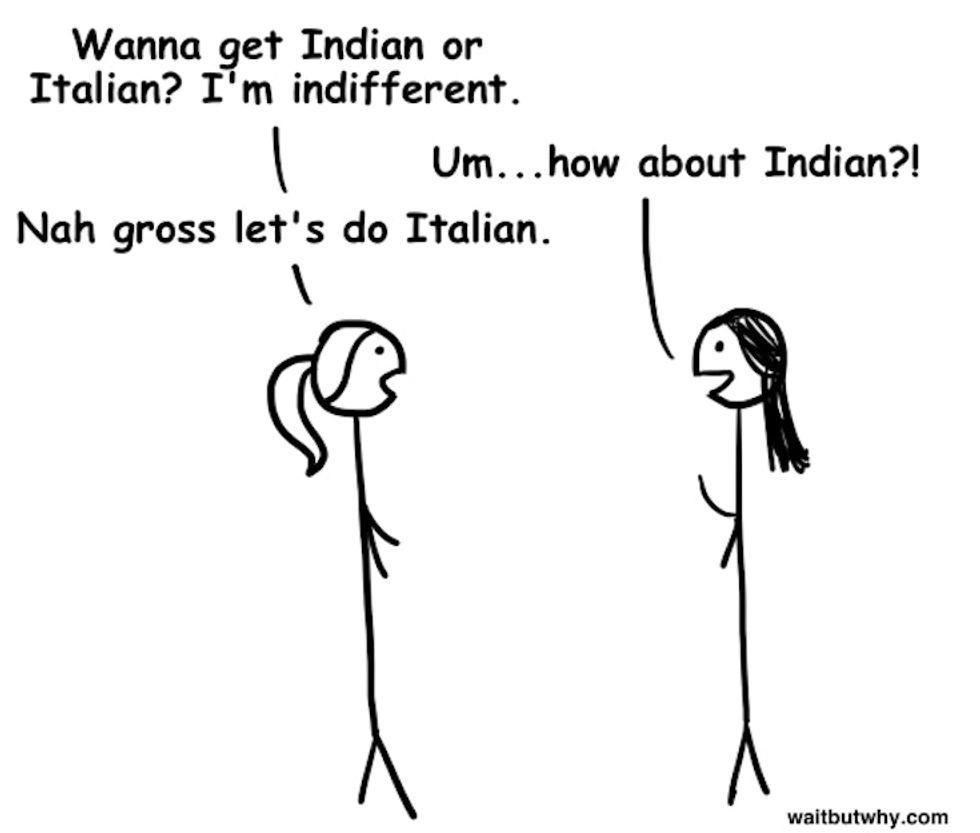
Can I make all the decisions... that was rhetorical.
via Wait But Why post and used with permission.
There are a lot of ways a friendship can be lopsided: Someone can be higher on their friend's mountain than vice versa. Someone can want to spend more time with a friend than vice versa. One member can consistently do 90% of the listening and only 10% of the talking, and in situations where most of the talking is about life problems, what's happening is a one-sided therapy situation, with a badly off-balance give-and-take ratio, and that's not much of a friendship—it's someone using someone else.
And then there's the lopsided power friendship. Of course, this is a hideous quality in many not-great couples, but it's also a prominent feature of plenty of friendships.
A near 50/50 friendship is ideal, but anything out to 65/35 is fine and can often be attributed to two different styles of personality. It's when the number gap gets even wider that something less healthy is going on—something that doesn't reflect very well on either party.
There are some obvious ways to assess the nature of a friendship's power dynamic: Does one person cut in and interrupt the other person while they're talking far more than the other way around? Is one person's opinion or preference just kind of understood to carry more weight than the other's? Is one person allowed to be more of a dick to the other than vice versa?
Another interesting litmus test is what I call the “mood determiner test." This comes into play when two friends get together but they're in very different moods — the idea is, whose mood “wins" and determines the mood of the hangout. If Person A is in a bad mood, Person B is in a good mood, and Person B reacts by being timid and respectful of Person A's mood, leaving the vibe down there until Person A snaps out of it on her own — but when the moods are reversed, Person B quickly disregards her own bad mood and acts more cheerful to match Person A's happy mood — and this is how it always goes — then Person A is in a serious power position.
But hey, not all friendships are grim.
In the Does This Friendship Make Sense graph above, the friendships we just discussed are all in Quadrants 2, 3, or 4 — i.e., they're all a bit unenjoyable, unhealthy, or both. That's why this has been depressing. On the bright side, there's also Quadrant 1—all the friendships that do make sense.
No friendship is perfect, but those in Quadrant 1 are doing what friendships are supposed to do: They're making the lives of both parties better. And when a friendship is both in Quadrant 1 of the graph and on Tier 1 of your mountain, that friendship is a rock in your life.
Rock friendships don't just make us happy — they're the thing (along with rock family and romantic relationships) that makes us happy.
Investing serious time and energy into those is a no-brainer long-term life strategy. But in the case of most people over 25—at least in New York— I think A) not enough time is carved out as dedicated friend time, and B) the time that is carved out is spread too thin, and too evenly, among the Tier 1 and Tier 2 friendships in all four quadrants. I'm definitely guilty of this myself.
There's something I call the Perpetual Catch-Up Trap. When you haven't seen a good friend in a long time, the first order of business is a big catch-up — you want to know what's going on in their career, with their girlfriend, with their family, etc., and they want to catch up on your life. In theory, once this happens, you can go back to just hanging out, shooting the shit, and actually being in the friendship. The problem is, when you don't make enough time for good friends, seeing them only for a meal and not that often — you end up spending each get-together catching up, and you never actually get to just enjoy the friendship or get far past the surface. That's the Perpetual Catch-Up Trap, and I find myself falling into it with way too many of the rocks in my life.
There are two orders of business right now:
First, think about your friendships, figure out which ones aren't in Quadrant 1, and demote them down the mountain. I'm not suggesting you stop being friends with those people—you still love them and feel loyal to them, and old friends are critical to hold onto—but if the friendships aren't that healthy or enjoyable, they don't really deserve to be in your Tier 1, and you probably shouldn't be in theirs. Most importantly, doing this clears up time to...
Second, dedicate even more time to the Quadrant 1, Tier 1 rocks in your life. If you're in your mid-20s or older, your current rocks are probably the only ones you'll ever have. Your rock friendships don't warrant two times the time you give to your other friends—they warrant five or 10 times!
Your rocks deserve serious, dedicated time so you can stay close. So go make plans with them.
This article was written by Tim Urban and originally published on Wait But Why. It originally appeared here nine years ago.
- People are sharing how they end conversations with excessive talkers - Upworthy ›
- Preschooler's deep thoughts on friendship are too relatable - Upworthy ›
- Video shows how baby talk in adult relationships is healthy - Upworthy ›
- He asked her to turn down a promotion to spare his ego and the story went viral - Upworthy ›
- Sit to stand test is a good indicator of longevity - Upworthy ›
- Why the '7 friends theory' is a problematic idea - Upworthy ›
- Woman's best friend reveals her secret strange pets - Upworthy ›
- Woman explains how we've devolved to 'catch-up friendships' - Upworthy ›
- Mom shares "Kind Can" idea to help her daughter make friends - Upworthy ›

 A Generation Jones teenager poses in her room.Image via Wikmedia Commons
 An office kitchen.via
  An angry man eating spaghetti.via
 Gif of baby being baptized
 Woman gives toddler a bath Canva


An Irish woman went to the doctor for a routine eye exam. She left with bright neon green eyes.
It's not easy seeing green.
Did she get superpowers?
Going to the eye doctor can be a hassle and a pain. It's not just the routine issues and inconveniences that come along when making a doctor appointment, but sometimes the various devices being used to check your eyes' health feel invasive and uncomfortable. But at least at the end of the appointment, most of us don't look like we're turning into The Incredible Hulk. That wasn't the case for one Irish woman.
Photographer Margerita B. Wargola was just going in for a routine eye exam at the hospital but ended up leaving with her eyes a shocking, bright neon green.
At the doctor's office, the nurse practitioner was prepping Wargola for a test with a machine that Wargola had experienced before. Before the test started, Wargola presumed the nurse had dropped some saline into her eyes, as they were feeling dry. After she blinked, everything went yellow.
Wargola and the nurse initially panicked. Neither knew what was going on as Wargola suddenly had yellow vision and radioactive-looking green eyes. After the initial shock, both realized the issue: the nurse forgot to ask Wargola to remove her contact lenses before putting contrast drops in her eyes for the exam. Wargola and the nurse quickly removed the lenses from her eyes and washed them thoroughly with saline. Fortunately, Wargola's eyes were unharmed. Unfortunately, her contacts were permanently stained and she didn't bring a spare pair.
- YouTube youtube.com
Since she has poor vision, Wargola was forced to drive herself home after the eye exam wearing the neon-green contact lenses that make her look like a member of the Green Lantern Corps. She couldn't help but laugh at her predicament and recorded a video explaining it all on social media. Since then, her video has sparked a couple Reddit threads and collected a bunch of comments on Instagram:
“But the REAL question is: do you now have X-Ray vision?”
“You can just say you're a superhero.”
“I would make a few stops on the way home just to freak some people out!”
“I would have lived it up! Grab a coffee, do grocery shopping, walk around a shopping center.”
“This one would pair well with that girl who ate something with turmeric with her invisalign on and walked around Paris smiling at people with seemingly BRIGHT YELLOW TEETH.”
“I would save those for fancy special occasions! WOW!”
“Every time I'd stop I'd turn slowly and stare at the person in the car next to me.”
“Keep them. Tell people what to do. They’ll do your bidding.”
In a follow-up Instagram video, Wargola showed her followers that she was safe at home with normal eyes, showing that the damaged contact lenses were so stained that they turned the saline solution in her contacts case into a bright Gatorade yellow. She wasn't mad at the nurse and, in fact, plans on keeping the lenses to wear on St. Patrick's Day or some other special occasion.
While no harm was done and a good laugh was had, it's still best for doctors, nurses, and patients alike to double-check and ask or tell if contact lenses are being worn before each eye test. If not, there might be more than ultra-green eyes to worry about.