upworthy
Add Upworthy to your Google News feed.
Google News Button
History (Education)

The actual border between the U.S. and Canada is much stranger than people realize

The border may look like a simple, mostly straight line, but it's got some weird quirks.

canada, united states, canadian border, international border, geography

The border between the U.S. and Canada has some funky anomalies.

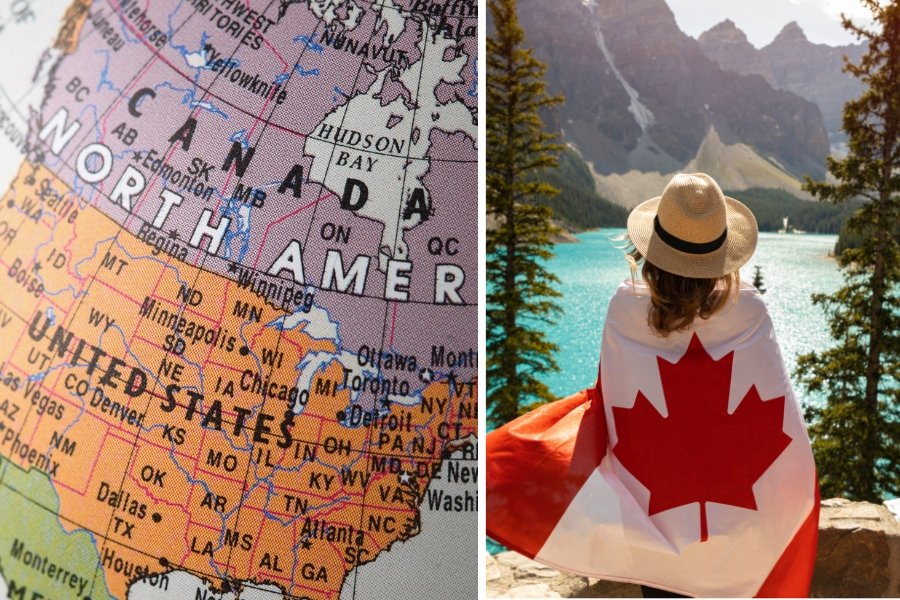
Canada has been the United States' friendly upstairs neighbor for over 150 years, with people on both sides of the border enjoying good relations and a mutual flow of tourism and trade. But the border that separates us is a bit…odd, and not just because President Trump's confusing second-term commentary about it: "If you look at a map, they drew an artificial line right through it, between Canada and the U.S. Just a straight, artificial line. Somebody did it a long time ago, many many decades ago. Makes no sense."

The border itself was formed before Canada officially became a country, when the 49th parallel was negotiated with Britain to become the boundary (without consulting the indigenous tribes that lived along it, which caused no shortage of confusion and displacement). But what appears to be a "straight, artificial line" is not actually straight (and no more artificial than any other manmade border). It's actually a kind of wobbly line with some dips and blips and sticky-outy-places and islands-in-dispute that the average American and Canadian remain largely unaware of.

Long before the leader of the free world began pontificating on the Canadian-U.S. border, CGP Grey created a video that shines a light on how strange it actually is.

Check this out:

- YouTubewww.youtube.com


The 5,500-mile-long border is the longest border between two countries in the world, and there's a 20-foot wide space along the border that's been deforested as basically a "no touchy" zone to delineate where it is. The border line looks straight on a map, but the actual, official border is actually 900 zig-zagging lines that twist and turn by as much as several hundred feet. The uncharted wilderness that made up most of the border when it was being established explains why the line is not perfectly straight. However, as CGP Grey points out, the hundreds of monuments marking the international border are in "about as straight a line as you could expect a pre-GPS civilization to make."

There are some strange anomalies along our border, including an island in the Northeastern U.S./Southeastern Canada that both countries believe belong to them. Machias Seal Island has a fascinating history as it's been a disputed territory since the origination of the border, with Canada and the U.S. holding different interpretations of what defines the parameters of the border. But thankfully, it's a peaceful dispute—or at least it has been so far.

- YouTubewww.youtube.com

Another weird anomaly on the Canadian border is the little rectangle of land that juts out from the top of Minnesota into the province of Manitoba, mostly over a lake. Oddly enough, that's a result of the erroneous way some maps that were used to plot out the border were made, which eventually led to a dilemma over how to connect the border in that area. Known as the Northwest Angle, or as locals call it, the Angle, this remote area of land and water actually marks the northernmost point in the contiguous U.S.

Another place where the 49th parallel caused an issue was with Vancouver Island, as the line cut off the southernmost tip of the island. That was easily solved by just going around it, but there is a tiny piece of U.S. land that gets cut off on the Canadian mainland, Point Roberts, which creates a bit of a strange reality for the 1,000 or so Americans who live there. Basically, residents can't drive anywhere else without crossing the border, including the kids who go to middle school and high school around the crook of Canadian land that connects the peninsula to the rest of Washington State. Not the end of the world to cross the border a few times a day as long as our countries remain on good terms.

There are several other places along the Canada-U.S. border where one country contains a little bit of the other, creating a fun little game of figuring out why certain places are the way they are. But again, as long relations between our countries stay friendly, those little quirks just constitute a fun part of our mutual history and are not a cause for conflict. Let's do our best to keep it that way.

Planet

Our favorite giveaway is back. Enter to win a free, fun date! 🌊 💗

It's super easy, no purchase or donation necessary, and you help our oceans! That's what we call a win-win-win. Enter here.

Our favorite giveaway is back. Enter to win a free, fun date! 🌊 💗
True

Our love for the ocean runs deep. Does yours? Enter here!

This Valentine’s Day, we're bringing back our favorite giveaway with Ocean Wise. You have the chance to win the ultimate ocean-friendly date. Our recommendation? Celebrate love for all your people this Valentine's Day! Treat your mom friends to a relaxing spa trip, take your best friend to an incredible concert, or enjoy a beach adventure with your sibling! Whether you're savoring a romantic seafood dinner or enjoying a movie night in, your next date could be on us!

Here’s how to enter:


  • Go to upworthy.com/oceandate and complete the quick form for a chance to win - it’s as easy as that.
  • P.S. If you follow @oceanwise or donate after entering, you’ll get extra entries!

Here are the incredible dates:

1. Give mom some relaxation

She’s up before the sun and still going at bedtime. She’s the calendar keeper, the lunch packer, the one who remembers everything so no one else has to. Moms are always creating magic for us. This Valentine’s Day, we’re all in for her. Win an eco-friendly spa day near you, plus a stash of All In snack bars—because she deserves a treat that’s as real as she is. Good for her, kinder to the ocean. That’s the kind of love we can all get behind.


Special thanks to our friends at All In who are all in on helping moms!

2. Jump in the ocean, together

Grab your favorite person and get some much-needed ocean time. Did you know research on “blue spaces” suggests that being near water is linked with better mental health and well-being, including feeling calmer and less stressed? We’ll treat you to a beach adventure like a surfing or sailing class, plus ocean-friendly bags from GOT Bag and blankets from Sand Cloud so your day by the water feels good for you and a little gentler on the ocean too.

Special thanks to our friends at GOT Bag. They make saving the ocean look stylish and fun!

3. Couch potato time

Love nights in as much as you love a date night out? We’ve got you. Have friends over for a movie night or make it a cozy night in with your favorite person. You’ll get a Disney+ and Hulu subscription so you can watch Nat Geo ocean content, plus a curated list of ocean-friendly documentaries and a movie-night basket of snacks. Easy, comfy, and you’ll probably come out of it loving the ocean even more.

4. Dance all day!

Soak up the sun and catch a full weekend of live music at BeachLife Festival in Redondo Beach, May 1–3, 2026, featuring Duran Duran, The Offspring, James Taylor and His All-Star Band, The Chainsmokers, My Morning Jacket, Slightly Stoopid, and Sheryl Crow. The perfect date to bring your favorite person on!

We also love that BeachLife puts real energy into protecting the coastline it’s built on by spotlighting ocean and beach-focused nonprofit partners and hosting community events like beach cleanups.

Date includes two (2) three-day GA tickets. Does not include accommodation, travel, or flights.

5. Chef it up (at home)

Stay in and cook something delicious with someone you love. We’ll hook you up with sustainable seafood ingredients and some additional goodies for a dinner for two, so you can eat well and feel good knowing your meal supports healthier oceans and more responsible fishing.

Giveaway ends 2/15/26 at 11:59pm PT. Winners will be selected at random and contacted via email from the Upworthy. No purchase necessary. Open to residents of the U.S. and specific Canadian provinces that have reached age of majority in their state/province/territory of residence at the time. Please see terms and conditions for specific instructions. Giveaway not affiliated with Instagram. More details at upworthy.com/oceandate

Pets

Vet demonstrates 'squish the cat' method of safe cat handling in delightfully helpful video

There's a reason Dr. Burstyn's "How to pick up a cat" video has been viewed 23 million times.

cats, pets, cat handling, veterinarian, feline behavior

Handling a cat may seem like a delicate matter, but being delicate isn't actually the way to go.

If you've ever tried to make a cat do something it doesn't want to do, you've likely experienced the terror that a cat's wrath can invoke. Our cute, cuddly feline friends may be small, but the razor blades on their feet are no joke when they decide to utilize them. Even cats who love us can get spicy if we try to manhandle them, so we can imagine how things will go with cats who don't know us well. But sometimes it's necessary to handle a cat even if it's resistant to the idea.

This is where Vancouver veterinarian Dr. Uri Burstyn comes in. His "How to pick up a cat like a pro" video, in which he demonstrates a few ways of picking up and handling a cat, has been viewed over 23 million times since he shared it in 2019. Unlike many viral videos, it's not humorous and nothing outrageous happens, but the combo of Burstyn's calm demeanor and his repeated instructions to "squish that cat" has endeared him to the masses.


- YouTube www.youtube.com

The video truly is helpful; he shows the ways to pick up a cat that make them feel the most secure using his cats, one-year-old Claudia and 14-year-old Mr. Pirate. He explains that cats spook very easily and it's best to introduce yourself to them gently. Let them sniff your fingers, keeping your fingers curled in, and once they've sniffed you, you can often give them a light rub on the cheek or under the chin.

Picking them up is a different story. The reason many cats will claw or scratch you when you try to pick them up is because they feel unsupported or unsafe, so they'll scramble around trying to get some footing. Burstyn shows how he picks up Claudia with one hand under the chest and one hand under her abdomen. If he needs to carry her around, he squishes her into his body so she feels "nice and supported." He may even put a hand under her front paws.

cats, pets, cat handling, veterinarian, feline behavior Cats can be finicky about how they're held. Photo credit: Canva

Then came the best part of the video: "Squish That Cat"

"Now if we do have a cat who's trying to get away from us?" Burstyn said. "We always squish that cat. If you're trying to hold the cat down, whether it's to trim their nails or to give them a pill, or whether you just want to have a cat not run off for a moment, squish that cat. All you need to know about cat restraint is to squish that cat."

Burstyn explains that cats generally feel very secure being squished, even if they're really scared.

"Sometimes cats come to me in the clinic, and they're quite afraid," he said. "And you just gently squish them, and they'll sit there and kind of not hurt themselves, not hurt us. Just hang out and let us do our thing."

He demonstrated putting a towel over the cat, explaining, "If you have a towel handy, this is one of the best cat restraint tools around. You can just throw a towel on the catty and squish her with the towel, that way they won't get a claw into you if they are scrambling about a bit. Very safe and gentle, and generally cats are very, very happy to be squished like that."

cats, pets, cat handling, veterinarian, feline behavior Squish that cat. Photo credit: Canva

Dr. Burstyn also showed how to do a "football hold," tucking the cat under your arm with them facing backwards. "So this is kind of an emergency way if you really need to carry a cat somewhere in a hurry," he said. Scooping up Claudia, he explained, "Little head's under your arm, butt in your hand, and you squish her tight to your body. And with that little football carry, you can basically hold a cat very securely and very safely, because it's really hard for them to rake you with their hind legs."

If you're worried about over-squishing your cat, Dr. Burnstyn says don't. "You don't have to worry about hurting a cat," he said. "They're very, very tough little beasts. You know, just squishing them against your body's never going to do them any harm. In fact, they tend to feel more safe and secure when they're being held tightly."

Dr. Burnstyn also demonstrated how to pick up and set down a "shoulder cat" who insists on climbing onto people's shoulders and hanging out there, as Mr. Pirate does. It's highly entertaining, as Mr. Pirate is a big ol' chonky kitty.


@yozron

she loves my shoulders i guess #catcore #kittendad #kittensoftiktok #cat #fyp

People in the comments loved Dr. Burnstyn's demonstration, with several dubbing him the Bob Ross of veterinary medicine. Even people who don't have cats said they watched the whole video, and many loved Claudia and Mr. Pirate as well.

"This is just proof that cats are liquid."

"12/10 cat. Excellent squishability."

"So essentially, cats love hugs? That's the most wonderful thing i've heard all day."

"This cat is so well mannered and looks educated."

"Mr Pirate is an absolute unit."

"S q u i s h . T h a t . C a t ."

"I need 'Squish that cat' shirt.

"Dang, that actually helped with my female cat. She has been through at least two owners before me and had some bad expriences which obviously resulted in trust issues. She has now been with me for two years and it had gotten loads better, but she still did not want me to hold her. Normally I simply would have let her be, but for vet visits and such it was not an ideal situation. But then I saw this video and tried to squish the cat. And she loves it! She is turning into quite the snuggly bug. Thank you!"

So there you go. When all else fails, squish that cat and see what happens.

You can follow Dr. Burstyn on YouTube at Helpful Vancouver Vet.


slow dances, school dances, millennials, gen x, music nostalgia
Photo credit: Canva, annastills (main image) / anlomaja (text box)

A young couple dances.

When you think back to your own school dances—from buttoned-up proms to casual after-the-ballgame romps—you may feel a tinge of wistful sadness, teenage angst, or residual awkwardness. But no matter the emotion, or perhaps because of it, you probably remember exactly which songs were playing. If you happen to hear an R&B slow jam or a classic rock power ballad on the radio, all of those feelings can come flooding back.

While some tracks transcend age, every generation has its definitive slow-dance songs. If you look around online, you'll find numerous threads devoted to the topic, with hundreds of people casting their votes. So let's all shuffle into our collective gymnasium and remember some of these eternal bangers.


- YouTube www.youtube.com

"I can almost smell the gym full of kids wearing too much cologne"

Our first stop is the r/GenX subreddit, where users shared some staples from middle school and high school. The OP mentioned a handful of '80s hits from Journey ("Open Arms," "Faithfully," and "Who's Crying Now") as well as favorites from Foreigner ("Waiting for a Girl Like You" and "I Want to Know What Love Is"). They also highlighted the Joe Cocker and Jennifer Warnes duet "Up Where We Belong," which sounds like it was scientifically engineered for slow dancing.

Here are some other popular responses:

  • Bryan Adams - "(Everything I Do) I Do It For You"
  • Bryan Adams - "Heaven"
  • Cyndi Lauper - "Time After Time"
  • The Cars - "Drive"
  • Nazareth - "Love Hurts"
  • The Bangles - "Eternal Flame"

"OMG," one person wrote. "[R]eading through this I can almost smell the gym full of kids wearing too much cologne and the popcorn machine run by a lunch lady getting in some overtime."

- YouTube www.youtube.com

"Still love that song!"

One song kept popping up in threads for both Xennials and Millennials: K-Ci & JoJo's 1998 R&B anthem "All My Life."

"My senior prom, I remember slow dancing to 'All My Life' by K-Ci & JoJo," one user wrote. "Still love that song!"

Another Redditor added, "STOP IT. I opened the comments to say exactly this."

These other '90s songs also got some votes:

  • Seal - "Kiss From a Rose"
  • Boyz II Men - "End of the Road"
  • Aerosmith - "I Don't Want to Miss a Thing"
  • Savage Garden - "I Knew I Loved You"
  • Goo Goo Dolls - "Iris"
  • Celine Dion - "My Heart Will Go On"
  • All-4-One - "I Can Love You Like That"
  • Edwin McCain - "I'll Be"
  • Brian McKnight - "Back at One"

But what about the current millennium? Do teenagers even slow-dance these days? In 2023, Billboard's Kyle Denis spoke with a number of DJs to find out whether the ritual has disappeared for Gen Z. It's a fascinating look at shifting cultural norms, including how factors such as the omnipresence of camera phones and the lyrical sentiments of popular songs have helped drive that change.

"I feel like the content directly relates to it—to me, slow [dancing] goes with more romantic music," said DJ R-Tistic. "Whether it's [Jodeci's] 'Forever My Lady,' a Luther [Vandross] song, or even, for the late '90s, a D'Angelo-Lauryn Hill 'Nothing Even Matters.' Those [songs] are more about romance."

- YouTube www.youtube.com

guitar, learning a skill, neuroscience, music, exposure, passive exposure, gardening

A woman learning how to play guitar.

Learning a new skill, such as playing an instrument, gardening, or picking up a new language, takes a lot of time and practice, whether that means scale training, learning about native plants, or using flashcards to memorize new words. To improve through practice, you have to perform the task repeatedly and receive feedback so you know whether you’re doing it correctly. Is my pitch correct? Did my geraniums bloom? Is my pronunciation understandable?

However, a new study by researchers at the Institute of Neuroscience at the University of Oregon shows that you can speed up these processes by adding a third element to practice and feedback: passive exposure. The good news is that passive exposure requires minimal effort and is enjoyable.


"Active learning of a... task requires both expending effort to perform the task and having access to feedback about task performance," the study authors explained. "Passive exposure to sensory stimuli, on the other hand, is relatively effortless and does not require feedback about performance."


woman reading, woman book, young woman, studying, new skills A woman reading a book.via Canva/Photos

How to pick up new skills faster?

So, if you’re learning to play the blues on guitar, listen to plenty of Howlin’ Wolf or Robert Johnson throughout the day. If you’re learning to cook, keep the Food Network on TV in the background to absorb some great culinary advice. Learning to garden? Take the time to notice the flora and fauna in your neighborhood or make frequent trips to your local botanical garden.

If you’re learning a new language, watch plenty of TV and films in the language you are learning. The scientists add that auditory learning is especially helpful, so listen to plenty of audiobooks or podcasts on the subject you’re learning about.

But, of course, you also have to be actively learning the skill as well by practicing your guitar for the recommended hours each day or by taking a class in languages. Passive exposure won't do the work for you, but it's a fantastic way to pick up things more quickly. Further, passive exposure keeps the new skill you're learning top-of-mind, so you're probably more likely to actively practice it.

What is passive exposure?

Researchers discovered the tremendous benefits of passive exposure after studying a group of mice. They trained them to find water by using various sounds to give positive or negative feedback, like playing a game of “hot or cold.” Some mice were passively exposed to these sounds when they weren't looking for water. Those who received this additional passive exposure and those who received active training learned to find the water reward more quickly.

gardening, woman gardening, gardening shears, leaning gardening, weeds A woman tending to her garden.via Canva/Photos


“Our results suggest that, in mice and in humans, a given performance threshold can be achieved with relatively less effort by combining low-effort passive exposure with active training,” James Murray, a neuroscientist who led the study, told University of Oregon News. “This insight could be helpful for humans learning an instrument or a second language, though more work will be needed to better understand how this applies to more complex tasks and how to optimize training schedules that combine passive exposure with active training.”

The one drawback to this study was that it was conducted on mice, not humans. However, recent studies on humans have found similar results, such as in sports. If you visualize yourself excelling at the sport or mentally rehearse a practice routine, it can positively affect your actual performance. Showing, once again, that when it comes to picking up a new skill, exposure is key.

The great news about the story is that, in addition to giving people a new way to approach learning, it’s an excuse for us to enjoy the things we love even more. If you enjoy listening to blues music so much that you decided to learn for yourself, it’s another reason to make it an even more significant part of your life.

- YouTube www.youtube.com

This article originally appeared last year.

science, scientific research, remote touch, human touch, five senses, sixth sense, seventh sense, shorebirds, tactile foraging

A person moves their hand through sand.

Humans have five main senses, of course, and there's even strong scientific agreement about a sixth: proprioception, or the ability to sense where our limbs are in space. But new research suggests we may also have a "seventh sense." Scientists are calling it "remote touch."

A study out of Queen Mary University of London (QMUL) recently set out to examine how humans compare to common shorebirds like sanderlings, sandpipers, and plovers.


These birds are masters at finding prey hidden in the sand. In fact, their survival depends on it. By sticking their beaks into the sand, they use a tactile foraging system finely tuned to detect subtle vibrations and pressure changes, alerting them to food sources they can't see, smell, or hear.

science, scientific research, remote touch, human touch, five senses, sixth sense, seventh sense, shorebirds, tactile foraging A sanderling looks for food. Photo by Joshua J. Cotten on Unsplash

The researchers had a hunch that humans might possess a similar ability and decided to put it to the test. They buried small cubes in a container of sand and asked participants to gently move their fingers around. Volunteers were told to stop when they felt they were close to touching or finding a cube, but before actually making physical contact with it.

Surprisingly, the results showed that humans were quite adept at sensing the object's presence before they could touch it.

"Participants were able to perceive extremely small shifts in the sand caused by the buried object," QMUL wrote on SciTechDaily. "This level of sensitivity comes close to the theoretical physical limit for detecting mechanical reflections in granular material, where moving sand subtly changes direction or resistance when it encounters a stable surface beneath it."

On average, the human participants in the study were about 70 percent accurate at detecting the hidden cube without actually touching it.

science, scientific research, remote touch, human touch, five senses, sixth sense, seventh sense, shorebirds, tactile foraging Humans' sense of remote touch has never been put to the test before. Photo by Juli Kosolapova on Unsplash

We've known for a long time that humans can be very sensitive to subtle changes in heat, pressure, and sensation.

For example, it's been a common party trick among kids for decades. One person closes their eyes while another slowly moves a finger toward the center of their forehead. Usually, the person with their eyes closed can sense when the finger is close, even before it actually makes contact. There might be a tingling, tickling, or light buzzing feeling.

However, research from QMUL shows just how advanced our remote touch abilities really are. To add further context for how finely tuned humans' remote touch ability is, the researchers then tested specially designed robots on the same task.

The robot, armed with tactile sensors, was able to detect the hidden cube from farther away than humans, but it was far less accurate overall, with just 40 percent precision.

The implications of this first-of-its-kind study are vast. For example, we may be able to better train robots based on what we learn about humans' extraordinarily fine-tuned sense of touch.

"The discovery opens possibilities for designing tools and assistive technologies that extend human tactile perception," said Zhengqi Chen, a PhD student at QMUL's Advanced Robotics Lab. "These insights could inform the development of advanced robots capable of delicate operations, for example locating archaeological artifacts without damage, or exploring sandy or granular terrains such as Martian soil or ocean floors. More broadly, this research paves the way for touch-based systems that make hidden or hazardous exploration safer, smarter, and more effective."

More immediately, it's always amazing to discover new things about the human body and how it works. Our sense of touch, in particular, is incredibly complex and fascinating. Did you know that the "phantom touch illusion" can cause people to experience physical sensations when they aren't being touched at all? Or that amputees sometimes feel phantom pain coming from a limb that no longer exists?

- YouTube www.youtube.com

According to the researchers, remote touch has never been studied in humans before, and we're truly only scratching the surface when it comes to understanding this extraordinary ability. It's also exciting to think about what an eighth sense might one day turn out to be.

ballet dancer, dementa, ballerina, poetry, poem

"I am still a dancer made of song."

What makes poetry poetry? There are certain technical elements that a poem might include, like rhyme and meter, but plenty of poetry doesn't follow any structural rules.

Perhaps the best definition of poetry comes from Emily Dickinson, who wrote, “If I feel physically as if the top of my head were taken off, I know that is poetry.” A good poem hits you in your brain, your heart, and your gut all at once. And one short poem that packs an incredibly moving punch has come from an unlikely source—an elderly woman with dementia.


Poet Joseph Fasano shared a message from a fan who shared that they used one of Fasano's poetry prompts with their mother, a 92-year-old former ballet dancer living with dementia. The mother was excited to write a poem, and they slowly worked through the prompt together aloud.

This poem was the result:

"Let the days be warm

Let the fall be long.

Let every child inside me find her shoes

and dance wildly, softly, toward the world.

I have a story I have never told

Once, when I was small,

I looked up at the sky and saw the wind

and knew I was a dancer made of song.

I am still a dancer made of song."

Wow. What a testament to the power of poetry to reach beyond our usual modes of communication, which dementia so cruelly disrupts. In a few simple lines, we're able to see this woman as she might see herself, as the human living under the veils of age and disease: "I am still a dancer made of song."

Poetry prompts can help people express themselves in ways they otherwise couldn't

The person who shared the poem thanked Fasano for "helping people find their voices," which is exactly what his book of poetry prompts, "The Magic Words: Simple Poetry Prompts That Unlock the Creativity in Everyone," was meant to do.

magic words, joseph fasano, poetry prompts, poems, creativity "The Magic Words" is a book of poetry prompts from Joseph Fasano. assets.rebelmouse.io

In the book's introduction, Fasano shares that he'd been invited to speak to a class of second graders in New Jersey in 2022 to share "the craft and magic of poetry." As part of his efforts, he came up with a poetry prompt that could "help guide their imaginations" and "unlock the images, thoughts and feelings inside them, without asking them to worry about how to structure a poem." He called the results "astonishing." When he shared one of the students' poems on social media, it and the prompt took off like wildfire, as people who never thought of themselves as poets felt empowered to share their imaginations within that framework.

From 7-year-olds to 92-year-olds, anyone can benefit from the self-expression that poetry facilitates, but many people feel hesitant or intimidated by the idea of writing a poem. Fasano writes, "Poetry is what happens when we let ourselves be," and this idea seems so clear in the former dancer's poem above. Dementia can create roadblocks, but poetry provides a different avenue of communication.

dementia, alzheimer's, elder care, caregiving, arts for dementia People with dementia are still themselves deep down. Photo credit: Canva

The arts can be a powerful tool for people with dementia

Using poetry to help dementia patients communicate and express themselves isn't just wishful thinking. Studies have demonstrated that cultural arts interventions, including poetry specifically, can be beneficial for people with dementia. In fact, the Alzheimer's Poetry Project (APP) aims to use poetry as a means of improving the quality of life of people living with dementia by facilitating creative expression. "We do not set boundaries in our beliefs in what possible for people with memory impairment to create," the APP website states. "By saying to people with dementia, we value you and your creativity; we are saying we value all members of our community."

Poet Gary Glazner founded APP and shared a story with WXPR radio about how he came up with the idea while studying poetry at Sonoma State University:

“I applied for a grant and got a grant to work at an adult care program. The moment I love to share with people is there was a guy in the group, head down, not participating and I said the Longfellow poem. ‘I shot an arrow into the air’ and his eyes popped open and he said, ‘It fell to earth I know not where.’ And suddenly he was with us and participating. It was just this powerful moment to see how poetry could be of use to elders but specifically with people with dementia."

dementia, alzheimer's, elder care, caregiving, arts for dementia Caregivers try many different ways to communicate with people living with dementia.Photo credit: Canva

Another initiative, Arts 4 Dementia, does poetry workshops with people in early stages of dementia.

"'Poetry allows freedom of expression and can add warmth and depth to what may start as prose," Arts 4 Dementia CEO Nigel Franklin told the Alzheimer's Society. "Through poetry, participants access certain images or memories from their lives, and build these fragments together. Older people living with dementia often learnt poems off by heart as a child, and many of these poems are still accessible. Our participants have early-stage dementia, so while short-term memory may be diminished, many skills can be retained. They are welcome to read poetry (at their own pace) or ask their companion to read and perhaps write what they have created. We give participants time to answer—we don't answer for them—and above all, we show respect and we're never patronising."

Whether we read it, write it, speak it, or hear it, poetry has the power to reach people of all ages and stages of life in all kinds of mysterious ways.

You can follow Joseph Fasano on Twitter and Instagram, and find his books on Amazon.

This article originally appeared two years ago and has been updated.