upworthy
Add Upworthy to your Google News feed.
Google News Button
Joy

People share unforgettable stories told by their grandparents, and some are just insane

These grandparents truly lived.

stories from grandparents reddit

When your grandpa's a BAMF.

It can be eye-opening to listen to stories told by our grandparents. For many of us, that might be the only connection we have to them.

Even the smallest glimpse into their former lives gives us insight–not only into their own personal history, but into the soul of a different era entirely. Of course, whether that inspires nostalgia or disgust depends on the story.

I, for instance, know next-to-nothing about my maternal grandfather, other than he used his job at a candy factory to cover the fact that he was in cahoots with an Asian mob. An odd thing to know about your grandfather, and I’ll never look at M&M’s the same way again.

stories from grandparentsGiphy

A Reddit user named LorieEve recently asked people to share stories from their own grandparents that they’d “never forget.” Some answers are short and simple. Others read like a sprawling novel. Some are hilarious; others heartbreaking. All offer a meaningful look into the past.

Here are 10 of the best responses:

1.

My grandfather was one of the earliest people to receive penicillin. His GP freaked out when he had a handwritten note from Alexander Fleming.” – melodicmusical

2.

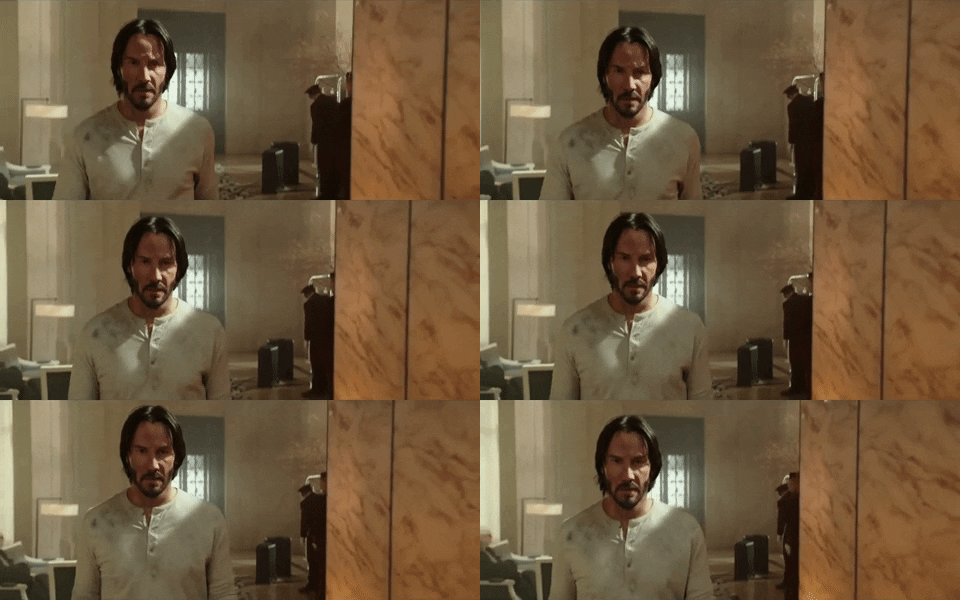
"My grandpa worked in a steel mill in Ohio during the 50s and 60s and he was robbed at gunpoint in the basement of said mill when he looked him in the eyes and said ‘nice gun, but mine’s bigger’ needless to say he was not robbed.

He was also launched out of a third story window and landed in a dumpster from a propane explosion. He had suffered 3rd degree burns and drove the other 3 people involved to the hospital where they received proper care. His scars are covered by his beard.

He was also involved in a helicopter crash that destroyed his back so he can no longer sit down very well. He also survived an airplane crash in the 50s when 3 out of the 4 engines lost power and caught fire. It was a military aircraft that had been repurposed after the war.

In the 60s he was involved in a car accident caused by 2 people who had just robbed a bank. He then helped the police chase them down in his partially destroyed car because he wanted insurance information.

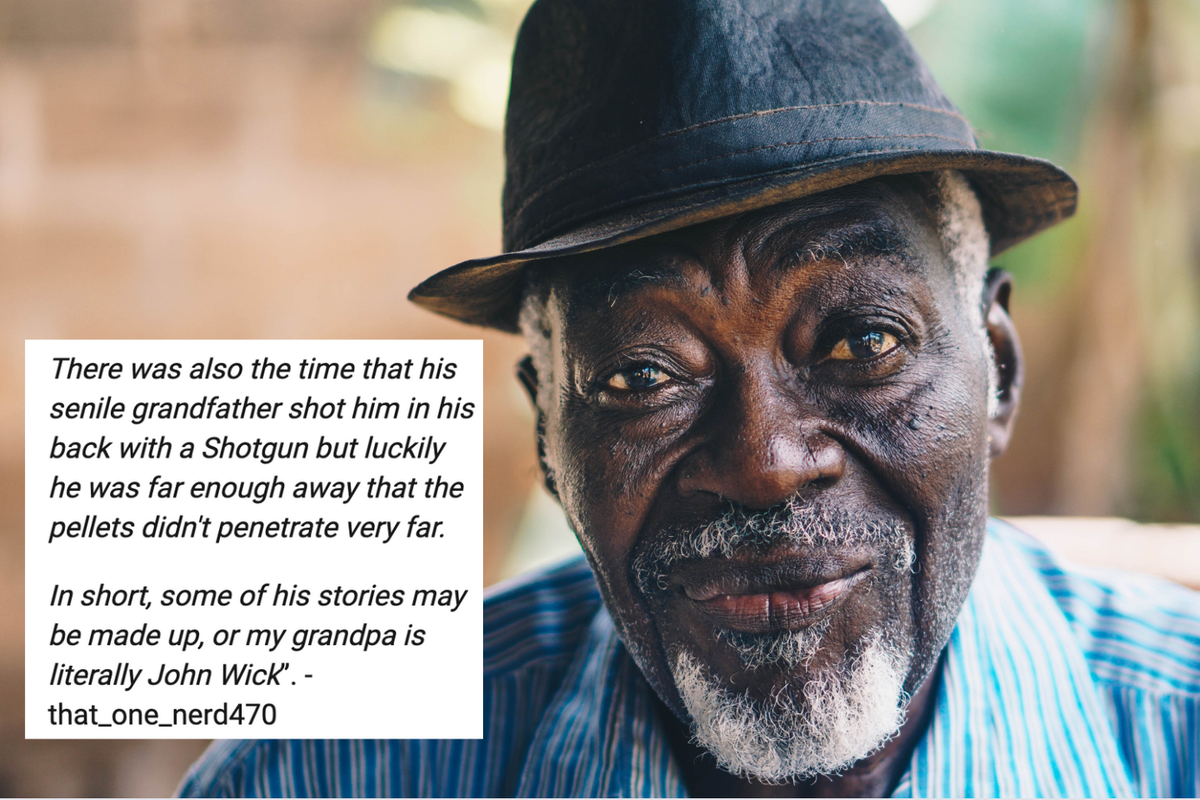
There was also the time that his senile grandfather shot him in his back with a shotgun but luckily he was far enough away that the pellets didn't penetrate very far.

In short, some of his stories may be made up, or my he's literally John Wick.” – that_one_nerd470
3.

My grandmother's brother was drafted in the Army and was sent to fight in the Korean War. He ended up in the 2nd Infantry Division. His division was caught in The Gauntlet and he didn’t make it back home. To this day, he is still unaccounted for.

Well, the day he left home the last time, my grandma went with him to the train station. She told me that the last thing he ever said to her was, ‘at least I made it back home for a home cooked meal before I left.’

She was probably well into her 70s when she told me that story. It still brought tears to her eyes.” – slider728

4.

My grandparents and all my relatives of that generation fled Germany after my great-grandfather was taken to a work camp.

My grandmother's most haunting story:

She was about 14, walking with a boy in their town square. She had blonde hair and would definitely 'pass' for Aryan. He apparently fit what the SS thought of as a Jew (he may have been wearing a yarmulke or other garment, I never knew that part.) The officers stopped them and grabbed him, told him to stay away from Aryan girls. He tried to say something, but didn't get to before they handcuffed him and dragged him away. They wished my grandmother goodnight and she never saw him again.” – DTownForever

5.

My grandmother's family fled for their lives from Austria to the USA. Her father had been an outspoken political opponent of Adolf Hitler, and helped organize an anti-Nazi resistance in his hometown. Then Hitler invaded Austria, and somebody was kind enough to tip my great-grandpa off that his name was on a list to get shipped off to the concentration camps.

My grandmother barely remembered Austria or the move to New York City. But she never forgot a year or so later walking into a store with her father one day, only to have the shopkeeper curse him out and refuse to serve him as soon as he opened his mouth and spoke with a German accent. That incident made a deep impression on her. She credited it with teaching her quickly…just how shitty prejudice can be, especially in times of war.

She never taught any of her children her native language. An enormous number of German-Americans lost or refused to pass on their heritage language during WWII, because that wasn't a great time to be visibly German in any way in the USA.” – hononononnoh

6.

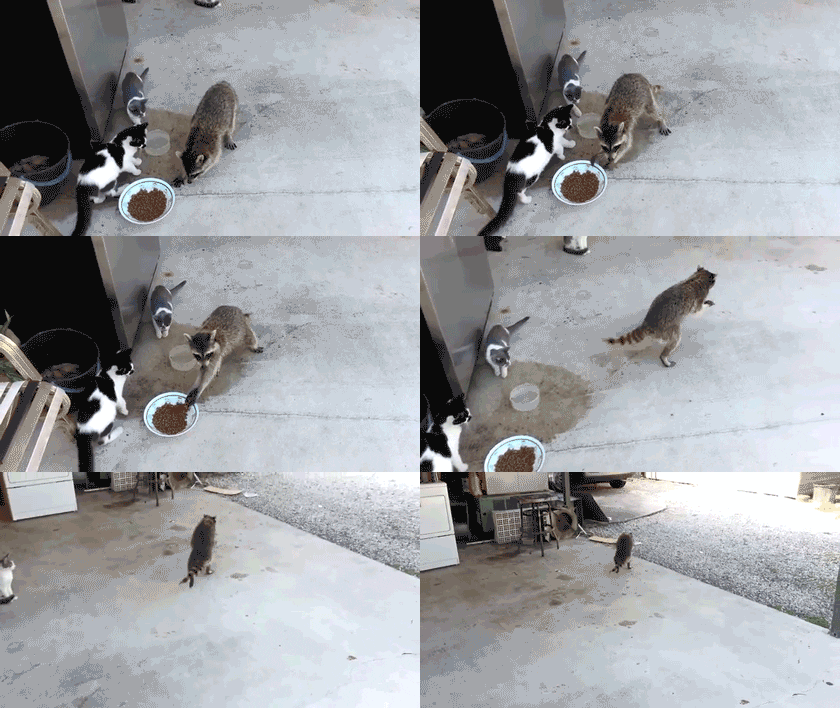
My grandfather was a kid during the Great Depression. He once told me they had raccoon one year for a special Christmas dinner.” – FlokiTrainer
7.

This one's more lighthearted than most.

Both of my grandparents grew up in South Africa, and dated throughout high school. Just as they're getting ready to graduate, Ouma's father decided to move the whole family to the US. Totally heartbroken, Ouma broke up with Oupa a week before the departure, then spent the next few days bawling her eyes out in between packing. To her surprise Oupa had 'taken the news way too well'.

On the day of the departure Ouma and her family arrive to find Oupa waiting on the dock for them. Ouma figured he was there to see them off, until she realizes that the suitcases all around his feet are his. And when he went to greet them he was holding a letter from his parents for her parents, a ticket for their ship, and an engagement ring. Turns out that man had looked so calm during the breakup because he'd already been planning on going across the ocean for her.

They're up in their eighties and still together now.” – Anxious_Cap51

8.

When my grandpa was 9 ish him and his friends were playing by the train tracks as people in their generation did. Him and his friends convinced a 4 year old who was playing with them at the time to get on a random train carriage where they then closed the door and told him he was going to Blackpool, he tried to frantically unlock the door but was too small to reach the lock.

He recalls watching this little boy's face as the train pulled off from the station.

After an hour the boy's mother asked them all where her son was where they just said ‘oh he's off to Blackpool.’ Luckily at the next train station a train conductor found the little boy and took him back on the next train.” – Remarkable-Ad-1107

9.

My grandfather was quite the badass when he was younger, lots of stories I remember from him, but I’ve gotta share this story:

Context, I’m a second gen Canadian which makes my grandparents the ones who immigrated. They immigrated from the Netherlands, which is popular for their culture, food, and of course beer.

When he immigrated to Canada, he knew some English but not much...There was a man who greeted my grandfather which I don’t remember how or when, but regardless, they got to talking and the man asked my grandfather to ‘go for a beer’. And in Holland when you're asked to go for a beer, it means go to the bar and go get a beer.

Note this was the late 60’s in Canada, and A&W was beginning to be popular. My grandfather of course agrees, to get to know more people around where he was going to live. The man brings my grandfather to A&W, for a root beer and a burger, so he was confused out of his mind not being able to speak a word of English in this new country, and trying to learn the culture. My grandfather then learned he hated root beer. He still has contact with the A&W man.” – I-am-johan

10.

My grandfather was a veteran of WWII, and one of the toughest but kindest people I ever had the honor of knowing.

One story from his military service he enjoyed sharing was his issues with driving on base. He was pulling up to his DI’s office, and went for a soft brake and park. Instead, due to how close the brake and gas pedals were in the truck he was driving, he hit the gas, and crashed into his DI’s office, stopping right at his desk.

While his DI stood there in shock and likely anger, my grandfather got out of the truck and just said hi. To which his DI responded ‘Hi? HI?! WHAT IS THE MATTER WITH YOU?!’

I miss my grandfather every day, and if there is a heaven, I hope he’s staying away from those trucks.” – SuburbanDJ


This article originally appeared two years ago.

empty nester, empty nesters, declutter, decluttering, decluttering tips

Mom and empty nester shares her tips for decluttering her home.

Deep cleaning and decluttering a home is a daunting task—especially for empty nesters. After spending a lifetime creating memories and living together under one roof, doing a big declutter can take an emotional toll.

It's a milestone that many empty nesters know the sting of. And in a cleaning community on Reddit, a 51-year-old mom and recent empty nester shared her experience cleaning and decluttering her home after entering this new phase of life.


"In my entire life, my house has always been messy. I mean, I didn’t have a disaster-level situation going on, but if someone dropped by unannounced, it would’ve been super embarrassing," she shared. "When my kids were younger, we had a housekeeper because I just couldn’t keep up. Now that we’re empty nesters, I realized I never really learned how to keep house."

- YouTube www.youtube.com

She explained that the book Unf*ck Your Habitat: You're Better Than Your Mess played an integral part in helping her declutter—and offered eight helpful tips to fellow empty nesters looking to organize their new lives.

1. Put stuff away, not down.

Her first tip is the key to decluttering.

"Whatever you have goes right back where it’s supposed to go when I’m done with it," she notes.

2. Do laundry every day.

And she doesn't just wash and dry her laundry when doing it.

"Just one load, start to finish. Wash, dry, fold, and put away," she shares. "Also, no chair or floor laundry. It gets put in the hamper or hung back up. No clothes are ever out."

3. I make the bed every day.

The benefits keep on giving by doing this, she notes.

"It just makes my bedroom look cleaner and I smile every time I come in my room," she writes. "Plus we aren’t fighting over the covers when we get in because the bed is straightened out."

- YouTube www.youtube.com

4. Do a quick daily clean-up of commonly used spaces.

She cleans the places that she and her husband use frequently.

"I keep a stack of cleaning rags in my master bath because it’s the only bathroom that’s used every single day. Every night, I spray the counter, wipe everything down, put everything back (that my husband leaves out), and wipe the mirror," she explains. "I also wipe down the toilet. I find that I don’t need a huge, big cleaning of this space because I’m keeping it up daily. Same goes for the kitchen."

5. Dishes are always put away, cabinet or dishwasher.

No dishes in the sink or stuck in the dishwasher.

"Dishes are finished in the dishwasher? It’s emptied and dirty ones are placed inside while waiting for the dishwasher to get full," she notes.

@brunchwithbabs

Life Changing Dishwasher Hack #tutorials #kitchenhacks #parentsoftiktok #dishwasherhack

6. Don't neglect your shoes.

When she takes them off, they get put away.

"Shoes are put away immediately upon walking in the house," she shares.

7. Knock out small tasks.

There is no time to waste.

"If it takes less than 5 minutes clean it while you’re waiting for something else to get done," she writes.

8. Take no days off.

Rather than assign certain days for cleaning, she is constantly doing it throughout the week.

"Lastly, I do not have scheduled cleaning days. I just do something all the time," she explains. "My life is kind of unpredictable, we love traveling or going out for the day so my so called cleaning schedule would be shot to hell every time. It’s better this way, because now I never feel behind."

bee gees, how deep is your love, bee gees live

The Bee Gees singing "How Deep is Your Love" in 1998.

Not all live performances are created equal, but when the circumstances and the talent are just right, they can far surpass studio recordings. In 1998, the Bee Gees, brothers Barry, Robin and Maurice Gibb, stopped by ITV’s “Des O'Connor Tonight” with acoustic guitars in hand to promote their recent release, “One Night Only,” an album and live concert DVD featuring many of the band’s biggest hits.

The highlight of the performance was when Barry got ready to strum his guitar for a performance of “How Deep Is Your Love,” the 1977 megahit from the “Saturday Night Fever Soundtrack,” but instead chose to sing the song a cappella.


Barry starts the song solo in his beautiful falsetto, but then, when his brothers join him, they create a wonderful harmony that only brothers can make. The show’s host, Des O’Connor, a notable singer himself, even joins in for a few bars.

- YouTube youtu.be

Earlier in the performance, the brothers played their version of “Islands in the Stream,” a song made famous by Dolly Parton and Kenny Rogers in 1983 that was written by the Bee Gees. In 1998, the song was enjoying a resurgence as its melody was used in the song “Ghetto Supastar” by Pras of The Fugees.

Robin Gibb later admitted that the song was initially written for Marvin Gaye to sing, but he was tragically murdered in 1984 by his father. The band also had Diana Ross in mind while composing the tune.

During the appearance, the band also sang “Guilty,” a song that the Bee Gees wrote for Barbara Streisand and Barry produced in 1980.

You can watch the entire performance here:

- YouTube youtu.be

The Gibb brothers started making music together when they were children, and after their first public appearance together at a local movie theater in 1956, they were hooked on performing.

“It was the feeling of standing in front of an audience that was so amazing," said Barry. "We’d never seen anything like it. We were very young, but it made an enormous impression. We didn’t want to do anything else but make music.”

After the family moved to Australia in 1958, Barry, Maurice, and Robin were "discovered" at the Redcliffe Speedway, where they had asked to perform between races. Even over the tinny PA system, their harmonies made an impression. Speedway manager Bill Goode introduced the trio to DJ Bill Gates, who set them up with a recording session.

the bee gees, gibb brothers, maurice, barry, robin gibb Stayin Alive GIF by Bee Gees Giphy

If you've ever wondered how the Bee Gees got their name, that was it: Bill Goode, Bill Gates, Barry Gibb, and the brothers' mother Barbara Gibb all had the initials B.G. After a strong reception on the airwaves in Brisbane, Gates forwarded the brothers' recordings to a Sydney radio station. They got a lot of airtime there as well, and the band had a run of success performing in Australia, but it wasn't until their return to England in 1967 that they became the international sensation we all know today.

Manager Robert Stigwood had received tapes from the Gibbs brothers and called them up within weeks of their arrival in the U.K.

“I loved their composing,” Stigwood told Rolling Stone in 1977. “I also loved their harmony singing. It was unique, the sound they made; I suppose it was a sound only brothers could make.”

- YouTube www.youtube.com

And, as they say, the rest is history. The award-winning 2020 HBO documentary, "The Bee Gees: How Can You Mend a Broken Heart" tells the story of the band with loads of footage from throughout their 40-year career, which includes not only their disco-era fame, but the various phases of their musical journey and the countless songs they wrote for other artists.

As one commenter wrote, "People that call the Bee Gees a 'disco group' don't have a clue. They had 10 albums out before they ventured into 'disco.' Their song catalogue is amazing and some of their very best songs were written long before Saturday Night Fever. Those 'disco' songs are classics as well. It is nice to see they are finally getting the recognition they deserve."

This article originally appeared last year. It has been updated.

Joe grew up without stability. Now, he’s giving 10 adopted sons the home he never had.
True
Dave Thomas Foundation for Adoption

Like many children who are placed in foster care across the United States, Joe’s childhood was marked by chaos and a struggle to survive.

Joe still remembers neglect and abuse being part of his daily reality. Often left to care for his younger siblings alone, Joe grew up far too quickly.


He and his brothers were placed in the New York foster care system at an early age. And when he aged out of foster care at 21, he had no family to turn to for support.

“Statistically, I should be in jail, or I could be dead,” Joe said. “But that’s not my destiny.”

Today, Joe is determined to change the trajectory for young people lingering in foster care … as an adoptive parent and as an advocate, raising awareness along with organizations like the Dave Thomas Foundation for Adoption.

A complex problem with an evidence-based solution

More than 100,000 children in the U.S. foster care system are waiting for a safe, permanent home. But the sad reality is that thousands will “age out” of the system between 18 and 21, stepping into adulthood without support, guidance or a safety net.

The consequences of this can be devastating. Youth who leave foster care without the support of a forever family are much more likely to experience negative outcomes, including homelessness, unemployment, substance abuse and early, unplanned parenthood.


Through its signature program, Wendy’s Wonderful Kids®, the Dave Thomas Foundation for Adoption is working to be a part of the solution across the U.S. and Canada. Through this program, the Foundation supports the hiring of adoption professionals — known as recruiters — who serve children most at risk of aging out of foster care, including older children, children with special needs and siblings.

Wendy’s Wonderful Kids recruiters use an evidence-based, child-focused model, identifying trusted adults in the child’s network who may be open to adoption — and research shows that it works. A five-year, national evaluation showed that children referred to the program are up to three times more likely to be adopted.

Changing the journey for a new generation

Xavier was 18 and at risk of aging out of foster care without family support when he met Joe.

“My biggest fear was that I was going to age out and not know how to be sufficient on my own,” Xavier said. But Joe adopted Xavier just weeks before he was set to age out of the system. In the years that followed, Joe adopted from foster care again. And again.

Today, Joe is a father to 10 sons, seven of whom were adopted with help from the Dave Thomas Foundation for Adoption.

“Meeting my boys has put them on a different path,” Joe said. “Wendy’s Wonderful Kids was a real support and guide to being able to do what I try to do: making sure they have the tools to survive.”

“For me, it’s been beautiful to see that [my brothers are] spreading out to go live their own lives,” Xavier said. “It’s something [Joe] has prepared us for. He gave us the mentality that we could do whatever we want.”

Writing a new ending

After aging out of foster care, Joe managed to defy the odds, graduating from college and becoming a school counselor. Still, despite his own success story, he knows that many children who spend time in foster care aren’t as fortunate.

Joe hopes providing a “home base” for his sons means a brighter future for them.

“Here, we have people you can call your family — your brothers, your father,” Joe said. “Everybody, no matter where they are, knows that they can come home.”

Learn more about the Dave Thomas Foundation for Adoption and how you can help find forever families for more children lingering in foster care right now.

work, coworkers, laughing, computer, people having fun, coffee

Coworkers laughing around the computer.

On Upworthy, we do a lot of stories on people skills to help people feel comfortable in social situations and make new friends. Across all our articles, we’ve found that people tend to like those who are interested in them, not those who go out of their way to impress. We’ve found that those who make a great first impression listen more than they talk and ask a lot of questions. We’ve also found that the kids who had the most friends in high school all have one thing in common: they like a lot of people back.

When you boil it all down, it comes to one big idea: People with excellent communication skills and who are well-liked make others feel seen. Having great people skills means being able to focus on others rather than ourselves, giving them our undivided attention, and showing genuine interest. When likable people talk to others, they make them feel like the only person in the room.


Likable people make others feel seen

“Whether it's a colleague, client, barista, or neighbor, highly likable people consistently show genuine interest and curiosity in other people. They don't throw around big gestures or declarations—they do it through small, everyday habits that signal warmth, attentiveness, and respect,” Lorraine K. Lee, an award-winning keynote speaker and best-selling author of Unforgettable Presence: Get Seen, Gain Influence, and Catapult Your Career, tells CNBC Make It.

5 ways to make other people feel seen

work, coworkers, laughing, people having fun, coffee Coworkers laughing in the hallway. via Canva/Photos

1. Match their emotional tone

One of the hallmarks of emotional intelligence is the ability to match others' emotional tone, which shows you are connected to them. If they’re smiling, you should be smiling; if they are feeling down, you don’t necessarily have to share the same emotions, but you should reflect their energy. Laughter matters, too. If they have a big laugh, then you should have one, too. In fact, matching laughter is such a strong indicator of emotional intelligence that NASA uses it to choose its astronauts.

2. Remember the small stuff

If you’re talking to someone at a party who you haven’t seen in a while, bring up something from the last time you spoke to show them you recall your last conversation. “How did that job interview go? I know you were up for a promotion,” or “I know you were planning on going to Europe, did you visit France?” This is also great in a professional setting when you remember your coworkers' children's names or ask how their mother is doing after surgery.

date, first date, man and woman, drinks, great tonversation, communications tips A man and woman enjoying a conversation.via Canva/Photos

3. Be a receptive listener

People who make others feel seen practice active listening so the person they're talking to knows they have their full attention. Active listeners don’t wait for their time to jump in and say something; they often reflect what the person is saying to show they understand them and are making a connection. Reflective listening involves two important techniques: mirroring and paraphrasing. “Mirroring involves repeating key phrases back to the speaker (‘I'm really upset that I missed my bus this morning.’ ‘You missed your bus.’) Paraphrasing involves repeating a rephrased version of what they've said (‘I'm really upset I missed my bus this morning.’ ‘You were upset about being late.’),” the University of New South Wales writes.

4. See them beyond their role

“People want to be recognized as whole humans—not just 'coworker,’ ‘parent,’ or ‘barista.’ Use their name, ask about their life outside their label, and notice who they are beyond what they do,” Lee writes. This way of seeing things also opens us up to better conversations. You don’t have to talk to the accountant at work about finances or another parent at the soccer game about the school your kids attend. By opening up the conversation to something more personal, people will feel seen.

5. Give credit to others

Whenever you have a moment in the spotlight, whether it’s receiving praise for a great campaign you just ran at work, or talking to your family at Christmas about how wonderful dinner was, spread the love around. When discussing your achievements, give others some credit. “Thanks for loving the turkey, you know, Grace made the stuffing,” or “The Target campaign did really well, it was Will who thought of the tagline.” Giving credit builds trust in others and makes them want to work with you.

Mental Health

22-year-old's blunt thoughts on grief after losing her younger brother provide comfort

"I don't feel like I see a ton of young people talking about grief. It's isolating."

grief, loss, sibling loss, losing a loved ones, death

Grief isn't linear and it isn't neat and tidy.

Anyone who has experienced the loss of a loved one knows that grief is weird. It's not linear. It's not simple or straightforward. It's doesn't fit neatly into a box or align with tidy definitions.

Grief is all the more complicated when you lose someone who, by the natural order of things, shouldn't have died. Some deaths are difficult but expected—we know at some point we will lose our grandparents, our parents, and others who are generations older than we are. But when a younger loved one dies, especially when we ourselves are young, there are loads of complex feelings to grapple with.


As 22-year-old TikToker Clara Rose Bell says, "I don't see a lot of young people talking about grief. It's isolating." Bell's younger brother died in June, and she shared some honest musings on her grief journey in a video that's since gone viral. So many people relate to her thoughts, and her articulation of some of the harder parts of grief to put into words is giving comfort.

Bell begins by saying that she feels like she's supposed to say she "lost" her brother, like she's not supposed to say "he died," but that's what happened.

"Grief is so confusing," Bell says. "I never thought I'd be walking through heavy grief like sibling grief at 22. It's so devastating, honestly. I know you're supposed to like package it up and give people a version of your grief that's like, 'Hard, but getting through it!' you know, 'Hard, but purpose!' Sometimes I don't feel like that. Sometimes I just to be like, 'No, actually, this freaking sucks. This is horrible.'"

But, she says, the first thing people learn about grief is to try to not make people uncomfortable with it. People don't want to be around people who are sad or depressed all the time—it's draining.

"I get that," Bell says. "But that's also kind of grief, though. I spend a lot of time sad. And I hate that that makes me a depressing person to other people."

She says it feels like you're not supposed to talk about grief that much, like you're just supposed to walk through it alone. And a lot of people won't say a word about your loved one's death, perhaps because they don't know what to say and they hope that you'll just process it and move on.

"I'm never going to move on," Bell says. "I will talk about it for the rest of my life. I will grieve it for the rest of my life…there will never be a day that comes when I don't grieve him and don't wish that he were here."

@notclarabell

missing you every second of everyday 💙 my beautiful little brother patrick. The world is cold without you. But I know we’ll see each other again 💙🪽 To know him was to love him, a soul like no other.

She shared that one interesting thing about grief is that it has made her fear death less—not seeking it out, but not being afraid of it, either.

"I'm not afraid of dying," she says. "Sometimes I am afraid of living. Sometimes I'm afraid of living in a world without him, celebrating holidays without him."

And then there's the fact that she's a mom of young children, so she's trying to create beautiful, magical holiday memories for them while at the same time struggling through the "crushingly hard" grief of the first Christmas without her little brother. She knows that every holiday will be "quietly sad."

"I don't feel like I see a ton of young people talking about grief," Bell says. "It's isolating, and it's really isolating to go through at a young age, so I'm going to talk about it."

Bell acknowledges that there are so many people who are grieving and most people wouldn't know.

"Sometimes when I'm at the grocery store and I'm in line, I almost think to myself, 'I wonder if anyone in this line is grieving,' because it feels like a whole other universe that you can't fully understand until you go through it. What it's like to live in devastating grief, to feel like you can't get up, and yet get up."

Bell shared that the "time heals all wounds" saying doesn't ring true at this point for her. "This is something that feels like it hurts more with time," she says. She takes it day by day, but there's a looming question of how it's going to feel, this missing her brother, years from now if it hurts this much after months.

She says that people's kind words have been "monumental" and "so impactful," even when it's from perfect strangers on the Internet. Seeing that people she doesn't even know, who have no obligation to care about her and her tragedy, will go out of their way to provide thoughtful words of comfort and kindness has her feeling hopeful for the world at large.

"One of my hard grief points is hopelessness for the world," Bell says. "So many bad things are happening. So many people are sad. It's just hard to feel hopeful sometimes. Like, is the world all bad? But it's the little things. How can the world be all bad when people exist that are caring with no obligation to?

Bell says she'll cycle through multiple emotions every hour. "I don't know if I believe so much in the steps of grief as much as it's like a circle of anger, denial, sadness, acceptance, kind of over and over. At least that's how it feels for me a lot of the time."

She also described the pressure she feels to "get over" her grief or to "handle" it, but she's realized that grief is proof of love, or "love with nowhere to go." Sometimes she just wants to be left alone in her sadness, to feel it all because, as she says, "Missing him is the closest I have to having him right now."

Bell does say that getting up to face the day has gotten a little bit easier than it was in the beginning, but some days and moments still feel impossible. "Mostly, I just miss him," she says.

@notclarabell

For me, grief changed the way I live. As hard as it is sometimes, I try to give life my all — to slow down and appreciate things and people in a deeper way. I’m hyper aware of the experiences and opportunities he’ll never get to have, and that hurts more than words can say. Every sunset, every beautiful day, I think of him first — how he would’ve loved it, and how he doesn’t get that chance. Because of that, I live for him. I try to notice every small moment, every person, every gift in my life. To live in the present and remember that our time here is fragile. And to keep finding purpose and meaning, while I have the opportunity to. 🖤

So many people commented with appreciation for Bell putting words to feelings they themselves have gone through in their own grief journeys, especially those who have experienced sibling loss:

"Let me tell you, I’m going on 3 years in December without my little brother. And I cried while watching your video. You never get over it. I miss him so much. I hate that we are able to relate but like you said at least we aren’t going through it alone. Sending love!"

"I lost my brother over 10 years ago who was my best friend💔 & everything you said is true. It never goes away & you just learn to cope better. I miss him everyday. Sometimes I talk about him without crying & other times I barely can get the words out without nearly sobbing. The milestones and holidays are always hard. Sending big hugs and love. 🤍🤍"

"I lost my brother 3 years ago, I’m so sorry you’re going through this. It’s scary and weird and it won’t feel real for a while, the first set of holidays are the hardest and it never really feels right again, but please don’t lose the will to celebrate holidays, birthdays, milestones, etc."

"I lost my sister when she was 18 and I was 20. 10 years later and I’m still not over it. It was right before the holidays too. I remember my mom calling us saying she was at the store and she forgot what she buys for thanksgiving dinner. My brothers and I laughed but looking back I think it was a huge moment of grief for her and I still think about that so much."

"Sibling loss is one of the worst and hardest thing i’ve ever had to go through, it’s confusing and so so unfair. everything you said is so completely valid."

When we share our experiences and put them into words, it helps others find expression for their own feelings. That's extra important for grief, which is particularly complicated. It's also important to know that we're never alone in our grief—sometimes we just need a reminder.

You can follow Clara Rose Bell on TikTok.