upworthy
Add Upworthy to your Google News feed.
Google News Button
Family

People are dying over this kid's emotional reaction to learning his sister is his half-sister

Pam's brother doesn’t quite grasp the concept of half-siblings.

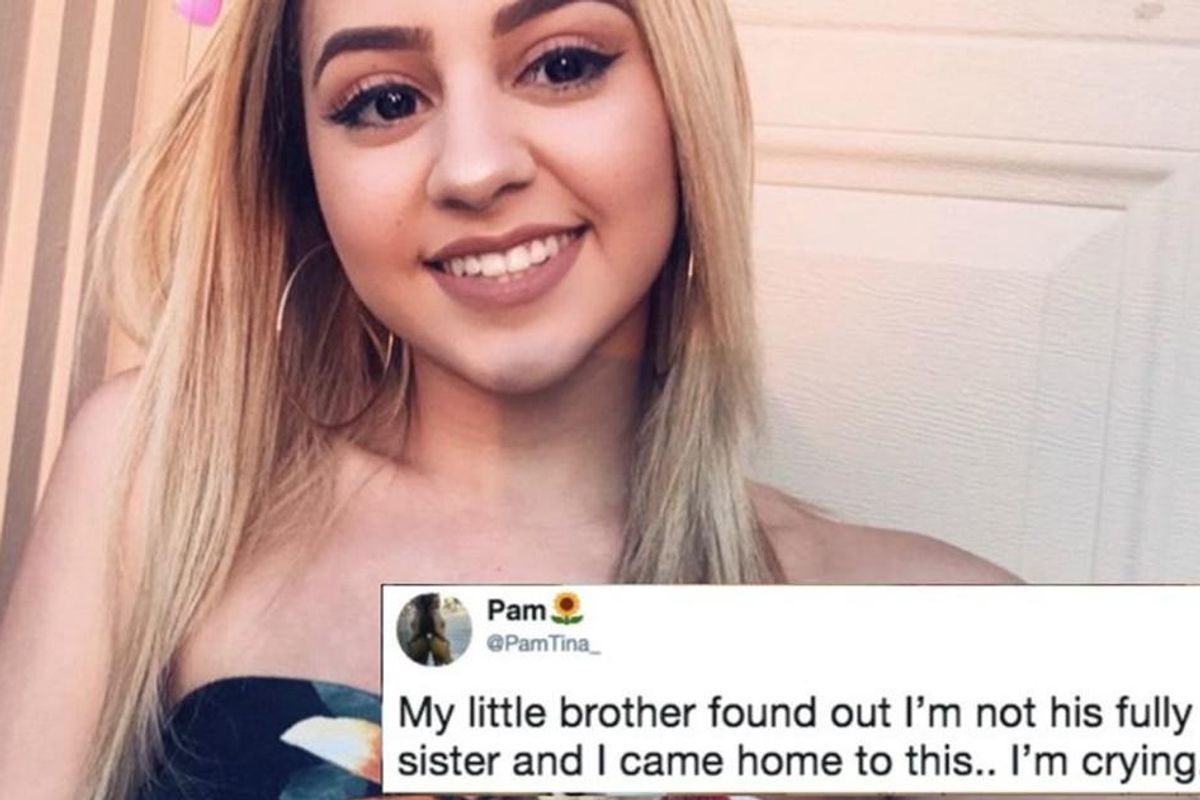
screenshot of a young woman next to a comment.
via PamTina_/Twitter

Pam's little brother is so sweet.

Pam has a little brother, who recently learned that he is actually her half-brother.

Of course, half-siblings are still very much siblings, but Pam's brother doesn't quite grasp the concept yet and seems upset about having to part with 50% of his sister.


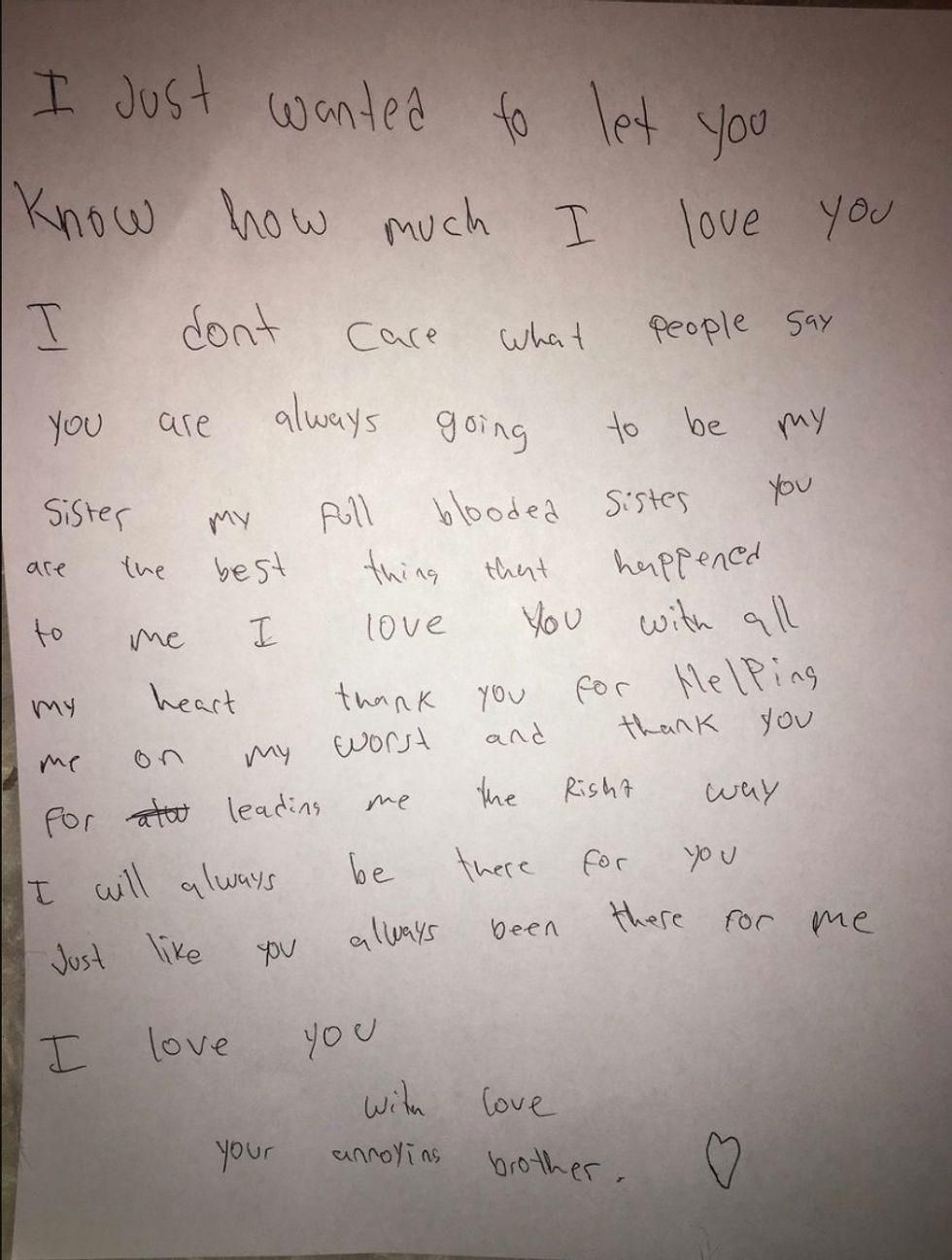
So, when she came home recently she found this letter he'd written. It will make you cry, so have off-brand tissues on hand:

a letter written by a child

Letter with love from her brother.

via PamTina_/Twitter

OMG.

As if this letter isn't enough to turn your heart into a soft pile of oatmeal, he also left her some of her (presumably) favorite snacks, like Chips Ahoy and Takis (excellent choices!).

Pam, being a human with a soul, was deeply moved and tweeted out a photo of her little brother's letter:

It quickly went viral. And now the whole internet is now welling up with tears.

Now others are sharing their own sibling stories:

These are so, so sweet.

Don't say we didn't warn you about the tissues.

Remember this next time you get into a fight with your sibling. Half or whole, doesn't matter. Love/hate is love/hate!


This article originally appeared two years ago.

Gen Z; Millennials; technology; cell phones; social media; teens and technology; teens social media

Gen Z is the first generation less cognitively capable than their parents. Denmark has the solution.

Nearly every parent hopes their child will be better off than they are: smarter, more secure, and more well-adjusted. Many parents see this as a stamp of successful parenting, but something has changed for children growing up today. While younger generations are known for their empathy, their cognitive capabilities seem to be lagging behind those of previous generations for the first time in history.

Dr. Jared Cooney Horvath, a teacher turned cognitive neuroscientist who focuses on human learning, appeared before Congress to discuss concerns about cognitive development in children. In his address to the members of Congress, he says, "A sad fact that our generation has to face is this: our kids are less cognitively capable than we were at their age. Since we've been standardizing and measuring cognitive development since the late 1800s, every generation has outperformed their parents, and that's exactly what we want. We want sharper kids."


kids, intelligence, sharp kids, generations, education, cognitive abilities Student smiling in a classroom, working on a laptop.Photo credit: Canva

Horvath explains that the reason this happens is that each generation has gone to school longer than the previous generation. Gen Z is no exception to the longer duration of time spent in school, but they're the first ones who aren't meeting this normal increase in cognitive development. According to the cognitive neuroscientist, the decline is due to the introduction of screens in the classroom, which started around 2010.

"Across 80 countries, as Jean was just saying, if you look at the data, once countries adopt digital technology widely in schools, performance goes down significantly. To the point where kids who use computers about five hours per day in school for learning purposes will score over two-thirds of a standard deviation less than kids who rarely or never touch tech at school," Horvath reveals.

In most cases, the decline in performance doesn't result in better strategies. The neuroscientist shares that the standardized testing has been adjusted to accommodate lower expectations and shorter attention spans. This is an approach that educators, scientists, and researchers went to Capitol Hill to express wasn't working. But not every country is taking the approach of lowering standards to meet lowered cognitive ability. Denmark went in the opposite direction when it realized their students were slipping behind.

France24 recently interviewed educators in Denmark following their seemingly novel approach to students struggling with cognitive development. Since the beginning of the 2025/2026 school year, Denmark has not only been having students turn in their cellphones, but they've also taken tablets, laptops, and computers out of the classroom. No more digital learning for the majority of the school day. Danes went old school by bringing back physical textbooks, workbooks, and writing assignments. The results have been undeniable. Even the students can't seem to deny the success of the countrywide shift in educational approach.

"I think the biggest issue has been that, because we kind of got rid of the books and started using screens instead, that we've noticed that a lot of the kids have trouble concentrating, so it's pretty easy to swipe with three fingers over to a different screen and have a video game going, for example, in class," Copenhagen English teacher, Islam Dijab tells France24.

Now, instead of computers being part of every lesson, Denmark uses computers very sparingly and with strict supervision. One student says that it has been nice not having screen time at school because she loves to read and write. But it wasn't just the lack of attention span children were developing, they were also developing low self-esteem and poor mental health due to the amount of time spent on devices.

kids, intelligence, sharp kids, generations, education, cognitive abilities Students focused and ready to learn in the classroom.Photo credit: Canva

The data showing the negative impact of screens on teens' brains has prompted a nationwide change in Denmark that extends outside of the classroom. Afterschool activities are eliminating or extremely limiting electronic use. There is also a national No Phone Day that encourages everyone to put away their devices for the day, and Imran Rashid, a physician and digital health expert, is petitioning parliament to ban social media use for children under the age of 15. The no phone movement in Denmark is a nationwide effort that hopes to right the ship before another generation feels the effects.

mispronounced words, commonly mispronounced words, pronunciation fails, word mispronunciations, mispronouncing words
Photo credit: Canva
People share commonly mispronounced words that annoy them.

Using words incorrectly is part of being an English speaker. Differentiating the use for "their, "there" and "they're" can trip up even the most devoted grammar lover. And another tricky thing about the English language is properly pronouncing words.

There's something about hearing mispronounced words that gets the gears grinding. And some words are more commonly mispronounced more than others—somehow becoming commonplace in our everyday language.


Mispronouncing words or phrases irks many people, and in a popular online forum, member @Wonderful-Economy762 posed this question about mispronounced words: "What is one word that people wrongly pronounce that makes your brain just wanna jump a cliff?" And its fellow members did not hold back.

- YouTube www.youtube.com

Everyone has that one word that drives them nuts

Many shared their feelings about how it feels when they hear people mispronouncing them:

"My rage bubbled up faster than expected reading this," one wrote.

Another added, "Oh man, nails on a chalkboard. I instantly make unfair assumptions about the person who says this."

And another quipped, "Does it count if I do it on purpose to be obnoxious sometimes?"

These are 40 words that are commonly mispronounced that received a passionate mention–with many pointing out how to properly pronounce them.

40 mispronounced words people just can’t stand

"Supposably. When a grown adult says 'Supposably' to mean 'supposedly', they sound like a petulant infant who just threw their broccoli off of their high chair onto the ground." —@s7o0a0p

"Lie-berry." —@DixonHerbox

"Exspecially." —@iamhere-2

"eXpresso." —@Turbulent_Gene7017

"On accident. (You don’t say you did something on accident. You did something by accident." —@Throwaway7219017, @_incredigirl_

@justintimberlake

#stitch with @umgabi It’s gonna be…

"'I could care less.' It's "I couldn't care less" which means you could NOT care less which means you DON'T CARE LOL." —@EmergencyPharmacy53

"Real-la-tor instead of real-tor." —@jajabibi67

"When people say Valentine’s Day as 'Valentimes day' 😭." —@Glittering_Pea5599

"Nuclear pronounced as 'New-queue-lur. Drives me bonkers!" —@Maleficent-Yam-5196

"Could of / should of / etc." —@Traditional_Goal6971

"Eggcetera." —@ufficient_Space8484

"Across. People here say 'acrost'. And I know it’s now accepted but it throws me when I hear people say 'axin' instead of 'asking'." —@UtahUtopia

mispronounce, mispronounced words, mispronouncing words, hearing words mispronounced, listening to words mispronounced Hearing people mispronounce words can be a pet peeve.Photo credit: Canva

"Irregardless." —@fineline3061

"For all INTENTS AND purposes." —@Doc308

"Mischievous. Miss-Chev-Us. But EVERYONE says Miss-Chee—VEE-us. I said it wrong for decades too." —@fleshvessel

"Amblance instead of Ambulance." —@katmcflame

"Pellow. Melk. Fustrated." —@KimboSliceChestHair

"Punkin instead of pumpkin." —@Geester43

"Italian. It's not Eyetalian." —@hairyairyolas

@indiagants

Replying to @BetweenTwoOars Some more words that are often misspelled or misprounounced :) #grammar #mispronounce #englishgrammar

"Hot take…When did we start pronouncing the 'T' in 'often?' I was taught in school it was silent :)" —@SilentConstant2114

"Pacifically instead of specifically." —@PepsiMaxHoe

"Pitcher for picture." —@shnarfmaster3000

"'FentaNAHL'. It’s fentanyl." —@daveindo

"I’m going to expose my middle-class here but it’s KEE-NWAH, not KIH-NOAH. And it’s ‘Champing at the bit’, not ‘chomping’." —@creator_chronicles

"Where people say 'seen' instead of 'saw'. 'I seen this car coming down the street...' My brain melts every time." —@Direct_Disaster9299

"Kindygarten, kiddygarden." —@NeverDidLearn

'Take for granite' u sound so dumb. Its GRANTED people." —@silly_creation650

"'Oh look! A strawbrery!'" —@WafflesTalbot

"'verbiage' as 'verb-uj'." —@valentinakontrabida

"Anyways. There is no 'S' in this." —@Zealousideal-Cook104

"Writing 'ect.' instead of 'etc.' and pronouncing it wrongly - 'eccetera' instead of 'et cetera'." —@KiwiFruit404

mispronouncing, mispronounced, mispronounced words, saying words wrong, saying words incorrectly Mispronouncing words are hard to hear. www.upworthy.com

"Foyer. It's Foy-yay, not Foy-yer." —@hoosiergirl1962

"There so many. Here are but a few. 'Burfday'. It’s birthday, damn it! 'Alls I know'. I want to rip my ears off. 'Ax' instead of 'ask'." —@mbc072558

"Poinsettia, people say it as pointsetta, it has irked me for years." —@dararie

"When people say 'pitcher' for 'picture'." —@Desperate_Holiday_78

Did your language pet peeve make the list?

Whether you're team "expresso" or ready to throw your coffee over "supposably", these everyday slip-ups clearly strike a nerve. Language is always evolving, but that doesn’t mean we have to suffer through "irregardless". What would you add?

This article originally appeared last year.

Science

Helicopters dump 6,000 logs into rivers in the Pacific Northwest, fixing a decades-old mistake

Forty years ago, restoration workers thought logs were the problem. They were wrong.

river restoration, washington, river fish, restoration, Yakama Nation, indigenous land, indigenoues tribes, salmon, trout, pacific northwest

Restoration workers now see how "critical" wood is to the natural habitat.

For decades, river restoration in the Northwestern United States followed a simple rule: if you saw logs in the water, take them out. Clean streams were seen as healthy streams, fast-moving water was seen as optimal, and wood was treated like a "barrier" to natural processes, particularly those of the local fish.

Now, helicopters are flying thousands of tree trunks back into rivers to undo that thinking.


In central Washington, one of the largest river restoration efforts ever attempted in the region is underway. More than 6,000 logs are being placed along roughly 38 kilometers, or 24 miles, of rivers and streams across the Yakama Reservation and surrounding ceded lands.

Nearly 40 years ago, Scott Nicolai was doing the opposite kind of work, all in the name of restoration.

"(Back then) the fish heads — what I call the fisheries folks — we stood on the banks, and we looked at the stream," Nicolai, a Yakama Nation habitat biologist, told Oregon Public Broadcasting. "If we saw a big log jam, we thought, 'Oh, that's a barrier to fish. We want the stream to flow.'"

river restoration, washington, river fish, restoration, Yakama Nation, indigenous land, indigenoues tribes, salmon, trout, pacific northwest Fish find shelter for spawning in the nooks and crannies of wood. Photo credit: Canva

At the time, logs were removed in an effort to simplify the habitat. However, it soon became clear that wood provided vital "complexity," creating sheltered pockets for salmon and bull trout to spawn and supporting algae that feed aquatic insects. Logs also slow water, spread it across floodplains, and allow it to soak into the groundwater. That water is then slowly released back into streams, helping keep them flowing and cooler during hot, dry periods.

The consequences of removing this "critical part of the system" (in addition to overgrazing, railroad construction, and splash dam logging) were made all too clear over the years as the rivers dried up and wildlife populations declined.

"We're trying to learn from our mistakes and find a better way to manage," said Phil Rigdon, director of the Yakama Nation Department of Natural Resources.

That's why Nicolai is now helping lead a project for the Yakama Nation aimed at rebuilding river complexity by returning logs to their rightful place. Many of these streams are now unreachable by road, which is why helicopters are used. Logs are flown from staging areas and carefully placed at precise drop locations marked with pink and blue flagging tape.

river restoration, washington, river fish, restoration, Yakama Nation, indigenous land, indigenoues tribes, salmon, trout, pacific northwest Many of these streams are now unreachable by road, which is why helicopters are used.Photo credit: Canva

The wood comes from forest-thinning projects led by The Nature Conservancy and includes species such as Douglas fir, grand fir, and cedar. Although some of the timber could have been sold, it is instead being used as river infrastructure.

For tribal leaders, the work carries even deeper meaning. During the helicopter flights, they gathered along the Little Naches River for a ceremony and prayer.

river restoration, washington, river fish, restoration, Yakama Nation, indigenous land, indigenoues tribes, salmon, trout, pacific northwest Tribal leaders gathered by the Little Naches River for a ceremony and prayer.Photo credit: Canva

"It was very simple: to bring what was rightfully part of this land back to us," said former tribal chairman Jerry Meninick.

The aftermath of the original restoration project illustrates how human concepts, such as the belief in the superiority of "cleanliness," can be limited and sometimes cause more harm than good. The miracle of nature, however, is that when left to her own devices, she can heal herself.

fathers, dads, women, dating, family, love, relationships, parenting, kids, cultural differences, sweden, america

A woman holding back her laughter.

Parenting is the ultimate test of a romantic partnership, and not all relationships can survive its rigors. One of the biggest topics in parenting these days is the mental and physical drain that comes with being the default parent in a family. The default parent is the one who is first in line to take responsibility for parenting duties, whether that means making doctor’s appointments, ensuring homework is done, or making sure the child has enough socks to make it through the week.

Being the default parent can lead to fatigue and burnout, and the parent can experience incredible anxiety when their attention turns away from the household or family. The situation is even worse when the default parent’s partner only does the bare minimum. Unfortunately, in American society, fathers are often the parents who do just enough to get by and are praised for it.


The notion that men don’t have to pull their equal weight in American family life is so ingrained that when Emma Hughes, a travel nanny with over one year of experience in childcare and family support, visited Sweden for two weeks, she experienced extreme culture shock.

A nanny shares why she'd never marry an American man


"I've been in Sweden now, and I think I've been ruined for American men," the 24-year-old said in a viral Instagram video. "Specifically, raising a child with an American man in America, because these Scandinavian dads? Chef's kiss …"

"I'm actually embarrassed to talk about this because all of the observations that I've made have really revealed to me how deeply ingrained [expletive] dads have become like in my brain, and it's just like the default,” she continued.

fathers, dads, dating, family, love, relationships, parenting, kids, cultural differences, sweden, america A Scandanavian man and his child.via Canva/Photos


The notion that fathers only have to do the bare minimum was so ingrained in Hughes’ psyche that she couldn’t understand seeing so many involved fathers in Sweden.

"When I see more dads pushing their strollers in the park on a Saturday morning than moms, what does my brain think … That's weird, there is something abnormal about that,” Hughes said. “When I see dads at the grocery store with their kids. When I see dads out at restaurants or in public. It is so deeply telling of a lot of subconscious stuff that I have going on in my brain after working with so many families."

She said that even the best dads she's worked with in America would be considered the "Scandinavian bare minimum." She applauded one Swedish father who bought a new size of diapers for his baby without his partner telling him to.

"Like I watched a Swedish dad go to the grocery store and come home with like four bags of groceries and in that trip he had bought size two diapers for a baby that had previously been wearing size one and was ready to move into size two, but that conversation had not happened between the mom and the dad,” she said.

Given Swedish dads' dedication to their parenting responsibilities, it’s fair to assume that their partners are much happier and less stressed than those in the States. But what about their kids? Researchers at the United Nations who studied “child well-being in rich countries” found that Swedish fathers also ranked high by their children. The survey asked children in 28 countries if it was easy to talk to their dads, and while 67% of children in the study said their parents were easy to talk to, Swedish fathers scored higher at 72.4%. Meanwhile, the U.S ranked 25, out of 28, at just 59.7%.

fathers, dads, dating, family, love, relationships, parenting, kids, cultural differences, sweden, america A Scandanavian man and his child.via Canva/Photos


Scandanavian and Nordic countries offer generous benefits to parents

It's also worth noting that many foreign countries, like Sweden, have far better cultural infrastructure in place for parents — dads included. Parental leave for new parents in Sweden makes American policies seem like an absolute embarrassment.

They also have far better work-life balance. So dads are getting involved earlier, more often, and spending more time outside the office as part of the family. All Nordic countries pay parents for their loss of income during the last few weeks before the child is born and for the first few months afterwards. Plus, all Nordic countries offer fathers time off and compensate them for the income loss.

Ultimately, Hughes makes an important point: Scandinavian men have set a high bar for fatherhood, and American men need to step up. The positive sign is that in America, the discussion around default parenting has been getting louder and louder, and hopefully, that will prompt more American men and women to set higher expectations so that one day, American men can catch up to Sweden’s.

This article originally appeared last year. It has been updated.

Animals & Wildlife

Why do we eat chicken eggs, duck eggs, and quail eggs, but not turkey eggs?

They're perfectly edible and apparently quite tasty, but you never see them on a menu.

turkey eggs, chicken eggs, quail eggs, food

Have you ever eaten a turkey egg?

Eggs are a staple food in most American households, used for everything from breakfast scrambles to cakes, cookies, and custards. We don't generally specify what kind of eggs we mean when we say "eggs" in the U.S, but we're almost always talking about chicken eggs. Occasionally, we might see duck eggs or quail eggs on a menu, and rarely, something exotic like an emu egg. But do we ever see turkey eggs being served? Nope, pretty much never.

Considering how many turkeys are raised domestically in the U.S. (around 218 million) and how many wild turkeys roam among us (around 7 million), it seems like we should make better use of their eggs. They are egg-laying birds, after all, and since turkey meat is so similar to chicken meat, it seems logical that turkey eggs would be similar to chicken eggs, right?


Basically, that's true. Turkey eggs are larger than chicken eggs, and they have a stronger shell, but from what people say, they're similar to eating chicken eggs, only a little richer. Larger and richer, and yet we don't eat them on the regular? Why the heck not?

The Self-Sufficient Backyard YouTube channel explains the whole thing in a video that's been viewed by nearly 4 million people. Clearly, this is a burning question for people once it's brought to their attention.

- YouTube youtu.be

Basically, what it boils down to is that their size makes them hard to handle, package, and store. Turkeys also aren't nearly as prolific as chickens. (Chickens lay eggs around once per day, while turkeys lay at most twice per week.) It's also more expensive to raise turkeys than chickens, so the price of a turkey egg is prohibitive, at around $3 per egg. Considering how everyone lost their minds over chicken eggs at $6 a dozen, it's unlikely people would pay $36 for a dozen turkey eggs.

However, some people who have eaten turkey eggs shared their thoughts on how they taste, and now people (me, I am people) really want to try them:

"I have eaten turkey eggs for years. They are larger shells are thicker but they taste wonderful."

"I've baked with Turkey eggs and they made the best pancakes I have EVER tasted."

"They taste like chicken eggs, I have turkeys. They only lay seasonally, generally starting in March, and they’ll continue to lay through June-August. They can lay 60ish eggs a year. They’re about 2x the volume of a chicken egg. They make excellent omelettes. Harder to crack, with a thicker membrane and shell."

Growing up, my family had a turkey! She laid eggs and we were always enamored by how huge they were. They taste wonderful!"

turkeys, turkey eggs, turkey farm, eggs, food Turkey eggs are delicious, according to folks who've eaten them.Photo credit: Canva

"We had turkeys with our chickens. They laid eggs daily with the chickens from March to September then would stop while the chickens would just slow down. I was surprised because I thought they would just lay a clutch once or twice because that’s what the wild turkeys do but nope. The only down fall we found was that cracking them was difficult. But if you use a butter knife to give it a whack at the top it works pretty well. It was like getting two egg whites and one yolk in chicken egg ratio lol."

"Taste exactly like chicken eggs. Way bigger. The only difference is the shell is way tougher to crack. So good."

Apparently experience with turkeys and turkey eggs is not uncommon? City folks, take note:

"I was raised on turkey's eggs... I come in from a part of Canada where we are raising turkeys. In Valcartier, turkey eggs used to be much cheaper than any other kind of eggs."

"Growing up on a farm being born in the 50s in western North Carolina we ate lots of turkey eggs. We usually had a dozen or so hen turkeys so we had quite a few to spare."

"My inlaws usually give us turkey eggs for the holidays. They have a big farm in Virginia with all sorts of animals. They usually just sell their eggs at the local market and give us the rest lol."

"The wild turkeys that live in my area used to get in my bird feeders when I had a house. One day I found an egg in the yard, possibly as payment lol."

eggs, turkey eggs, food, turkeys, eating Turkey eggs are larger than chicken eggs, making them tricky to package and transport.Photo credit: Canva

"I've got a turkey for a pet. Her name is "Sweetpea" and I keep her around for no other reason except that she's awesome and provides good conversation. Every now and then during the warm months of the year she leaves me breakfast somewhere around the yard."

And then, just for funsies, there's this little anecdote about those "technically edible" emu eggs:

"Back in elementary school we had a teacher that raised Emus. She would always make delicious cakes but would tell no one how she made them. Eventually she told my mother the reasons she told no one was because she was afraid that people would stop eating them if they found out that she was using one emu egg for every three chicken eggs. We didn’t care."

There you go. Answering a question you may never have asked, but desperately needed answered once you thought about it. (Kind of want to try one now, don't you?)

This article originally appeared last year. It has been updated.