Hilarious Texas diner owner’s sign pokes fun at customers who still refuse to wear a mask
One of the things about the pandemic we’ll always remember are the people who got caught on camera completely losing it because they had to wear a mask inside of a supermarket or restaurant. These are the people who were given the opportunity to be either part of the problem or the solution to the…
One of the things about the pandemic we’ll always remember are the people who got caught on camera completely losing it because they had to wear a mask inside of a supermarket or restaurant.
These are the people who were given the opportunity to be either part of the problem or the solution to the global pandemic and they often unapologetically chose the former.
While some of these incidents result in ugly confrontations, a business owner in North Texas is having a little fun with the anti-maskers that frequent his restaurant. He’s posted a sign notifying them, upfront, that they will be charged if they don’t comply with his mark rule.
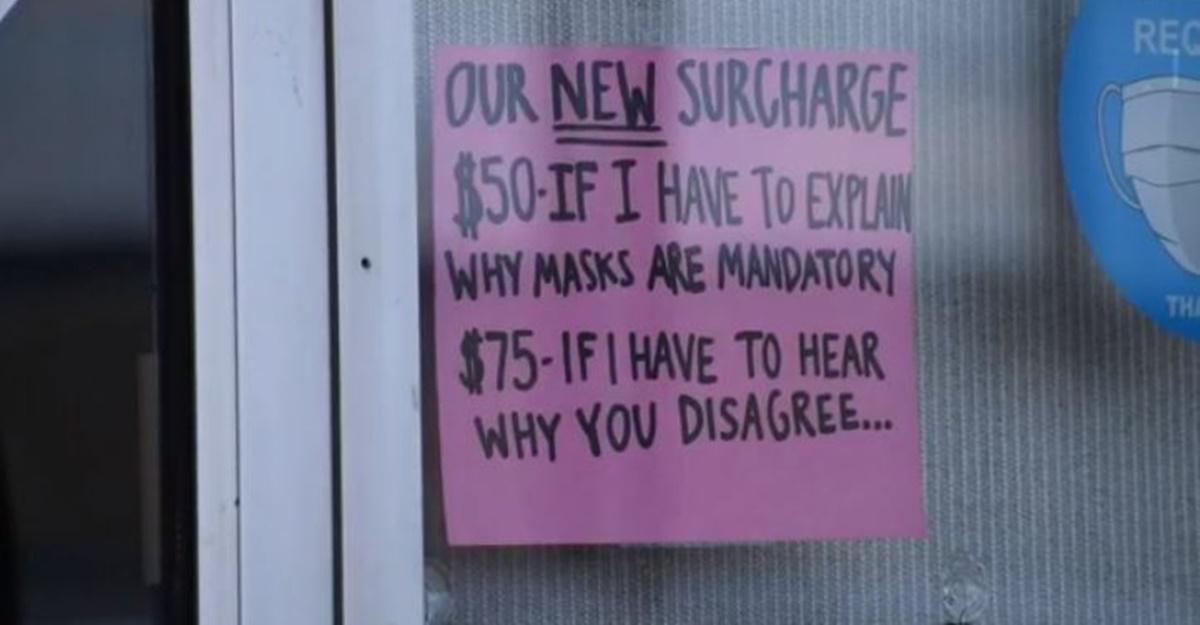
Legends diner owner Wayne LaCombe says that he charges “$50 if I have to explain why masks are mandatory” and “$75 if I have to hear why you disagree.”
The tongue-in-cheek sign has been getting a lot of attention at his restaurant and online. “People laughing taking pictures of it,” LaCombe said. “Mostly great reactions.”
The fact that the sign has been generating mostly positive responses is comforting because earlier this month Texas governor Greg Abbott lifted the state’s mask mandate, leaving many to fear a massive COVID-19 outbreak.
But, as a private business owner, LaCombe is allowed to create his own rules for his restaurant, so he hasn’t changed his mask policy. One of the main reasons why is that his clientele is older and more likely to be seriously affected by the virus.
“Our business is 50, 60, 70, 80-year-olds,” Wayne LaCombe said. “Unless we all work as a team, we’re not going to finish the race.” He asks his customers to wear a mask for his safety, too.
“I just can’t afford to get the virus. We’d have to shut our business down,” LaCombe said.
One customer had an issue with a restaurant owner telling him what to do about his health. So LaCombe’s wife, Kat, the co-owner and chef at the restaurant, had to take him to school on Facebook.
Kat is a retired RN with 28 years in oncology.
“I do have a Medical degree. 28 years as a Registered Nurse, specializing in Oncology. Also 5 years teaching nursing,” she wrote. “With my background in healthcare I feel that we are doing the right thing. At the restaurant we comply with city and state mandates. But some things must be done without someone telling you to.”
“I with my husband try to protect and respect the people who come to our restaurant,” she added. “The sign was a sort of joke….it was aimed at the people who feel the need to try to argue (and of course they’re not wearing masks at the time). No one wants this world to get back to normal more than small business owners.”
In the end, we’re all just trying to get back to normal, and hopefully, found some crumbs of joy along the way. Good for the LaCombes for sticking up for what’s right and protecting the health of themselves and others at a time when many around them are not. Also, that sign is one of the funniest things to come out of this dark time.
In a small village in Pwani, a district on Tanzania’s coast, a massive dance party is coming to a close. For the past two hours, locals have paraded through the village streets, singing and beating ngombe drums; now, in a large clearing, a woman named Sheilla motions for everyone to sit facing a large projector screen. A film premiere is about to begin.
It’s an unusual way to kick off a film about gender bias, inequality, early marriage, and other barriers that prevent girls from accessing education in Tanzania. But in Pwani and beyond, local organizations supported by Malala Fund and funded by Pura are finding creative, culturally relevant ways like this one to capture people’s interest.
The film ends and Sheilla, the Communications and Partnership Lead for Media for Development and Advocacy (MEDEA), stands in front of the crowd once again, asking the audience to reflect: What did you think about the film? How did it relate to your own experience? What can we learn?
Sheilla explains that, once the community sees the film, “It brings out conversations within themselves, reflective conversations.” The resonance and immediate action create a ripple effect of change.
MEDEA Screening Audience in Tanzania. Captured by James Roh for Pura
Across Tanzania, gender-based violence often forces adolescent girls out of the classroom. This and other barriers — including child marriage, poverty, conflict, and discrimination — prevent girls from completing their education around the world.
Sheilla and her team are using film and radio programs to address the challenges girls face in their communities. MEDEA’s ultimate goal is to affirm education as a fundamental right for everyone, and to ensure that every member of a community understands how girls’ education contributes to a stronger whole and how to be an ally for their sisters, daughters, granddaughters, friends, nieces, and girlfriends.
Sheilla’s story is one of many that inspired Heart on Fire, a new fragrance from the Pura x Malala Fund Collection that blends the warm, earthy spices of Tanzania with a playful, joyful twist. Here’s how Pura is using scent as a tool to connect the world and inspire action.
A partnership focused on local impact, on a global mission
Pura, a fragrance company that recognizes education as both freedom and a human right, has partnered with Malala Fund since 2022. In order to defend every girl’s right to access and complete 12 years of education, Malala Fund partners with local organizations in countries where the educational barriers are the greatest. They invest in locally-led solutions because they know that those who are closest to the problems are best equipped to solve and build durable solutions, like MEDEA, which works with communities to challenge discrimination against girls and change beliefs about their education.
But local initiatives can thrive and scale more powerfully with global support, which is why Pura is using their own superpower, the power of scent, to connect people around the world with the women and girls in these local communities.
The Pura x Malala Fund Collection incorporates ingredients naturally found in Tanzania, Nigeria, Pakistan, and Brazil: countries where Malala Fund operates to address systemic education barriers. Eight percent of net revenue from the Pura x Malala Fund Collection will be donated to Malala Fund directly, but beyond financial support, the Collection is also a love letter to each unique community, blending notes like lemon, jasmine, cedarwood, and clove to transport people, ignite their senses, and help them draw inspiration and hope from the global movement for girls’ education. Through scent, people can connect to the courage, joy, and tenacity of girls and local leaders, all while uniting in a shared commitment to education: the belief that supporting girls’ rights in one community benefits all of us, everywhere.
You’ve already met Sheilla. Now see how Naiara and Mama Habiba are building unique solutions to ensure every girl can learn freely and dare to dream.
Naiara Leite is reimagining what’s possible in Brazil
Julia with Odara in Brazil. Captured by Luisa Dorr for Pura
In Brazil, where pear trees and coconut plantations cover the Northeastern Coast, girls like ten-year-old Julia experience a different kind of educational barrier than girls in Tanzania. Too often, racial discrimination contributes to high dropout rates among Black, quilombola and Indigenous girls in the country.
“In the logic of Brazilian society, Black people don’t need to study,” says Naiara Leite, Executive Coordinator of Odara, a women-led organization and Malala Fund partner. Bahia, the state where Odara is based, was once one of the largest slave-receiving territories in the Americas, and because of that history, deeply-ingrained, anti-Black prejudice is still widespread. “Our role and the image constructed around us is one of manual labor,” Naiara says.
But education can change that. In 2020, with assistance from a Malala Fund grant, Odara launched its first initiative for improving school completion rates among Black, quilombola, and Indigenous girls: “Ayomidê Odara”. The young girls mentored under the program, including Julia, are known as the Ayomidês. And like the Pura x Malala Fund Collection’s Brazil: Breath of Courage scent, the Ayomidês are fierce, determined, and bursting with energy.
Ayomidês with Odara in Brazil. Captured by Luisa Dorr for Pura
Ayomidês take part in weekly educational sessions where they explore subjects like education and ethnic-racial relations. The girls are encouraged to find their own voices by producing Instagram lives, social media videos, and by participating in public panels. Already, the Ayomidês are rewriting the narrative on what’s possible for Afro-Brazilian girls to achieve. One of the earliest Ayomidês, a young woman named Debora, is now a communications intern. Another former Ayomidê, Francine, works at UNICEF, helping train the next generation of adolescent leaders. And Julia has already set her sights on becoming a math teacher or a model.
“These are generations of Black women who did not have access to a school,” Naiara says. “These are generations of Black women robbed daily of their dreams. And we’re telling them that they could be the generation in their family to write a new story.”
Mama Habiba is reframing the conversation in Nigeria
Centre for Girls' Education, Nigeria. Captured by James Roh for Pura
In Mama Habiba’s home country of Nigeria, the scents of starfruit, ylang ylang and pineapple, all incorporated into the Pura x Malala Collection’s “Nigeria: Hope for Tomorrow,” can be found throughout the vibrant markets. Like these native scents, Mama Habiba says that the Nigerian girls are also bright and passionate, but too often they are forced to leave school long before their potential fully blooms.
“Some of these schools are very far, and there is an issue of quality, too,” Mama Habiba says. “Most parents find out when their children are in school, the girls are not learning. So why allow them to continue?”
When girls drop out of secondary school, marriage is often the alternative. In Nigeria, one in three girls is married before the age of 18. When this happens, girls are unable to fulfill their potential, and their families and communities lose out on the social, health and economic benefits.
Completing secondary school delays marriage, and according to UNESCO, educated girls become women who raise healthier children, lift their families out of poverty and contribute to more peaceful, resilient communities.
Centre for Girls’ Education, Nigeria. Captured by James Roh for Pura
To encourage young girls to stay in school, the Centre for Girls’ Education, a nonprofit in Nigeria founded by Mama Habiba and supported by Malala Fund and Pura, has pioneered an initiative that’s similar to the Ayomidê workshops in Brazil: safe spaces. Here, girls meet regularly to learn literacy, numeracy, and other issues like reproductive health. These safe spaces also provide an opportunity for the girls to role-play and learn to advocate for themselves, develop their self-image, and practice conversations with others about their values, education being one of them. In safe spaces, Mama Habiba says, girls start to understand “who she is, and that she is a girl who has value. She has the right to negotiate with her parents on what she really feels or wants.”
“When girls are educated, they can unlock so many opportunities,” Mama Habiba says. “It will help the economy of the country. It will boost so many opportunities for the country. If they are given the opportunity, I think the sky is not the limit. It is the starting point for every girl.”
From parades, film screenings to safe spaces and educational programs, girls and local leaders are working hard to strengthen the quality, safety and accessibility of education and overcome systemic challenges. They are encouraging courageous behavior and reminding us all that education is freedom.
Experience the Pura x Malala Fund Collection here, and connect with the stories of real girls leading change across the globe.
For whatever reason, we love a good survival story. Whether it’s a Hollywood film about Tom Hanks stranded on a desert island or a reality TV show about a former special forces soldier foraging for food and shelter in the jungle, we can’t get enough.
Unfortunately, for many of us, our knowledge of survival and emergency situations doesn’t go much further than what we’ve seen on television. Worse, much of what we’ve learned and come to accept as good advice is actually wrong. Many of the techniques in question are either ineffective, dangerous, or exaggerated for entertainment value.
If you ever find yourself stranded, lost, or in a life-threatening situation, here are a few popular survival myths to be aware of:
1. Sucking venom out of a snakebite
If you get bitten by a venomous snake, the smart move is to get the venom out of the wound as soon as possible. The only problem? This doesn’t actually work. And neither do devices that claim to extract the venom.
“Snake venom rapidly diffuses into deep tissue—it’s not just pooled up under the skin ready to be suctioned out,” prepper Sean Gold tells Upworthy. “Being able to suck the venom back through the snake’s bite is also impossible, since the bite tracks immediately collapse when the fangs are removed.”
What to do instead: You need medical attention and antivenom. If you can’t get help, immobilize the wound and keep it below heart level.
2. Drinking cactus water
We all know that cacti thrive in the desert due to their incredible ability to store water. That makes the idea of cutting one open to quench your thirst pretty appealing. Unfortunately, the water stored in a cactus isn’t suitable for drinking.
“Most cactus species further protect their spongy flesh with acids and potent alkaloids. These chemicals are usually too acrid for most humans to tolerate and are taxing on the kidneys if ingested. The flesh of some cactus species can also cause vomiting, diarrhea, or temporary paralysis—none of which is conducive to your survival in an emergency situation.”
What to do instead: Your best bet is digging in a dry riverbed to find water, or following birds, bees, and trees to a better source. More importantly, don’t overexert yourself in the heat of the day in order to conserve hydration.
3. Counting on moss to navigate
Ever heard the old rule that moss only grows on the north side of a tree? The idea comes from the fact that moss prefers shady areas, which are more likely to face north. Some people believe you can use this concept to navigate your way out of being lost.
Sadly, moss will grow just about anywhere. It’s often found on north-facing surfaces, but not reliably enough to use as a compass.
What to do instead: Serious survivalists learn how to navigate using the stars and the sun. The easiest thing to remember is that the sun rises in the east and sets in the west, though not precisely.
“By drinking urine with higher concentrations of waste products (and/or if your kidneys are impaired), urea and other metabolic waste products can accumulate in your body. This can become toxic to cells, particularly those in the nervous system. This can lead to symptoms such as vomiting, muscle cramps, itching and changes in consciousness. Without treatment, this toxic state (known as uraemia) can be life-threatening.”
What to do instead: Finding fresh drinking water is one of the most difficult aspects of survival. Studying the topography of the area and heading downhill are usually your best bets for finding a stream.
5. Hiding in a tunnel from a tornado
A lot of people believe that if they encounter a tornado while driving, a highway overpass or tunnel is a good place to take shelter from flying debris.
On the contrary, a bridge or overpass can act as a wind tunnel, accelerating the force of the wind and flying debris. That’s even more dangerous. Depending on your head start and which direction the tornado is moving, you may be able to drive away from it, but it’s not usually recommended, as tornadoes can reach forward speeds of 75 miles per hour.
What to do instead: Missouri’s Storm Awarewebsite notes, “If you are in your vehicle and a tornado is approaching, you should pull your vehicle to the side of the road immediately, get out, and lay flat in a nearby ditch covering your neck and head.”
6. Drinking alcohol to warm up
It’s not out of the realm of possibility to imagine yourself in a broken-down car on the side of the road during a blizzard with nothing but an old bottle of whiskey that’s been rolling around in the back for months.
As tempting as it might be to drink it, experts say don’t do it. Drinking hard liquor can temporarily make your body feel warm, but it actually makes the situation worse.
Outdoor Life explains: “Although you may feel warmer, alcohol actually dilates skin-surface blood vessels and capillaries, which will chill your core even faster.”
What to do instead: Save the celebratory drink for after you’re rescued.
There are many survival techniques and myths that would require years of learning and practice to master. But a good general rule is that real survival is boring, not flashy. In most situations, the best thing to do is stay calm, seek shelter, and try to signal for help.
Gen X stylist Jennine Jacob posts a lot of content encouraging women not to fall victim to ageism and instead find confidence in their self-expression. But in a recent video, she got candid about how freeing it’s been to reject society’s norms in her own life.
In the clip, Jacob referenced a woman on Instagram who shared that “no one prepares you for mid-forties ugly.” The video appears to come from content creator Susie Trigg Tucker, who got candid about the natural “grieving process” that comes with “your physical beauty changing.”
Addressing her own gray hair and textured skin, Tucker urged other women to “lean into acceptance” and “work on redefining what makes us beautiful.”
But for Jacob, the experience hasn’t been quite so painful. In fact, it’s been rather liberating.
“No one prepared me for how little I would care about what people think about my looks,” she said. “Nobody prepared me for how comfortable I would feel about my looks at this age.”
“And yes, I have wrinkles, I have thinning hair, I have gray hair…I have all of the things that are like conventionally bad, but I literally could not care less,” she added.
Her reason for this laissez-faire attitude is simple. “I did my time in the patriarchy, and my time is done,” she shared.
“I have never felt more free being so ‘ugly’…I am so grateful for it,” Jacob concluded.
Judging by the comments, she’s not the only one who has felt this way.
“100000000000%!!!! I feel the best ever!!!!❤️”
“I couldn’t agree more! Aging out of the male gaze is the best part! Now there’s an inner peace like I have never known. I wish this gift for all women.”
Granted, it seems that Jacob did spend some time, as Tucker put it, “redefining what beauty looks like.” In previous videos, she shared that when she first turned 40, she used Botox, face tape, and filters in hopes of looking younger. Now she doesn’t use any of those things and says she feels “1,000x better.”
Really, these two women aren’t arguing two different points of view. It’s perfectly natural for women (or anyone, really) to grieve a physical way of being that no longer exists one moment, and the next appreciate the wisdom and confidence that come with growing older. That’s pretty much adult life in a nutshell.
Their conversation arrives at a moment when aging, beauty standards, and cosmetic procedures are being talked about more openly than ever. Social media feeds are filled with discussions about Botox, fillers, preventative treatments, and whether embracing natural aging is empowering or simply another unrealistic expectation placed on women.
For some people, cosmetic procedures feel like a form of self-expression and autonomy. For others, rejecting those options can feel equally empowering. Increasingly, women are speaking honestly about the complicated emotions that come with getting older in a culture that has long prioritized youth.
What voices like Tucker’s and Jacob’s show is that there isn’t just one correct way to navigate that experience. Some people grieve the changes that come with age. Others feel an unexpected sense of freedom when they realize they no longer feel pressured to perform beauty for anyone else.
And, sometimes, those two feelings can exist at the very same time.
What matters most, as both women suggest in their own ways, is giving people the space to define beauty and self-worth on their own terms. For many women entering their 40s and beyond, that definition is finally becoming something they get to write themselves.
Kids of all ages can be cruel, but middle schoolers have a particularly savage sense of humor. Unfortunately, teachers often end up on the receiving end of it.
Thankfully, teachers are quite resilient and have their own sense of humor.
Insults turned inspo
Take middle-school teacher Amy McKinzie, who decided to take some of the ahem, questionable things her students have said to her and make faux inspirational posters out of them.
“What doesn’t kill you makes you humble,” quipped McKinzie in her Instagram caption. In the video, dreamy landscape photos serve as the backdrop for these gems:
“You look like you cry watching Hallmark movies.”
Screenshot
“It gives me the ick when you tell us to read our books.”
“You’re older than my grandma.”
“Will there be any math problems on our English test?”
“Did you mean to wear your hair like that?”
Screenshot
Ouch!
The format alone is comedy gold. Pairing brutally honest middle-school commentary with soft-focus sunsets and mountain vistas feels almost poetic. If you’ve ever spent time around 12- and 13-year-olds, you know that their observations come out fast, unfiltered, and usually with impeccable timing (not to mention zero mercy). Sometimes they mean it as a joke, but often they truly do not realize how devastating the comment might sound. Either way, the result is often unintentionally hilarious.
And sure enough, tons of viewers could instantly clock the insults as distinctly middle-school shade-throwing:
“Lol… my daughter is that age & i can totally hear her saying some of these to me! 😮😂”
“You teach middle school don’t you? Those kids are vicious hahaha.”
It prompted many other teachers to share their favorite jokes hurled at them by their students:
Screenshot
“My favorite- were you alive during the attack at Pearl Harbor? I’m in my 30s.”
“My favorite is, ‘frankly, don’t you think you’re a little old to be dating?’😮”
“Brings back great memories teaching high school English. ‘It’s time to touch up your roots.’”
“I wore a really cute blue and white horizontal shirt or so I thought .. the girls said ‘why do you have your pajamas on.’”
“I had a student tell me ‘You look nice today. You just need to get that hair under control.’ Yeah, still trying to figure it (my hair) out. 🤷♀️”
“After showing a photo of a telegraph: ‘Is this what you used?’”
“‘Why do you look so tired today?’ on a day I didn’t wear makeup or mascara.”
“What was it like watching black and white tv?”
This proves once again that teachers are made of stronger stuff.
Teachers, of course, develop a thick skin pretty quickly. When you spend your days with students who are still figuring out how the world works and where the line between observation and roast actually lies, you learn to laugh. And sometimes, the best way to survive the burn is to frame it—literally—and turn it into content. Because let’s face it, the burns are just gonna keep comin’.
As one of the first iconic villains to hit the big screen, the Wicked Witch of the West lives in our collective memory. Those who’ve seen the original 1939 film The Wizard of Oz can hear the witch’s high-pitched cackle. We can recite her menacing line: “I’ll get you, my pretty! And your little dog, too!”
Margaret Hamilton played the role in the film when she was 35 years old. Even though she was only on screen for 12 minutes, her performance was unforgettable. While speaking to a live audience in her later years (exact time and place unknown), Hamilton shared the story of how she was cast, showcasing her delightful personality in the process.
Hamilton said she had done about six pictures for MGM before the opportunity to appear in The Wizard of Oz came along. Then she shared the details of that conversation with the audience:
“One day, my agent called and said, ‘Maggie, they’re really kind of interested in you for a part in The Wizard of Oz.’ And I said, ‘Oh gosh. Think of that,’ I said, ‘I loved that story from the time I was four years old. What is it?’ And he said, ‘Well, the Witch.’ And I said, ‘The Witch?!’ Then he said the final thing, he said, ‘Yes, what else?’”
The audience burst out laughing.
“I thought, ‘Well, that’s kind of an exciting part.’ But jeez, I had my, you know, my eyes on something else. I don’t know what it was exactly, but I didn’t think about the Witch. However, I ought to because I’d had that nose quite a long while.”
The audience busted up again.
Margaret Hamilton wore a prosthetic nose tip and a prosthetic chin in the film. Photo credit: Public domain
The fact that she totally owned her prominent nose, a signature feature few in Hollywood would embrace today, is so refreshing. It’s especially notable considering the Wicked Witch was originally conceived as a bit more glamorous and beautiful in the film. Producer Mervyn LeRoy said he didn’t want the character to be hideous, as he didn’t want to “scare children away from the theatre.”
Hamilton is by no means hideous. But when LeRoy changed his mind about the character’s look, she fit it perfectly. When she tested for the role, she wore “the oldest, crummiest-looking clothes I could find, some dirty things that sort of hung on me like a Mother Hubbard, and then a little shawl.”
“There was no witch’s hat,” she said, “and I really looked more like an old hag. And I cackled and screamed and said a few lines from the script.”
The Wicked Witch of the West was born.
Margaret Hamilton as the Wicked Witch of the West in The Wizard of Oz (1939) didn’t just play a villain, she created the template. Every witch after her is either copying or reacting to what she did first. An entire archetype born from one performance. pic.twitter.com/nYXj6sbFeqhttps://t.co/NLAjPZ6vUw
And scare children she did. People in the comments shared how terrified they were of her when they were kids:
“This woman scared the absolute s__t out of me when I was a child.”
“Gave me nightmares. Her and those flying monkeys. Yow!”
“Her witch scared the hell out of me as a child, and even as a man I still found her frightening.”
“That scene in the tornado where she turns from Almira Gulch on the bicycle, into the witch on the broomstick was absolutely terrifying when I was 6 years old.”
“She made the witch utterly terrifying! Job well done no doubt.”
“She scared me so much as a little kid. I was amazed to discover later that she had been, of all things, a *kindergarten teacher*!”
That’s right, this terrifying witch was a kindergarten teacher when she wasn’t acting.
She frightened audiences for generations. In fact, Hamilton’s appearance as the Wicked Witch on Sesame Street in 1976 was prohibited from airing after parents complained that their children were frightened. (Though Hamilton’s appearance wasn’t nearly as scary as her character in the film, the Sesame Street audience was very young.)
However, she also appeared on Mister Rogers’ Neighborhood as herself. Talking to Fred Rogers, she explained how she viewed the character of the Wicked Witch of the West:
“Sometimes the children feel she’s a very mean witch, and she does seem that way. But I always think two things about her: She does enjoy everything she does, whether it’s good or bad, she does enjoy it. She also is what we sometimes refer to as ‘frustrated.’ She’s very unhappy because she never gets what she wants, Mr. Rogers. Most of us get something we want along the line, but as far as we know that witch has never got what she wanted…”
She also dressed up as the Witch, but without the green makeup, showing kids that it was really just a nice lady in a costume all along.
Despite the fear she evoked with her most famous role, people loved Hamilton’s real-life character. Patty Duke, who worked with her on The Patty Duke Show in the 1960s, called Hamilton “the gentlest soul you could ever meet” in her memoir.
Folks in the comments on her casting story shared the same sentiment:
“A friend of mine had the opportunity to meet and have lunch with Mrs. Hamilton in Manhattan in the mid – 70’s after she had retired. He told me she was one most humble, kind, and sweetest lady you could ever meet….and insisted on picking up the check for their meal.”
“My mother met her in the late 60’s. She said she was nicest, sweetest person she had ever met.”
“She was my mother’s kindergarten teacher.”
Margaret Hamilton in 1929 (left) and in 1973 (right). Photo credit: Public domain
“I met Margaret Hamilton while I was working at a drug store in Beverly Hills as a teenager in the early 1970s. The other young staff and I crouched down and marched around her chanting the Wicked Witch theme from the movie. Ms. Hamilton laughed and was so kind to us.”
“She’s so naturally charismatic. Not even acting, just being herself and telling a story and I was captivated. No wonder her performance was so mesmerizing. She’s just an awesome lady.”
“I remember her when I was a child and not just from the film. She was on Mr. Roger’s Neighborhood as herself to show everyone she was a nice person and that the witch was just a character she played. She seemed like such a kind person.”
Hamilton died in 1985 at age 82. She is remembered today both for the characters she portrayed on screen and for the character she exemplified in real life.
Throughout human history, we have had a lot of gods, at least 18,000, to be specific. Most people believe in just one and forget about the other 17,999 that have fallen in and out of favor over the millennia. If we focus on the major god of the Abrahamic religions—Christianity, Judaism, and Islam—we, as mortal…
Throughout human history, we have had a lot of gods, at least 18,000, to be specific. Most people believe in just one and forget about the other 17,999 that have fallen in and out of favor over the millennia. If we focus on the major god of the Abrahamic religions—Christianity, Judaism, and Islam—we, as mortal humans, still have many questions that remain unanswered in their holy books.
The problem is that humans can ask all the questions we like, and the big answer we usually get is: “God works in mysterious ways.”
Well, a group of folks on Reddit wouldn’t accept that as an answer, so they got together and listed all the questions they would ask God if they had the chance. Many people questioned whether we truly have free will, while others wondered where God is when tragedies happen. It’s great food for thought, and just maybe God will one day pop into the comments section and sort things out.
1. The question of evil
“Are you willing to stop evil, but unable? Or are you able to stop evil, but unwilling?”
2. Can I have a do-over?
“Can I start all over again and retain my memories, please?”
3. Where did you come from?
“How were you created if you’re the creator?”
This is a big question, and for many religious people the answer is simple: God is eternal and the “uncaused cause” of everything else. This rubs determinists the wrong way because they believe that everything must have a prior cause.
4. The Fieri conundrum
“Why did you allow Guy Fieri to create Donkey Sauce?”
For the uninitiated, Donkey Sauce was popularized by Guy Fieri on his TV show Diners, Drive-Ins and Dives. Although it may have a bizarre name, it’s basically a mayo-and-garlic sauce that often features Dijon mustard, lemon juice, and Worcestershire sauce.
5. The big three
“I have no singular question, I have three that are combined…
How can we have free will if you’re omniscient (all-knowing). You knew what colour my pajama pants were before I put them on tonight, yet I’m supposed to have made that decision myself with my own free will? That doesn’t make sense if you already knew.
If you’re omnipotent (all powerful) then how could you make a stone so powerful that you couldn’t lift it… if you couldn’t, you’re not all powerful, if you can… then you’re not all powerful.
If you’re all-loving then why is there so much pointless suffering?”
6. Why such a poor communicator?
“Why do you make yourself in a way that makes it so humanity has to follow a thousand-year-old book. Why can’t you just give us monthly updates or some sh*t via our phones. Seems a lot more effective.”
7. The pizza predicament
“Why is pizza such an unhealthy food? It should be something you consume all the time to stay in shape and fight cancer.”
“Why don’t you just give us a clear evidence, before blaming us for not believing in you?”
“If you have a plan for us and know everything that will ever happen, why do you blame us and condemn people to suffer forever for the crime of not doing what you wanted us to do when you already knew everyone who was going to was going to do that and counted on it?”
10. A corgi question
“Did you just put all the creation points in cuteness and herding skills when you made the corgi, or was there another plan for this dog?”
“Could you microwave a burrito so hot that you yourself could not eat it?”
It seems that God would probably be able to eat a burrito cooked as hot as it can get, because that would only reach 212°F, the boiling point of water. Microwaves cook food by making water molecules vibrate, so once the temperature reaches the boiling point, the water turns into steam rather than getting any hotter.
13. Why are we here?
“It’s one of life’s great mysteries isn’t it? Why are we here? I mean, are we the product of some cosmic coincidence, or is there really a God watching everything? You know, with a plan for us and stuff. I don’t know, man, but it keeps me up at night.”
14. Is it all about suffering?
“The weird thing about this for me is wondering what I’d do next. like if god really answers ‘to suffer, it’s fun for me to watch you all be miserable’ do you just … go to work the next day”
15. Reincarnation
“What’s my soul’s goal so I can stop reincarnating already?”
When it comes to villain songs, few are as instantly recognizable as “The Imperial March,” better known as Darth Vader’s theme from Star Wars. The G minor key, one of the darkest in classical music, plus the relentlessly steady rhythm, reminiscent of a military march…it’s all so bombastically, unapologetically evil-sounding. It also helps that composer…
When it comes to villain songs, few are as instantly recognizable as “The Imperial March,” better known as Darth Vader’s theme from Star Wars. The G minor key, one of the darkest in classical music, plus the relentlessly steady rhythm, reminiscent of a military march…it’s all so bombastically, unapologetically evil-sounding.
It also helps that composer John Williams used the Star Wars franchise to introduce the cinematic world to the Wagnerian leitmotif—a concept well known in opera, where recurring bits of music act as a character’s calling card. In Vader’s case, viewers would hear the tune whenever he slaughtered innocents and enforced the Empire’s tyranny, making it pretty much synonymous with bad guy behavior.
But composer and pianist Avishai Darash wondered what that dastardly march might sound like if things had played out a little differently—namely, if Vader had, as Darash put it, “gone to therapy,” done away with his imperial ways, and been the dad Luke and Leia deserved.
The result: a revamped theme song (using major keys, of course) that feels like it belongs more in the world of Jane Austen than sword fighting in space.
Instead of dread and looming danger, the melody suddenly feels light, warm, and oddly wholesome, like something you might hear while strolling through a sunlit garden rather than watching a galactic conquest unfold.
“Maybe Luke just wanted to hear ‘I’m proud of you, son,’” Darash quipped in the comments.
Viewers react
The clip, which racked up 92,000 views, inspired a ton of funny (and punny) comments from Star Wars fans:
“Episode V: The empire loves you back.”
“I bet this Vader knows how to French braid Leia’s hair.”
“The love is strong with this one.”
“It evokes images of Darth Vader skipping whimsically through a meadow.”
“Luke, I am your caregiver 😶🌫️”
“Well that’s a major plot twist 🍿”
“You are not a Jedi yet… but your journey is valid and I admire the hard work- keep going, I’ll always have your back, Mom’s getting Starbucks, what’s your order?”
“Luke, I am your emotionally and physically present father.”
A specialty for Darash
This isn’t the first time Darash has taken a well-known character song from a movie score and completely reimagined it. In fact, turning famous themes on their heads has become something of a specialty for him.
For instance, in this video he imagines Clark Kent as just your average Joe, with no Superman alter ego. Suddenly his life feels far more grounded and ordinary.
Or this one, where Vito Corleone “just ran a family restaurant” and “paid his taxes,” rather than being a mob boss, making him a “good father” instead of a “Godfather.”
Or this one, which imagines what would have happened if the Titanic had never sunk and Jack and Rose had lived happily ever after. Less tragedy and a lot more hope, but it still tugs at the heartstrings.
After seeing these, isn’t it nice to know that in this complicated life there are a few simple things we can rely on? Two plus two equals four. Blue and red make purple. Major chords sound happy; minor chords do not. You don’t have to be a music genius to understand that on a visceral level.
Now, what if the dinosaurs from Jurassic Park were actually cute and cuddly rather than wild and carnivorous? That’s the cover I’m waiting to hear.
Unless someone is a trained professional, you never quite know how you’ll react in an emergency. San Antonio, Texas, resident Rene Villarreal-Albe recently witnessed a potentially deadly situation and responded quickly. The man was driving down the highway with his wife when he noticed something strange. A car was swerving in and out of traffic…
Unless someone is a trained professional, you never quite know how you’ll react in an emergency. San Antonio, Texas, resident Rene Villarreal-Albe recently witnessed a potentially deadly situation and responded quickly.
The man was driving down the highway with his wife when he noticed something strange. A car was swerving in and out of traffic before hitting a barrier on the side of the road, only to swerve back into speeding traffic. Realizing something was likely seriously wrong, the couple decided to pull closer to the erratic vehicle.
They were right. The driver of the vehicle was not only in trouble but also completely unconscious. With no one else in the car to help, Villarreal-Albe had to make a split-second decision. He knew that if he didn’t stop the car, it could seriously injure or kill someone. So he decided to stop it himself.
Villarreal-Albe is a welder, not a police officer. He isn’t trained in vehicular maneuvers to immobilize a moving vehicle. But that didn’t stop him from trying.
“I was just really worried about his well-being,” Villarreal-Albe told KENS 5. “Seeing his state like that, it’s terrible. I don’t wish that upon nobody.”
The man essentially mimicked a maneuver often seen on television used by law enforcement. It’s called a PIT maneuver, which stands for Precision Immobilization Technique, according to the Federal Law Enforcement Training Centers. The technique has been used since the 1980s.
The Good Samaritan used his truck to the best of his ability to force the runaway SUV to stop. It worked. Shortly afterward, a licensed-vocational nurse who witnessed what happened joined the couple. The unnamed nurse jumped out of her car and immediately began CPR on the unconscious man.
“This lady started CPR right away, and he lost color, but he came back, and that made it worth it,” Villarreal-Albe said.
In a separate interview, the unnamed nurse explained why she pulled over, sharing that several other motorists stopped to help as well.
“I just felt that I need to stop, so I pulled over to the side, and I put my hazards on, and I ran over there,” she told KENS 5. “I just immediately started CPR, and I was going at it for a little bit, and I was doing mouth-to-mouth. I was able to see the color come back to him, and he was in and out. He was gasping for some air.”
The other Good Samaritans were the ones who pulled the man out of the car and laid him on the ground. This allowed the nurse to begin chest compressions, though it was her first time ever performing CPR on a real person. Within minutes, she became fatigued. Thankfully, another woman trained in CPR took over, giving the nurse a break. Between the two women, they were able to continue CPR until an ambulance arrived.
There’s no word on what caused the man’s medical emergency, but the extraordinary teamwork of a group of strangers saved his life. He is still recovering in a San Antonio hospital.
Gen Z is obsessed with the 2000s and 2010s, which they’ve labeled the “last era of sweet delusion.” They’ve also latched onto a number of Millennial fashion trends, including low-rise jeans. There’s no doubt that Gen Z has established plenty of its own fashion trends, from suits with shorts to barrel jeans. But the generation…
There’s no doubt that Gen Z has established plenty of its own fashion trends, from suits with shorts to barrel jeans. But the generation is also embracing a ’00s hair trend that has Millennials shook: the hair pouf, a bubbly bouffant style popularized by celebrities like Laguna Beach star Lauren Conrad and Jersey Shore standout Nicole “Snooki” Polizzi.
Now, Gen Z is getting a little extra help from one iconic volumizing hair accessory: Bumpits.
On TikTok, many Gen Zers are showing off the results of their 2000s hair transformations using Bumpits. Inspired by French actress Brigitte Bardot’s legendary bouffant style, Gen Z is also putting its own twist on how it uses Bumpits.
Hairstylist Stephanie Angelone told Bustle that Bumpits are coming back with Gen Z in a “more lax way.”
“Millennials used dozens of bobby pins to pin their pouf into place, which made it very defined, almost like an updo,” she said. “Gen Z prefers micro claw clips so it’s easy and effortless.”
Gen Zers are documenting themselves trying out Bumpits in different styles, from half-up, half-down ‘dos to simple hair-down looks. Many note that it takes multiple tries to get it right, but once they do, they love the results.
TikToker @blackhairedbrat noted, “While figuring out how to secure everything, I realized it’s essential to tease all the hair up to hide the Bump-It properly. Otherwise, it might lead to an embarrassing peek-a-boo of the hidden accessory!”
Once she figured it out, she was a happy camper: “So far, I’d give this a solid 7 out of 10. It’s definitely something I would use, especially for those blessed with thick hair.”
The history of Bumpits
Bumpits were invented by Kelly Fitzpatrick-Bennett and made their debut in 2009 on the now-defunct As Seen on TV channel. Fitzpatrick-Bennett claims that more than 10 million units were sold.
In an interview on Fran Drescher’s talk show, she explained that her career as a hairdresser inspired her to create Bumpits after clients came in wanting hair like Jennifer Aniston’s on Friends—but didn’t have the volume for it.
Bumpits featured an over-the-top commercial with dramatic clips of women struggling to achieve volumized looks that seem to be cemented in Millennial memories.
“Are you exhausted from dealing with flat, lifeless hairstyles? Do you find yourself using an entire can of hairspray just to achieve that voluminous look? It’s time to ‘bump it up’ with the iconic Bumpit!” the commercial said.
Millennials react
On Reddit, Millennials shared their personal experiences and funny stories wearing Bumpits back in the day:
“Ooof, I totally used to use these 😬To be fair, I was in cosmetology school and that hairstyle was popular at the time. One Saturday a bunch of my classmates and I went out to a bar after school and I ran into a guy I had a HUGE crush on. He is extremely tall and when he bent down to give me a hug, his chin hit the bump-it HARD, it scratched his chin and rammed the bump-it into my scalp. Embarrassing and painful and I’m sure the reason we never dated. I stopped wearing them shortly after that, but I still have them around here somewhere.”
“I felt indignant at the time that they didn’t make them for red hair…My perspective has changed somewhat in hindsight.”
“I had one, didn’t work.”
“Used these RELIGIOUSLY during the time ‘Jersey Shore’ was coming out. Even used one for my prom hair 😭😭😂😂.”
“I could never get mine to not be visible. I have fine hair and had lots of it at the time, but no matter how I tried, I couldn’t get the blessed thing hidden completely.”
“I still have mine 🤣🤣🤣.”
“Being a HS cheerleader in 2008-2010 in the Midwest, these were EVERYTHING.”
“This trend was so awful. It brings back hilarious memories.”