
upworthy
Add Upworthy to your Google News feed.
Google News Button
Democracy

It is possible to be morally pro-life and politically pro-choice at the same time.

Abortion remains an incredibly polarizing issue but it doesn't have to be.

pro life and pro choice demonstrators face each other
Wikicommons

Pro-choice and pro-life demonstrators face off

The legality of abortion is one of the most polarized debates in America—but it doesn't have to be.

People have big feelings about abortion, which is understandable. On one hand, you have people who feel that abortion is a fundamental women's rights issue, that our bodily autonomy is not something you can legislate, and that those who oppose abortion rights are trying to control women through oppressive legislation. On the other, you have folks who believe that a fetus is a human individual first and foremost, that no one has the right to terminate a human life, and that those who support abortion rights are heartless murderers.


Then there are those of us in the messy middle. Those who believe that life begins at conception, that abortion isn't something we'd choose—and we'd hope others wouldn't choose—under most circumstances, yet who choose to vote to keep abortion legal.

It is entirely possible to be morally anti-abortion and politically pro-choice without feeling conflicted about it. Here's why.


There's far too much gray area to legislate.

No matter what you believe, when exactly life begins and when “a clump of cells" should be considered an individual, autonomous human being is a debatable question.

I personally believe life begins at conception, but that's my religious belief about when the soul becomes associated with the body, not a scientific fact. As Arthur Caplan, award-winning professor of bioethics at New York University, told Slate, “Many scientists would say they don't know when life begins. There are a series of landmark moments. The first is conception, the second is the development of the spine, the third the development of the brain, consciousness, and so on."

But let's say, for the sake of argument, that a human life unquestionably begins at conception. Even with that point of view, there are too many issues that make a black-and-white approach to abortion too problematic to ban it.

Abortion bans hurt some mothers who desperately want their babies to live, and I'm not okay with that.

a man holds a sign for pro-choice arguments reading "our life - our decision"a man holding a sign that says our life - our decisionPhoto by Aiden Frazier on Unsplash


One reason I don't support banning abortion is because I've seen too many families deeply harmed by restrictive abortion laws.

I've heard too many stories of families who desperately wanted a baby, who ended up having to make the rock-and-a-hard-place choice to abort because the alternative would have been a short, pain-filled life for their child.

I've heard too many stories of mothers having to endure long, drawn out, potentially dangerous miscarriages and being forced to carry a dead baby inside of them because abortion restrictions gave them no other choice.

I've heard too many stories of abortion laws doing real harm to mothers and babies, and too many stories of families who were staunchly anti-abortion until they found themselves in circumstances they never could have imagined, to believe that abortion is always wrong and should be banned at any particular stage.

I am not willing to serve as judge and jury on a woman's medical decisions, and I don't think the government should either.
pro-life and pro-choice demonstrators face each otherIt is possible to be morally pro-life and politically pro-choice at the same time.


Most people's anti-abortion views—mine included—are based on their religious beliefs, and I don't believe that anyone's religion should be the basis for the laws in our country. (For the record, any Christian who wants biblical teachings to influence U.S. law, yet cries “Shariah is coming!" when they see a Muslim legislator, is a hypocrite.)

I also don't want politicians sticking their noses into my very personal medical choices. There are just too many circumstances (seriously, please read the stories linked in the previous section) that make abortion a choice I hope I'd never have to make, but wouldn't want banned. I don't understand why the same people who decry government overreach think the government should be involved in these extremely personal medical decisions.

Protestors gather outside Supreme Court after Dobbs decision

a crowd of people in front of the Supreme Court after Dobbs decision

Photo by Sarah Penney on Unsplash

And yes, ultimately, abortion is a personal medical decision. Even if I believe that a fetus is a human being at every stage, that human being's creation is inextricably linked to and dependent upon its mother's body. And while I don't think that means women should abort inconvenient pregnancies, I also acknowledge that trying to force a woman to grow and deliver a baby that she may not have chosen to conceive isn't something the government should be in the business of doing.As a person of faith, my role is not to judge or vilify, but to love and support women who are facing difficult choices. The rest of it—the hard questions, the unclear rights and wrongs, the spiritual lives of those babies,—I comfortably leave in God's hands.

Most importantly, if the goal is to prevent abortion, research shows that outlawing it isn't the way to go.


The biggest reason I vote the way I do is because based on my research pro-choice platforms provide the best chance of reducing abortion rates.

Abortion rates fell by 24% in the past decade and are at their lowest levels in 40 years in America. Abortion has been legal during that time, so clearly, keeping abortion legal and available has not resulted in increased abortion rates. Switzerland has one of the lowest abortion rates on earth and their rate has been falling since 2002, when abortion became largely unrestricted.

Outlawing abortion doesn't stop it, it just pushes it underground and makes it more dangerous. And if a woman dies in a botched abortion, so does her baby. Banning abortion is a recipe for more lives being lost, not fewer.

At this point, the only things consistently proven to reduce abortion rates are comprehensive sex education and easy, affordable access to birth control. If we want to reduce abortions, that's where we should be putting our energy. The problem is, anti-abortion activists also tend to be the same people pushing for abstinence-only education and making birth control harder to obtain. But those goals can't co-exist in the real world.

Our laws should be based on reality and on the best data we have available. Since comprehensive sex education and easy, affordable access to birth control—the most proven methods of reducing abortion rates—are the domain of the pro-choice crowd, that's where I place my vote, and why I do so with a clear conscience.


This article originally appeared on 01.22.19


guitar, learning a skill, neuroscience, music, exposure, passive exposure, gardening

A woman learning how to play guitar.

Learning a new skill, such as playing an instrument, gardening, or picking up a new language, takes a lot of time and practice, whether that means scale training, learning about native plants, or using flashcards to memorize new words. To improve through practice, you have to perform the task repeatedly and receive feedback so you know whether you’re doing it correctly. Is my pitch correct? Did my geraniums bloom? Is my pronunciation understandable?

However, a new study by researchers at the Institute of Neuroscience at the University of Oregon shows that you can speed up these processes by adding a third element to practice and feedback: passive exposure. The good news is that passive exposure requires minimal effort and is enjoyable.


"Active learning of a... task requires both expending effort to perform the task and having access to feedback about task performance," the study authors explained. "Passive exposure to sensory stimuli, on the other hand, is relatively effortless and does not require feedback about performance."


woman reading, woman book, young woman, studying, new skills A woman reading a book.via Canva/Photos

How to pick up new skills faster?

So, if you’re learning to play the blues on guitar, listen to plenty of Howlin’ Wolf or Robert Johnson throughout the day. If you’re learning to cook, keep the Food Network on TV in the background to absorb some great culinary advice. Learning to garden? Take the time to notice the flora and fauna in your neighborhood or make frequent trips to your local botanical garden.

If you’re learning a new language, watch plenty of TV and films in the language you are learning. The scientists add that auditory learning is especially helpful, so listen to plenty of audiobooks or podcasts on the subject you’re learning about.

But, of course, you also have to be actively learning the skill as well by practicing your guitar for the recommended hours each day or by taking a class in languages. Passive exposure won't do the work for you, but it's a fantastic way to pick up things more quickly. Further, passive exposure keeps the new skill you're learning top-of-mind, so you're probably more likely to actively practice it.

What is passive exposure?

Researchers discovered the tremendous benefits of passive exposure after studying a group of mice. They trained them to find water by using various sounds to give positive or negative feedback, like playing a game of “hot or cold.” Some mice were passively exposed to these sounds when they weren't looking for water. Those who received this additional passive exposure and those who received active training learned to find the water reward more quickly.

gardening, woman gardening, gardening shears, leaning gardening, weeds A woman tending to her garden.via Canva/Photos


“Our results suggest that, in mice and in humans, a given performance threshold can be achieved with relatively less effort by combining low-effort passive exposure with active training,” James Murray, a neuroscientist who led the study, told University of Oregon News. “This insight could be helpful for humans learning an instrument or a second language, though more work will be needed to better understand how this applies to more complex tasks and how to optimize training schedules that combine passive exposure with active training.”

The one drawback to this study was that it was conducted on mice, not humans. However, recent studies on humans have found similar results, such as in sports. If you visualize yourself excelling at the sport or mentally rehearse a practice routine, it can positively affect your actual performance. Showing, once again, that when it comes to picking up a new skill, exposure is key.

The great news about the story is that, in addition to giving people a new way to approach learning, it’s an excuse for us to enjoy the things we love even more. If you enjoy listening to blues music so much that you decided to learn for yourself, it’s another reason to make it an even more significant part of your life.

- YouTube www.youtube.com

This article originally appeared last year.

Joy

Woman's silly typo in a philosophical post is bringing thousands of people unexpected, pure joy

Sometimes one tiny error can shift the entire meaning of a sentence.

typos, grammar, errors, writing, texting, comma
Photo credit: Canva

Left: A woman typing on a laptop. Right: A closeup of the word "Grammar."

Sometimes one tiny error can shift the entire meaning of a sentence. Perhaps someone tries to sign off an email with "Take care," but instead writes "Cake care," leaving you wondering whether you somehow missed receiving a delicious pastry (or, more importantly, the instructions on how to "care" for it).

For Threads user Maureenmzobe, merely adding a single letter turned what could have been a profound question into a ridiculous one. They asked, "You are in a comma, you wake up it's 2040. What are you Googling first?"


Threads, punctuation, spelling, commas, coma, typos A person on Threads makes a typo.Photo credit: Threads/@maureenmzobe

Obviously, the OP meant to write "coma" (we're assuming), but the happy accident led to more than 3,100 hilarious responses. As you might guess, many of those answers are punctuation-related.

One Threader joked, "Better than waking up in a colon, I suppose."

Another added a much more poetic answer:

"I woke up with a comma,
felt a pause in my head,
tripped over a semicolon
before getting out of bed.
I googled an apostrophe,
ate breakfast with a dash,
spilled tea on a question mark,
now my kitchen's an exclamation crash.
I spoke in quotation marks,
whispered softly in italics,
shouted once in capital letters
when my thumb remained static.
My words ran on like a sentence
that clearly should have stopped,
but I missed the full stop,
so the meaning was sort of lost."

This commenter had further questions: "Am I in an Oxford comma, or just a regular comma? Context matters here."

Of course, one Threader had to point out the obvious:

"First, I'd Google: 'difference between comma and coma — and how long I've apparently been unconscious.' Because if I've been in a comma since 2025, I'm less worried about the future and more concerned about who punctuated my life so aggressively.
Did I pause…
take a breath…
or has existence just been one long, unnecessary clause?
Either way, I'm searching for: 'how to end a 15-year comma — semicolon acceptable?'"

And some answers were just funny: "At least be grateful you didn't come to a full stop."

This person included a little wordplay: "I came here for the commas and they did not disaperiod."

The truth, of course, is these tiny flubs can happen to anyone. In a Reddit post titled "Funniest typos/mistakes you've caught yourself making?" the OP admits, "So, we're all human and we're not perfect. We all make typos and errors every now and again, and some of them can change the meaning of a sentence entirely. What's your funniest one?"

They go on to describe their most embarrassing editorial mistake: "I'm currently editing a chapter, and instead of 'Shannon's eyes went wide and she slid away a few inches,' I wrote 'Shannon's eyes went wide and slid away a few inches.' It's one pronoun. And yet without it, her eyes slide off her face. It made me giggle."

The post received 85 comments, most of them from people sharing their own unfortunate typos.

A Redditor shared, "I tried to type 'memento' one time and ended up getting autocorrected to 'Meme and toad' for some odd reason. Looking back I probably threw in a space on accident." Luckily, this person truly enjoyed the outcome: "Meme and Toad are the best of friends."

Pets

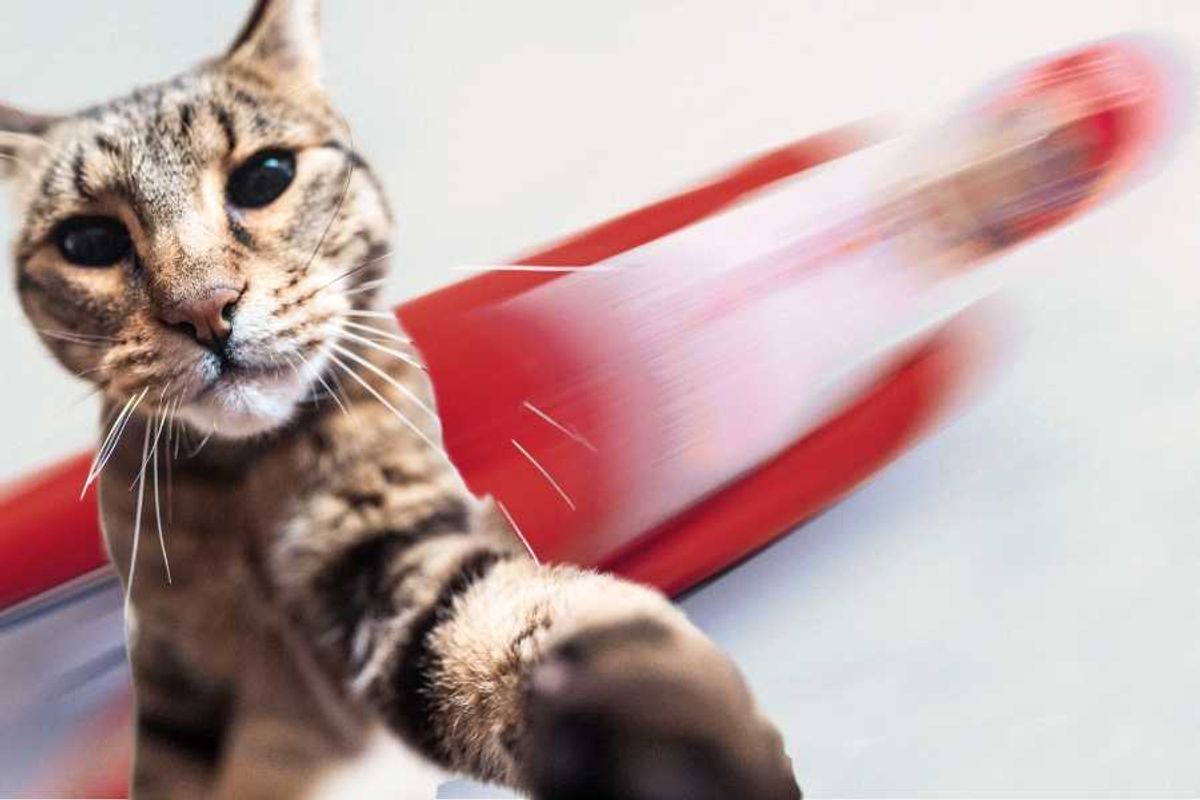
Vet demonstrates 'squish the cat' method of safe cat handling in delightfully helpful video

There's a reason Dr. Burstyn's "How to pick up a cat" video has been viewed 23 million times.

cats, pets, cat handling, veterinarian, feline behavior

Handling a cat may seem like a delicate matter, but being delicate isn't actually the way to go.

If you've ever tried to make a cat do something it doesn't want to do, you've likely experienced the terror that a cat's wrath can invoke. Our cute, cuddly feline friends may be small, but the razor blades on their feet are no joke when they decide to utilize them. Even cats who love us can get spicy if we try to manhandle them, so we can imagine how things will go with cats who don't know us well. But sometimes it's necessary to handle a cat even if it's resistant to the idea.

This is where Vancouver veterinarian Dr. Uri Burstyn comes in. His "How to pick up a cat like a pro" video, in which he demonstrates a few ways of picking up and handling a cat, has been viewed over 23 million times since he shared it in 2019. Unlike many viral videos, it's not humorous and nothing outrageous happens, but the combo of Burstyn's calm demeanor and his repeated instructions to "squish that cat" has endeared him to the masses.


- YouTube www.youtube.com

The video truly is helpful; he shows the ways to pick up a cat that make them feel the most secure using his cats, one-year-old Claudia and 14-year-old Mr. Pirate. He explains that cats spook very easily and it's best to introduce yourself to them gently. Let them sniff your fingers, keeping your fingers curled in, and once they've sniffed you, you can often give them a light rub on the cheek or under the chin.

Picking them up is a different story. The reason many cats will claw or scratch you when you try to pick them up is because they feel unsupported or unsafe, so they'll scramble around trying to get some footing. Burstyn shows how he picks up Claudia with one hand under the chest and one hand under her abdomen. If he needs to carry her around, he squishes her into his body so she feels "nice and supported." He may even put a hand under her front paws.

cats, pets, cat handling, veterinarian, feline behavior Cats can be finicky about how they're held. Photo credit: Canva

Then came the best part of the video: "Squish That Cat"

"Now if we do have a cat who's trying to get away from us?" Burstyn said. "We always squish that cat. If you're trying to hold the cat down, whether it's to trim their nails or to give them a pill, or whether you just want to have a cat not run off for a moment, squish that cat. All you need to know about cat restraint is to squish that cat."

Burstyn explains that cats generally feel very secure being squished, even if they're really scared.

"Sometimes cats come to me in the clinic, and they're quite afraid," he said. "And you just gently squish them, and they'll sit there and kind of not hurt themselves, not hurt us. Just hang out and let us do our thing."

He demonstrated putting a towel over the cat, explaining, "If you have a towel handy, this is one of the best cat restraint tools around. You can just throw a towel on the catty and squish her with the towel, that way they won't get a claw into you if they are scrambling about a bit. Very safe and gentle, and generally cats are very, very happy to be squished like that."

cats, pets, cat handling, veterinarian, feline behavior Squish that cat. Photo credit: Canva

Dr. Burstyn also showed how to do a "football hold," tucking the cat under your arm with them facing backwards. "So this is kind of an emergency way if you really need to carry a cat somewhere in a hurry," he said. Scooping up Claudia, he explained, "Little head's under your arm, butt in your hand, and you squish her tight to your body. And with that little football carry, you can basically hold a cat very securely and very safely, because it's really hard for them to rake you with their hind legs."

If you're worried about over-squishing your cat, Dr. Burnstyn says don't. "You don't have to worry about hurting a cat," he said. "They're very, very tough little beasts. You know, just squishing them against your body's never going to do them any harm. In fact, they tend to feel more safe and secure when they're being held tightly."

Dr. Burnstyn also demonstrated how to pick up and set down a "shoulder cat" who insists on climbing onto people's shoulders and hanging out there, as Mr. Pirate does. It's highly entertaining, as Mr. Pirate is a big ol' chonky kitty.


@yozron

she loves my shoulders i guess #catcore #kittendad #kittensoftiktok #cat #fyp

People in the comments loved Dr. Burnstyn's demonstration, with several dubbing him the Bob Ross of veterinary medicine. Even people who don't have cats said they watched the whole video, and many loved Claudia and Mr. Pirate as well.

"This is just proof that cats are liquid."

"12/10 cat. Excellent squishability."

"So essentially, cats love hugs? That's the most wonderful thing i've heard all day."

"This cat is so well mannered and looks educated."

"Mr Pirate is an absolute unit."

"S q u i s h . T h a t . C a t ."

"I need 'Squish that cat' shirt.

"Dang, that actually helped with my female cat. She has been through at least two owners before me and had some bad expriences which obviously resulted in trust issues. She has now been with me for two years and it had gotten loads better, but she still did not want me to hold her. Normally I simply would have let her be, but for vet visits and such it was not an ideal situation. But then I saw this video and tried to squish the cat. And she loves it! She is turning into quite the snuggly bug. Thank you!"

So there you go. When all else fails, squish that cat and see what happens.

You can follow Dr. Burstyn on YouTube at Helpful Vancouver Vet.


Immigration

2,000 people sing directly to ICE agents in Minneapolis, beautifully imploring them to come together

The "singing resistance" choir shows the power of incorporating art into peaceful protests.

singing resistance, singing protest, ice protest, minneapolis, non-violent resistance

The "singing resistance" is growing in Minneapolis and beyond.

From the night the Sons of Liberty dumped hundreds of chests of tea into Boston Harbor in 1773, Americans have protested government policies and actions they disagree with in various ways. Some have staged peaceful sit-ins, while others have rioted in rage. Millions have marched to make their voices heard, carrying signs and chanting slogans that express their displeasure with what's happening in their country.

But occasionally, a unique form of protest stands out. Several weeks into the ICE operation in Minneapolis, in which the federal government sent 2,000+ agents and officers to carry out "the largest immigration operation ever," and which has led to disruptions at schools, conflict between federal agents and the community, and the killing of U.S. citizens, thousands of Minnesota residents have taken to the streets in protest. Among them is a growing band of singers who, instead of calling out the government with shouting and chants, are calling in the federal agents with songs and signs, inviting them to join the resistance.


It's a different approach to take, tapping into the humanity of individual agents instead of confronting the government as a whole. But 2,000 people have added their voices to the "singing resistance," forming a massive choir. They gather at a church to practice their songs, then take their message to the places where ICE agents are staying, singing:

We walk the same ground

We've been torn apart

Put down your weapons

And sing your part


The effect of combining the arts with our constitutional right to peacefully assemble is powerful, and the signs the singing resisters are holding are, too: "Please ICE agents. Join Us." "Love > Fear," "Choose Humanity. Quit ICE." "Stop the Violence." "We Are Family." "Be the hero that walks away." "The time is always right to do what is right." "You, too, are here to love and be loved."

The Singing Resistance Instagram account shared the heart of the message the singers hope to send to ICE agents, imploring them to quit their jobs and join "the side of love and humanity":

"Under federal occupation, Minneapolis has been going through immense pain, rage, and grief. But when they come at us with violence, we fight back with love. We still have space in our hearts for ICE agents who are willing to walk away from the path of violence and take accountability for harm they’ve caused. We paid ICE agents a visit today to call them home."

Another song they sang says:

It’s okay to change your mind
Show us your courage
Leave this behind
It’s okay to change your mind
And you can join us
Join us here anytime

The idea of inviting agents and officers to join a resistance movement isn't without precedent. Singing resistance organizers shared that they were inspired by the Otpor! civil resistance that helped overthrow Serbian dictator Slobodan Milosevic in 2000. Otpor! members would chant, "You may not join us today, but you can join us tomorrow," when they were arrested by the police. Ultimately, when hundreds of thousands marched on Belgrade, most of the police and military joined the opposition and refused to follow Milosevic's orders to fire on the protesters.

According to an Ipsos poll conducted on January 30 and 31, 2026, a full 62 percent of U.S. adults feel ICE’s actions go too far, compared to 13 percent who think they don't go far enough and 23 percent who said it was about right. That disapproval is four points higher than the week before, indicating that the ICE operations are unpopular with Americans, even those who normally support the Trump administration's policies.

People from all over the United States shared words of encouragement for the choir, expressing how moved they are by the singing resistance:

"I love how the singing is both dissent/resistance and it feeds hope and replenishes energy. It is so soul-nourishing. I’d love to be a part of this! Sending my love and care to you all from Maryland as a MN born and raised woman. Sing on!!!"

"I think the music resistance is very effective and moving. Thank you for all your fine efforts from way over here in upstate New York. Thank you for standing up for all of us in the country."

"We are one chord, beautiful beautiful voices thank you so much for sharing Minnesota. I’m a musician and singer here in Eugene, Or, and when I hear hundreds of you singing like that, I cannot tell you how healing it is for me how powerful and indeed how brave."

"I have a song in my heart again! After weeks of crying crying in despair, thank you for singing us into a hopeful future of healing, reconciliation, and RESISTANCE❤️

"This is more revolutionary than so many know."

"Prince left his legacy forever. Minneapolis strong."

"This reminds me of Estonia's singing revolution and I'm here for it. ❤️❤️"

The Singing Resistance account has shared a toolkit and songbook and organized a virtual training on how to organize a local singing resistance choir for those interested in doing something similar.

The right to peacefully assemble and voice our disagreement with our government is guaranteed in the Constitution, and there are many creative ways to do it. When people are singing in harmony in the street, it not only gets attention, but it's hard to criticize or confront that kind of peaceful protest. (Imagine the optics of trying to break up a peacefully singing crowd.) Will the choir's earworms calling to their humanity really make a difference with any ICE agents in Minneapolis? Time will tell. In the meantime, people around the world are hearing them loud and clear and joining the harmonious chorus of non-violent resistance.

social skills, michael baker, conversation tips, small talk, small talk tips, social science, how to be social, making friends

Two men having a conversation

You probably heard plenty of people say they hate small talk. You might even consider yourself someone who loathes it. One of the most common arguments against small talk is that it’s “superficial,” energy draining, and doesn’t foster a real human connection.

Well, according to British etiquette enthusiast and content creator on all things conversation-related (not to mention author) Michael Baker, “You don’t hate small talk. You’re just terrible at it.”


In an Instagram post, Baker argued that those who see small talk as “beneath them” are failing to see it as a “test” (for compatibility, connection, shared values, etc.), which will inevitably lead to getting “left out.”

He then gave five tips to help folks shift that mindset and make small talk work for them. Honestly, even those who aren’t adamantly against small talk might find themselves guilty of some of these mistakes and could benefit from making these tweaks.

five, five fingers, five tips, man, advice, help Young man holds up his hand to show five.Photo credit: Canva

#1 Avoid answering questions too literally

Perhaps in an attempt to be authentic, or to avoid taking up all the oxygen in the room, people might use responses that are accurate and succinct, but not exactly conversational. This doesn’t give the other person anything to “bounce off of,” which is what’s really being asked for.

To remedy this, Baker suggests to always give a real response plus a “hook.” He gave the example of saying “Mostly work, but I’m trying to teach myself how to play guitar. Chaos!” when asked, “What have you been up to?” rather than saying “Not much, just working.”

#2 Don’t ask questions like it’s a job interview

Baker says ask “open-ended, low-stakes” questions like “what’s keeping you busy outside of work?” to invite a sense of “play.” Conversely, asking things like “where are you from?” invites a sense of formality, pressuring people to “perform.”

social skills, michael baker, conversation tips, small talk, small talk tips, social science, how to be social, making friends Two women having a conversation at a coffee shop. Photo credit: Canva

#3 Allow depth to come in naturally

Since the thought of shallow conversation might seem uncomfortable, those who are small talk-averse might find themselves immediately asking overarching existential questions like, “What drives you?” Baker argues that one must trust that “shallow comes before depth,” and must be used as a “warm-up act.” Otherwise, people are put on the spot unnecessarily, which obviously doesn't foster connection.

#4 Initiate conversation instead of only speaking when spoken to

What may seem like “politeness” can come across as unapproachable. The good thing is: this is an opportunity for some “low-pressure,” even “lightly self-deprecating” observations. Baker used the example of saying, “That snack table’s dangerously close to me.”

#5 Treat small talk as the “main event”

social skills, michael baker, conversation tips, small talk, small talk tips, social science, how to be social, making friends Two women talking as the leave a yoga classPhoto credit: Canva

This might be the biggest tip of all. Here, Baker reminds us that for the majority of human interaction, small talk is the way in, and therefore should be “respected.” Virtually no one is going to say, “Let’s network,” but odds are they’ll easily comment on the weather. It’s our job to learn what they’re really saying with this mundane phrase.

Because, at the end of the day, “if you keep waiting for ‘real’ conversation, you’ll miss all the real opportunities,” Baker writes.

After reading these tips, you very well might still loathe the idea of small talk, which is totally fine. It doesn’t have to be for everyone, nor should it. But what Baker really presents here is a way to reflect on whether or not our attitudes are preventing us from making valuable connections. If we suspect that might be the case, then it could be worth experimenting with some of these tools.

If you’d like even more tips, Baker has a guide aptly titled Let’s Not Make It Weird, which you can check out here.