Ever heard of a dynamite tree? It's a tree built to kill.
The planet never ceases to provide things that leave us in awe.

Who's stringing lights on this guy for the holidays?
Ah, trees. One of Mother Nature’s most majestic creations. Always glorious sights to behold, with their bountiful blooms, luscious leaves and poisonous fruit bombs…
Wait, what?
You read that correctly. The sandbox tree, also known as the monkey no-climb or dynamite tree, lives up to all of its nicknames. It might not hold the official record for being the “most deadly tree in the world,” but it certainly comes close.
A video posted to YouTube by Animalogic gives a fun deep dive on the sandbox tree and all the ways in which it “chooses violence.” Reader beware: This might cause trust issues with other trees. Suddenly you might find yourself wondering what that birch in your front yard’s real intentions are.
First off, let’s talk about those fruit bombs.
The sandbox tree’s official name references the small pumpkin-like fruit it bears. Up until the mid-1800s, when sand was the primary tool for blotting ink, these small gourds made a perfect container for sand and therefore were a standard desk item until they were replaced with blotting paper, Animalogic explained.
But when not being harvested as desk ornaments, these fruits can act as seed explosives. Though this is more of a reproductive strategy than a defensive attack (aiming to get the seeds as far away from the parent plant as possible), humans and animals caught in the crossfire can still be badly hurt by a relentless seed onslaught.
Luckily these seed grenades are fairly predictable and therefore avoidable. They don’t explode at night or when the air is damp, as they need heat and dryness to be ignited. When temperatures are high, however, the fruit will lose more than half of its moisture—becoming so dry each of the 15 sections will violently split away from each other … sort of like distant cousins at an outdoor family reunion. If that happens, look out!
Next, we have stabbing bark.
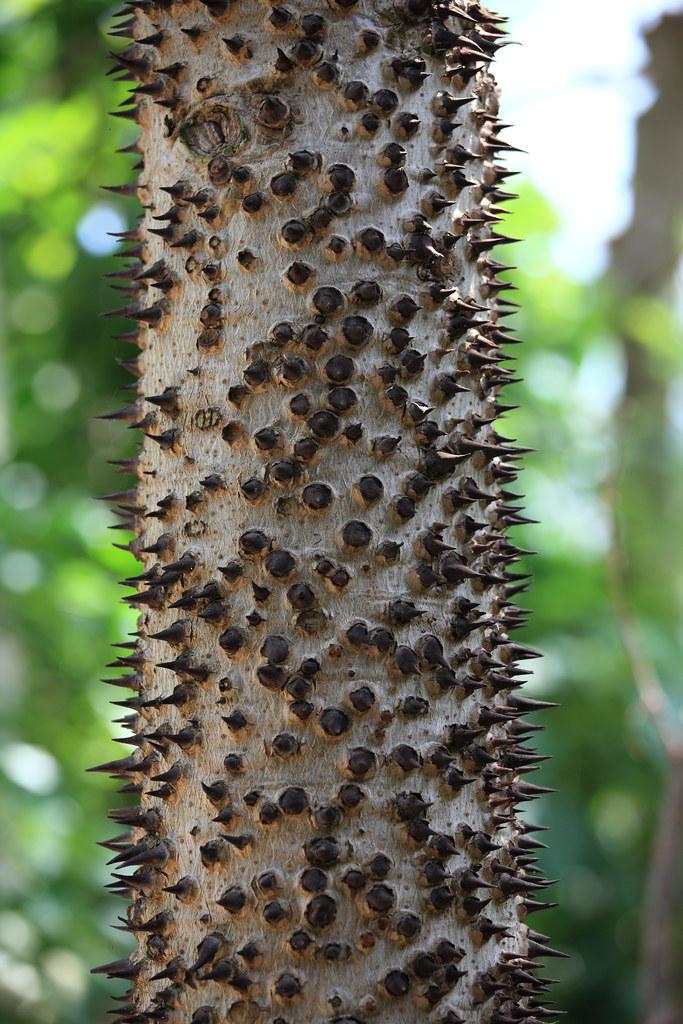
Yep, from top to bottom, the sandbox tree is densely covered in needle sharp, knife-like points. Hence, monkey no-climb (and hopefully nothing else tries to climb it either). No wonder Animalogic likened it to a “medieval torture device.”
When all else fails, the sandbox tree relies on a weapon that’s withstood the test of time—poison.
Remember those fruit bombs? Well, even if they don’t explode and kill you, just one bite could result in violent cramps, vomiting and diarrhea. OK, so maybe it’s not death … but it ain’t great.
The sandbox tree’s thick, red sap it secretes is also toxic, creating a skin rash on contact, not to mention temporary blindness if it gets into your eye. Indigenous peoples would dip their darts into this sap for hunting and warfare. On the plus side, certain parts of the plant can allegedly be used to treat stomach issues, eczema, rheumatoid arthritis and intestinal worms. Please, please don’t try this at home.
Much like Audrey II in “Little Shop of Horrors,” this tree seems hellbent on world domination. Because of its explosive and efficient seed dispersing system, the species is now considered invasive in East Africa. Ironically, the trees were consciously planted there for shade.
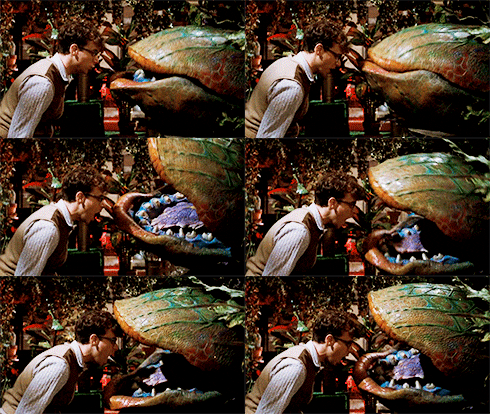
GiphyOne person joked in the video’s comments, “okay, who thought the poisonous, explosive, thorn-covered tree would be the best option to import for shade?” A fair question!
The sandbox tree might be a tad toxic, deadly, intrusive and insidious, but it’s still pretty cool to learn about. The planet never ceases to provide things that leave us in awe … and in this case, terrified.
And special kudos to Animalogic for providing entertaining and educational videos. You might have given us some nightmare fuel, but we love it.

- FDR planted trees during the last climate crisis - Upworthy ›
- Why you can't grow a Hass avocado from a Hass avocado seed ... ›
- Moringa is known as 'The Miracle Tree,' and its powers are ... ›
- Guy uses wood from states' official trees to make US map - Upworthy ›
- 'Tree Mountain' is a man-made forest designed by Agnes Denes - Upworthy ›


a man sitting at a desk with his head on his arms Photo by
Can a warm cup of tea help you sleep better? If you believe it, then yes. Photo by 
A woman is getting angry at her coworker.via
A man with tape over his mouth.via
A husband is angry with his wife. via 
Three women sit on a blanket in the park. 
Two women engaging in a pleasant conversation inside a coffee shop
Two men engaging in a peaceful disagreement.
Resurfaced video of French skier's groin incident has people giving the announcer a gold medal
"The boys took a beating on that one."
Downhill skiing is a sport rife with injuries, but not usually this kind.
A good commentator can make all the difference when watching sports, even when an event goes smoothly. But it's when something goes wrong that great announcers rise to the top. There's no better example of a great announcer in a surprise moment than when French skier Yannick Bertrand took a gate to the groin in a 2007 super-G race.
Competitive skiers fly down runs at incredible speeds, often exceeding 60 mph. Hitting something hard at that speed would definitely hurt, but hitting something hard with a particularly sensitive part of your body would be excruciating. So when Bertrand slammed right into a gate family-jewels-first, his high-pitched scream was unsurprising. What was surprising was the perfect commentary that immediately followed.
This is a clip you really just have to see and hear to fully appreciate:
- YouTube youtu.be
It's unclear who the announcer is, even after multiple Google inquiries, which is unfortunate because that gentleman deserves a medal. The commentary gets better with each repeated viewing, with highlights like:
"The gate the groin for Yannick Bertrand, and you could hear it. And if you're a man, you could feel it."
"Oh, the Frenchman. Oh-ho, monsieurrrrrr."
"The boys took a beating on that one."
"That guy needs a hug."
"Those are the moments that change your life if you're a man, I tell you what."
"When you crash through a gate, when you do it at high rate of speed, it's gonna hurt and it's going to leave a mark in most cases. And in this particular case, not the area where you want to leave a mark."
Imagine watching a man take a hit to the privates at 60 mph and having to make impromptu commentary straddling the line between professionalism and acknowledging the universal reality of what just happened. There are certain things you can't say on network television that you might feel compelled to say. There's a visceral element to this scenario that could easily be taken too far in the commentary, and the inherent humor element could be seen as insensitive and offensive if not handled just right.
The announcer nailed it. 10/10. No notes.
The clip frequently resurfaces during the Winter Olympic Games, though the incident didn't happen during an Olympic event. Yannick Bertrand was competing at the FIS World Cup super-G race in Kvitfjell, Norway in 2007, when the unfortunate accident occurred. Bertrand had competed at the Turin Olympics the year before, however, coming in 24th in the downhill and super-G events.
As painful as the gate to the groin clearly as, Bertrand did not appear to suffer any damage that kept him from the sport. In fact, he continued competing in international downhill and super-G races until 2014.
According to a 2018 study, Alpine skiing is a notoriously dangerous sport with a reported injury rate of 36.7 per 100 World Cup athletes per season. Of course, it's the knees and not the coin purse that are the most common casualty of ski racing, which we saw clearly in U.S. skier Lindsey Vonn's harrowing experiences at the 2026 Olympics. Vonn was competing with a torn ACL and ended up being helicoptered off of the mountain after an ugly crash that did additional damage to her legs, requiring multiple surgeries (though what caused the crash was reportedly unrelated to her ACL tear). Still, she says she has no regrets.
As Bertrand's return to the slopes shows, the risk of injury doesn't stop those who live for the thrill of victory, even when the agony of defeat hits them right in the rocks.