upworthy
Add Upworthy to your Google News feed.
Google News Button
Pets

Snoopy is real, her name is Bayley and the internet can't get enough of her

Everyone's childhood hearts just melted into a puddle.
Snoopy is real, her name is Bayley and the internet can't get enough of her

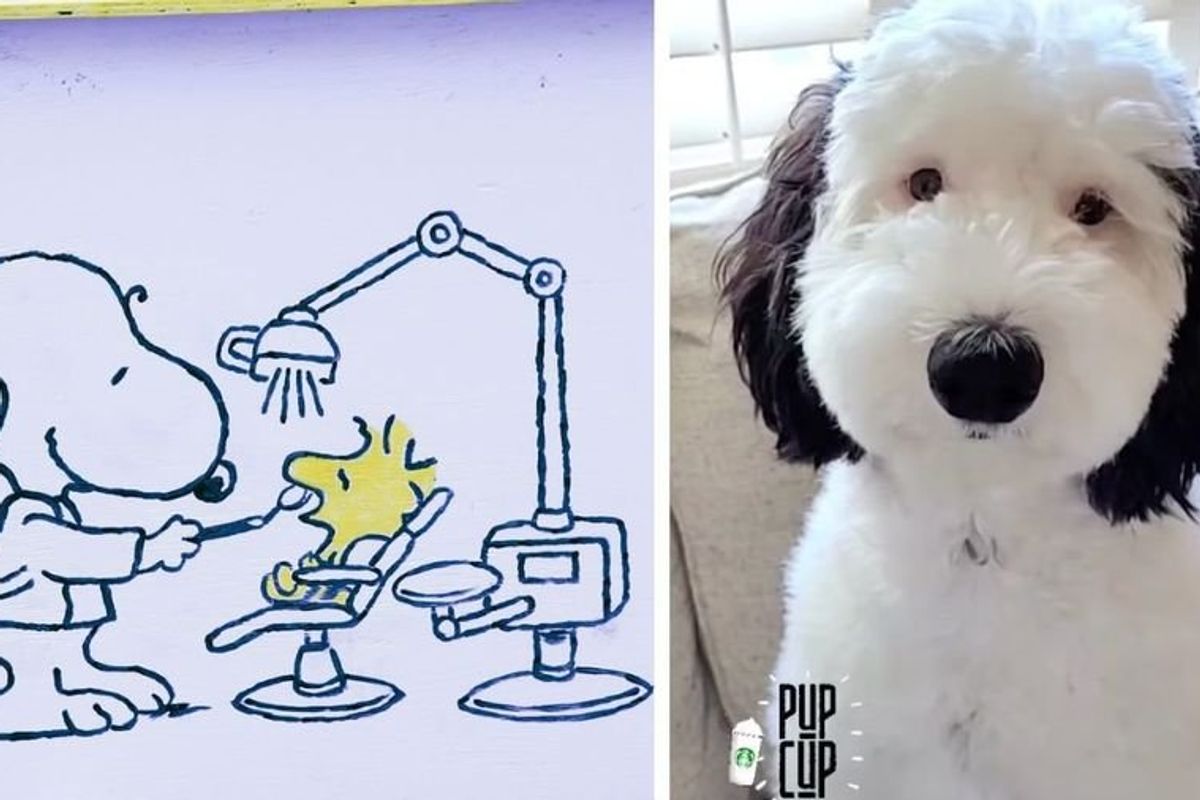
Stop what you're doing. There's a dog that looks just like Snoopy.

Soooo, there's this dog and I'm pretty sure it's the actual Snoopy come to life. Seriously all the dog needs is a red dog house out back and a little yellow bird that follows it around. If you think it can't be true, then you're going to have to fight the entire internet about it because nobody can get enough of how much this sweet dog looks like the iconic cartoon character.

Snoopy is Charlie Brown's pet from the comic strip "Peanuts" that eventually spawned several movies and cartoon series, and Bayley is a dead ringer for the black and white animated pup. Since we live in a digital age, people across the country have been falling all over themselves to get to the pooch's Instagram account and admire her cartoonish mug.

Bayley is a 1-year-old mini sheepadoodle, which is a cross between a miniature poodle and an Old English Sheepdog. Her sweet face is something you have to see to believe and even then you may question if she's real.


The dog's perfectly groomed curly fur makes her face look fluffy and cartoon-like. Once you add in her black ears and black button nose, that honestly looks more like a smooth lump of coal than a dog nose, then you have the perfect Snoopy doppelgänger. Bayley came into her viral fame after Doodle Dogs Club shared her photo on their Instagram account that has over 230,000 followers, and just like that, she was "famous."

The introductory post of the live version of Charlie Brown's best friend racked up over 1.4 million likes and 10.3K comments. The comments ranged from people reminding others that the fictional dog was a Beagle to people demanding Bayley star in the live action version of Charlie Brown.

Whether Snoopy was a Beagle or not, there's no arguing that Bayley looks more like the cartoon canine than real life Beagles. This probably has a lot to do with cartoons being...cartoons. Everything tends to be a bit bubbly and over exaggerated with cartoons.

Charlie Brown was supposed to be between the ages of 4 and 8 years old according to PeanutsWiki, who busted out the comic strip receipts. If cartoons looked exactly like real life, poor Charlie Brown would have a hard time walking with his oversized noggin.

Bayley's curly fluffy fur gives her an advantage over actual Beagle's when it comes to the ability to look like the famous cartoon character. It's something she probably couldn't care less about, unless every time she got compared to Snoopy equaled a dog treat. Otherwise, I'm sure the black and white sheepadoodle is perfectly happy just being a dog wondering why suddenly her mom keeps taking pictures of her.

Since Bayley's debut on Doodle Dogs Club, the animated dog come to life has climbed up to over 240k followers and her fanbase just can't get enough of her. To make people love her even more, the dog's mom uploads videos of Bayley using audio that makes it sound like the pup is a toddler trying to tell a story.

Check out some of the love Bayley gets on her Instagram account.


This article originally appeared on 4.17.23

generation jones, gen jones, gen jonesers, girls in 1970s, 1970s, teens 1970s
Image via Wikimedia Commons

Generation Jones is the microgeneration of people born from 1954 to 1965.

Generational labels have become cultural identifiers. These include Baby Boomers, Gen X, Millennials, Gen Z and Gen Alpha. And each of these generations is defined by its unique characteristics, personalities and experiences that set them apart from other generations.

But in-between these generational categories are "microgenerations", who straddle the generation before and after them. For example, "Xennial" is the microgeneration name for those who fall on the cusp of Gen X and Millennials.


And there is also a microgeneration between Baby Boomers and Gen X called Generation Jones, which is made up of people born from 1954 to 1965. But what exactly differentiates Gen Jones from the Boomers and Gen Xers that flank it?

- YouTube www.youtube.com

What is Generation Jones?

"Generation Jones" was coined by writer, television producer and social commentator Jonathan Pontell to describe the decade of Americans who grew up in the '60s and '70s. As Pontell wrote of Gen Jonesers in Politico:

"We fill the space between Woodstock and Lollapalooza, between the Paris student riots and the anti-globalisation protests, and between Dylan going electric and Nirvana going unplugged. Jonesers have a unique identity separate from Boomers and GenXers. An avalanche of attitudinal and behavioural data corroborates this distinction."

Pontell describes Jonesers as "practical idealists" who were "forged in the fires of social upheaval while too young to play a part." They are the younger siblings of the boomer civil rights and anti-war activists who grew up witnessing and being moved by the passion of those movements but were met with a fatigued culture by the time they themselves came of age. Sometimes, they're described as the cool older siblings of Gen X. Unlike their older boomer counterparts, most Jonesers were not raised by WWII veteran fathers and were too young to be drafted into Vietnam, leaving them in between on military experience.

How did Generation Jones get its name?

generation jones, gen jones, gen jones teen, generation jones teenager, what is generation jones A Generation Jones teenager poses in her room.Image via Wikmedia Commons

Gen Jones gets its name from the competitive "keeping up with the Joneses" spirit that spawned during their populous birth years, but also from the term "jonesin'," meaning an intense craving, that they coined—a drug reference but also a reflection of the yearning to make a difference that their "unrequited idealism" left them with. According to Pontell, their competitiveness and identity as a "generation aching to act" may make Jonesers particularly effective leaders:

"What makes us Jonesers also makes us uniquely positioned to bring about a new era in international affairs. Our practical idealism was created by witnessing the often unrealistic idealism of the 1960s. And we weren’t engaged in that era’s ideological battles; we were children playing with toys while boomers argued over issues. Our non-ideological pragmatism allows us to resolve intra-boomer skirmishes and to bridge that volatile Boomer-GenXer divide. We can lead."

@grownupdish

Are you Generation Jones? Definitive Guide to Generation Jones https://grownupdish.com/the-definitive-guide-to-generation-jones/ #greenscreen #generationjones #babyboomer #generationx #GenX #over50 #over60 #1970s #midlife #middleage #midlifewomen #grownupdish #over50tiktok #over60women #over60tiktok #over60club

However, generations aren't just calculated by birth year but by a person's cultural reality. Some on the cusp may find themselves identifying more with one generation than the other, such as being culturally more Gen X than boomer. And, of course, not everyone fits into whatever generality they happened to be born into, so stereotyping someone based on their birth year isn't a wise practice. Knowing about these microgenerational differences, however, can help us understand certain sociological realities better as well as help people feel like they have a "home" in the generational discourse.

As many Gen Jonesers have commented, it's nice to "find your people" when you haven't felt like you've fit into the generation you fall into by age. Perhaps in our fast-paced, ever-shifting, interconnected world where culture shifts so swiftly, we need to break generations into 10 year increments instead of 20 to 30 to give everyone a generation that better suits their sensibilities.

This article originally appeared two years ago. It has been updated.

angela duckworth, grit, ted talk, success, psychologist, therapist
via TED / YouTube

Angela Duckworth speaking at a TED event.

Why is it that some people are high achievers who have a track record of success and some people never come close to accomplishing their dreams? Is it talent, luck, or how you were raised? Is it that some people are just gifted and have exceptional talents that others don't?

The good news is, according to psychologist Angela Duckworth, the most critical factor in being a high achiever has nothing to do with talent or intelligence. It’s how long you can keep getting back up after getting hit. She calls it “grit” and, according to Duckworth’s research, it’s the common denominator in high achievers across the board, whether it’s cadets at West Point or kids in a spelling bee. Duckworth goes into depth on the topic in her book Grit: The Power of Passion and Perseverance.


What personal traits make someone successful?

“The common denominator of high achievers, no matter what they’re achieving, is this special combination of passion and perseverance for really long-term goals,” Duckworth revealed on The Mel Robbins Podcast. “And in a word, it’s grit.”


“Partly, it’s hard work, right? Partly it’s practicing what you can’t yet do, and partly it’s resilience,” she continued. “So part of perseverance is, on the really bad days, do you get up again? So, if you marry passion for long-term goals with perseverance for long-term goals well then you have this quality that I find to be the common denominator of elite achievers in every field that I've studied."

When pressed to define the specific meaning of grit, Duckworth responded: “It’s these two parts, right? Passion for long-term goals, like loving something and staying in love with it. Not kind of wandering off and doing something else, and then something else again, and then something else again, but having a kind of North Star."

- YouTube www.youtube.com

For anyone who wants to achieve great things in life, grit is an attitude that one can develop for themselves that isn’t based on natural abilities or how well one was educated. Those things matter, of course, but having a gritty attitude is something someone can learn.

"I am not saying that there aren't genes at play because every psychologist will tell you that's also part of the story for everything and grit included,” Duckworth said. “But absolutely, how gritty we are is a function of what we know, who were around, and the places we go."

Why grit is so important

Grit is critical for people to become highly successful because it means that you stick with the task even when confronted with barriers. In every journey of taking an idea that you love and turning it into reality there is going to be what’s known as the dark swamp of despair—a place that you must wade through to get to the other side. It takes grit and determination to make it through the times when you fear that you might fail. If it were easy, then everyone could be high achievers.


Grit is what keeps people practicing in their room every night as teenagers and makes them an accomplished guitar player. Grit is what makes a basketball player the first one in the gym and the last to leave so that they make the starting lineup. Grit is knocking on the next door after 12 people have just slammed their doors in your face.

The wonderful thing about Duckworth’s work is that it presents an opportunity for everyone willing to do the work. You can no longer use the fact that you may not have specialized intelligence or a God-given talent as an excuse. All you need is perseverance and passion and you have as good a shot as anyone at achieving your dreams.

This article originally appeared last year.

Culture

26 words that have gone nearly 'extinct' in the English language

"Comely (meaning beautiful) and homely (meaning ugly)."

words, english words, old words, old fashioned words, disappearing words, extinct words

Black and white 1920s woman on the phone.

Our vernacular is always changing. Every generation has its own slang words, from Xennials to Millennials and Gen Z.

In 2025, Dictionary.com deemed '67' as the word of the year, the Oxford University Press claimed the word of the year was "rage bait," and Merriam-Webster claimed it was "slop."


In an interview with the BBC, host Kate Colin offered an example of words that have disappeared in English when she opened a segment for the broadcasting network with this greeting: "Good morrow! I beseech thee, whence comest thou?" (Translation: "Good morning. Where do you come from?")

- YouTube www.youtube.com

Colin noted that this phrase was "Old English" used hundreds of years ago, and a great example of "disappearing words." Colin's co-host Jackie Dalton added, "Yes, English is a language which is evolving all the time. So this mean there are new words continuously appearing, and older words are disappearing."

In English, words are here today and will likely be gone tomorrow. Language lovers on Reddit shared their favorite old-fashioned words that have gone nearly "extinct" in English today (and many they wish would make a comeback).

26 disappearing words

"Overmorrow. It means 'the day after tomorrow'." - TheGloveMan

"I remember the word 'grody' from the 90s. It meant gross or yucky." - Glittering_Age_5591

"Comely (meaning beautiful) and homely (meaning ugly)." - oddwithoutend, Suspicious_Art9118

"Rolodex. There was something great about those. My own was a desk model with a lockable closing cover. Something about the tangibleness, the physicality and the control. Having the different kinds of cards and card covers, hearing them click when you spun it. I was sad to let it go." - Matsunosuperfan, BASerx8

"Bitchin' (meaning excellent)." - fox3actual

"Yellow pages." - Matsunosuperfan

"Forsooth." - fingermagnets459

Merriam-Webster notes that the definition of forsooth is "in truth : indeed —often used to imply contempt or doubt; now usually used to evoke archaic speech." It comes from Middle English and dates back to the 12th century.

"Lunting: walking while smoking a pipe." - RainbowWarrior73

@pbsdigitalstudios

Wouldn’t it be a dilly idea to bring back these 1900s slang words!? Which one fractured you the most 😅 Let us know in the comments and catch up on episodes of Otherwords with @Dr. Erica Brozovsky on the Stoired YouTube channel! #slang #english #language #linguistics #history #vintage @PBS

"Only a 'square' would remember things like that." - EighthGreen

"'Cattywampus' also sometimes known as 'catawampus'. A cool word that you don't hear much anymore." - Dead_Is_Better

"I use finagle and my high school students think I'm so weird. I'm 47. This word is normal." - MLAheading

"Frippery, at least in American English (think it's used in France for thrift shops?)" - KobayashiWaifu

Merriam-Webster notes that the definition of frippery is "finery, also an elegant or showy garment; something showy, frivolous, or nonessential." Its origins are Old French and date back as far as 1568.

"Handsome (when describing a woman)." - Odd-Scheme6535, Popular-Solution7697

"I love the word 'scrimshaw.' I don't hear it enough." - nocatleftbehind420

"Maybe not extinct but it's meaning completely obliterated: nonplussed." - LeFreeke

"Oblige. Rarely hear it except in old westerns." - ReadySetGO0

"Druthers." - Embarrassed_Wrap8421

- YouTube www.youtube.com

"Bogart. Monopolizing something that's meant to be shared." - CoderJoe1

"Bumbershoot." - kelariy

Merriam-Webster notes that "bumbershoot" is an American nickname for an umbrella that was first used in 1856.

"Ne'er-do-well. From the early 20th century, basically some who never-does -well, implying a slacker or underachiever. Although people never said it even when I was growing up, I still think it's a cool word." - fabgwenn

"Whippersnapper - a young and inexperienced person considered to be presumptuous or overconfident. I've heard people on TV say it, (maybe Dennis the Menace, or some other 50s show). I heard a 90 year old woman say it IRL and I laughed so hard." - JazzFan1998

"Xeroxing a document." - C-ute-Thulu

"Blatherskite." - Biff_Bufflington

Merriam-Webster notes that the definition of "blatherskite" is "a person who blathers [talks foolishly at length] a lot; nonsense." Its first known use dates back to 1650.

"I don't seem to hear penultimate much anymore." - TakeMetoLallybroch

"I'm quite fond of the word slubberdegullion, meaning 'dirty scoundrel'. I use it frequently when I talk to my senior, who is a rather clean upstanding citizen. We laugh and then he tells me to get back to work." - r-pics-sux

cat, kitty, cat behavior, pets, animals

"Your home. My rules."

Whether you're a cat person, a dog person, or neither, you likely know that cats have a reputation for being…mmm, particular. Cats like what they like and don't like what they don't like, and they expect you to not only know this but to cater to their likes and dislikes without ever having to voice them aloud.

That's right, there are unspoken rules that cat owners are expected to know and follow. If you own a cat or are around a cat, it's vital that you understand these rules. It's like a feline code of law you're just supposed to intuit or learn by trial and error, but thankfully, our friends at Feline Fanatics have laid them out clearly for us all.


Here are 11 rules that will make your life with your kitty much more pleasant for everyone if you follow them:

- YouTube www.youtube.com

1. Don't stare at them for too long

While gazing into the eyes of your cat might feel like you're bonding with them, you're not when the stare goes on too long. Cats are highly visual, and in cat language, holding eye contact is a challenge—an aggressive indicator that you're down for a fight. "Among cats, even friends don't hold eye contact," the video says. "They glance, blink, and move on." So give your cat a look, but don't hold their gaze.

2. Let them come to you

If you've ever walked up to a cat and tried to pick them up, unless it's a rare kitty who actually enjoys being manhandled, most cats will not respond positively. They may immediately wriggle out of your grasp and some might scratch or bite. Others may begrudgingly accept their fate, but in general, they prefer to come to you. "Autonomy is their love language," as the video states. Yep, they want affection, but on their terms.

cat, kitty, cat behavior, pets, animals "This blanket smells like me now."Photo credit: Canva

3. Respect their 'scent map'

A cat's scent map is their way of marking territory with their scent by rubbing their cheeks and bodies on items (as well as marking with urine or feces, but hopefully not in your house). This scent marking creates a sense of familiarity and comfort for a cat, and if you mess with that too much, it can make them feel disoriented. Of course, we have to wash things like blankets, pillows, beds, etc., but Feline Fanatics suggests washing things gradually and not all at once so as not to disturb their scent map.

4. Respond to their meows

Cats mostly meow for humans. They sometimes meow at one another, but rarely and mostly as kittens. When they meow, they're communicating with us in some way, even if we don't understand what they're "saying." Acknowledging their meows tells your cat that you heard them, even if you didn't understand them.

cat, kitty, cat behavior, pets, meowing "Hey, I'm talking to you."Photo credit: Canva

5. Give them an escape route

In the wild, being trapped means danger, and cats are sensitive to that feeling. They like to know they can get away, so always make sure they have an exit strategy. That might mean leaving a door cracked open or avoiding crowding them. Ironically, if a cat knows they can leave, they're more likely to stay, so always give them a way to escape.

6. Don't pet them like a dog

Most cats like affection, but petting a cat is different than petting a dog. Cats don't usually enjoy heavy strokes or pets that run their whole body. Their favorite petting spots are usually their heads, cheeks, and under the chin. Avoid their bellies unless you've really earned their trust, and even then a cat may or may not like their belly touched.

cat, kitty, cat behavior, pets, animals "Do not disturb."Photo credit: Canva

7. Honor the 'Do Not Disturb' sign

See a cat loafing on the sofa or curled up in a sun spot on the carpet? Leave them be. Cat naps are sacred and they do not want to be disturbed. (It is tempting, though. A cat sleeping is the kind of cute that begs for cuddles. Resist the urge.)

8. Speak cat body language

Cats communicate far more with their body language than with sounds. A flicking tail means a cat is stimulated, possibly irritated. Purring can be a sign of contentment, but it can also be a signal of stress or pain or a way to self-soothe. Cats knead (or "make biscuits") for comfort. Showing you their belly can mean they trust you, but it can also be a trap. Watch for patterns to learn what your cat is telling you with their body language.

cat, litter box, kitty litter, cat behavior, pets The litter box is sacred. Giphy

9. Keep the litter box sacred

Cats don't love to do their business in front of people or in busy, noisy parts of the house. They also like their toilet to be clean, so keep it scooped daily and change out the litter frequently. Use unscented litter and use an open box if possible (enclosed litter boxes trap odors inside). And have one litter box for each cat in your home, plus one extra.

10. Routine isn't boring—it's comfort.

Cats may seem like wild creatures in many ways, but they actually love routine. Too much change to their home environment and regular routine can stress them out, so things like the family going on vacation or getting new furniture can cause stress and anxiety. As the video states, "Cats don't see routine as boring; they see it as safe."

11. Quiet is connection

Kitties love sitting silently in the same place with their people. "Cats are masters of presence," the video says. Cats love quiet companionship, so if they're sitting silently in the room with you, that's a form of bonding. Just be with them in the silence and try not to disturb the peace too much.

Following these unspoken rules can help create a comfortable, happy life for our feline friends, even if they can't tell us that directly. You can follow Feline Fanatics on YouTube for more helpful cat tips.

This article originally appeared last year.