Appalachian mom's speech on Kentucky's proposed abortion ban is a must-hear for everyone
Danielle Kirk is speaking up for those often overlooked in our cultural debates.

Appalachian mom gives passionate speech.
Many people felt a gut punch when the Supreme Court issued its decision on Dobbs v. Jackson Women’s Health Organization, which overturned the decades-old Roe v. Wade decision that protected a woman's right to an abortion. However, for some this was a call to action.
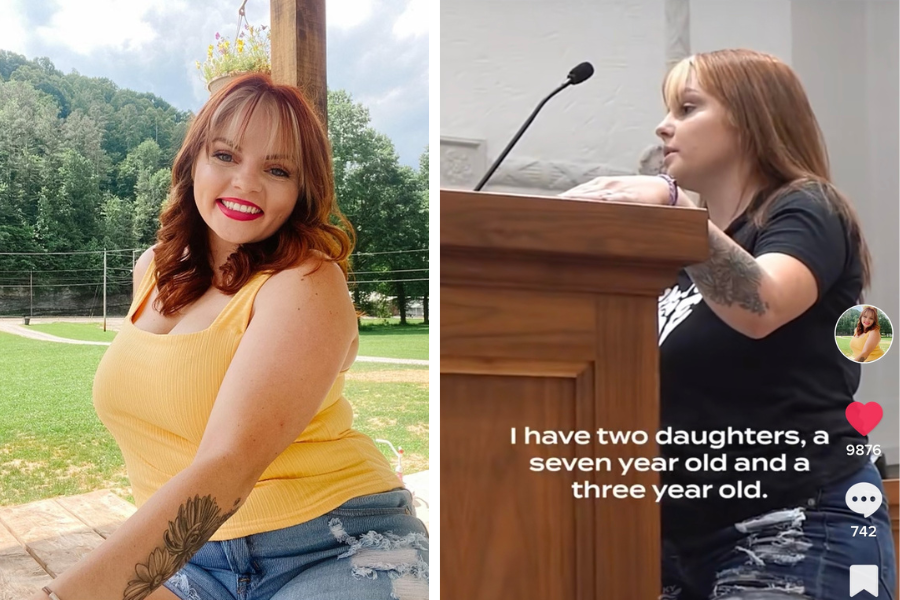
Danielle Kirk, 27, a mom of two and an activist on TikTok, used her voice in an attempt to educate the people that make decisions in her small town. Kirk lives in Kentucky where a trigger law came into effect immediately after Roe v. Wade was overturned. Being a former foster child, she knew she had to say something. Kirk spoke exclusively with Upworthy about why she decided to speak up.
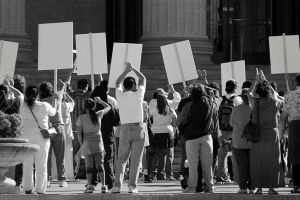
Kirk hadn't planned to speak at the Pikeville rally, a protest against Kentucky's Human Life Protection Act, triggered in the wake of the Supreme Court ruling. But when the organizers asked for speakers, she felt compelled to make her way to the podium. “I felt like what I had to say had not been said before, coming from someone that had been in the system," Kirk explained. "There's so much of a gray area when it comes to this issue and they're trying to make it black and white. The law in Kentucky does not give way to people that I know."
She further explained that the wording of the act is so unclear that doctors she knows personally are afraid because there's no clear distinction on what is considered a great enough threat to the mother's life, which is the only exception given in the state's law.
@daniellekirk731 I didnt plan on speaking today, but something told me to. For so long our voices have been silenced into sumbission. No more. Its time for us to all band together, create the support systems we need HERE, turn our tears and anger into outreach. If they want to pass this back to the states, let your state representives & congressmen know that they work for us, if they cant, we’re coming for their jobs!!!! @appalachian_nana thanks for sending me this video
Kirk asked the question, "Do I have to be on my death bed to have an abortion?"
Appalachia is an expansive territory that spans 13 states, including Pennsylvania, West Virginia, Kentucky and Mississippi. Of those 13 states, five have trigger laws and four others are either fighting in court to enact bans on abortion or plan to call a special session to enact a ban. In the state of Kentucky, where Kirk lives, the trigger law does not allow for any exceptions for rape or incest, even if the victim is a child.
Kirk has two small daughters and is a victim of childhood sexual abuse herself, which gives her a unique perspective on why this extreme ban is harmful. She was raised by her biological mother for only a short period of time before her mother's death, and she spent time in and out of the foster care system where she experienced sexual abuse. Being born and raised in rural Appalachia, first West Virginia, then Kentucky, Kirk understands what this ban would mean for the people in her small town and other towns like hers across the country.
At 15.2% of the population, Appalachia has some of the highest poverty rates in the country. According to the U.S. Census Bureau, the 2020 national average poverty rate was 11.4%. Resources for people living in Appalachian areas are scarce due to the remote locations that most of the population lives in. Most rural areas don’t have public transportation or Uber to take them places. There are regions in Appalachia that don’t even have internet access. So being able to get appropriate medical care when pregnant can be a challenge for those living in the region.
Poverty doesn’t only stop at transportation, the area's residents are also challenged in terms of employment as well as access to grocery stores, clean water or even running water. It's a population that is struggling to survive on limited resources.
@daniellekirk731 I understand a lot of people have been warning of this, & they didn’t listen in the past. But young voters here are tired & ready to fight. #Kentucky #606 #OrganizeAppalachia
Which is why Kirk’s speech is what government officials need to hear. It’s also what people who are supporting the abortion ban need to hear. Because sometimes, speaking the truth of your personal experiences is the only way to change the minds of neighbors and politicians. And things can seem far removed when you don’t personally know someone affected by larger decisions.
During our interview, Kirk expressed hope that the trigger law could be halted. In fact, on June 30, a Louisville Circuit Court Judge issued a temporary restraining order to block the state's abortion ban. This means abortions can continue in the state, for now.
Kirk said she feels it's important for people to see someone that talks like her taking a stance against something that is supposed to be popular in a conservative state like Kentucky. "People have been silenced into submission," she said. She hopes that others might be inspired to speak up and even become motivated to run for local or state office—something she is considering for when her children are a bit older.


A woman is getting angry at her coworker.via
A man with tape over his mouth.via
A husband is angry with his wife. via 
a man sitting at a desk with his head on his arms Photo by
Can a warm cup of tea help you sleep better? If you believe it, then yes. Photo by 
Three women sit on a blanket in the park. 
Two women engaging in a pleasant conversation inside a coffee shop
Two men engaging in a peaceful disagreement.
Resurfaced video of French skier's groin incident has people giving the announcer a gold medal
"The boys took a beating on that one."
Downhill skiing is a sport rife with injuries, but not usually this kind.
A good commentator can make all the difference when watching sports, even when an event goes smoothly. But it's when something goes wrong that great announcers rise to the top. There's no better example of a great announcer in a surprise moment than when French skier Yannick Bertrand took a gate to the groin in a 2007 super-G race.
Competitive skiers fly down runs at incredible speeds, often exceeding 60 mph. Hitting something hard at that speed would definitely hurt, but hitting something hard with a particularly sensitive part of your body would be excruciating. So when Bertrand slammed right into a gate family-jewels-first, his high-pitched scream was unsurprising. What was surprising was the perfect commentary that immediately followed.
This is a clip you really just have to see and hear to fully appreciate:
- YouTube youtu.be
It's unclear who the announcer is, even after multiple Google inquiries, which is unfortunate because that gentleman deserves a medal. The commentary gets better with each repeated viewing, with highlights like:
"The gate the groin for Yannick Bertrand, and you could hear it. And if you're a man, you could feel it."
"Oh, the Frenchman. Oh-ho, monsieurrrrrr."
"The boys took a beating on that one."
"That guy needs a hug."
"Those are the moments that change your life if you're a man, I tell you what."
"When you crash through a gate, when you do it at high rate of speed, it's gonna hurt and it's going to leave a mark in most cases. And in this particular case, not the area where you want to leave a mark."
Imagine watching a man take a hit to the privates at 60 mph and having to make impromptu commentary straddling the line between professionalism and acknowledging the universal reality of what just happened. There are certain things you can't say on network television that you might feel compelled to say. There's a visceral element to this scenario that could easily be taken too far in the commentary, and the inherent humor element could be seen as insensitive and offensive if not handled just right.
The announcer nailed it. 10/10. No notes.
The clip frequently resurfaces during the Winter Olympic Games, though the incident didn't happen during an Olympic event. Yannick Bertrand was competing at the FIS World Cup super-G race in Kvitfjell, Norway in 2007, when the unfortunate accident occurred. Bertrand had competed at the Turin Olympics the year before, however, coming in 24th in the downhill and super-G events.
As painful as the gate to the groin clearly as, Bertrand did not appear to suffer any damage that kept him from the sport. In fact, he continued competing in international downhill and super-G races until 2014.
According to a 2018 study, Alpine skiing is a notoriously dangerous sport with a reported injury rate of 36.7 per 100 World Cup athletes per season. Of course, it's the knees and not the coin purse that are the most common casualty of ski racing, which we saw clearly in U.S. skier Lindsey Vonn's harrowing experiences at the 2026 Olympics. Vonn was competing with a torn ACL and ended up being helicoptered off of the mountain after an ugly crash that did additional damage to her legs, requiring multiple surgeries (though what caused the crash was reportedly unrelated to her ACL tear). Still, she says she has no regrets.
As Bertrand's return to the slopes shows, the risk of injury doesn't stop those who live for the thrill of victory, even when the agony of defeat hits them right in the rocks.