7-year-old responds to being bullied by making inspirational videos for his classmates
The thought of a 7-year-old being picked on is heartbreaking, but the way this incoming second-grader chose to respond to being bullied is filling hearts with joy. Rowyn Montgomery of Tiverton, Rhode Island, has been making motivational videos for his classmates and even grownups are finding them inspiring. The wisdom and positive attitude this kiddo…
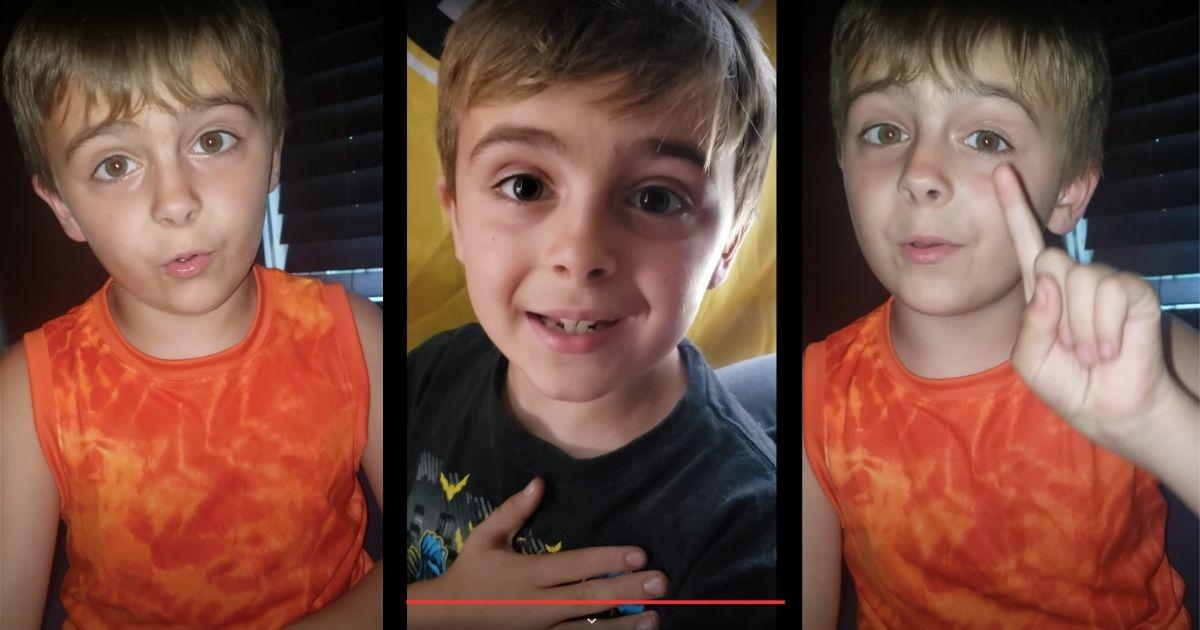
The thought of a 7-year-old being picked on is heartbreaking, but the way this incoming second-grader chose to respond to being bullied is filling hearts with joy.
Rowyn Montgomery of Tiverton, Rhode Island, has been making motivational videos for his classmates and even grownups are finding them inspiring.
The wisdom and positive attitude this kiddo exudes is just awesome. Watch the message he has for his class as they get ready to tackle the second grade:
“God knows how many grades there’s gonna be!” Holy hilarious, Batman. But Rowyn is right: “Believing in yourself is always the right thing to do.”
Rowyn’s mom, Michelle Montgomery told FUN 107 that the 7-year-old regularly has conversations beyond his years. “He’s so funny,” she said. “He’s an old soul. You can talk to him about such deep things.”
Check out Rowyn’s advice for kids who are being picked on.
“I have a unibrow and I used to be picked on because of it. But, I don’t care because I’m myself!” he says. “With bullies, it doesn’t matter what they think about you, it matters what you think about yourself and it’s good to embrace yourself and tell other people who you are.”
Right on, little man.
“When I make videos, it makes me feel happy that other people can watch them and feel happy,” Rowyn said, according to ABC 6. “If they’re getting picked on or if they’re shy or something, they can watch the videos.”
Dealing with bullying is hard for people at any age. To see such a young person not only internalize a message of self-worth and confidence, but also be able to so eloquently share it with others, is truly inspiring.
Rowyn’s mom works in the behavioral health field and Rowyn himself hopes to be a counselor one day so he can keep helping and motivating others. Judging by his videos, he’s got a bright future ahead of him.
In a small village in Pwani, a district on Tanzania’s coast, a massive dance party is coming to a close. For the past two hours, locals have paraded through the village streets, singing and beating ngombe drums; now, in a large clearing, a woman named Sheilla motions for everyone to sit facing a large projector screen. A film premiere is about to begin.
It’s an unusual way to kick off a film about gender bias, inequality, early marriage, and other barriers that prevent girls from accessing education in Tanzania. But in Pwani and beyond, local organizations supported by Malala Fund and funded by Pura are finding creative, culturally relevant ways like this one to capture people’s interest.
The film ends and Sheilla, the Communications and Partnership Lead for Media for Development and Advocacy (MEDEA), stands in front of the crowd once again, asking the audience to reflect: What did you think about the film? How did it relate to your own experience? What can we learn?
Sheilla explains that, once the community sees the film, “It brings out conversations within themselves, reflective conversations.” The resonance and immediate action create a ripple effect of change.
MEDEA Screening Audience in Tanzania. Captured by James Roh for Pura
Across Tanzania, gender-based violence often forces adolescent girls out of the classroom. This and other barriers — including child marriage, poverty, conflict, and discrimination — prevent girls from completing their education around the world.
Sheilla and her team are using film and radio programs to address the challenges girls face in their communities. MEDEA’s ultimate goal is to affirm education as a fundamental right for everyone, and to ensure that every member of a community understands how girls’ education contributes to a stronger whole and how to be an ally for their sisters, daughters, granddaughters, friends, nieces, and girlfriends.
Sheilla’s story is one of many that inspired Heart on Fire, a new fragrance from the Pura x Malala Fund Collection that blends the warm, earthy spices of Tanzania with a playful, joyful twist. Here’s how Pura is using scent as a tool to connect the world and inspire action.
A partnership focused on local impact, on a global mission
Pura, a fragrance company that recognizes education as both freedom and a human right, has partnered with Malala Fund since 2022. In order to defend every girl’s right to access and complete 12 years of education, Malala Fund partners with local organizations in countries where the educational barriers are the greatest. They invest in locally-led solutions because they know that those who are closest to the problems are best equipped to solve and build durable solutions, like MEDEA, which works with communities to challenge discrimination against girls and change beliefs about their education.
But local initiatives can thrive and scale more powerfully with global support, which is why Pura is using their own superpower, the power of scent, to connect people around the world with the women and girls in these local communities.
The Pura x Malala Fund Collection incorporates ingredients naturally found in Tanzania, Nigeria, Pakistan, and Brazil: countries where Malala Fund operates to address systemic education barriers. Eight percent of net revenue from the Pura x Malala Fund Collection will be donated to Malala Fund directly, but beyond financial support, the Collection is also a love letter to each unique community, blending notes like lemon, jasmine, cedarwood, and clove to transport people, ignite their senses, and help them draw inspiration and hope from the global movement for girls’ education. Through scent, people can connect to the courage, joy, and tenacity of girls and local leaders, all while uniting in a shared commitment to education: the belief that supporting girls’ rights in one community benefits all of us, everywhere.
You’ve already met Sheilla. Now see how Naiara and Mama Habiba are building unique solutions to ensure every girl can learn freely and dare to dream.
Naiara Leite is reimagining what’s possible in Brazil
Julia with Odara in Brazil. Captured by Luisa Dorr for Pura
In Brazil, where pear trees and coconut plantations cover the Northeastern Coast, girls like ten-year-old Julia experience a different kind of educational barrier than girls in Tanzania. Too often, racial discrimination contributes to high dropout rates among Black, quilombola and Indigenous girls in the country.
“In the logic of Brazilian society, Black people don’t need to study,” says Naiara Leite, Executive Coordinator of Odara, a women-led organization and Malala Fund partner. Bahia, the state where Odara is based, was once one of the largest slave-receiving territories in the Americas, and because of that history, deeply-ingrained, anti-Black prejudice is still widespread. “Our role and the image constructed around us is one of manual labor,” Naiara says.
But education can change that. In 2020, with assistance from a Malala Fund grant, Odara launched its first initiative for improving school completion rates among Black, quilombola, and Indigenous girls: “Ayomidê Odara”. The young girls mentored under the program, including Julia, are known as the Ayomidês. And like the Pura x Malala Fund Collection’s Brazil: Breath of Courage scent, the Ayomidês are fierce, determined, and bursting with energy.
Ayomidês with Odara in Brazil. Captured by Luisa Dorr for Pura
Ayomidês take part in weekly educational sessions where they explore subjects like education and ethnic-racial relations. The girls are encouraged to find their own voices by producing Instagram lives, social media videos, and by participating in public panels. Already, the Ayomidês are rewriting the narrative on what’s possible for Afro-Brazilian girls to achieve. One of the earliest Ayomidês, a young woman named Debora, is now a communications intern. Another former Ayomidê, Francine, works at UNICEF, helping train the next generation of adolescent leaders. And Julia has already set her sights on becoming a math teacher or a model.
“These are generations of Black women who did not have access to a school,” Naiara says. “These are generations of Black women robbed daily of their dreams. And we’re telling them that they could be the generation in their family to write a new story.”
Mama Habiba is reframing the conversation in Nigeria
Centre for Girls' Education, Nigeria. Captured by James Roh for Pura
In Mama Habiba’s home country of Nigeria, the scents of starfruit, ylang ylang and pineapple, all incorporated into the Pura x Malala Collection’s “Nigeria: Hope for Tomorrow,” can be found throughout the vibrant markets. Like these native scents, Mama Habiba says that the Nigerian girls are also bright and passionate, but too often they are forced to leave school long before their potential fully blooms.
“Some of these schools are very far, and there is an issue of quality, too,” Mama Habiba says. “Most parents find out when their children are in school, the girls are not learning. So why allow them to continue?”
When girls drop out of secondary school, marriage is often the alternative. In Nigeria, one in three girls is married before the age of 18. When this happens, girls are unable to fulfill their potential, and their families and communities lose out on the social, health and economic benefits.
Completing secondary school delays marriage, and according to UNESCO, educated girls become women who raise healthier children, lift their families out of poverty and contribute to more peaceful, resilient communities.
Centre for Girls’ Education, Nigeria. Captured by James Roh for Pura
To encourage young girls to stay in school, the Centre for Girls’ Education, a nonprofit in Nigeria founded by Mama Habiba and supported by Malala Fund and Pura, has pioneered an initiative that’s similar to the Ayomidê workshops in Brazil: safe spaces. Here, girls meet regularly to learn literacy, numeracy, and other issues like reproductive health. These safe spaces also provide an opportunity for the girls to role-play and learn to advocate for themselves, develop their self-image, and practice conversations with others about their values, education being one of them. In safe spaces, Mama Habiba says, girls start to understand “who she is, and that she is a girl who has value. She has the right to negotiate with her parents on what she really feels or wants.”
“When girls are educated, they can unlock so many opportunities,” Mama Habiba says. “It will help the economy of the country. It will boost so many opportunities for the country. If they are given the opportunity, I think the sky is not the limit. It is the starting point for every girl.”
From parades, film screenings to safe spaces and educational programs, girls and local leaders are working hard to strengthen the quality, safety and accessibility of education and overcome systemic challenges. They are encouraging courageous behavior and reminding us all that education is freedom.
Experience the Pura x Malala Fund Collection here, and connect with the stories of real girls leading change across the globe.
Gen Z is obsessed with the 2000s and 2010s, which they’ve labeled the “last era of sweet delusion.” They’ve also latched onto a number of Millennial fashion trends, including low-rise jeans. There’s no doubt that Gen Z has established plenty of its own fashion trends, from suits with shorts to barrel jeans. But the generation…
There’s no doubt that Gen Z has established plenty of its own fashion trends, from suits with shorts to barrel jeans. But the generation is also embracing a ’00s hair trend that has Millennials shook: the hair pouf, a bubbly bouffant style popularized by celebrities like Laguna Beach star Lauren Conrad and Jersey Shore standout Nicole “Snooki” Polizzi.
Now, Gen Z is getting a little extra help from one iconic volumizing hair accessory: Bumpits.
On TikTok, many Gen Zers are showing off the results of their 2000s hair transformations using Bumpits. Inspired by French actress Brigitte Bardot’s legendary bouffant style, Gen Z is also putting its own twist on how it uses Bumpits.
Hairstylist Stephanie Angelone told Bustle that Bumpits are coming back with Gen Z in a “more lax way.”
“Millennials used dozens of bobby pins to pin their pouf into place, which made it very defined, almost like an updo,” she said. “Gen Z prefers micro claw clips so it’s easy and effortless.”
Gen Zers are documenting themselves trying out Bumpits in different styles, from half-up, half-down ‘dos to simple hair-down looks. Many note that it takes multiple tries to get it right, but once they do, they love the results.
TikToker @blackhairedbrat noted, “While figuring out how to secure everything, I realized it’s essential to tease all the hair up to hide the Bump-It properly. Otherwise, it might lead to an embarrassing peek-a-boo of the hidden accessory!”
Once she figured it out, she was a happy camper: “So far, I’d give this a solid 7 out of 10. It’s definitely something I would use, especially for those blessed with thick hair.”
The history of Bumpits
Bumpits were invented by Kelly Fitzpatrick-Bennett and made their debut in 2009 on the now-defunct As Seen on TV channel. Fitzpatrick-Bennett claims that more than 10 million units were sold.
In an interview on Fran Drescher’s talk show, she explained that her career as a hairdresser inspired her to create Bumpits after clients came in wanting hair like Jennifer Aniston’s on Friends—but didn’t have the volume for it.
Bumpits featured an over-the-top commercial with dramatic clips of women struggling to achieve volumized looks that seem to be cemented in Millennial memories.
“Are you exhausted from dealing with flat, lifeless hairstyles? Do you find yourself using an entire can of hairspray just to achieve that voluminous look? It’s time to ‘bump it up’ with the iconic Bumpit!” the commercial said.
Millennials react
On Reddit, Millennials shared their personal experiences and funny stories wearing Bumpits back in the day:
“Ooof, I totally used to use these 😬To be fair, I was in cosmetology school and that hairstyle was popular at the time. One Saturday a bunch of my classmates and I went out to a bar after school and I ran into a guy I had a HUGE crush on. He is extremely tall and when he bent down to give me a hug, his chin hit the bump-it HARD, it scratched his chin and rammed the bump-it into my scalp. Embarrassing and painful and I’m sure the reason we never dated. I stopped wearing them shortly after that, but I still have them around here somewhere.”
“I felt indignant at the time that they didn’t make them for red hair…My perspective has changed somewhat in hindsight.”
“I had one, didn’t work.”
“Used these RELIGIOUSLY during the time ‘Jersey Shore’ was coming out. Even used one for my prom hair 😭😭😂😂.”
“I could never get mine to not be visible. I have fine hair and had lots of it at the time, but no matter how I tried, I couldn’t get the blessed thing hidden completely.”
“I still have mine 🤣🤣🤣.”
“Being a HS cheerleader in 2008-2010 in the Midwest, these were EVERYTHING.”
“This trend was so awful. It brings back hilarious memories.”
Communication has always been a hit-or-miss reality, even before the Internet. Misunderstandings, misreadings, and misinterpretations happen. But the age of emojis and online-only acronyms has opened up even more opportunities for miscommunication, sometimes resulting in mortifying hilarity. A thread on X highlights misuses of modern acronyms and emojis, largely revolving around the letter “F.” (Fair…
Communication has always been a hit-or-miss reality, even before the Internet. Misunderstandings, misreadings, and misinterpretations happen. But the age of emojis and online-only acronyms has opened up even more opportunities for miscommunication, sometimes resulting in mortifying hilarity.
A thread on X highlights misuses of modern acronyms and emojis, largely revolving around the letter “F.” (Fair warning here that many of these contain f-bombs.) It starts with someone who thought “JFC” stood for “just for clarification.”
JFC ≠ Just For Clarification
Imagine putting JFC in a professional email without knowing that the common meaning is “Jesus F____ing Christ.” As in, “JFC, we’ll go over that at our meeting next week.” Has a whole different feel, doesn’t it?
Someone just told me about this woman on Instagram who genuinely thought "JFC" stood for "just for clarification." She'd been dropping it casually in professional emails for years.
It instantly reminded me of my own mom, who for the longest time was convinced "LOL" meant "lots…
A super common acronym confusion is LOL. In modern online usage, it means “laugh out loud.” However, the acronym predates texting and social media. Traditionally, LOL was used to say “lots of love” at the end of a letter.
Those two different usages create some very awkward interchanges, such as when a person responds with condolences: “So sorry for your loss. LOL”
My mom did this exact same thing with LOL. Her dad passed, my grandpa, while I was out boating and she texted me, “Grandpa passed away this morning. I will let you know about services. Call me when you get home. LOL, Mom”. As soon as I got to land, I called. She had sent a…
This one isn’t an acronym or emoji, but it has become a common slang term. In modern usage, “hard pass” means “Nope, nope, nopity nope. I immediately and absolutely do NOT want to do that thing.” So imagine how embarrassing it would be if you used “hard pass” to respond to a party invitation, thinking it meant, “It’s hard for me to pass on this, but I’m afraid I have to, so sorry.”
Hopefully, the person receiving the “hard pass” RSVP knew the person well enough to know they may be confused about the phrase, because ouch.
Read someone who’d thought “hard pass” meant “hard to turn it down but I have to, sorry” and had been saying it to party invitations. Obvious horrified when she found out.
Sometimes an acronym takes hold in a specific time period or subgroup of people, then later takes hold with a whole different meaning.
Enter “FTW.” Apparently, the punk rockers of the 80s and 90s would use FTW to mean “F___ The World.” But the acronym gained traction among online gamers to mean “For The Win.” The latter has since spilled over into popular culture, but for some folks, the older meaning still comes to mind first.
However, there’s another FTW (usually written as F.T.W.) for bikers. Even that has more than one meaning, as some use it to mean “Forever Two Wheels” and others use it for “Forever Together Wherever.”
WTF can be a minefield of misunderstanding
Rearrange the letters of FTW and we have WTF, which has been a great source of confusion. The commonly understood (and most vulgar) usage is “What The F___.” But people have misread it or misunderstood it to mean various things, including:
Why The Face?
Welcome To Facebook!
Where’s The Food?
Well That’s Fantastic!
WOW That’s Fantastic!
One person shared a hilarious tale about that last one:
LOL… seriously, that's funny
— NicoleTheCat random retweeter of interesting stuff (@NicoleTheCat4) March 10, 2026
“My kid told his 8th grade science teacher that WTF! written on his notebook was for ‘WOW! That’s Fantastic!’ The teacher was so excited to finally learn what it meant he was using it all the time! I swear this is the truth: he shouted ‘WTF!’ at a class tour at the Smithsonian. He graded tests & if kids got an A, he wrote WTF! At the top of their paper. He finally found out the other meaning and had to apologize to the whole school. My kid got a week detention.”
F/U ≠ follow up (though it could)
In a professional email, you can be pretty sure f/u stands for “follow-up.” But you can never be 100% sure…
Sometimes, one letter makes a world of difference. FFS is generally understood to mean “For F___’s Sake.” Add a C to make FCFS, and you have “First Come First Served.”
So yeah, using FFS instead of FCFS gives a Facebook Marketplace listing a whole different vibe.
Lol! A Facebook marketplace lady I knew from church was putting FFS instead of FCFS on all her garage sale leftovers. It was amazing. 🤣😇
It’s the “F” that really gets people in trouble with the acronyms, isn’t it? At this point, it’s probably best to assume that any acronym that uses an F is potentially vulgar to avoid something embarrassing.
For instance, it’s understandable that one might interpret GFY as “Good For YOU.” Wholesome and sweet and totally the opposite of the more commonly understood “Go F___ Yourself.” (Is there someone we can petition to change this one? Good For You is so much better.)
Reminds me of the lady who shared that she thought GFY meant Good For You and used it often in work emails. “My wife just gave birth to our first child.” “GFY!”
— No soup for you. Next! (@JeffHerndon33) March 11, 2026
Oh, the emojis
People also shared ways emojis have been misunderstood and misused. For instance, the poop emoji looks an awful lot like chocolate softserve ice cream. Apparently, more than a few people have thought that’s what it was and used it in texts accordingly. Imagine the possibilities there.
The tearful emojis have also been a source of confusion, with some people thinking the cry-laughing emoji is just crying. Imagine sending the cry-laugh emoji in a text expressing sorrow for someone’s loss.
The size of emojis can make deciphering them a little tricky, which is why a couple of people thought the middle finger emoji was simply a pointer finger. Woops.
Oh I used it in an advertisement once. It was a tragic day at work😂
And some emojis are simply confusing, period. No one seems to agree whether the two hands together emoji means praying hands or high five. And unfortunately, the search function doesn’t help because it comes up when you search “pray” and also when you search “high five.”
Considering that entire wars have begun over miscommunications, it’s kind of important that we are generally on the same page about what things mean. But at least in the fast-changing era of online communications, we understand such confusion is bound to occur on occasion and are able to laugh about it.
Nostalgia is all about remembering how things were in the “gold old days.” But sometimes, upon further reflection, some things really sucked in the past despite how rosy our colored glasses made them look. Boomers and Gen Xers are reminiscing on the things they really don’t miss from the 1980s and 1990s. Over on Reddit,…
Nostalgia is all about remembering how things were in the “gold old days.” But sometimes, upon further reflection, some things really sucked in the past despite how rosy our colored glasses made them look. Boomers and Gen Xers are reminiscing on the things they really don’t miss from the 1980s and 1990s.
Over on Reddit, member pizzagamer35 posed the question to Boomers and Gen Xers: “What is something you do NOT miss from the 80s-90s?”
Boomers and Gen Xers had plenty of throwback experiences and products they are happy to never come across again. These are 30 of the most nostalgic responses from Boomers and Gen Xers about things they don’t miss about the ’80s and ’90s.
“Using those Noxzema pads to burn and dry out my pimply face. It had a smell, too.” —poizon_elff
“Waiting for JPGs to load one line at a time.” —timmayd
“Those hair ties with the two giant plastic beads on them that EVERY mom used to tie up their daughter’s hair in pigtails. God forbid she lose her grip on one while she was already ripping your soul out through your scalp.” —Honey-Badger-90
“Third degree burns from metallic seat belt fasteners.” —JLMTIK88
“Not being able to use the internet if someone needed the phone line to be free.” —Joshawott27
“Buying a CD and realizing all the songs suck, except for one, maybe two.” —11B-E5
“Batteries and flashlight bulbs. Holy crap they were crap. I still remember seeing the little LED light on our shitty car radio and asking dad what kind of light that tiny dot was. He told me it was a diode and diodes kinda ‘last forever’. I immediately wondered why the hell we weren’t developing that tech.” —snoozieboi
“Ordering pizza by calling the restaurant and yelling your order to a guy in a noisy kitchen. Missing an episode of your favorite TV show (or forgetting to tape it if you had a VCR) and not being able to see it until summer reruns, or maybe never.” —Imaginary-List-4945
“Terrible contact lenses.” —MandatoryMatchmaker
“To contribute something small: manual computer defragmentation. It took several hours and you couldn’t do anything else.” —rena-vee
“Pay Phones that gave you limited talk time.” —Aggravating-Iron9804
“Gym class. Boys were expected to know how to play sports. My dad taught me how to fix tractors and cut firewood, but he didn’t teach me sports because no one ever taught him. The gym teacher didn’t teach us sh*t. When we f*cked up or didn’t know what to do, the jocks would laugh and the teacher would join in the fun.” —Fluffy-Cupcake9943
“The ‘heroin chic’ body type.” —Heartbreak_Star
“Panty hose.” —Kitty-haha
“Aqua net=hair that absolutely did not move! And you could see little hairspray bubbles .” — IAmTheBlackStar1979
“Having to rewind VHS tapes like it was a part-time job.” -—Repulsive_Corgi_6187
“Waiting by the radio for your song to play so you can record it on tape.” —mycrml
“Serial killers. They just can’t exist at the same level anymore. Plus we got all the lead out of stuff. So now people are 100% normal. 100%.” —PrimeNumbersby2
“Manual roll up/down windows in cars.” —Human-Average-2222
“Carpeted bathrooms. someone shared a bunch of pictures of them on some nostalgia account and i could smell the pictures through my phone .” —GoblinHeart1334
“Busy signal on the phone.” —crjconsulting
This article originally appeared last year. It has been updated.
Generation X, typically the children of Baby Boomers born between the years of 1965-1980 tend to have a complicated reputation depending on who you ask. Some view them as a feral generation never to be spoken of poorly without consequence, while others view them as innovators pushing us into the future. But in recent years,…
This multi-year conversation started when a video went viral calling Gen X out for being “terrible” grandparents, claiming that they never want to help with grandchildren. It didn’t take long before other Millennials piled on to air their own grievances about Gen X grandparents. Most people criticizing the “new grandparents” were genuinely perplexed as to how they did not want to be more involved in the lives of their grandchildren.
Kylie Muse reveals in a video that she felt neglected by her Gen X parents growing up, saying, “It’s quite a common theme for Gen X parents to be neglectful in some capacity and it’s just crazy to me how more of them haven’t learned from the past 20 to 30 years, instead of these grandparents seeing their kids having kids as an opportunity to restore the health in their relationships with their kids by showing up and helping them during the hardest transition of their lives, they would rather double down and compromise their relationship with that next generation. All for the sake of hyper-individualism and pride.”
The critique coming from the younger generation is not lost on Gen X, and they started coming out in force to respond with such vigor you’d think John Hughes had just announced the re-release of The Breakfast Club. It would seem that some of the people complaining of the lack of involvement have not considered that Gen X could have valid reasons for not immediately jumping in to take on grandparenting in the way some expect. A man by the name of John S. Blake gives a candid look into why Gen X was neglected as children and, in turn, became hype-independent at an early age.
“As a Gen X who’s been on this earth long enough to have some hindsight I can tell you this, being independent at a young age is not a flex, what it actually means is capitalism is so brutal that our parents were forced to neglect their own children to stay alive. My generation was struggling so much that we had to leave our children unattended in order to produce enough so that we could afford to exist,” Blake says.
But perhaps one of the most heart wrenching explanations comes from an elder Millennial who goes by the name Amazing Dea. In response to another Millennial who asks about Gen X being let off the hook, Dea shares, “Being as though you look like you might be a younger Millennial, let me go ahead and enlighten you. Generation X and older Millennials had to live through more than just this pandemic. We had the crack epidemic, we had the AIDS epidemic and let me tell you something, it was scary as f***.”
Dea went on to explain that there were apartment complexes burned due to high populations of people with AIDS living in them and how they would witness people go from being completely normal to being addicted to crack in a matter of weeks. It seems that depending on socioeconomic status, Gen Xers lived wildly different lives with the common theme being growing up entirely too fast at an extremely young age.
Another person kindly breaks down the confusion over why Gen X isn’t rising to the occasion of being award-winning grandparents. In response to the criticism she replies, “We grew up in a different time, first of all. A lot of us, meaning me, Gen X, I was raised by boomers. A lot of us did not get raised by our grandparents. We were like the feral kids, like by 7 and 9 years old we were actually babysitting our brothers and sisters, alright.”
The woman explains further in the video that Gen X doesn’t want to raise their grandchildren or simply be babysitters, that there’s a difference between expecting grandparents to be involved and expecting them to be babysitters.
Let’s take it a step further. You share DNA with your grandkids they are part of you not everyone gets the privilege of being a grandparent so if you are one take that as a blessing #genxgrandparents
In many of the response videos shared by Gen Xers, they certainly seem to love their grandchildren and children alike, but there’s a discrepancy in expectation. The consensus of the forgotten generation seems to be that they had adult responsibilities much too early, were exposed to adult life experiences at a young age, and were often left to their own devices for long periods of time while also being told that their voices didn’t matter.
While the argument seems to be around their lack of involvement as grandparents, they appear to be saying that they want to enjoy the freedom they didn’t have as children, while being valued as a person and not a babysitter. In many follow up videos, Gen Xers gushed over their grandchildren and how they loved when they were around. It’s just that they draw the line at raising them. Maybe for some, their experiences with their own childhood isn’t enough to move Gen X out of the “worst grandparents” category, but for others it provides much needed context.
This article originally appeared last year. It has been updated.
There are only a few things in this life we can’t evade. One of them is aging. Sure, there’s Botox and facelifts and all that jazz to help us look younger. But in the end, our cells simply insist on keeping score, and no matter how hard some might fight it, our DNA is bombarded…
There are only a few things in this life we can’t evade. One of them is aging. Sure, there’s Botox and facelifts and all that jazz to help us look younger. But in the end, our cells simply insist on keeping score, and no matter how hard some might fight it, our DNA is bombarded with hits that will eventually take us down.
The good news is that with years often comes wisdom. I like to think of our minds as though they were hiking trails. Each trail has a sign, but instead of telling us which way to go, the signs remind us who we are. This past week, I was honored to read some of those signs at the senior home where my mom resides. Nearly every conversation, at least for me, yielded little sage sachets of advice that are truly invaluable.
Know someone before you marry them.
A woman in her early 80s shared that it takes about a year for someone’s “true nature” to be revealed, even in the most intimate of relationships. (This, at least according to a professor she had in graduate school.) In other words, she says, “A person can hide their psychological pathologies, on average, for about a year.”
So, she wishes younger people would wait at least that long before moving in or getting married. “Slow down,” she said. “Really take your time before you take the leap. Everyone puts their best foot forward at first and then sometimes that mask can slip. Don’t get stuck.”
Some research shows that the “honeymoon phase” can, of course, vary in length. Brides.com shares, “The honeymoon phase is an early part of a couple’s relationship where everything seems carefree and happy. It usually lasts from six months to two years and can be marked with lots of laughs, intimacy, and fun dates.”
No matter how long that phase lasts, her advice to slow down and really get to know someone before fully committing seems like (mostly) a good idea.
I met a woman who was a retired OBGYN. We talked at length about perimenopause, hormones, and life after 50. She urges, “Do the research, but also (for the most part) listen to your doctors. Most of them know what they’re doing.”
We both kind of laughed, and then she leaned in and said, “No. Really.” She added, “Nothing wrong with getting a second, or even third opinion. But listen and read all you can before it’s too late.”
One thing my mom rather casually mentioned really stuck with me. This was how difficult it is to make new friends—and not for reasons one might think. Sure, senior living facilities can be just as cliquey as groups were in middle school. But for my mother, it was less about fitting in and more about fearing she would lose people as she grew to love them.
“No one warns you how many of your new friends will pass on. When I first moved here, I befriended a brilliantly funny woman and within six months she was gone. This happens more and more and you never get used to it. You’re never prepared.”
If you don’t want to eat dinner at 4:30, you don’t have to.
On a simpler note, this one might be obvious to some, but it was certainly a common topic among the people with whom I spoke. Even though they serve dinner at 5:00 in many senior homes, it doesn’t mean you can’t put it in Tupperware and save it for later. To that point, just because people age, doesn’t mean they have to go to bed at 8:00 p.m. (Though for many, that timeline is just perfect.)
One man noted, “Just because we all live in one place doesn’t mean we all become one person. We’ve got night owls and early birds and every other kind of bird you could imagine. Eat and sleep when you want to. It’s still your life.”
His friend added, “If you want to play Mahjong at midnight, do it!”
This article originally appeared last year. It has been updated.
McDonald’s President and CEO Chris Kempczinski went viral recently after taste-testing the new Big Arch burger. Kempczinski, dressed in a light blue sweater, refers to the burger as “product” (not a burger, mind you) and takes a very timid bite, looking uncomfortable eating his own food. The video inspired the CEOs of Burger King, Wendy’s,…
McDonald’s President and CEO Chris Kempczinski went viral recently after taste-testing the new Big Arch burger. Kempczinski, dressed in a light blue sweater, refers to the burger as “product” (not a burger, mind you) and takes a very timid bite, looking uncomfortable eating his own food.
The video inspired the CEOs of Burger King, Wendy’s, and Kentucky Fried Chicken to take confident bites of their burgers, while Jack in the Box’s mascot, Jack, warned against timid eaters. Just when it looked like the burger wars were flaming out, the Columbus Metropolitan Library in Ohio stepped up with a challenge of its own: make the CEO “eat a book like it’s a hamburger.”
The library’s X feed is known for sharing interesting local history while also having fun.
On March 5, the library issued a challenge to its X followers: If the post reached 10,000 likes, CEO Lauren Hagan would eat a book. The tweet did much better than that, receiving more than 60,000 likes.
10K likes and we get our CEO to eat a hardcover book like it's a hamburger
The CEO of the Columbus Metropolitan Library was challenged to eat a book “like a hamburger”
In a follow-up video in which the social media admin promised the CEO would eat a book, he explained to Hagan how the library got caught up in the burger wars. After a quick cut, Hagan gets into character. “Hi, I’m Lauren Hagan, CEO of Columbus Metropolitan Library,” she says. “Last week, more than 50,000 of you made your voice clear. You’d like me to eat my words. More accurately, the words of our social media admin, who did not tell me about this.” She then grabs a book from the top of a pile and, after a very obvious edit, chomps into something resembling the book, which was probably a block of fondant or compressed cotton candy. Hagan ends the video with a pitch for libraries everywhere: “Check out your library, but remember, read them, don’t eat them.”
The video was funny and well acted, and Hagan and the social media admin looked like they could have been cast in The Office. Commenters overwhelmingly thought the social media admin deserved a raise.
This SMM turned this into a beautiful message and I think he should get a raise.
Do you know how much people pay for the following that he gained? You're on the world stage… Use it!
The video brought a satisfying end to the burger wars and reminded people how much they love libraries.
The most popular commenter on a Reddit thread about the video wrote:
“Libraries are consistently great when allowed to be by their local governments and properly funded. I have never met a librarian who wasn’t an absolute gem of a person as long as they were treated respectfully. I feel like it’s the perfect example of letting people do what they love. Every librarian I’ve encountered had such a genuine love of reading and helping people find a book that it was hard not to get excited.”
Can kids predict the future? In 1966, the BBC’s Tomorrow’s World asked a group of 13-year-olds to share their predictions about what life in the year 2000 would be like. As you might expect, it was fascinating. Two decades later, the showrunners did the same thing again. Only this time, they asked the young teens…
Two decades later, the showrunners did the same thing again. Only this time, they asked the young teens of 1986 what they thought life in 2020 would be like. How did Gen X’s answers about the future differ from those of their Baby Boomer predecessors?
The 1966 cohort’s predictions dealt with space travel, robots, and computers. They were concerned about overpopulation and nuclear war.
“That was before the manned moon landings, the microprocessor, strategic arms limitation talks, or test-tube babies,” the feather-haired host shared. “So have the hopes and fears of today’s 13-year-olds changed as they look forward to the year 2020?”
The kids from 1986 offered their predictions:
“Perhaps brain waves to convert into radio waves, sent to someone else, convert back into brain waves. And it’d be like, what would you call it, like a telepathy thing.”
Kids who listened to music on cassette tapes had no concept of the Internet. Photo credit: Canva
“Well, instead of a channel tunnel, you could have something like a space tunnel, where you could go [from] one planet to the other, like bypasses.”
“Obviously, nuclear war worries me, but I don’t think that’ll happen unless they’ve got computers that press the button for them. Because no, I don’t think any human being is capable of actually pressing some button that releases all nuclear arms cuz it just means destruction of the world.”
“I don’t think they’ll be living on Mars yet, but I think they’ll still be living around here.”
“I think they may, unless they have another planet to go to, just there’ll be loads of tower blocks. Or people will be restricted to a certain amount of kids.”
“Probably be computers running the country.”
Predicting the future is hard work. In 1983, most people viewed the home computer as a passing fad.
“But when it comes to wars and things like that, nuclear bombs, and then they’re designing these different gases that can kill people within seconds and things like that. I think that aspect of technology should be wiped out completely.”
It’s interesting how similar many of the issues were between 1966 and 1986. Some of the worries these kids had are still major concerns 40 years later. But how accurate were their predictions of what 2020 would hold?
The kid talking about not living on Mars yet was right. One could make an argument that computers do run the country, but not necessarily in the way a 13-year-old in 1986 would have imagined. They had no concept of the Internet at that point, which made imagining the reality of 2020 impossible. But the threat of nuclear war and questions about whether a person would ever actually “push the button”? That still feels relevant.
“Every thinking person fears nuclear war, and every technological state plans for it. Everyone knows it is madness, and every nation has an excuse.” — Carl Sagan
However, it’s 2026, and there’s nary a space tunnel in sight, so that one was a bust. It’s wild to remember how we assumed things like flying cars and easy space travel would be common in adulthood. (And yet somehow Google Maps still feels like a miracle every time we use it.) It feels like we’re farther from actual telepathy than we imagined in the ’80s, but who knows? With advancements in nanotechnology and the Wild West of AI, even the near future feels entirely unpredictable.
In 1985, wild-haired scientist “Doc” asked a philosophical question in Back to the Future: “Since when can weathermen predict the weather, much less the future?” Thankfully, we’ve drastically improved our ability to predict the weather since then. Predicting the future, however, remains as impossible as it has always been.
The English language is full of idiosyncrasies and inconsistencies that can drive English learners batty. But even for native English speakers, some words and phrases can cause confusion in ways they may not expect. For instance, not only are there English words that mean opposite things depending on how they are used (called contronyms), but…
The English language is full of idiosyncrasies and inconsistencies that can drive English learners batty. But even for native English speakers, some words and phrases can cause confusion in ways they may not expect.
For instance, not only are there English words that mean opposite things depending on how they are used (called contronyms), but there are also words and phrases that have opposite meanings depending on where they are used.
A person holding an American flag and a person holding a British flag. Photo credit: Canva.
Evan Edinger moved to the United Kingdom 13 years ago. He shares videos on YouTube about his experience as an American living in the U.K., including linguistic differences. For instance, saying the food in London is “quite good” may sound like a compliment, but it would likely be received as a bit of an insult by Londoners.
“English is full of words that quietly flip meaning when you cross the Atlantic,” he says. “Words that you think sound polite or a compliment, like this one, can really land you in hot water if you use them across the pond.”
“Quite”
That’s because Americans generally use “quite” as an intensifier. If something is “quite good,” we see it as better than just “good.” For Brits, “quite” is often used as a dampener, so “quite good” can mean less good than simply “good.”
“With all due respect…”
Other opposite meanings are less subtle, like the phrase “with all due respect.”
“I’ve lived in this country for over 13 years, and I’ve only found out this year, Brits do not mean this when they say it,” shares Edinger. “When an American says, ‘With all due respect,’ it’s usually just a polite way to pad out some criticism. ‘With all due respect, I think we should do it this way instead.’ Basically, ‘I respect you. I do. But I do disagree with you in this instance.’ In Britain, they say the same words, ‘with all due respect,’ but the implication is that they actually don’t respect you or your opinion at all. The amount of respect that you’re due? That’s in question. ‘With the respect you’re due,’ which, of course, is nothing.”
Can we just all admit that when someone says "With all due respect" they don't respect them at all?
It’s a bit similar with “I’ll bear that in mind.” In the U.S., that usually means you’ll consider it and might actually do it. In the U.K., it more often means you have no intention of doing it and have probably already forgotten it.
“Though diving deeper into the data, it would appear that Americans in the Northeast are significantly more likely to share the British stance,” Edinger adds. “I think that makes sense, actually. But overall, American culture prioritizes direct communication. If they like your idea, an American will probably tell you. Same as if they dislike it, you’ll know. As a lot of British culture emphasizes indirectness and not causing offense, expressions like, ‘I’ll bear that in mind,’ act as a polite way of refusing an idea without outright saying it to soften the blow.”
To “table” something
If you’re an American and you hear “let’s table that discussion,” it means, “Let’s not talk about this now. We’ll come back to it later, if we have time.” For Brits, it means, “Let’s talk about this right now.”
“This is one expression that causes a lot of confusion in international meetings,” says Edinger. “In British English, to table a motion or an issue means to bring it forward for discussion. For instance, if an item is tabled in parliament, well, it has been figuratively put on the table to be addressed immediately.”
In the U.S., it’s the opposite.
“In both houses of the United States Congress, the motion to table is used to kill a motion without debate or further discussion,” he says. “Quite interesting that both countries’ political bodies have the same word that means quite literally the very opposite. It’s quite literally the difference between, ‘Well let’s talk about this immediately. It’s really important,’ and ‘Let’s never speak of this again.’”
A “moot point”
For Brits, a “moot point” is a point that’s debatable—something that can be argued either way, which aligns with its original meaning. A moot was an Anglo-Saxon assembly or court, so a moot point is one that would be argued there.
For Americans, a moot point isn’t debatable—it’s irrelevant. It doesn’t matter. There’s no point in debating it at all anymore. (Or, as Joey on Friends would say, “Like a cow’s opinion.”)
How did we end up with such an opposite meaning? Edinger explains:
“Often, an important part of law school is arguing hypothetical cases in a moot court for practice. It’s similar to a mock trial. So, a moot point would be a point brought up in a moot court. During the 19th century in America specifically, this evolved more to focus on the hypothetical nature of the moot point.”
Edinger points out that even the Supreme Court of the United States uses the term “moot question” to refer to a question that has no bearing on an issue.
Solicitor
In the U.S., when we hear the word “solicitor,” we usually think of a door-to-door salesperson or someone who knocks on the door trying to persuade us to buy something or believe something. People often hang “No Solicitors” signs on their front porches to deter them.
A “No Solicitors” sign in the U.K. might be confusing, as a solicitor is not a salesperson but “a qualified legal professional who provides specialist legal advice on different areas of law and is responsible for representing a client’s legal interests.” Americans would call them lawyers, but in the U.K., a lawyer could be anyone working in a law-related role.
Public school
A solicitor in the U.S. probably went to public school, and a highly regarded solicitor in the U.K. also probably went to public school, but the term means something completely different in each country.
In the U.S., a public school is a free school funded by the government that anyone has the right to attend. In the U.K., a public school is one of the prestigious, selective, and expensive private boarding schools attended by the children of wealthy families. The famous Eton College is a public school in the British sense, but not at all in the American sense.
In Britain, the secondary school you attended is often considered a lot more important than the university you attended.
For instance, attending prestigious "public schools" like Harrow, Winchester and Eton signals you are of a "higher class".
To make matters even more confusing, what Americans call public schools, Brits call state schools. In the U.S., we usually use “state school” to refer to public universities.
Momentarily
If a pilot announces, “We’ll be landing momentarily,” Americans understand that to mean “very soon.” But for Brits, that sentence might be confusing, since “momentarily” means “just for a moment.” As in, maybe the plane will touch down and then immediately take off again.
It’s the difference between “in a moment” and “for a moment,” which may not seem huge but could lead to big misunderstandings.
It just goes to show that even when we speak the same language, there’s plenty of room for miscommunication.