11-yr-old letter writer receives hundreds of personal notes from grateful postal workers

While the 245-year old U.S. postal service battles for its survival, a story of the power of a personal letter is showing us why we cannot let it fail. Not only does USPS provide mail services to rural areas that otherwise wouldn’t have anyone to deliver mail or packages, but it serves the public with…

Array
Photo credit: Hugh Weber/TwitterArray

While the 245-year old U.S. postal service battles for its survival, a story of the power of a personal letter is showing us why we cannot let it fail. Not only does USPS provide mail services to rural areas that otherwise wouldn’t have anyone to deliver mail or packages, but it serves the public with diligence and heart.

A story shared by a dad of a daughter who loves to write and send letters has tugged at people’s heartstrings on social media. Graphic designer Hugh Weber wrote on Twitter:


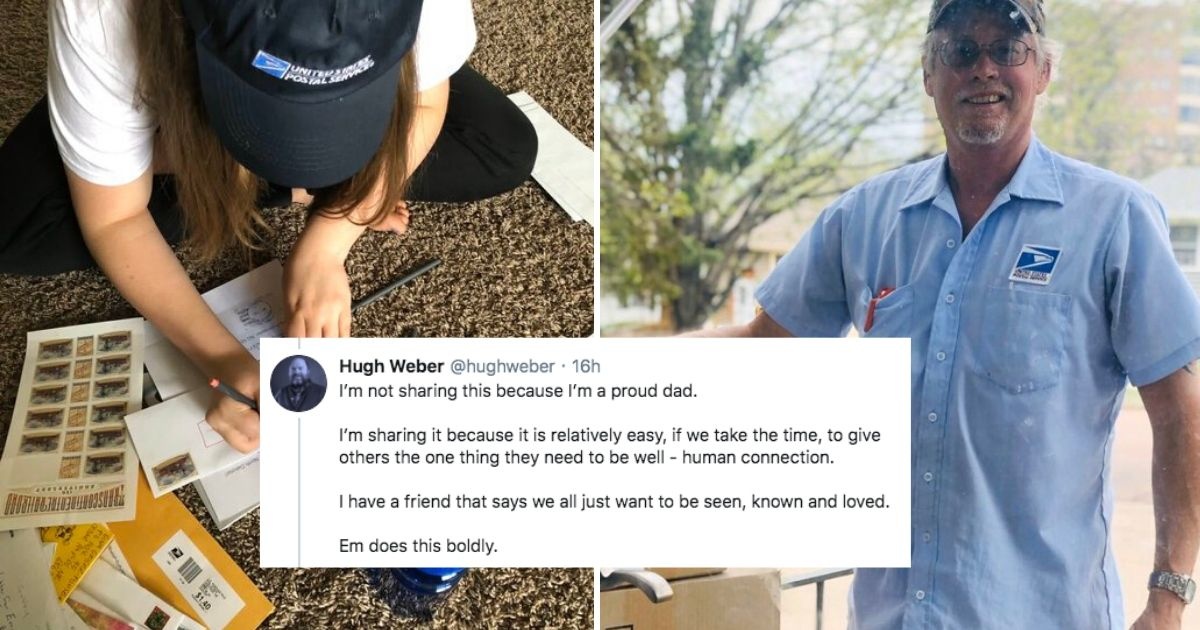
“Emerson, my 11 year old, is on a bit of a wild ride with the @USPS and our local mail carrier, Doug.

And, I think there’s a deeper message to it all.

First, the backstory…

Em has a serious letter writing habit. She maintains active correspondence with over a dozen of her favorite people. And, if you’ve been the lucky recipient of one of Em’s hand decorated letters and envelopes, then you have a pretty good idea of the joy they bring.

A letter from Emerson is likely to include some art, a joke or two, a mention of her younger brother, confessions of her love for Taylor Swift and enough questions to guarantee a response.

So, when she decided to thank our mail carrier for the service he provides us, she left nothing out. In went Taylor Swift, in went the little brother, in went the jokes.

Q: Why do you never see elephants hiding in trees?
A: Because they’re really good at it.

Em wrote, “I’m Emerson. You may know me as the person that lives here that writes a lot of letters & decorated the envelopes. Well, I wanted to thank you for taking my letters and delivering them. You are very important to me. I make people happy with my letters, but you do too.”

She continued, “The reason you are very important in my life is because I don’t have a phone so how else am I supposed to stay in touch with my friends? You make it possible!”

She put it in the box, smiled when he took it & that was enough.

The next day a package arrived with some stamps & two letters. Doug had shared Em’s letter with his supervisor, Sara, and they both wanted to share how touched they were by her note.

Sara said that, as an essential worker, Doug might not be able to maintain regular correspondence, but she sure could. Em started writing that very afternoon.

This is when things get interesting. The next week, we got a letter address to ‘Mr and Mrs Weber.’ It seems that Sara had shared Em’s note as a ‘Token of Thanks’ in the internal newsletter for the Western US and there were some postal folks that wanted to thank her.

Today, we saw Doug getting out of the truck with two BOXES of letters from around the country. We snapped a quick photo through the door as he and Emerson met for the first time. It was a beautiful moment on silent reciprocity.

These letters are so deeply human. They are filled with family, pets, hobbies, community and an overwhelming sense of kindness.

Because Em was fully vulnerable, they were too.

Em shared jokes, so they shared jokes.

Em share her brother, so every gift that was sent came in duplicate.

Em shared @taylorswift13 and it turns out that the US Postal service is filled with lots of undercover Swifties.

One maintenance manager from Minnesota wanted to inspire her to start collecting stamps so he sent along two stamps of his own from the bulletin board in his office to start her collection.

And, they sent stamps to be used as well. Stamps for her to write back. Stamps for her to write others. Stamps, stamps, stamps. (218 by Em’s count.)

But, there was something more in these letters. People felt seen – some for the first time in a long time.

“I work alone in a small rural post office…”
“My kids all live far away…”
“Not a lot of people think about how hard we work…”

One wrote,
“I can’t tell you how much it means to read your letter…”

Another,
“I have a son in Kuwait and if you have a second to send him a letter he would love it.”

And another,
“I know you can’t write back to all of us, but maybe I can drop you a line from time to time?”

With dozens of new pen pals, Em did what she does best.

She wrote the dad.
She wrote his son.
She assured the secret swifties not to be embarrassed because her dad likes TSwift, too.
She acknowledged that there WERE a lot of letter but that she had time.
She sees them all.

I’m not sharing this because I’m a proud dad. I’m sharing it because it is relatively easy, if we take the time, to give others the one thing they need to be well – human connection.

I have a friend that says we all just want to be seen, known and loved.

Em does this boldly.

It’s #MentalHealthAwareness month and I want to be bold and brave like Em.

We’re all in a moment of physical isolation that is amplifying a real epidemic of loneliness, anxiety and depression. I’ve been feeling it personally since long before we locked our front door.

In the second week of quarantine, I responded to hundreds of DMs from creatives who are feeling this disconnect in a significant way. I heard from college students to senior executives who personally and professionally are stressed, worried and/or afraid.

Two weeks ago, I personally started working with a @talkspace therapist for the 1st time.

For years I’ve travelled the country talking about relationships of influence, but I’ve used that travel as an excuse not to seek the support I know I need. This pause gave me time to act.

I have incredible family & friends, but the truth is that I needed more. And, sending texts via an app has been the small step I needed.

Moral of the story: it’s the small things that matter most, friends.

Send a letter.
Make a call.
Practice self care.
Take a step of boldness.
For yourself or for others.

And, thank your mail carrier (from an appropriate distance.) They are working extremely hard to keep us all connected.

And, if any of you are feeling isolated, anxious, scared or depressed, those feelings are valid. I’m feeling them, too.

And, I’m here if you need me.”

What a beautiful example of humans reaching out and touching other human hearts in simple yet profound ways. In a time when we are more physically isolated than ever, seeing these sincere efforts to connect are truly hopeful. And at a time when the postal service needs support, what a lovely illustration of why it’s worth saving.

To support USPS, you can buy stamps on their website. (“Forever” stamps will always work for sending a letter, even if stamp prices go up. Stock up and send grandma or an old friend a card or letter in the mail. You know they’ll love it.)


  • How does an election with no electioneering work? A peek inside the Bahá’í electoral process.
    Photo credit: Annie ReneauThe National Spiritual Assembly of the Bahá'ís of the United States, left, and the Bahá'í House of Worship in Wilmette, Illinois, right.
    ,

    How does an election with no electioneering work? A peek inside the Bahá’í electoral process.

    Around the world, the nine-member governing bodies of the Bahá’í Faith are democratically elected with no nominations, campaigns, or even mention of individual names.

    While doing research for her 2021 book, High Conflict, investigative journalist Amanda Ripley posed a question: “Are there examples of institutions that do conflict better, institutionally, sort of enshrined in what they do?”

    That question led Ripley to the Bahá’í Faith and the process it uses to elect its governing bodies. Ripley specializes in exploring “depolarization” and found the faith’s electoral process to be a solid example of how to avoid polarization while electing the most qualified people.

    Elections with zero electioneering? How?

    Imagine a democratic election process with no nominations, no campaigning, no parties or factions, and no electioneering of any kind. Not a whisper of “You should vote or shouldn’t vote for so-and-so.” Not even an “I’d like to humbly put myself forward for consideration.” That’s what Bahá’í elections are like.

    “It’s literally the opposite of elections today in the United States, in every way,” Ripley told the Society Builders podcast. “And yet, it’s happening all around the world, so it’s very encouraging.”

    As a Bahá’í myself, seeing Ripley explain the Bahá’í electoral process from an outside perspective is fascinating. I’m so used to it, having participated in dozens of elections, that I sometimes forget how unique it is. But when contrasted with nearly every other democratic voting system, I can see why it drew Ripley’s attention.

    Bahá’í elections at the local level

    At the local level of administration (town, city, or county), Bahá’ís elect nine-member bodies called Local Spiritual Assemblies. The elected members of a Spiritual Assembly have no individual authority, but function as a collective, consultative institution that tends to the affairs of the community.

    Here’s how these institutions are elected: Throughout the year, we spend time getting to know the members of our community, keeping in mind that we will elect some of these people to serve on the Local Spiritual Assembly each spring. No names are ever mentioned when discussing the Assembly election, though. We only discuss the combination of qualities necessary to serve, which include selfless devotion, a well-trained mind, unquestioned loyalty, recognized ability, and mature experience.

    At election time, after prayer and reflection, every adult member of the community votes by secret ballot for the nine people they believe are best qualified to serve on the Assembly.

    The way ballots are handled ensures that even the tellers who tally the votes don’t see who voted for whom. The nine people who receive the most votes overall are called to serve on the Local Spiritual Assembly.

    Serving on a Spiritual Assembly is viewed as a sacred, selfless duty, not as a personal victory or promotion. As Ripley shared, “If you get asked to serve, you gotta serve. And the ego is really subverted in that process.”

    How Bahá’ís conduct national elections

    The electoral process looks slightly different at the national level, where we use a delegate system. I participated as a delegate in helping elect the National Spiritual Assembly of the Bahá’ís of the United States this year, so I can share an insider’s view of what that process looked like.

    Last October, a total of 171 delegates were elected (again by secret ballot, with no electioneering) from electoral units around the U.S. Every adult Bahá’í has the opportunity and responsibility to participate in their local delegate election. And again, whoever receives the most votes serves.

    Baha'i temple, Baha'i house of worship, Wilmette, Illinois
    The Bahá’í National Convention was held at the Bahá’í House of Worship in Wilmette, Illinois. Photo credit: Annie Reneau

    In April, those 171 delegates gathered for the Bahá’í National Convention at the Bahá’í House of Worship in Wilmette, Illinois. The purpose of the convention was twofold: to elect the National Spiritual Assembly and to consult and share what we’ve been learning through our community activities over the past year.

    It may be hard to imagine, but the admonition against electioneering is taken to heart in elections at every level. The convention began on Thursday morning, and the election took place on Saturday. The delegates were together all day Thursday and Friday, and there was not a single conversation about who should or should not be elected to the National Spiritual Assembly.

    Instead, we consulted about what’s been happening in our communities, sharing triumphs and challenges, heartening stories and heartfelt concerns. We discussed the qualities necessary to serve on the Assembly, but never names. Not even the slightest indirect hint about any particular individual.

    Baha'i, delegates, election
    Bahá’í delegates from around the U.S. gathered in Wilmette, Illinois, to elect the National Spiritual Assembly. Photo credit: Nancy Wong

    What the actual voting looks like

    The morning of the election, the delegates gathered in the sanctuary of the House of Worship for prayer and meditation. Then we returned to the meeting hall downstairs to vote. Each of us silently filled out a paper ballot with the names of nine people we felt were most qualified to serve. Then we placed our ballots into plain white envelopes. Once all delegates had finished voting, we deposited the envelopes, one by one, into a box at the front of the room. The atmosphere was peaceful, calm, and reverent.

    Our votes are secret and private—no one will ever know who we voted for unless we choose to tell someone. (In 30 years of participating in elections, I’ve never had another Bahá’í tell me who they voted for.) As delegates, we represent our local areas at the convention, but we are elected to vote according to our own consciences. No one from our electoral unit talks to us about who they want us to vote for.

    The process is about as pure as an election process can be. And the result is a high-functioning administrative body that beautifully reflects our national community.

    Baha'i, National Spiritual Assembly, election
    The National Spiritual Assembly of the Bahá’ís of the United States elected in April 2026. Photo credit: Annie Reneau

    (Every five years, the world’s National Spiritual Assemblies from every country gather to elect the Universal House of Justice, the nine-member body that guides the international Bahá’í community. Again, no electioneering—just prayerful, conscientious voting by secret ballot.)

    Bahá’í consultation: A low-conflict approach to making decisions

    The other low-conflict element of Bahá’í administration that Ripley found in her research is the process of decision-making, simply referred to as “consultation.” As Ripley shared with the Aspen Institute, the ideal way to deal with conflict is to avoid it in the first place. Bahá’í consultation, she said, is designed “to keep the ego in check and keep high conflict less likely.”

    When the Assembly needs to discuss an issue or make a decision, all members are encouraged to voice their thoughts and opinions frankly and openly. But as soon as an idea is presented, it becomes the idea of the group to discuss. It is no longer associated with the individual who shared it. Discussion centers on the idea itself and the spiritual principles that need to be applied to the situation. Ripley says this method aligns with how humans naturally function, helping “reduce the odds of the kind of binary, us-versus-them dynamic that we know tends to lead to high conflict.”

    Of course, we are ever-evolving humans doing our best, not perfect beings. I have occasionally seen personal conflict arise over the years, and I’ve seen it handled well and not so well. But considering the inherent complexities of human dynamics, the Bahá’í system works remarkably well as designed and intended. Compared with how elections and institutions so often function, it’s truly a beautiful thing to witness and participate in.

  • After touring the globe, Mark Twain listed 60 American dishes he sorely missed
    Photo credit: The Guardian/Wikimedia Commons & Cary Bass-Deschênes/Wikimedia CommonsA raccoon, left, and Mark Twain, right.
    ,

    After touring the globe, Mark Twain listed 60 American dishes he sorely missed

    Baked apples ’n’ cream? Yum. “‘Possum”? Not so much.

    Mark Twain is often seen as the quintessential American novelist, having penned classics such as The Adventures of Tom Sawyer and Adventures of Huckleberry Finn. But he was also a popular travel writer who wrote six books about his adventures abroad. In 1867, he was sent by a newspaper to travel throughout Europe and the Holy Land via the Mediterranean Sea, resulting in the popular book The Innocents Abroad.

    In 1880, Twain wrote an unofficial sequel to The Innocents Abroad called A Tramp Abroad, a fictionalized account of himself, his traveling companion “Harris,” and their attempt to walk through Europe. The book is both a travelogue from a time when it was rare for most Americans to travel to Europe and a satire of how clueless they can be when encountering new cultures.

    Twain didn’t care much for European cuisine

    One unforgettable passage in A Tramp Abroad has Twain critiquing European food and longing for his favorite comfort foods. He refers to European fare as unsatisfying, to say the least. “The number of dishes is sufficient, but then it is such a monotonous variety of UNSTRIKING dishes. It is an inane, dead-level of ‘fair-to-middling.’ There is nothing to ACCENT it,” Twain wrote.

    mark twain, twain relaxing, mark twain book, mark twain suit,
    Mark Twain relaxing. Photo credit: The Guardian/Wikimedia Commons

    In the book, he jokes that when he returns to the States, he will have a “modest” meal of his favorite foods prepared for him and will send his requests ahead of time so they are ready when he arrives. The menu contains 60 of his favorite American comfort foods.

    Twain lists his favorite comfort foods

    “It has now been many months, at the present writing, since I have had a nourishing meal, but I shall soon have one, a modest, private affair, all to myself,” Twain wrote. “I have selected a few dishes, and made out a little bill of fare, which will go home in the steamer that precedes me, and be hot when I arrive, as follows:

    Radishes. Baked apples, with cream

    Fried oysters; stewed oysters. Frogs.

    American coffee, with real cream.

    American butter.

    Fried chicken, Southern style.

    Porter-house steak.

    Saratoga potatoes.

    Broiled chicken, American style.

    Hot biscuits, Southern style.

    Hot wheat-bread, Southern style.

    Hot buckwheat cakes.

    American toast. Clear maple syrup.

    Virginia bacon, broiled.

    Blue points, on the half shell.

    Cherry-stone clams.

    San Francisco mussels, steamed.

    Oyster soup. Clam Soup.

    Philadelphia Terapin soup.

    Oysters roasted in shell-Northern style.

    Soft-shell crabs. Connecticut shad.

    Baltimore perch.

    Brook trout, from Sierra Nevadas.

    Lake trout, from Tahoe.

    Sheep-head and croakers, from New Orleans.

    Black bass from the Mississippi.

    American roast beef.

    Roast turkey, Thanksgiving style.

    turkey, thanksgiving turkey, cooked turkey, stuffed turkey, roast turkey,
    A Thanksgiving turkey. Photo credit: Canva

    Cranberry sauce. Celery.

    Roast wild turkey. Woodcock.

    Canvas-back-duck, from Baltimore.

    Prairie hens, from Illinois.

    Missouri partridges, broiled.

    ‘Possum. Coon.

    Boston bacon and beans.

    Bacon and greens, Southern style.

    Hominy. Boiled onions. Turnips.

    Pumpkin. Squash. Asparagus.

    Butter beans. Sweet potatoes.

    Lettuce. Succotash. String beans.

    Mashed potatoes. Catsup.

    Boiled potatoes, in their skins.

    New potatoes, minus the skins.

    Early rose potatoes, roasted in the ashes, Southern style, served hot.

    Sliced tomatoes, with sugar or vinegar. Stewed tomatoes.

    Green corn, cut from the ear and served with butter and pepper.

    Green corn, on the ear.

    Hot corn-pone, with chitlings, Southern style.

    Hot hoe-cake, Southern style.

    Hot egg-bread, Southern style.

    Hot light-bread, Southern style.

    Buttermilk. Iced sweet milk.

    Apple dumplings, with real cream.

    Apple pie. Apple fritters.

    Apple puffs, Southern style.

    Peach cobbler, Southern style

    Peach pie. American mince pie.

    Pumpkin pie. Squash pie.

    All sorts of American pastry.

    Fresh American fruits of all sorts, including strawberries, which are not to be doled out as if they were jewelry, but in a more liberal way. Ice-water—not prepared in the ineffectual goblet, but in the sincere and capable refrigerator.”

    mark twain, twain relaxing, mark twain book, mark twain suit, mark twain pool
    Mark Twain playing pool. Photo credit: The World’s Work/Wikimedia Commons

    Twain’s list of favorite foods is notable because he spent much of his life in different regions of the United States, including Hannibal, Missouri (his boyhood home), Hartford, Connecticut (his adult home), and Elmira, New York (his summer retreat).

    His career as a writer also took him to places in the West, including San Francisco and Sacramento, California, as well as Carson City and Virginia City, Nevada. This led him to develop a taste for many regional cuisines, which he referenced specifically on his list. The oysters should be from San Francisco, and the black bass from Mississippi.

    Some may recoil when they see a few items on his list, namely “’coon” (short for raccoon) and “’possum,” short for opossum. These days, most Americans would shudder at the idea of eating them for dinner, but in the 1800s, they were seen as delicacies. Both were commonly roasted or stewed and served with sweet potatoes.

    Twain’s over-the-top menu is a fun look at the types of food that were popular in the late 1800s, and it’s also a charming example of how every region of the U.S. has its own specialty. Whether it’s fish in the Sierras or duck in Baltimore, Maryland, every place has its own flavor, and to a man who lived just about everywhere, they were all something to savor.

  • Brendan Fraser surprised everyone at a screening of ‘The Mummy’ by showing up in costume
    Brendan Fraser dressed as Rick O'Connell.

    Brendan Fraser might be making the greatest career comeback ever, having won the Academy Award for Best Actor for his dramatic, transformative role in “The Whale.” But the OG Fraser fans (the ones who watch “Doom Patrol” solely to hear his voice and proudly pronounce his last name as Fray-zure, for this is the proper pronunciation) have known of his remarkable talent since the ’90s, when he embodied the ultimate charming, dashing and slightly goofball Hollywood action lead.

    Let us not forget his arguably most well-known and beloved ’90s character, Rick O’Connell from the “Mummy” franchise. Between his quippy one-liners, Indiana Jones-like adventuring skills, and fabulous hair, what’s not to like? During a double feature of “The Mummy” and “The Mummy Returns” in London, moviegoers got the ultimate surprise when who should walk in but Brendan Fraser himself, completely decked out in Rick O’Connell attire. The brown leather jacket. The scarf. Everything.

    stephen colbert, brendan fraser, montclair film festival, red carpet,
    Stephen Colbert and Brendan Fraser at the Montclair Film Festival 2022. Photo credit: Montclair Film/Wikimedia Commons

    What Fraser said to the crowd that night

    “I am proud to stand before you tonight,” he told the audience. “This is a film that was made in Britain. You should know that! Even the second one, too. Be proud. Thank you for being here.”

    He continued, “We didn’t know if it was a drama or a comedy or a straight-ahead action or romance, a horror picture, more action, all of the above. No idea until it tested in front of British audiences. Thank you for that.”

    Fraser then asked the crowd if anyone hadn’t actually seen the movie yet, before shouting, “Outstanding!” when somebody raised their hand. He then quickly made a polite plug, encouraging people to go see “The Whale” before whisking himself away, saying, “I won’t take up any more of your time.”

    Uh, yeah…I don’t think any time spent with Brendan Fraser is a waste. Do you?

    Watch:

    Mummy 4 is officially happening

    The answer to whether we’ll see Fraser back as Rick O’Connell is now a resounding yes. The Mummy 4 was officially confirmed in early 2026, with Fraser and Rachel Weisz both set to reprise their roles, and a release date of October 15, 2027. Directors Matt Bettinelli-Olpin and Tyler Gillett are attached to direct.

    This article originally appeared three years ago. It has been updated.

  • The ‘Knight Rider’ car somehow got a speeding ticket even though museum owners swear it hasn’t moved in years
    Photo credit: Morn, NBC Universal, Wikimedia CommonsDavid Hasselhoff, left, and his car KITT from "Knight Rider."

    “Give me every ounce of turbo boost you’ve got,” Michael Knight often demanded of his black Pontiac Firebird Trans Am, KITT.

    If you didn’t grow up glued to television (like much of Gen X), this is a reference to the NBC hit show Knight Rider, starring David Hasselhoff as Knight. Its first incarnation ran from 1982 to 1986 and featured the crime-fighting Knight alongside his well-ahead-of-its-time talking car, KITT, short for Knight Industries Two Thousand. (In a later reboot of the series, KITT stood for Knight Industries Three Thousand.)

    So imagine everyone’s surprise when KITT was allegedly spotted by traffic cameras driving 36 miles per hour in a 25 mph zone in Brooklyn on April 22. Or was it KITT? A car was seen zipping through a New York City intersection with a California plate that read KNIGHT.

    Where is the real KITT?

    The only issue? The speeding ticket was sent to the Volo Museum in Illinois, which has a replica of the KITT car on display. A spokesperson for the museum took to Facebook to share the mix-up:

    “Well, this is a new one… we got this in the mail today. This is 100% legit. A traffic camera captured Knight Rider’s KITT speeding down the streets of New York City. The camera captured the novelty license plate (not a real plate…and also a California plate). Their official system ties the novelty plate to Volo Museum and we got a bill for $50! You can’t make this up! Our KITT hasn’t moved from our museum in years! Does anyone have Hasselhoff’s number? He owes us $50!!!!”

    WABC-TV reports that the “summons, complete with a picture from a traffic camera, was sent to the Volo Museum in Volo, Illinois, where a black 1982 Pontiac Firebird Trans Am replica of the TV show car is on display. It linked the KNIGHT license plate to the museum’s display vehicle. The museum has requested a hearing to dispute the ticket.”

    Turbo boost

    Of the more than 20 KITT cars built for the series, only five remain. According to Road & Track:

    “KITTs were made out of 1982, 1983, and 1984 Trans Ams, as well as base Firebird hardtops. Transmissions got swapped for Turbo 350 3-speeds, brake line locks were added, as well as some additional bracing, while the team used as much body filler as the panels would take.

    The second-to-last KITT ever built started out as an ’84 base hardtop before taking up the role of a disposable stunt car. Yet after the show, NBC chose this example to be retrofitted with their sound stage dashboard, T-tops, and all the things children would expect to see once they put it on display at their theme park.”

    “KITT’s been out traveling and breaking the law”

    So why was Volo Museum in Illinois on the hook for a California-plated car? Theories and jokes abound. One Facebook user commented under the museum’s post, “You THINK that KITT hasn’t moved in years, but you forget KITT can drive anywhere he wants without Michael Knight. KITT’s been out traveling and breaking the law.”

    And this case of mistaken identity isn’t unique. Another commenter added, “There’s a guy in southern Indiana who drives his KITT on a novelty plate while going through a toll bridge into Kentucky. Since I have a legitimate Indiana KNIGHT plate, they charge his tolls to my EZ-Pass.”

    KITT conspiracy theories

    On a Reddit thread titled, “Museum’s ‘Knight Rider’ replica car got a speeding ticket. It hasn’t gone anywhere in years,” commenters were quick with the nostalgic jokes. “I think there is an obvious answer. This car is a Brum, and every night it drives out into the big city on adventures,” one user wrote.

    This Redditor shared the story of someone reportedly trying to evade speeding tickets: “There’s a story about an engineer who tried to be clever and got the plate ‘NULL’ in the hopes of avoiding tickets (if you’re not aware, NULL is used in some databases as a way of saying ‘no data’). He ended up with every ticket that didn’t have a plate number attached to it.”

    Another user jokingly quoted KITT, writing, “I do not understand how you’ve managed to get us a speeding ticket without even being in motion, Michael.”

    Will the real KITT please stand up?

    As for the real KITTs? The remaining five cars used in the series have been spread among various museums and private owners. One famous car enthusiast, Jay Leno, got to take a ride in Joe Huth’s fabulous ride and even featured it on his show Jay Leno’s Garage.

    It’s possible that if KITT were asked for comment about this whole affair, he might repeat one of his more memorable lines: “Really, some people are simply too much.”

  • 9 fascinating Colonial-era words to brush up on for America’s 250th birthday
    Photo credit: CanvaSigning of the Declaration of Independence.
    ,

    9 fascinating Colonial-era words to brush up on for America’s 250th birthday

    The word “vulgar” had a different meaning than it does today.

    On July 4, the United States of America will celebrate its 250th birthday. Called the “semiquincentennial,” the day will commemorate 250 years since the Declaration of Independence was signed.

    Of course, English was spoken by colonial Americans, and they had a distinctive accent that was unique to the newly formed country.

    Surprisingly, they did not sound British. That’s because by the time of the Revolutionary War, two new generations had been born on American soil, according to JSTOR.

    British English and American English began to develop separately. An English tourist commented on the colonial American dialect in 1770:

    “The colonists are composed of adventurers, not only from every district of Great Britain and Ireland, but from almost every other European government…Is it not therefore reasonable to suppose that the English language must be greatly corrupted by such a strange admixture of various nations? The reverse is however true. The language of the immediate descendants of such promiscuous ancestry is perfectly uniform, and unadulterated; nor has it borrowed any provincial, or national accent from its British or foreign parentage.”

    9 interesting Colonial American words

    Many words from colonial America have faded from the modern-day lexicon. But a book from 1785 titled The Vulgar Tongue by author Francis Grose documented slang used during colonial times. The book was reprinted over the years, including an updated version titled 1811 Dictionary of the Vulgar Tongue.

    The word “vulgar” had a different meaning than it does today. “Vulgar” meant “common” or “ordinary,” according to Merriam-Webster.

    Here are nine fascinating colonial-era words to add to your lexicon:

    Adam’s ale

    This is another word for water. According to Merriam-Webster, its origins are “after the biblical Adam; from its being provided by nature and thus presumably being the only drink in the Garden of Eden.” The term’s first known use was in 1643.

    Altitudes

    This is another word for drunk. According to the 1811 Dictionary of the Vulgar Tongue, it means “the man is in his altitudes, i.e. he is drunk.”

    Arsy yarsey

    According to the 1811 Dictionary of the Vulgar Tongue, it means “to fall arsy varsey, i.e. head over heels.”

    Merriam-Webster defines it as “backside forward; head over heels; topsy-turvy.” It goes on to add that the word is “a non-reduplicative (yet still very cheeky) equivalent of arsy-varsy would be the expression ass over teakettle. However, arsy-varsy may be used as both adverb (modifying an action, as in the first example below) or an adjective (modifying a noun, as in the second) meaning ‘topsy-turvy’ or ‘disordered.’”

    Calibogus

    Surprisingly, this is the name of a colonial drink. According to the 1811 Dictionary of the Vulgar Tongue, it means “rum and spruce beer, American beverage.” It may also have been sweetened with molasses, according to Merriam-Webster.

    Carroty-pated

    This is another word for a redhead. According to the Collins Dictionary, “carroty” means “a reddish or yellowish-orange colour; having red hair.” The word “pated” means “having a (specified kind of) pate, or head.”

    Caudge-pawed

    This is another word for left-handed, according to the 1811 Dictionary of the Vulgar Tongue.

    Flam

    According to the 1811 Dictionary of the Vulgar Tongue, it means “a lie, or sham story: also a single stroke on a drum. To flam; to hum, to amuse, to deceive. Flim flams; idle stories.”

    While it was used in colonial times, its history dates further back. Merriam-Webster explains:

    “‘Flimflam’ first entered English as a noun meaning ‘deceptive nonsense’ in the second half of the 16th century. A sense meaning ‘deception’ or ‘fraud’ soon developed. The verb use didn’t show up until well into the next century. In addition to general deceiving or tricking, the verb ‘flimflam’ is often used specifically to refer to swindling someone out of money. The ultimate origin of ‘flimflam’ is uncertain, but the word is probably of Scandinavian origin and may be related to the Old Norse flim, meaning ‘mockery’.”

    Huzza

    This celebratory word was chanted during colonial times. According to the 1811 Dictionary of the Vulgar Tongue, it means “said to have been originally the cry of the huzzars or Hungarian light horse; but now the national shout of the English, both civil and military, in the sea phrase termed a cheer; to give three cheers being to huzza thrice.”

    American colonists also adopted the word. According to Dr. Tyler Putman at the Museum of the American Revolution, it also had a surprising pronunciation: hu-ZAY (like “hooray”), not hu-ZAH (like “hoorah”).

    Oyster

    This word had a second meaning besides the shellfish. According to the 1811 Dictionary of the Vulgar Tongue, it means “a gob of thick phlegm, spit by a consumptive man; in law Latin, UNUM [one] VIRIDUM [green] GOBBUM [lump or mass].”

  • Eric Church’s guitar-as-life metaphor UNC commencement speech strikes a universal chord
    Photo credit: Townsquare Media/Wikimedia CommonsEric Church playing guitar on stage.
    ,

    Eric Church’s guitar-as-life metaphor UNC commencement speech strikes a universal chord

    “The right partner is the string that makes the whole chord ring fuller, and warmer, and truer than anything you could ever play alone.”

    Writing a commencement speech in 2026 must be tough. Thousands of graduation speakers have come and gone, offering pithy bits of wisdom and advice, much of which feels recycled and overused by this point. How do you come up with a message that feels new and fresh?

    If you’re Eric Church, you pull out your guitar and offer a metaphor for life that hits all the right notes. The country music superstar spoke to the 2026 graduates of the University of North Carolina at Chapel Hill, but most of his speech felt universal. Some are calling it the best commencement speech they’ve ever heard.

    Church said he struggled to write his speech and tore up many drafts before picking up his guitar and realizing what he wanted to say. He started by describing and demonstrating an out-of-tune chord.

    “Some ancient, honest part of your brain knows it immediately,” he said. “You don’t need training to hear it. You just know. That sound is the sound of something beautiful that has not been tended to.”

    He talked about the power of a six-string chord that’s in tune and how just one string being off causes the whole chord to unravel.

    “Not gradually, not politely,” he said. “The moment you strike it, you know. I believe your life runs on this principle, and I’m going to break it down for you right now and tell you about your strings.”

    String #1 = Faith

    Church said the lowest, thickest, and heaviest string on the guitar—the low E—is the foundation: “Every chord a guitar can make rests on this string being in tune.”

    guitar, guitar strings, faith
    Faith is the foundation string. Photo credit: Canva

    “Your faith is the low E of your life,” he said. “The thing that sits at the very bottom of you. Your belief about what this life is for, what you owe, what holds the universe together when science reaches the edge of its own explanation and shrugs.”

    He explained that faith gives people a foundation to return to throughout life’s difficulties.

    “The world will try to untune this string,” he said, “through busyness, through slow accumulation of a full schedule, a full inbox, a full life. Listen to me. Tend to your faith, not just when you’re broken, but when you’re whole.”

    String #2 = Family

    Church said the A string is your family, “who has loved you longer than you’ve been easy to love” and “who saw you at your actual worst, not your public-facing worst, and didn’t leave you.”

    Your family has made sacrifices and cried over you, wondering whether they’d done enough.

    “The A string is where the music starts to get warm,” he said. “It gives a chord its body, its richness. It’s the string that makes you feel like you’re not alone in a room.”

    family, graduate, graduation
    Family adds richness to life. Photo credit: Canva

    Church warned the students that they were about to become very busy in their post-graduation lives.

    “And family, because they will love you with a grace you will spend most of your life trying to deserve, will rarely demand your time,” he said. “They’ll tell you they understand, and they’ll mean it. Do not take them up on it. Call your people. Not when there’s news, not when there’s nothing. Show up when it costs you something. Let them see you when things are hard. The A string is not a holiday string. It’s an everyday string. Protect it.”

    String #3 = Your spouse/partner

    The D string, Church said, is the heart of a chord—the string that gives a chord its body and soul.

    marriage, partner, spouse
    Choose your life partner wisely. Photo credit: Canva

    “Strike a full chord and the D string is what you feel in the center of your chest,” he said. “That is not an accident. That is exactly what the right spouse and partner will do for your life.”

    Outside of your faith, choosing a life partner is the most important decision you’ll ever make, Church said. “They will either amplify every other string you’re playing, or slowly pull the whole instrument into an out-of-tune mess,” he added. “The right partner is the string that makes the whole chord ring fuller, and warmer, and truer than anything you could ever play alone. Choose them wisely, and then love them fiercely.”

    String #4 = Ambition and resilience

    Church pointed out that the G string drifts faster than the other strings on a guitar and frequently needs to be retuned.

    “Both ambition and resilience live on this string, and they pull in opposite directions,” he said. “I want you to want things. You should want things. The world has more than enough people standing at the edge of their own potential, waiting for a permission slip that was never gonna arrive. Want the thing. Say it out loud. Build toward it with everything you have. And when you fail, and you will fail…get back up, tune the string, and keep playing.”

    String #5 = Community

    “Your generation faces a temptation no generation before has ever faced,” Church said. “The temptation to perform for everyone and belong to no one. To be globally visible and locally invisible. To have thousands of followers, and no one knows actually where you live.”

    “Resist this,” he advised. “Plant yourself somewhere. Put down roots with the full intention of growing there. Learn the actual names, not usernames, of the people around you. Volunteer. Coach the team. Build the thing your community needs, even if the Internet will never see it. Generosity is not something you do after you make it; it’s how you make it.”

    String #6 = Your uniqueness

    The high E string is the one that carries the melody—the single line above the chord that people recognize.

    “It’s also the one bent most easily by outside pressure,” Church said. “Social media is going to show you a thousand versions of a life that looks better than yours. The comparison will be relentless, curated, and a lie dressed up in really good lighting. Someone’s comments, someone’s criticism, someone’s cold opinion is going to try to convince you to retune yourself to match what they think you should sound like. Do not let them touch your string.”

    “You were made uniquely, wonderfully, distinctly,” he continued. “There’s a sound only you can make, a voice that has never existed before you and will never exist again. A contribution only you can bring. A way of seeing that belongs only to you. The world does not need another cover song. It needs an original.”

    Life is about retuning when any of these strings drift

    Church ended his speech by explaining that when these six strings—the principles and pillars of your life—are in tune, then “the chord your life makes is full and resonant and true.”

    “All six will drift,” he warned. “Not one or two. All six, in their own time, in their own season. Your faith will go quiet when you need it loud. Your family will get complicated in a way only the people who love you most can complicate things. You will go through hard seasons with your spouse. Your ambition will hollow out, and your resilience will wear thin. Your community will start to feel like an obligation. And your world will try to sand down the edges of exactly who you are.”

    “This is not failure,” he continued. “This is not weakness. It’s the inevitable, universal experience of living in an imperfect world that doesn’t stop to let us tune up. And the difference between a life that sounds like music and a life that sounds like noise is whether you stop and listen, whether you’re honest enough to hear which string has drifted out of tune and humble enough to make the adjustment, instead of just turning up the volume and hoping nobody notices. Because you will notice. The part of you that knows what the chord should sound like will always notice. It will not let you go. Life won’t be right until it is tuned. Trust what your heart hears and is telling you about your song.”

    What a beautiful way to send these graduates out into the world. And what a great reminder for the rest of us to stop and adjust our own strings when we hear our chord falling out of tune.

  • She bought the perfect wedding dress that went viral on TikTok, for $3.75
    Photo credit: TikTok Making a priceless memory.
    ,

    She bought the perfect wedding dress that went viral on TikTok, for $3.75

    Lynch is part of a growing crowd of newlyweds going against the regular wedding tradition of spending loads of money.

    At first glance, one might think that Jillian Lynch wore a traditional (read: expensive) dress to her wedding. After all, it did look glamorous on her. But this bride has a secret superpower: thrifting.

    Lynch posted her bargain hunt on TikTok, sharing that she had been perusing thrift shops in Ohio for four days in a row, with the actual ceremony being only a month away. Lynch then displays an elegant ivory-colored Camila Coelho dress that fits her perfectly and still brand new with the tags on it, no less.

    She found it at a thrift shop

    You can find that exact same dress on Revolve for $220. Lynch bought it for only $3.75. The bride-to-be’s video quickly went viral, racking up 2.6 million views. People were floored that Lynch was able to find such a huge deal on a dress that seemed to be made just for her.

    “Honestly, brides pay 1000s of dollars to look that good in a white slip dress like that, I think you’re rocking it & it’s perfect,” complimented one person.

    OK, maybe it did cost her a little more than $3.75. In an interview with Business Insider, Lynch disclosed that she did make some customizations based on suggestions from the comments including ”elevating” the gown with non-adjustable shoulder straps, taking in the waist and adding a “demure” bit of lace to the front slit.

    Altogether, those alterations totaled out to $110. Add to that some $8 shoes (also thrifted, of course) and Lynch still created an entire wedding look for only $113.75. That, ladies and gentlemen, is a steal.

    Turns out, spending less might be the smarter move

    Lynch is part of a growing line of newlyweds going against the regular wedding tradition of spending loads of money and she might be better off for it. Research has shown that when it comes to creating happy long-lasting marriages, frugality often beats extravagance.

    According to a recent article in Brides, popular wedding planning site Zola predicts the average wedding cost is $36,000 for 2025. The numbers have been rising steadily over the last five years. Brides cites Brooke Ashivay, owner of Orange Blossom Special Events, who said that “comparing a 2019 wedding budget with one from 2024 at a similar venue and guest count, [we] observed an approximately 30 percent increase in costs,” likely due to increased demand after the worst of the COVID-19 pandemic. Not only that, but the average wedding dress now costs $2,000 according to The Knot. Weddings are supposed to be fun, celebratory and joyous, but it can be hard to feel any of those things when financial stress is involved. Who would want to start off a (hopefully) lifelong partnership that way? Save that money for the honeymoon, I say! Or the gas station!

    She did keep one tradition, though

    Still, Lynch didn’t say no to every wedding tradition. As she walked down the aisle in her gorgeous discounted gown, looking like a Grecian goddess, her father walked right alongside her. “I could see how much it meant to him, and it actually ended up meaning a lot to me,” she told Business Insider.

    And perhaps most important of all, Lynch felt good in her own skin on her big day. “I don’t think I’ve ever felt that great in something. That’s what brides should feel on their wedding day, like they’re at their peak beautiful self. That’s exactly how I felt when I put it on.”

    It doesn’t have to cost an arm and a leg to make lasting memories. And when you are able to show up for life’s big moments authentically, that feeling is priceless.

    This article originally appeared four years ago. It has been updated.

  • A homeless man returns a pet dog’s stolen ashes to their owner. It’s changing his life.
    Photo credit: Kathryn Michie via GoFundMeKathryn Michie and Chris Engdahl, left, and a flyer.

    When Holly and Brandon Dunn’s car was broken into, the stolen items were ones they thought they’d never get back. The thief took a bag containing the ashes of their late chihuahua named Tia. The thief also took Tia’s ceramic paw prints and a memorial stuffed-animal replica of the beloved pup. Two weeks later, the items were found and returned. Now the Seattle community is chipping in to reward the hero with a fresh start.

    Brandon explained to KING-TV that the couple was unable to have children, so Tia had been their furry kid throughout their 20-year relationship.

    “It’s a bit cliche, I guess, comparing a dog to a child. But, you know, for us that was my child,” he said.

    The search was on

    The Dunns put up flyers offering a reward for the return of the ashes and memorial items. Folks on social media and Reddit offered to help search and put up additional flyers in the Seattle area. There were even people willing to 3D-print a replica of Tia’s paw prints to replace the original ones.

    A hero reaches out

    Two weeks later, the unlikely happened. The items were found and returned by a homeless man named Chris Engdahl.

    For the past seven years, Engdahl had been living unhoused in the Seattle area. He made a living off what he could find and sell from dumpsters. It was in a random dumpster that Engdahl found Tia’s ashes, paw prints, and stuffed replica. Engdahl knew the items had sentimental value and held onto them in hopes of finding their owner. After seeing one of the flyers, Engdahl texted Brandon’s phone number and made sure the Dunns got Tia’s remains back.

    The Seattle community chips in

    Engdahl didn’t want a reward from the couple and was just happy that a fellow dog lover got their precious memorial items back. The Dunns had already moved out of the state. However, they and the Seattle community still wanted to do something to help Engdahl.

    Kathryn Michie, a person who helped post flyers for the Dunns, started a GoFundMe for Engdahl to help restart his life. As of this writing, Engdahl has recently moved into his first apartment, and the GoFundMe has raised more than $6,700. The money will be used to help Engdahl get furniture and other supplies. Some of the money will also go toward food for his new dog, Reo, whom he recently rescued from the street. Altogether, it will help Engdahl’s new place feel more like home.

    “I just got off the phone with Chris and he’s absolutely floored with the support from this community!” Michie wrote in a May 6 update on the GoFundMe page. “Thank you to everyone who is changing his life for the better. He is such an angel and deserves all the help!”

    Kindness and support from an entire community helped recover lost items, house someone in need, and create a new life for a dog, too.

Nostalgia

The ‘Knight Rider’ car somehow got a speeding ticket even though museum owners swear it hasn’t moved in years

Nostalgia

9 fascinating Colonial-era words to brush up on for America’s 250th birthday

Life Hacks

Fyodor Dostoevsky shared one powerful habit necessary to lead an authentic life

Moms

Mom shares 19 gems of knowledge for her daughter’s 19th birthday