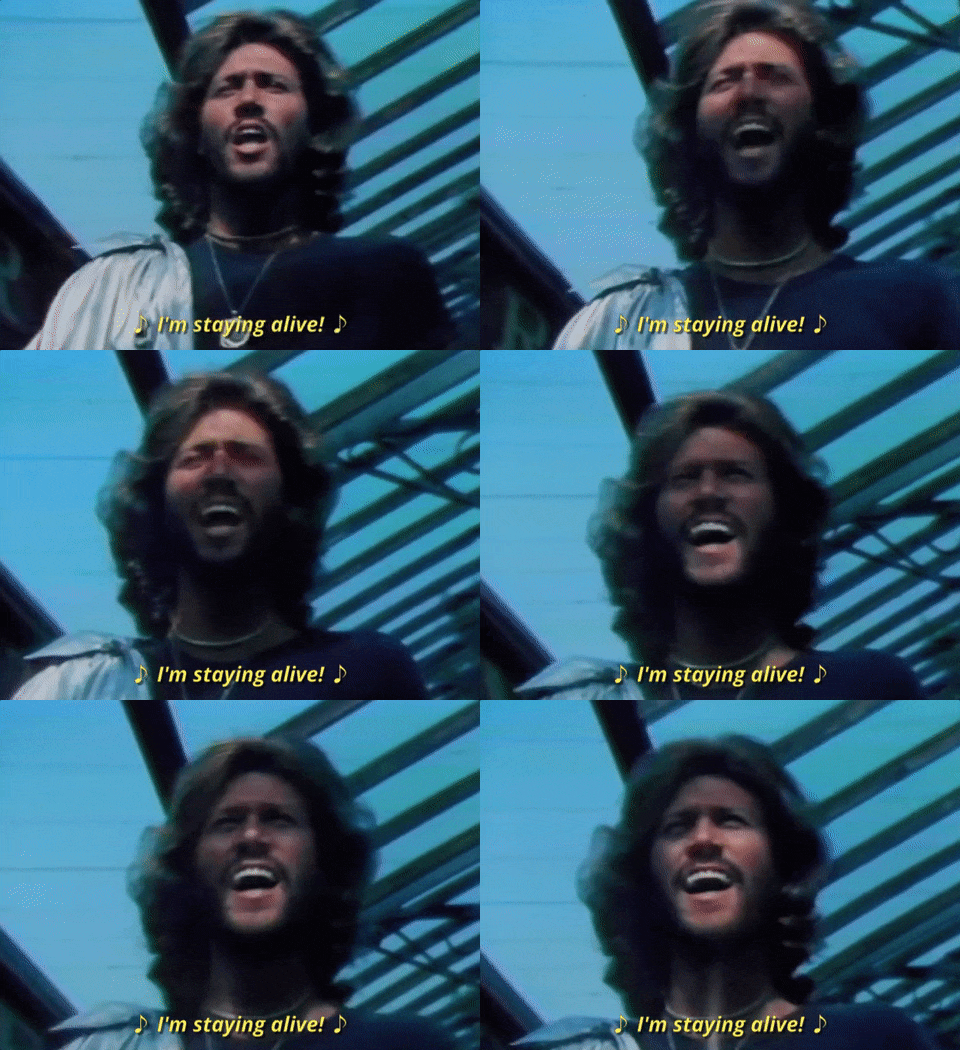
A wife saved her husband during his heart attack by singing the lyrics to 'Stayin' Alive'

A year ago a woman in Pearland, Texas helped save her husband's life because of her quick thinking and the sweet, four-on-the-floor disco beat of the Bee Gees.
After finishing a two-mile run with her husband Quan, Ganesa Collins watched him fall to the ground. "We sat on the bench, and he was in front of me," Collins told ABC. "I was standing behind and stretching, and he just went face forward. His head hit the dirt."
She quickly called 911 and the operator said he was having a heart attack.
"My husband had some issues with heart disease about five years ago, and he had a stent put in. A pretty minor procedure," Ganesa said.
Ganesa started giving her husband chest compressions with the 911 operator helping her count on the other end of the line. Suddenly, her American Heart Association training kicked in and she began administering compressions while singing the Bee Gees 1977 disco megahit "Stayin' Alive."
We're not sure whether she sang the song in the beautiful soaring falsetto of Barry Gibb, but that would have made the scene even more impressive.
A study by the University of Illinois College of Medicine found that the song has the perfect beat for performing CPR. It contains 103 beats per minute, which's close to the recommended chest compression rate of 100 every 60 seconds.
"I sung over her and sung out loud while I was performing CPR," she said.
A police officer arrived on the scene and began administering compressions. Quan was rushed to a local hospital where he was in a coma until it was discovered that he had a blood clot in his stint that caused the heart attack.
Doctors performed double bypass surgery on Quan and now he's now doing much better. Ganesa wanted to share her story to remind people to get CPR training. "My husband is able to live another day," Ganesa said. "We just have so much perspective."
A recent study found that training people to give chest compressions to the rhythm of "Stayin' Alive" helped them to remember the correct rhythm five months later.
"Properly performed CPR can triple survival rates for cardiac arrest, but many people hesitate to jump in because they don't feel confident about maintaining the proper rhythm," said researcher Dr. David Matlock of the University of Illinois College of Medicine at Peoria.
Those who are familiar with the hit from "Saturday Night Fever" are more likely to jump in and help due to their musical training.
Plus, who doesn't feel confident when they first start thinking of the slinky main guitar riff and John Travolta walking down the street in Brooklyn eating a folded slice of pizza?

"This was a small study, but the results are encouraging enough that a further study, using a larger and more diverse population, is warranted," said Dr. Matlock. "A number of pop songs have the right rhythm for CPR, but of course the meaning of 'Stayin' Alive' is pretty powerful when you are trying to save someone's life."
The American Heart Association produced a video starring former physician turned comedian Ken Jeong to share the life-saving power of disco.
Ken Jeong - Leslie Chow American Heart Association Hands-Only CPR Videowww.youtube.com
There is something beautifully propulsive about the beat to "Stayin' Alive" that seems to echo the basic rhythms of the human body. Combined with lyrics about perseverance it feels like the perfect metaphor for the human condition.
Next time you hear someone utter the blasphemous '70s catchphrase "Disco sucks," kindly remind them that, "No, disco saves lives."
Bee Gees - Stayin' Alive (Official Music Video)www.youtube.com
- Woman shares her therapist's surprisingly helpful mental health tip ... ›
- Denver is sending mental health experts instead of cops in response ... ›
- The Health Benefits of Watching Cute Animal Videos Are Invaluable ›
- A woman suffers cardiac arrest on the dance floor. Three nurses jump in to save her life. - Upworthy ›
- Woman who died for 4 minutes saved by AT&T worker - Upworthy ›
- Bee Gees a capella version of 'How Deep is Your Love'' goes viral - Upworthy ›
- Health experts created a patch that can repair damaged hearts - Upworthy ›


A woman is getting angry at her coworker.via
A man with tape over his mouth.via
A husband is angry with his wife. via 
a man sitting at a desk with his head on his arms Photo by
Can a warm cup of tea help you sleep better? If you believe it, then yes. Photo by 
Three women sit on a blanket in the park. 
Two women engaging in a pleasant conversation inside a coffee shop
Two men engaging in a peaceful disagreement.
Resurfaced video of French skier's groin incident has people giving the announcer a gold medal
"The boys took a beating on that one."
Downhill skiing is a sport rife with injuries, but not usually this kind.
A good commentator can make all the difference when watching sports, even when an event goes smoothly. But it's when something goes wrong that great announcers rise to the top. There's no better example of a great announcer in a surprise moment than when French skier Yannick Bertrand took a gate to the groin in a 2007 super-G race.
Competitive skiers fly down runs at incredible speeds, often exceeding 60 mph. Hitting something hard at that speed would definitely hurt, but hitting something hard with a particularly sensitive part of your body would be excruciating. So when Bertrand slammed right into a gate family-jewels-first, his high-pitched scream was unsurprising. What was surprising was the perfect commentary that immediately followed.
This is a clip you really just have to see and hear to fully appreciate:
- YouTube youtu.be
It's unclear who the announcer is, even after multiple Google inquiries, which is unfortunate because that gentleman deserves a medal. The commentary gets better with each repeated viewing, with highlights like:
"The gate the groin for Yannick Bertrand, and you could hear it. And if you're a man, you could feel it."
"Oh, the Frenchman. Oh-ho, monsieurrrrrr."
"The boys took a beating on that one."
"That guy needs a hug."
"Those are the moments that change your life if you're a man, I tell you what."
"When you crash through a gate, when you do it at high rate of speed, it's gonna hurt and it's going to leave a mark in most cases. And in this particular case, not the area where you want to leave a mark."
Imagine watching a man take a hit to the privates at 60 mph and having to make impromptu commentary straddling the line between professionalism and acknowledging the universal reality of what just happened. There are certain things you can't say on network television that you might feel compelled to say. There's a visceral element to this scenario that could easily be taken too far in the commentary, and the inherent humor element could be seen as insensitive and offensive if not handled just right.
The announcer nailed it. 10/10. No notes.
The clip frequently resurfaces during the Winter Olympic Games, though the incident didn't happen during an Olympic event. Yannick Bertrand was competing at the FIS World Cup super-G race in Kvitfjell, Norway in 2007, when the unfortunate accident occurred. Bertrand had competed at the Turin Olympics the year before, however, coming in 24th in the downhill and super-G events.
As painful as the gate to the groin clearly as, Bertrand did not appear to suffer any damage that kept him from the sport. In fact, he continued competing in international downhill and super-G races until 2014.
According to a 2018 study, Alpine skiing is a notoriously dangerous sport with a reported injury rate of 36.7 per 100 World Cup athletes per season. Of course, it's the knees and not the coin purse that are the most common casualty of ski racing, which we saw clearly in U.S. skier Lindsey Vonn's harrowing experiences at the 2026 Olympics. Vonn was competing with a torn ACL and ended up being helicoptered off of the mountain after an ugly crash that did additional damage to her legs, requiring multiple surgeries (though what caused the crash was reportedly unrelated to her ACL tear). Still, she says she has no regrets.
As Bertrand's return to the slopes shows, the risk of injury doesn't stop those who live for the thrill of victory, even when the agony of defeat hits them right in the rocks.