Why John Lennon's son performed 'Imagine' for the first time after swearing he never would
"Within this song, we’re transported to a space, where love and togetherness become our reality, if but for a moment in time."

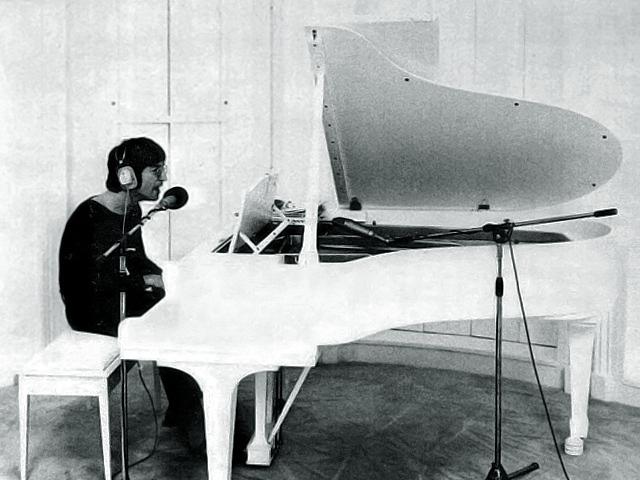
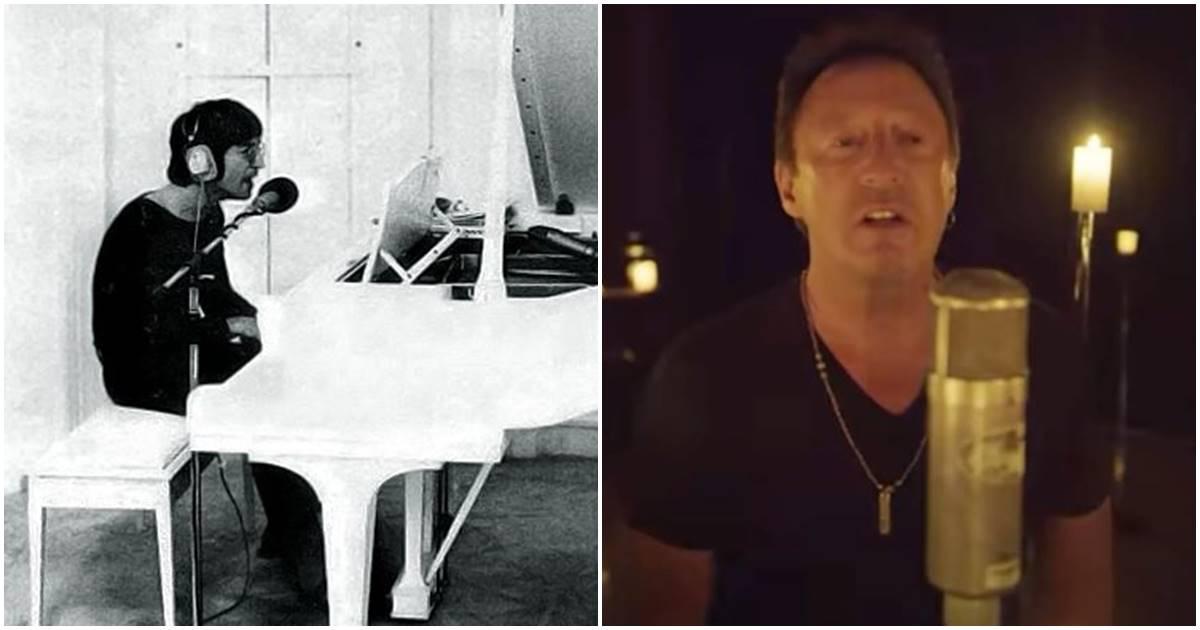
John and Julian Lennon both performing "Imagine."
In 1971, a year after the break-up of the Beatles, John Lennon released his most important piece of music, the song “Imagine.” The song is an appeal to humanity’s better angels and urges the listener to "join us" in visualizing a world without war, hunger or greed.
The song provides a glimmer of hope in that if we can visualize a perfect world, then maybe one day it will be achievable. Over the past 50 years, the song has become a secular hymn that can conjure hope in the aftermath of the most tragic events. The song was played by Queen at Wembley Arena after Lennon was murdered in 1980. Steve Wonder sang it at the closing ceremonies of the 1996 Olympics to honor the lives of those lost at the Centennial Olympic Park bombing. Neil Young played it at the 9/11 Tribute to Heroes concert.
“Imagine” is also seen as Lennon’s signature song that encapsulates his artistic persona. No small feat given the earth-shattering effect the songs he wrote with the Beatles have had on the world.
Given the song’s incredible power, Lennon’s son Julian vowed never to perform it in public. Julian has had success as a musician over the years, most notably with his 1984 hit, “Too Late for Goodbyes.” He’s also a philanthropist who has produced numerous documentaries.
The war in Ukraine pushed Julian to break his vow and he performed a beautiful rendition of “Imagine” as part of Global Citizen’s social media rally, “Stand Up For Ukraine” on April 8. The campaign is working to raise money for the war-torn country.
Julian was accompanied for the performance by guitarist Nuno Bettencourt, who is best known as the lead guitarist of the Boston rock band Extreme and a member of Rihanna's touring band.
"The War on Ukraine is an unimaginable tragedy... As a human, and as an artist, I felt compelled to respond in the most significant way I could," Lennon wrote. "So today, for the first time ever, I publicly performed my Dad’s song, IMAGINE. Why now, after all these years? — I had always said, that the only time I would ever consider singing ‘IMAGINE’ would be if it was the ‘End of the World’…But also because his lyrics reflect our collective desire for peace worldwide.
“Because within this song, we’re transported to a space, where love and togetherness become our reality, if but for a moment in time… The song reflects the light at the end of the tunnel, that we are all hoping for…" he continued.
“As a result of the ongoing murderous violence, millions of innocent families, have been forced to leave the comfort of their homes, to seek asylum elsewhere,” Lennon concluded his message. “I’m calling on world leaders and everyone who believes in the sentiment of IMAGINE, to stand up for refugees everywhere! Please advocate and donate from the heart. #StandUpForUkraine.”
Lennon’s decision to never play “Imagine” was a wonderful way to honor his father’s legacy by respecting the power of his song. But John would probably be proud if he knew that he sang it at a time when we all need to imagine “all the people living life in peace.”
This article originally appeared three years ago.

- You've heard this song. Have you ever really tried to imagine it ... ›
- John Lennon fights with a reporter over peace - Upworthy ›
- The message behind John Lennon's 'Imagine' is more relevant than ... ›
- Tenacious D covers the Beatles' 'Abbey Road' Medley - Upworthy ›
- Ethan Hawke puts the 'Who's your favorite Beatle?' debate to bed forever - Upworthy ›
- Jim Carrey's brilliant cover of Beatles' 'I Am the Walrus' - Upworthy ›


A woman is getting angry at her coworker.via
A man with tape over his mouth.via
A husband is angry with his wife. via 
a man sitting at a desk with his head on his arms Photo by
Can a warm cup of tea help you sleep better? If you believe it, then yes. Photo by 
Three women sit on a blanket in the park. 
Two women engaging in a pleasant conversation inside a coffee shop
Two men engaging in a peaceful disagreement.
Resurfaced video of French skier's groin incident has people giving the announcer a gold medal
"The boys took a beating on that one."
Downhill skiing is a sport rife with injuries, but not usually this kind.
A good commentator can make all the difference when watching sports, even when an event goes smoothly. But it's when something goes wrong that great announcers rise to the top. There's no better example of a great announcer in a surprise moment than when French skier Yannick Bertrand took a gate to the groin in a 2007 super-G race.
Competitive skiers fly down runs at incredible speeds, often exceeding 60 mph. Hitting something hard at that speed would definitely hurt, but hitting something hard with a particularly sensitive part of your body would be excruciating. So when Bertrand slammed right into a gate family-jewels-first, his high-pitched scream was unsurprising. What was surprising was the perfect commentary that immediately followed.
This is a clip you really just have to see and hear to fully appreciate:
- YouTube youtu.be
It's unclear who the announcer is, even after multiple Google inquiries, which is unfortunate because that gentleman deserves a medal. The commentary gets better with each repeated viewing, with highlights like:
"The gate the groin for Yannick Bertrand, and you could hear it. And if you're a man, you could feel it."
"Oh, the Frenchman. Oh-ho, monsieurrrrrr."
"The boys took a beating on that one."
"That guy needs a hug."
"Those are the moments that change your life if you're a man, I tell you what."
"When you crash through a gate, when you do it at high rate of speed, it's gonna hurt and it's going to leave a mark in most cases. And in this particular case, not the area where you want to leave a mark."
Imagine watching a man take a hit to the privates at 60 mph and having to make impromptu commentary straddling the line between professionalism and acknowledging the universal reality of what just happened. There are certain things you can't say on network television that you might feel compelled to say. There's a visceral element to this scenario that could easily be taken too far in the commentary, and the inherent humor element could be seen as insensitive and offensive if not handled just right.
The announcer nailed it. 10/10. No notes.
The clip frequently resurfaces during the Winter Olympic Games, though the incident didn't happen during an Olympic event. Yannick Bertrand was competing at the FIS World Cup super-G race in Kvitfjell, Norway in 2007, when the unfortunate accident occurred. Bertrand had competed at the Turin Olympics the year before, however, coming in 24th in the downhill and super-G events.
As painful as the gate to the groin clearly as, Bertrand did not appear to suffer any damage that kept him from the sport. In fact, he continued competing in international downhill and super-G races until 2014.
According to a 2018 study, Alpine skiing is a notoriously dangerous sport with a reported injury rate of 36.7 per 100 World Cup athletes per season. Of course, it's the knees and not the coin purse that are the most common casualty of ski racing, which we saw clearly in U.S. skier Lindsey Vonn's harrowing experiences at the 2026 Olympics. Vonn was competing with a torn ACL and ended up being helicoptered off of the mountain after an ugly crash that did additional damage to her legs, requiring multiple surgeries (though what caused the crash was reportedly unrelated to her ACL tear). Still, she says she has no regrets.
As Bertrand's return to the slopes shows, the risk of injury doesn't stop those who live for the thrill of victory, even when the agony of defeat hits them right in the rocks.