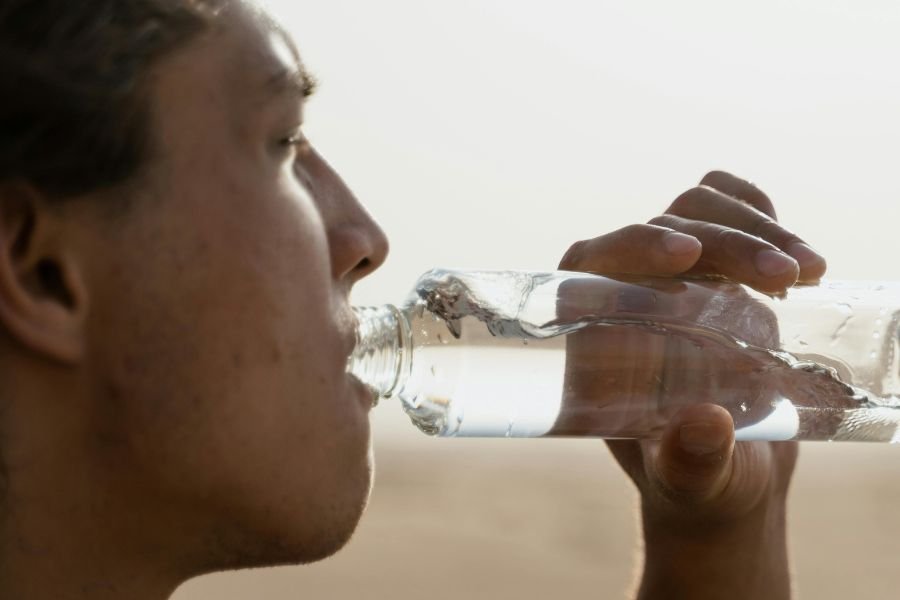
Why the classic '8 glasses of water a day' needs to be debunked once and for all.
For many, this could be too much water. Experts say there's a much easier way to get your daily hydration needs met.

Are we drinking too much water or not enough?
We all know that humans need water to survive, but how much just plain water do we actually need to consume each day to be healthy?
If your instinct is to say 6 to 8 glasses of water a day, you're not alone. For many of us, that figure has been ingrained into us since we were kids by health class teachers, family doctors and concerned caregivers alike.
However, needing 8 glasses a day of water is a total and complete myth.
Despite being deeply embedded in our collective conscience, there's little to no scientific evidence to back up the idea that drinking 8 glasses—or any specific number of ounces—of water per day is ideal. This fact might take a minute to digest, since these days so many of us carry water bottles measured in specific ounces to help us stay hydrated and may even track our water consumption with an app or daily planner.
Knowing how many ounces of water we should drink and tracking how much we do drink may give us a satisfying sense of control, but it's largely meaningless. According to the Mayo Clinic, staying hydrated isn't so much about how much water you drink but about how much fluid you consume overall, including from foods and beverages besides water. And that amount is different for every person because every person's body is different.
Additionally, our circumstances are different each day. If you're exercising or sweating from the heat, your body's hydration needs change. If you're sick, pregnant or breastfeeding, your hydration needs change. Certain medications can alter how much fluid your body needs, as can a high-salt diet.
But there must be some kind of guideline, right? We can't just be willy nilly drinking water whenever we feel like it in the age of step counts and sleep tracking apps, can we?
Inadequate hydration is linked to early aging and chronic disease, among other things, so it's important to get enough fluids. The U.S. National Academies of Sciences, Engineering, and Medicine lists adequate daily fluid intake as:
- About 15.5 cups (3.7 liters) of fluids a day for men
- About 11.5 cups (2.7 liters) of fluids a day for women
Some doctors point out that we have a natural mechanism to tell us when we aren't well-hydrated—thirst. "Drink when you're thirsty" may sound like basic advice, but it's what many physicians recommend. However, thirst is a sign that your body is already mildly dehydrated, so some recommend drinking before you get thirsty as well.
Just don't go too far that way, either. Another common myth is that you can't drink too much water, but that's not true. A tragedy in 2023 in which a healthy mother of two drank four bottles of water in about 20 minutes and died of water intoxication highlighted the importance of not drinking too much water too fast. And drinking an excess of water overall, though rarely a problem for well-nourished adults, can make it hard for your kidneys to process properly.
One way to gauge your hydration level besides monitoring thirst is to check your pee. While it doesn't need to be clear(contrary to popular belief) it shouldn't be dark. According to Healthline's handy hydration chart, "lemonade" is about the shade you're looking for. Too clear means you're probably overhydrating. Darker than a light beer and it's time to up your liquid intake a bit.
Water is good. Hydration is important. Pay attention to thirst. Shoot for lemonade-shade pee. That ought to keep you on the right track for getting enough liquid without having to keep track of how many glasses or ounces of water you drink each day.

- Doctor destroys the myth about 'clear pee' that just about everyone believes ›
- Amazing WaterCube invention can create up to 100 gallons of water a day out of thin air ›
- Teacher explains how '90s kids never had water bottles in school and 'somehow' survived ›
- The surprising best temperature for drinking water, according to experts - Upworthy ›


A Generation Jones teenager poses in her room.Image via Wikmedia Commons
An office kitchen.via
An angry man eating spaghetti.via 
Gif of baby being baptized
Woman gives toddler a bath Canva


An Irish woman went to the doctor for a routine eye exam. She left with bright neon green eyes.
It's not easy seeing green.
Did she get superpowers?
Going to the eye doctor can be a hassle and a pain. It's not just the routine issues and inconveniences that come along when making a doctor appointment, but sometimes the various devices being used to check your eyes' health feel invasive and uncomfortable. But at least at the end of the appointment, most of us don't look like we're turning into The Incredible Hulk. That wasn't the case for one Irish woman.
Photographer Margerita B. Wargola was just going in for a routine eye exam at the hospital but ended up leaving with her eyes a shocking, bright neon green.
At the doctor's office, the nurse practitioner was prepping Wargola for a test with a machine that Wargola had experienced before. Before the test started, Wargola presumed the nurse had dropped some saline into her eyes, as they were feeling dry. After she blinked, everything went yellow.
Wargola and the nurse initially panicked. Neither knew what was going on as Wargola suddenly had yellow vision and radioactive-looking green eyes. After the initial shock, both realized the issue: the nurse forgot to ask Wargola to remove her contact lenses before putting contrast drops in her eyes for the exam. Wargola and the nurse quickly removed the lenses from her eyes and washed them thoroughly with saline. Fortunately, Wargola's eyes were unharmed. Unfortunately, her contacts were permanently stained and she didn't bring a spare pair.
- YouTube youtube.com
Since she has poor vision, Wargola was forced to drive herself home after the eye exam wearing the neon-green contact lenses that make her look like a member of the Green Lantern Corps. She couldn't help but laugh at her predicament and recorded a video explaining it all on social media. Since then, her video has sparked a couple Reddit threads and collected a bunch of comments on Instagram:
“But the REAL question is: do you now have X-Ray vision?”
“You can just say you're a superhero.”
“I would make a few stops on the way home just to freak some people out!”
“I would have lived it up! Grab a coffee, do grocery shopping, walk around a shopping center.”
“This one would pair well with that girl who ate something with turmeric with her invisalign on and walked around Paris smiling at people with seemingly BRIGHT YELLOW TEETH.”
“I would save those for fancy special occasions! WOW!”
“Every time I'd stop I'd turn slowly and stare at the person in the car next to me.”
“Keep them. Tell people what to do. They’ll do your bidding.”
In a follow-up Instagram video, Wargola showed her followers that she was safe at home with normal eyes, showing that the damaged contact lenses were so stained that they turned the saline solution in her contacts case into a bright Gatorade yellow. She wasn't mad at the nurse and, in fact, plans on keeping the lenses to wear on St. Patrick's Day or some other special occasion.
While no harm was done and a good laugh was had, it's still best for doctors, nurses, and patients alike to double-check and ask or tell if contact lenses are being worn before each eye test. If not, there might be more than ultra-green eyes to worry about.