upworthy
Add Upworthy to your Google News feed.
Google News Button
Health

Interesting video explains why people looked a lot older in the past than they do today

Were people unhealthy? Did they spend too much time in the sun?

vsauce, people look older, michael stevens

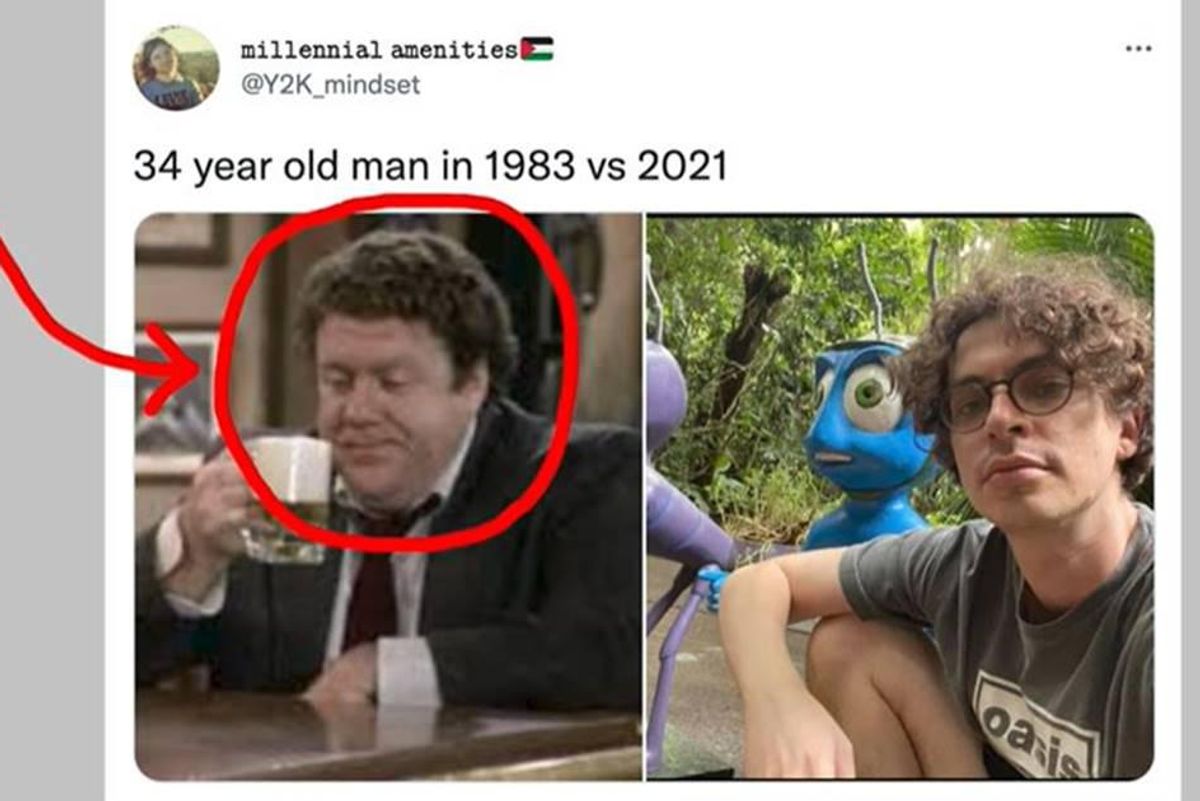
Norm was only in his 30s?

Ever look at your parents' high school yearbooks and think people looked so much older back then? All of the teenagers look like they’re in their mid-30s and the teachers who are 50 look like they’re 80. When we watch older movies, even those from the 1980s, the teenagers appear to be a lot older as well. Why is it that they looked so much older? Was life harder? Did people act more mature? Did they spend more time outdoors and less time playing video games? Is it their sense of fashion? Were they all smokers?

Educator Michael Stevens, who runs the super-popular Vsauce YouTube channel, explains the phenomenon in a new video called, “Did people used to look older?” In the video, he explains that people in the past appear a lot older due to a phenomenon known as retrospective aging.

When we see people in the past, they are wearing outdated styles that we associate with older people; therefore, we think they have aged rapidly. For example, a teenager in the 1950s may have been in fashion while wearing thick Buddy Holly-style glasses.

But as people age, they tend to cling to the fashion of their youth. So many people of that generation continued to wear the Buddy Holly-style glasses into their 50s. So when younger people see those glasses they see them as old people's glasses and not a hip kid from the '50s.

So in the photo from the '50s, the teen appears to look a lot older because our perspective has been tainted by time.

But it isn’t all just an illusion. Stevens also points out that people did age faster back in the day due to differences in nutrition, lifestyle and medicine.

This article originally appeared three years ago.

shhh, quiet, zip it, mouth closed, say nothing, be quiet

A woman zipping up her lips.

There are times to speak up, moments when it’s best to say nothing, and opportunities be very considerate in your response. But when you’re on the receiving end of a back-handed compliment, a foolish remark, or a coworker takes you down a peg, and your emotions are up, it can be hard to have a thoughtful response. Often, we say something we shouldn’t.

How is it that some folks fly off the handle and say things they’ll later regret, while others can stay calm and remove themselves from the situation or take the high ground? One way to be less impulsive with your words is to use the “name it to tame it” neuroscience hack, originally coined by author and psychiatrist Dr. Dan Siegel. When used properly, it allows you to step back from the moment and choose the best response in a challenging situation.


shhh, quiet, zip it, mouth closed, say nothing, be quiet A man saying "be quiet."via Canva/Photos

How to use the ‘name it to tame it’ hack

When someone upsets you, the first thing to do is to go inside yourself and describe the emotion that you feel in your body. Are you angry? Are you sad? Are you afraid? Do you feel rejected? Are you disappointed? The moment you name the emotion, it will begin to subside and give you the emotional and mental room to respond to the person who caused the negative emotion, rather than impulsively reacting.

How to respond to a reactive emotion so you don’t fly off the handle:

Event happens:

1. Your body stiffens up

2. You feel an intense emotion

3. You examine the emotion and give it a name: “My body is telling me I am angry.”

4. You should feel the emotion beginning to subside

5. Choose your response instead of being impulsive

shhh, quiet, zip it, mouth closed, say nothing, be quiet A woman zipping up her mouth.via Canva/Photos

Why does ‘name it to tame it’ work?

“Name it to tame it” works because, when we have a strong emotional reaction, our lizard brain kicks in, and we go into fight, flight, or freeze mode. The lizard brain is not known for giving thoughtful and strategic responses to challenging situations. When we name the emotion, our prefrontal cortex, or the thinking brain, kicks in. The thinking brain looks at the situation and says, “Alright, we don’t need to run or fight here. It's best to give a strategic response.”

When we tune into the negative emotions by naming them, they relax because they feel heard, like when a child has hurt their knee or a loved one has real concern and you gives them undivided attention. Once the emotions are named, they are tamed. Then, you are more likely to respond to the negative person with grace and speak from the best part of yourself.

Dr. Dan Siegel, who coined the phrase “Name it to tame it,” explains the brain science behind the technique in the video below. He does a great job of explaining how it allows us to transfer our thoughts from the downstairs brain (the lizard brain) to the upstairs brain (the thinking brain), so we can calm down and respond appropriately to the situation.

- YouTube www.youtube.com

Celebrity

Watch Colin Jost try Olympic bobsledding and gain a whole new level of respect for the sport

"I swear to God, I thought I was going to die. I thought my back was gonna snap in half."

colin jost, bobsled, bobsledding, olympic sports, winter olympics

Bobsledding is a lot more intense than it looks.

Some Olympic sports are obviously difficult and, clearly, inherently dangerous. You can't watch a snowboarder twirl upside down in mid-air, 17 feet above a 22-foot halfpipe wall, and not admire the heck out of the effort it takes to reach that level of courage, skill, and athleticism. Watching skiers barreling down a mountain at 60 to 80 mph with nothing but a thin suit between them and the ground, expertly avoiding obstacles as they do it, is objectively impressive to the average person.

But the challenge of other sports isn't as immediately appreciated. Curling may be hard, but it doesn't look that hard. And bobsled might take some level of athletic ability, but other than a 5-second run before you jump into the sled, it's really just about momentum and steering, right? Sure, they go fast, but bobsledders sit inside a protective metal casing, so it looks more like a thrilling roller coaster ride than a physically challenging and dangerous sport, right?


That's what Saturday Night Live's Colin Jost thought. Then he tried it, and thankfully, he took all of us along with him. In a clip from NBC Sports, Jost describes his bobsled ride in Lake Placid, New York, as "by far, the scariest experience I've ever had in my life."

First, watch his full run here:

Jost rode along with an experienced driver and didn't even have to do anything but feel it. And, boy, did he feel it. We can see how his body was violently jostled from the physics of flying down the track. As the driver said, astronauts take off in a space shuttle at about three Gs. In the bobsled, they did about 5 Gs, which means he was feeling five times his body weight pushing down on him.

We can see and hear the shift from "Wow!" to "Holy ____!" as Jost's thrill turned to terror on the track.

"I was in no way prepared for that," Jost said. "I truly thought my body was going to break apart. I'm not exaggerating. It was so much more intense than I expected."

Jost told Mike Tirico that he was "not prepared for the level of terror of this bobsled."

"I swear to God, I thought I was going to die," he said. "I thought my back was gonna snap in half. I thought my bones were gonna fly off my body and be littered all up and down the bobsled track."

@nbcsports

Bobsled: 1; Colin Jost: 0. 😅 #winterolympics


People loved seeing an average person partake in an Olympic event, especially someone as honest about the experience as Jost was, as evidenced in the comments:

"Now THIS is the kind of commentary I want!"

"Huge thank you to whoever put Colin Jost in a bobsled."

"Can we have him do every event for a reference point?"

"This is what we've been asking for - an average person participating so we can get a real account! Thank you for your service, Colin Jost!"

"He was so horrified he couldn’t even be hilarious about it 💀"

"He completely lost his composure, 😂 you could tell he was scared, and it did look like the fastest thing anyone would ride."

"You know what... his explanation really helped me understand how scary bobsledding is and now I'm more interested in watching. Keep this guy on the air. That second scream shows me he's telling the truth 😂"

The video really does offer a whole different perspective on how difficult bobsledding actually is. Jost was just trying to keep his body together. Imagine having to focus and steer on top of handling those G-forces.

Retired NFL player and popular podcaster Jason Kelce also tried out the bobsled in Park City, Utah, and had a similar "holy ____" experience. He seemed to enjoy it a little more than Jost did, perhaps more accustomed to his body taking a beating as a professional football player, but he said it was far more intense than it looked. It didn't feel like a roller coaster, he said. The 1,400 pounds of pressure pushing him into the metal bars of the sled bruised his hips, and, at one point, it got so loud he couldn't hear his own screams.

- YouTube www.youtube.com

Seeing how careening down an ice track in an aerodynamic sled feels really does lend a whole new level of wow to a sport that some might mistakenly see as glorified sledding. It also lends more weight to 41-year-old Elana Meyers Taylor's run that earned her her first Olympic gold medal in her sixth Olympic Games in Milano Cortina. She had earned three silver medals and two bronze medals, making her the most decorated U.S. female bobsledder of all time.

Seriously, nothing but respect for the bobsledders from here on out.

arthur c. brooks, harvard, psychology, happiness research, bucket list

Harvard researcher Arthur C. Brooks studies what leads to human happiness.

We live in a society that prizes ambition, celebrating goal-setting, and hustle culture as praiseworthy vehicles on the road to success. We also live in a society that associates successfully getting whatever our hearts desire with happiness. The formula we internalize from an early age is that desire + ambition + goal-setting + doing what it takes = a successful, happy life.

But as Harvard University happiness researcher Arthur C. Brooks has found, in his studies as well as his own experience, that happiness doesn't follow that formula. "It took me too long to figure this one out," Brooks told podcast host Tim Ferris, explaining why he uses a "reverse bucket list" to live a happier life.


bucket list, wants, desires, goals, detachment Many people make bucket lists of things they want in life. Giphy

Brooks shared that on his birthday, he would always make a list of his desires, ambitions, and things he wanted to accomplish—a bucket list. But when he was 50, he found his bucket list from when he was 40 and had an epiphany: "I looked at that list from when I was 40, and I'd checked everything off that list. And I was less happy at 50 than I was at 40."

As a social scientist, he recognized that he was doing something wrong and analyzed it.

"This is a neurophysiological problem and a psychological problem all rolled into one handy package," he said. "I was making the mistake of thinking that my satisfaction would come from having more. And the truth of the matter is that lasting and stable satisfaction, which doesn't wear off in a minute, comes when you understand that your satisfaction is your haves divided by your wants…You can increase your satisfaction temporarily and inefficiently by having more, or permanently and securely by wanting less."

Brooks concluded that he needed a "reverse bucket list" that would help him "consciously detach" from his worldly wants and desires by simply writing them down and crossing them off.

"I know that these things are going to occur to me as natural goals," Brooks said, citing human evolutionary psychology. "But I do not want to be owned by them. I want to manage them." He discussed moving those desires from the instinctual limbic system to the conscious pre-frontal cortex by examining each one and saying, "Maybe I get it, maybe I don't," but crossing them off as attachments. "And I'm free…it works," he said.

- YouTube www.youtube.com

"When I write them down, I acknowledge that I have the desire," he explained on X. "When I cross them out, I acknowledge that I will not be attached to this goal."

The idea that attachment itself causes unhappiness is a concept found in many spiritual traditions, but it is most closely associated with Buddhism. Mike Brooks, PhD, explains that humans need healthy attachments, such as an attachment to staying alive and attachments to loved ones, to avoid suffering. But many things to which we are attached are not necessarily healthy, either by degree (over-attachment) or by nature (being attached to things that are impermanent).

"We should strive for flexibility in our attachments because the objects of our attachment are inherently in flux," Brooks writes in Psychology Today. "In this way, we suffer unnecessarily when we don't accept their impermanent nature."

What Arthur C. Brooks suggests that we strive to detach ourselves from our wants and desires because the simplest way to solve the 'haves/wants = happiness' formula is to reduce the denominator. The reverse bucket list, in which you cross off desires before you fulfill them, can help free you from attachment and lead to a happier overall existence.

This article originally appeared last year.

Culture

26 words that have gone nearly 'extinct' in the English language

"Comely (meaning beautiful) and homely (meaning ugly)."

words, english words, old words, old fashioned words, disappearing words, extinct words

Black and white 1920s woman on the phone.

Our vernacular is always changing. Every generation has its own slang words, from Xennials to Millennials and Gen Z.

In 2025, Dictionary.com deemed '67' as the word of the year, the Oxford University Press claimed the word of the year was "rage bait," and Merriam-Webster claimed it was "slop."


In an interview with the BBC, host Kate Colin offered an example of words that have disappeared in English when she opened a segment for the broadcasting network with this greeting: "Good morrow! I beseech thee, whence comest thou?" (Translation: "Good morning. Where do you come from?")

- YouTube www.youtube.com

Colin noted that this phrase was "Old English" used hundreds of years ago, and a great example of "disappearing words." Colin's co-host Jackie Dalton added, "Yes, English is a language which is evolving all the time. So this mean there are new words continuously appearing, and older words are disappearing."

In English, words are here today and will likely be gone tomorrow. Language lovers on Reddit shared their favorite old-fashioned words that have gone nearly "extinct" in English today (and many they wish would make a comeback).

26 disappearing words

"Overmorrow. It means 'the day after tomorrow'." - TheGloveMan

"I remember the word 'grody' from the 90s. It meant gross or yucky." - Glittering_Age_5591

"Comely (meaning beautiful) and homely (meaning ugly)." - oddwithoutend, Suspicious_Art9118

"Rolodex. There was something great about those. My own was a desk model with a lockable closing cover. Something about the tangibleness, the physicality and the control. Having the different kinds of cards and card covers, hearing them click when you spun it. I was sad to let it go." - Matsunosuperfan, BASerx8

"Bitchin' (meaning excellent)." - fox3actual

"Yellow pages." - Matsunosuperfan

"Forsooth." - fingermagnets459

Merriam-Webster notes that the definition of forsooth is "in truth : indeed —often used to imply contempt or doubt; now usually used to evoke archaic speech." It comes from Middle English and dates back to the 12th century.

"Lunting: walking while smoking a pipe." - RainbowWarrior73

@pbsdigitalstudios

Wouldn’t it be a dilly idea to bring back these 1900s slang words!? Which one fractured you the most 😅 Let us know in the comments and catch up on episodes of Otherwords with @Dr. Erica Brozovsky on the Stoired YouTube channel! #slang #english #language #linguistics #history #vintage @PBS

"Only a 'square' would remember things like that." - EighthGreen

"'Cattywampus' also sometimes known as 'catawampus'. A cool word that you don't hear much anymore." - Dead_Is_Better

"I use finagle and my high school students think I'm so weird. I'm 47. This word is normal." - MLAheading

"Frippery, at least in American English (think it's used in France for thrift shops?)" - KobayashiWaifu

Merriam-Webster notes that the definition of frippery is "finery, also an elegant or showy garment; something showy, frivolous, or nonessential." Its origins are Old French and date back as far as 1568.

"Handsome (when describing a woman)." - Odd-Scheme6535, Popular-Solution7697

"I love the word 'scrimshaw.' I don't hear it enough." - nocatleftbehind420

"Maybe not extinct but it's meaning completely obliterated: nonplussed." - LeFreeke

"Oblige. Rarely hear it except in old westerns." - ReadySetGO0

"Druthers." - Embarrassed_Wrap8421

- YouTube www.youtube.com

"Bogart. Monopolizing something that's meant to be shared." - CoderJoe1

"Bumbershoot." - kelariy

Merriam-Webster notes that "bumbershoot" is an American nickname for an umbrella that was first used in 1856.

"Ne'er-do-well. From the early 20th century, basically some who never-does -well, implying a slacker or underachiever. Although people never said it even when I was growing up, I still think it's a cool word." - fabgwenn

"Whippersnapper - a young and inexperienced person considered to be presumptuous or overconfident. I've heard people on TV say it, (maybe Dennis the Menace, or some other 50s show). I heard a 90 year old woman say it IRL and I laughed so hard." - JazzFan1998

"Xeroxing a document." - C-ute-Thulu

"Blatherskite." - Biff_Bufflington

Merriam-Webster notes that the definition of "blatherskite" is "a person who blathers [talks foolishly at length] a lot; nonsense." Its first known use dates back to 1650.

"I don't seem to hear penultimate much anymore." - TakeMetoLallybroch

"I'm quite fond of the word slubberdegullion, meaning 'dirty scoundrel'. I use it frequently when I talk to my senior, who is a rather clean upstanding citizen. We laugh and then he tells me to get back to work." - r-pics-sux