If Donald Trump decides to run for president in 2024, there’s a good chance that he’ll win the Republican nomination. A recent survey from the John Bolton Super PAC found that 46% of likely general election voters would back Trump being the party’s nominee.
Florida governor Ron DeSantis came in a distant second with 13% support.
Trump’s latest fundraising figures show that he has a whopping $102 million war chest to finance a run in 2024.
Trump’s former chief of staff Mark Meadows said that the former president recently met with “cabinet members” to discuss his political future and that they’re “moving forward” in a “real way.”
Mark Meadows from Bedminster: “We met with some of our Cabinet members tonight .. I can tell you this. We wouldn’t be meeting tonight if we weren’t making plans to move forward in a real way.” pic.twitter.com/kQHCLcxk02— Ron Filipkowski (@RonFilipkowski) July 30, 2021
It’s hard to believe that a president who inspired an insurrection at the Capitol building and did everything he could to overturn the results of an election could still have a single supporter, let alone tens of millions.
Shouldn’t there be a law that prevents people who attack the very fabric of American democracy from having the honor of holding its highest office? Fox News contributor Juan Williams believes there is a strong legal case to deny Trump the ability to run again.
Williams is a liberal outlier at the news outlet and was a regular co-host on Fox’s “The Five.” He stepped down from the role on the show earlier this year after contracting COVID-19.
No Person shall be a Senator or Representative in Congress, or elector of President and Vice-President, or hold any office, civil or military, under the United States, or under any State, who, having previously taken an oath, as a member of Congress, or as an officer of the United States, or as a member of any State legislature, or as an executive or judicial officer of any State, to support the Constitution of the United States, shall have engaged in insurrection or rebellion against the same, or given aid or comfort to the enemies thereof. But Congress may by a vote of two-thirds of each House, remove such disability.
“The facts say Trump tried to stage a coup,” Williams wrote.
Williams cites three actions by Trump that prove he engaged in insurrection.
He tried to hamstring acting Attorney General Jeffrey Rosen into saying the election was “corrupt.”
“Just say the election was corrupt [and] leave the rest to me and the [Republican] congressmen,” Trump told Jeffrey Rosen, then the acting attorney general, in a December phone call.
In the weeks before that call, Trump also pressured his Attorney General William Barr to do the same. “We realized from the beginning it was just bullshit,” Barr later told ABC News’s Jonathan Karl.
The former president also tried to get Georgia’s secretary of State, Brad Raffensperger to “find” him votes to help him win the state.
“So, yes, there is a case to be made that Trump committed crimes against America,” Williams wrote.
In a recent op-ed for The Washington Post, lawyers Laurence Tribe, Barbara McQuade, and Joyce White Vance urged Garland to block Trump from running again. “The bottom line is this: Now that Trump is out of office, the DOJ’s view that sitting presidents cannot be indicted no longer shields him. Attempted coups cannot be ignored,” they wrote.
“If Garland’s Justice Department is going to restore respect for the rule of law, no one, not even a former president can be above it,” the op-ed continued.
When Donald Trump was elected president he swore to “preserve, protect and defend the Constitution of the United States.” His failure to do so should not only make him an unworthy choice for the American people but disqualify him from having the opportunity in the first place.
Williams makes a compelling argument that that Trump is legally ineligible to run again.
“Yes, Garland has the power to stop Trump from running again,” Williams wrote. “It is time to use it.”
A single door can open up a world of endless possibilities. For homeowners, the front door of their house is a gateway to financial stability, job security, and better health. Yet for many, that door remains closed. Due to the rising costs of housing, 1 in 3 people around the world wake up without the security of safe, affordable housing.
Since 1976, Habitat for Humanity has made it their mission to unlock and open the door to opportunity for families everywhere, and their efforts have paid off in a big way. Through their work over the past 50 years, more than 65 million people have gained access to new or improved housing, and the movement continues to gain momentum. Since 2011 alone, Habitat for Humanity has expanded access to affordable housing by a hundredfold.
A world where everyone has access to a decent home is becoming a reality, but there’s still much to do. As they celebrate 50 years of building, Habitat for Humanity is inviting people of all backgrounds and talents to be part of what comes next through Let’s Open the Door, a global campaign that builds on this momentum and encourages people everywhere to help expand access to safe, affordable housing for those who need it most. Here’s how the foundation to a better world starts with housing, and how everyone can pitch in to make it happen.
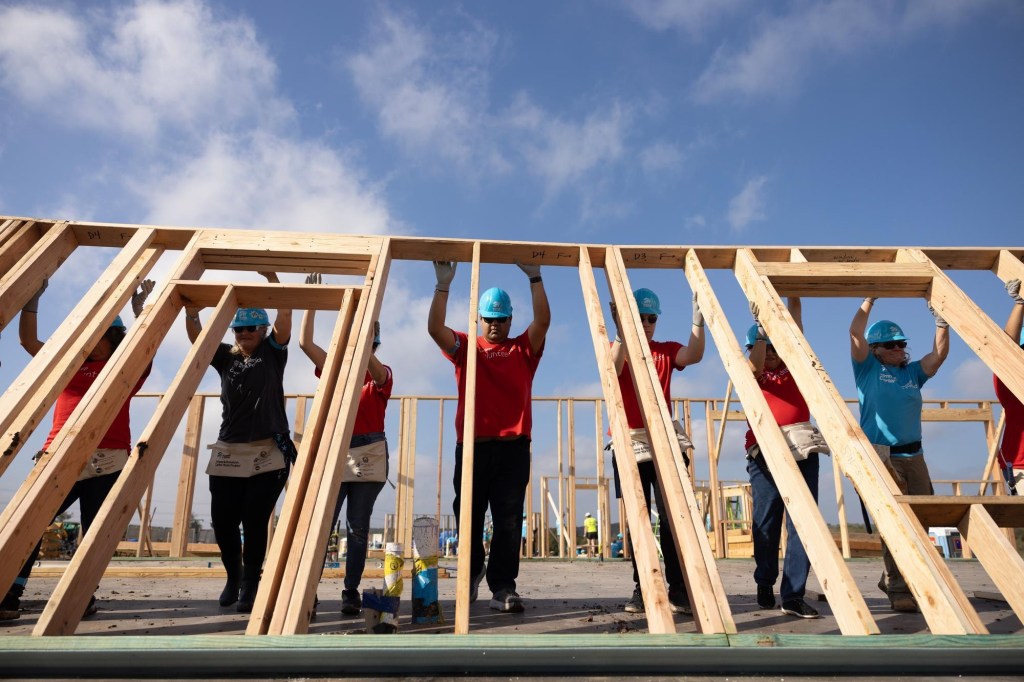
Volunteers raise a wall for the framework of a new home during the first day of building at Habitat for Humanity’s 2025 Carter Work Project.
Globally, almost 3 billion people, including 1 in 6 U.S. families, struggle with high costs and other challenges related to housing. A crisis in itself, this also creates larger problems that affect families and communities in unexpected ways. People who lack affordable, stable housing are also more likely to experience financial hardship in other areas of their lives, since a larger share of their income often goes toward rent, utilities, and frequent moves. They are also more likely to experience health problems due to chronic stress or environmental factors, such as mold. Housing insecurity also goes hand-in-hand with unstable employment, since people may need to move further from their jobs or switch jobs altogether to offset the cost of housing.
Affordable homeownership creates a stable foundation for families to thrive, reducing stress and increasing the likelihood for good health and stable employment. Habitat for Humanity builds and repairs homes with individual families, but it also strengthens entire communities as well. The MicroBuild® Initiative, for example, strengthens communities by increasing access to loans for low-income families seeking to build or repair their homes. Habitat ReStore locations provide affordable appliances and building materials to local communities, in addition to creating job and volunteer opportunities that support neighborhood growth.
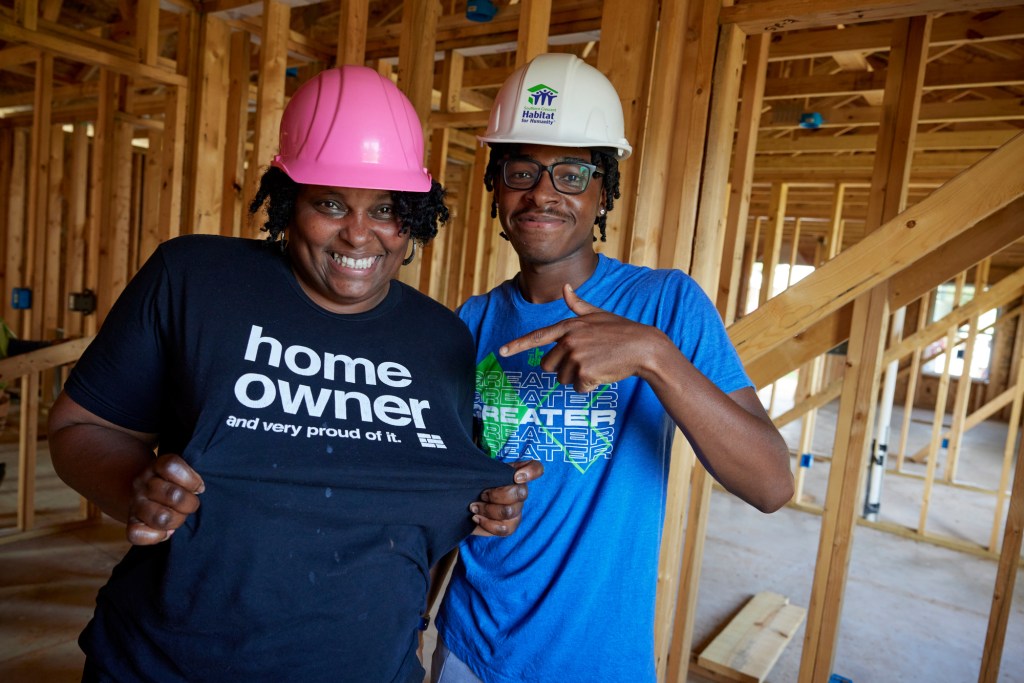
Marsha and her son pose for a photo while building their future home with Southern Crescent Habitat for Humanity in Georgia.
Everyone can play a part in the fight for housing equity and the pursuit of a better world. Over the past 50 years, Habitat for Humanity has become a leader in global housing thanks to an engaged network of volunteers—but you don’t need to be skilled with a hammer to make a meaningful impact. Building an equitable future means calling on a wide range of people and talents.
Here’s how you can get involved in the global housing movement:
Speaking up on social media about the growing housing crisis
Volunteering on a Habitat for Humanity build in your local community
Travel and build with Habitat in the U.S. or in one of 60+ countries where we work around the globe
Join the Let’s Open the Door movement and, when you donate, you can create your own personalized door
Every action, big and small, drives a global movement toward a better future. A safe home unlocks opportunity for families and communities alike, but it’s volunteers and other supporters, working together with a shared vision, who can open the door for everyone.
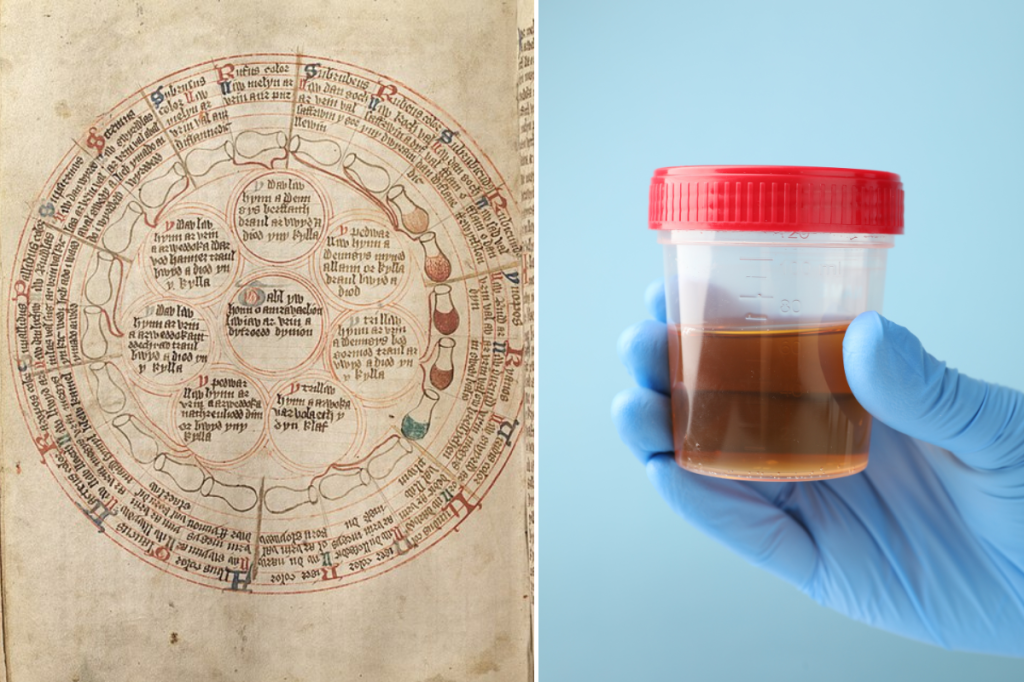
Photo credit: National Library of Wales/Wikimedia Commons & Canva Photos – A guy says he can tell when he's getting sick based on the taste of his pee. Ancient doctors would probably agree.
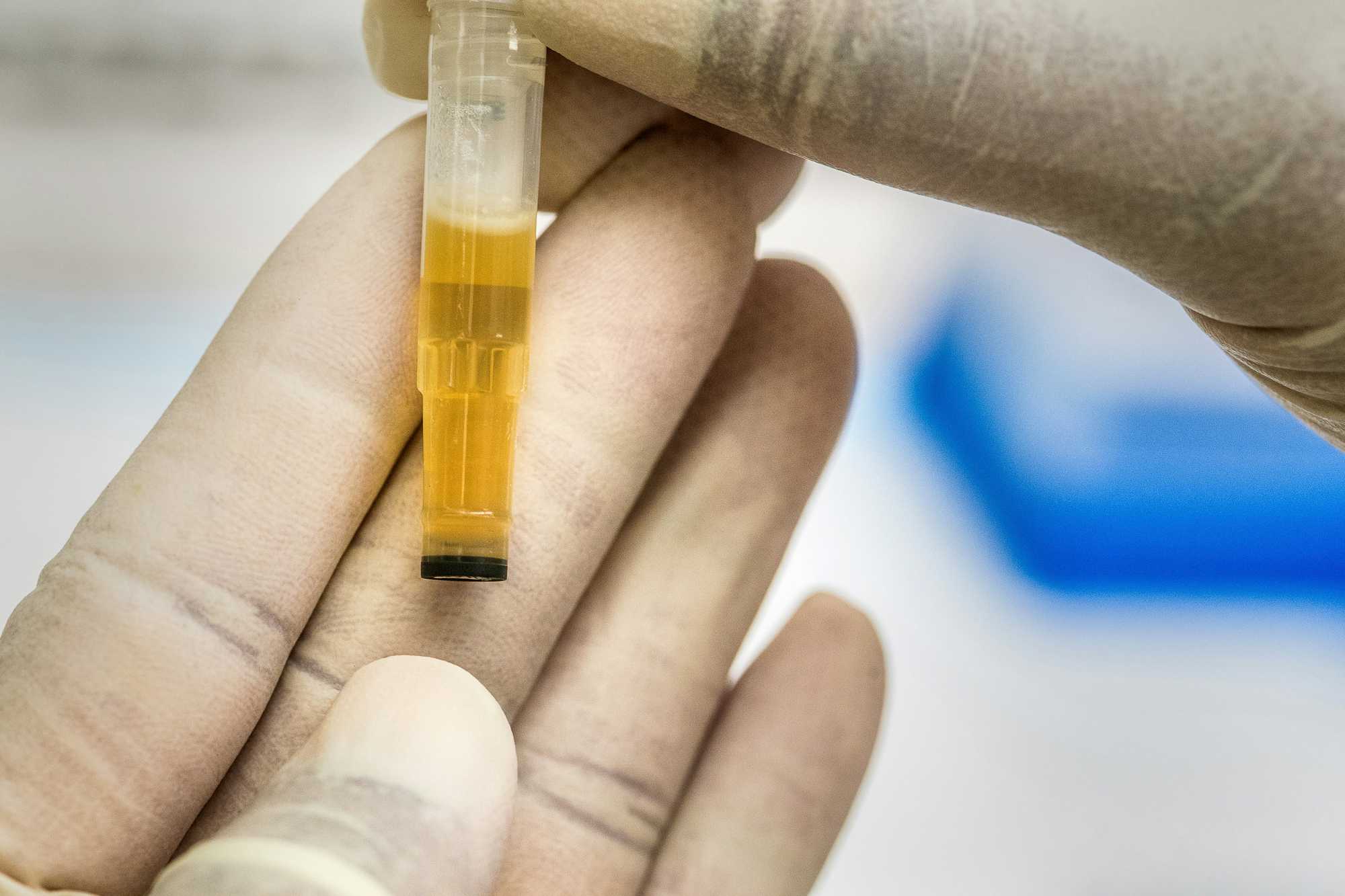
A recent Super Bowl ad by the hydration brand Liquid IV urges viewers, with an assist from Phil Collins, to “take a look” at their urine as the color could be a warning sign of dehydration. It’s long been known that lighter pee often means you’ve been drinking more water and other fluids. Darker yellow or amber pee can mean you’re not well-hydrated, which forces the kidneys to concentrate the urine, leading to darker colors and a more powerful odor. Crucially, striving for pee that is completely clear isn’t ideal.
In short, there’s a lot you can learn from pee without any complicated lab tests. But some people take this pee science more seriously than others. A user on Reddit recently went viral for confessing that he’s been not only tracking the color and clarity of his own pee for four years, he’s been tasting it as well.
“Every morning for the past four years, I’ve tasted my own urine. Approximately 5ml, enough for proper palate evaluation,” he wrote in a post.
“I’ve developed what I call the Golden Index, a standardized evaluation framework with six primary metrics,” he explained, going on to list how he evaluates his urine’s color, clarity, sweetness, salinity, bitterness, and mouthfeel each on a five-point scale each morning.
He writes that after a while, he grew sensitive to any slight change in the color, clarity, and yes, especially the taste. Those changes were often a sign of something happening in his body. Most notably, he says that he could tell he was getting sick about three days before feeling any symptoms.
“At approximately month eight, I identified a predictive pattern. When salinity exceeds 4.0 AND a copper/metallic undertone is detected, illness onset occurs within 72 hours. I’ve now observed this pattern 12 times and eleven predictions were accurate – that’s a 91.7% accuracy rate with an average lead time of 68.4 hours before symptom manifestation.” He also writes that he could see and taste when he was dehydrated, had consumed alcohol, had eaten red meat, and even when he was overly stressed.
Naturally, the jokes practically wrote themselves over the course of several hundred comments:
“‘Hi Mr. Johnson, just wanted to call in sick for my shift on the 19th…’ … ‘But it’s only the 16th’ swishes profusely around mouth ‘Trust me sir, you’re gonna want to find coverage’”
“Please tell me stool isn’t your next experiment”
“I am equally impressed and disgusted by this”
And OP was kind enough to answer the question on everyone’s mind: “My wife believes I simply ‘take a long time’ in the bathroom each morning. She’s not aware of the research.”
We don’t know for sure who this anonymous, and brave, Internet data-nerd is, but modern doctors advise that you should never drink, or even taste, your own urine. But he’s not wrong about one thing: Medical professionals used to taste pee all the time.
It’s hard to stomach, but the tasting of pee proved to be a crucial step forward in the diagnosing of some illnesses, especially diabetes.
Diabetes was, if not discovered, then at least noticed by the ancient Egyptians as far back as around 1550 BCE. Papers discovered from the time recommended an antiquated treatment for “excessive urination” involving a concoction of pond water, elderberry, milk, and more. A few hundred years later, ancient Indian physicians noted that the urine of people who were sick with this mysterious affliction attracted ants.
It wasn’t until 1674 that a doctor named Thomas Willis tasted diabetic urine and couldn’t help but notice how sweet it was. “Wonderfully sweet as if it were imbued with honey or sugar,” were his exact words. Further experiments would eventually prove that the pee was full of sugar. It took centuries, but, in 1921, the very beginnings of an effective treatment for diabetes began to pop up. The discovery of sugar in urine was an incredible key to understanding the disease.
Doctors had been tasting and visually analyzing urine for centuries in order to detect illnesses. They even had complex charts correlating different colors with potential diagnoses. It was a practice called uroscopy.
Most of it was, respectfully, bunk, and uroscopy became mostly extinct not long after Thomas Wills’ discovery. But some elements of it persist today.
Signs of ailments like urinary tract infections, liver failure, and certain kidney issues can be outwardly visible in urine samples upon visual inspection. Doctors will still look for color, clarity, and thickness in their visual exams. But most of the rest of urinalysis is best performed in a lab, where accurate readings on pH levels, protein, glucose, nitrites, and more can tell them far better information.
But as gross as it is, not to mention unsanitary and potentially unsafe, there are crazier ideas out there than the concept that tasting your own pee could alert you to a brewing illness. Ancient Indian and Egyptian doctors would probably agree with this guy.
From the night the Sons of Liberty dumped hundreds of chests of tea into Boston Harbor in 1773, Americans have protested government policies and actions they disagree with in various ways. Some have staged peaceful sit-ins, while others have rioted in rage. Millions have marched to make their voices heard, carrying signs and chanting slogans that express their displeasure with what’s happening in their country.
But occasionally, a unique form of protest stands out. Several weeks into the ICE operation in Minneapolis, in which the federal government sent 2,000+ agents and officers to carry out “the largest immigration operation ever,” and which has led to disruptions at schools, conflict between federal agents and the community, and the killing of U.S. citizens, thousands of Minnesota residents have taken to the streets in protest. Among them is a growing band of singers who, instead of calling out the government with shouting and chants, are calling in the federal agents with songs and signs, inviting them to join the resistance.
It’s a different approach to take, tapping into the humanity of individual agents instead of confronting the government as a whole. But 2,000 people have added their voices to the “singing resistance,” forming a massive choir. They gather at a church to practice their songs, then take their message to the places where ICE agents are staying, singing:
The effect of combining the arts with our constitutional right to peacefully assemble is powerful, and the signs the singing resisters are holding are, too: “Please ICE agents. Join Us.” “Love > Fear,” “Choose Humanity. Quit ICE.” “Stop the Violence.” “We Are Family.” “Be the hero that walks away.” “The time is always right to do what is right.” “You, too, are here to love and be loved.”
The Singing Resistance Instagram account shared the heart of the message the singers hope to send to ICE agents, imploring them to quit their jobs and join “the side of love and humanity”:
“Under federal occupation, Minneapolis has been going through immense pain, rage, and grief. But when they come at us with violence, we fight back with love. We still have space in our hearts for ICE agents who are willing to walk away from the path of violence and take accountability for harm they’ve caused. We paid ICE agents a visit today to call them home.”
Another song they sang says:
It’s okay to change your mind Show us your courage Leave this behind It’s okay to change your mind And you can join us Join us here anytime
The idea of inviting agents and officers to join a resistance movement isn’t without precedent. Singing resistance organizers shared that they were inspired by the Otpor! civil resistance that helped overthrow Serbian dictator Slobodan Milosevic in 2000. Otpor! members would chant, “You may not join us today, but you can join us tomorrow,” when they were arrested by the police. Ultimately, when hundreds of thousands marched on Belgrade, most of the police and military joined the opposition and refused to follow Milosevic’s orders to fire on the protesters.
According to an Ipsos poll conducted on January 30 and 31, 2026, a full 62 percent of U.S. adults feel ICE’s actions go too far, compared to 13 percent who think they don’t go far enough and 23 percent who said it was about right. That disapproval is four points higher than the week before, indicating that the ICE operations are unpopular with Americans, even those who normally support the Trump administration’s policies.
People from all over the United States shared words of encouragement for the choir, expressing how moved they are by the singing resistance:
“I love how the singing is both dissent/resistance and it feeds hope and replenishes energy. It is so soul-nourishing. I’d love to be a part of this! Sending my love and care to you all from Maryland as a MN born and raised woman. Sing on!!!”
“I think the music resistance is very effective and moving. Thank you for all your fine efforts from way over here in upstate New York. Thank you for standing up for all of us in the country.”
“We are one chord, beautiful beautiful voices thank you so much for sharing Minnesota. I’m a musician and singer here in Eugene, Or, and when I hear hundreds of you singing like that, I cannot tell you how healing it is for me how powerful and indeed how brave.”
“I have a song in my heart again! After weeks of crying crying in despair, thank you for singing us into a hopeful future of healing, reconciliation, and RESISTANCE❤️
“This is more revolutionary than so many know.”
“Prince left his legacy forever. Minneapolis strong.”
“This reminds me of Estonia’s singing revolution and I’m here for it. ❤️❤️”
The Singing Resistance account has shared a toolkit and songbook and organized a virtual training on how to organize a local singing resistance choir for those interested in doing something similar.
The right to peacefully assemble and voice our disagreement with our government is guaranteed in the Constitution, and there are many creative ways to do it. When people are singing in harmony in the street, it not only gets attention, but it’s hard to criticize or confront that kind of peaceful protest. (Imagine the optics of trying to break up a peacefully singing crowd.) Will the choir’s earworms calling to their humanity really make a difference with any ICE agents in Minneapolis? Time will tell. In the meantime, people around the world are hearing them loud and clear and joining the harmonious chorus of non-violent resistance.
Imagine a prison without bars. The cells are private rooms with doors that lock, and inmates hold their own keys. Social workers replace guards. For some, this may sound impossible, but two hours from Paris in a quiet French village, it exists.
La Ferme de Moyembrie is a working farm that doubles as a prison. It’s a pioneering prison farm that challenges traditional ideas of incarceration. Here, the focus shifts from punishment and confinement into something much more meaningful: dignity, responsibility, and the heartfelt belief that everyone deserves a chance to rebuild their life.
For the men who arrive here—many after years in conventional prisons—Moyembrie offers something radical: trust. At Moyembrie, these men work the land, care for animals, and slowly remember what it’s like to be regarded as humans who are responsible, dependable, and honest. It’s a sanctuary where they can rediscover their self-worth, reconnect with nature’s soothing rhythms, and prepare to step back into a world that too often leaves them behind.
A safe haven born from compassion
The story of Moyembrie began in 1990, not as a government program but as a personal mission. Jacques and Geneviève Pluvinage, two retired agricultural engineers, invested their life savings into the 24-hectare farm in Coucy-le-Château-Auffrique. Their plan was straightforward: give people a place to land when they had nowhere else to go.
Jacques had volunteered in prisons and had seen what happened to inmates after release: the panic, the paralysis. He began receiving letters from inmates desperate for support as they reentered society. In response, he and Geneviève did something unusual: they invited them in. The men lived in their house, ate at their table, and worked the fields alongside them.
By the early 2000s, the French justice system took notice. A progressive judge encouraged the farm to formally accept inmates serving sentences but eligible for “placement à l’extérieur” (work release). Moyembrie transformed from a shelter into a professional reintegration facility, but it never lost its sense of community. Today, it stands as proof that rehabilitation succeeds best in a supportive and collaborative environment, not behind bars.
Breaking the mold: no cells, no guards
The first thing you notice at Moyembrie is the absence: No barbed wire. No watchtowers. No scary guards in uniform. It’s a working organic farm bustling with activity, the kind you might pass on any country road without a second thought.
The 20 or so men living here aren’t just inmates. They’re employees and community members. They hold the keys to their own rooms—a small but meaningful gesture that restores the privacy and autonomy lost in traditional prisons.
Security isn’t enforced with bars; it’s built on trust. The staff are social workers and technical supervisors—not corrections officers—who are there to guide and support, not to watch. This relationship sends a clear message: “I believe you are more than your worst mistake.”
Finding purpose in the soil
The residents at Moyembrie wake early. From 8 a.m. until noon, they’re busy in the fields or workshops, tending to goats and chickens, cultivating organic vegetables, and producing fresh cheese and yogurt.
The work is hard. It’s repetitive. It’s the kind of labor that makes your back ache and your hands feel like sandpaper. But it’s real. Vegetables grow. Goats, eventually, will need milking. Cheese must be made.
The farm pays the men a small wage and equips them with valuable life skills. Photo credit: Canva
The farm pays them a small wage and sells their produce at local farmers’ markets. The economic element is just a bonus, though. The work—tending to something outside yourself, being responsible for something alive, something fragile—changes the way you relate to your own life. On a deeper level, this work can be exquisitely therapeutic.
“Work is about relearning essential life skills like punctuality or decision-making,” says Leila Desesquelle, one of the nine members on the farm. “In detention, the smallest choices were made for them. So it’s a big deal if they can decide on their own.”
You learn to show up on time. Work with other people. Begin to see your hands as tools of creation, not destruction. There is a profound sense of healing that comes from nurturing a living thing and watching it thrive.
At lunch, everyone sits together—staff and residents share the same table. There is no hierarchy, no separation. It’s just lunch.
The afternoon then shifts into personal growth. The men work on the mechanics of reentry: getting a driver’s license, familiarizing themselves with their paperwork, and learning how to open a bank account or apply for housing. Some take creative writing classes. Others meet with social workers to discuss what comes next.
These afternoons are when residents learn to manage their independence, a skill that’s been eroded by years of incarceration. Whether they’re taking a workshop or working with social workers to secure health insurance and ID cards, every task is a step towards successful reentry.
“I used to cry when I received judicial letters because I couldn’t understand what they meant,” explains Mahamady. Originally from Mali, he spent seven years in French jails before arriving at the farm—without ever learning the language.
Reasons to Be Cheerfulreports that Mahamady took his first French lessons in detention, then continued with bi-weekly classes at the farm. He eventually passed a French language certification test.
The power of a second chance
Does it work? In France, recidivism, or the rate at which people return to prison, is notoriously high. Reports say that two out of three people leaving prison in France will be back within five years. Moyembrie’s numbers tell a different story. While exact statistics for the farm are difficult to pin down due to its small size, one report estimates that only 7% of the men who pass through the farm return to prison.
Part of that’s due to structure. Before leaving, the farm ensures every resident has a safety net: their housing is pre-arranged. Most have jobs or find employment within three months. These are the building blocks of a functioning life—practical victories, the ones that make all the difference when you’re starting over with nothing.
However, Moyembrie’s success is best reflected in personal stories rather than just statistics. It shows up in the man who spends his weekends with his daughter, trying to rebuild their relationship.
Olivier, a former resident who now works at the farm as a counselor, credits Moyembrie with changing his life. “I lost so much during my years in prison, including my family,” he said. The farm’s relaxed, welcoming environment made visits with loved ones easier, helping to heal old wounds. “Slowly, we became close again.”
Why we need more places like Moyembrie
Despite its undeniable impact, Moyembrie is still a rarity in the prison industry. The farm can only take in about fifty people a year, and must turn away many more applicants than it can hold
It’s a double-edged sword. The program’s effectiveness lies in its small scale; the deep personal bonds between staff and residents are at its heart.
Still, the idea is spreading. Since 2018, similar farms have opened across France, including a dedicated site for women. They call them “farms of hope”—living proof that justice, healing, and growth over time can go hand-in-hand, and that simple punishment isn’t always the answer.
What Moyembrie shows is simple: prison doesn’t have to be about punishment. Instead, it can provide people with the tools they need to rebuild and move towards a brighter future. As Christian, a former resident, describes his experience:
“After prison, you start from scratch. Everything has to be done again,” he exclaims. “I had a job, a partner… I lost everything in prison. My son was born during my incarceration; I didn’t know him. After that, we have to rebuild everything. It’s not easy.”
Then, while reflecting on his time at Moyembrie, Christian continues, “I found moral support and a family atmosphere. I went back to work like a normal guy. At the end of my sentence, I became a supervisor. I wanted to thank the Farm for all the help it had given me, and to show the residents that we can get out of it.”
When Kerwin Pittman was 18 years old, he was convicted and served 11 years and six months in prison for conspiracy to commit murder. Now, eight years after his release, he returns to another prison, not to serve time, but to offer hope for other former inmates. Pittman purchased an abandoned correctional facility to create a campus that helps former inmates transition back into life outside prison.
Since his release, Pittman has founded and serves as the executive director of Recidivism Reduction Educational Program Services, Inc. (RREPS), a nonprofit organization committed to helping incarcerated people reintegrate into society after completing their sentences. Through a series of donations and grants, Pittman was able to purchase the former Wayne Correctional Center in Goldsboro, North Carolina. He is believed to be the first formerly incarcerated person in the United States to have purchased a prison.
Pittman aims to transform the 400-bed correctional facility into a campus where former inmates in his program can live for six months while earning certifications in trades such as electrical work, plumbing, HVAC, and construction. Pittman’s formation of RREPS and purchase of the abandoned prison were inspired by seeing too many former cellmates return to prison because of the stigma attached to incarceration.
“I had family support, so I had housing. But a lot of my friends didn’t have any place to go. Or if they did, there was a time limit on how long they could stay,” Pittman told NC Newsline. “The campus would be like a stabilization phase for guys coming out of jail or prison, to give them a six-month pause so they can get their life back on track.”
It’s A Blessing To Be A Blessing ~ over 250 plus lives touched, 100 plus records cleared, and countless new beginnings sparked. RREPS Wake County Expungement Clinic reminded us what it truly means to serve with purpose. Throughout the day, well over 200 people showed up, each one ready to take a step toward a fresh start. By the end, over 120 plus people had dismissed charges and convictions cleared from their records, giving them a real chance at new opportunities. We also helped folks obtain birth certificates, Social Security cards, and IDs, while connecting them to housing, jobs, food, and more! Heartfelt thanks to all the attorneys and law students who volunteered their time and expertise, and to our incredible partners: SouthLight, North Carolina Empowerment Organization, The Black Coalition of Forensic Peer Support Specialists, Wake LRC, Affluent Logistics and Transportation and Healing Transitions for standing alongside us in this work. Photos by:Glenn Alan #RREPS#ExpungementClinic#ReentryMatters#viral#fyp
Once the prison has been refurbished and looks less like a correctional facility, Pittman plans to have up to 300 residents live on the campus during a six-month training program designed to help them acclimate to life outside prison, learn a trade, and prepare to live and work independently. After that six-month period, a new group of 300 former inmates will be granted the same opportunity, and the cycle will continue.
“Normally, people will go to a halfway house or a reentry house, and those individuals will have to go outside for services,” retired correctional officer Mario Davis told WITN. “But what he’s done here is bringing formerly incarcerated people in, so they don’t have to go out to get services.”
In the U.S., a combination of stigma and lack of education makes it difficult for many former prisoners to find jobs. This often leaves former inmates desperate and unhoused, forcing some to return to crime to make ends meet or, in some cases, to be incarcerated again. For many, it’s better to be in prison than to be homeless. By offering both shelter and what is essentially a trade school, Pittman can give former prisoners the chance not only to find jobs through trade certification, but also to work for themselves as independent contractors.
“For me to be a beacon of light in somebody’s life when they’re in a dark place, I know how it feels,” said Pittman. “I remember when I was in that dark place of having to transition and not knowing what the possibility of my life could become, so to be able to guide somebody into that next step is extremely important, and I’m grateful to be able to do it.”
If Pittman’s mission inspires you to support people who have served their time and are seeking a second chance, there are resources available to donate your time, skills, or money.
There are few things more frustrating than America’s enormous wealth inequality. Consider that the United States has more money held by private citizens than any other country in the world. According to the Federal Reserve, U.S. households hold a total of $160.35 trillion, which is the value of each person’s assets minus their liabilities. However, many Americans are perplexed by the fact that, in a country with such wealth, so many people still struggle to make ends meet.
Although Americans hold the largest amount of privately held wealth in the world, many of us still struggle with financial stress. A recent report found that 68% don’t have enough money to retire, 56% are struggling to keep up with the cost of living, and 45% are worried about their debt levels. A significant reason is that a small number of people hold a large portion of the privately held wealth in the U.S..
Nearly two-thirds of America’s private wealth is held by the top 10% of people, leaving the remaining one-third to be divided among 90% of the population. For reference, the richest man in the world, Elon Musk, is currently worth about $681 billion; a truly mind-numbingly, staggeringly large number.
What if there were a radical way of fixing the problem?
What would happen if America divided its privately held money evenly?
With so many people struggling in America, while a few at the top are unbelievably wealthy, what would happen if the money were magically divided evenly among the 340 million people who live in the United States?
If everyone received a truly equal share of the American pie, every person would receive approximately $471,465. That’s $942,930 per couple and $1.89 million for those with two kids.
That would be a life-changing windfall for a large majority of Americans.
With that chunk of change, the couple could easily pay off the average U.S. mortgage and have plenty of resources to save for a good retirement and send both kids to a decent college or trade school. They’d have no trouble buying groceries and putting food on the table, affording a car, and taking regular vacations.
The billionaire who once had more assets than they knew what to do with, on the other hand, would probably have to move into a middle-class neighborhood.
Of course, beyond just the logistical and ethical hurdles that make a move like this essentially impossible, it might not even be a good idea. Such a drastic redistribution of wealth would be cataclysmic for the economy, as people would have to liquidate their investments to give their assets to others. The sudden increase in wealth for many, without a corresponding increase in goods and services, would lead to incredibly high inflation. The dramatic reconfiguring of the economy would also disincentivize some from working and others from innovating.
Some posit that if everyone were equal, in just a few months, those with wealth-generating skills would immediately begin rising to the top again, while others would fall behind, and in a few generations we’d be right back where we started. Without a deeper, more fundamental change to our system of capitalism, a one-off radical redistribution of wealth wouldn’t stick, most likely.
What programs actually do reduce poverty?
Although it seems that a massive redistribution of wealth isn’t in the cards for many reasons, we do have some evidence from recent history on how programs that give people money can help lift them out of poverty.
Government stimulus programs during the COVID-19 pandemic brought the U.S. poverty level to a record low of 7.8% in 2021. Child poverty was also helped by the American Rescue Plan’s Child Tax credit expansion, which drove child poverty to an all-time low of 5.2%. It’s also worth noting that the trillions in government stimulus had a downside, as it was partially responsible for a historic rise in inflation.
Another popular idea for reducing poverty is providing citizens with a Universal Basic Income. It’s a concept that has been tested in several places, even in America, usually with good results. Experiments have generally shown an increase in health, life satisfaction, and even full-time employment for people who received “free guaranteed money” from UBI.
Finally, there’s philanthropy. Many millionaires and billionaires give a small portion of their wealth to charities, but a select few have pledged to give away the vast majority of their fortune before their lifetime comes to an end. Bill Gates, and Warren Buffett are just two notable examples of billionaires who are set to give away more than $600 billion in the next several decades.
While for many, the notion that there are billionaires while others can hardly get by feels obscene, redistributing America’s wealth is more of a thought experiment than something that would realistically happen. But it highlights an important truth: massive wealth inequality exists in the world’s wealthiest nation. While perfect equality will never exist, that shouldn’t stop us from making targeted efforts to reduce poverty that make a meaningful difference in people’s lives.
This article originally appeared in July. It has been updated.
It seems like every year there is a story about how the United States is more politically divided than ever, to the point in which some are manipulating the way basic democracy is done in order to achieve extra votes. As President Trump pushes for the congressional redistricting of various states in order to assure his party stays in power during his presidency, the Republicans in GOP-governed Indiana voted against it to favor democracy over allegiance to their party.
To many, Trump’s push for redistricting in order for traditionally Republican-voting states to receive more congressional seats is a blatant form of gerrymandering. Gerrymandering is an unfair, yet sadly common, tactic in order to redraw and rig voting maps to favor specific politicians or political parties. This method has been used from incumbents to retain their seats of power for upcoming elections, undermining voters.
As of this writing, the GOP-controlled Texas has redrawn their maps to favor five additional seats for Republicans and Democrats in California voted to redraw their maps in response. This had led to Trump encouraging other red states to redistrict, but his own party members in Indiana broke rank to keep their current map and let the voters decide who to represent them in the 2026 midterm elections. These Republicans also are reported to have received violent threats regarding this vote along with upsetting the President.
The hope of several politicians, including former ones like Arnold Schwarzenegger, is that gerrymandering is something that is universally reviled by all political parties and “terminated” as Arnold would put it.
Former California Gov. Arnold Schwarzenegger criticized congressional redistricting efforts happening across the United States during an interview with CNN’s Jake Tapper. Schwarzenegger said both parties are “trying to outcheat each other” through redistricting. #CNN#News#politics
Douglas J. Amy of FairVote.Org shares how discarding gerrymandering tactics could be achieved:
“The only sure way to eliminate gerrymandering – both intentional and unintentional – from American elections is to abandon single-member plurality arrangements and adopt proportional representation. Indeed, the whole purpose of PR is to minimize wasted votes and ensure that the parties are represented in proportion to the votes they receive. This eliminates the possibilities of unfair representation produced by gerrymandering. The key to eliminating partisan gerrymandering is the large multimember districts used in PR systems.As numerous studies have shown, as long as a PR system has at least five seats in every district, it is effectively immune from gerrymandering.These districts largely eliminate the wasted votes that make gerrymandering possible. In such districts, even small political minorities do not waste their votes and are able to elect their fair share of representatives. Thus, under PR arrangements, where voters live or how district lines are drawn makes no difference – fair representation will result.”
It is indeed still a turbulent political landscape that will still be filled with disagreement, however this move by Republican Hoosiers allows the fights to be more fair and encourages politicians to work together for the people’s will rather than their own party’s. On the same day Indiana rejected the gerrymandering, a few GOP senators sided with Democrats for a three-year extension of Affordable Care Act subsidies after months of contention and a government shutdown over them. This, too, leads to hope and a possible trend that disagreement and debate leads to better outcomes over outright party allegiance at any cost.
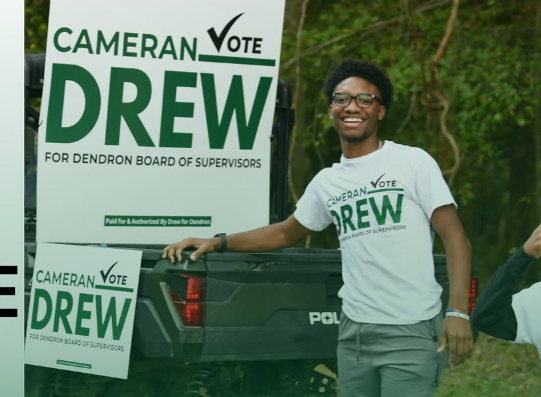
It’s improbable that a teenager could win public office in the United States, let alone do so by besting an opponent he once called his teacher. But Cameran Drew, a pro-business liberal from Surry, Virginia, did just that on November 4 when he defeated conservative Kenneth Bell, 44, a civics teacher at Surry County High School, in a contest for the Surry County Board of Supervisors. Bell was appointed to the seat six months ago, after the previous supervisor resigned.
Drew, a student at Virginia Peninsula Community College, was in Bell’s high school class last year and called him his favorite civics teacher. He defeated Bell in a close race that was decided by just eight votes, 345 to 337.
“I wanted this job because I knew I could serve the people,” Drew told CBS News. “I knew I could be an advocate for the youth and be an advocate for our county.”
In a rarity for today’s politics, both candidates refrained from personal attacks, and things never got uncomfortable. “We were both respectful about it, so it was never an awkward moment,” Drew said. In fact, Bell even backed up his opponent when his age was questioned. “Yes, he’s young, but he’s really invested in trying to make a difference,” Bell said.
After the election, Bell had nothing but positive things to say about his former pupil. “He would have been formidable against any opponent against whom he would have run,” Bell told CBS News.
Lowering property taxes was a big issue for Drew’s campaign. Surry’s real estate tax rate is higher than that of neighboring Sussex County and the City of Williamsburg. “The biggest issues I ran on were opportunities for the youth and lowering the tax rate,” he told Virginia Peninsula Community College. “I made a promise to the folks that I will ensure that I will do my best to lower the tax rate for them, ensure I will do my best to establish a stronger tax base for them, and bring other local businesses within the county.”
Drew understands the needs of the local business community because he’s an entrepreneur himself. He owns Prez Productionz, works as a motivational speaker, and runs an apparel business. “I always tell people and other young folks that if you’re into politics, you’ve got to also know some business because politics is business,” he said. “It correlates so much with business, and I know that this degree will help me within my business, my foundation, and my political journey.”
In addition to helping businesses and the county’s youth, Drew believes in working across the aisle with those he may not agree with to help his constituents. “Every opinion is valuable because it sparks conversation, and that is what civil discourse is all about. Even when disagreements arise, the goal should be to find shared ground and move forward together. I firmly believe that ‘Iron sharpens Iron,’” he said in a candidate statement.
Drew was sworn into office on December 2. He plans to transfer to Virginia State University after graduating from VPCC in spring 2026.
Abortion is not a black-and-white issue, no matter how some folks want to make it one. Despite being viewed as one of the most polarizing issues in America, most of us sit somewhere in the messy middle of the abortion debate, with our personal moral convictions and what we want our laws to be not necessarily aligning perfectly.
People have big feelings about abortion, which is understandable. On the one hand, some people feel that abortion is a fundamental women’s rights issue, that our bodily autonomy is not up for debate, and that those who oppose abortion rights are trying to control women through oppressive legislation. On the other hand, some believe that a fetus is a human individual first and foremost, that no one has the right to terminate a human life, period, and that those who support abortion rights are heartless murderers.
And then there’s the rest of us, who have personal, moral, and/or religious objections to abortion under many circumstances, but who choose to vote to keep abortion legal with few if any restrictions attached. According to a 2024 Pew Research report, there appear to be a whole lot of us. Most Americans (63%) want abortion to be legal with few or no restrictions, and most white non-evangelical Protestants (64%), most Black Protestants (71%), and most Catholics (59%) support abortion being legal in all or most cases. White evangelical Protestants were the only religious affiliation shared by Pew that believed abortion should be illegal in all or most cases.
Some people don’t understand being personally anti-abortion but politically pro-choice, citing the moral conflict seemingly inherent in that equation. But I don’t feel conflicted about it at all. Here’s why:
There are too many unknowns and far too much gray area to legislate abortion.
No matter what you personally believe, when exactly life begins and when “a clump of cells” should be considered an individual, autonomous human being with the same rights as a person who is not dependent on a woman’s body for life is a completely debatable question with no clear scientific answers.
I believe life begins at conception, but that’s my own religious belief about when the soul becomes associated with the body, not a proven scientific fact. As Arthur Caplan, award-winning professor of bioethics at New York University, told Slate, “Many scientists would say they don’t know when life begins. There are a series of landmark moments. The first is conception, the second is the development of the spine, the third the development of the brain, consciousness, and so on.”
There are many unanswerable questions about when life officially begins. Photo credit: Canva
But let’s say, for the sake of argument, that a human life unquestionably begins at conception. Even with that point of view, there are too many issues that make a black-and-white approach to abortion too problematic to ban it. The biggest issue I see is that medicine is complex, and obstetrical medicine is particularly so. It’s simply not as simple as “abortion is wrong.” Every single pregnancy is personally and medically unique throughout the entire process—how can we effectively legislate something with so many individual variables that are always in flux?
Abortion bans hurt women, even those who desperately want their babies to live.
One reason I don’t support banning abortion is that I’ve seen too many families deeply harmed by restrictive abortion laws.
I’ve heard too many stories of families who desperately wanted a baby, who ended up having to make the rock-and-a-hard-place choice to abort because the alternative would have been a short, pain-filled life for their child.
A midwife friend shared a story of a client with a super rare pregnancy condition that necessitated an abortion. She sent the client to her previous OB, who practiced in a state with strict abortion restrictions. Despite the mother’s health declining quickly and zero chance of the fetus surviving, the OB couldn’t help her without risking legal action because there was still a fetal heartbeat and the mother’s life was not yet in enough danger to qualify for the “to save the mother’s life” exception. The mother, going downhill with a deteriorating baby she very much wanted, had to be driven two hours to a hospital in another state to get the care she needed.
A new study shows that since the overturning of Roe & Idaho passing of an abortion ban, Idaho has lost 35% of the OBs that practiced there.
Rural areas are being hit the hardest with only 23 OBs left to serve the 569,000 Idahoans living in the 37 rural counties in the state. pic.twitter.com/lGLfKnzstw
I’ve heard too many stories of abortion laws doing real harm to mothers and babies, and too many stories of families who were staunchly anti-abortion until they found themselves in circumstances they never could have imagined, to believe that abortion is always wrong and should be banned at any particular stage.
I refuse to serve as judge and jury on someone’s medical decisions, and I don’t think the government should, either.
Most people’s anti-abortion views—mine included—are based on their religious beliefs, and I don’t believe that anyone’s religion should be the basis for the laws in our country. The Constitution makes that quite clear.
I also don’t want politicians sticking their noses into my very personal medical choices. There are just too many circumstances (seriously, please read the stories linked in the previous section) that make abortion a choice I hope I’d never have to make but wouldn’t want banned. I don’t understand why the same people who decry government overreach think the government should be involved in these extremely personal medical decisions.
And yes, ultimately, abortion is a personal medical decision. Even if I believe that a fetus is a human being at every stage, that human being’s creation is inextricably linked to and dependent upon its mother’s body. And while I don’t think that means women should abort inconvenient pregnancies, I also acknowledge that trying to force a woman to grow and deliver a baby that she may not have chosen to conceive isn’t something the government should be in the business of doing.
As a person of faith, my role is not to judge or vilify, but to love and support women who are facing difficult choices. The hard questions, the unclear rights and wrongs, the spiritual lives of those babies, I comfortably leave in God’s hands, not the government’s.
Research shows that if the goal is to prevent abortion, there are more effective ways than abortion bans.
The last big reason I vote the way I do is that, based on my research, pro-choice platforms actually provide the best chance of reducing abortion rates.
Just after Roe vs. Wade was passed, abortion rates skyrocketed, peaked around 1990, and then plummeted steadily for nearly two decades. Abortion was legal during that time, so clearly, keeping abortion legal and available did not result in increased abortion rates in the long run. And in the three years since the Dobbs decision overturned Roe vs. Wade, abortion rates in the U.S. have actually risen. So stricter laws don’t seem to be lowering rates, either.
Outlawing abortion doesn’t stop abortion, it just pushes it underground and makes it more dangerous. And if a woman dies in a botched abortion, so does her baby. Banning abortion and imposing strict restrictions on it are a recipe for more lives being lost, not fewer.
Our laws should be based on the best data we have available. At this point, the only things consistently proven to reduce abortion rates on a societal scale are comprehensive sex education and easy, affordable access to birth control. The problem is, anti-abortion activists also tend to be the same people pushing for abstinence-only education and making birth control harder to obtain. But those goals can’t co-exist with lowering abortion rates in the real world.
The polarization of politics has made it seem like the only choices are on the extreme ends of the spectrum, but it doesn’t have to be that way. We can separate our own personal beliefs and convictions from what we believe the role of government should be. We can look at the data and recognize when bans may not actually be the most effective means of reducing something we want to see less of. We can listen to people’s individual stories and acknowledge that things are not as black-and-white as they’re made out to be.
We can want to see fewer abortions and still vote to keep abortion legal without feeling morally conflicted about it.
This article originally appeared six years ago and has been updated.



















.jpg)