What a disaster! In troubled times, movies about calamities can be an unexpected comfort

In the 1960s and 1970s, the world seemed to be falling apart – cultural, social, economic and political upheavals imparted a general sense of gloom that pervaded everything, and the movies reflected that. In part, that was through gritty, independent films that presented a bleak view of the American landscape. There was another side of…

Array
ArrayPhoto credit: Array

In the 1960s and 1970s, the world seemed to be falling apart – cultural, social, economic and political upheavals imparted a general sense of gloom that pervaded everything, and the movies reflected that. In part, that was through gritty, independent films that presented a bleak view of the American landscape.

There was another side of Hollywood, though, which found a way to capture the discomfort and fear of the time and turn it into something spectacular: the disaster film. Starting with the huge success of the all-star Airport in 1970, movie producers discovered that putting movie stars in peril was big business.


Audiences couldn’t get enough, which in part might be because by portraying the most terrifying and seemingly impossible concepts, then thrusting big movie stars into the roles of victims and survivors, the disaster films showed moviegoers that anything, even the end of the world, was theoretically survivable.

It’s one of the reasons that in the midst of the coronavirus pandemic, disaster movies seem oddly, unexpectedly comforting. “We like to find hope, and these movies do find hope,” says Los Angeles-based psychotherapist Louise Bale, who specializes in helping clients work through trauma. “The hope is always in human resilience and in humanity coming together.” Adding in big-name stars and big-budget productions actually helps audiences connect. “They start out glamorous, but the glamour gets stripped down and they become more like us. We can relate to that person, who looks a little more haggard than they did at the beginning of the movie.”

Whether finding an impossible path through an overturned luxury liner or looking for the way out of a 138-story building, “On a psychological level, the stories help us know that that’s what surviving looks like, and we root for these people because we know they are not helpless or hopeless.”

Of course, coping with crisis isn’t as simple as watching a disaster movie. But for many people, seeing movie stars beat impossible odds can be wonderfully cathartic. Whether you’re unfamiliar with the disaster-movie genre, or you’ve always longed to board the S.S. Poseidon, here are four can’t-miss disaster movies that will make you think, “Hey, if they can get through that horrible thing, so can I” – and that’s a message we all could hear these days. Plus, as Bale notes, what we’re experiencing is hard, unprecedented and downright scary at times, but not everyone wants to express those fears. “Maybe we’re trying really hard right now not to look as scared as we feel, but if we watch something that’s scary or very thrilling, we can say, ‘Ah, I’m only feeling this way because the movie is so intense.’ And that helps us work through our own emotions.”

Whatever the reason for watching them, you cannot go wrong with these four disaster films!


The Poseidon Adventure (1972)


Get past the dated, hokey (but often funny) first 20 minutes and as soon as a giant tidal wave smacks into the grand luxury ship S.S. Poseidon this super-blockbuster, which grossed the adjusted-dollar equivalent of $515 million, holds up as one of the most riveting adventures ever put on film. Led by Gene Hackman as a disillusioned preacher and Ernest Borgnine as a gruff cop, a group of survivors have to find a way out of the ship, which has completely turned over. They’ve got just hours to do it, and The Poseidon Adventure consistently finds ways to capture the humanity of these scared, shell-shocked people even while the sets explode and fill with water all around them. Between they explosions, they create compelling, affecting characters, plus an undercurrent of real moral consequence; as they move deeper into the fiery ship that resembles hell, even the preacher isn’t sure God is on their side. (Available on all streaming services for $4 to $5 rental.)

The Towering Inferno (1974)


Paul Newman, Steve McQueen, Faye Dunaway and William Holden were all huge stars, but the movie’s real star is the 138-story glass tower that’s getting ready for its grand opening. If The Poseidon Adventure found some humanity in its giant cast of characters, The Towering Inferno seems more focused on the thrills themselves. It takes all those pretty people, locks them in a room 138 stories over San Francisco, and then lights the whole thing on fire. How they get down is the film’s primary story, but why you’ll watch is to see what happens when rich and powerful people find out they’re in the same boat as everyone else. (Available on streaming services from $3.99 to $14 to own)

Earthquake (1974)


Also released in 1974, leading some to suggest a double-feature of this and Towering Inferno could be called “Shake and Bake,” Earthquake plays a surprising amount of its story for laughs. It knows its campy and over-the-top, that it’s an everything-but-the-kitchen-sink approach that’s just a half-step above parody. It also looks at times like a made-for-TV movie. But none of that can diminish its success. Charlton Heston, Ava Gardner, Genevieve Bujold, George Kennedy, Lorne Greene and Victoria Principal are the human stars, but you’re here to see them crawl their way through a shattered Los Angeles, and on that the movie delivers. (Available on major streaming services for $3.99 to $4.99)

Deep Impact (1998)


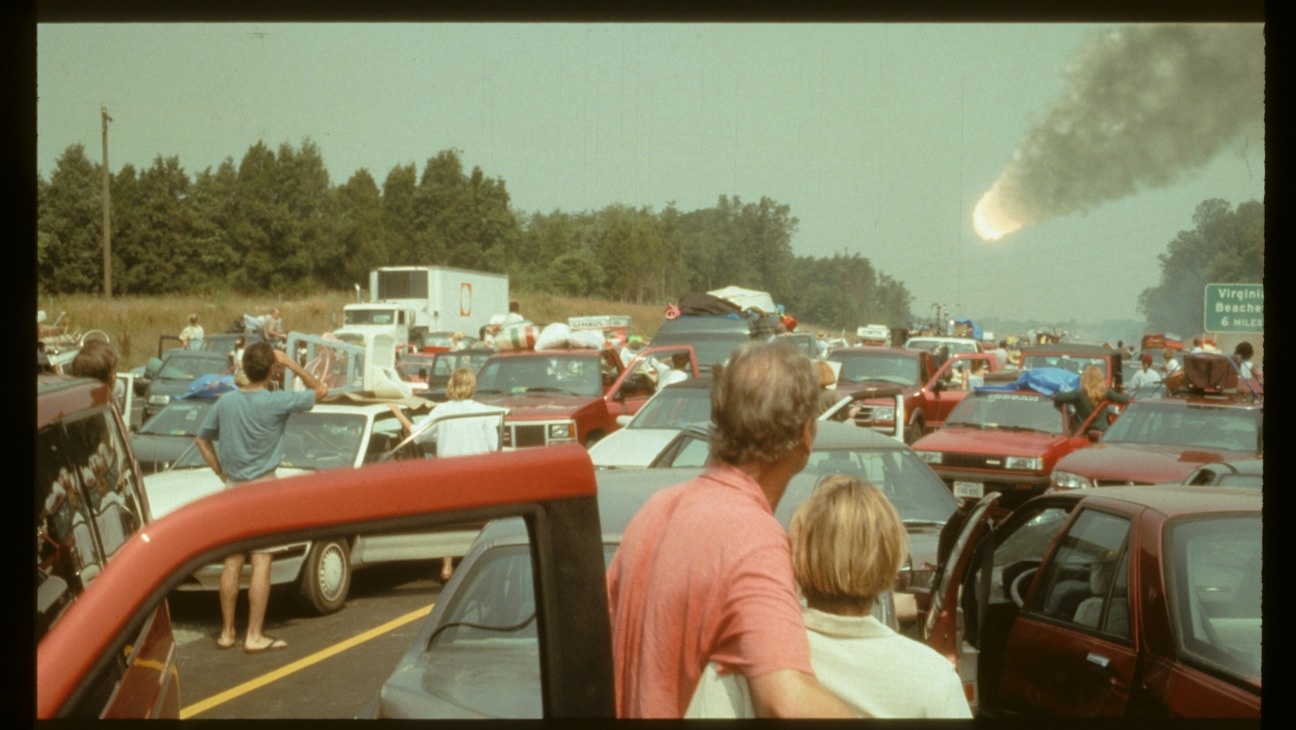
Disaster movies lost their appeal for a while, but in 1998 came two end-of-the-world movies just around the time that some were predicting the new millennium would be the end of the world for everyone. Between Armageddon and Deep Impact, only one cares about the human element of its story, and director Mimi Leder’s more gentle (yet still plenty crash-and-burn) approach to Deep Impact makes it the most lasting and affecting of the two films. It’s about a comet that’s hurtling toward Earth, and what happens when science discovers that the world really might end. The epic story never forgets the human scale – it’s fascinating to watch these characters try to grasp the magnitude of what is happening. There’s also Morgan Freeman as history’s most pragmatic, kind-hearted and well-spoken president. (Available on all major streaming services for $4 to $5)


John Singh is a writer and entertainment-industry veteran who began his career as a newspaper journalist and has also worked at Disney, Lucasfilm Ltd., DreamWorks Animation and on a variety of films and TV series.

  • Grocery store’s produce section concerts give indie musicians a live venue. People want more.
    A band plays in the produce section of Fiesta Fresh Market. Photo credit: Fiesta Fresh Market/YouTube
    ,

    Grocery store’s produce section concerts give indie musicians a live venue. People want more.

    “We need this right now in the world…Real humans doing real human things.”

    On the outside, Fiesta Fresh Market looks like just another neighborhood grocery store in New Castle, Delaware. Inside the produce section, however, customers can listen to local bands perform their latest songs live and in person. These “Mercadito Sessions” have since evolved from a simple community offering into a full-fledged live music event.

    While grocery stores and live music don’t typically mix, at Fiesta Fresh Market, it’s part of the family. The Aguilar Garcia family, who run the store, have music in their roots—especially co-owner José Luis Aguilar Garcia, who works in the music industry.

    In the hope of helping Mexican American bands gain more exposure, José and his family offered their produce section as a space for Latin musicians to perform for customers. They were inspired by National Public Radio’s “Tiny Desk Concerts,” which feature artists performing live in a confined space.

    These produce section mini-concerts, dubbed “The Mercadito Sessions,” initially puzzled customers. Over time, however, shoppers came to welcome and enjoy the live music, with some even visiting just for the performances. Then, posts on the store’s social media featuring the bands began to go viral.

    “The idea is to highlight independent artists from the area,” José told CBS Philadelphia. “Because it’s getting more attention online, people are excited. They’ll ask when we’re doing the next one.”

    Commenters on the store’s Instagram celebrated the market’s concert concept:

    “This is so cool. Not everyone wants to go to bars and/or have to stay up late to hear live music. I love this so much.”

    “Honestly this is the absolute coolest thing ever.”

    “Amazing music scenes going on everywhere, love the magic being shared.”

    “We need this right now in the world…Real humans doing real human things.”

    “Such an innovative and creative idea! 🥹💫”

    @fiestafreshmarket

    Just put the bananas in the bag bro @erre6ixx

    ♬ original sound – Fiesta Fresh Market

    While the Mercadito Sessions showcase Mexican regional music, they are open to any genre. As the series gained attention online, many bands reached out to Fiesta Fresh Market to get booked. Several acts have come to perform and record as customers pick out fresh fruits and vegetables.

    Concerts for the community, by the community

    Musicians and customers alike say these concerts provide a sense of community among Latin Americans living in Delaware. They not only celebrate their culture, but also showcase it to others in New Castle.

    “It gives us a platform to portray who we really are,” musician Jesús Beltran Méndez told CBS Philadelphia. “There’s a lot of misconceptions about who we are. There are bad people. There are good people. We are just human.”

    @fiestafreshmarket

    @Los K-Bros “Ya No Me Llames” (Unreleased) live desde Fiesta Fresh Market

    ♬ original sound – Fiesta Fresh Market

    Demand for the music has grown so much that the grocery store is now hosting and promoting a full-fledged concert event. What was once a place to buy groceries has become a spotlight for the community—all by offering a small space in an aisle.

  • A ‘gentleman’ reveals 4 reasons why men suddenly stopped wearing fancy hats in the ’60s
    Men wearing hats speak in the 1930s.Photo credit: Mitchell Library, State Library of New South Wales/Wikimedia Commons
    ,

    A ‘gentleman’ reveals 4 reasons why men suddenly stopped wearing fancy hats in the ’60s

    Men and women once went out wearing hats, and then suddenly, they disappeared.

    One of the most striking things about real-life footage of Americans from the advent of the camera until around 1970 is that nearly all men, and many women, are wearing hats. In footage from the 1940s, for example, men boarding the subway to go to work are almost always seen in fedoras, trilbys, or homburgs. Earlier clips show them in bowlers and top hats.

    It’s as if, before TV turned color, Americans were a nation of conformists who all dressed the same way. So how did men across the Western world go from wearing hats every day for decades to suddenly going bareheaded? Preston Schlueter of the Gentleman’s Gazette outlines four reasons in a YouTube video with more than 2 million views.

    Four reasons why men stopped wearing hats

    1. Climate control

    “One of the biggest reasons for the loss of hat-wearing is likely that we now have better control over our indoor climate than we used to,” Schlueter says. “This is also why men can now go in and out of doors wearing sometimes fewer than two layers of clothing, and why things like gloves and scarves aren’t as popular as they used to be.”

    2. Social class

    “Social class was an incredibly important aspect of Western society, and people were absolutely expected to know their place,” Schlueter says. “But, after the horrors of war brought every social class just a bit closer, we began to focus more on the individual, rather than on the class in which they resided. As a result, then, the practice of wearing clothing and, particularly, hats to signify yourself as part of a distinct group has become largely extinct.”

    hats, vintage hats, old-timey fashion, top hat
    A man and woman wearing hats at the turn of the century. Photo credit: Adományozó/Wikimedia Commons

    3. Highways and cars

    Back in the day, when transportation consisted of subway cars, trolley cars, horse-drawn buggies, or horseback travel, there was plenty of headroom, even for someone wearing a top hat. However, with the advent of the automobile, headroom in vehicles changed drastically.

    “Look up at the ceiling in your own car. How much headroom do you have there? The answer is probably not much, perhaps even for a relatively soft or short hat style,” Schlueter says. “Simply put, modern cars aren’t built to accommodate the hat styles of old.”

    bogart, bacall, the big sleep, classic films, movie stills
    Lauren Bacall and Humphrey Bogart in The Big Sleep. Photo credit: Warner Bros./Wikimedia Commons

    4. The Internet

    “In the last decade and a half or so, hats like the fedora and trilby have gained an increasingly negative reputation thanks to Internet memes from websites like 4chan, Reddit, and Tumblr,” Schlueter says. “Indeed, for some younger members of our audience, when we mention fedoras, they might first think of the infamous ‘tips fedora’ meme. Because there are now thousands of these easily spreadable memes all over the Internet, the fedora, in recent years, took on a decidedly less-than-cool reputation.”

    Hats are due for a comeback

    In the end, there are many reasons people stopped wearing fancy hats every day. It appears to be a confluence of historical events, technological progress, and social pressures that influenced this major shift in fashion. But that doesn’t mean the era of the hat is gone forever. If one thing is certain, what goes out of fashion is always bound to come back.

  • Comedian Jack Shep steals new ‘SNL UK’ scene with impeccable Princess Diana impression
    Comedian Jack Shep as Princess Diana in a "Saturday Night Live UK" sketch. Photo credit: Sky TV/YouTube

    Saturday Night Live UK debuted over the weekend on Sky TV (and Peacock in America), and already, one performer is a fan favorite.  In a skit titled “David Attenborough’s Last Supper,” the famed naturalist, played by George Fouracres, invites several of “history’s greatest Britons,” who have been resurrected thanks to his brother Richard Attenborough’s “Jurassic Park technology.”

    Naturally, the sketch featured a slew of impressive celebrity impersonations, from Freddie Mercury to Winston Churchill to Agatha Christie. But even in a sea of notable performances, it was comedian Jack Shep’s Princess Diana who really stole the show.

    Watch:

    While Shep’s Diana does speak here and there—thanking Attenborough for the invitation and reassuring Freddie Mercury that if a menu item “has an asterisk next to its name, then it comes with free rice”—most of the laugh-out-loud moments come from her coy, flirtatious glances at the camera while others are speaking. The People’s Princess has, after all, long been a queer icon. But this takes things to a whole new level.

    Reactions

    One leisurely scroll through the YouTube comments makes it clear that Shep was a fan favorite. Many are eager for Diana to become an SNL UK staple.

    @gaytimes

    Saturday Night Live UK premiered last night and we can’t stop thinking about Jack Shep’s impersonation of gay icon Princess Diana! The British version of the long-running US sketch show debuted with host Tina Fey and musical guest Wet Leg. ‘The Last Supper with David Attenborough’ saw a dinner party featuring a number of resurrected British icons, including Princess Di, Freddie Mercury and Elizabeth I 👏 #snl #princessdiana #diana #tinafey #saturdaynightlive

    ♬ original sound – GAY TIMES

    “The way he was eyeing the camera was hilarious.”

    I hope that Diana becomes a regular that randomly pops up in episodes to steal the show as she/he does here.”

    “Princess Di was to die for.”

    “I loved Princess Di but that Jack Shep impression was the funniest thing I’ve seen in ages.”

    “Hope she’s a recurring visitor…”

    “The Diana impression is an instant classic. Absolutely spot on.”

    “The star of this show is definitely the person that played Princess Diana.”

    Perhaps this comment says it best:

    “Princess Di was uniquely special in real life and this actor does do her memory justice even though it’s a silly comedy skit. I feel she might have had a good laugh about the whole thing and it’s not disrespectful at all.”

    Though Shep undoubtedly helped win favor among viewers, the overall reaction to an across-the-pond version of SNL has been mixed.

    Some things, like host Tina Fey’s opening monologue and the edgier “Weekend Update” segment, have been mostly well-received.

    However, some critics have lambasted the show as a “tepid cosplay” of its American predecessor, arguing that it copies the format without adding a unique touch. Still, even those critics seem to agree that certain elements need time to develop before the show can be fully assessed.

    One promising sign is that, much like SNL in the U.S., SNL UK can give relatively unknown comedians like Shep a chance to share their gifts with the world. That certainly seems like a win-win for everyone.

  • Brit shares the one-word ‘dead giveaway’ that American actors can’t do in an English accent
    Peter Dinklage on "Game of Thrones"Photo credit: Warner Bros Discovery
    ,

    Brit shares the one-word ‘dead giveaway’ that American actors can’t do in an English accent

    “There is one word that is a dead giveaway that an English character in a movie or a TV show is being played by an American.”

    When it comes to actors doing accents across the pond, some Americans are known for their great British accents, such as Natalie Portman (“The Other Boleyn Girl”), Robert Downey, Jr. (“Sherlock Holmes”), and Meryl Streep (“The Iron Lady”). Some have taken a lot of heat for their cartoonish or just plain weird-sounding British accents, Dick Van Dyke (“Mary Poppins”), Kevin Costner (“Robin Hood: Prince of Thieves”) and Keanu Reeves (“Bram Stoker’s Dracula”).

    Some actors, such as Tom Hardy (“The Drop”) and Hugh Laurie (“House”), have American accents so good that people have no idea they are British. Benedict Townsend, a London-based comedian and host of the “Scroll Deep” podcast, says there is one word that American actors playing characters with a British accent never get right.

    And no, it’s not the word “Schedule,” which British people pronounce the entire first 3 letters, and Americans boil down to 2. And it’s not “aluminum,” which British and American people seem to pronounce every stinking letter differently.

     
    @benedicttown

    The one word American actors aways get wrong when doing an English accent

    ♬ original sound – Benedict Townsend

    What word do American actors always get wrong when they do British accents?

    “There is one word that is a dead giveaway that an English character in a movie or a TV show is being played by an American. One word that always trips them up. And once you notice it, you can’t stop noticing it,” Townsend says. “You would see this lot in ‘Game of Thrones’ and the word that would always trip them up was ‘daughter.’”

    Townsend adds that when British people say “daughter,” they pronounce it like the word “door” or “door-tah.” Meanwhile, Americans, even when they are putting on a British accent, say it like “dah-ter.”

    “So, top tip if you are an actor trying to do an English accent, daughter like a door. Like you’re opening a door,” Townsend says.

    Townsend later confirmed in a follow-up video that he and his wife identified the American actor in Netflix’s “A Good Girl’s Guide to Murder” within moments of hearing her speak. He also noted in an interview that “America” itself may be one of the hardest words for non-Americans to pull off convincingly in an American accent — which adds a pleasing layer of irony to the whole thing.

    As it turns out, the problem runs both ways.

    Some American commenters returned the favor by sharing the word that British actors never get right when using American accents: “Anything.”

    “I can always tell a Brit playing an American by the word anything. An American would say en-ee-thing. Brits say it ena-thing,” Dreaming_of_Gaea wrote.

    “The dead giveaway for English people playing Americans: ‘Anything.’ Brits always say ‘EH-nuh-thin,’” marliemagill added. “I can always tell an actor is English playing an American when they say ‘anything.’ English people always say it like ‘enny-thin,’” mkmason wrote.

    What is the cot-caught merger?

    One commenter noted that the problem goes back to the cot-caught merger, when Americans in the western US and Canadians began to merge different sounds into one. People on the East Coast and in Britain pronounce them as different sounds.

    “Depending on where you live, you might be thinking one of two things right now: Of course, ‘cot’ and ‘caught’ sound exactly the same! or “There’s no way that ‘cot’ and ‘caught’ sound the same!” Laura McGrath writes at DoYouReadMe. “As a result, although the different spellings remain, the vowel sounds in the words cot/caught, nod/gnawed, stock/stalk are identical for some English speakers and not for others.” For example, a person from New Jersey would pronounce cot and catch it as “caht” and “cawt,” while someone from Los Angeles may pronounce them as “caht” and “caht.”

    To get a better idea of the big difference in how “caught” and “cot” are pronounced in the U.S., you can take a look at the educational video below, produced for a college course on linguistics.

    American actors owe Townsend a debt of gratitude for pointing out the one thing that even the best can’t seem to get right. For some actors, it could mean the difference between a great performance and one that has people scratching their heads. He should also give the commenters a tip of the cap for sharing the big word that British people have trouble with when doing an American accent. Now, if we could just get through to Ewan McGregor and tell him that even though he is fantastic in so many films, his American accent still needs a lot of work.

    This article originally appeared last year.

  • One seemingly simple question stumped all three Final Jeopardy contestants in 1984
    "Jeopardy!" contestants ready to competePhoto credit: Rosemaryetoufee
    ,

    One seemingly simple question stumped all three Final Jeopardy contestants in 1984

    It was only Alex Trebek’s second day on the job when all three contestants gave the same wrong answer and all ended up with $0.

    The popular game show “Jeopardy!” originated in 1964, and for six decades it has stumped contestants and viewers with tough trivia questions and answers (or answers and questions, to be more accurate). Competing on “Jeopardy!” is practically synonymous with being a smartypants, and champions win lifelong bragging rights along with whatever monetary winnings they take home.

    To win “Jeopardy!,” you place a wager in the Final Jeopardy round with whatever money you’ve collected through the first two rounds. All three contestants write down their wagers based solely on the category given, then they have 30 seconds to write down the question for the same answer after it’s revealed. Very rarely do all three contestants get the Final Jeopardy wrong.

    But in 1984, on Alex Trebek’s second day hosting the show, a deceptively simple Final Jeopardy answer resulted in all three contestants making the same wrong guess and ending the round with $0 each.

    The category was “The Calendar,” and after the contestants placed their bets, the answer was revealed: “Calendar date with which the 20th century began.”

    The 20th century was the 1900s, as most of us are aware, and all three contestants wrote down identical responses: “What is January 1, 1900?” But they were all incorrect. And unfortunately, all three had wagered their entire amount, leaving them with nothing across the board.

    “Oh, I don’t believe it!” exclaimed one of the contestants as they all laughed at the absurdity. “I’m at a loss for words,” said Trebek.

    A member of the audience asked what the correct answer–or question— was, and Trebek shared that the correct response would have been “What is January 1, 1901?”

    If that seems confusing, it’s probably because we all made a huge deal about the year 2000, marking it as the end of the 20th century as well as the turn of the millennium. But basically, we were wrong. Some people did point it out at the time, but the excitement and momentum of celebrating Y2K had us all in a frenzy and no one was going to wait until January 1, 2001 to celebrate the new millennium.

    jeopardy!, alex trebek, jeopardy! host, uso gala, trebek
    “Jeopardy!” host Alex Trebek at the 2016 USO Gala. Credit: Jim Greenhill/Wikimedia Commons


    Why should we have? It all comes down to the fact that in the Gregorian calendar, the first year wasn’t 0 A.D., it was 1 A.D. The first century spanned from 1 to 100 A.D., the second century from 101 to 200 A.D. and so on, leading up to the 20th century officially being from 1901 to 2000. So January 1, 1901 is actually the date that the 20th century began, despite how unintuitive it feels.

    To be fair, you’d think a “Jeopardy!” contestant might recognize that the question seemed awfully simple for a Final Jeopardy round, but only having 30 seconds to think under pressure is tough. And it’s not like these people lived in the internet era where random trivia questions like this regularly go viral, making us more aware of them. And this episode aired over a decade before the “Seinfeld” episode where Jerry explains the “no year zero” thing to Newman, who had planned a millennium party.

    As one person pointed out, the calendar answer is technically correct, but it’s not the way the average person thinks of centuries, just as a tomato is technically fruit but the average person thinks of it (and uses it) as a vegetable. Even though there were some sticklers about the year 2000, most of us just went along with seeing it as the turn of the millennium because it felt like that’s how it should be. It’s kind of wild how most of us can think of something incorrectly but we just sort of collectively accept our wrongness about it.

    The 1984 episode, making a viral comeback, also prompted people to share how much they missed Alex Trebek. The beloved, long-time “Jeopardy!” host died in 2020 at age 80 after an 18-month battle with pancreatic cancer. He worked up until the point where he couldn’t anymore, even while undergoing chemotherapy. His final episode included a touching tribute honoring his 37 seasons with the game show, the end of an illustrious and iconic era.

    Ken Jennings, former “Jeopardy!” champion with the record for the longest winning streak, has been the sole host of the show since late 2023, after previously sharing hosting duties with Mayim Bialik.

    This article originally appeared last year.

  • When an autistic 12-year-old showed up to back his mom in court, his reactions to her violations stopped the room
    A judge presiding over the courtPhoto credit: Canva

    A clip from Caught in Providence, the nationally syndicated courtroom show that made Judge Frank Caprio one of the most beloved figures on the internet, captured a hearing that stopped the room cold in the best possible way.

    A woman named Michelle Verdayo had come to the Providence Municipal Court to answer for four red light violations. She brought her 12-year-old son Arion, who is on the autism spectrum and has ADHD. Arion introduced himself the moment they arrived.

    “I am Arion. A-R-I-O-N. I am 12 years old, I’m in the seventh grade.”

    Caprio, already won over, asked what Arion wanted to do after school. The boy said he was still deciding, but that he definitely wanted to be successful. “It’s hard to decide,” he told the judge. “When you’re at that age, you don’t know what you wanna do. At some points you wanna do what you wanna do but you don’t want to disappoint your family in any way.” Caprio looked at him for a moment. “You are speaking with the maturity of an adult,” he said.

    Then they pulled up the footage.

    As Caprio walked through each violation, Arion watched alongside his mom, offering live commentary. Some of the red lights, he allowed, seemed fairly minor. Then came the clip of his mom nearly hitting another car. Arion gasped. “How dare you!?” The courtroom broke.

    “You think you know your mom,” he said, shaking his head, “and she goes out and blatantly does that.”

    Caprio turned to Michelle with a grin. “You are being chastised right now, and rightfully so. You’ve got a great kid.”

    A woman testifies in court. Photo credit: Canva

    When Caprio asked about Arion’s autism, Michelle was candid. It had been hard, she said, especially with his father out of the picture. As she spoke, Arion stepped in, not to deflect but to reframe it entirely. He told Caprio that despite being teased, he had never seen his diagnosis as a problem.

    “I’m proud to have my autism because it makes me who I am now.”

    Caprio paused. “I am so impressed.”

    He invited Arion up to the bench, shook his hand, and asked for his verdict. The boy picked up the gavel, brought it down, and announced: “Case dismissed.”

    (L) 12-year-old Arion Verdayo speaks to the judge. (R) Judge Frank Caprio speaks during hearing. Photo course: Facebook | Caught In Providence

    “You won your case,” Caprio told Michelle. “Your boy presented you well.” He closed by echoing something Arion had said earlier: “Just because you’re different doesn’t mean that you should be treated differently, because we’re all human beings.”

    Judge Frank Caprio presided over the Providence Municipal Court for nearly four decades and built a YouTube following of close to three million subscribers through Caught in Providence. He died on August 20, 2025, at 88, after a battle with pancreatic cancer. He was remembered widely as the nicest judge in the world. It is not hard to see why.

    This article originally appeared two years ago.

  • A Navy veteran died with no known family to claim him. Then hundreds of strangers showed up.
    A sailor stands on the deck of a ship; (Inset) mourners pay their respectsPhoto credit: Canva
    ,

    A Navy veteran died with no known family to claim him. Then hundreds of strangers showed up.

    When they put out a public invitation to honor him, they hoped for a respectable turnout. They were not prepared for what arrived.

    On the morning of March 10, the Tennessee Department of Veterans Services was hoping enough people would show up that a Navy veteran named Lonnie D. Wayman wouldn’t have to be buried alone.

    Wayman, who was 74 when he died on February 21, had no known living relatives. After no family members came forward to claim his remains, officials at the Middle Tennessee State Veterans Cemetery listed him as an “unclaimed” veteran, a designation that applies to roughly 2,300 veterans per year across the country, according to Department of Veterans Affairs data. The Tennessee Department of Veterans Services put out a public Facebook invitation asking community members and veterans to attend Wayman’s 9 a.m. service and “ensure he receives the farewell he deserves.” Country singer John Rich amplified the post to his followers. Local news station WZTV covered the call the day before.

    By the time the service began, the chapel was full. People stood along the walls. Others filled the hallway. More were still arriving outside as the ceremony started.

    A spokesperson for the Tennessee Department of Veterans Services described the turnout as “absolutely amazing,” and said they had never seen anything like it. The Gallatin Police Department, 30 miles northeast of Nashville, sent representatives. Veterans groups, community members, and military personnel stood in rows as prayers were offered and full military honors were rendered.

    The VA representative who spoke at the service addressed the word that had appeared on Wayman’s paperwork. “When the paperwork for Lonnie Wayman came across my desk, it was marked as an unclaimed veteran,” he said. “But I say that’s incorrect. I say that’s a misnomer. Thanks to the support of the United States military, the good folks at Gupton Mortuary, and all the support I see here today, we are able to claim our honorable veterans and provide them the dignity and honor that they have earned.”

    VA Chaplain Conard Donarski, who had met Wayman at the hospice before his death, presided over part of the service. A priest offered prayers. A naval honor guard folded an American flag and presented it over the casket. The service ended with a dove release at the cemetery’s flagpoles.

    Journalist Cabot Phillips posted video from outside as the crowd continued to grow, writing: “Hundreds of strangers have shown up for the funeral of a Tennessee veteran who died with no known relatives. This is America.”

    Wayman was laid to rest in section P of the Middle Tennessee State Veterans Cemetery. The site is open to visitors.

    This article originally appeared earlier this year.

  • A record store owner sat on a lost Beatles audition tape for years without knowing it. Then Paul McCartney got involved.
    Record store owner in his shop; (Inset) the BeatlesPhoto credit: Canva
    ,

    A record store owner sat on a lost Beatles audition tape for years without knowing it. Then Paul McCartney got involved.

    Rob Frith could have auctioned the 1962 Decca tape for a small fortune. Instead, he said, he got paid in a different way entirely.

    For roughly a decade, a reel-to-reel tape labeled “Beatles Early Demos” sat behind the cash register at Neptoon Records, a beloved independent record shop in Vancouver that Rob Frith has owned since 1981, Antique Reader reported. He assumed it was a bootleg. He never played it.

    In March 2025, Frith brought the tape to the studio of his friend Larry Hennessey, who had the equipment to play it. When the tape started rolling, they both stopped what they were doing. The sound was clean, present, and immediate, not the murky quality of a copied bootleg but something far closer to the source. What they were hearing was a master-generation recording of the Beatles’ failed audition for Decca Records, taped on January 1, 1962, eight months before Ringo Starr even joined the band. “It was like the Beatles were in the room with us,” Frith said.

    Decca had famously passed on signing the group that day, with executives reportedly telling their manager that guitar bands were on their way out. The 15-song tape (including early Lennon-McCartney originals like “Like Dreamers Do” and “Love Of The Loved”) had been considered lost in master form for decades. Bootleg copies had circulated since the late 1970s, but nothing with this clarity.


    The Beatles wave to fans after arriving at Kennedy Airport February 7, 1964. Photo credit: Wikimedia Commons

    When Frith posted a clip online, the reaction was immediate and international. A representative for Paul McCartney reached out. On September 18, Frith traveled to Los Angeles with his wife Vicki and their two sons, including Ben, who helps manage the store. McCartney invited them to lunch and to a rehearsal with his band. He greeted Frith’s wife by name. “I thought I saw her soul exit her body right about then,” Ben said.

    Frith handed over the tape. McCartney signed albums and photographs in return, including black-and-white prints from the Beatles’ early years. For context on what Frith walked away from: a single reel of the same Decca audition tape, from the estate of Beatles manager Brian Epstein, sold at Sotheby’s in 2019 for £62,500 (roughly $81,000). Frith had been offered the chance to auction his. He declined.

    “I told Paul, ‘You changed my life as far as music,’” Frith said. “‘Basically, that’s why I have a record store, because of the influence from you guys.’”

    His son Ben had put it plainly before the meeting happened: “That tape would have sat in some millionaire or billionaire’s basement never to be looked at again.”

    Frith came home with signed memorabilia, photographs from the visit, and what he described as “certainly the best 24 hours I can remember.” He also came home without the tape, which is exactly what he wanted.

    “I got paid because I got to meet Paul McCartney,” he said. “So that was good enough for me.”

    This article originally appeared earlier this year.

Pop Culture

One seemingly simple question stumped all three Final Jeopardy contestants in 1984

Culture

When an autistic 12-year-old showed up to back his mom in court, his reactions to her violations stopped the room

Science

You were born with a playlist already in your soul: Why science says musicality is hardwired

Culture

A Navy veteran died with no known family to claim him. Then hundreds of strangers showed up.