upworthy
Add Upworthy to your Google News feed.
Google News Button
Heroes

Why a biology student and future scientist didn't realize she was 6 months pregnant.

Science is glorified by a lot of people, and that's OK because it's responsible for a lot of great things. Like, um, toothpaste. But we can't forget that science is also messy. Real messy. Like toothpaste.

Gen Z; Millennials; technology; cell phones; social media; teens and technology; teens social media

Gen Z is the first generation less cognitively capable than their parents. Denmark has the solution.

Nearly every parent hopes their child will be better off than they are: smarter, more secure, and more well-adjusted. Many parents see this as a stamp of successful parenting, but something has changed for children growing up today. While younger generations are known for their empathy, their cognitive capabilities seem to be lagging behind those of previous generations for the first time in history.

Dr. Jared Cooney Horvath, a teacher turned cognitive neuroscientist who focuses on human learning, appeared before Congress to discuss concerns about cognitive development in children. In his address to the members of Congress, he says, "A sad fact that our generation has to face is this: our kids are less cognitively capable than we were at their age. Since we've been standardizing and measuring cognitive development since the late 1800s, every generation has outperformed their parents, and that's exactly what we want. We want sharper kids."


kids, intelligence, sharp kids, generations, education, cognitive abilities Student smiling in a classroom, working on a laptop.Photo credit: Canva

Horvath explains that the reason this happens is that each generation has gone to school longer than the previous generation. Gen Z is no exception to the longer duration of time spent in school, but they're the first ones who aren't meeting this normal increase in cognitive development. According to the cognitive neuroscientist, the decline is due to the introduction of screens in the classroom, which started around 2010.

"Across 80 countries, as Jean was just saying, if you look at the data, once countries adopt digital technology widely in schools, performance goes down significantly. To the point where kids who use computers about five hours per day in school for learning purposes will score over two-thirds of a standard deviation less than kids who rarely or never touch tech at school," Horvath reveals.

In most cases, the decline in performance doesn't result in better strategies. The neuroscientist shares that the standardized testing has been adjusted to accommodate lower expectations and shorter attention spans. This is an approach that educators, scientists, and researchers went to Capitol Hill to express wasn't working. But not every country is taking the approach of lowering standards to meet lowered cognitive ability. Denmark went in the opposite direction when it realized their students were slipping behind.

France24 recently interviewed educators in Denmark following their seemingly novel approach to students struggling with cognitive development. Since the beginning of the 2025/2026 school year, Denmark has not only been having students turn in their cellphones, but they've also taken tablets, laptops, and computers out of the classroom. No more digital learning for the majority of the school day. Danes went old school by bringing back physical textbooks, workbooks, and writing assignments. The results have been undeniable. Even the students can't seem to deny the success of the countrywide shift in educational approach.

"I think the biggest issue has been that, because we kind of got rid of the books and started using screens instead, that we've noticed that a lot of the kids have trouble concentrating, so it's pretty easy to swipe with three fingers over to a different screen and have a video game going, for example, in class," Copenhagen English teacher, Islam Dijab tells France24.

Now, instead of computers being part of every lesson, Denmark uses computers very sparingly and with strict supervision. One student says that it has been nice not having screen time at school because she loves to read and write. But it wasn't just the lack of attention span children were developing, they were also developing low self-esteem and poor mental health due to the amount of time spent on devices.

kids, intelligence, sharp kids, generations, education, cognitive abilities Students focused and ready to learn in the classroom.Photo credit: Canva

The data showing the negative impact of screens on teens' brains has prompted a nationwide change in Denmark that extends outside of the classroom. Afterschool activities are eliminating or extremely limiting electronic use. There is also a national No Phone Day that encourages everyone to put away their devices for the day, and Imran Rashid, a physician and digital health expert, is petitioning parliament to ban social media use for children under the age of 15. The no phone movement in Denmark is a nationwide effort that hopes to right the ship before another generation feels the effects.

public speaking tips, news anchor, communication tips, public speaking, talking

Learn how to speak with authority and clarity.

You may be preparing for a wedding speech, a work presentation, or another event where you’ll be speaking publicly. No matter how prepared you are, you're nervous and wondering if you could sound as confident, authoritative, and clear as a news anchor on TV. Well, one newsman shared his tips on how he sounded confident live and on camera even when he had to report under stressful conditions.

News anchor Dan Schrack of 12WHAM News in Western New York shared on TikTok why and how people in the news sound confident even when they’re not, and especially when they have to speak without a script. Schrack went on to share three tips that helped him “eliminate uncertainty” in his voice and fully keep a group’s attention.


@danschracktv

Ever wonder how news anchors sound so calm and confident - even when chaos is unfolding live? Here’s the secret: it’s not about being fearless. It’s about sounding certain, even when you’re not. 🗣️ Cut the hedging. Drop your voice. Slow down. That’s how you sound like you belong in control. #PublicSpeakingTips #CommunicationSkills #SpeakWithConfidence #VoiceTraining #NewsAnchor

1. Remove hedging language

Schrack recommends removing hedging terms like “maybe,” “probably,” “sort of,” etc. from your vocabulary. This is because such terms automatically make you sound uncertain and can remove authority from your sentence before you’ve finished saying it. Other speech coaches agree with this, adding that qualifiers water down your message and act as needless filler, too.

2. End sentences with certainty/a period

Making declarative statements and ensuring that they verbally end with a period helps you establish your credibility. Schrack points out that speaking with an uplift in pitch and tone could make whatever you say sound like a question or unsure, so it’s best to be mindful about how you speak along with the content. While you should speak declaratively and without hedging, it’s important to note that you are clear when you are stating an opinion, a theory, or a fact so your declaration remains true.

@leogonzall

duet this 😂 who’s on the other line?

3. Slow down and don’t be afraid to pause

Speaking quickly isn’t really speaking efficiently. Talking too fast can indicate to people that you’re nervous or anxious. Along with that, speeding through your speech can make it harder for people to understand and keep track of what you’re saying.

Conversely, speaking at a slower pace indicates that you’re in control. Adding pauses between your sentences also allows whoever is listening to fully digest your words and gives them more weight, encouraging them to listen closely to you.

Schrack says that these three tips will help you sound confident even when you’re not.

@tamaranews

The art of talking like a #newsanchor #tvnews #newsanchor #voiceeffects #voice #behindthescenes #bts #tvreporter #foryou

Fellow news anchors and communication specialists weigh in

Many of Schrack’s peers, along with other communication experts that reached out to Upworthy, agree with his advice, but have other tips and insight to offer.

“One thing I would add is that it’s helpful to understand the story you’re telling through your public speaking and adapt your tone accordingly,” advised Vishakha Mathur, communications specialist and Vice President of SKDK. “You want to make sure that your tone during a serious story conveys the gravitas of the issue, while during a funny story it conveys the lightheartedness of the moment.”

"People resonate with people,” said Ryan Bass, Media Director at Otter PR and sports broadcaster for the Tampa Bay Rays. “Over-the-top declarative statements or hyperbolic tone are not the best way to actually reach people."

@pierredalati

Stop talking like this, here’s how to sound more confident and clear #confidence #communication #selfgrowth #fyp

“The pause, the inflection in tone, and the force behind the words should all be intentional,” said Mathur. “Used well, these elements help convey emphasis, signal confidence, and guide the audience toward what matters most in what you’re saying.”

"Authenticity is everything," added Bass. "That’s the biggest way to create valuable connection and to get people to pay attention."

"The very phrase 'public speaking' should remind anyone who is communicating that it is not solely about them. It's about their audience,” said Christina Butler, a former Emmy-winning local news anchor turned professional communication trainer. “Keeping the focus on that audience and what their needs are is one of the most fool-proof ways to become a strong public speaker. Your points will become more concise, your body language more authentic, and perhaps best of all: your nerves will disappear when you quit focusing on yourself and how you look and sound."

All of these things could help you sound more confident, cool, and convicting whether it’s performing on a stage, at a projection screen at work, or during the nightly news.

Science

Helicopters dump 6,000 logs into rivers in the Pacific Northwest, fixing a decades-old mistake

Forty years ago, restoration workers thought logs were the problem. They were wrong.

river restoration, washington, river fish, restoration, Yakama Nation, indigenous land, indigenoues tribes, salmon, trout, pacific northwest

Restoration workers now see how "critical" wood is to the natural habitat.

For decades, river restoration in the Northwestern United States followed a simple rule: if you saw logs in the water, take them out. Clean streams were seen as healthy streams, fast-moving water was seen as optimal, and wood was treated like a "barrier" to natural processes, particularly those of the local fish.

Now, helicopters are flying thousands of tree trunks back into rivers to undo that thinking.


In central Washington, one of the largest river restoration efforts ever attempted in the region is underway. More than 6,000 logs are being placed along roughly 38 kilometers, or 24 miles, of rivers and streams across the Yakama Reservation and surrounding ceded lands.

Nearly 40 years ago, Scott Nicolai was doing the opposite kind of work, all in the name of restoration.

"(Back then) the fish heads — what I call the fisheries folks — we stood on the banks, and we looked at the stream," Nicolai, a Yakama Nation habitat biologist, told Oregon Public Broadcasting. "If we saw a big log jam, we thought, 'Oh, that's a barrier to fish. We want the stream to flow.'"

river restoration, washington, river fish, restoration, Yakama Nation, indigenous land, indigenoues tribes, salmon, trout, pacific northwest Fish find shelter for spawning in the nooks and crannies of wood. Photo credit: Canva

At the time, logs were removed in an effort to simplify the habitat. However, it soon became clear that wood provided vital "complexity," creating sheltered pockets for salmon and bull trout to spawn and supporting algae that feed aquatic insects. Logs also slow water, spread it across floodplains, and allow it to soak into the groundwater. That water is then slowly released back into streams, helping keep them flowing and cooler during hot, dry periods.

The consequences of removing this "critical part of the system" (in addition to overgrazing, railroad construction, and splash dam logging) were made all too clear over the years as the rivers dried up and wildlife populations declined.

"We're trying to learn from our mistakes and find a better way to manage," said Phil Rigdon, director of the Yakama Nation Department of Natural Resources.

That's why Nicolai is now helping lead a project for the Yakama Nation aimed at rebuilding river complexity by returning logs to their rightful place. Many of these streams are now unreachable by road, which is why helicopters are used. Logs are flown from staging areas and carefully placed at precise drop locations marked with pink and blue flagging tape.

river restoration, washington, river fish, restoration, Yakama Nation, indigenous land, indigenoues tribes, salmon, trout, pacific northwest Many of these streams are now unreachable by road, which is why helicopters are used.Photo credit: Canva

The wood comes from forest-thinning projects led by The Nature Conservancy and includes species such as Douglas fir, grand fir, and cedar. Although some of the timber could have been sold, it is instead being used as river infrastructure.

For tribal leaders, the work carries even deeper meaning. During the helicopter flights, they gathered along the Little Naches River for a ceremony and prayer.

river restoration, washington, river fish, restoration, Yakama Nation, indigenous land, indigenoues tribes, salmon, trout, pacific northwest Tribal leaders gathered by the Little Naches River for a ceremony and prayer.Photo credit: Canva

"It was very simple: to bring what was rightfully part of this land back to us," said former tribal chairman Jerry Meninick.

The aftermath of the original restoration project illustrates how human concepts, such as the belief in the superiority of "cleanliness," can be limited and sometimes cause more harm than good. The miracle of nature, however, is that when left to her own devices, she can heal herself.

teenagers, tiktok, funny videos, viral videos, tiktok trend, household items
Photo credit: Canva, Vecteezy Images (left, cropped) / Andsx from andsxx (top right) / wistudio from WiStudio Elements (bottom right)

High-schoolers are trying to crack each other up with random household items.

No matter your age, it’s always easy to look at younger generations and think, "Kids these days with their technology." But one new teenage TikTok trend is so analog and evergreen, it feels like it could have existed in the 1900s. It’s pretty simple: Kids are bringing random household items to school, gathering with their friends, plopping their selections down onto a table, and hoping the surprises will make each other laugh to the point of a classic spit-take.

It’s hard to pinpoint exactly who started this wholesome game, but it’s quickly become popular enough to spawn an entire social media account rounding up the most popular clips. Several of the best belong to TikToker eliblair._, who posted their first such video on January 9. It shows five kids sitting in a circle, each taking turns in a sort of show-and-tell style. The first one ends with the biggest group laugh: a stuffed Super Mario toy.


@eliblair._

#fypシ #viral #school #funny

That clip earned over one million views, and (as of this writing) they’ve posted nine more videos, showing the friends cracking each other up with everything from jumper cables to robot vacuums to a large Boston Terrier mask. Some of the biggest laughs happen when two people bring in the same item, including clothes irons and packages of hot dogs. It's hard to describe exactly why this is funny, but...it just is.

Will this trend eventually extend beyond schools into our offices, break rooms, and living rooms? It seems entirely possible, given how universal the whole thing is. At any rate, lots of people on TikTok are delighted by these displays of good, clean, (if slightly bizarre) fun. It seems to have triggered a certain nostalgia for many viewers, who made comparisons to the former MTV game show Silent Library (2009-2011), in which contestants tried to stay quiet in strange situations. Here are some of the top reactions to eliblair._’s videos:

@eliblair._

#fypシ #viral #funny #school #trending

"We gotta bring back silent library"

"If you think about it [you’re] really just playing show n tell"

"2026 and we’ve finally brought back silent library. the world may be healing"

"humans are so easily entertained it's amazing"

"The children yearn for Silent Library"

"Everything is so much funnier at school 😩"

"'hey mom can i bring the roomba to school?'"

"Fellas please don’t stop doing this. It’s so simple yet it’s freaking hilarious. I’m 53 and I laughed my a-- off every time I watch this. This is so me when I was in high school. I love every second of it please keep doing it."

"Roomba trying to find its home dock all day"

"48.2 million views proving THIS is what tiktok was made for."

"this IS EXACTLY what it's like to hang out with your bros lmfaooooo"

"71 year old grandma here and I love these. Always a good laugh."

Speaking of absurd but joyful TikTok trends, please turn your attention to the German craze of "pudding mit Gabel," in which teens meet up in parks, bring along a cup of pudding and a fork, and eat together. That’s pretty much it! And it’s gone viral beyond Germany, even extending into other countries: One meet-up even took place in New York City’s Central Park.

kids, teens, wholesome, fun, youth Teenagers hanging out at a park. Photo credit: Canva, Africa Images (both images, cropped)

carmen san diego, meal planning, easy meal planning, easy recipes, leftovers, food, dinner, recipes, simple recipes, bulk cooking

Carmen San Diego (left) a stressed women trying to meal plan (right)

For many of us, the struggle to effectively meal plan is very, very real. It's made all the more challenging with rising grocery prices and less time to actually cook. Perhaps, though, part of the issue comes from the pressure we put on ourselves to treat daily meals like an international vacation.

Or as Evelyn Ngugi, also known as @myinternetcousin, put it, our need to “Carmen Sandiego meal plan.”


“The reason you’re stressed out about meal planning,” Ngugi bluntly began in a TikTok video, is because you’re under the false idea that you need to eat vastly different food every single day.”

Ngugi theorized that this might be a strictly “American” quirk, since we have constant access to so many different cultural cuisines, and thus subconsciously think we need to be “hitting every continent in the span of a calendar week.”

carmen san diego, meal planning, easy meal planning, easy recipes, leftovers, food, dinner, recipes, simple recipes, bulk cooking A family enjoying dinner Photo credit: Canva

This is something you won’t see in non-American households, argued Ngugi.

“Fried rice Monday, taco Tuesday, tikka masala Wednesday... nobody else does that, it’s too much…Have you ever been to a Korean household? Kimchi, kimchi, soy sauce, soy sauce, every single day, every single day.”

And for those who feel they “could never eat the same things every day,” Ngugi had some choice words: “Yes you freaking can!” But she also clarified that it’s more about “scaling it back” than removing any and all variety.

“I’m not saying you gotta eat the same chicken breast and broccoli for seven days in a row, but there’s no need to go all around the world in seven days.”

@myinternetcousin I’m blocking anyone who misses the point govern yourselves accordingly #beansoup ♬ original sound - ✨evelyn✨

Down in the comments, people playfully admitted to being called out:

“Without being dramatic, I think you just changed my life.”

“No cause same, why do I do this to myself?”

“You’re speaking directly to me, and I don’t like it.”

“Did you just call me a culinary slut?”

There were also others who had already adopted Ngugi’s philosophy who chimed in:

“Mine is a rotisserie chicken... on a salad, made into chicken salad, on nachos, made into Verde enchiladas with pepperjack... all of these take me less than 10 mins prep.”

“I meal prep something that makes more than 5 meals so you can freeze some. When I get bored of the meal of the week I hit the freezer for a previous meal.”

“You also can have all that variety if you’re smart about your ingredients. Rotisserie chicken and rice on Monday is chicken fried rice with leftovers on Tuesday.”

“You ever been to a Filipino household? It’s rice and garlic every single day babe.”

"As an Indian family, we had roti every day. Then, we started having Fridays as our ‘other’ days: pizza, burgers, pasta, ONE day of the week lol.”

“Told my mom once that I didn’t want to make Mexican food three nights in a row, and she goes, ‘Mexicans do?’ So simple but changed everything for me lmao.”

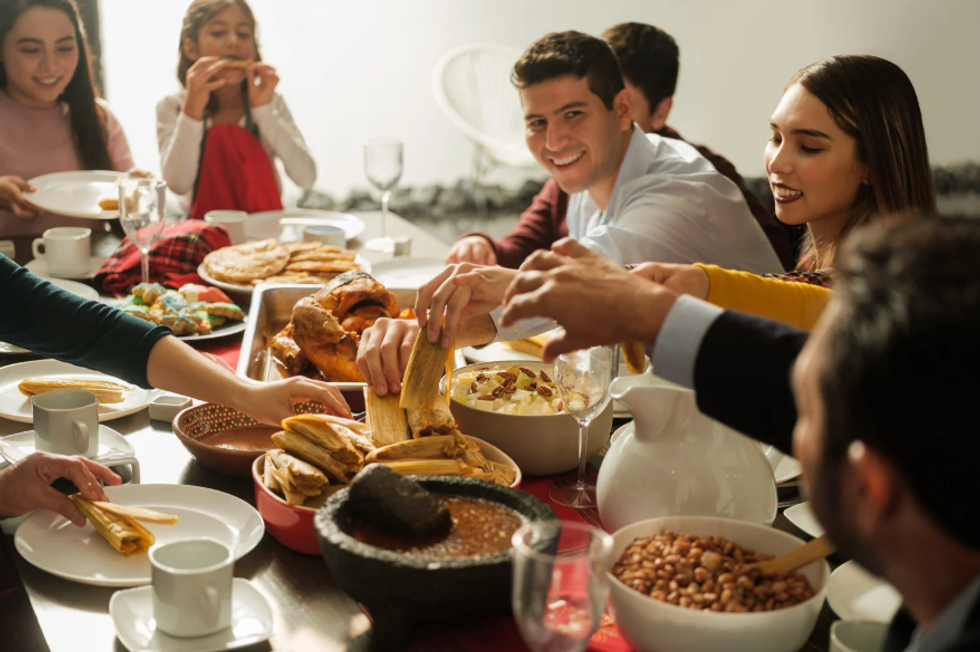
carmen san diego, meal planning, easy meal planning, easy recipes, leftovers, food, dinner, recipes, simple recipes, bulk cooking A Mexican family enjoying dinner Photo credit: Canva

It is a luxury to have access to so many different culinary delights, but if what we’re really craving is a bit more peace of mind, maybe we could opt to simplify things a bit.