upworthy
Add Upworthy to your Google News feed.
Google News Button
Family

This innocent question we ask boys is putting more pressure on them than we realize

When it's always the first question asked, the implication is clear.
This innocent question we ask boys is putting more pressure on them than we realize


Studies show that having daughters makes men more sympathetic to women's issues.

And while it would be nice if men did not need a genetic investment in a female person in order to gain this perspective, lately I've had sympathy for those newly woke dads. My two sons have caused something similar to happen to me. I've begun to glimpse the world through the eyes of a young male. And among the things I'm finding here in boyland are the same obnoxious gender norms that rankled when I was a girl.

Of course, one notices norms the most when they don't fit. If my tween sons were happily boy-ing away at boy things, neither they nor I would notice that they were hemmed in.

But oh boy, are they not doing that.

In fact, if I showed you a list of my sons' collective interests and you had to guess their gender, you'd waver a bit, but then choose girl.

Baking, reading, drawing, holidays, films, volleyball, cute mammals, video games, babies and toddlers, reading, travel, writing letters.

I imagine many of you are thinking at this point: That's awesome that your boys are interested in those things!

There's more. One loves comics and graphic novels but gravitates to stories with strong female protagonists, like Ms. Marvel and The Unbeatable Squirrel Girl.

Cool! I love it.

And sports. They are thoroughly bored by team sports. They don't play them. They won't watch them. They will up- or down-arrow through any number of sporting events on TV to get to a dance contest or to watch competitive baking.

So? Nothing wrong with that.

Those are the kinds of things all my progressive friends say.

But it's often not the message my sons themselves hear from the other adults in their lives, their classmates, and the media.

For example, the first get-to-know-you question they are inevitably asked by well-meaning grown-ups is, "So, do you play sports?" When they say, "No, not really," the adult usually continues brightly, "Oh, so what do you like to do, then?"

No one explicitly says it's bad for a boy not to play sports. But when it's always the first question asked, the implication is clear: playing sports is normal; therefore, not playing them is not.

The truth is that one of them does play a sport. He figure skates, as does my daughter. When people find out that she skates, they beam at her, as if she suddenly has possession of a few rays of Olympic glory. In the days before my son stopped telling people that he ice skates, most of them hesitated and then said, "Oh, so you are planning to play hockey?"

But it's not just what people say. It's all those pesky, unwritten rules. When he was in second grade, my younger son liked the Nancy Drew and the Clue Crew series. But he refused to check any out of the school library. He explained: "Girls can read boy books, but boys can't read girl books. Girls can wear boy colors or girl colors, but boys can only wear boy colors. Why is that, Mom?"

I didn't have an answer.

An obvious starting point — and the one that we have the most control over — is to change the way we speak to the boys in our lives.

As Andrew Reiner suggests in a spot-on essay, we should engage boys in analytical, emotion-focused conversations, just like we do with girls. In "How to Talk to Little Girls," Lisa Bloom offers alternatives to the appearance-focused comments so often directed at young girls: asking a girl what she's reading or about current events or what she would like to see changed in the world. I could copy-paste Bloom's list and slap a different title on it: "How to Ask Boys About Something Besides Sports."

And with a few more built-in nudges, we might expand the narrow world of boyhood more quickly. Boy Scouts could offer badges for developing skills in child care, teamwork, and journaling. Girl-dominated activities like art, dance, gymnastics, and figure skating could be made more welcoming to boys, with increased outreach and retention efforts. My son could write his own essay about trying to fit in to the nearly all-girl world of figure skating, including the times he has had to change clothes in a toilet stall at skating events because there were no locker rooms available for boys.

I used to think that the concept of gender — of "girl things" and "boy things" — was what was holding us back.

Now I see it differently.

The interdependent yin and yang of gender is a fundamental part of who we are, individually and collectively. We need people who like to fix cars and people who like to fix dinner. We need people who are willing and able to fight if needed and people who are exquisitely tuned into a baby's needs. But for millennia, we have forced these traits to align with biological sex, causing countless individuals to be dissatisfied and diminished. For the most part, we've recognized this with girls. But we have a long way to go when it comes to boys. As Gloria Steinem observed, "We've begun to raise daughters more like sons … but few have the courage to raise our sons more like our daughters."

I acknowledge that young boys feeling pressured to be sports fans is not our country's biggest problem related to gender.

Transgender individuals still confront discrimination and violence. The #MeToo movement has revealed to anyone who didn't already know it that girls and women can't go about their everyday lives without bumping into male sexual aggression.

But if our culture shifts to wholeheartedly embrace the whole spectrum of unboyishness, it may play some small role in addressing these other issues, too. Male culture will be redefined, enriched, and expanded, diluting the toxic masculinity that is at the root of most of our gender-related problems.

Boys and girls alike will be able to decide if they would rather be made up of snips and snails, sugar and spice, or a customized mix. And my future grandsons, unlike my sons, won't think twice about wearing pink or reading about a girl detective at school.

This story originally appeared on Motherwell and is reprinted here with permission.


This article originally appeared six years ago.
Joy

People from around the globe share 15 signs that someone is obviously an American

"An Italian told me that Americans walk confidently in the wrong direction."

tourists, american tourists, us tourists, vacation, american style

Americans on vacation.

One of the fun things about traveling to different countries is that you not only get to learn about other cultures, but you also learn some things about your own. Americans who travel abroad often learn that people around the world appreciate them for being open, friendly, and good at spreading hope and optimism.

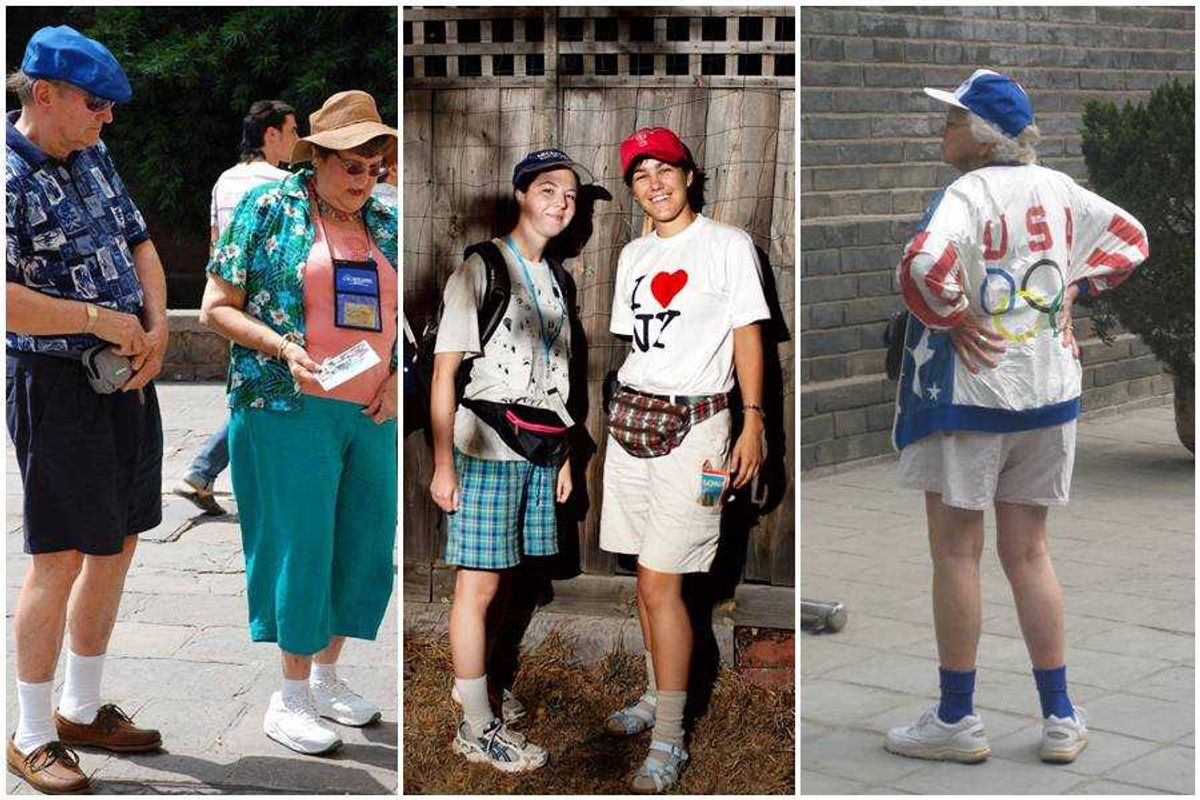
On the other hand, people in other countries can often tell when an American is coming from a mile away because they speak loudly, whether indoors or outdoors. Americans also have a very peculiar body language and are known to lean on things when they have to stand for an extended period.


A Reddit user posed a question in the AskReddit subforum to learn more about how Americans stand out abroad: What's an "obvious" sign that someone is American? The post received more than 35,000 responses, with an overwhelming number of commenters noting that Americans are all smiles and love to make small talk, something most people appreciate.

According to Redditors, here are 15 "obvious" signs that someone is American:

1. They have a unique confidence

"An Italian told me that Americans walk confidently in the wrong direction."

"Been taught to walk fast, and look worried.. People think you know what you're doing."

2. They're friendly

"I worked as a cashier in a tourist place in Paris, I always recognised Americans because they were kinda friendly to me and they always left tips."

"I guess there are worse things than friendly and generous."


3. Time = distance

"If someone asks how far away something is, an American will tell how you long it takes to get there as opposed to a physical distance."

"It actually pisses off some Americans to give a distance in miles, unless they're calculating gas mileage. In some places, you have to give with and without traffic options. I think it's more valuable info in time than in distance."

4. Grinning at strangers

"The gentle grins you give to strangers if you make eye contact with them as you pass by, at least in the Midwest. was not well received in Germany."

"I dated a European man here in the US. When we walked together, every time I made eye contact with someone on our path I would smile at them, and they would always smile back. Boyfriend was so confused at all these strangers smiling at me. Kept asking if I knew all these people. It was hilarious."


5. They like personal space

"How much personal space they give themselves. Americans like at LEAST an arm's length."

"We're conditioned to fill spaces evenly. I noticed when i worked delivery, spending lots of quality time on elevators that for every new person that enters, everybody shuffles to even things out. Similar thing plays out in social gatherings and bars. Not sure if that's universal or not, but I find it interesting. I think the size of our personal bubbles is because our spaces are generally much larger because we've got the space (heh) to build bigger buildings, sidewalks, roads etc. Might also explain why we're louder. Used to filling larger spaces with volume."

Body language expert Joe Navarro says that among Americans, the social zone for acquaintances and casual interactions is four to 12 feet, while family and close friends stand 1.5 to four feet apart. The intimate zone, for those closest to us, ranges from the skin to about 18 inches.


6. They lean

"According to the CIA, when training to be a spy, you have to unlearn how to lean. Americans tend to lean on things when standing still."

All of this is true, according to Jonna Mendez, the former chief of disguise at the CIA, who has shared some of her tips and tricks for making Americans seem more European. "So we would de-Americanize you," Mendez told NPR. "They think that we are slouchy, a little sloppy. And they think that they can almost see that in our demeanor on the street because they stand up straight. They don't lean on things."


7. They don't have an indoor voice

"I've lived in America for 25 years, and it still irritates me that instead of lowering their voices in restaurants so everyone can hear, Americans just scream over each other and make their restaurants as loud as clubs."

"For some reason, my otherwise smart and wonderful American friends will speak in the same volume, diction, and speed regardless of any outside factor unless specifically asked."

8. Dessert for breakfast

"In my homestay in London, I was told that I was 'so American' for enjoying a piece of cake for breakfast (not frosted cake, but like a nuts and dried fruit spiced coffeecake kind of thing). Apparently, that's exclusively for like a 4 pm snack, and breakfast is more of a savory meal."

"A lot of American breakfast items in my mind are desserts (pancakes, muffins, waffles, etc.). It doesn't mean I won't eat them, but it's kinda weird to do so."

9. They wear their clothes differently

"A British man once told me he knew I was American because I was wearing a baseball cap backwards."

"An Italian told me they could tell I was American because I wore my sunglasses on the top of my head when I wasn't using them."


10. Exposed soles

"While visiting Turkey, I was told that I looked American because I was sitting with one leg across the other, and the bottom of my shoe was exposed. Apparently, it's rude idk."

"In a lot of places outside of the US, showing the bottom of your shoe is rude."

11. Tactical gear

"Tactical sunglasses."

"I'm in the US, and virtually anything marketed towards men has the word 'tactical' in front of it."

12. They love small talk

"I'm from California (though a smallish town), and we wave to neighbors on our road, even if we haven't met, and start conversations in the grocery line with people if the opportunity presents itself. Also, smiling and saying hello to someone you happen to walk by and make eye contact with is quite normal. We are a social species, it would be so weird not to be friendly, even to strangers, for me, and I'm not even that social of a person."

"What really gets me to it is not that Americans do small talk constantly, but the fact that they are so good and fast at it. I mean, I say 'yeah, it's hot,' and they reply with some interesting fact or make a connection to their hometown. I feel less of myself after this. They must have some small talk class in school or some sh*t."

13. They like to point

"I've always observed my US friends like to point at stuff while walking and say what it is…. We were out walking around Amsterdam recently and they were like 'hey look it's a smoke shop'…. 'Oh look a sex shop'…. 'Oh hey, it's a prostitute' …. 'Look at the canal'…. 'Wow it's another prostitute'….. 'another canal' etc etc. It was like watching Netflix with Audio Descriptions turned on."

"You know that little voice inside your head, your internal monologue? Americans seem to monologue their thoughts."


14. Optimism and enthusiasm

"Dunno in all context, but Americans in Europe stand out with their ceaseless optimism and enthusiasm."

"I'm reminded a lot of Ted Lasso. Everyone I know (all Americans) loves the show. I wonder what kind of European fan base it has."

"Americans are so positive and have such a thirst for life. It sickens me."

15. They eat while walking

"When I lived in Europe, people said only Americans eat while walking. I'd be eating a bagel or something on the way to work or class, and multiple people asked if I was American lol."

"Jay Leno said on Top Gear, I think it was, that Americans are also the only people who eat while driving. I don't do this, but I constantly see people who do, haha, especially in LA, where people spend a lot of time in their cars."

'90s, '90s tv shows, television, daytime tv, forgotten tv shows
Photo credit: Canva, Ocskaymark from Getty Images (main image), anlomaja (text box)

These mostly forgotten '90s TV shows comforted kids during sick days.

If you were home sick from school in the '90s, you likely didn't have much to do. Your friends weren't around, and you couldn't risk getting them sick anyway. And if you felt well enough to play video games or roam outside, your parents probably argued you had enough energy to sit through science class. That left one obvious option: sprawl out under the covers, thermometer in your mouth, belly full of crackers and Sprite, and watch whatever TV shows happened to be on.

This daytime programming might have felt like transmissions from an alien world. After all, you typically weren't even home to watch the game shows, soap operas, and talk shows that filled morning and early afternoon TV. Looking back now, many '90s kids feel a sparkly nostalgia for this retro entertainment, much of which has faded into the pop-culture rearview mirror, if not been forgotten entirely.


Here are five series that make adults of a certain age look back fondly on their "sick at home" days. (Disclaimer: We're not including The Price Is Right. It's the ultimate example—too obvious.)

- YouTube www.youtube.com

Judge Judy

Reality court shows were a big thing in the '90s, and Judge Judy remains the most iconic, having run from 1996 through 2021.

Its namesake star was Judith Sheindlin, whom New York Magazine once described as a "tart-tongued, bouffant-headed fury." She presided over small-claims disputes with a satisfyingly no-BS style. The show became a ratings smash and one of the highest-rated programs in syndication, and it wasn't only kids home with the flu tuning in. After Judge Judy ended its run, Sheindlin launched another courtroom series, Judy Justice, on Amazon's streaming platform Freevee.

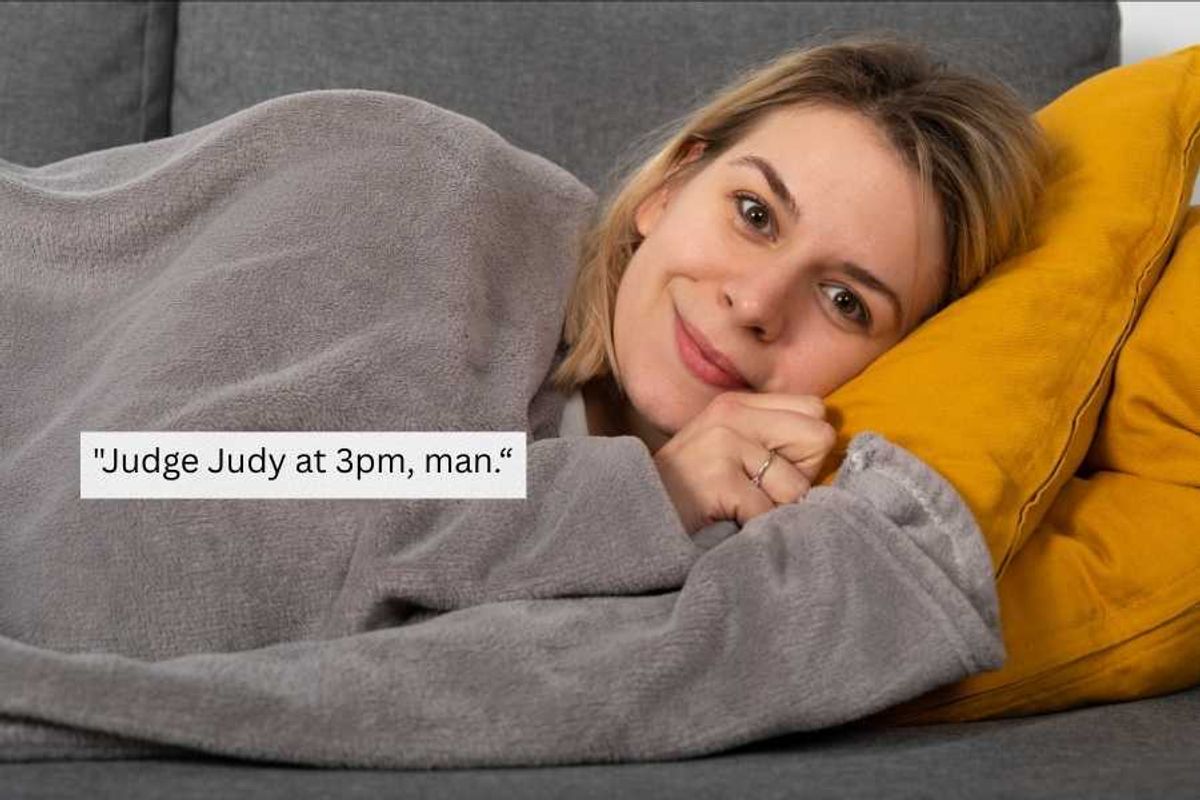
"Judge Judy at 3pm, man," one person wrote in a Reddit thread about sick-day TV. "That was the s—."

- YouTube www.youtube.com

Ricki Lake

There were so many daytime talk shows in the '90s: Maury, The Jerry Springer Show, and the long-running Oprah Winfrey Show. Younger viewers today, however, may be less familiar with Ricki Lake, which aired from 1993 to 2004.

"The conflicts of real people are what people want to watch," Lake told The Los Angeles Times, explaining her vision for the show, which tackled topics like relationship turmoil and family drama, often with a more youthful slant. In 1995, Time wrote that
"[h]er impact on TV has been enormous."

Lake, who has also worked as an actor, later went on to host another talk show, the short-lived The Ricki Lake Show (2012–2013), and appeared on several reality TV series, including The Masked Singer and Dancing With the Stars.

"Ricki Lake because 1. That was my mom's favorite and 2. That intro song f---ng hits," one Redditor recalled. Others added, "The results are in!" and "I literally can't choose over Jenny Jones, Ricki Lake, Maury or Jerry."

- YouTube www.youtube.com

Allegra's Window

Nickelodeon was a staple for many '90s kids, airing innovative cartoons alongside goofy but endearing live-action shows. Not everyone remembers the short-lived Allegra's Window, however, which ran from 1994 to 1996 and blended live actors with puppets and animation in the style of Sesame Street.

There's a real sweetness and innocence to the show, which follows a little-girl puppet named Allegra as she navigates daily life. (Fun fact: One of the show's co-creators was Jim Jinkins, who later went on to create the beloved Nickelodeon animated series Doug.)

"Holy s---! I forgot all about this," one Redditor wrote. "I remember this being on whenever I would stay home sick from school…"

- YouTube www.youtube.com

Wings

It's a strange sitcom setting: Wings, which ran from 1990 to 1997 on NBC, starred Tim Daly and Steven Weber as pilots operating a one-plane airline in Nantucket.

As Variety reported in 1995, Wings truly took off through reruns: "Instead of dropping off in the ratings during their regular primetime run on NBC, the original episodes of Wings actually took flight in the Nielsens—the show went from being a modest success to a genuine winner, a vital cog in NBC's powerhouse Thursday sitcom block."

If you were home sick in the '90s, you may have caught some of those reruns yourself.

"Price is Right in the morning," one Redditor wrote. "Wings on the small tv while eating ramen or soup at the kitchen table. Then later Maury while laying on the couch."

- YouTube www.youtube.com

Classic Concentration

Concentration, a game show spun off from the classic card memory game, enjoyed an impressively long run from 1958 to 1991, with various hosts passing the torch over the years. The last in line was Alex Trebek, who helmed a revival titled Classic Concentration from 1987 to 1991. (Wild fact: He did this while simultaneously hosting Jeopardy! and, briefly, To Tell the Truth.) Like the original, contestants solved puzzles by translating visual clues into words—a perfect setup for moments of minimal brain power.

"Classic Concentration," one Redditor added. "Alex Trebek's other game show gig. I loved it! Used to make my own version of the board and have my cousin as my only contestant."

- YouTube www.youtube.com

names, name tag, beautiful names, beautiful name, pretty names
Image via Milan Radulovic's Image

A list of the most beautiful names.

There is a lot of pressure to name a baby the absolute *perfect* name. And for many, the goal is to come up with a seriously beautiful name that is unique-sounding—a name that will stick with you forever.

Looking through baby names lists can help. But to get more ideas on beautiful names, a person posed the question on Reddit: "What’s the most beautiful first name you’ve ever heard?"


The crowd-sourced name-inspo led to a detailed and distinctive list of beautiful baby names, with many noting that the majority were for baby girls. "I love that 90% of these are women's names, meanwhile men are like this is my boy Daryl," one commenter joked.

These are 36 of the most beautiful names people can think of:

"I saw a best guy employers name tag: Orion." - spaceshiplazer

"I used to know a woman called Isis, thought it was beautiful to be named after a goddess, now its just unfortunate." - ShireNorse

"I knew two Muslim sisters back in the 4th grade. One was Neda and her sister was Nezerine. I have always thought Nezerine was one of the prettiest names I have ever heard." - a-passing-crustacean

"When I was a kid I was obsessed with 'Swan Princess' and I thought the name Odette was beautiful lol idk if it’s even real." - messyowl


odette, name odette, swan princess, swan princess gif, odette gif Princess Odette Girl GIF by The Swan Princess Giphy

"My sister's childhood friend's grandfather's name was Diogenes. He was a very nice old bloke too, so maybe I just associate the name with a friendly face. Nonetheless, it's both a strong name, and a beautiful name." - MrSlipperyFist

"Met a guy who said his name was Levi. Eventually I noticed he had a tattoo of a sea dragon. I asked him about it, and he told me it was for his name, because Levi was short for Leviathan. Coolest name ever." - Weird-is-norm

"My therapist's name is Althea, I think it’s so lovely." - FroggySpirit

"Vivienne - I find the French spelling the prettiest, it just sounds so melodic." - Looktothecookiee

"Genevieve in French pronunciation, like Genevieve Bujold (actress) is a fantastic name." - FlamingoRare8449

"I knew a woman named Eleanora which sounds so beautiful when pronounced by Italians." - CursingWhileCrafting

"Tbh most of the flower names like: Dahlia, Iris, Rose, Jasmine, Lily, Ivy, Alyssa." - frizzyno

rose, rose name, rose gif, pretty rose, roses Rose GIF Giphy

"Violet." - garythegyarados

"Met an Italian girl named Alessandra. That was 30 years ago and it's still in my brain as the most beautiful name I've ever heard." - Mothman

"Isildur." - Few_Image7673

"Aurelia." - worstnameIeverheard

"Evelyn is so pretty to me." - 1mALittl3N0tStraight

- YouTube www.youtube.com

"'Derry Girls' made me absolutely love Orla." - sarathev

"Noelle. 'Her name is Noelle I have a dream about her she rings my bell'." - Special-Strategy7225

"'Sailor Moon' made me fall in love with Serena. I also really like Celeste, Aria and Evangeline (no one but me seems to appreciate the last one lol). They were on my short list of baby names but I went with another fav." - endoftheworldvibe

sailor moon, sailor moon gif, sailor moon name, sailor moon names, sailor moon anime sailor moon GIF Giphy

"The Māori name Anahera." - lizzietnz

"Seraphina. Heard it at coffee shop and it stopped me dead. Sounds like angels and fire rolled into one." - Twisted_Metalx

"Leilani was always pretty to me." - MathTutorAndCook

"There are so many, but I’ve always loved ‘Aurora’ ......it sounds magical and brings to mind the dawn and the northern lights." - Special_You_7103

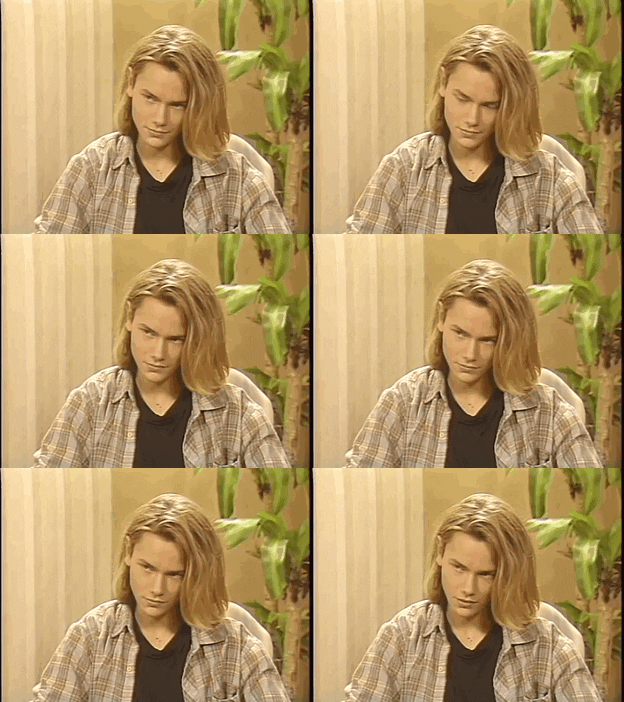
"River Phoenix most beautiful name I heard." - Mona_Mour__

river phoenix, river phoenix, gif, river phoenix name, river, river name river phoenix 80s GIF Giphy

"Adelaide, my Mama's name." - Cantretiresoonenough

"Clementine." - iamnotasheep

"Lydia. I just love it for some reason." - Beautifulone_2


This article originally appeared last year

robert frost, poet robert frost, robert frost poem, robert frost poems, writer robert frost
Images via Wikipedia

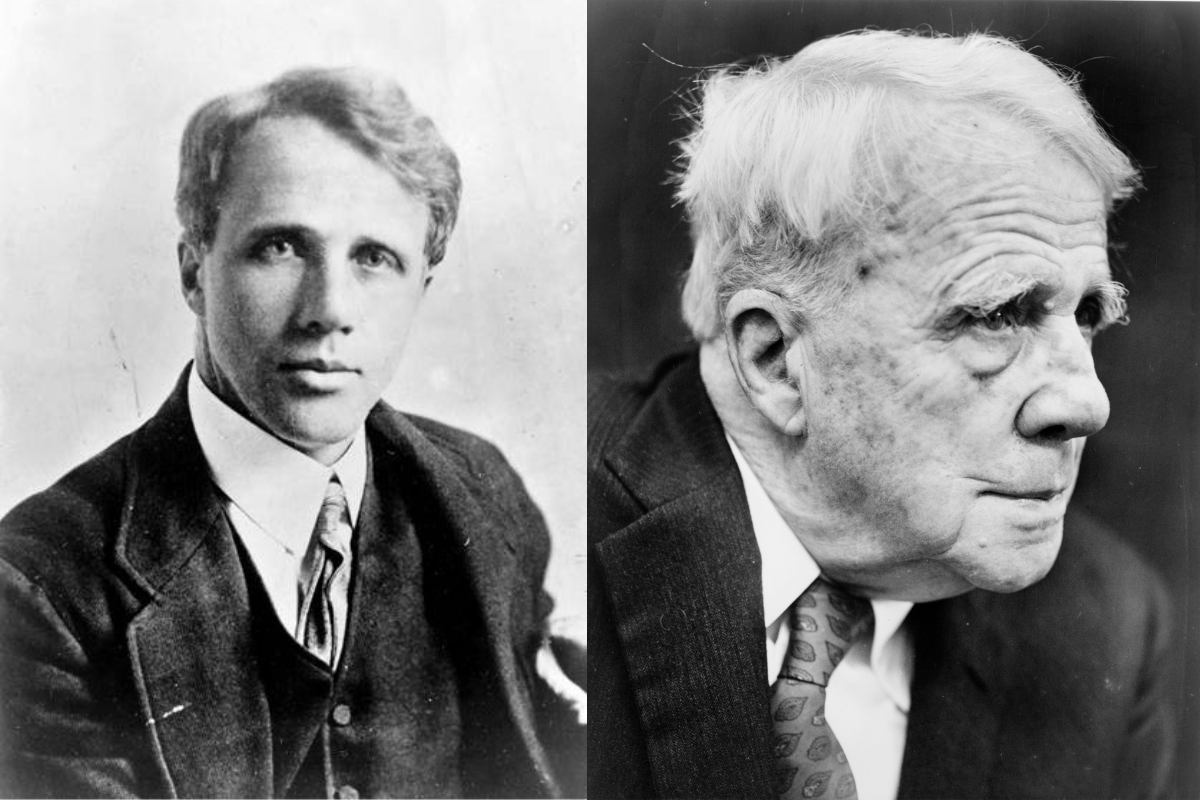
American poet Robert Frost as a young man in 1910 and again in 1949.

Poet Robert Frost created inspiring poems that are beloved around the world. Frost was known for his simple yet deep style of poetry, and, although he didn't publish his first book until he was 40, he went on to earn four Pulitzer Prizes.

He created a body of work that continues to touch people. Yet, like many great artists, Frost struggled with his mental health throughout his life. (Frost was born in 1874 and died in 1963.) William & Mary English Professor and Frost biographer Henry Hart found that many of Frost's relatives struggled with schizophrenia as well as depression.


"Throughout his life, he struggled to fit in. His education was irregular, routinely disrupted when Frost dropped out after suffering attacks of anxiety and depression that expressed themselves in various physical ailments," notes the National Endowment for the Humanities (NEH).

- YouTube www.youtube.com

Frost experienced many hardships during his life, beginning at a young age. His father William Prescott Frost, Jr., died when he was just 11 years old. His sister Jeanie would later suffer from mental illness, and died in a mental hospital.

Frost would go on to marry his high school girlfriend, Elinor White, in 1895. The couple had six children, a blessing that came with loads of tragedy.

"Four of Frost’s six children died before he did, including Carol, the son who committed suicide. Frost’s daughter Irma suffered mental problems that required hospitalization, and Elinor battled anxiety, too. She died of heart failure in 1938," according to the NEH. "Frost’s own bouts of depression brought physical and mental anguish. 'Cast your eye back over my family luck, and perhaps you will wonder if I haven’t had pretty near enough,' he lamented at one point."

- YouTube www.youtube.com

His wife Elinor was diagnosed with breast cancer in 1937, and died in 1938 from heart disease. "She had been the unspoken half of everything I ever wrote," Frost said. He would go on to live 26 more years without her.

Through these challenges, Frost developed resilience and perseverance. One of his most famous quotes describes his advice on how he pushed through:

"In three words I can sum up everything I've learned about life: it goes on."

The quote is reported to come from a September 1954 interview with journalist Ray Josephs for This Week Magazine. During the interview, Josephs asks Frost, "In all your years and all your travels, what do you think is the most important thing you’ve learned about life?"

- YouTube www.youtube.com

From there, Frost shared his wise insights.

"He paused a moment, then with the twinkle sparkling under those brambly eyebrows he replied: 'In three words, I can sum up everything I’ve learned about life. It goes on. In all the confusions of today, with all our troubles . . . with politicians and people slinging the word fear around, all of us become discouraged . . . tempted to say this is the end, the finish. But life — it goes on. It always has. It always will. Don’t forget that.'"

Frost died at age 88 in 1963 and was buried in Bennington, Vermont, next to his wife Elinor. Honest about life's struggles to the end, Frost's gravestone reads: "I had a lover's quarrel with the world."

introduction, meeting people, coworkers, red-haired woman, man in sweatshirt

A woman introducing herself to coworkers.

Back in the days of cavemen, if a stranger wandered into your camp claiming they could make fire, you'd probably be skeptical at first. Your first reaction would be to assess whether this new person was trustworthy or posed a danger to the tribe. Then, once you realized they weren't dangerous, you could try to suss out whether they were actually good at making fire.

Once the newcomer proved trustworthy and competent, you'd probably strike a deal, trading some bearskin for a roaring fire.


These evolutionary tendencies to assess trustworthiness first and competence second are among the most practical findings from Harvard University's research on first impressions. In fact, Harvard's Program on Negotiation found that warmth and competence account for roughly 80% of our judgements of others.

introduction, meeting people, coworkers, handshake, glasses A woman meeting her new coworkers.via Canva/Photos

Therefore, if you want to make a great first impression, whether in a job interview, on a blind date, or on a retail floor, it's essential to communicate warmth and competence.

"If someone you're trying to influence doesn't trust you, you're not going to get very far; in fact, you might even elicit suspicion because you come across as manipulative," Amy Cuddy, a professor at Harvard Business School, told Business Insider. "A warm, trustworthy person who is also strong elicits admiration, but only after you've established trust does your strength become a gift rather than a threat."

How to communicate warmth and competence

Step 1: Communicate warmth

Cuddy suggests that when you meet new people, you approach them with calm warmth. Avoid appearing overly eager, and use a reassuring tone that signals sincerity.

"Aim for a tone that suggests that you're leveling with people—that you're sharing the straight scoop, with no pretense or emotional adornment," Cuddy writes. "In doing so, you signal that you trust those you're talking with to handle things the right way."

You can also create a sense of warmth by nodding as they speak and maintaining an open posture. At the beginning of the conversation, sharing a quick personal anecdote can help build rapport.

introduction, meeting people, coworkers, handshake, smile A man and woman meeting for the first time.via Canva/Photos

Step 2: Communicate competence

When you're communicating competence to a new acquaintance, they don't have your resume in hand or references from your past relationships. One of the most effective ways to project competence, then, is through your posture.

"Stand up straight. It is hard to overstate the importance of good posture in projecting authority and an intention to be taken seriously," Cuddy writes. "As Maya Angelou wrote, 'Stand up straight and realize who you are, that you tower over your circumstances.'"

Cuddy adds that good posture communicates strength and competence without sacrificing warmth: "Standing tall is an especially good way to project strength because it doesn't interfere with warmth in the way that other signals of strength—cutting gestures, a furrowed brow, an elevated chin—often do."

The caveman analogy offers a useful way to think about meeting new people. You have to earn their trust before you can help them build a fire. While this strategy may feel a bit awkward at first, Cuddy believes that persistence pays off.

"The strategies we suggest may seem awkward at first, but they will soon create a positive feedback loop," she writes.