upworthy
Add Upworthy to your Google News feed.
Google News Button
Joy

A man found a mysterious egg and incubated it. 28 days later, it hatched and changed his life.

It's like something straight out of a Pixar movie.

duck egg on the ground, duck egg in incubator, duckling just hatched, humanity, kindness, ducks, animals, wildlife, conservation
Courtesy of Riyadh Khalaf/Instagram (used with permission)

When Riyadh found an egg, he had no idea how much it would change his life.

Some love stories are so out of the ordinary that they are worth sharing with the world. And few love stories are as extraordinary as the one between a man and the sweet creature that hatched from a mysterious egg he found and incubated.

The true tale of Riyadh and Spike's starts like the opening to a children's book: "One day, a man was walking along and spotted a lone egg where an egg should not have been…" And between that beginning and the story's mostly sweet ending is a beautiful journey of curiosity, care, and connection that captivated people all over the world.

Irish author, broadcaster, and activist Riyadh Khalaf was out walking in Devon, England, when he came upon an egg.

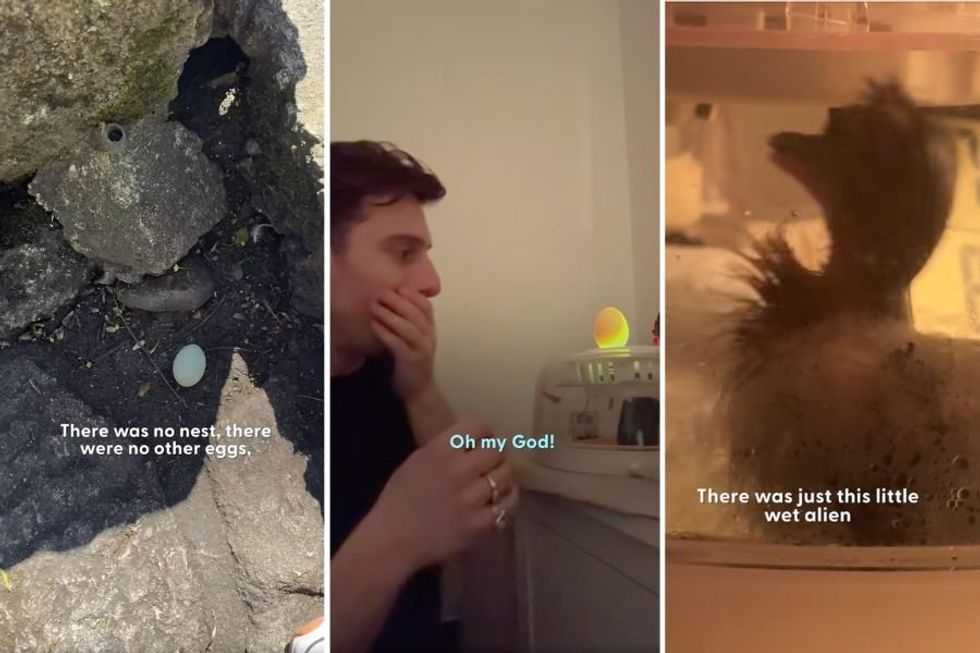
"We just found what we think is a duck egg," Riyadh says in a video showing the milky white egg sitting in a pile of dirt. "Just sitting here on its own. No nest. No other eggs."


duck egg on the ground, duck egg in incubator, duckling just hatched, humanity, kindness, ducks, animals, wildlife, conservation What do you do when you find an egg where it doesn't belong? Photo credit: Canva

Thinking there was no way it was going to survive on its own, Riyadh put the egg in a paper cup cushioned with a napkin and took it home to London, which entailed two car rides, a hotel stay, a train ride, a tube ride, and a bus ride. He said he used to breed chickens and pigeons, so he had some experience with birds. Knowing the egg could survive for a while in a dormant state, he ordered an incubator on Amazon. An incubator keeps eggs at a particular temperature and humidity range in order to allow them to continue growing. They mimic the warmth the egg receives from the mother bird sitting on it in the nest. Without that warmth, the fetus inside the egg will die.

With the egg tucked safely inside the warm incubator, the journey to see if the egg was viable began.


Even though it was "just an egg," Riyadh quickly became attached, and once it showed signs of life he took on the role of "duck dad."

Every day, the egg showed a drastic change in development. The incubator was working, and Riyadh's giddy joy at each new discovery—movement, a discernible eye, a beak outline—was palpable. He devoured information on ducks to learn as much as he could about the baby he was (hopefully) about to hatch and care for.

Finally, 28 days later, the shell of the egg began to crack. The baby was coming!


"I could see this very clear outline of the most gorgeous little round bill," Riyadh said—confirmation that it was, indeed, a duck as he had suspected. But duckling hatching is a process, and one they have to do it on their own. Ducklings instinctively know to turn the egg as it hatches so that the umbilical cord detaches, and the whole process can take up to 48 hours. Riyadh watched and monitored until he finally fell asleep, but at 4:51am, 29 hours after the egg had started to hatch, he awakened to the sound of tweets.

"There was just this little wet alien staring back at me," he said. "It was love at first sight."

Riyadh named his rescue duckling Spike. Once Spike was ready to leave the incubator, he moved into "Duckingham Palace," a setup with all of the things he would need to grow into a healthy, self-sufficient duck—including things that contribute to his mental health. (Apparently, ducklings can die from poor mental health, which can happen when they don't have other ducks to interact with—who knew?)

"My son shall not only survive, but he shall thrive!" declared the proud papa.


Riyadh knew it would be impossible for Spike not to imprint on him somewhat, but he didn't want him to see him as his mother. Riyadh set up mirrors so that Spike could see another duckling (even though it was just himself) and used a surrogate stuffed duck to teach him how to do things like eat food with his beak.

He used a duck whistle and hid his face from Spike while feeding him, and he played duck sounds on his computer to accustom Spike to the sounds of his species. He knew that Spike could not stay and live with him forever, so he'd need to learn how to become a normal, everyday duck.

"It's just such a fulfilling process to watch a small being learn," said Riyadh.

As Spike grew, Riyadh took him to the park to get him accustomed to the outdoors and gave him opportunities to swim in a small bath. He learned to forage and do all the things a duck needs to do. Throughout, Riyadh made sure that Spike was getting the proper balanced nutrition he needed as well.

In the wild, most ducks eat plants, small insects, seeds, grains, and fruits. Some species of ducks will even eat small fish. Contrary to popular belief, bread is not good for ducks. It's not inherently harmful, but it's basically candy to them — it has little to none of the nutrients their bodies need. So if they fill up on bread, they may eat less of the foods they really need. Riyadh had a lot to learn!

Check this out:


After 89 days, the day finally came for Spike to leave Riyadh's care and be integrated into a community of his kind "to learn how to properly be a duck."

A rehabilitation center welcomed him in and he joined a flock in an open-air facility where he would be able to choose whether to stay or to leave once he became accustomed to flying. Within a few weeks of being at the rehabilitation center, his signature mallard colors developed, marking his transition from adolescence. Spike has been thriving with his flock, and Riyadh was even able to share video of his first flight.

This is where "And they all lived happily ever after" would be a fitting end to the story, but unfortunately, Spike and his fowl friends are living in trying times. The rehabilitation center was notified by the U.K. government in December of 2024 that the duck flock needed to be kept indoors for the time being to protect them from a bird flu outbreak and keep it from spreading.

Building an entire building for a flock of ducks is not a simple or cheap task, so Riyadh called on his community of "daunties" and "duncles" who had been following Spike's story to help with a fundraiser to build a "Duckingham Palace" for the whole flock. Riyadh's followers quickly raised over £11,000, which made a huge difference for the center's owners to be able to protect Spike and his friends.

All in all, Riyadh and Spike's story is a testament to what can happen when people genuinely care. If Riyadh had left that egg where it was, it may not have made it. If Spike hadn't survived and been moved to the rehab center, the ducks there would be in greater danger of the bird flu due to the costs of building an indoor shelter for them. Despite the ongoing bird flu threat, the story really does have a happy ending.

In an update from June 2025, Riyadh shares that Spike is currently living with Leanne Clarke, who built a rescue shelter called "The Quack Shack" in her home. Riyadh's story and fundraising made much of the construction possible. Spike is starting to remember Riyadh less and less, which is bittersweet, but means that Spike is thriving in his new, safe, domesticated life.

Thanks to Riyadh for sharing Spike's journey with us. (You can follow Riyadh on Instagram here.)

This article originally appeared in January. It has been updated.

Planet

Our favorite giveaway is back. Enter to win a free, fun date! 🌊 💗

It's super easy, no purchase or donation necessary, and you help our oceans! That's what we call a win-win-win. Enter here.

Our favorite giveaway is back. Enter to win a free, fun date! 🌊 💗
True

Our love for the ocean runs deep. Does yours? Enter here!

This Valentine’s Day, we're bringing back our favorite giveaway with Ocean Wise. You have the chance to win the ultimate ocean-friendly date. Our recommendation? Celebrate love for all your people this Valentine's Day! Treat your mom friends to a relaxing spa trip, take your best friend to an incredible concert, or enjoy a beach adventure with your sibling! Whether you're savoring a romantic seafood dinner or enjoying a movie night in, your next date could be on us!

Here’s how to enter:


  • Go to upworthy.com/oceandate and complete the quick form for a chance to win - it’s as easy as that.
  • P.S. If you follow @oceanwise or donate after entering, you’ll get extra entries!

Here are the incredible dates:

1. Give mom some relaxation

She’s up before the sun and still going at bedtime. She’s the calendar keeper, the lunch packer, the one who remembers everything so no one else has to. Moms are always creating magic for us. This Valentine’s Day, we’re all in for her. Win an eco-friendly spa day near you, plus a stash of All In snack bars—because she deserves a treat that’s as real as she is. Good for her, kinder to the ocean. That’s the kind of love we can all get behind.


Special thanks to our friends at All In who are all in on helping moms!

2. Jump in the ocean, together

Grab your favorite person and get some much-needed ocean time. Did you know research on “blue spaces” suggests that being near water is linked with better mental health and well-being, including feeling calmer and less stressed? We’ll treat you to a beach adventure like a surfing or sailing class, plus ocean-friendly bags from GOT Bag and blankets from Sand Cloud so your day by the water feels good for you and a little gentler on the ocean too.

Special thanks to our friends at GOT Bag. They make saving the ocean look stylish and fun!

3. Couch potato time

Love nights in as much as you love a date night out? We’ve got you. Have friends over for a movie night or make it a cozy night in with your favorite person. You’ll get a Disney+ and Hulu subscription so you can watch Nat Geo ocean content, plus a curated list of ocean-friendly documentaries and a movie-night basket of snacks. Easy, comfy, and you’ll probably come out of it loving the ocean even more.

4. Dance all day!

Soak up the sun and catch a full weekend of live music at BeachLife Festival in Redondo Beach, May 1–3, 2026, featuring Duran Duran, The Offspring, James Taylor and His All-Star Band, The Chainsmokers, My Morning Jacket, Slightly Stoopid, and Sheryl Crow. The perfect date to bring your favorite person on!

We also love that BeachLife puts real energy into protecting the coastline it’s built on by spotlighting ocean and beach-focused nonprofit partners and hosting community events like beach cleanups.

Date includes two (2) three-day GA tickets. Does not include accommodation, travel, or flights.

5. Chef it up (at home)

Stay in and cook something delicious with someone you love. We’ll hook you up with sustainable seafood ingredients and some additional goodies for a dinner for two, so you can eat well and feel good knowing your meal supports healthier oceans and more responsible fishing.

Giveaway ends 2/15/26 at 11:59pm PT. Winners will be selected at random and contacted via email from the Upworthy. No purchase necessary. Open to residents of the U.S. and specific Canadian provinces that have reached age of majority in their state/province/territory of residence at the time. Please see terms and conditions for specific instructions. Giveaway not affiliated with Instagram. More details at upworthy.com/oceandate

arthur c. brooks, harvard, psychology, happiness research, bucket list

Harvard researcher Arthur C. Brooks studies what leads to human happiness.

We live in a society that prizes ambition, celebrating goal-setting, and hustle culture as praiseworthy vehicles on the road to success. We also live in a society that associates successfully getting whatever our hearts desire with happiness. The formula we internalize from an early age is that desire + ambition + goal-setting + doing what it takes = a successful, happy life.

But as Harvard University happiness researcher Arthur C. Brooks has found, in his studies as well as his own experience, that happiness doesn't follow that formula. "It took me too long to figure this one out," Brooks told podcast host Tim Ferris, explaining why he uses a "reverse bucket list" to live a happier life.


bucket list, wants, desires, goals, detachment Many people make bucket lists of things they want in life. Giphy

Brooks shared that on his birthday, he would always make a list of his desires, ambitions, and things he wanted to accomplish—a bucket list. But when he was 50, he found his bucket list from when he was 40 and had an epiphany: "I looked at that list from when I was 40, and I'd checked everything off that list. And I was less happy at 50 than I was at 40."

As a social scientist, he recognized that he was doing something wrong and analyzed it.

"This is a neurophysiological problem and a psychological problem all rolled into one handy package," he said. "I was making the mistake of thinking that my satisfaction would come from having more. And the truth of the matter is that lasting and stable satisfaction, which doesn't wear off in a minute, comes when you understand that your satisfaction is your haves divided by your wants…You can increase your satisfaction temporarily and inefficiently by having more, or permanently and securely by wanting less."

Brooks concluded that he needed a "reverse bucket list" that would help him "consciously detach" from his worldly wants and desires by simply writing them down and crossing them off.

"I know that these things are going to occur to me as natural goals," Brooks said, citing human evolutionary psychology. "But I do not want to be owned by them. I want to manage them." He discussed moving those desires from the instinctual limbic system to the conscious pre-frontal cortex by examining each one and saying, "Maybe I get it, maybe I don't," but crossing them off as attachments. "And I'm free…it works," he said.

- YouTube www.youtube.com

"When I write them down, I acknowledge that I have the desire," he explained on X. "When I cross them out, I acknowledge that I will not be attached to this goal."

The idea that attachment itself causes unhappiness is a concept found in many spiritual traditions, but it is most closely associated with Buddhism. Mike Brooks, PhD, explains that humans need healthy attachments, such as an attachment to staying alive and attachments to loved ones, to avoid suffering. But many things to which we are attached are not necessarily healthy, either by degree (over-attachment) or by nature (being attached to things that are impermanent).

"We should strive for flexibility in our attachments because the objects of our attachment are inherently in flux," Brooks writes in Psychology Today. "In this way, we suffer unnecessarily when we don't accept their impermanent nature."

What Arthur C. Brooks suggests that we strive to detach ourselves from our wants and desires because the simplest way to solve the 'haves/wants = happiness' formula is to reduce the denominator. The reverse bucket list, in which you cross off desires before you fulfill them, can help free you from attachment and lead to a happier overall existence.

This article originally appeared last year.

NASA; Challenger explosion; Challenger crew; teacher in space; Challenger 40th anniversary

The Challenger crew.

In January 1986, the space shuttle Challenger took off with seven crew members on board, ready to make history. It was a big deal because this space mission wasn't just full of astronauts. Christa McAuliffe, a high school history teacher, was on board the spacecraft after winning a contest for the Teacher in Space Project. This would've made her the first teacher in space, so schools across the country wheeled televisions into their classrooms to allow students to watch history.

Instead, tragedy struck. The shuttle exploded just 73 seconds after takeoff due to "the destruction of the seals that are intended to prevent hot gases from leaking through the joint during the propellant burn of the rocket motor," according to NASA. All seven passengers on the Challenger perished in the explosion, leaving the country in shock.


NASA; Challenger explosion; Challenger crew; teacher in space; Challenger 40th anniversary The Challenger on crawler transportNASA/Wikimedia Commons

January 2026 was the 40th anniversary of the accident, and NewsChannel 5 caught up with one of the teachers who was competing for the seat McAuliffe occupied. Carolyn Dobbins taught at McMurray Middle in Tennessee in 1984 when NASA announced the Teacher in Space Project. Having always wanted to go to space, Dobbins applied for a seat on the shuttle. Over 11,000 teachers applied to be the one who would make history, and to Dobbins' surprise, she was chosen as a semifinalist. "I had no idea that anything like this could ever be part of my life," she said.

The retired teacher explains to the news station that she spent days on her application for space, saying, "An amazing thing happened." She shares about the series of snow days in 1985. "Snow day. Then we had another snow day and another snow day. Those snow days were what I needed! It was basically a mini-book about your beliefs, your desire to go into space, getting to the soul of the person."

NASA; Challenger explosion; Challenger crew; teacher in space; Challenger 40th anniversary The Challenger explosion. Kennedy Space Center/Wikimedia Commons

She admits that some of her students were worried about her going into space if she were to be chosen, but she brushed off their concerns, saying, "'Oh, I'll be back.'" Dobbins was completely confident in the success of the mission and excited to be able to do something she once thought was impossible. After being interviewed by a panel in Washington, D.C., she was sure she would be chosen for the mission. All of the teachers invited to be interviewed were also confident they'd be chosen, according to Dobbins. But only one could go, and the person chosen was 37-year-old mom of two, Christa McAuliffe, a teacher at Concord High School in Concord, New Hampshire.

Dobbins stood in front of her television watching the shuttle take off instead of experiencing it herself. Once the announcer said the magic words, "We have liftoff," the almost astronaut shares that she let out a sigh of relief before saying, "Way to go, Christa." She then turned off the television.

"Within seconds, the phone rang," Dobbins tells NewsChannel 5. "It was a friend. I said, 'Isn't it great? The shuttle has gone!' She said, 'Carolyn, you don't know.' It was the tone. You don't know. I just put the phone down, flipped on the TV. There it was. Already the footage was going of the explosion. That is still such an emotional moment."

NASA; Challenger explosion; Challenger crew; teacher in space; Challenger 40th anniversary Jay Greene in the control room after the Challenger explodesNASA/Wikimedia Commons

Dobbins taught for 53 years before retiring, and while she would've been willing to go on another mission that aimed to put a teacher in space, she's thankful for the life she has been able to live.

Learning

27 English words people have a hard time enunciating properly, even native speakers

"The word I notice people struggle with is 'vulnerable'. Something about that N following an L is tricky."

enunciate, enunciation, english, words hard to say, hard to pronounce
Image via Canva/Povozniuk

English words that are difficult to enunciate.

The English language is hard to master, even for native speakers. With over an estimated one million words in the language, not only are English words hard to memorize—they can be hard to properly pronounce and enunciate. Getting tripped up with pronunciation can make your communication unclear, or worse—make you sound uneducated.

As American English teacher Vanessa explains, many mispronounced words are common and used in daily conversation due to tricky consonants and vowels in English words. But by knowing the proper pronunciation, it can help you become a more confident speaker, which is why she shared 33 words that are hard for English language learners to pronounce, such as "probably," "drawer," and "sixth."


On the subreddit r/words, a person posed the question: "What's a word you've noticed many native English speakers have difficulty enunciating even though the word is used fairly often?"

Turns out, there are a menagerie of words people notoriously stumble over. These are 27 English words that people say are the hardest to enunciate.

- YouTube www.youtube.com

Tricky 'R' words

"The word I notice people struggle with is 'vulnerable'. Something about that N following an L is tricky." - common_grounder

"Rural." - Silent-Database5613

“'Nucular' for nuclear." - throwawayinthe818

"Remuneration v renumeration (first one is correct)." - RonanH69

"February. It sounds like you're pronouncing it like it's spelled Febuary. But it's spelled February." - SDF5-0, ShadedSpaces

"Mirror. Some people pronounce it 'meer'." - weinthenolababy, diversalarums

"Anthropomorphize is a word I have to use semi-frequently with limited success each attempt." - ohn_the_quain

"I can’t say the phrase 'rear wheel' without considerable effort." - ohn_the_quain

"Eraser (erasure, but they're talking about the pink rubber thing)." - evlmgs

- YouTube www.youtube.com

Multiple syllables

"Exacerbated vs exasperated." - SNAFU-lophagus

"'Asterisk'. A lot of people wind up inadvertently name-checking Asterix. I think it's best for those who struggle to use the alternative name for that punctuation mark, the 'Nathan Hale', after the American patriot who famously declared, 'I can only regret that I have but one asterisk for my country!'" - John_EightThirtyTwo

"I realized recently I have always mispronounced mischievous. It's mis-chiv-us, not mis-chee-vee-us. I don't know if I've ever heard anyone pronounce that correctly." - callmebigley"

'Supposebly' [supposedly]. Drives me up the wall." - BlushBrat

"Library. My coworker knows I hate it, so he’ll say Liberry every time." - Jillypenny"ET cetera, not 'ect' cetera. I think people are used to seeing the abbreviation etc and since there is no diphthong tc in English their mind bends it into ect." - AdFrequent4623

"The amount of people who say Pacific when they're trying to stay specific is pretty alarming. I'm not even sure if they know it's a different word sometimes." - Global-Discussion-41

"Then there was my old boss who would confidently and consistently use the word tenant when he meant tenet." - jaelith"

"Probably." - Rachel_Silver

"Contemplate. It's one of those word I hear people stumble over more than anything, often it comes out as Comtemplate, Contempate or a combination of both." - megthebat49

- YouTube www.youtube.com

Foods

"Turmeric. People drop the first R. It drives me nuts!" - Jillypenny

"Oh, and it’s espresso, no X [ex-presso]." - Jillypenny

"Also cardamom with an N." - nemmalur

"Pumpkin (punkin)." - evlmgs

espresso, espresso gif, sipping espresso, espresso drink, drinking espresso sipping modern family GIF Giphy

Awkward vowels

"Crayon 👑. My ex pronounced it 'cran'. Drove me up a wall." - rickulele, premeditatedlasagna

'Mute' for moot. A good friend of mine, who's extremely intelligent and articulate otherwise, says that. Unfortunately, it's a word she likes to use. I haven't had the heart to tell her she's pronouncing it incorrectly, and it's been three decades." NewsSad5006, common_grounder

"Jewelry." - weinthenolababy

"I hear grown adults calling wolves woofs and they're not doing it to be funny." - asexualrhino


This article originally appeared last year.

quiet, finger over lips, don't talk, keep it to yourself, silence

A woman with her finger over her mouth.

It can be hard to stay quiet when you feel like you just have to speak your mind. But sometimes it's not a great idea to share your opinions on current events with your dad or tell your boss where they're wrong in a meeting. And having a bit of self-control during a fight with your spouse is a good way to avoid apologizing the next morning.

Further, when we fight the urge to talk when it's not necessary, we become better listeners and give others a moment in the spotlight to share their views. Building that small mental muscle to respond to events rather than react can make all the difference in social situations.


argument, coworkers, angry coworkers, hostile work enviornment, disagreement A woman is getting angry at her coworker.via Canva/Photos

What is the WAIT method?

One way people have honed the skill of holding back when they feel the burning urge to speak up is the WAIT method, an acronym for the question you should ask yourself in that moment: "Why Am I Talking?" Pausing to consider the question before you open your mouth can shift your focus from "being heard" to "adding value" to any conversation.

The Center for The Empowerment Dynamic has some questions we should consider after taking a WAIT moment:

  • What is my intention behind what I am about to say?
  • What question can I ask to better understand what the other person is saying?
  • Is my need to talk an attempt to divert the attention to me?
  • How might I become comfortable with silence rather than succumb to my urge to talk?

tape over muth, sielnce, be quiet, mouth shut, saying nothing A man with tape over his mouth.via Canva/Photos

The WAIT method is a good way to avoid talking too much. In work meetings, people who overtalk risk losing everyone's attention and diluting their point to the extent that others aren't quite sure what they were trying to say. Even worse, they can come across as attention hogs or know-it-alls. Often, the people who get to the heart of the matter succinctly are the ones who are noticed and respected.

Just because you're commanding the attention of the room doesn't mean you're doing yourself any favors or helping other people in the conversation.

The WAIT method is also a great way to give yourself a breather and let things sit for a moment during a heated, emotional discussion. It gives you a chance to cool down and rethink your goals for the conversation. It can also help you avoid saying something you regret.

fight, spuse disagreement, communications skills, upset husband, argument A husband is angry with his wife. via Canva/Photos

How much should I talk in a meeting?

So if it's a work situation, like a team meeting, you don't want to be completely silent. How often should you speak up?

Cary Pfeffer, a speaking coach and media trainer, shared an example of the appropriate amount of time to talk in a meeting with six people:

"I would suggest a good measure would be three contributions over an hour-long meeting from each non-leader participant. If anyone is talking five/six/seven times you are over-participating! Allow someone else to weigh in, even if that means an occasional awkward silence. Anything less seems like your voice is just not being represented, and anything over three contributions is too much."

Ultimately, the WAIT method is about taking a second to make sure you're not just talking to hear yourself speak. It helps ensure that you have a clear goal for participating in the conversation and that you're adding value for others. Knowing when and why to say something is the best way to make a positive contribution and avoid shooting yourself in the foot.

Learning

Video games used to build the cognitive skills Gen Alpha is missing out on. It's an easy fix.

"Children in the '90s played games that forced the brain to fail and try again."

video games; cognitive decline; cognitive skills; Gen Alpha; Millennials; Gen Z; old school gaming

Kids playing video games.

There was nothing more frustrating as a kid in the '90s than almost completing a level in a game only to hear that dreaded sound. It was your last life blinking before your eyes. Your only choice was to start over or turn off the video game and try again tomorrow. There was no getting around the fact that you were going to have to do it all over again, but next time you'd be faster, smarter, and better prepared than the last.

This is a skill that was built through repetition for Millennials and Gen X. That small annoyance in older video games exercised a muscle that would be helpful throughout life—one that increased the cognitive skills of these two older generations. And while older Gen Zers experienced this important brain development tool built into older video games, younger Gen Zers and Gen Alpha are critically missing out.


video games; cognitive decline; cognitive skills; Gen Alpha; Millennials; Gen Z; old school gaming Two kids enjoying a video game together on the couch. 🎮✨Photo credit: Canva

The brain development skills consistently present in video games from the late '70s through the '90s were frustration tolerance, critical thinking skills, delayed gratification, and pattern recognition. Licensed mental health counselor and former teacher, Veronica Lichtenstein, discussed '90s video games with Newsweek, saying, "You fought through levels, memorized patterns and finally saw the ending. It felt like you accomplished something. Your brain gave you this solid, lasting dose of satisfaction, like finishing a tough project.”

In a video by The Pizza Breakroom on Instagram, two men discuss an article allegedly written by a psychologist exploring this very phenomenon. "He said children in the '90s played games that forced the brain to fail and try again," one man reads. "Mario, Sonic, Prince of Persia, you had three lives, no saves, no hints. When you lost you learned patience, planning, and frustration tolerance. Today, many games guide kids step-by-step. Autosave every ten seconds and removes real challenge."

Games like Roblox and Minecraft, which a lot of kids enjoy playing, are never-ending. The game seems to be designed to encourage the player to spend money to keep up with trends, such as offering new "skins." This isn't game money; it's actual money that requires an adult's debit or credit card. There are no significant rewards offered through the satisfaction of beating a level or the game in its entirety. If a child is struggling in the room they chose to play in, the game allows them to leave and enter a different room filled with different players.

“Nineties games are a challenge for building your skills. Today’s games are often a test for your psychological resistance. A great deal are built to track, exploit and addict,” Lichtenstein shares with Newsweek.

video games; cognitive decline; cognitive skills; Gen Alpha; Millennials; Gen Z; old school gaming Family gaming fun: everyone is focused and competitive!Photo credit: Canva

But all hope is not lost on building these important skills in the youngest generations. Nineties games are still around, along with their original, refurbished consoles. There are also all-in-one Nintendo and Sega consoles that have all the '90s games preloaded. Parents can encourage video game play on actual consoles, not tablets or computers. A big perk is also that parents can actually get to play with their child while jogging their own memory of cheat codes and game layout.

For some, it may be difficult to watch their child struggle to figure out how to move through the old school games, but the point is for them to learn frustration tolerance and other cognitive skills. These skills are essential to navigate the world as an adult, and introducing kids to the games their parents played at their age is a fun way to do it.