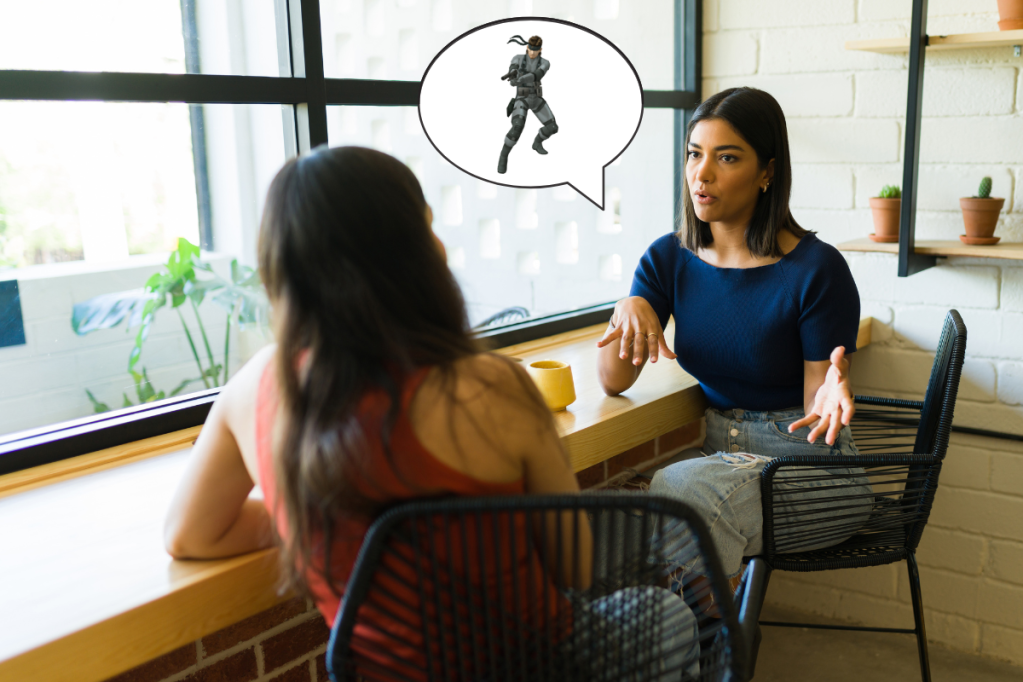
The dirty little secret of people who are good listeners is that they actually have to work at it. Physically using your ears to hear what someone is saying, and your brain to process it, is only part of the battle. You also have to show the person you’re talking to that you’re listening and that you care, and there are a lot of subtle (and some not-so-subtle) ways of doing so. Asking questions is a great way to keep the conversation flowing and let your talking partner know you’re engaged. But what if you’re socially anxious, shy, or just can’t think of anything to say? It’s harder than it seems, especially when meeting new people!
The solution is easy. Just take a page out of Solid Snake’s book. Who’s Solid Snake? Just a former Green Beret, special ops solider, spy, assassin, and the protagonist of the popular Metal Gear Solid video games. They were a huge hit back in the days of Playstation 2 in the early 2000s, but the franchise is still going strong with dedicated fans and a new 2025 release.
Whether you’re a gamer or not, you might wonder what the heck Solid Snake, aka David, knows about active listening. It turns out, quite a lot.
The “Solid Snake conversation method” is taking the world by storm. It’s part trend, part meme, and 100% effective.

You don’t need to know anything about video games to understand where the method comes from. Suffice it to say, Metal Gear Solid is a plot-heavy game series, full of cut-scenes that feature lots of dialogue and exposition.
It’s become a bit of a joke in the gaming world that Snake, a man of few words, tends to fall back on one particular conversational technique over and over: He repeats, or echoes, bits of what the other characters say. It adds emphasis to important points, creates good conversational pacing, and allows the plot and dialogue to continue on smoothly. The unique style of dialogue also allows Snake to feel like a player-insert into the world of the game. He only knows what you know, and he asks the questions you’re thinking as you’re thinking them. In his own unique way, of course.
Here’s a (made up) example:
“Snake, we’ve got to get the blueprints!”
“The blueprints?”
“Yes, the bad guys are constructing a devastating bomb!”
“A bomb?”
“Indeed! You’ll find the prototype in that bunker over there.”
“A bunker?”
You get the idea. You can watch it in action here.
Why does this random video game character speak in this strange cadence? And why are people stealing it to use in real life?
You might think this dialogue is just a clunky tool for exposition or the result of bad writing, but you’d be wrong!
The Metal Gear Solid games are written and developed in Japan by a team led by legendary developer Hideo Kojima. Though translated into English and created in part for an American audience, the games feature a lot of bits and pieces of Japanese culture.
Frequent repetition and conversational echoes are extremely commonplace in Japanese. It’s part of a polite active listening technique called “Aizuchi,” which refers to frequent interjections to show interest, engagement, reassurance, and politeness.
Aizuchi includes interjecting with words or phrases (or their equivalents) like “I get it,” “Yeah,” “Really?” or even repeating back parts of the original speaker’s words, a la Solid Snake.
According to Niko Smith at FluentU, “Perhaps you already use some of these interjections in conversation. While your friend is [telling you a story]… you might nod a few times or throw in a surprised ‘No way!’ or ‘What happened next?’ [Aizuchi] works in a similar way, but it’s more relentless. As the listener in a conversation, you might find yourself doing just as much talking as the speaker.”
Smith adds that in America, young people are often taught specifically not to interrupt or speak while someone else is talking. In Japan, doing so frequently—in the right way—is a sign of respect and interest.
Better yet, Aizuchi doesn’t require the listener to be particularly brilliant in conversation, charismatic, or creative. Even socially awkward people, or anyone who clams up in social situations, can muster a few polite interjections!
This technique exists outside of Japanese culture, too. In fact, it’s a well-known wat to keep conversations flowing effortlessly, give you time to think about what you’re going to say, and make your conversation partner feel heard and appreciated.
It’s no surprise that people familiar with the game have been trying the technique in real life for years. In 2023, a viral 4chan post helped popularize the idea, and more recently a (now deleted) post on X went super viral referencing how effective the “Solid Snake conversation method” is for meeting new people.
The technique is hitting home with young people, especially gamers and the chronically-online, which makes for a really productive and much-needed discussion.
“I do this often too, and can second that it works really well. I’m almost never being super intentional with it, I’ll just be listening and one specific thing jumps out to me as interesting enough to ask for more details about. Repeating that one thing back to them also doubles as making sure I heard it right,” one user wrote in a Reddit thread on the topic.
“I need all the help I can get. Covid isolation destroyed my real life interaction skills and they have not resurfaced,” said another. Though others warned that while the Solid Snake method can be useful, the key is not to overdo it and appear disinterested.
Gen Z has grown up with social media taking the place of many in-person interactions, screens everywhere, and of course, the COVID years. All of these factors affect the way they communicate with each other, especially in real life:
Maddy Mussen writes for The Standard, “Gen Z slang is all about shutting people out. It’s an inside joke, the more unintelligible the better. It’s in keeping with its etymology. When your whole modus operandi is being exclusionary, it doesn’t make for a lot of meaningful conversation.”
It would be an unfair blanket generalization to say young people only speak in brainrot and have no idea how to operate in the real world. But Gen Z is racked with social anxiety to a far greater degree than previous generations. They need all the tools and practice they can get when it comes to operating in the real world and speaking to people they don’t know well.
If they, or anyone else, can take a useful tip from their favorite video game character, there’s nothing wrong with that at all.
This article originally appeared in July