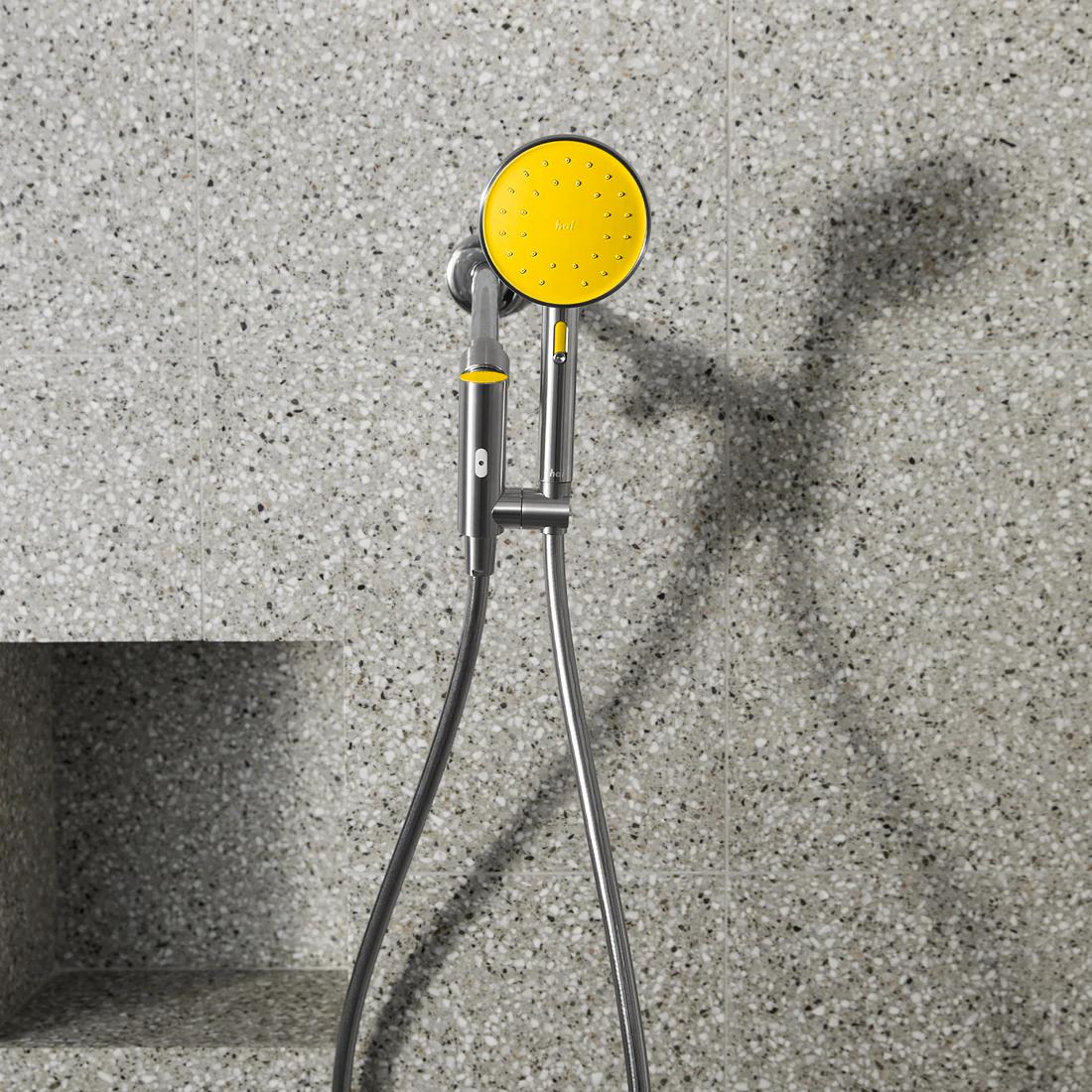
As the clean water crisis grows, new technologies are emerging that help us to conserve and maintain a sustainable usage of water in our daily lives. One such innovation is the Smart Showerhead from Hai. Powered by a small turbine inside the showerhead, the Hai Smart Showerhead is a brilliant piece of connected technology that…
As the clean water crisis grows, new technologies are emerging that help us to conserve and maintain a sustainable usage of water in our daily lives. One such innovation is the Smart Showerhead from Hai. Powered by a small turbine inside the showerhead, the Hai Smart Showerhead is a brilliant piece of connected technology that helps us conserve water and better understand our water usage. It’s also a great self-care tool that provides perfect pressure and a spa-like experience, truly the best of both worlds.
A spa-like experience
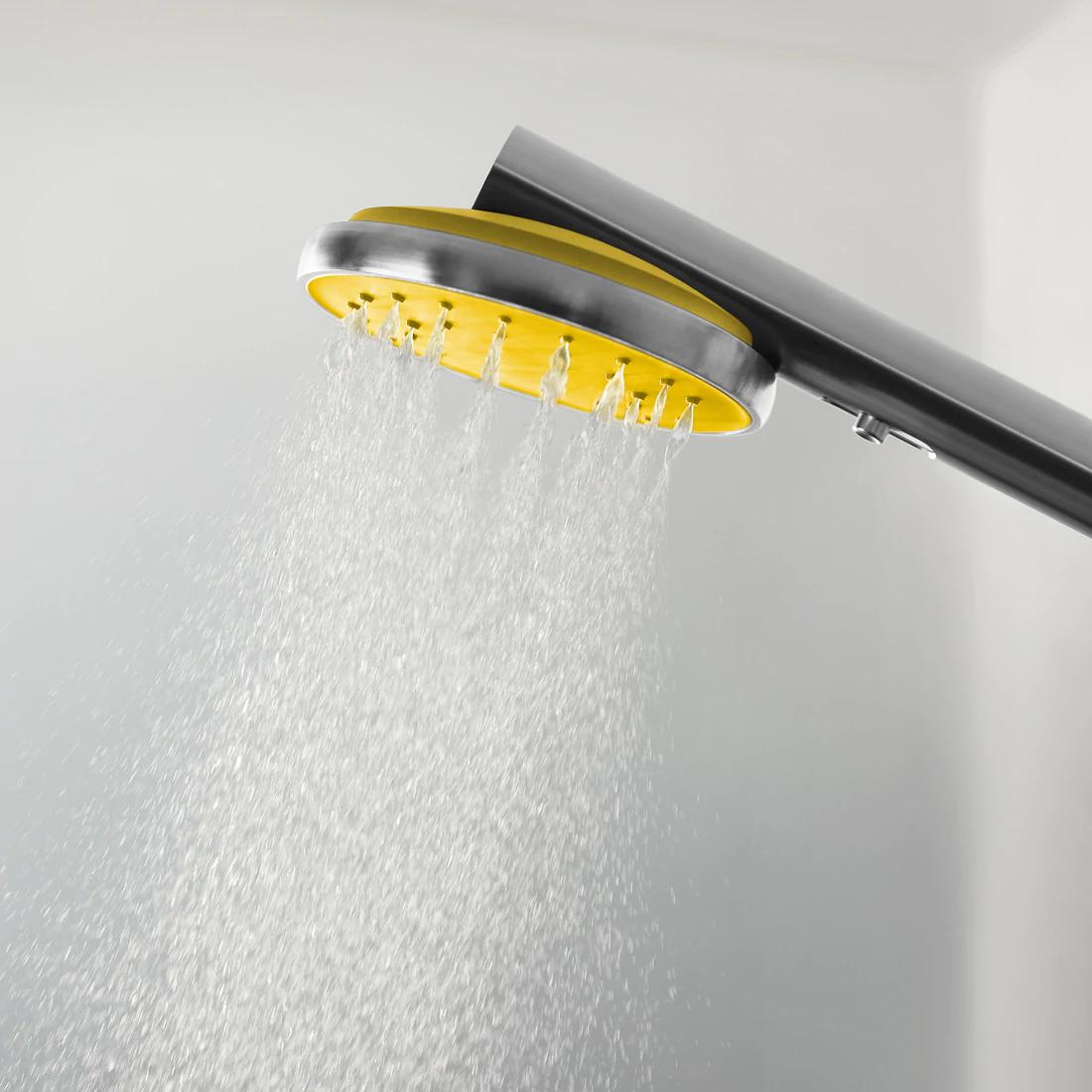
The Hai Smart Showerhead comes with many spa-like features that can help improve your self-care routine. First, the Hai Smart Showerhead is engineered to offer a greater range of coverage than the average showerhead. This also makes showering easier, since you won’t have to adjust the showerhead or move around as much.
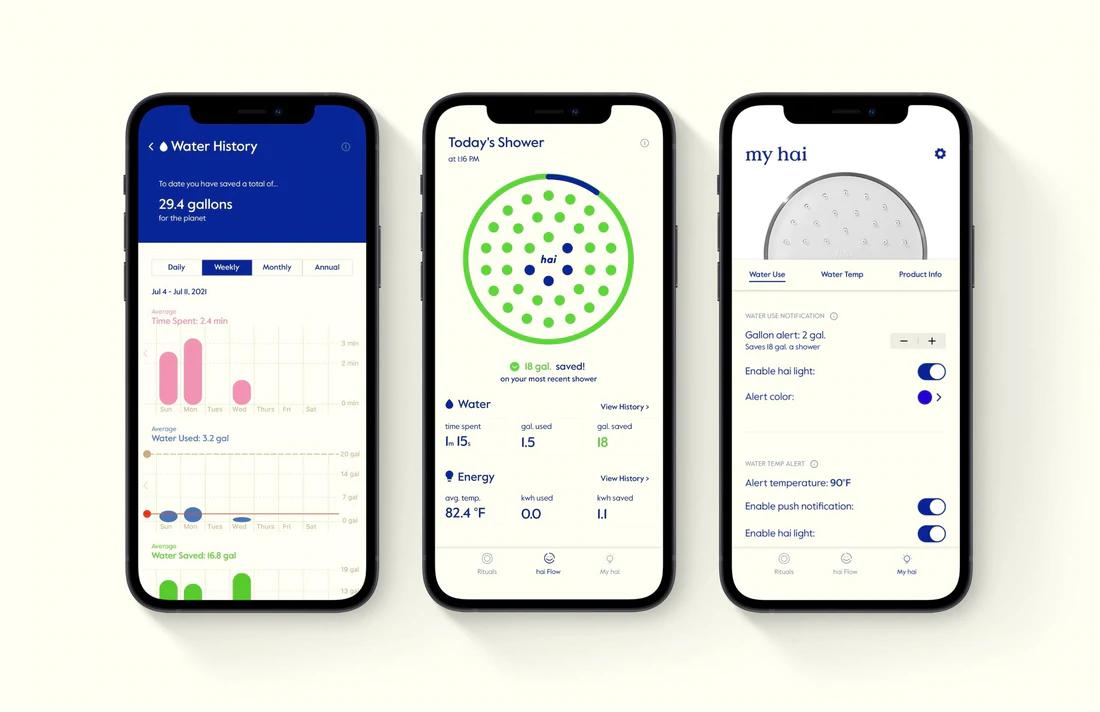
Second, the Hai Smart Showerhead effortlessly changes between different settings which can be programmed using the companion app on your smartphone. The settings range from a fine mist to a steady stream. You can find the perfect pressure by playing around with the sliding adjuster on the app.
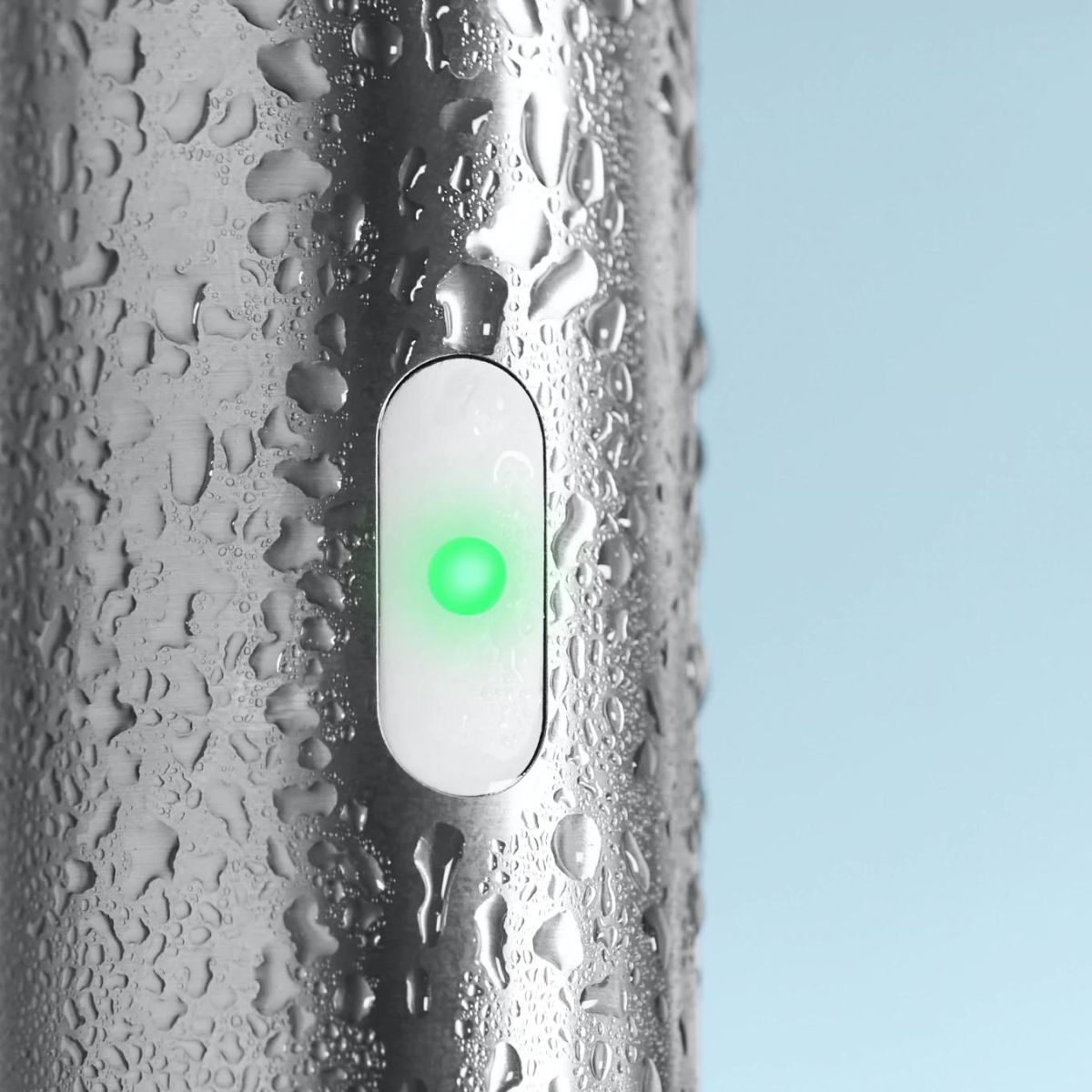
Third, if you’re tired of waiting for your shower water to get warm, then the Hai Smart Showerhead is definitely for you. An LED alert will notify you when the shower water is warm enough for you to enter. No more freezing cold starts to your morning, perfect for anyone who’s always freezing.
How the smart showerhead works
Inside the Hai Smart Showerhead is a small turbine which spins from the flow of the shower water. The turbine generates electricity which powers a light on the showerhead. It also powers Bluetooth connectivity so you can monitor your shower usage using an app on your smartphone. There’s also a feature that can alert you after 20 gallons of water have been used, helping you conserve water by letting you know that it’s time to stop your shower. With the Hai Smart Showerhead you can take the time you need in the shower without feeling guilty that you’re wasting water.
The Hai Smart Showerhead also comes in two different flow rates: water sense and regular. The water sense flow rate is certified by the U.S. Environmental Protection Agency’s WaterSense program as a water saving product. It’s intended to conserve water and has a flow rate of 1.8 gallons per minute. The showerhead for the water sense model is designed to improve low water pressure and has 29 individual spray nozzles. In comparison, the regular showerhead has a flow rate of 2.5 gallons per minute and 35 individual spray nozzles.
Sustainable packaging
All of the packaging for the Hai Smart Showerhead is 100% sustainable. The product and shipping boxes are one and the same so there isn’t any unnecessary box-within-a-box packaging. That saves a lot of unnecessary cardboard from ending up in the landfill.
Easy showerhead installation
The Hai Smart Showerhead is an easy DIY install that will fit onto any existing shower arm. Simply unscrew your current showerhead and replace it with the Hai Smart Showerhead. It’s that easy.
What are you waiting for? To improve your self-care routine and monitor your water usage, check out the Hai Smart Showerhead today!

In March 2023, after months of preparation and paperwork, Anita Omary arrived in the United States from her native Afghanistan to build a better life. Once she arrived in Connecticut, however, the experience was anything but easy.
“When I first arrived, everything felt so strange—the weather, the environment, the people,” Omary recalled. Omary had not only left behind her extended family and friends in Afghanistan, she left her career managing child protective cases and supporting refugee communities behind as well. Even more challenging, Anita was five months pregnant at the time, and because her husband was unable to obtain a travel visa, she found herself having to navigate a new language, a different culture, and an unfamiliar country entirely on her own.
“I went through a period of deep disappointment and depression, where I wasn’t able to do much for myself,” Omary said.
Then something incredible happened: Omary met a woman who would become her close friend, offering support that would change her experience as a refugee—and ultimately the trajectory of her entire life.
Understanding the journey
Like Anita Omary, tens of thousands of people come to the United States each year seeking safety from war, political violence, religious persecution, and other threats. Yet escaping danger, unfortunately, is only the first challenge. Once here, immigrant and refugee families must deal with the loss of displacement, while at the same time facing language barriers, adapting to a new culture, and sometimes even facing social stigma and anti-immigrant biases.
Welcoming immigrant and refugee neighbors strengthens the nation and benefits everyone—and according to Anita Omary, small, simple acts of human kindness can make the greatest difference in helping them feel safe, valued, and truly at home.
A warm welcome
Dee and Omary's son, Osman
Anita Omary was receiving prenatal checkups at a woman’s health center in West Haven when she met Dee, a nurse.
“She immediately recognized that I was new, and that I was struggling,” Omary said. “From that moment on, she became my support system.”
Dee started checking in on Omary throughout her pregnancy, both inside the clinic and out.
“She would call me and ask am I okay, am I eating, am I healthy,” Omary said. “She helped me with things I didn’t even realize I needed, like getting an air conditioner for my small, hot room.”
Soon, Dee was helping Omary apply for jobs and taking her on driving lessons every weekend. With her help, Omary landed a job, passed her road test on the first attempt, and even enrolled at the University of New Haven to pursue her master’s degree. Dee and Omary became like family. After Omary’s son, Osman, was born, Dee spent five days in the hospital at her side, bringing her halal food and brushing her hair in the same way Omary’s mother used to. When Omary’s postpartum pain became too great for her to lift Osman’s car seat, Dee accompanied her to his doctor’s appointments and carried the baby for her.
“Her support truly changed my life,” Omary said. “Her motivation, compassion, and support gave me hope. It gave me a sense of stability and confidence. I didn’t feel alone, because of her.”
More than that, the experience gave Omary a new resolve to help other people.
“That experience has deeply shaped the way I give back,” she said. “I want to be that source of encouragement and support for others that my friend was for me.”
Extending the welcome
Omary and Dee at the Martin Luther King, Jr. Vision Awards ceremony at the University of New Haven.
Omary is now flourishing. She currently works as a career development specialist as she continues her Master’s degree. She also, as a member of the Refugee Storytellers Collective, helps advocate for refugee and immigrant families by connecting them with resources—and teaches local communities how to best welcome newcomers.
“Welcoming new families today has many challenges,” Omary said. “One major barrier is access to English classes. Many newcomers, especially those who have just arrived, often put their names on long wait lists and for months there are no available spots.” For women with children, the lack of available childcare makes attending English classes, or working outside the home, especially difficult.
Omary stresses that sometimes small, everyday acts of kindness can make the biggest difference to immigrant and refugee families.
“Welcome is not about big gestures, but about small, consistent acts of care that remind you that you belong,” Omary said. Receiving a compliment on her dress or her son from a stranger in the grocery store was incredibly uplifting during her early days as a newcomer, and Omary remembers how even the smallest gestures of kindness gave her hope that she could thrive and build a new life here.
“I built my new life, but I didn’t do it alone,” Omary said. “Community and kindness were my greatest strengths.”
Are you in? Click here to join the Refugee Advocacy Lab and sign the #WeWillWelcome pledge and complete one small act of welcome in your community. Together, with small, meaningful steps, we can build communities where everyone feels safe.
This article is part of Upworthy’s “The Threads Between U.S.” series that highlights what we have in common thanks to the generous support from the Levi Strauss Foundation, whose grantmaking is committed to creating a culture of belonging.
Humans have devised many ways of measuring things in an attempt to learn more about our world, including numerical systems that help get us all on the same page. But we haven’t always agreed. The ongoing battle between the imperial and metric systems demonstrates the challenge of standardizing measurement. As most of the world uses the base-10 metric system, the United States remains the primary imperial holdout.
But one thing we agree on is how we measure time, or at least how we measure hours and seconds. And oddly enough, it’s not using the metric system. Why is that? How did we decide to split days into 60-minute hours and 60-second minutes instead of splitting them into, say, hundredths?
Why 60-minute hours and 60-second minutes? Photo credit: Canva
Why there are 24 hours in a day
Let’s start with how we got the 24-hour day. We measure time, in general, by years using the Earth’s full orbit of the sun. But we could really split that year up any way we choose. The rising and setting of the sun gives us a framework for days, so that’s a helpful divisor. However, daylight length varies greatly from place to place and from season to season. So how did we land on 24 hours in a day?
We have the ancient Egyptians, Babylonians, and Greeks—and their affinity for duodecimals (counting by 12)—to thank for that. They each had a way of breaking light and dark hours into 12 parts each, giving us a 24-part day. However, those 12 parts were not measured equally.
The way we organise time is strange.
365 days in a year, 12 months (of 31, 30, 28, or sometimes 29 days), 52 weeks, 7 days in a week, 24 hours in a day, 60 minutes in an hour, and 60 seconds in a minute.
“The concept of fixed-length hours, however, did not originate until the Hellenistic period, when Greek astronomers began using such a system for their theoretical calculations. Hipparchus, whose work primarily took place between 147 and 127 B.C., proposed dividing the day into 24 equinoctial hours, based on the 12 hours of daylight and 12 hours of darkness observed on equinox days. Despite this suggestion, laypeople continued to use seasonally varying hours for many centuries. (Hours of fixed length became commonplace only after mechanical clocks first appeared in Europe during the 14th century.)”
Why there are 60 minutes in an hour
Oddly enough, the need for a standard way to divide 12-hour days and nights into smaller parts led us back to ancient times once again. The Babylonians used a sexagesimal (base-60) system to make astronomical calculations, which they had inherited from the Sumerians, who used it around 2000 B.C.
What makes 60 special? With 12 divisors (1, 2, 3, 4, 5, 6, 10, 12, 15, 20, 30, 60), it can be evenly divided in more ways than any other number up to and including 100, which has only nine divisors.
Fun fact: every time you look at a clock, you are using a 4,000 year old idea. The reason we have 60 seconds in a minute and 60 minutes in an hour comes from ancient Babylonian mathematics, not modern science.
Using that system, Greek astronomer Eratosthenes (276 to 194 B.C.) divided a circle into 60 parts to measure latitude. Hippocrates honed this sexagesimal (base-60) system by adding in longitude a century later. Ptolemy later improved those measurements, subdividing the 360 degrees of latitude and longitude into smaller parts.
The first 60 parts became known as partes minutae primae, or “minutes.” The second division of 60 became partes minutae secundae, or “second minute” (what we now call seconds).
Minutes and seconds were first used in geography, not time measurement. Photo credit: Canva
Those minutes and seconds were used for measuring latitude and longitude, not time, but a circle is a circle. The very first round clock displays divided hours into halves, thirds, quarters, and even twelfths, but not sixtieths. The 60-minute hour didn’t become popularized until minutes were put on mechanical clocks at the end of the 16th century. The spread of the Gregorian calendar around that time also helped universalize how humans measured time, but countless questions remained about the precision of timekeeping.
Exactly how long is a second?
After all, how long is a second exactly? We can measure it as a division of larger units of time, but on its own, how do we determine a standard for it? Precision and standardization in timekeeping became more and more important as things like train travel, where people had to know what time a train would arrive or depart, became more common.
That happened in 1967, when researchers gathered at the 13th General Conference of the International Committee for Weights and Measures. Among other things, they debated which element to use as the standard for atomic clocks. Ultimately, they landed on Cesium-133, which had been used in atomic clock research since the 1950s.
The video above explains exactly how and why scientists chose that element and made the calculation, but the result was that a second became formally defined as exactly 9,192,631,770 ticks of a Cesium-133 atom.
That may be far more than you ever wanted to know about time measurement. But isn’t it fascinating how a combination of ancient wisdom and modern technology gave us 60-minute hours and clocks that can tell us, down to the second, what time it is anywhere in the world? Aren’t humans amazing?
You’re standing in line at the grocery store and you see someone cute. You’d like to strike up a conversation without it being awkward…but that feels kinda nerve-wracking, right? Or maybe you’re standing around at a party and see someone you’d like to get to know, and want to approach them in a way that doesn’t feel uncomfortable. That probably feels a little scary, too.
The good news is that with a few easy tricks, you can improve your communication skills and feel confident approaching anyone.
According to years of psychological research, several principles can help make striking up conversations with strangers easier. The great thing is that they all work best when approached in a casual, effortless way.
1. Comment on the environment
Let’s say you’re at a party in someone’s living room. You can comment on physical objects: “Gee, this guy sure has a lot of books.” Or maybe you’re at a party where everyone brought food: “The food smells great. What are you grabbing first?” You can also comment on people’s behavior: “Is it me, or is everyone really well dressed tonight?”
This works because of the Joint Attention Effect, which says that when two people pay attention to the same thing at the same time, they create a common point of reference. This shared focus can immediately make people feel closer, even in social situations.
People will usually respond when you make a playful or unexpected comment, as long as it isn’t threatening. For example, if the person you want to talk to is holding a cocktail, you might joke, “That drink looks serious.” If you’re stuck in a long line: “Do you know why we’re here? I almost forgot why we’re in line—it’s been so long.” Or if you’re at a child’s birthday party and spot another parent you’d like to talk to: “Be honest, how tired of Little Caesars’ pizza are you?”
This works because of the Benign Violations Theory, which suggests that when someone violates a social norm in a non-threatening way, it makes people laugh and activates bonding mechanisms. It signals to your new friend that you’re playful and friendly, and when they laugh at your joke, it shows that you share similar values.
Another effortless way to engage someone you don’t know is to ask their opinion. For example, if you’re in the produce section at the supermarket, you might ask, “Do these peaches look good to you?” Or if you’re at a party and bring up a pop culture moment most people watched: “So, was Bad Bunny great at the Super Bowl, or is he overrated?”
This works because of what’s known as Cognitive Ease: people are more likely to respond to questions that are easy to process. Asking someone for their subjective opinion is non-threatening, and it’s easy for them to come up with an answer that makes them feel comfortable. Plus, if social media has taught us anything, it’s that everyone loves to share their opinions.
Given that all of these strategies are psychologically designed to elicit a response, even from someone you’ve never met, you have a strong chance of sparking a conversation. The key is to widen the exchange once you get that response by asking two more questions. In fact, a Harvard University study found that one of the easiest ways to be likable is to start a conversation with a question and then follow up with two more.
“We identify a robust and consistent relationship between question-asking and liking,” the study’s authors wrote. “People who ask more questions, particularly follow-up questions, are better liked by their conversation partners.”
These three psychological rules show that it doesn’t take a Herculean effort to coax a stranger into having a conversation. All you have to do is make an effortless invitation by tapping into the environment you share with them, make a playful joke, or ask their opinion. Then ask a few questions, listen, and there’s a good chance you’ve made a new friend.
In a recent, thought-provoking episode of the Impact Theory podcast with Tom Bilyeu, renowned divorce attorney and authorJames Sexton shared how being a hospice volunteer changed his perspective on life so drastically that he thinks it should be “mandatory” at the age of 18.
“I think it would change your entire way of viewing the world. It did mine,” he told Bilyeu.
Sexton recalled that while death itself wasn’t necessarily the prime source of conversation—most of his volunteer work involved doing little odds and ends for folks— its presence was still palpable. And because of that, he walked out of each visit “feeling like a samurai” as all the things he thought were “so important five minutes ago” fell to the wayside.
Death gives us perspective on what really matters
“Spend time with people that are dying. They don’t really…all their stuff is a great big pile of nothing. Like, all that they can talk about is the people that they love, the connections that they made, and the experiences that they had that were beautiful or painful,” he said.
That realization became even more apparent when he learned that his own mother was terminally ill with cancer, and past the point that any doctor could help her.
“In that moment, all of the other things that I was stressed about and worried about, the volume was turned so far down on all those things because my mom was gonna die. All that became important was how I could spend a little more time with her. How can I make sure she knows that I love her? How can I savor these wonderful things?”
Hospice volunteering could help us navigate anti-death culture
Developing an awareness of death during early adulthood, Sexton argued, would help people not get “distracted” by a society that constantly tries make you forget that death is inevitable. Therefore, they wouldn’t pay attention to the “meaningless shit that keeps the machine moving,” and instead focus on what really matters.
And what really matters? Important things like kissing our spouse, for example, which Sexton reminded Bilyeu (and, conversely, all of us) is a finite number of times. You won’t know what that finite number is “until you’ve passed it,” he warned.
“If you don’t keep that in your line of sight, then you’re a fool. You’re gonna think you’re gonna get to do that forever. You don’t. That’s the most beautiful thing in the world. It’s what makes that so special.”
For Sexton, being a hospice volunteer cemented this perspective, and since then, “nothing has been the same.” It didn’t mean suddenly “living life like a monk,” but it did mean sharing his love a little more freely, and appreciating that “things have to end.”
Between hospice volunteering and working as a divorce lawyer, Sexton has become an expert of sorts with “endings,” he noted with Bilyeu. And he argues that we must look at life through this lens because the one constant is that “everything is ending all the time,” and ignoring that fact “does a great disservice.”
A death ritual for the modern day
American culture generally treats death with avoidance, viewing it as a taboo topic or a medical failure rather than a natural life stage. It is highly clinical and sanitized, with many dying in hospitals away from family and loved ones. While shifting toward more home-based hospice care, US society remains heavily influenced by “death-denying” attitudes, emphasizing quick, efficient mourning. Compare that to other cultures that have consistent mourning rituals, like Mexico’s Dios De Los Muertos and Japan’s Obon. Perhaps Sexton’s hospice volunteering concept could act as something similar to these traditions…a rite of passage that doesn’t have us avoiding death, but walking alongside it.
You can watch the full Impact Theory episode here:
We spend a third of our lives asleep, and during that time, our bodies and minds are restored. But wouldn’t it be great if we could also use that time to think brilliant thoughts that help us when we wake? Imagine if, while you sleep, your mind could solve problems, come up with creative ideas, and recall long-forgotten memories.
A new study by neuroscientists at Northwestern University has taken the first step toward making this possible by training people to solve difficult puzzles in their sleep.
The researchers conducted a sleep study with 20 participants with prior experience with lucid dreaming. Participants were given a series of tough brainteasers to work on for three minutes, with each one paired with its own musical soundtrack.
The brainteasers were difficult enough that most went unsolved. As participants went to bed in the lab that night and entered REM sleep, researchers played the soundtracks from the unsolved puzzles to encourage them to dream about them. When participants woke up the next morning, the findings were remarkable.
Sixty percent of the participants had dreams that referenced the specific puzzles they couldn’t solve while awake. Those who dreamed about the unsolved puzzles increased their problem-solving ability from 20% to 40%.
Karen Konkoly, a post-doctoral researcher in Paller’s Cognitive Neuroscience Laboratory, explained the findings in a press release:
“Even without lucidity, one dreamer asked a dream character for help solving the puzzle we were cueing. Another was cued with the ‘trees’ puzzle and woke up dreaming of walking through a forest. Another dreamer was cued with a puzzle about jungles and woke up from a dream in which she was fishing in the jungle, thinking about that puzzle. These were fascinating examples to witness because they showed how dreamers can follow instructions, and dreams can be influenced by sounds during sleep, even without lucidity.”
The study shows incredible potential for using our dreams to solve complex problems and increase creativity.
“My hope is that these findings will help move us towards stronger conclusions about the functions of dreaming,” Konkoly said. “If scientists can definitively say that dreams are important for problem solving, creativity, and emotion regulation, hopefully people will start to take dreams seriously as a priority for mental health and wellbeing.”
Wouldn’t it be incredible if you could tap into the power of your dreams to solve problems or generate new ideas, as the participants did in the laboratory? Even though it may sound too good to be true, there are research-backed ways to learn how to control your dreams. One of the most popular is the MILD (Mnemonic Induction of Lucid Dreams) technique.
Shower liners are like any other piece of fabric; they need to be washed. As people become more environmentally conscious, fewer plastic shower liners are ending up in the trash. Instead, people have been investing a few extra dollars into reusable shower liners, but are finding that the dreaded orange stain is still showing up after a washing.
The orange stain seems to start creeping up, not long after hanging the bright white liner behind your shower curtain. What is this stain, and how can you get it out without having to replace the entire liner? According to experts, the orange stain can be caused by different things, but ruling out dye from a shower curtain, the likely culprits are hard water or bacteria.
“If you live in an area prone to hard water, then there’s a good chance that the orange stains in your shower curtains are caused by mineral buildup,” Allie Ogletree writes for Angi before later sharing the other culprit. “If your shower curtains are orange and slimy, then bacteria called Serratia marcescens could be the reason behind your orange shower curtains.”
While hard water is more of an annoyance than a health hazard, an orange stain caused by bacteria may be a bigger concern, making it a priority to keep it off your shower liner.
The Cleveland Clinic notes that this particular bacteria, often found on shower curtains, can cause unpleasant health issues. They write, “Serratia marcescens is bacteria that sometimes causes infections, including UTIs and pneumonia. You’re at higher risk for infection if you’re in the hospital or at a long-term care facility, have a weakened immune system or a medical device in your body. S. marcescens can be hard to treat because it’s often resistant to many antibiotics.”
Tossing the shower curtain into the washer may kill the bacteria, but it doesn’t always get the stain out. Cleaning experts have a solution.
Spray down the orange parts of the liner with an enzyme stain remover spray, then soak it in OxyClean and scrub with a soft brush. Once the first few steps are done, toss it in the washing machine with a half cup of baking soda. When the washer reaches the rinse cycle, add a half cup of vinegar. According to Real Simple, following these steps will have your shower liner looking good as new.
If you have a plastic liner, you can wash it by hand and skip a few of the steps, but you may still want to scrub any residue off with a scrub brush. Cleaning enthusiast Jeneva Aaron tells Real Simple, “You can soak a plastic liner in a baking soda and vinegar solution to remove soap residue.”
Going back to basics just may be what works. Angi touts using a simple vinegar and water mixture on the stain, allowing it to sit for 15 minutes before scrubbing, which can do the job. But you can take it one step further by adding baking soda to a few drops of white vinegar to create a paste to spread onto the grime, then scrub off.
According to the experts at Angi, “If your shower curtain still has discoloration after cleaning it, you can toss the shower curtain in the washing machine on the delicate setting to try to remove any remaining bacteria and then soak it in bleach to remove the orange. Just be sure to wear PPE, have good ventilation, and avoid mixing bleach and vinegar, as this creates a hazardous gas.”
One of the reasons bacteria builds up is due to the moisture in the bathroom, so ventilating the bathroom will help cut down on how often the liner needs to be washed. In addition to ventilating the bathroom, close the shower curtain and place it on the outside of the bathtub where it’s dry. Closing the shower curtain after getting out of the shower will allow the liner to dry completely, as it will not be folded onto itself.
Surprisingly, there’s no need to wash the shower liner weekly to aid in keeping the bacteria from discoloring it. Cleaning experts at Real Simple say that a fabric shower curtain should be washed once every three months, as long as a shower liner is used. The liner should be washed monthly to interrupt bacterial growth.
In a moment conservationists are dubbing “wildlife history,” seven beavers were released into the crystal-clear waters of Glen Affric, marking a monumental homecoming for a species that disappeared from the area four centuries ago.
Forestry and Land Scotland (FLS), working alongside the charity Trees for Life, released a family of five and a breeding pair of beavers at two sites on Loch Beinn a Mheadhoin in the nature reserve in Invernesshire. These animals are now swimming in waters that haven’t felt the paddle of beaver tails since the 16th century.
For the people of Scotland, and nature lovers around the world, this release offers a profound sense of hope. It signals that we have the power to repair what was once broken, and that nature, when given the chance, can return to its rightful glory.
The long road home
To understand the magnitude of this occasion, we have to look back at what was lost. The European beaver was once a common sight across Britain. These animals were architects of wetlands, shaping the rivers and valleys people know today. Over time, however, humans hunted them to extinction for their fur, meat, and musk oil, and they disappeared from Scotland’s landscape roughly 400 years ago.
For generations, ecosystems managed without them, but their absence was felt. Rivers flowed too fast, and wetlands dried up too quickly.
The tide began to turn in 2009 with the Scottish Beaver Trial in Knapdale Forest. This marked the UK’s first licensed release of a mammal into the wild, bringing European beavers back to Argyll. The trial proved to scientists that beavers could once again thrive in Scottish waters. Since then, populations have grown in the Tay and Forth catchments, with current estimates suggesting more than 1,500 beavers now call Scotland home. The release in Glen Affric marks the next exciting chapter in this recovery, expanding their range into one of the country’s most iconic nature reserves.
Nature’s hardworking engineers
You might wonder why there’s so much commotion over what, to many, looks like a giant rodent. The answer lies in the beaver’s nickname, ecosystem “engineer.” These creatures possess a remarkable ability to transform their environment, benefiting nearly everything around them.
When beavers build dams, they slow the flow of water. This creates complex wetland habitats, ponds and pools that become nurseries for fish, amphibians, and insects. These wetlands act like giant sponges in the landscape. During heavy rains, they hold back water, reducing the risk of catastrophic flooding for downstream communities. During droughts, they store water, keeping rivers flowing and providing a lifeline for wildlife.
Dams have dramatic impacts on the surrounding ecosystem. Photo credit: Canva
Recent studies highlight the benefits of beaver reintroduction for ecosystems. Research led by the University of Stirling found that beaver dams can reduce peak water pollution levels by 95%. These dams act like the kidneys of a river system, filtering out agricultural runoff and helping keep the water clean. By bringing beavers back to Glen Affric, scientists have effectively reinstalled a natural life-support system for the entire glen.
Added bonus: a boost to local communities
The return of the beaver is good news for people, too. Across Scotland, the presence of these charismatic creatures is becoming a significant draw for visitors—and a boost to local economies. Wildlife tourism is booming, with “beaver safaris” in places like Perthshire often booked to capacity.
Estimates now suggest that a single reintroduction site could eventually inject an estimated £2 million—roughly $2.7 million—into the local economy each year. Visitors come for the chance to see a beaver gliding through the water at dusk or to spot the telltale signs of gnawed wood and dams. This interest in the environment supports local hotels, guides, and cafes, breathing new life into rural areas.
Crucially, the Glen Affric release was not a top-down decision. FLS and Trees for Life spent years engaging with local communities, listening to concerns and building a plan that works, for the most part, for everyone. This model of community consultation helps ensure holistic sustainability and that the beavers are welcomed neighbors rather than a nuisance, setting a high bar for conservation projects worldwide.
A bright vision for the future
This release is part of a larger picture. In 2022, the Scottish Government published “Scotland’s Beaver Strategy 2022-2045,” an ambitious roadmap endorsed by more than 45 organizations. The mission is simple but powerful: to see the beaver population actively expand across Scotland.
@stvnews Beavers have returned to the Glen Affric National Nature Reserve in the Highlands, 400 years after their extinction in Scotland. #stvnews #scotland #beavers♬ original sound – STV News
The strategy recognizes that beavers are essential allies in tackling the twin crises of biodiversity loss and climate change. By restoring wetlands, beavers help sequester carbon and create natural firebreaks in forests. Scotland is hoping for a future in which beavers are no longer a novelty but an integrated, widespread part of the natural world.
Navigating challenges
Of course, bringing back a species that’s been gone for nearly 400 years comes with its own learning curve. In low-lying areas, beaver activity can cause localized flooding that impacts farmers on prime agricultural land.
This is where the beaver strategy shifts from pure conservation to vigilant, careful management. Mitigation comes first: tree guards protect timber, and “flow devices” are installed on dams to regulate water levels. If conflicts remain unresolved, beavers are translocated, with experts trapping and moving them to areas where they are wanted and needed, such as the family relocated to Glen Affric.
Approaches like these balance and respect the needs of land managers while acknowledging the broader benefits to biodiversity. They recognize that living alongside wildlife requires compromise and adaptation, but that the rewards are well worth the effort.
A legacy of hope
As the seven beavers settle into their new lodges in Glen Affric, scientists look forward to them building dams—and a legacy. These animals represent a meaningful shift in how we relate to the natural world, moving from a mindset of exploitation to one of restoration.
Steve Micklewright, the chief executive of Trees for Life, described the release as a “moment of wildlife history.” In a world where we often hear about what we’re losing, the return of the beaver after 400 years is a powerful reminder of what we can regain. It offers a tangible sign that with patience, cooperation, and a little help from our furry friends, we can heal our landscapes and leave a richer, wilder world for future generations.
Wintery weather can be beautiful, but it can also be brutal when temperatures dip to frigid levels, not just for humans but for animals as well. Stray animals are generally pretty good at taking care of themselves, especially stray cats, but kind-hearted people still want to make sure they have a place to go to escape the elements when harsh conditions hit.
One woman took that desire to the next level with an elaborate cat apartment she built for the many stray cats in her neighborhood. We’re not just talking about a shelter; it’s like luxury hotel living for her feline friends. The apartment has multiple rooms, cushy blankets that get taken out and cleaned, and even a temperature-controlled water source so they’re always able to find drinking water in below-freezing temps.
The woman who built the apartment actually lives in China and was sharing her videos on TikTok, but it seems her account has since been deactivated. This hasn’t stopped people from talking about her and her impressive project, though. This thread on TikTok contains updates about the cat hotel from people finding and reposting the adorable story.
Welcome to the Meowtel Catifornia
Of course, the clever hotel jokes and puns started rolling in first thing:
‘Welcome to the hotel catifornia.”
“Such a lovely place.”
“They can check out any time but they won’t ever leave.”
“I prefer Hotel Calicofornia.”
“Meowriott.”
“Given my skill, mine would be more like Meowtel 6.”
People loved seeing the care and ingenuity she put into the “meowtel,” as well as how happy the cats seem with the arrangement. In fact, some people were sure their own house cats would move out just to go live in this kind of cat commune.
“My cat just looked at me and sighed…”
“All the neighbours be looking for their cats and they’ve bailed to live at the kitty motel.”
“They’d pack their little bags and move in without a second thought.”
“They wouldn’t even wait to pack their bags.”
“Alright Carol it’s been real but we’re gonna head out. Found a great deal on a luxury apartment so yanno… take care.”
Cats live where they want, when they want
Those people may have been joking, but several others shared that their cats really did ditch them to go live with neighbors who had more desirable living situations.
“I’ve had two cats do this. One was annoyed at our second dog’s puppy energy so she moved in with an older lady a street over. We used to see her all the time until she passed. The other missed our kids being little so she moved next door where there’s a little girl. We talked to both neighbors and said if they get sick of them to let us know and we’ll take them back but both lived the rest of their lives with their new families.”
Some stray cats wander from home to home like a drifter. Photo credit: Canva
“One of our cats moved next door because he loves children and wanted to be with the little girl next door. Because it’s a very small village, he goes to the school most days to wait for her and they come home together. School is 3 buildings away.”
“We had a cat do the same thing about 20 years ago. She hated the barks of our new puppy and would put her paw on his mouth to try and stop it. One day, she slipped outside and I found her a month later, two streets over, hanging with a couple who didn’t have a dog. They said she just showed up at the door and moved in. I gave them all her cat food and hope she had a nice quiet life.”
Is it a bad idea to feed and shelter stray cats?
People have differing opinions about whether it’s good to feed stray cats or not, as cats can cause problems for local wildlife, and it’s not great to encourage an increasing stray cat population. According to Catster, in the United States alone, an estimated four billion birds and 22 billion mammals (such as mice, voles, rabbits, and shrews) are killed annually by both domestic and stray cats. In Canada, cats are the number one killer of birds, killing “between 100 and 350 million birds every year.” These numbers are staggering, but the bird and small mammal populations can be protected if stray cats are cared for responsibly: namely, spaying and neutering those in your area to cut down on the population and finding homes for those who are friendly and comfortable with humans.
Most of us learn about the Earth’s shifting tectonic plates by middle school. But in Marie Tharp’s time, this fact we now take for granted was a groundbreaking, radical concept…and one that had to overcome gender bias.
In 1957, Tharp, a geologist and oceanographic cartographer, and her colleague Bruce Heezenhad published the first map of the Atlantic. Tharp endured considerable challenges due to sexism. For one thing, women weren’t allowed on the ships that collected the seafloor data to make the maps in the first place. So Tharp spent hours at a desk translating thousands of sonar readings from those ships that wouldn’t take her.
Her hand-drawn maps eventually revealed that the seafloor was covered in canyons, ridges, and mountains…all of which suggested that at some point, pieces of the Earth had moved.
This was important because the previous mainstream view was that the ocean floor was flat and motionless. However, Tharp’s findings supported Alfred Wegener highly controversial “continental drift theory,” which first suggested that the present-day continents once fit together as a supercontinent, aka Pangaea, in 1912.
Of course, we now know Pangea to be a real thing, but not long ago, this idea was considered heresy. And so when Tharp reintroduced it through her findings, Heezen dismissed it as “girl talk,” or an “old wives’ tale,” depending on where you look. Either way, the context reads pretty clear.
Heezen would come around in time, but the duo would also have to sway the rest of the scientific community. Keep in mind, the supposed peaks and valleys were, at this point, only conjecture. However, in 1959, when Jacques Cousteau, determined to prove Tharp wrong, lowered his underwater camera with 16-millimeter film into the middle of the ocean, and a valley was indeed there…it became fairly evident that she was right.
Though it was primarily Tharp’s groundbreaking findings that paved the way for our new understanding, she was still seen as “merely a technician,” and therefore Heezen took the lion’s share of the credit as they continued their work together, which eventually included mapping all of the world’s oceans. She wouldn’t even be allowed to set foot on a research cruise until 1968.
But proving her tenacity, Tharp was nevertheless able to make a life-changing scientific contribution in spite of it all, a) because she was resourceful, and b) because she believed in the importance of her work. As she herself said,
“I had a blank canvas to fill with extraordinary possibilities, a fascinating jigsaw puzzle to piece together. It was a once-in-a-lifetime — a once-in-the-history-of-the-world-opportunity for anyone, but especially for a woman in the 1940s.”
In time, Tharp would get some recognition. In 1997, the Library of Congress named her one of the greatest cartographers of the 20th century. And in 2023, National Geographic awarded her the highly prestigious Hubbard Medal.
And of course, every time we look at a map, we witness a bit of her signature. Still, one can’t help but wonder what other women from history secretly shaped the way we view the world today, and the pains they took to do so.