
Looking for a way to change the world? Start with magical activism.

When the world around you is teeming with oppressive power structures, disconnection and fear, what can you do to make a real difference? As history has shown us, it can be achieved through magical practice. Rachel Lang is a highly sought-after astrologer, author and scholar of magic. Her Instagram is filled with astrological insights and…

Rachel Lang, astrology, magic activism, feminism
Photo credit: pixabay.comArray

When the world around you is teeming with oppressive power structures, disconnection and fear, what can you do to make a real difference? As history has shown us, it can be achieved through magical practice.

Rachel Lang is a highly sought-after astrologer, author and scholar of magic. Her Instagram is filled with astrological insights and ritual ideas, and promotions for her new book, “Modern Day Magic: 8 Simple Rules to Realize Your Power and Shape Your Life,” published in September. I recently interviewed her to get a better understanding of what “magical activism” really is.

First off, let’s define magic by stating what it is not.

As Lang put it: “Magic is not witchcraft, or a religion. It’s our innate spiritual power, heartfelt passion and creative potential that brings us into a wondrous relationship with all life. Think of that little sparkle you feel when you’re like, ‘oh my God, I’m in the right place at the right time. I just had deja vu’. We all have that experience. And so we all have magic coursing through us.”

When you put it that way, many of us practice magic under a different name. Call it “law of attraction” or “using the force,” we all have our little ways of trying to enact change in tangible ways. Whether it’s as mainstream as meditation, or as “woo-woo” as drawing a tarot card or spritzing some rose water.


https://www.instagram.com/p/CUX0P2zJkVu/


Rather than a religion, magic is “a more body-centric experience that creates a shift in an awakening within ourselves and then compels us into having more compassion, more empathy,” she said. “And we start seeing ourselves as a part of the whole, not just as these isolated people out there doing our own thing. And, you know, and I think that that’s the gift of magic. … We connect with the planet and we connect with one another in a real way.”

Combine that with activism, and you have activating your own innate personal power in an effort to create lasting, positive social change; connecting with something greater than yourself, to affect the greater good.

https://www.instagram.com/p/CUDlZwshNEJ/


Take for instance the suffragettes, who incorporated seance rituals of spiritualism to fight for women’s rights in the 1800s. Matilda Joslyn Gage, suffrage leader and writer of “Woman, Church and State,” even claimed herself as a “witch.”

Or in the ’60s, when the Women’s International Terrorist Conspiracy from Hell (aka W.I.T.C.H.) paraded down the streets of New York with brooms and pointy pants, chanting hexes on Wall Street bankers and campaigning against the sexism of beauty pageants and the Playboy Club. A day later, the stock market reportedly fell 13 points. As if by magic.

Fast forward to the year following Trump’s presidential inauguration, when protestors dressed as witches carried signs reading “Witches Against White Supremacy,” “Hex White Supremacy” and “Good Night Alt-Right”. There was even a “Spell to Bind Trump and All Those Who Abet Him” posted online. And in 2020, people were coming together to create sigils—magical symbols or drawings—to protect democracy during the Biden and Harris presidential inauguration.
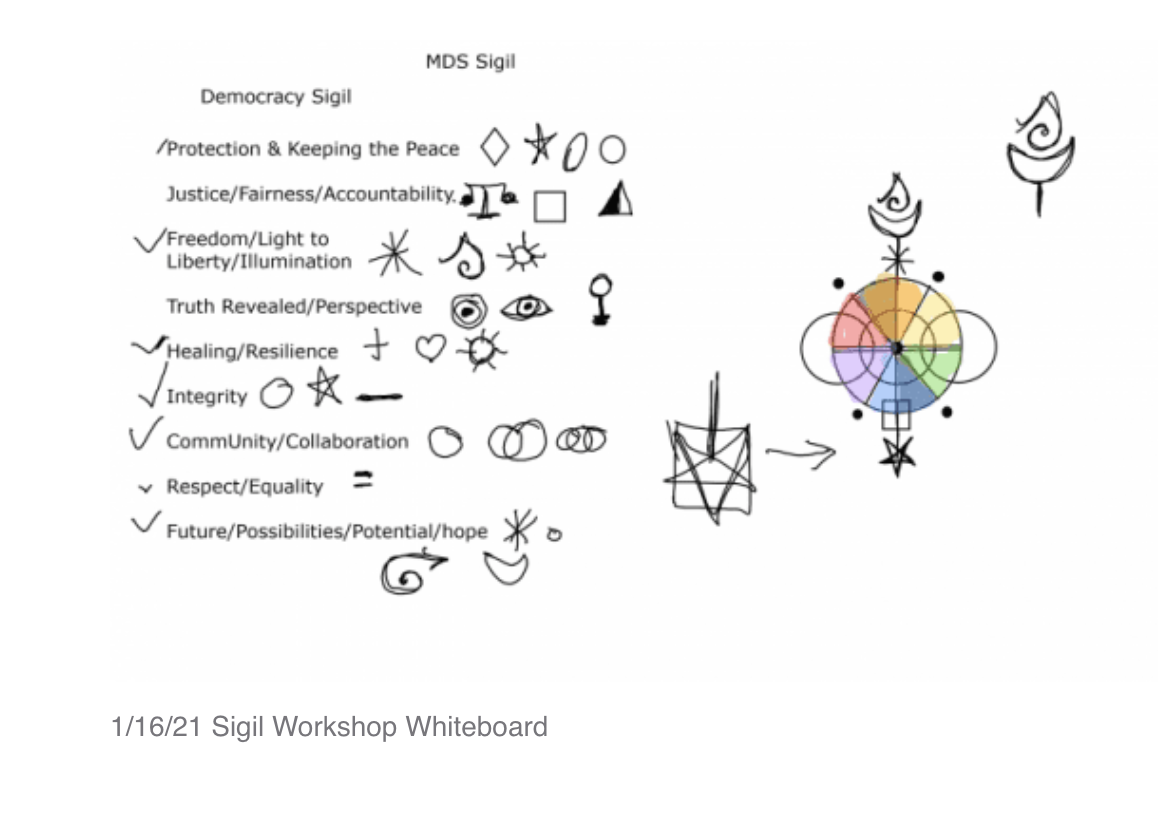

Magic Activism

“It only makes sense that it rises in popularity in major times of needing to take personal ownership of our expression,” said Lang.

Hexes and broomsticks aside, the disenfranchised continue to turn to magic because it’s inherently about standing up against what is wrong in our world. As Lang put it, “We are a country that needs healing. We have a history of racism, of sexism, of violence and of spiritual abuse. If we are truly going to change as a society, we need to distance ourselves from that religious rhetoric. And one of the ways we can do that is by reclaiming our magic and reclaiming the word. When we do that, we distance ourselves from the colonial past.”

Lang suggested that one way to do this is through community.

“When we gather in groups, we can generate so much more energy together than we can alone. We rally around a shared intention of being a part of something. We get energized. And that’s really powerful. I think in many ways, it’s going back to indigenous practices,” she said.

If the thought of joining a coven sounds a little too intense for you, it might help to know that mysticism has found its way into the digital space. Take a quick glimpse at #witchtok and you’ll see there’s no shortage of people looking to add a bit of mystical power into their lives. It might not be exactly as our ancestors did, but it’s a step in that direction. And as we have seen in the past, when individuals form a group to combine their passions with purpose, big things can happen.

https://www.instagram.com/p/CUdn46XMtw9/

Or, you can start by reclaiming your own magic, aka personal power. That is more than enough to start changing the world. How to start? It might be simpler than you think…

Lang ended our interview by saying, “When we bring spiritual presence to the everyday activities of our lives, like cooking dinner, taking a shower or cleaning our rooms. When we find sacredness in the mundane aspects of life, then we open ourselves to all kinds of possibilities for feeling connected to the world that we live in, to spiritual forces beyond our understanding and to one another. It becomes a way of life and suddenly you feel more passion, you feel more alive and centered. And so you start tapping into that deep well of feelings you might have suppressed. That’s the realm where magic lives. I’m a big advocate for everyday rituals to make life feel more magical.”

If you’re looking for a deeper dive on this topic, or for ideas on how to make your everyday world more magical, I highly suggest reading Lang’s book. It might be the only invocation you need to start making a difference.


Hands Globe Earth – Free image on Pixabay

  • Pete Holmes makes it anything but weird in conversation with Upworthy
    Photo credit: Pete Holmes, CanvaComedian Pete Holmes on stage.
    ,

    Pete Holmes makes it anything but weird in conversation with Upworthy

    “You can just live your life and make a difference where you can.”

    Comedian Pete Holmes isn’t just funny. He’s a deep thinker who digs so far beneath the crust of your average every day “observational” comic that he might just touch the lava. He takes an aerial view on everything from parenting to science to sex to faith, and all of the tiny minutia that comes with them. His rise as a beloved writer and stand-up has barreled through the atmosphere from tiny gigs to podcasts to TV shows.

    Holmes and I have a mutual friend who put us in touch for this Upworthy interview. And although we had never met, I immediately felt like we were long lost friends upon answering his call. He was ready to break down not only the rules (or lack thereof) of comedy, but to deconstruct human thought and how the most sensitive people might navigate the world.

    What especially stood out in this half hour chat beyond his quick wit, was his deep commitment to supporting other talented people. He seemingly laughs as easily as he makes others laugh, and that alone is a gift.

    Pete Holmes, Stoicism, philosophy
    Photo credit: Neal Brennan/YouTubeComedian Pete Holmes.

    Upworthy: I must tell you there’s a podcast interview you did on You Made it Weird with Gareth Reynolds about Doritos where he did a Jay Leno impression. Do you remember this?

    Holmes: “Of course!”

    Upworthy: I legit look at this once a week when I’m having a bad day and need to laugh. Is there something that you come back to often when you’re in a bad mood and need to laugh?

    Holmes: “Oh my God, first of all, I love Gareth so much. What a funny person! In fact, people come up and say, ‘I love your Doritos thing!’ Which is funny because I have a lot of jokes about Doritos, so I’m never sure what they mean.

    To answer your question, what do I watch when I’m in a bad mood? I watch Nirvana the Band the Show. They just had their movie come out, and I think the whole second season is on YouTube.

    I think Matt Johnson and Jay McCarrol are just two of the funniest people in the world, and I just watch clips from that show sort of endlessly if I’m looking to laugh. The ones that really get me are the ones that are a little bit over the line, and that’s what I like about them.

    They’re just two friends finding fun together, and it just makes me so happy. So it’s not just the content, it’s the medium. It’s how they made it, and it really captures the feeling of two just free people, two people that realize that we’re in this weird reality, we’re in this weird world, and we’re only here for a little time. And one of the things we can do is be really funny and make each other laugh, and they just go at it with this innocence that I really admire.”

    Upworthy: To that end, who would you say back in the day and now are your major influences as a comic?

    Holmes: “I love that question. When I read the book SeinLanguage—which is I’m just so sure that Jerry Seinfeld regrets calling it. I don’t know him. I’m not basing that on anything that you don’t also have access to, just his comedy and his show. I’m just so sure that he is like, “Why did I call it SeinLanguage?

    But I read it because I didn’t really have control over our TV in our house. When a comedy special came out in book form, I could get the book and I could read it privately and re-read it. And he actually talks a bit about comedy theory in it as well. Anyway, I read this book and I just couldn’t believe that the kind of thoughts I was already having were not that different from the thoughts of a professional comedian.

    I just didn’t feel like I had that tour de force, wild, loud guy Boston energy, if that makes sense. I felt way more in line with Jerry Seinfeld and Ellen and Ray Romano. These sort of like 7 p.m. show guys.

    Okay, I don’t know if you’re old enough to remember, that was the fringe. In the ’90s, comedy was sort of for pirates. And a lot of my best friends are pirates. I’m just saying they hooked up late night, you know, freewheeling lunatics. And I just didn’t see myself up there. So Jerry Seinfeld once said about Robert Klein that he was the first comedian that he saw that was like, ‘Oh, it just seemed like me.’ And when I saw Seinfeld I was like, ‘Oh, this is like me, this is like a guy I know.’ So the book SeinLanguage and the fact that it was clean was really important to me.”

    Upworthy: I read there was one point you had plans to be a youth pastor. Was that a real thing you were considering or just what your parents thought you would do?

    Holmes: “No, it was my idea. You could look at it two ways: one, my parents were sort of detached in a way that you were like, ‘Shouldn’t you be more involved?’ Or you can be like they really were letting me find my own way, and I actually look at it more the latter.

    It was as serious as when you’re in high school you want to be a teacher, you know what I mean? You just don’t know any other jobs. So I knew teachers that I admired, and I knew my youth pastor and my pastor that I admired. And this is a Steve Martin thing: he said, ‘Teachers are in show business.’ Pastors are too. And that doesn’t mean to say they’re phony or false. It just means if you’re up in front of a crowd holding their attention, you’re putting on a show. Teachers and pastors are doing something substantial, but they’re doing it in the style of a show.”

    Upworthy: I saw a clip where you were talking about the idea of saying ‘Yes, thank you’ to the universe. It seems very Stoic. Are there other elements of that that help you in your daily life?

    Holmes: “I would say that my understanding of ‘Yes, thank you’ has deepened a little bit. There’s a couple different altitudes you can look at that. One of them is just very basic—basic doesn’t mean bad—it’s just basic psychology. Meaning suffering comes from seeking and resisting. I know that’s sort of spiritual terminology, but it’s also psychological terminology. If you’re suffering, you’re by definition seeking a different experience.

    And there’s pain or there’s discomfort, but suffering really comes from building a story. And anybody that has kids knows that that’s true. My daughter won’t go to bed, let’s say. And that really is, if we can pause and just be on a planet in outer space in these finite spaces, that is just so insignificant.

    So when we’re resourced and with friends and rested and fed and all these things, we can see that. But often when your kid won’t go to bed, you’re not resourced and you start spinning out. People love talking about catastrophizing. You’re just making a story, and it’s never in your favor. You go, ‘She won’t go to sleep. Why is this happening to me?’ You start thinking about what you would be doing if she was asleep. ‘I can’t watch that show, I can’t relax. My whole life is just being a parent.’ None of that is really happening, your brain just sort of is torturing you.

    It’s important to recognize that your brain doesn’t always have your best interest in mind. So giving it another path to take, which is ‘Yes, thank you.’ So the flight delayed is a good example, and just about the right temperature of spice for this exercise. You know it can be deeply upsetting when a flight is cancelled until you realize, you know, you don’t resist it, you just go with it, and you realize all you have to do is sit in your chair.”

    Upworthy: Sometimes it just takes a little packaging, but just hearing you say that honestly reframed my thinking.

    Holmes: “Me too! But it has to be simple. It can’t be like the Buddhists or whoever would say, ‘Don’t resist,’ right? That’s a little too conceptual. I want to get right to the phrase that’s easy to remember, that when you’re stressed you can go to it. To talk about the deepening of that, you can look at yourself. You are what’s aware of your experience, right? You haven’t always been this body, you haven’t always been this age, your name, your country. All of these are concepts that you sort of reinforce by thinking them over and over: ‘My name is Cecily. I live in America.’

    All these are things. But what you really are is this space-like aware presence that encompasses your body, encompasses reality, your thoughts, your feelings, your emotions, your perceptions, right? So ‘Yes, thank you’ isn’t just a life hack. It’s actually your nature, meaning awareness or consciousness. This is almost over, by the way.”

    Upworthy: Are you kidding? This is amazing. This is therapy.

    Holmes: “Awareness is like a mirror, alright? So it’s like a mirror indiscriminately reflects what is in front of it. And you are like that. My voice is being recognized by you completely effortlessly. The feeling of your phone in your hand or your butt in your chair, all of that is just being registered completely defenseless. It just enters, it just comes in.

    So thinking ‘Yes, thank you’ isn’t just a trick. It’s actually more in line with your nature. You do say yes to everything. I’m driving down the highway right now, every nanosecond this is just being embraced by my awareness. So when I can get my mind in line with my true nature, which is just free flowing, it’s spontaneous, it’s like jazz.

    Like my daughter wouldn’t go upstairs two nights ago. She just wouldn’t even go upstairs to go to bed. And look, I can’t always do this, but in that moment I was able to go, ‘What is 10 minutes?’ And not 10 minutes where I’m trying to get her to go upstairs, 10 minutes where I just sit on the stairs with her, and now I’m looking at my stairs and I’ve never even seen them from that angle. I’m really just dropping the entire agenda. And I really think kids energetically can pick up on that. And I think grown-ups can pick up on that.

    Like a good date that you’re on is somebody that’s just awake and aware and spontaneous. Why do we love spontaneity? Why do we love humor? Because it’s so alive and so accommodating and so fresh, right? You are alive, you’re accommodating, you are fresh. Those are aspects of you. I don’t mean you, Cecily, or me, Pete. I mean the thing that’s running the whole show. It’s ‘Yes’ to the whole thing. So when we get in tune with that ‘Yes,’ even when you’re miserable, even when you’re having a bad situation, a bad experience, if you can just sort of go with it.

    You know the Stoics are like, ‘Control what you can control.’ You can get on another flight, and if you can’t, so they’re proactive, and I’m all about being proactive. But there is something about like, you know, a 40-minute delay where you don’t really need to look for another flight. You know what I mean? That’s really the right level for this practice.”

    Upworthy: Do you find when you travel that you’re freer? I find I am when I’m out of my element and just going with the flow and not making a whole lot of plans.

    Holmes: “Well, because when you’re home you have a lot more expectation for how things have gone. That’s why people like traveling, you know? And that’s an Eckhart Tolle thing. It’s like people like traveling because it forces them to be present. I would say when you’re being present, you’re actually being yourself. What you are is present, right? And everything else is mind activity.

    Why does it feel so good to not think about anything? Why does it feel so good to just be? If you can stop the anxiety or the fear or the chattering thoughts, if you can just be still, it feels really good. That’s because the present moment and your true self, the nature of awareness, those are the same thing. People are just pointing to it using different words.

    And when you travel, you are forced to go with the flow because you don’t even know what’s normal. ‘Oh, in Barcelona, they eat dinner at 10 o’clock.’ You’re completely out of control, so you surrender. And people are much more likely to say ‘Yes, thank you’ when they’re in Spain than they will at their home.”

    Upworthy: Back to comedy, would you bill yourself as a ‘clean comic?’ And what are your thoughts on the concept of punching up or punching down?

    Holmes: “I think a good entertainer should always be surprising, right? So like I think people that aren’t real fans of mine that just might come to a show, they might be surprised. There might be more swearing. There might be more sex stuff. But, to me, that’s sort of my job. I don’t want to just deliver what you’ve already seen.

    Like my new special that just came out (Silly Silly Fun Boy) people have noticed that I’m swearing a little bit more in the beginning. And I’m like, yeah, it was the late Friday show and people weren’t there yet. There were huge sections of the crowd that were empty, and I’m filming a special, so I wasn’t asking. I was going out with a knife between my teeth like Predator. I was going out to insist that I do very well and that we get somewhere that we all want to be.

    Other shows, the crowd—and by the way, the crowd was great—it was just kind of chunky up top. Other shows, you know, that’s not required. But I’m not doing a routine. It’s like what we were saying, I’m being present and fresh and alive for that crowd.

    And to answer your question more directly… the hour that I’m touring now (which isn’t the hour that I just released) also has what I would call dirtier jokes. Meaning they’re not ugly, but they’re jokes that are sort of a little bit outrageous, I guess.”

    Upworthy: So you feel like it’s not that you’re making a choice to be edgier? You’re just doing you.

    Holmes: “Oh yeah, and that’s how material shows up too. I always liken it to if you’ve ever gotten an Amazon package on your doorstep and you don’t even remember what it is. That’s how the material shows up. I’m not trying to be a flashy artist like, ‘Oh I’m just the vessel.’ I’m just saying I’m living my life and certain things come up. I write them down, I perform them, people like them, and then you have about an hour and ten minutes of that and you have a show.

    I’m not Marvel. I like Marvel, but I’m not Marvel thinking like, ‘Okay, we need a female-led 20-something that has…’ you know, like they’re trying to guess what people want and give it to them. They’re very good at that, but that’s not what I’m doing. I’m much more like a weather vane or a lightning rod. I’m just waiting to see what happens. But to finish my point: I’ll do these jokes—could be considered dirty, meaning I’m swearing, I’m talking about dicks, I’m talking about sex, whatever that might be. And then after the show, literally, this isn’t just something I’m making up, little old ladies will come up and tell me that they love how clean I am.”

    Upworthy: The bar has changed, right? The line has moved.

    Holmes: “Well, I think it’s the medium, going back to medium and message, right? I think it’s very possible that someone does what’s considered clean comedy, meaning they’re not talking about their penis, or sex, or about drugs, and they’re not swearing. They’re not saying the seven words, right? And that comedy can be toxic. It can be ugly. It can be encouraging really backwards thinking and harmful ideologies, right? By the way, I’ll defend someone’s right to be able to do that, I’m just saying what I see sometimes.

    And then I think it’s quite possible to talk about your dick, talk about drugs, acknowledge the existence of sex, and say all of the seven words and do a joke that is really beautiful. In fact, I think that’s part of the message. I talk about this in the special. I am demonstrating to myself and to them: this is what it looks like to be ‘unembarrassingly’ human. I’m not ashamed. I don’t choose my thoughts. I don’t choose my feelings. I’m here to report on them and laugh at them, and thereby take away some of their power.

    And that’s what you’re doing by laughing with me, you’re recognizing yourself in me and you’re laughing at yourself, and everybody leaves feeling a little bit lighter. Now did I say ‘f–k’? Yes, but if that’s your line in the sand, whether or not a comic says ‘f–k,’ that’s fine. That was me for the first 28 years of my life. It’s not my line anymore, and I’m happy to say that there are lots and lots of people that are nuanced, that are lovely, compassionate, generous, interesting, interested people that aren’t turned off by the full human experience.

    By the way, I love clean comedy too. It’s just like I don’t think clean necessarily means it’s not going to be mean or ugly or somehow harmful, and I don’t think ugly means you swear. I think it’s completely what are you saying and how are you saying it? And I’m proud that even the jokes that I have that are about me letting myself down or making some sort of mistake, there’s something beautiful in the message. We can still laugh at that, and we can still not take ourselves too seriously, and we can get better.”

    Upworthy: There are a lot of comics who have been punching down these days, and I’m hoping that becomes unpopular soon.

    Holmes: “It’s always a pendulum, and it always goes back and forth. I will defend my fellow comedians whom I don’t agree with, their right to share their experience. That being said, it’s kind of like you wake up one day and every movie that’s in the theater is a horror movie, and you’re like, ‘When did this happen?’ And there can be a parallel there. Like Chris Fleming’s special was probably one of the best specials I’ve ever seen in my entire life, and it couldn’t have been more beautiful, but also deeply hilarious. So it’s not—nor has it ever only been—one thing.

    Like look at pictures from 1972. It would look like everybody was a hippie. My dad was alive in 1972, he was not a hippie. These things get painted in these broad brushes, and you see certain trends in comedy, and it can start to feel like it’s been taken over by a certain perspective, but that’s not my experience. When we look at the bird’s-eye view, you’ll go, ‘Oh, every perspective was always being represented the whole time.’”

    Upworthy: It’s an algorithm thing, you know?

    Holmes: “I really feel like there’s room for everything. I don’t think there are any new groups. I don’t even think there are any really new perspectives. It’s just this constant fluctuation. But everybody was there the whole time. What it looked like, I can’t say, and nobody can. You can just live your life and make a difference where you can.”

  • Woman who crashed out after awful ‘wolf’ haircut is saved by ‘angel’ sister’s amazing styling
    Photo credit: CanvaA woman annoyed with her hair.

    There’s nothing more deflating than getting a bad haircut. You show the stylist a photo of how you want to look, sometimes inspired by a celebrity or fashion model, but when it translates to your head and face, it just doesn’t look right. Ultimately, much of the blame falls on the stylist for failing to execute the style or for not admitting it wouldn’t work.

    Run Zhang of England shared her bad-haircut journey on TikTok, and millions of people have followed her transformation from disaster to a look that is cute and matches her upbeat, quirky personality. In the first video, she said she was excited to get a “cool girl…spiky” short haircut, similar to a “wolf” style. However, after the haircut, she didn’t look cool at all.

    After the haircut, Run had to go straight to work and had no idea how to style her hair.

    “This is not right at all. And I have to go straight to work. I’m driving three hours to go straight to work to look like a small fruit,” she joked while prepping herself for a day of embarrassment.

    Maybe the haircut is…French?

    “Why don’t hair stylists just say they don’t know how to do a cut?! It’s not even close!” Masdelaselva wrote in the comments.

    Others joked that the hairstyle may be “French,” referencing an inspired scene from Fleabag in which Phoebe Waller-Bridge’s character tries to convince Sian Clifford’s Claire that her haircut isn’t terrible.

    Others joked that Run looks like comedian Jimmy O. Yang.

    jimmy o yang, hong kong comedia, comedian yang, fung bros
    Comedian Jimmy O. Yang. Photo credit: Fung Bros/Wikimedia Commons & Wikimedia Commons

    In a wonderful example of taking lemons and turning them into lemonade, Run enlisted her sister, Yun, to make her hair presentable.

    “Yun’s been fixing my hair like a magician or an angel or perhaps a saint,” she said while revealing her new ‘do, which features a semi-slicked-back look held in place by old-school metal clips. Strangely, the new haircut kind of fits Run’s fun-loving vibe.

    “Holy sh*t, your sister nailed that! I thought it was unsaveable, but I didn’t realize you had a team behind you,” Amy wrote. “Your sister is a miracle worker!” Harmony added.

    Run and Yun did a fantastic job of turning a tragedy into a style that looks great until her hair grows back. One wonders whether Run will try to find another hairdresser who can get the wolf cut right or lean into her new ’90s-girl throwback hairstyle.

    Until then, Run is still having trouble because she doesn’t know how to style her hair without Yun’s help.

    Run’s bad-haircut saga started as a sad story about a woman who was destined to feel bad about her looks for a few months. But in the end, with a little ingenuity and help from her sister, she proved that she could turn a bad haircut into something that reflected her true personality. It’s a great reminder that nothing is impossible when we have people who can lift us up when we’re down.

  • When she told her mom with Alzheimer’s she’d been married for 40 years, her reaction said everything
    Photo credit: CanvaA woman comforts her elderly mother.

    There’s a particular kind of grief that comes with watching a parent disappear into Alzheimer’s. It’s not a single moment of loss but a slow, ongoing one. And then, sometimes, something cuts right through all of it.

    Molly Bell Walls (@mollybellwallson) was sitting with her mother in a doctor’s office lobby, waiting for her dad to come out after an appointment. Her mom has stage 6 Alzheimer’s. In a video she posted on TikTok that has since been watched more than 19 million times, Molly is just trying to keep her mom engaged in conversation.

    She mentions, almost casually, that her parents have been married for 40 years.

    @mollybellwalls

    After Mom’s neurology appt today; waiting on Dad in the lobby. Trying to keep her occupied in conversation. It always turns to Dad. She looks for him constantly. Their love is so special. 🥰 #dementia #alzheimer #caregiver #alzheimersawareness

    ♬ original sound – Molly Bell Walls

    Her mom’s face changes. She pauses. Then, with the kind of genuine awe you can’t fake, she says: “Really? Yeah. Oh, my gosh. We are.”

    She’s learning it for the first time again. And she’s just as delighted as she probably was the first time.

    alzheimers, dementia, aging parents, marriage, viral
    An older couple embracing on a couch. Photo credit: Canva

    What makes the video so quietly devastating is what Molly wrote in the caption: her mom looks for her dad constantly. Conversations always turn to him. Even with so much gone, that part holds. The disease took the memories but apparently couldn’t touch whatever it is that makes her turn toward him in every room.

    Commenters noted how present and warm she seems for stage 6, which typically involves significant cognitive decline. “She seems so alert and actively interacting,” one person wrote. After the initial moment, she and Molly chat easily about makeup – a tiny ordinary exchange that somehow makes the whole thing more moving, not less.

    What stays with you isn’t the forgetting. It’s the rediscovering. Forty years of marriage, relearned in a lobby, and met with pure joy.

    You can follow Molly Bell Walls at @mollybellwalls on TikTok.

  • A hot air balloonist revealed man’s ‘secret’ forest he created as a tribute to his wife
    Photo credit: Canva and Google MapsA farmer at dusk.
    ,

    A hot air balloonist revealed man’s ‘secret’ forest he created as a tribute to his wife

    “It was a flash of inspiration.” For years, this husband’s beautiful tribute to his late wife was hidden from the world, until a hot air balloonist looked down.

    Grief often demands a physical outlet, a way to channel the weight of loss into something that lives and grows. For Winston Howes, a farmer in South Gloucestershire, England, that outlet became a six-acre labor of love. After his wife of 33 years, Janet, died suddenly from heart failure at age 50, Howes found himself looking at a blank field on his farm and seeing a way to keep her spirit alive.

    In the months following her death in 1995, Howes began planting 6,000 young oak trees. For nearly two decades, the project remained a private family sanctuary, unknown to the public. However, as The Guardian reported, the true scale of his tribute was finally revealed to the world when a hot air balloonist drifted over the property and looked down.

    The aerial perspective revealed a perfect, massive heart-shaped meadow hidden in the center of the dense oak forest. Howes had strategically left a clearing in the middle of the saplings, creating a secret “room” in the woods that is entirely invisible from the road.

    The heart-shaped meadow only viewable from above. Photo credit: Google Maps

    “I came up with the idea of creating a heart in the clearing of the field after Janet died,” Howes explained. “I thought it was a great idea, it was a flash of inspiration.” He even added a sentimental detail that can only be appreciated from the sky: the point of the heart is aimed directly toward Janet’s childhood home.

    A farmer tends to his field. Photo credit: Canva

    Inside the heart, Howes placed a seat where he could go to sit and think. It is a quiet place where the bustle of the farm fades away, replaced by the rustle of oak leaves. According to the American Psychological Association, engaging in meaningful tributes is a vital part of the grieving process, helping to transform acute sadness into a lasting legacy of love.

    When images of the heart-shaped forest went viral, they resonated with millions. Social media users across the globe were moved by the quiet, patient dedication required to plant thousands of trees by hand just to create a sanctuary for a person who was no longer there to see it.

    As the oaks continue to grow and the forest thickens, the heart remains a permanent fixture of the Gloucestershire landscape. It’s nice to remember that while life may be fleeting, the love we leave behind can take root and grow for generations. It is a lovely and lasting tribute that will remain standing long after we are gone, proving that sometimes, the most beautiful secrets are the ones grown from the heart.

  • Woman cleverly track downs the name and address of the person who stole her credit card
    Photo credit: via Absolutely Lauren/TikTok TikTok user Absolutely Lauren catches an online scammer.

    There was a massive jump in credit card fraud in America the last few years due to the pandemic. According to a 2025 report from Security.org, 62 million Americans experienced credit card fraud in a single year, with unauthorized purchases exceeding $6.2 billion annually. In a world where online transactions are part of everyday life, it’s hard to completely protect your information. But, by staying vigilant and monitoring your accounts you can report fraud before it gets out of hand.

    A TikTok user by the name of Lauren (@absolutelylauren) from San Diego, California, got a notification that there was a $135 charge on her card at Olaplex’s online store that she hadn’t made. Olaplex sells bond-building hair care products designed to repair and strengthen damaged hair. Before reporting the charge to her credit card company she asked her family members if they used her card by mistake.

    “I don’t wanna shut my card down if it’s just my mom ordering some shampoo,” Lauren said in the video. “Definitely not my two younger brothers, they’ve got good hair but they don’t color it.”

    How Lauren tracked down the person who stole her card

    After realizing the charge was fraudulent, most people would have called their credit card company and had their card canceled. But Lauren was curious and wanted to know who stole her information and used it to buy hair care products. So she concocted a plan to get their information. She called Olaplex’s customer service line asking for the name and address of the purchaser to see if it was made by a family member.

    “Hey, can you help me with something?” Lauren asked Tanya, the Olaplex customer service agent. “If I can give you the time and date, purchase amount and card number and whatever could you let me know who placed an order?”

    Tanya had no problem helping Lauren with her request.

    “At this point, I’m willingly giving Tanya enough info to steal my card as well — she could have very well taken advantage of me in that moment but she didn’t,” Lauren said. “She comes back — tell me why she gave me the little scammer their full government name and address.”

    Tanya revealed that a guy named Jason in a modest suburb in Texas used her card to buy a gift for his wife. “They also did it on Black Friday so at least they got a deal I guess, it was the gift set,” Lauren continued.

    Lauren then called her credit card company and shared the information she had on the fraudster. The card company is currently investigating the situation.

    Was the customer service agent supposed to share that information?

    One commenter thought that Olaplex wasn’t supposed to share that information with Lauren.

    “For some reason, I don’t think Olaplex was supposed to give that info,” Arae270 said.

    People should use utmost caution before deciding to track down a credit card thief. But kudos to Lauren for being clever enough to track down the person who stole her card information to help the authorities with their investigation. She didn’t put herself in harm’s way and if someone follows up on the tip, maybe they can prevent the same thing from happening to someone else.

    This article originally appeared three years ago. It has been updated.

  • Jennifer Garner worked as a restaurant hostess at 22. Her confession about how seating decisions were made is uncomfortable to read.
    Photo credit: Gage Skidmore via Wikimedia Commons and CanvaJennifer Garner and a recording studio.
    ,

    Jennifer Garner worked as a restaurant hostess at 22. Her confession about how seating decisions were made is uncomfortable to read.

    “If we put a circle next to their name, they got seated in Siberia.” Jennifer Garner just confirmed what a lot of us suspected about restaurant seating.

    Before Jennifer Garner was a household name, she was a 22-year-old hostess at a restaurant in New York City. She was seating people, managing waits, and doing something else she’d kept quiet about for a long time.

    On the Dish Podcast with broadcaster Nick Grimshaw and Michelin-starred chef Angela Hartnett, released March 4, Garner finally laid it out. “You put the beautiful people at certain tables,” she said. “You put celebrities at certain tables. And if somebody even mildly famous walked in…”

    The system had a name for the people who didn’t meet the standard. When Garner and her colleagues wrote down reservation names, some of them got a circle next to them. “If we put a circle next to them, they got seated in Siberia,” she said.

    Hartnett confirmed this wasn’t unique to Garner’s restaurant. In high-end dining establishments, she said, the word “Siberia” is industry shorthand for the section where less desirable customers are quietly deposited — away from the windows, away from the room’s natural center of gravity, and away from the diners the restaurant actually wants other people to see.

    One of Garner’s clearest memories involves Steve Martin, who was a regular and had a very specific preference: table five. If someone was already sitting at table five when Martin arrived, Garner had to move them. Mid-meal, mid-date, mid-whatever they were doing.

    “I would have to go to those people and say, ‘I am moving you to the bar, and I’m going to buy you some calamari and that’s going to be on me,’” she said, describing the awkwardness of being a 22-year-old telling a couple on a date that they were being relocated because someone more famous had shown up.

    Garner called the whole practice “merchandizing” the restaurant — treating the dining room the way a retailer treats a window display, positioning the most appealing elements where they’d be seen.

    Grimshaw’s response, on hearing the Siberia detail for the first time: “I’m going to rethink every restaurant I’ve ever been in.”

    The phenomenon isn’t just anecdotal. A 2016 Channel 4 documentary investigation called Tricks of the Restaurant Trade sent groups of models into three upscale London restaurants. In each case, the models were seated at prime front-of-house tables. When co-presenter Adam Pearson, who has neurofibromatosis, a condition that causes visible tumors on the face and skin, attempted the same exercise, he was seated in a corner at the first restaurant, initially ignored at the second, and turned away entirely at the third.

    Research has also found an appearance premium for the servers themselves. One study found that attractive servers earn roughly $1,261 more per year in tips than unattractive ones.

    Garner, for her part, said her hostess days were more psychologically taxing than almost anything that came after. “I’ve had more nightmares about my days as a hostess than I have had actor’s nightmares,” she said. “And I’ve had a lot of actor’s nightmares.”

    You can follow Nick Grimshaw (@nicholasgrimshaw) on Instagram for more celebrity content.

  • She thought the waiter was just bringing a birthday dessert. What he said when he relit the candles made her sob.
    canva.com/photosA waiter brings a woman a piece of birthday cake.

    Jada Jones hadn’t planned anything special. She was at a restaurant in Los Angeles with her friend Shikha, having a casual meal and a casual conversation with their waiter, Phae’l, who had recently moved from Jamaica. She mentioned she was an actor. She mentioned her birthday was in two days.

    That was enough.

    Phae’l brought out a birthday dessert with candles. Jada smiled, made a wish, and blew them out. Then he relit the candles and paused.

    “Red is for who you lost yesterday,” he said. “Yellow is to celebrate your birthday as bright as the sun today. And green is what you are about to prosper in the world.”

    Then: “You are about to be the best actor in the world.”

    Jada started crying.

    She shared the video on Instagram on March 30, 2026 under her handle @jadajonesss, and the caption explained something Phae’l hadn’t known when he chose those colors. Red was the color associated with her partner Chris’s mother, who had recently passed away. Red was even in her username. The family wore red to her funeral, which took place on Jada’s birthday.

    kindness, birthday, restaurant, grief, viral video
    A woman blows out her birthday candles. Photo credit: Canva

    He hadn’t known any of that. He was a stranger who had listened to a few minutes of conversation and offered something back that happened to land exactly where she needed it. Past, present, and future, bound up in three candles at a restaurant table.

    “What I thought was just a free birthday dessert,” the on-screen text in her video reads, “turned out to be a moment I will never forget.”

    Jada said she couldn’t stop crying, kept thanking him, and hugged him before she left.

    For more delightful content, follow @jadajonesss on Instagram.

  • Man on Delta flight ‘forced’ to babysit stranger’s kid for four hours. He earned major karma.
    Photo credit: Canva PhotosA guy said he found himself sitting next to a young boy on a plane and had no choice but to babysit.

    Not a week goes by where we aren’t treated to a story of a fare-paying airline passenger being asked to change seats with a parent who’s trying to sit next to their kids. People take sides. Outrage builds. The parents are labeled entitled and thoughtless, while the people who refuse to yield the seats they paid for sometimes get harassed for their perceived unkindness.

    Meanwhile, it’s the kids who are stuck in the middle, seated away from their parents and surrounded by strangers for hours at a time. One recent story with this familiar start took a surprisingly heartwarming, if frustrating, turn.

    Man pays extra for aisle seat before mom asks him to switch

    A social media user took to a Delta discussion subreddit to share his story, aptly titled “What would you have done?”

    The 30-year-old man describes how he had paid extra for an aisle seat due to his size. When he sat down, however, he was surprised to find a small boy seated next to him in the middle seat.

    planes, airplanes, airport, travel, etiquette, culture, kids, parenting, controversy, debate, plane etiquette, airport etiquette, reddit
    A man on a Delta flight was surprised to find a young boy sitting next to him without a parent. Photo Credit: Canva Photos

    At first, he was excited. Kids don’t take up much room and he wouldn’t have to share the armrest. In air travel terms, that’s a win.

    Then, a tap on the shoulder. “His mom was a few rows back also in a middle seat,” the man wrote. “She asked me to swap seats with her so she could sit next to her son.”

    The poster says he politely declined, and no one could blame him. However, that left everyone involved in a pretty uncomfortable position. The cost of the man keeping the aisle seat he paid for was having an unaccompanied boy (around 5-8 years old, he says) sitting next to him for the duration of the four hour flight.

    Kind stranger steps up—even if he wasn’t happy about it

    The man says he didn’t raise a stink when the mom then asked if he could show the boy how to use the seatback display with movies and games.

    And help him order snacks.

    “I basically ended up having to babysit the kid for 4 straight hours, endlessly begging me to play games with him on the screen and constantly begging for more snacks , food etc. and then he just slept on my shoulder the last 60-90 minutes ish.”

    “I tried to be the nice guy so I never said anything, just made my flight experience horrible honestly … We got that boy 4 rounds of snacks and played every single game on the screen.”

    He adds that the mom thanked him for his kindness at the end of the flight.

    Commenters give kudos for kindness

    Though the OP was frustrated with having to grin-and-bear the experience, plenty of commenters chimed into applaud him for doing exactly that:

    “thank you for being kind to the boy”

    “You were truly a good sport!”

    “You are a good man. As a parent I appreciate how you handled it. It’s easy to judge the mom but you never know the circumstances that lead to them being on that flight and separated.”

    It no doubt meant the world to the boy to have a friendly face next to him, with his mom seated several rows away. It’s unfortunate that the man’s own flight wasn’t as relaxing as he had planned, but he earned himself major good karma points by stepping up and making the young boy comfortable throughout the duration of the flight.

    Why is this still happening in 2026?

    While some commenters opined that the mom was at fault for the mix-up and even may have somehow “arranged it” to get a free babysitter, the idea is laughable.

    No parent wants their 5-year-old sitting next to a random man they’ve never met. And, like any human, parents sometimes have to book last minute or find themselves with surprise seating arrangements courtesy of an airline blunder.

    The more important question is why minor children continue to be seated away from their parents on many flights.

    The U.S Department of Transportation has recommended and encouraged all airlines to adopt better policies in this area. The DOT urges airlines “to guarantee that young children are seated adjacent to an accompanying adult without charging any additional fee.”

    However, according to the agency’s own dashboard, only about half of the major U.S. carriers offer such a guarantee. Delta is one notable name that still allows young children to be placed in seats away from their guardians. That’s why the DOT has proposed to make the “strong suggestion” into a formal law that would carry penalties for airlines that don’t comply.

    It’s important to remember that people, kids or otherwise, don’t necessarily end up getting stuck in middle seats by themselves because of laziness. Airlines do a lot of sleight-of-hand in how they categorize seats. “Basic Economy,” the most affordable option, sometimes means middle-seat only. The new proposal, if enacted, would put an end to the confusion.

    The proposal, though, is still just that: a proposal. It will need Congressional approval to be enacted into law.

    In the meantime, we can only count on two things: families planning ahead as best they can, and a little kindness and empathy from passengers like the man who shared this story. As frustrated and annoyed as he was by the whole ordeal, he did the right thing, and deserves a little kudos for so admirably stepping up to the plate.

Family

At her dad’s wedding, a teen’s toast turned out to be for someone else entirely and made the whole room cry

Culture

A hot air balloonist revealed man’s ‘secret’ forest he created as a tribute to his wife

Family

Grandma realized her granddaughter didn’t look like her siblings so she got secret DNA test

Culture

Woman cleverly track downs the name and address of the person who stole her credit card