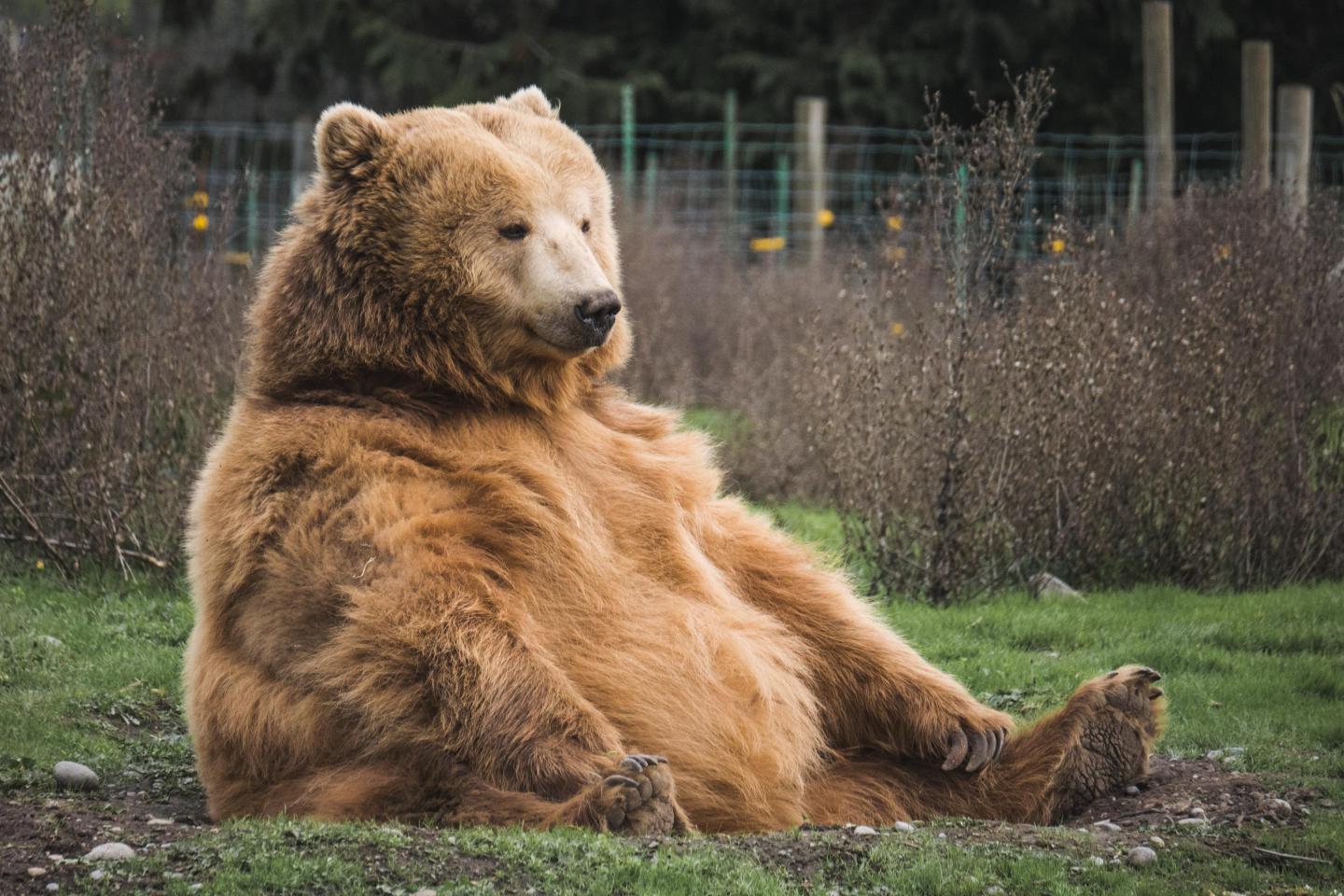
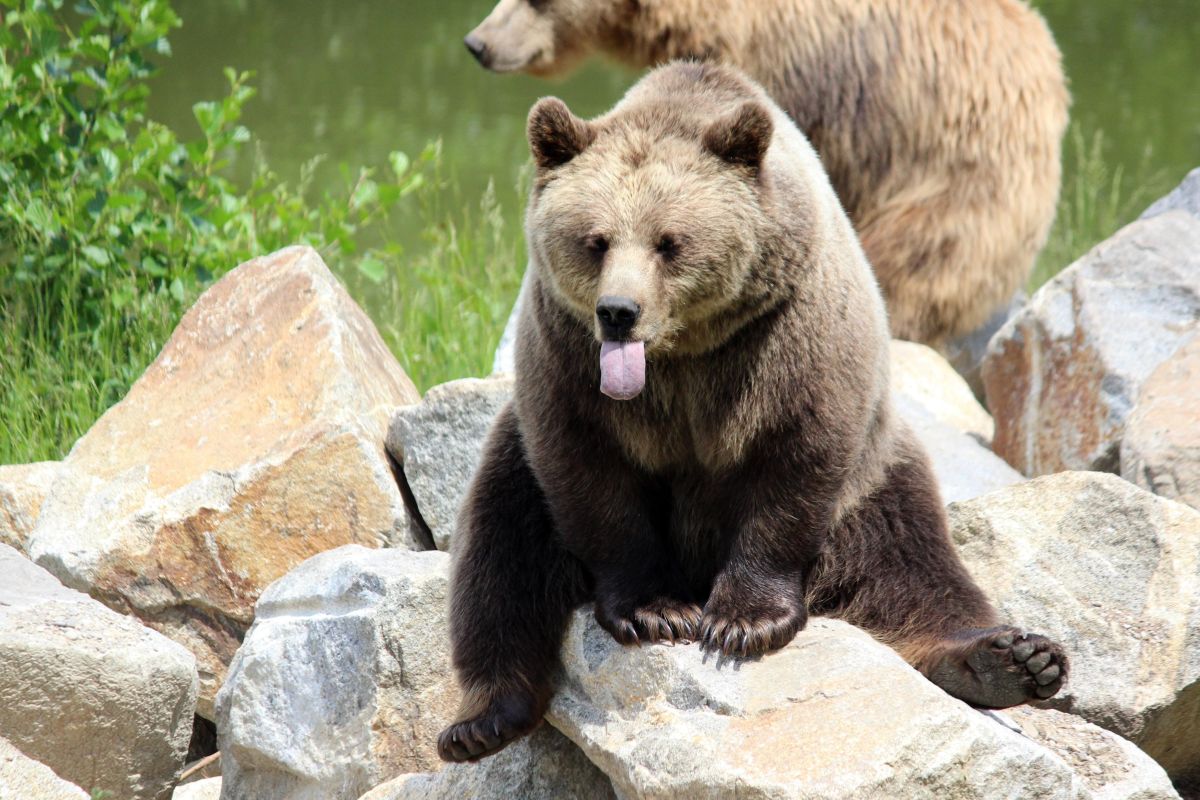
Everyone knows that fat animals are infinitely more visually appealing, much to veterinarians’ collective dismay. They may not be at their pinnacle of health, yet we love them anyway, especially when they’re babies. Bears, however, are supposed to get chunky so they get a pass. Before the winter when they hibernate, they’re all about feeding their faces and storing fat for the winter. Wildlife archivists Explore has put all these fat bears in one place so we can vote on who gets to be supreme Fat Bear. Fat Bear Week is an annual event that anyone with internet access can participate in.
The bears, unfortunately, don’t win any prizes for being named the fattest bear in Alaska, but America wins a prize by seeing big fuzzy bear bellies. Sure, the bears make you wish you could pet them and give them all the head scratches, and yes they’d probably try to eat you if you actually tried. That doesn’t stop this from being the cutest competition out there. The event is well run, with brackets to predict the winner. I don’t know what brackets are but it makes it sound so much more exciting.
When exactly is Fat Bear Week, you may be asking? It’s now, like right now, so go download your bracket thingy and enter your picks or whatever you do with brackets. Fat Bear Week runs from October 5 through October 11 and match-ups for voting start at 12 p.m. and end at 9 p.m. EST. This contest is ruthless because there are no second chances. If a bear’s extra fluff isn’t up to the internet’s standards then it’s eliminated. No take backs.
For every head-to-head match-up between chubby little cubbies, you get one vote to pick the bear that’s showing the most fat gained. The bear with the most votes gets to move to the next round and the bear with the least amounts of votes gets to no longer be judged by random strangers on the internet. Wait, I think we all would like the prize of not being judged by strangers on the internet.
This all may seem like a weird thing to have turned into a competition but it really isn’t. Fat Bear Week started in 2013 after someone took pictures of the same bear from the bear cam and commented on how fat the bear had gotten when preparing for hibernation. According to video journalist Mike Fritz, he noticed comments under the videos of the bears from the bear cam about how chubby all of the bears were getting, and an idea was born.
Can you blame the commenters? These fat bears are seriously cute and once I figure out what brackets are and how to use them, I’m going to vote in this unexpectedly wholesome contest. May the fattest bear win and come out of hibernation looking as if they haven’t skipped a meal and are well rested. Now, go vote! It’ll make you feel better.

In March 2023, after months of preparation and paperwork, Anita Omary arrived in the United States from her native Afghanistan to build a better life. Once she arrived in Connecticut, however, the experience was anything but easy.
“When I first arrived, everything felt so strange—the weather, the environment, the people,” Omary recalled. Omary had not only left behind her extended family and friends in Afghanistan, she left her career managing child protective cases and supporting refugee communities behind as well. Even more challenging, Anita was five months pregnant at the time, and because her husband was unable to obtain a travel visa, she found herself having to navigate a new language, a different culture, and an unfamiliar country entirely on her own.
“I went through a period of deep disappointment and depression, where I wasn’t able to do much for myself,” Omary said.
Then something incredible happened: Omary met a woman who would become her close friend, offering support that would change her experience as a refugee—and ultimately the trajectory of her entire life.
Understanding the journey
Like Anita Omary, tens of thousands of people come to the United States each year seeking safety from war, political violence, religious persecution, and other threats. Yet escaping danger, unfortunately, is only the first challenge. Once here, immigrant and refugee families must deal with the loss of displacement, while at the same time facing language barriers, adapting to a new culture, and sometimes even facing social stigma and anti-immigrant biases.
Welcoming immigrant and refugee neighbors strengthens the nation and benefits everyone—and according to Anita Omary, small, simple acts of human kindness can make the greatest difference in helping them feel safe, valued, and truly at home.
A warm welcome
Dee and Omary's son, Osman
Anita Omary was receiving prenatal checkups at a woman’s health center in West Haven when she met Dee, a nurse.
“She immediately recognized that I was new, and that I was struggling,” Omary said. “From that moment on, she became my support system.”
Dee started checking in on Omary throughout her pregnancy, both inside the clinic and out.
“She would call me and ask am I okay, am I eating, am I healthy,” Omary said. “She helped me with things I didn’t even realize I needed, like getting an air conditioner for my small, hot room.”
Soon, Dee was helping Omary apply for jobs and taking her on driving lessons every weekend. With her help, Omary landed a job, passed her road test on the first attempt, and even enrolled at the University of New Haven to pursue her master’s degree. Dee and Omary became like family. After Omary’s son, Osman, was born, Dee spent five days in the hospital at her side, bringing her halal food and brushing her hair in the same way Omary’s mother used to. When Omary’s postpartum pain became too great for her to lift Osman’s car seat, Dee accompanied her to his doctor’s appointments and carried the baby for her.
“Her support truly changed my life,” Omary said. “Her motivation, compassion, and support gave me hope. It gave me a sense of stability and confidence. I didn’t feel alone, because of her.”
More than that, the experience gave Omary a new resolve to help other people.
“That experience has deeply shaped the way I give back,” she said. “I want to be that source of encouragement and support for others that my friend was for me.”
Extending the welcome
Omary and Dee at the Martin Luther King, Jr. Vision Awards ceremony at the University of New Haven.
Omary is now flourishing. She currently works as a career development specialist as she continues her Master’s degree. She also, as a member of the Refugee Storytellers Collective, helps advocate for refugee and immigrant families by connecting them with resources—and teaches local communities how to best welcome newcomers.
“Welcoming new families today has many challenges,” Omary said. “One major barrier is access to English classes. Many newcomers, especially those who have just arrived, often put their names on long wait lists and for months there are no available spots.” For women with children, the lack of available childcare makes attending English classes, or working outside the home, especially difficult.
Omary stresses that sometimes small, everyday acts of kindness can make the biggest difference to immigrant and refugee families.
“Welcome is not about big gestures, but about small, consistent acts of care that remind you that you belong,” Omary said. Receiving a compliment on her dress or her son from a stranger in the grocery store was incredibly uplifting during her early days as a newcomer, and Omary remembers how even the smallest gestures of kindness gave her hope that she could thrive and build a new life here.
“I built my new life, but I didn’t do it alone,” Omary said. “Community and kindness were my greatest strengths.”
Are you in? Click here to join the Refugee Advocacy Lab and sign the #WeWillWelcome pledge and complete one small act of welcome in your community. Together, with small, meaningful steps, we can build communities where everyone feels safe.
This article is part of Upworthy’s “The Threads Between U.S.” series that highlights what we have in common thanks to the generous support from the Levi Strauss Foundation, whose grantmaking is committed to creating a culture of belonging.
In a moment conservationists are dubbing “wildlife history,” seven beavers were released into the crystal-clear waters of Glen Affric, marking a monumental homecoming for a species that disappeared from the area four centuries ago.
Forestry and Land Scotland (FLS), working alongside the charity Trees for Life, released a family of five and a breeding pair of beavers at two sites on Loch Beinn a Mheadhoin in the nature reserve in Invernesshire. These animals are now swimming in waters that haven’t felt the paddle of beaver tails since the 16th century.
For the people of Scotland, and nature lovers around the world, this release offers a profound sense of hope. It signals that we have the power to repair what was once broken, and that nature, when given the chance, can return to its rightful glory.
The long road home
To understand the magnitude of this occasion, we have to look back at what was lost. The European beaver was once a common sight across Britain. These animals were architects of wetlands, shaping the rivers and valleys people know today. Over time, however, humans hunted them to extinction for their fur, meat, and musk oil, and they disappeared from Scotland’s landscape roughly 400 years ago.
For generations, ecosystems managed without them, but their absence was felt. Rivers flowed too fast, and wetlands dried up too quickly.
The tide began to turn in 2009 with the Scottish Beaver Trial in Knapdale Forest. This marked the UK’s first licensed release of a mammal into the wild, bringing European beavers back to Argyll. The trial proved to scientists that beavers could once again thrive in Scottish waters. Since then, populations have grown in the Tay and Forth catchments, with current estimates suggesting more than 1,500 beavers now call Scotland home. The release in Glen Affric marks the next exciting chapter in this recovery, expanding their range into one of the country’s most iconic nature reserves.
Nature’s hardworking engineers
You might wonder why there’s so much commotion over what, to many, looks like a giant rodent. The answer lies in the beaver’s nickname, ecosystem “engineer.” These creatures possess a remarkable ability to transform their environment, benefiting nearly everything around them.
When beavers build dams, they slow the flow of water. This creates complex wetland habitats, ponds and pools that become nurseries for fish, amphibians, and insects. These wetlands act like giant sponges in the landscape. During heavy rains, they hold back water, reducing the risk of catastrophic flooding for downstream communities. During droughts, they store water, keeping rivers flowing and providing a lifeline for wildlife.
Dams have dramatic impacts on the surrounding ecosystem. Photo credit: Canva
Recent studies highlight the benefits of beaver reintroduction for ecosystems. Research led by the University of Stirling found that beaver dams can reduce peak water pollution levels by 95%. These dams act like the kidneys of a river system, filtering out agricultural runoff and helping keep the water clean. By bringing beavers back to Glen Affric, scientists have effectively reinstalled a natural life-support system for the entire glen.
Added bonus: a boost to local communities
The return of the beaver is good news for people, too. Across Scotland, the presence of these charismatic creatures is becoming a significant draw for visitors—and a boost to local economies. Wildlife tourism is booming, with “beaver safaris” in places like Perthshire often booked to capacity.
Estimates now suggest that a single reintroduction site could eventually inject an estimated £2 million—roughly $2.7 million—into the local economy each year. Visitors come for the chance to see a beaver gliding through the water at dusk or to spot the telltale signs of gnawed wood and dams. This interest in the environment supports local hotels, guides, and cafes, breathing new life into rural areas.
Crucially, the Glen Affric release was not a top-down decision. FLS and Trees for Life spent years engaging with local communities, listening to concerns and building a plan that works, for the most part, for everyone. This model of community consultation helps ensure holistic sustainability and that the beavers are welcomed neighbors rather than a nuisance, setting a high bar for conservation projects worldwide.
A bright vision for the future
This release is part of a larger picture. In 2022, the Scottish Government published “Scotland’s Beaver Strategy 2022-2045,” an ambitious roadmap endorsed by more than 45 organizations. The mission is simple but powerful: to see the beaver population actively expand across Scotland.
@stvnews Beavers have returned to the Glen Affric National Nature Reserve in the Highlands, 400 years after their extinction in Scotland. #stvnews #scotland #beavers♬ original sound – STV News
The strategy recognizes that beavers are essential allies in tackling the twin crises of biodiversity loss and climate change. By restoring wetlands, beavers help sequester carbon and create natural firebreaks in forests. Scotland is hoping for a future in which beavers are no longer a novelty but an integrated, widespread part of the natural world.
Navigating challenges
Of course, bringing back a species that’s been gone for nearly 400 years comes with its own learning curve. In low-lying areas, beaver activity can cause localized flooding that impacts farmers on prime agricultural land.
This is where the beaver strategy shifts from pure conservation to vigilant, careful management. Mitigation comes first: tree guards protect timber, and “flow devices” are installed on dams to regulate water levels. If conflicts remain unresolved, beavers are translocated, with experts trapping and moving them to areas where they are wanted and needed, such as the family relocated to Glen Affric.
Approaches like these balance and respect the needs of land managers while acknowledging the broader benefits to biodiversity. They recognize that living alongside wildlife requires compromise and adaptation, but that the rewards are well worth the effort.
A legacy of hope
As the seven beavers settle into their new lodges in Glen Affric, scientists look forward to them building dams—and a legacy. These animals represent a meaningful shift in how we relate to the natural world, moving from a mindset of exploitation to one of restoration.
Steve Micklewright, the chief executive of Trees for Life, described the release as a “moment of wildlife history.” In a world where we often hear about what we’re losing, the return of the beaver after 400 years is a powerful reminder of what we can regain. It offers a tangible sign that with patience, cooperation, and a little help from our furry friends, we can heal our landscapes and leave a richer, wilder world for future generations.
Wintery weather can be beautiful, but it can also be brutal when temperatures dip to frigid levels, not just for humans but for animals as well. Stray animals are generally pretty good at taking care of themselves, especially stray cats, but kind-hearted people still want to make sure they have a place to go to escape the elements when harsh conditions hit.
One woman took that desire to the next level with an elaborate cat apartment she built for the many stray cats in her neighborhood. We’re not just talking about a shelter; it’s like luxury hotel living for her feline friends. The apartment has multiple rooms, cushy blankets that get taken out and cleaned, and even a temperature-controlled water source so they’re always able to find drinking water in below-freezing temps.
The woman who built the apartment actually lives in China and was sharing her videos on TikTok, but it seems her account has since been deactivated. This hasn’t stopped people from talking about her and her impressive project, though. This thread on TikTok contains updates about the cat hotel from people finding and reposting the adorable story.
Welcome to the Meowtel Catifornia
Of course, the clever hotel jokes and puns started rolling in first thing:
‘Welcome to the hotel catifornia.”
“Such a lovely place.”
“They can check out any time but they won’t ever leave.”
“I prefer Hotel Calicofornia.”
“Meowriott.”
“Given my skill, mine would be more like Meowtel 6.”
People loved seeing the care and ingenuity she put into the “meowtel,” as well as how happy the cats seem with the arrangement. In fact, some people were sure their own house cats would move out just to go live in this kind of cat commune.
“My cat just looked at me and sighed…”
“All the neighbours be looking for their cats and they’ve bailed to live at the kitty motel.”
“They’d pack their little bags and move in without a second thought.”
“They wouldn’t even wait to pack their bags.”
“Alright Carol it’s been real but we’re gonna head out. Found a great deal on a luxury apartment so yanno… take care.”
Cats live where they want, when they want
Those people may have been joking, but several others shared that their cats really did ditch them to go live with neighbors who had more desirable living situations.
“I’ve had two cats do this. One was annoyed at our second dog’s puppy energy so she moved in with an older lady a street over. We used to see her all the time until she passed. The other missed our kids being little so she moved next door where there’s a little girl. We talked to both neighbors and said if they get sick of them to let us know and we’ll take them back but both lived the rest of their lives with their new families.”
Some stray cats wander from home to home like a drifter. Photo credit: Canva
“One of our cats moved next door because he loves children and wanted to be with the little girl next door. Because it’s a very small village, he goes to the school most days to wait for her and they come home together. School is 3 buildings away.”
“We had a cat do the same thing about 20 years ago. She hated the barks of our new puppy and would put her paw on his mouth to try and stop it. One day, she slipped outside and I found her a month later, two streets over, hanging with a couple who didn’t have a dog. They said she just showed up at the door and moved in. I gave them all her cat food and hope she had a nice quiet life.”
Is it a bad idea to feed and shelter stray cats?
People have differing opinions about whether it’s good to feed stray cats or not, as cats can cause problems for local wildlife, and it’s not great to encourage an increasing stray cat population. According to Catster, in the United States alone, an estimated four billion birds and 22 billion mammals (such as mice, voles, rabbits, and shrews) are killed annually by both domestic and stray cats. In Canada, cats are the number one killer of birds, killing “between 100 and 350 million birds every year.” These numbers are staggering, but the bird and small mammal populations can be protected if stray cats are cared for responsibly: namely, spaying and neutering those in your area to cut down on the population and finding homes for those who are friendly and comfortable with humans.
Police departments have long relied on the incredible smelling power of canines, but even their sniffing skills have their limits. Bodies of water, for instance, aren’t exactly locations that dogs can traverse easily, hence why oceans and lakes are often spots that criminals might dispose of evidence or victims.
That’s where Splash comes in. Splash is an Asian small-clawed otter specially trained to detect and recover human remains in the water. Hey, it’s a tough job, but somebody’s got to do it.
How exactly did Splash stumble (or swim) upon this unique career normally reserved for dogs? You have his owner, Michael Hadsel, to thank for that.
An image of Splash with his owner,u00a0Michael Hadsel @prsark/Facebook
For the last 46 years, forensic diver Hadsel has trained dogs SAR squads, law enforcement, and recovery teams through his Peace River K9 Search and Rescue company. Around 2018, Hadsel began seeing if other animals, like horses, could also be trained to sniff out dead bodies. Then he read an article about fishermen in Bangladesh and India teaching local river otters to chase prey into fishing nets.
Once Hadsel learned that otters are believed to be the only mammals capable of smelling underwater—a feat they achieve by exhaling small, rapid air bubbles from their noses and sniffing them back in—he began attempting to train them to do similar K9 tasks. By 2024, Splash had been adopted and proved to be quite a worthwhile trainee.
A phot of Splash in a pool perfoming his training @prsark/Facebook
According to an interview with Outside, Splash’s training went a little something like this: Hadsel would mark an object with the odor of human remains in a pool. Then, he placed that same smell on a ball on the end of a stick. After Hadsel said the word “Hoffa” (a nod to a Teamsters president who disappeared in the ‘70s), Splash would sniff the ball, dive into the pool, and go searching for the same scent.
If Splash inhaled bubbles with the same odor on the ball, he would swim back and notify Hadsel in exchange for a piece of salmon. Farm-raised only, apparently. “He won’t eat wild salmon,” Hadsel told Outside.
Where Splash could easily smell underwater, hearing was a different story, since otters have a membrane that protects their ears when they swim. But once Hadsel tied a string to Splash and developed a tug language (“One tug is turn right, two tugs is turn left, and three tugs is come back to the boat.”), that would prove to be a minor obstacle.
Following his debut mission in Alabama, where he helped recover a weapon used in a 25-year murder case, Splash has been on 27 recovery missions across the country, and has so far had six confirmed finds, including four bodies. Morbid, sure, but without him, these cases go unsolved.
Splash’s success has turned him into an online sensation. He’s made the Peace River K9 Search and Rescue Facebook page blow up, has been featured by several news outlets, and he’s been invited to multiple law enforcement conferences. He is, after all, the first of his kind.
Whether or not Splash will be the first of many search and rescue otters remains to be seen, and there are still a few other challenges to face, like how to deal with potential predators in the water. But Splash is a shining example of the awesome power of nature itself, which will always be our greatest collaborator.
What creatures have eight legs, nine brains, and dozens of fun and fascinating facts about them? Octopuses, of course. (Wait, is octopuses or octopi? Octopodes, perhaps?)
“However impressed or fascinated you are by octopuses, it’s honestly probably not enough,” she says. “We are severely underreacting to octopuses collectively.”
Once you see her video, it’s clear she’s not wrong.
With a hilariously understated sense of humor, Sarah shares facts like the idea that octopuses don’t have tentacles, as many of us have been led to believe, but arms instead. Tentacles have suckers only at the end, while an octopus’s arms have them from top to bottom.
“They decorate their front yards with shells and other shiny things they find in the ocean,” Sarah says, adding, “I wonder if they judge other octopuses for how they decorate their front yard. Like, is there an octopus HOA?”
Sarah points out that The Beatles’ song “Octopus’s Garden” was inspired by this delightful fact.
I’d like to be, under the sea…
Listen as 'Octopus’s Garden' evolves — from the rehearsal to the final master ? pic.twitter.com/qJItnY6PIY
Many of us know that octopuses are smart, but we may not know that they have a brain in each arm in addition to the brain in their heads, which is shaped like a donut. They can solve mazes and complete tricky tasks. And if their beak can fit through a hole, so can their whole body.
“So a fully grown giant Pacific octopus, which can literally be 30 feet long, can fit through a hole the size of a lemon,” says Sarah. “And I don’t care for that, particularly. I would never say that to an octopus’s face because, evidently, they can recognize us, which I find unsettling. Note to self: Do not be mean to an octopus.”
Because each arm has its own brain, it can operate independently, complete with its own sensory system.
“I feel like they’re smarter than us,” Sarah says. “Are we confident they’re not smarter than us? For instance, they will prank their prey. You know the joke where like old men will tap you on one shoulder, but surprise, they’re at the other shoulder? Octopus do that. If they’re hunting a shrimp, they’ll tap it on the faraway shoulder so the shrimp runs directly into them. Like, ‘gotcha!’ I don’t want octopus to do gotcha.”
On a positive note, Sarah shows some examples of exquisitely colorful octopuses, though some of the most “fancy and beautiful” ones are also highly venomous.
That may have been the end of Sarah’s video, but she wasn’t finished. There’s a part two that features blanket octopuses, the female superheroes of the sea. And that’s not even the wildest part:
A male blanket octopus is basically an inch tall and the female can grow to over six feet. The males can fit inside the pupil of the female’s eye. What?! Basically, their only job is to produce sperm, which just raises way too many questions.
Sarah also talks about the mimic octopus, which she calls “the Jafar of the ocean” because it’s basically a sorcerer (and one of them genuinely looks like Jafar from Aladdin).
That wasn’t all. Even after the second video, she still wasn’t done. Part three was every bit as fascinating, terrifying, wonderful, and chuckle-worthy as the first two (and also slightly NSFW in the most PG way possible):
The blob octopus? Who even knew? The eighth-arm situation is too much. Sarah was 100% right. We are, collectively, not reacting to octopuses nearly as strongly as we should be.
Eggs are a staple food in most American households, used for everything from breakfast scrambles to cakes, cookies, and custards. We don’t generally specify what kind of eggs we mean when we say “eggs” in the U.S, but we’re almost always talking about chicken eggs. Occasionally, we might see duck eggs or quail eggs on a menu, and rarely, something exotic like an emu egg. But do we ever see turkey eggs being served? Nope, pretty much never.
Considering how many turkeys are raised domestically in the U.S. (around 218 million) and how many wild turkeys roam among us (around 7 million), it seems like we should make better use of their eggs. They are egg-laying birds, after all, and since turkey meat is so similar to chicken meat, it seems logical that turkey eggs would be similar to chicken eggs, right?
Basically, that’s true. Turkey eggs are larger than chicken eggs, and they have a stronger shell, but from what people say, they’re similar to eating chicken eggs, only a little richer. Larger and richer, and yet we don’t eat them on the regular? Why the heck not?
The Self-Sufficient Backyard YouTube channel explains the whole thing in a video that’s been viewed by nearly 4 million people. Clearly, this is a burning question for people once it’s brought to their attention.
Basically, what it boils down to is that their size makes them hard to handle, package, and store. Turkeys also aren’t nearly as prolific as chickens. (Chickens lay eggs around once per day, while turkeys lay at most twice per week.) It’s also more expensive to raise turkeys than chickens, so the price of a turkey egg is prohibitive, at around $3 per egg. Considering how everyone lost their minds over chicken eggs at $6 a dozen, it’s unlikely people would pay $36 for a dozen turkey eggs.
However, some people who have eaten turkey eggs shared their thoughts on how they taste, and now people (me, I am people) really want to try them:
“I have eaten turkey eggs for years. They are larger shells are thicker but they taste wonderful.”
“I’ve baked with Turkey eggs and they made the best pancakes I have EVER tasted.”
“They taste like chicken eggs, I have turkeys. They only lay seasonally, generally starting in March, and they’ll continue to lay through June-August. They can lay 60ish eggs a year. They’re about 2x the volume of a chicken egg. They make excellent omelettes. Harder to crack, with a thicker membrane and shell.”
Growing up, my family had a turkey! She laid eggs and we were always enamored by how huge they were. They taste wonderful!”
Turkey eggs are delicious, according to folks who've eaten them. Photo credit: Canva
“We had turkeys with our chickens. They laid eggs daily with the chickens from March to September then would stop while the chickens would just slow down. I was surprised because I thought they would just lay a clutch once or twice because that’s what the wild turkeys do but nope. The only down fall we found was that cracking them was difficult. But if you use a butter knife to give it a whack at the top it works pretty well. It was like getting two egg whites and one yolk in chicken egg ratio lol.”
“Taste exactly like chicken eggs. Way bigger. The only difference is the shell is way tougher to crack. So good.”
Apparently experience with turkeys and turkey eggs is not uncommon? City folks, take note:
“I was raised on turkey’s eggs… I come in from a part of Canada where we are raising turkeys. In Valcartier, turkey eggs used to be much cheaper than any other kind of eggs.”
“Growing up on a farm being born in the 50s in western North Carolina we ate lots of turkey eggs. We usually had a dozen or so hen turkeys so we had quite a few to spare.”
“My inlaws usually give us turkey eggs for the holidays. They have a big farm in Virginia with all sorts of animals. They usually just sell their eggs at the local market and give us the rest lol.”
“The wild turkeys that live in my area used to get in my bird feeders when I had a house. One day I found an egg in the yard, possibly as payment lol.”
Turkey eggs are larger than chicken eggs, making them tricky to package and transport. Photo credit: Canva
“I’ve got a turkey for a pet. Her name is “Sweetpea” and I keep her around for no other reason except that she’s awesome and provides good conversation. Every now and then during the warm months of the year she leaves me breakfast somewhere around the yard.”
And then, just for funsies, there’s this little anecdote about those “technically edible” emu eggs:
“Back in elementary school we had a teacher that raised Emus. She would always make delicious cakes but would tell no one how she made them. Eventually she told my mother the reasons she told no one was because she was afraid that people would stop eating them if they found out that she was using one emu egg for every three chicken eggs. We didn’t care.”
There you go. Answering a question you may never have asked, but desperately needed answered once you thought about it. (Kind of want to try one now, don’t you?)
This article originally appeared last year. It has been updated.
Imagine you’re a skunk, just minding your own business waddling down the street. You’re sniffing around when suddenly a glass jar gets stuck onto your snout. It becomes harder to breathe as carbon dioxide fills the jar, leaving you little to no room to exhale.
The clock is ticking. Perhaps you begin to panic. But, because there really is still absolute good in this world, so you’re in luck.
This is what happened when Cheryl Rhodes spotted a skunk with a jar on its head. In a video posted to her TikTok page in December 2025, we see her running after the tiny skunk, knowing that time is of the essence. “Oh gosh, please,” she exclaims. As she approaches, she bends down and beckons, “Come here, baby. Come here, come on.” The skunk continues walking toward her as she gently gives it direction. “Come here. Let me get it off of your face.”
I found a lil skunk with a glass jar stuck on its head. Against my husband’s advice, I pursued the skunk. I’m still in shock that it let me relieve it without retaliation. Ain’t smellin like a skunk today! #skunkrescue#animalrescue#skunkslivesmatter#savealife#skunksoftiktok
She gingerly reaches out and grabs the jar, lifting the skunk temporarily into the air. Her voice becomes tense. “Please get it off. Please come on. Good boy!” She is able to remove the jar and quickly yells to her husband, “Honey, I got it! He didn’t spray me!” She then cries in joyous relief.
The last shot of the clip is of the dirty little jar, which created all the trouble in the first place.
Rhodes told Storyful, “I asked my husband to try to take the glass jar off the skunk’s head. He said no, he’s been sprayed before in the past. I couldn’t just leave the skunk in that condition. My husband started to record unbeknownst to me. He thought I was going to get sprayed. Thankfully, I had a much better outcome.”
Skunk spray is actually a fluid stored in their glands. Other animals, like opossums, have similar abilities. Havahart, “a leading manufacturer of wildlife control products,” explains, “Skunk spray consists of a chemical called N-butylmercaptan, which is a pungent mix of sulfur-based compounds. The skunk stores the spray in glands positioned alongside its anus, which is why it needs to lift its tail to spray.”
On the ABC Humane Wildlife site, they share that skunks don’t actually enjoy spraying. “They actually only use their spray as a last resort when they feel they have exhausted all of their other defense mechanisms. A skunk only holds about 4 tablespoons of its noxious fluid, and it can take several days to replenish, leaving it vulnerable in the meantime.”
In fact, they often attempt other defense mechanisms first. “When someone is bold enough to threaten them, the skunk’s first instinct is to run away. If this doesn’t work, it will turn around to face its enemy, raise its tail as a warning, and stomp its front feet. If this still isn’t effective in scaring away the attacker, the skunk will then use its spray.”
The comments on this heroic story are so lovely. On TikTok, one person paraphrases writer Karen Davidson, who once said, “Saving one dog won’t change the world, but for that one dog, the whole world will change forever.” The commenter changed it to, “Saving one animal won’t change the world, but for that one animal, the whole world will change forever.”
Another notes the tears at the end. “The crying while walking away victorious in your rescue mission is so valid.”
Yet another noticed the skunk seeming to trust her, though it must have also been terrified. “The fact that the skunk came to you for help makes me (four smiling face emojis).”
And many simply wish the skunk-helper wonderful wishes. “I hope your pillow is always cool and you get all the green lights when you’re running late.”
On ABC 7’s Instagram, others relay their admiration for Rhodes rescue. “I don’t know her, but I love her,” says one. Another agrees, “More people like her in the world please.” And “Bay Area…protect this woman at all costs.”
Another Instagrammer notes what helping the skunk says about her character. “You know the type of person they are when they show compassion towards animals.”
Unfortunately, the world isn’t always safe for animals like these. In a perfect scenario, a skunk or other wildlife wouldn’t have access to a dangerous jar or other trash that might be left around.
Environmental consultant and educator Roberta C. Barbalace writes on EnvironmentalChemistry.com how dangerous trash can be, giving many examples. “Broken glass can cut the feet of foxes, coyotes, or badgers, and unbroken bottles present a hazard to various small animals. Lizards often crawl inside bottles or cans to bask in the warm interior, to seek protection, or search for food; but they may find it difficult to squeeze out again and can die of overheating. Small mammals in search of food often get their heads caught in the openings of jars. Replacing lids on bottles and jars before discarding can help prevent animals from becoming entrapped. Birds, fish, and mammals may be ensnared by plastic six-pack holders.”
But there are solutions: “This can be prevented by cutting up the plastic rings so that they do not become traps.”
There are other ways people can do their part. The website Plain Disposal offers tips on keeping raccoons, skunks, and even bears safe and out of your trash.
“Keep trash in a secure location,” they recommend. “When possible, store your trash inside an enclosed shed or garage until it’s time for pickup. This will prevent animals from accessing it and help keep the trash contained and out of sight. This is probably the easiest solution to keep wildlife out of trash.”
They also suggest “installing a small secure enclosure or fencing area where you can store your bins,” and/or putting your trash out of reach. “Elevating your trash bins off the ground can help deter them.”
As for this little skunk, hopefully it went on to have the best day milling about town—thanks to this good, animal-loving Samaritan.
We often think of war as a strictly human phenomenon, but there are plenty of structured territorial battles that go on within the animal kingdom. Ants, in particular, engage in highly complex warfare, including “slave-making” (raiding other species’ nests to steal young) and large-scale territorial conflicts between colonies.
In fact, there is one ant battle that’s gone on for so long that experts think it might be the longest non-human conflict in the world.
As explained by a video posted by Michael McBride, creator of the “edutainment” social media channel @IdeaSoup, this ongoing conflict spans a whopping 600 miles of the California coast. The main antagonist, if you will, is a “super colony” of Argentine ants, which have a unique set of superpowers.
For one thing, Argentine ants ignore other nests of the same species. They also support several queens, rather than one. This allows them to create massive interconnected, cooperative colonies that span across continents.
In fact, they “co-colonized” alongside the Europeans during a “peak point” of colonization. ”The earliest record of the Argentine ant in the United States specifically is from around 1890, when ships carrying sugar from Argentina landed in New Orleans. They traversed 2,000 miles to reach the Golden State sometime around 1905, and have been waging war ever since. Some believe that the Argentine ant is the only non-human species capable of such widespread “globalization,” according to McBride. They are technically the largest society in the world.
The warfare that goes on between Argentine ants and other super colonies is “surprisingly complex,” said McBride, with defined frontlines on which 30 million ants die every year. And yet, the Argentine ants have the upper hand in their ability to unite. They might not have the size that some species possess, nor large mandibles, nor a stinger for weaponry, but they do have relentless aggression, overwhelming numbers, and extreme organization.
That, and their proclivity for chemical warfare. A major strategy Argentine ants implement is spraying toxic chemicals onto their enemies, which disorients the victim and marks them for other Argentine ants. A mob then surrounds the prey, pins them down, and dismembers them.
Showing that their greed knows no bounds, Argentine ants also rather easily take down spiders, flies, and other native insects. And when those resources are exhausted, they might find themselves in our own homes. Yes, these are the ants we might see lurking in our pet food bowls, kitchens, and dumpsters.
Gardens are a particularly precarious place for Argentine ants to dwell, because, get this, they are apparently capable of making negotiations with aphids. In exchange for the aphid’s sweet secretion (yuck), Argentine ants will kill off their predators.
However, while Argentine ants have won many, many battles in California, they might not yet win the war. Some of their factions have broken off and formed their own empires, resulting in civil war and compromising their most winning strategy.
That, and fire ants, which also came from South America by way of Alabama, are a formidable foe, both in aggression and the ability to super-colonize. They’re also larger in size and have venomous stingers. Basically, the war they waged in their homeland has now been moved to foreign lands. Who shall become the ultimate victor is still up to fate. Are you not entertained?!
Sure, some dogs lick way more than others, but it’s rare to find a dog who never licks anyone or anything. Many dogs communicate and show affection by licking, which is sweet—if a little gross—depending on how slobbery they are. There’s a common saying that dogs’ mouths are cleaner than humans’, which is a bit hard to believe when you see what some dogs put in their mouths, but it is true?
What does science say about dog tongues and saliva? Is a dog licking our face something we should worry about?
It turns out, the answer to whether a dog’s mouth is cleaner than ours isn’t super straightforward.
An 8th grader named Abby tackled this question in a science experiment that won her a Young Naturalists Award from the American Museum of Natural History in 2011. Her family had gotten a dog and her mom kept telling her not to let the dog lick her face because dog mouths are full of bacteria. Instead of arguing, Abby decided to find out herself if this was true.
“I hypothesized that human tongues would be cleaner than dog tongues,” she wrote. “I thought this because humans brush their teeth at least once a day. I hypothesized that dogs’ tongues would be dirty because they were always licking dirty things like garbage.”
After diving into the research about bacteria that live in and on humans and dogs, Abby decided she had a testable hypothesis. But this wasn’t any old middle school science experiment. She applied for and got a grant to the State Hygienic Lab at the University of Iowa, where she was assigned a mentor to work with her.
You can read the nitty-gritty details of her experiment here, but it involved a lab, swabs, agar plates, and more. Here was the conclusion:
“I concluded that dog and human mouth flora are very different. (Flora means the bacteria found in a mouth or anywhere else.) The bacteria found in human mouths are more similar to another human’s oral bacteria than the bacteria found in a dog’s mouth.
“I also concluded that dogs’ mouths are cleaner than humans’ in some ways, and dirtier in other ways. Humans have more bacteria in their mouths than dogs do, based on the total number of bacteria. Most of the humans had a ‘moderate’ number of bacteria, and most of the dogs had ‘few’ bacteria. A possible explanation of this might be that dogs pant a lot, and maybe while panting, bacteria falls off their tongues along with their saliva. But dogs had more types of bacteria. The average number of different bacterial colonies in a dog’s mouth was about 5.7. The average number of different bacterial colonies in a human’s mouth was about 4.1. I think this is so because dogs sniff and lick a variety of things, like carpets, floors, chairs, grass, etc., so they pick up bacteria from many places.”
But what about the licking of our faces? That’s a bit of a subjective call, but Abby’s results gave her some peace of mind:
“In conclusion, will I let my dog continue to lick me? The answer to the question is yes!” she wrote. “I will feel guiltless about letting my dog lick me because I found out that human and dog oral bacteria are different, so my dog’s oral bacteria present no harm to me.”
What do the experts say?
According to Colin Harvey, professor at the University of Pennsylvania’s School of Veterinary Medicine and executive secretary at the American Veterinary Dental College, comparing dogs’ mouths to humans’ mouth is “like comparing apples to oranges.” As Abby found, the microbes in a dog’s mouth are very different than those in a human’s.
“Most of the bacteria in your dog’s mouth aren’t zoonotic, which means you probably won’t get a disease from a big old doggy kiss. There are exceptions to this. Dogs that eat a raw diet are at an increased risk of contracting salmonella, which can be spread to humans. You also probably shouldn’t share kisses with a dog that regularly raids the litter box.
In other words, kissing your dog is less risky than kissing another human, but that doesn’t mean that your dog’s mouth is necessarily cleaner than a human’s—they just have a mostly incompatible set of germs.”
Keeping your dog’s mouth healthy through regular teeth cleaning and dental check-ups can also help prevent issues that could potentially come from dog licks.
So there you have it. If your dog doesn’t eat a raw diet and doesn’t go snacking in the cat box (or some other equally fecal-bacteria-ridden place), their kisses are probably not going to hurt you. Guilt-free pooch smooches for the win!