
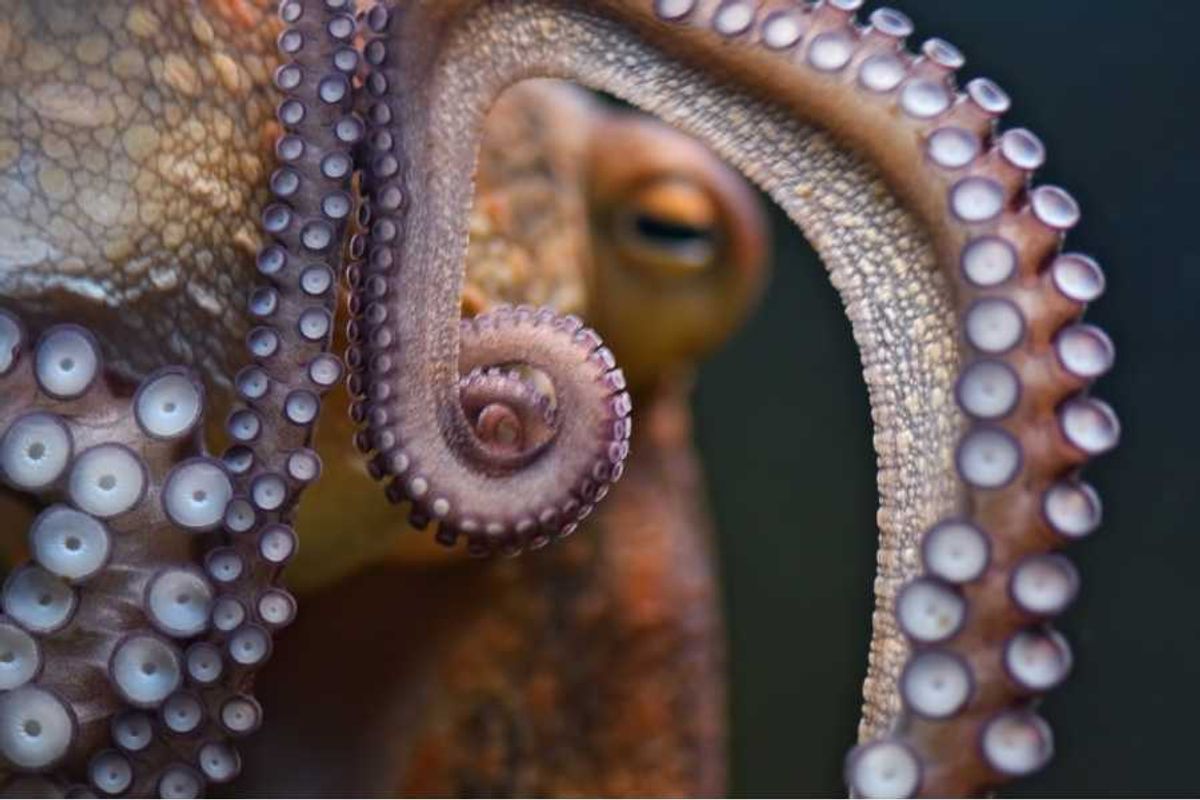
Octopuses are just wildly interesting creatures.
What creatures have eight legs, nine brains, and dozens of fun and fascinating facts about them? Octopuses, of course. (Wait, is octopuses or octopi? Octopodes, perhaps?)
However interesting we think our suction-cupped, cephalopodic friends are, we're probably selling them short. That's the contention of Sarah, a comedic content creator on TikTok who's been sharing everything she's learned about octopuses, because they're far more bizarre than we might think.
"However impressed or fascinated you are by octopuses, it's honestly probably not enough," she says. "We are severely underreacting to octopuses collectively."
Once you see her video, it's clear she's not wrong.
@sarahmakesmelaugh Octopuses are fascinating and I DO want to hold a tiny guy if possible just putting that out in to the universe 😬🐙#creatorsearchinsights #octopus #weirdanimals #animalfacts #didyouknow
With a hilariously understated sense of humor, Sarah shares facts like the idea that octopuses don't have tentacles, as many of us have been led to believe, but arms instead. Tentacles have suckers only at the end, while an octopus's arms have them from top to bottom.
"They decorate their front yards with shells and other shiny things they find in the ocean," Sarah says, adding, "I wonder if they judge other octopuses for how they decorate their front yard. Like, is there an octopus HOA?"
Sarah points out that The Beatles' song "Octopus's Garden" was inspired by this delightful fact.
Many of us know that octopuses are smart, but we may not know that they have a brain in each arm in addition to the brain in their heads, which is shaped like a donut. They can solve mazes and complete tricky tasks. And if their beak can fit through a hole, so can their whole body.
"So a fully grown giant Pacific octopus, which can literally be 30 feet long, can fit through a hole the size of a lemon," says Sarah. "And I don't care for that, particularly. I would never say that to an octopus's face because, evidently, they can recognize us, which I find unsettling. Note to self: Do not be mean to an octopus."
Because each arm has its own brain, it can operate independently, complete with its own sensory system.
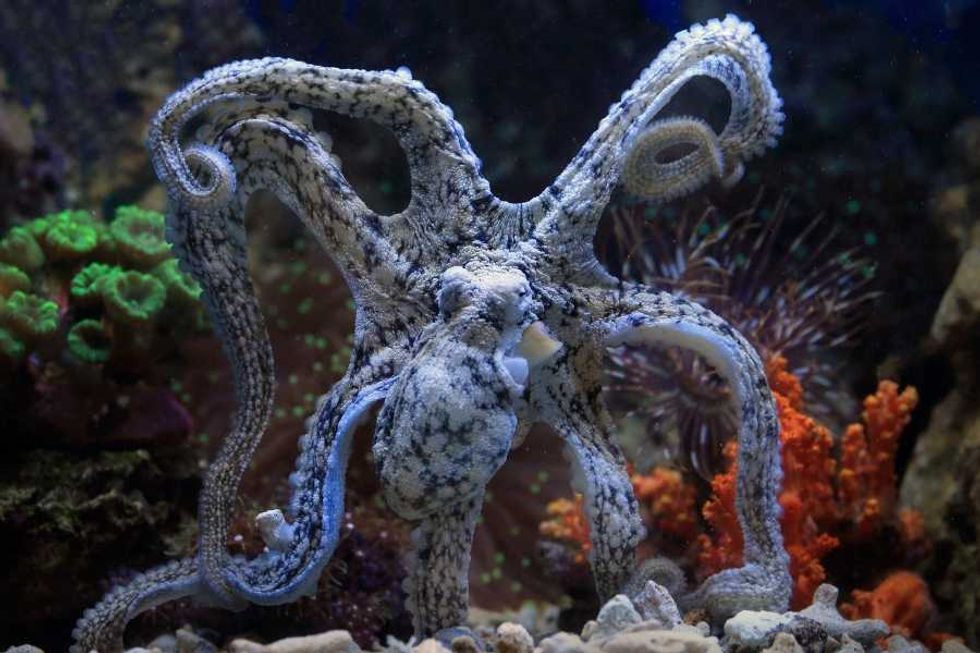 Each of those arms has its own brain?Photo credit: Canva
"I feel like they're smarter than us," Sarah says. "Are we confident they're not smarter than us? For instance, they will prank their prey. You know the joke where like old men will tap you on one shoulder, but surprise, they're at the other shoulder? Octopus do that. If they're hunting a shrimp, they'll tap it on the faraway shoulder so the shrimp runs directly into them. Like, 'gotcha!' I don't want octopus to do gotcha."
On a positive note, Sarah shows some examples of exquisitely colorful octopuses, though some of the most "fancy and beautiful" ones are also highly venomous.
That may have been the end of Sarah's video, but she wasn't finished. There's a part two that features blanket octopuses, the female superheroes of the sea. And that's not even the wildest part:
@sarahmakesmelaugh Replying to @LalainID did yall know about the blanket octopus and didn’t tell me? Except those of you who did thank you 😂 #octopus #animalfacts #science #learnontiktok #learnwithme
A male blanket octopus is basically an inch tall and the female can grow to over six feet. The males can fit inside the pupil of the female's eye. What?! Basically, their only job is to produce sperm, which just raises way too many questions.
Sarah also talks about the mimic octopus, which she calls "the Jafar of the ocean" because it's basically a sorcerer (and one of them genuinely looks like Jafar from Aladdin).
That wasn't all. Even after the second video, she still wasn't done. Part three was every bit as fascinating, terrifying, wonderful, and chuckle-worthy as the first two (and also slightly NSFW in the most PG way possible):
@sarahmakesmelaugh More Octopus species, this could go on forever y’all 😂 #octopus #weirdanimals #learnwithme #funfacts #creatorsearchinsights
The blob octopus? Who even knew? The eighth-arm situation is too much. Sarah was 100% right. We are, collectively, not reacting to octopuses nearly as strongly as we should be.
You can follow Sarah (@SarahMakesMeLaugh) on TikTok.

 Homemade granola bars with chocolate chips – perfect for a delicious snack!
 Refresh with a healthy green juice boost.
 Making fresh orange juice in the kitchen. 🍊
 Be careful with supplements.
 A man being licked by a golden retreiver.
  A dog's tongue close-up.
  A golden retreiver getting their teeth brushed.
 A white porcelain doll with a tear stain. Photo by
Men try to read the most disturbing comments women get online back to them.
If you wouldn't say it to their faces, don't type it.
This isn’t comfortable to talk about.
Trigger warning for discussion of sexual assault and violence.
in 2016, a video by Just Not Sports took two prominent female sportswriters and had regular guys* read the awful abuse they receive online aloud.
Sportswriters Sarah Spain and Julie DiCaro sat by as men read some of the most vile tweets they receive on a daily basis. See how long you can last watching it.
*(Note: The men reading them did not write these comments; they're just being helpful volunteers to prove a point.)
It starts out kind of jokey but eventually devolves into messages like this:
Awful.
All images and GIFs from Just Not Sports/YouTube.
These types of messages come in response to one thing: The women were doing their jobs.
Those wishes that DiCaro would die by hockey stick and get raped? Those were the result of her simply reporting on the National Hockey League's most disturbing ordeal: the Patrick Kane rape case, in which one of the league's top players was accused of rape.
DiCaro wasn't writing opinion pieces. She was simply reporting things like what the police said, statements from lawyers, and just general everyday work reporters do. In response, she received a deluge of death threats. Her male colleagues didn't receive nearly the same amount of abuse.
It got to the point where she and her employer thought it best for her to stay home for a day or two for her own physical safety.
The men in the video seemed absolutely shocked that real live human beings would attack someone simply for doing their job.
Not saying it.
All images and GIFs from Just Not Sports/YouTube.
Most found themselves speechless or, at very least, struggling to read the words being presented.
It evoked shame and sympathy.
All images and GIFs from Just Not Sports/YouTube.
Think this is all just anecdotal? There's evidence to the contrary.
The Guardian did a study to find out how bad this problem really is. They combed through more than 70 million comments that have been posted on their site since 2006 and counted the number of comments that violated their comment policy and were blocked.
The stats were staggering.
From their comprehensive and disturbing article:
If you can’t say it to their face... don’t type it.
All images and GIFs from Just Not Sports/YouTube.
So, what can people do about this kind of harassment once they know it exists?
There are no easy answers. But the more people who know this behavior exists, the more people there will be to tell others it's not OK to talk to anyone like that.
Watch the whole video below:
This article originally appeared nine years ago.