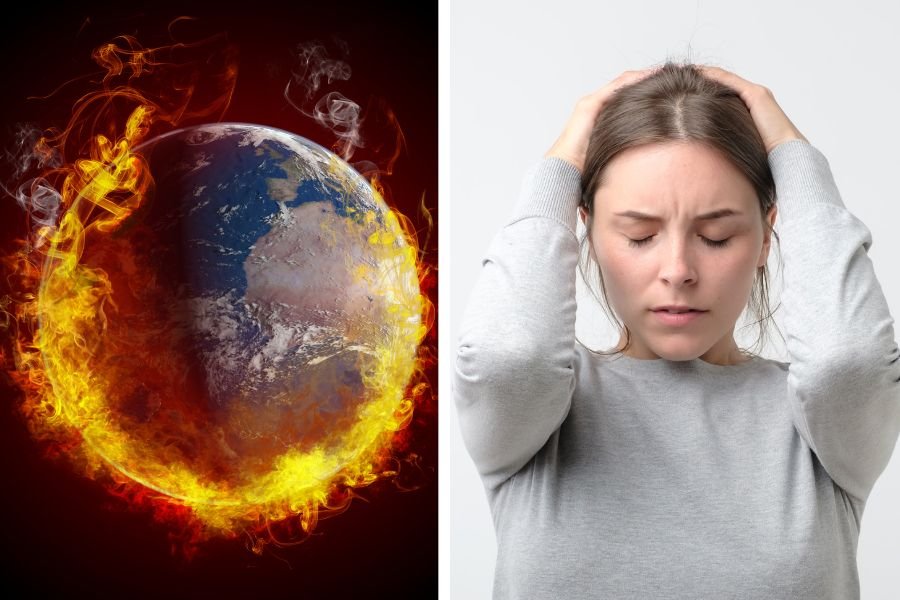
Many of us, for many reasons, are feeling a deep sense of disconnection between what is happening in the world around us, and how society acknowledges those events…or doesn’t. Whether it’s about climate change or our current political regime or whether or not we’re using technology ethically, there’s this viscerally felt notion that old systems are no longer working. All the while, life seems to be going on as normal. Which can be as crazy-making as any other type of gaslighting.
For those that are feeling this way, that something is deeply off with the world,” author and digital anthropologist Rahaf Harfoush says “you’re not alone.” and inf act, there’s actually a name for this collective feeling. It’s called hypernormalization.
As Harfoush explained in an Instagram video, hypernormalization was a term first coined by historian Alexei Yurchak in his 2005 book Everything Was Forever, Until It Was No More: The Last Soviet Generation. In it, Yurchak described the paradox of living in the Soviet Union before its dissolution in 1991, when everyone knew the system was failing, but since no one could imagine a possible alternative to the status quo, politicians and citizens alike were resigned to maintaining the pretense of a functioning society. Sound familiar?
Years later, filmmaker Adam Curtis took this concept and ran with it for his 2016 BBC documentary, aptly titled HyperNormalisation, which essentially argued that this time period—and events like the rise of Trumpism, Brexit, the War in Syria, and more—was a self fulfilling prophecy of sorts, causing world leaders to give up on trying to reshape the world, and opt instead to establish a similar, albeit “fake” world for the benefit of corporations.
The documentary also posited that the West’s fixation on individualism played its own part in this. By and large people are too concerned with themselves to worry of the greater reality unfolding behind the scenes. The combination results in inexplicable, chaotic events that keep happening, which are either denied, are accepted as normal. Again, this might hit close to home.
As Harfoush explains, hypernormalization today looks a lot like “the disconnect between seeing that systems are failing, that things aren’t working, that structures are crumbling, that society is going through these massive shifts, and yet the institutions and the people that are in power just are like ignoring it and are pretending like everything is going to go on the way that it has.”
“We all know that that’s not true, so you are feeling the discomfort between what you know to be true and how you’re seeing people react to it,” she concluded, reassuring that, “your vibes are not off. Your instincts are not off. There’s a term for it. You’re welcome.”
This insight doesn’t necessarily solve the issue, but it can certainly help us begin seeing things a little more objectively. After all, change doesn’t happen without first exposing the absurdity for what it is.
By the way, you can watch the full version of Curtis’ HyperNormalisation documentary on Youtube.