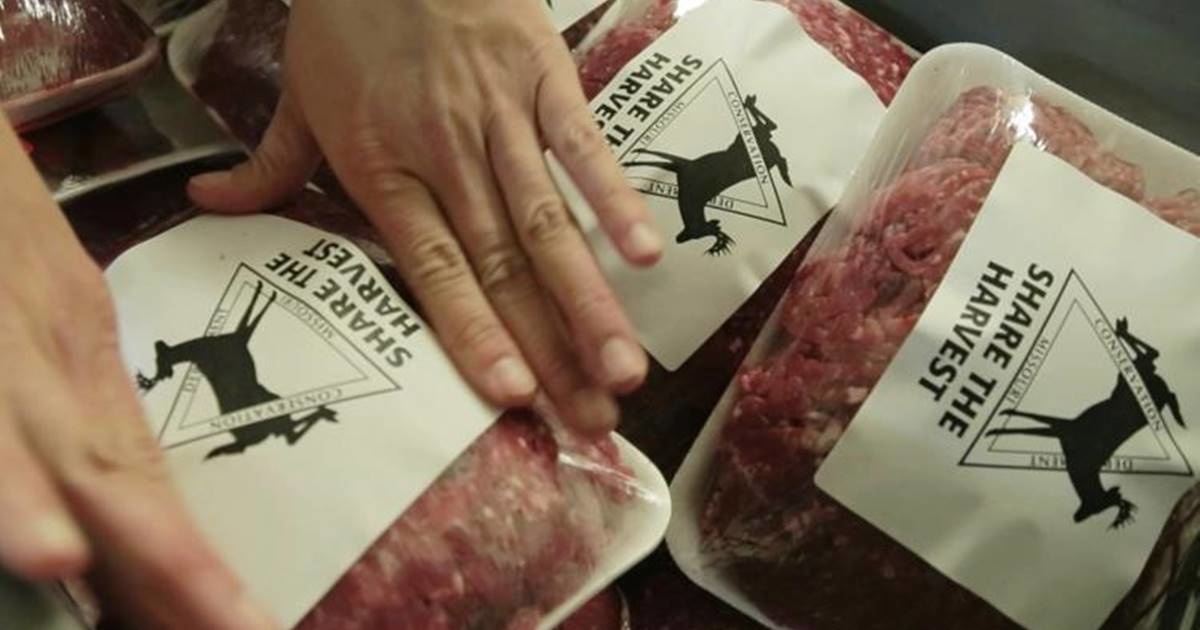
Missouri hunters donated nearly 350,000 pounds of venison to food banks this season
America’s economy may be doing well, but that doesn’t mean hunger still isn’t a major issue. In the state of Missouri, one in seven adults and one in six children are struggling with hunger. That’s 865,400 people. Over the past decade, the number of people in Missouri experiencing hunger has more than doubled, the largest…
America’s economy may be doing well, but that doesn’t mean hunger still isn’t a major issue. In the state of Missouri, one in seven adults and one in six children are struggling with hunger.
That’s 865,400 people.
Over the past decade, the number of people in Missouri experiencing hunger has more than doubled, the largest increase in the entire country. This hasn’t been helped by a 2016 law that prohibited most able-bodied adults without dependents from receiving food stamps.
This change in the law has put an extra burden on food banks.
“If the SNAP benefits aren’t coming, then you start to rely on food pantries,” Conner Kerrigan with Empower Missouri said according to KRCG TV. “Well, if you’re like in a rural area, it’s probably hard to travel to a food pantry and you have to put gas in the tank in order to do that.”
The problem is that the amount of food donated to the food banks hasn’t increased by much since the law passed.
One group that’s doing its best to help feed Missouri’s hungry are hunters.

Missouri deer hunters donated nearly 350,000 pounds of venison to pantries and food banks this hunting season, the Missouri Department of Conservation (MDC) said in a news release.
While shooting animals seems like a pretty lame way to have a good time, at least the deer meat is going to help the most vulnerable.
The hunters donated the meat to Missouri’s Share the Harvest program which provides “lean, healthy” venison to help feed hungry Missourians. According to Good Housekeeping, venison has a third of the amount of fat found in beef, and less calories than chicken.
“Venison is richer in protein than any other red meat, which means that it satiates the appetite really well, keeping you fuller for longer,” nutritionist Naomi Mead says.
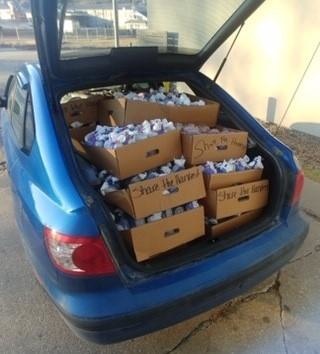
“Hunters started Share the Harvest because they saw a need in their communities and hunters remain the driving force behind this popular program that helps feed our fellow Missourians who are in need,” MDC director Sara Parker Pauley said in a statement.
“We sincerely thank the thousands of deer hunters who support Share the Harvest, along with the many participating meat processors and sponsors who help make it possible,” Pauley continued.
Over 100 meat processors throughout the state packaged and ground the donated meat for free before it was handed over to the food pantries.
“We greatly appreciate the hunters, processors, and sponsors for their support of Share the Harvest,” CFM executive director Tyler Schwartze said in the news release. “The donated venison stays in the local areas where the deer were harvested so it truly is helping out neighbors in need.”

In a small village in Pwani, a district on Tanzania’s coast, a massive dance party is coming to a close. For the past two hours, locals have paraded through the village streets, singing and beating ngombe drums; now, in a large clearing, a woman named Sheilla motions for everyone to sit facing a large projector screen. A film premiere is about to begin.
It’s an unusual way to kick off a film about gender bias, inequality, early marriage, and other barriers that prevent girls from accessing education in Tanzania. But in Pwani and beyond, local organizations supported by Malala Fund and funded by Pura are finding creative, culturally relevant ways like this one to capture people’s interest.
The film ends and Sheilla, the Communications and Partnership Lead for Media for Development and Advocacy (MEDEA), stands in front of the crowd once again, asking the audience to reflect: What did you think about the film? How did it relate to your own experience? What can we learn?
Sheilla explains that, once the community sees the film, “It brings out conversations within themselves, reflective conversations.” The resonance and immediate action create a ripple effect of change.
MEDEA Screening Audience in Tanzania. Captured by James Roh for Pura
Across Tanzania, gender-based violence often forces adolescent girls out of the classroom. This and other barriers — including child marriage, poverty, conflict, and discrimination — prevent girls from completing their education around the world.
Sheilla and her team are using film and radio programs to address the challenges girls face in their communities. MEDEA’s ultimate goal is to affirm education as a fundamental right for everyone, and to ensure that every member of a community understands how girls’ education contributes to a stronger whole and how to be an ally for their sisters, daughters, granddaughters, friends, nieces, and girlfriends.
Sheilla’s story is one of many that inspired Heart on Fire, a new fragrance from the Pura x Malala Fund Collection that blends the warm, earthy spices of Tanzania with a playful, joyful twist. Here’s how Pura is using scent as a tool to connect the world and inspire action.
A partnership focused on local impact, on a global mission
Pura, a fragrance company that recognizes education as both freedom and a human right, has partnered with Malala Fund since 2022. In order to defend every girl’s right to access and complete 12 years of education, Malala Fund partners with local organizations in countries where the educational barriers are the greatest. They invest in locally-led solutions because they know that those who are closest to the problems are best equipped to solve and build durable solutions, like MEDEA, which works with communities to challenge discrimination against girls and change beliefs about their education.
But local initiatives can thrive and scale more powerfully with global support, which is why Pura is using their own superpower, the power of scent, to connect people around the world with the women and girls in these local communities.
The Pura x Malala Fund Collection incorporates ingredients naturally found in Tanzania, Nigeria, Pakistan, and Brazil: countries where Malala Fund operates to address systemic education barriers. Eight percent of net revenue from the Pura x Malala Fund Collection will be donated to Malala Fund directly, but beyond financial support, the Collection is also a love letter to each unique community, blending notes like lemon, jasmine, cedarwood, and clove to transport people, ignite their senses, and help them draw inspiration and hope from the global movement for girls’ education. Through scent, people can connect to the courage, joy, and tenacity of girls and local leaders, all while uniting in a shared commitment to education: the belief that supporting girls’ rights in one community benefits all of us, everywhere.
You’ve already met Sheilla. Now see how Naiara and Mama Habiba are building unique solutions to ensure every girl can learn freely and dare to dream.
Naiara Leite is reimagining what’s possible in Brazil
Julia with Odara in Brazil. Captured by Luisa Dorr for Pura
In Brazil, where pear trees and coconut plantations cover the Northeastern Coast, girls like ten-year-old Julia experience a different kind of educational barrier than girls in Tanzania. Too often, racial discrimination contributes to high dropout rates among Black, quilombola and Indigenous girls in the country.
“In the logic of Brazilian society, Black people don’t need to study,” says Naiara Leite, Executive Coordinator of Odara, a women-led organization and Malala Fund partner. Bahia, the state where Odara is based, was once one of the largest slave-receiving territories in the Americas, and because of that history, deeply-ingrained, anti-Black prejudice is still widespread. “Our role and the image constructed around us is one of manual labor,” Naiara says.
But education can change that. In 2020, with assistance from a Malala Fund grant, Odara launched its first initiative for improving school completion rates among Black, quilombola, and Indigenous girls: “Ayomidê Odara”. The young girls mentored under the program, including Julia, are known as the Ayomidês. And like the Pura x Malala Fund Collection’s Brazil: Breath of Courage scent, the Ayomidês are fierce, determined, and bursting with energy.
Ayomidês with Odara in Brazil. Captured by Luisa Dorr for Pura
Ayomidês take part in weekly educational sessions where they explore subjects like education and ethnic-racial relations. The girls are encouraged to find their own voices by producing Instagram lives, social media videos, and by participating in public panels. Already, the Ayomidês are rewriting the narrative on what’s possible for Afro-Brazilian girls to achieve. One of the earliest Ayomidês, a young woman named Debora, is now a communications intern. Another former Ayomidê, Francine, works at UNICEF, helping train the next generation of adolescent leaders. And Julia has already set her sights on becoming a math teacher or a model.
“These are generations of Black women who did not have access to a school,” Naiara says. “These are generations of Black women robbed daily of their dreams. And we’re telling them that they could be the generation in their family to write a new story.”
Mama Habiba is reframing the conversation in Nigeria
Centre for Girls' Education, Nigeria. Captured by James Roh for Pura
In Mama Habiba’s home country of Nigeria, the scents of starfruit, ylang ylang and pineapple, all incorporated into the Pura x Malala Collection’s “Nigeria: Hope for Tomorrow,” can be found throughout the vibrant markets. Like these native scents, Mama Habiba says that the Nigerian girls are also bright and passionate, but too often they are forced to leave school long before their potential fully blooms.
“Some of these schools are very far, and there is an issue of quality, too,” Mama Habiba says. “Most parents find out when their children are in school, the girls are not learning. So why allow them to continue?”
When girls drop out of secondary school, marriage is often the alternative. In Nigeria, one in three girls is married before the age of 18. When this happens, girls are unable to fulfill their potential, and their families and communities lose out on the social, health and economic benefits.
Completing secondary school delays marriage, and according to UNESCO, educated girls become women who raise healthier children, lift their families out of poverty and contribute to more peaceful, resilient communities.
Centre for Girls’ Education, Nigeria. Captured by James Roh for Pura
To encourage young girls to stay in school, the Centre for Girls’ Education, a nonprofit in Nigeria founded by Mama Habiba and supported by Malala Fund and Pura, has pioneered an initiative that’s similar to the Ayomidê workshops in Brazil: safe spaces. Here, girls meet regularly to learn literacy, numeracy, and other issues like reproductive health. These safe spaces also provide an opportunity for the girls to role-play and learn to advocate for themselves, develop their self-image, and practice conversations with others about their values, education being one of them. In safe spaces, Mama Habiba says, girls start to understand “who she is, and that she is a girl who has value. She has the right to negotiate with her parents on what she really feels or wants.”
“When girls are educated, they can unlock so many opportunities,” Mama Habiba says. “It will help the economy of the country. It will boost so many opportunities for the country. If they are given the opportunity, I think the sky is not the limit. It is the starting point for every girl.”
From parades, film screenings to safe spaces and educational programs, girls and local leaders are working hard to strengthen the quality, safety and accessibility of education and overcome systemic challenges. They are encouraging courageous behavior and reminding us all that education is freedom.
Experience the Pura x Malala Fund Collection here, and connect with the stories of real girls leading change across the globe.
Close your eyes and let your imagination take you to the seaside coast of the southern Chilean rainforest. Now picture a giant cypress tree—an alerce, to be exact—thought to be a relative of the giant sequoia of North America. Beneath it is where the magic happens. Researchers have unearthed a massive number—more than 300—of fungal…
Close your eyes and let your imagination take you to the seaside coast of the southern Chilean rainforest. Now picture a giant cypress tree—an alerce, to be exact—thought to be a relative of the giant sequoia of North America. Beneath it is where the magic happens.
Researchers have unearthed a massive number—more than 300—of fungal species beneath one of these trees. While scientists already knew about the symbiosis between trees and fungi, they were shocked to find so many different types of fungi in a single soil sample. What this means for the ecosystem could be groundbreaking and, at the very least, supportive of the Darwinian view that the fittest species survive.
According to writer Helen Pilcher’s article in Discover Wildlife, these trees are not only enormous, they can grow to be thousands of years old: “These slow-growing trees can grow as tall as the Arc de Triomphe, and as wide as a shipping container. Renowned for their longevity, some individuals have lived for over 3,600 years, making Alerce the second-longest-lived tree species on Earth.”
The tree that is especially exciting to researchers in this study is called Alerce Abuelo. This individual, whose soil was studied alongside that of 31 other trees by researchers in Biodiversity and Conservation, is approximately 2,400 years old.
How it works
Pilcher explains the partnership: “These mycorrhizal fungi funnel water and nutrients into the tree roots, and help the plants to fight stressors, such as drought and pathogens. In exchange, the trees feed their fungal partners with sugars, fuelling the growth of underground networks that help shunt carbon into the soil.”
On the National Park Service’s website, they also explain how mutually beneficial these relationships can be: “Mycorrhizal fungi form a mutualistic relationship with the Redwoods and other plants in the forest. A mutualistic relationship is when both organisms benefit. The fungi will combine their mycelium with the tree’s roots. As a result, the fungi make it easier for the trees to get more nutrients and moisture from the soil, and the fungi get access to sugars from the trees.”
Why it matters
At a time when many people are concerned about climate change happening at an alarming rate, this doubling of fungal species is promising. Pilcher reiterates how exciting it was that one tree had so many fungal species: “In addition, the fungal richness under Alerce Abuelo was more than two times greater than in any other sample. The study highlights the importance of protecting these older, bigger trees.”
Pilcher also cites Adriana Correlaes, field science lead at the Society for the Protection of Underground Networks (SPUN), who exclaimed, “All that diversity means resilience.”
The Nature Conservancy further explains how important it is to have thriving, healthy trees for a number of reasons: “Through photosynthesis, trees absorb carbon dioxide from the air and store it in its wood. Trees and plants will store this carbon dioxide throughout their lives, helping slow the gas’s buildup in our atmosphere that has been rapidly warming our planet.”
A viral video has been making the rounds lately that shows a giant (and extremely bizarre) ship opening up at its middle and dropping a metric buttload—that’s the official term—of cinderblocks directly into the ocean. The video is fascinating, so much so that I was certain it was AI-generated at first. After all, what kind…
A viral video has been making the rounds lately that shows a giant (and extremely bizarre) ship opening up at its middle and dropping a metric buttload—that’s the official term—of cinderblocks directly into the ocean. The video is fascinating, so much so that I was certain it was AI-generated at first. After all, what kind of ship can part down the middle like that?
Turns out, the video is real! The ship is called a split hopper barge and is often used to transport and deliver dredged soil. Dumping concrete like this looks like the world’s worst case of littering, but in actuality, the concrete blocks serve an important purpose that benefits sea life of all varieties.
But how?
Dumping concrete block in the ocean. Soon coral and algae will take root on them and help them create a reef. pic.twitter.com/IgEiMb3HhP
— non aesthetic things (@PicturesFoIder) July 24, 2025
For answers, look no further than the GARP — that’s the Grenada Artificial Reef Project (also known as the Grand Anse Artificial Reef Project or GAARP).
With coral reefs under threat and disappearing all over the world, the team behind the project came up with an interesting solution they wanted to test out.
In 2013, the scientists placed four concrete pyramids (basically, cinderblocks stacked together into something of a tower structure) in a barren part of the Caribbean Sea. The location was just off the coastal beaches of Grenada.
In just 3 months, the pyramids had attracted tons of marine life.
The block pyramids gave shelter to the animals who otherwise had nowhere to hide, nest, or feed in this part of the water. “An initial growth of algae and colourful encrusting sponge was soon followed by a varied range of invertebrates. These included feather duster worms, lobster, crab, and urchins. Excitement developed as we started to see a range of juvenile fish including squirrel fish, goat fish, grunts and scorpionfish,” says the official website.
After a year, word must have spread among the fish, because the simple concrete blocks transformed into “buzzing diverse communit[ies] of marine life.”
At around 18 months, things started to get really exciting. Stony and brain corals, described as the “building blocks of coral” began to appear on the pyramids.
Over the following 10 years, the project has exploded with more and more coral growing on the blocks and more fish and other sea life moving in. “Each subsequent year more pyramids have been added to increase biomass. GARP is becoming a balanced ecosystem, home to over 30 species of fish, 14 different kinds of corals and many of the invertebrates and algae you would find on a naturally occurring reef.”
Today, there are upwards of 100 pyramid blocks in the location. Other, similar projects are taking place in waterways all over the globe.
GARP/GAARP isn’t the first or only project of its kind. Concrete has been shown again and again to make an excellent shelter for marine life and a perfect launching pad for new coral growth.
People have tried other materials before, to varied results. One such project off the coast of Florida in the 1970s utilized millions (!) of old tires in an effort to create new fish habitats. Called the Osborne Reef, the effort is now considered a major ecological disaster as storms and sea currents have tossed many of the tires around, washing them ashore and even damaging otherwise healthy natural reefs nearby. Talk about a backfire. Major clean up initiatives to undo the damage are still underway.
Specialized concrete structures are heavy enough to stay put in rough conditions and are one of the few things that can withstand years and years of being battered by rough, salty seawater without degrading.
Coral reefs are disappearing around the globe at an alarming rate. Physical damage, both natural and manmade, along with pollution, coral harvesting, global warming, and bleaching wreaks havoc on natural ecosystems under the sea.
Coral reefs aren’t just there to look pretty. They dampen waves and currents before they hit land, reducing erosion and protecting people who live on the coast. Reefs are home to a huge variety of marine life who use it for shelter and finding food. And, finally, they’re amazing destinations for scientific discovery—new species and even medical treatments are being discovered on reefs all the time!
All that and the very existence of coral reefs may be in jeopardy, according to the EPA.
There’s no easy fix to this grave problem. Natural coral reefs take thousands of years to grow and mature. So, even with all the cinderblocks in the world acting as growth platforms, it would be impossible for us to replace all the coral we’ve already killed or destroyed. Saving our oceans must be a multi-faceted effort, with initiatives that combat pollution and rising sea temperatures in addition to creating artificial reefs.
But projects like GARP/GAARP are an awesome start. They may not save the planet all on their own, but if you ask me, those fish look pretty darn grateful for their new home.
This article originally appeared last year. It has been updated.
Cat owners can attest to how their furry friends enrich their lives, and how important it is to support their well-being in return. This isn’t just about feeding them and giving them shelter, but also providing social interaction. It’s considered so important to a cat’s well-being that Sweden passed a requirement for cat owners. The…
Cat owners can attest to how their furry friends enrich their lives, and how important it is to support their well-being in return. This isn’t just about feeding them and giving them shelter, but also providing social interaction. It’s considered so important to a cat’s well-being that Sweden passed a requirement for cat owners. The rule? Check in on your cats or expect a fine.
The Swedish Board of Agriculture set rules requiring cat owners in the country to check on their cats at least twice a day. Simply setting out food and water doesn’t count. The purpose of the rule is to ensure owners pay attention to their cat’s behavior and health. If a cat isn’t acting like itself, it could indicate illness, injury, or stress that might lead to more serious problems if left untreated.
This rule applies to both indoor and outdoor cats. That means even if a cat is the prototypical barnyard cat, the owner still has to check on it to ensure it’s in good health. The rule also encourages more frequent check-ins if a cat is sick, pregnant, or injured.
What’s the penalty for neglecting your cat in Sweden?
“If [the county administrative board] discovers that you have not followed the rules, they can demand that you correct the deficiencies. This requirement can be combined with a fine if you do not correct the deficiencies. You can also be sentenced to a fine or imprisonment for a maximum of two years if you are convicted by a court of violating animal welfare legislation.”
Are cats actually social?
This brings up a common misconception about cats. While they’re often considered solitary creatures, cats aren’t antisocial. They actually benefit from social interaction with humans; they just socialize differently than dogs. Although they aren’t pack animals and can be territorial, house cats do form strong bonds with their humans.
House cats tend to see the humans they live with as peers. This is why domesticated cats lick, groom, and nuzzle their humans, much as they would other cats. It also explains why they sometimes present dead animals to their owners, since they consider you part of their safe “core territory” after a hunt. Another sign that a cat has bonded with you is when it gives you a “slow blink,” a gesture that indicates trust.
Whether you already own a cat or are thinking about getting one, it’s best to interact with them regularly, regardless of whether there’s a rule requiring it. It’s a great way to make sure your kitty is safe while also providing social time that both of you can benefit from.
The simple ritual of going outside to welcome nightfall can be extremely relaxing. Of course, this has been done since the dawn of time. However, the practice of “dusking” has recently regained popularity and has become a trend for people looking to boost their mental well-being. The Dutch have been doing this for ages. In…
The simple ritual of going outside to welcome nightfall can be extremely relaxing. Of course, this has been done since the dawn of time. However, the practice of “dusking” has recently regained popularity and has become a trend for people looking to boost their mental well-being.
The Dutch have been doing this for ages. In the Netherlands, dusking is referred to as “schemeren,” which translates to “be dusky, to be in twilight.” It’s the idea of letting the lights turn off while the starry night envelops the day. Watching the color of the sky subtly fade can do wonders for a busy mind.
In a piece for The Guardian, writer Rachel Dixon describes her time at the Dark Skies “dusking event” in the United Kingdom in February 2026. “The darkening sky is faintly illuminated by a sharp sliver of crescent moon and the first stars. Bats are swooping in search of supper, an owl is softly hooting, and the dark outline of a ruined castle looms beyond the walls.”
She explains how this ritual has resurged, writing, “The custom had all but died out until it was revived by Dutch poet and author Marjolijn van Heemstra a few years ago. Now she is encouraging other countries to adopt dusking, running events in Ireland, Germany, and here in Yorkshire.”
Dixon shares that van Heemstra also spoke at the event she attended. “Dusking is about looking at one point and seeing it fade. Don’t look around too much; focus. Trees are very good – they rise up for a moment and then fade away,” van Heemstra eloquently said.
Not only is the concept beautiful, but it can also do wonders for anxiety and spark the imagination.
In Country & Townhouse, Digital Editor Ellie Smith notes that dusking intentionally forces a pause, writing, “In today’s non-stop hustle culture, it’s rare that we sit and do nothing. But intentional moments of pause can offer many benefits for our mental wellbeing—studies show mindfulness can reduce stress and anxiety, boost sleep quality, and develop better self-acceptance.”
She also shares the concept of choosing nothing at all. “The Dutch are well-versed in the art of doing nothing: niksen, which translates as ‘doing nothing without purpose,’ is another wellness concept entrenched in their culture which went viral in 2019 as a way to combat burnout.”
Smith cites van Heemstra once more while describing someone who says they read their interior magazines at night. “When she can’t see the images sharply, she told me, her imagination takes over and populates the interiors with strange shapes and presences. In a blurred sketch, you invent your own boundaries, and there is dialogue between inner and outer worlds.”
On a Facebook post about the North York Moors dusking event, many commenters were eager to share their thoughts. One explains, “Dusking is a ritual and modern practice that involves consciously observing the transition from day to night. It is seen as a form of ‘slow living’ or resistance to the 24-hour economy, where one consciously stops working and waits to turn on the lights until it is truly dark.”
Another admits they already loved the concept without knowing it had a name, writing, “Love dusking. Although I didn’t know it had a name!”
Beau, a golden retriever, is a very big deal. Like many dogs in the modern age, he has his own social media accounts. But one particular Instagram post went so viral that he’s gaining followers by the minute—and for good reason.
His “person” happened to be filming him being his adorably goofy self one day in a parking lot. That’s when he spotted a tiny gray mouse. Some were concerned it wouldn’t end well. But Beau, tail wagging and fur shedding, immediately circled around it and lay down as though he’d known the mouse his entire life. His mom asked, “What are you doing? Did you find a mouse? Is that your friend?” Beau’s tail continued to wag as he occasionally side-eyed the little critter.
In less than a week, the clip had 1.6 million likes and over 9,000 comments from new fans around the world. Both Beau and his new, unassuming pal seem to have become a symbol of hope—or at the very least, a gentle distraction.
His bio is written in the first person on another Instagram post. While we can’t confirm or deny that Beau actually wrote it, it states:
“Hello to all my new friends 🥰 I’m Beau 👋🏻🐾
I was born in Utah and spent a year on the farm with my golden family, before my parents found me in March 2025 and moved me to Denver 😍
I love tennis balls, morning cuddles, fresh snow, frozen cucumbers, and spending time in Minnesota with my cousin @cocobabydoodle ❤️
My superpower is giving hugs. I learned it from my grand-doggy 🫶🏼
During the week, I go to mom’s office and shed my hair all over her coworkers 💁🏽♀️
My parents spoil me with toys, but my favorite is my Simba. He goes where I go 🥺
I recently went viral for making friends with a mouse. I’m not sure why because I make friends with everyone, but I appreciate all the love ❤️”
His new fans seem overjoyed. One person notes, “This is the most Golden Retriever behavior I’ve ever seen.”
A few jokingly point out that if that mouse—or any mouse—crossed paths with THEIR breed of canine, it might not fare as well: “Our dachshund would have swallowed it whole. Ask me how I know.”
Others seem to resonate with how wholesome the short clip is: “This needs to be a Disney movie.”
Some animal experts might argue that Beau was “resource guarding” rather than becoming actual besties with the cute rodent. In a Los Angeles Timesarticle, Kevin Spencer explains:
“Resource guarding in dogs is a common canine behavior that does not always initially manifest as something dramatic. Sometimes resource guarding refers to a subtle head turn when a dog guards a food bowl. Other times, the same guarding behavior escalates into something far more obvious and unsettling. At its core, resource guarding describes a dog’s attempt to protect a valuable resource it finds important. This may be food, toys, bones, a dog bed, or other items dogs steal and stash. It might even be a favorite human.”
It seems Beau has lots of cute quirks. Other photos on his Instagram page show him loving car rides, park days, and chasing balls. In one photo, Beau snuggles onto the couch with a leaf in his mouth. The caption reads, “Beau has been really into eating leaves lately.”
While Upworthy wasn’t able to confirm with Beau (or his family) that the tiny mouse wound up having the best day ever, it seemed the dog’s owner did her best to keep him safe. All in all, Beau’s wagging tail was a delight to see—so much so that another commenter suggested maybe Beau needs his own pet buddy, writing, “Buy him a puppy!” Someone seemingly in the family replied, “We’re working on it!”
Pretty much every elementary school student on Earth learns the names and order of the planets in our solar system. They label worksheets, color activity sheets, and build models. We teach them songs and mnemonic devices to help them remember the order of the planets by their distance from the Sun.
But when we see the planets neatly lined up, we don’t get a clear picture of the distances between them. And as a CGP Grey video illustrates, one of the most interesting things about the distances between planets isn’t how far apart they are from each other, but how close they all are to Mercury.
Or at least, how close they are to Mercury most of the time. The distances between the planets vary due to the speed and shape of their orbits. But as Grey’s “You Learned the Solar System Wrong” video illustrates, the planet that is closest to every other planet most often is Mercury.
Yep, every single planet in our solar system. It feels counterintuitive, but the math checks out.
Mercury, the “mostest closest” planet
“Planets are not humans queuing for coffee but rather spheroids scattered in space, always in motion,” says CGP Grey. “Not in simple circles, either, but ellipses at untidy angles.”
He explains that because of differences in their orbits, there’s no clear answer to the question of which planet is closest to another, because it changes all the time. The better question is, “Which planet is closest most often?”
Mercury. It’s always Mercury. And it comes down to its small orbit.
“Mercury’s small orbit means he never goes as far away as the other planets with their bigger orbits,” CGP Grey says. “The orbital math that shows Mercury is the mostest closest to Jupiter is the same for all the planets and everything that orbits the Sun.”
Mercury is the social butterfly of planets
People were delighted to learn this fun fact and shared some clever comments:
“Mercury must be a really good friend, he’s got so many friends but he makes time for them all.”
“This is why Mercury was the messenger, he was able to reach every God.”
“Mercury is that one kid who has ties with the seniors.”
“All other planets are in some toxic relationship: constantly shifting between being super intimate and escaping as far as they can from each other. And Mercury is that one guy who’s not very close, but always within reach, if you ever need him.”
“Mercury is like that kid in school who knows EVERYone.”
It’s impossible to fit all the planets into one image with their proper distances. Photo credit: Canva
“Mercury is just the little brother that everyone loves.”
“This is so delightfully appropriate for the planet named after the messenger of the gods. Who else can pass notes between them better but the mostest closest?”
“Mercury is that hot (literally) playboy who steals everybody’s heart, from girls to guys, young to old.”
Mercury does seem to get around, doesn’t it? It’s even the closest to Pluto, the poor, no-longer-a-planet outcast of our solar system.
It is rather wee. When Pluto was downgraded, Mercury claimed the title of smallest planet. It’s approximately one-third the size of Earth.
It is extreme. Daytime temperatures can reach 800 degrees Fahrenheit (430 degrees Celsius), and nighttime temperatures can drop to negative 290 degrees Fahrenheit (minus 180 degrees Celsius). A 1,000-degree swing is wild.
It has major magnetic tornadoes. According to NASA, “Though Mercury’s magnetic field at the surface has just 1% the strength of Earth’s, it interacts with the magnetic field of the solar wind to sometimes create intense magnetic tornadoes that funnel the fast, hot solar wind plasma down to the surface of the planet.”
It’s so metal. Mercury has a metallic core that takes up about 85% of its radius.
It is moonless. Mercury and Venus have no moons. Every other planet in our solar system has at least one.
Mercury, the “mostest closest” of all the planets, truly is special.
Have you ever wanted to visit the African savanna, inhale the beautiful scents of the grasslands, and watch a stunning sunset while walking beside a herd of elephants? It’s a little tough for most people to get to Africa, but now you can come close to the experience at Denny Sanford Elephant Valley. The newly opened interactive habitat at the San Diego Zoo Safari Park puts visitors at the center of the experience.
What’s unique about Elephant Valley is that Safari Park visitors are surrounded by elephants on both sides and can follow the herd as they march beneath a bridge in the center of the habitat. This gives guests a 360-degree view of these majestic animals as they chew on thorn trees, wade in a lake, or use their mighty tusks to pull treats from high up in the trees. Guests can also get face-to-face with the world’s largest land mammal at viewing windows that put them just inches from the herd.
At Elephant Valley, you can experience elephants from above and below.
Marco Wendt, wildlife ambassador for the San Diego Zoo Wildlife Alliance, hopes the immersive experience inspires visitors to support conservation efforts in Africa.
“We want to connect the guests, the people around the world, here in San Diego, to our projects out in Africa,” Wendt told Upworthy. “Garner that empathy, that understanding of elephants, so we can all work together.”
An elephant at Elephant Valley at the San Diego Zoo Safari Park. Photo credit: Declan Perry (used with permission)
Wendt’s message is important, considering African savanna elephants are listed as Endangered on the International Union for Conservation of Nature’s Red List of Threatened Species. This is due in large part to the rise of human-elephant conflict across the continent.
The San Diego Zoo Wildlife Alliance’s commitment to conservation is especially apparent in the three elephants of the eight-member herd that were saved from being culled in Swaziland.
“We were able to help out by offering this massive space that we have here at the Safari Park and rescue the three 36-year-old adult females that you see here today,” Wendt said. “You’ll see those 36-year-old adults, but the youngest, is seven years old. So we have generations of grandma, aunties, daughters, and a little boy.”
An elephant at Elephant Valley at the San Diego Zoo Safari Park. Photo credit: Declan Perry (used with permission)
Which elephants live at Elephant Valley?
The herd at Elephant Valley consists of eight elephants: matriarch Swazi, 36; Umngani, 36; Ndlulamitsi (Ndlula), 36; Khosi, 19; Phakamile (Kami), 18; Qinisa (Nisa), 13; young male Umzula-Zuli (Zuli), 7; and Mkhaya, 7. The herd’s founding members—Swazi, Ndlula, and Umngani—were rescued in 2003.
To recreate the African savanna, a team of horticulturists and arborists worked together to replicate the region’s smells and sounds. The team grew more than 350 individual plants for Elephant Valley, including African thorn trees, a common food source for elephants.
Ultimately, Elephant Valley is about strengthening the connection between elephants and humans.
“I want everyone here to gain some kind of empathy and understanding of this majestic animal, to leave the Safari Park with a little bit of hope, knowing that they were part of something bigger than themselves,” Wendt said. “I don’t care if you’re the emperor of the world or a kid from the barrio, that this is going to be for everyone, and we all have the opportunity to change the world together.”
One of the longest-running scientific studies of its kind might not sound all that interesting on its surface. For more than 60 years, scientists on the flank of Mauna Loa, an active volcano in Hawaii, have been collecting air. Yes, air.
The work, while repetitive and tedious at times, is surprisingly among the most important scientific research ever conducted.
In the early 1900s, a handful of scientists had captured similar air samples from around the globe. An engineer named Guy Stewart Callendar was one of the first to compare these datasets and conclude that the human burning of fossil fuels was causing carbon dioxide levels in the atmosphere to rise.
However, the datasets weren’t very good. They were collected at different locations around the globe and at different times. In the 1930s, there wasn’t a strong baseline for what Earth’s atmosphere should look like, so the scientific community was skeptical of Callendar’s ideas.
That’s where scientist Charles David Keeling comes in.
Charles David Keeling. Photo credit: National Science Foundation/Wikimedia Commons
In 1958, Keeling had the idea to collect air samples from the same spot every single day. It was radical at the time. His method required stationing a team at the Mauna Loa Observatory, far from cars, factories, and other human emissions, and collecting air samples in simple flasks.
The entire process doesn’t sound all that scientific. One of the researchers would take a volleyball-shaped glass flask that had all of its air vacuumed out, hold his breath, walk into the wind, and open a valve that allowed air to rush in. Other teams repeated this process at various spots around the world, but the measurements at the Mauna Loa Observatory were where it all began. Despite how it sounds, Keeling was a stickler for precision and helped pioneer more accurate atmospheric measurements than the world had ever seen.
Once Keeling had enough data, he realized two remarkable things about our planet.
For starters, the Earth was breathing
Carbon dioxide (CO2) levels in the atmosphere weren’t exactly steady. Keeling observed that they would rise and fall throughout the day, and even more so in a seasonal pattern.
“First, Keeling determined that CO2 levels rise and fall during the day, as well as throughout the seasons, based on vegetation growth. Plants feed themselves through photosynthesis, and CO2 is a vital ingredient of that process. With more plants growing in the Northern hemisphere’s summer months, the CO2 levels drop for a time as the plants ‘breathe’ it in.”
In the winter, as plants die off and begin to decay, they release more CO2 into the air. In the Southern Hemisphere, this pattern is more or less reversed.
Revealing this simple pattern helped form our understanding of Earth’s CO2 cycle, where carbon flows through the soil, oceans, atmosphere, and living organisms on the planet. This discovery also helps scientists build models that calculate the environmental impact of human behavior.
Next, baseline CO2 levels were steadily rising every single year
Soon, a more alarming trend became clear from Keeling’s data. Carbon dioxide levels were rising. He even developed something called the “Keeling Curve,” which is less of a curve and more of a line trending steadily up and to the right, indicating rising carbon dioxide levels.
The Keeling Curve was one of the first undeniable pieces of evidence of human-caused climate change. As carbon dioxide levels rise, the atmosphere traps more heat and steadily warms the planet. This, in turn, leads to melting ice, rising sea levels, and more extreme weather, to name only a few consequences.
Many scientists consider it one of the most important discoveries of the last century.
Of course, Keeling was not the sole “founding father” of climate science. There was Callendar, whose hypotheses Keeling’s data eventually helped confirm. There was Irish scientist John Tyndall, who in 1861 discovered how certain gases could trap heat—what we now call the “greenhouse effect.” Fascinatingly, a less-heralded amateur scientist named Eunice Newton Foote demonstrated these ideas several years before Tyndall. And we’d be remiss not to give a shoutout to Jan Baptista van Helmont, a Flemish alchemist who helped identify carbon dioxide as a distinct gas.
The sample collection at Mauna Loa continues to this day and remains one of the longest continuously running studies in the field. If anything, in recent years the work has only become more important.