Dish soap is one of those things that you have to buy even if you have a dishwasher. Sometimes pots need to soak or you only need to wash out a bowl and spoon for a late-night snack. Either way, there’s no real getting around buying dish soap, and there’s nothing more frustrating than using soap that has the consistency of water, or worse, leaves your dishes greasy.
Nothing makes me want to throw dishes in the trash faster than grabbing a “clean” dish from the dish rack and feeling that familiar slimy film slip across your fingertips. That’s it. Paper plates for all eternity. But why does that happen and what does dish soap actually do? Once again, Melissa Pateras, the queen of “laundry-tok,” has an answer and it’s fascinating.
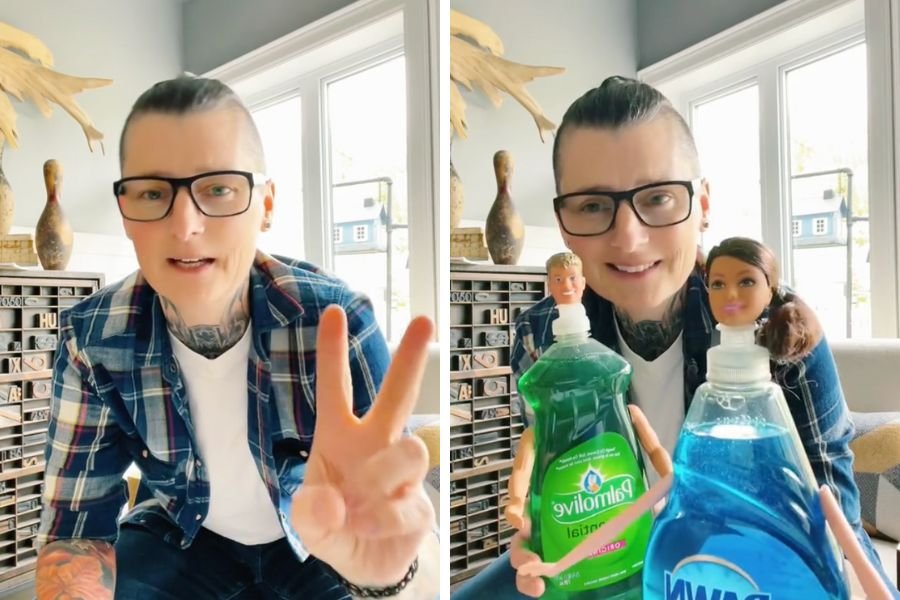
In this particular video, she brought along two friends to help her explain what the deal is with dish soap—a disembodied Ken and Barbie doll glued to two different bottles of dish soap.
Ken is Palmolive and Barbie’s head and extremities are attached to the bottle of Dawn. Pateras uses the dolls to explain that the difference between dish soaps is usually the surfactants. (I think it’s a safe guess that most people aren’t thinking about surfactants when shopping.)
“Think about Dawn as Barbie and Ken as Palmolive. Now think about surfactants as outfits. Barbie has a huge wardrobe of outfits and accessories, whereas Ken only has a few, mostly just the same in different colors,” Pateras says while holding the two bottles. “Now, if Ken is all you have to play with, he’s fine, but he’s never anybody’s first choice.”
She explains that while Ken can do things, Barbie has had over 80 careers and has adapted over the years, while Ken has essentially stayed the same. Obviously, we’re still discussing dish soap, but the visual and descriptive explanation helps bring the point around before she does a test with both soaps to demonstrate how the surfactants work.
“I understand surfactant so much better now. Thank you,” one commenter wrote.
“I loved this!!!! And I learned something,” another person said.
One thought she should be compensated by Dawn for her demonstration, writing, “Melissa I stg if Dawn doesn’t pay you for this…”
Through her demonstrations, there’s a clear better choice, and it’s Dawn. Now whether the dish soap giant will send Pateras a check for her entertaining and informative video is yet to be determined, but maybe she’ll get a few free bottles of the good stuff.

In a small village in Pwani, a district on Tanzania’s coast, a massive dance party is coming to a close. For the past two hours, locals have paraded through the village streets, singing and beating ngombe drums; now, in a large clearing, a woman named Sheilla motions for everyone to sit facing a large projector screen. A film premiere is about to begin.
It’s an unusual way to kick off a film about gender bias, inequality, early marriage, and other barriers that prevent girls from accessing education in Tanzania. But in Pwani and beyond, local organizations supported by Malala Fund and funded by Pura are finding creative, culturally relevant ways like this one to capture people’s interest.
The film ends and Sheilla, the Communications and Partnership Lead for Media for Development and Advocacy (MEDEA), stands in front of the crowd once again, asking the audience to reflect: What did you think about the film? How did it relate to your own experience? What can we learn?
Sheilla explains that, once the community sees the film, “It brings out conversations within themselves, reflective conversations.” The resonance and immediate action create a ripple effect of change.
MEDEA Screening Audience in Tanzania. Captured by James Roh for Pura
Across Tanzania, gender-based violence often forces adolescent girls out of the classroom. This and other barriers — including child marriage, poverty, conflict, and discrimination — prevent girls from completing their education around the world.
Sheilla and her team are using film and radio programs to address the challenges girls face in their communities. MEDEA’s ultimate goal is to affirm education as a fundamental right for everyone, and to ensure that every member of a community understands how girls’ education contributes to a stronger whole and how to be an ally for their sisters, daughters, granddaughters, friends, nieces, and girlfriends.
Sheilla’s story is one of many that inspired Heart on Fire, a new fragrance from the Pura x Malala Fund Collection that blends the warm, earthy spices of Tanzania with a playful, joyful twist. Here’s how Pura is using scent as a tool to connect the world and inspire action.
A partnership focused on local impact, on a global mission
Pura, a fragrance company that recognizes education as both freedom and a human right, has partnered with Malala Fund since 2022. In order to defend every girl’s right to access and complete 12 years of education, Malala Fund partners with local organizations in countries where the educational barriers are the greatest. They invest in locally-led solutions because they know that those who are closest to the problems are best equipped to solve and build durable solutions, like MEDEA, which works with communities to challenge discrimination against girls and change beliefs about their education.
But local initiatives can thrive and scale more powerfully with global support, which is why Pura is using their own superpower, the power of scent, to connect people around the world with the women and girls in these local communities.
The Pura x Malala Fund Collection incorporates ingredients naturally found in Tanzania, Nigeria, Pakistan, and Brazil: countries where Malala Fund operates to address systemic education barriers. Eight percent of net revenue from the Pura x Malala Fund Collection will be donated to Malala Fund directly, but beyond financial support, the Collection is also a love letter to each unique community, blending notes like lemon, jasmine, cedarwood, and clove to transport people, ignite their senses, and help them draw inspiration and hope from the global movement for girls’ education. Through scent, people can connect to the courage, joy, and tenacity of girls and local leaders, all while uniting in a shared commitment to education: the belief that supporting girls’ rights in one community benefits all of us, everywhere.
You’ve already met Sheilla. Now see how Naiara and Mama Habiba are building unique solutions to ensure every girl can learn freely and dare to dream.
Naiara Leite is reimagining what’s possible in Brazil
Julia with Odara in Brazil. Captured by Luisa Dorr for Pura
In Brazil, where pear trees and coconut plantations cover the Northeastern Coast, girls like ten-year-old Julia experience a different kind of educational barrier than girls in Tanzania. Too often, racial discrimination contributes to high dropout rates among Black, quilombola and Indigenous girls in the country.
“In the logic of Brazilian society, Black people don’t need to study,” says Naiara Leite, Executive Coordinator of Odara, a women-led organization and Malala Fund partner. Bahia, the state where Odara is based, was once one of the largest slave-receiving territories in the Americas, and because of that history, deeply-ingrained, anti-Black prejudice is still widespread. “Our role and the image constructed around us is one of manual labor,” Naiara says.
But education can change that. In 2020, with assistance from a Malala Fund grant, Odara launched its first initiative for improving school completion rates among Black, quilombola, and Indigenous girls: “Ayomidê Odara”. The young girls mentored under the program, including Julia, are known as the Ayomidês. And like the Pura x Malala Fund Collection’s Brazil: Breath of Courage scent, the Ayomidês are fierce, determined, and bursting with energy.
Ayomidês with Odara in Brazil. Captured by Luisa Dorr for Pura
Ayomidês take part in weekly educational sessions where they explore subjects like education and ethnic-racial relations. The girls are encouraged to find their own voices by producing Instagram lives, social media videos, and by participating in public panels. Already, the Ayomidês are rewriting the narrative on what’s possible for Afro-Brazilian girls to achieve. One of the earliest Ayomidês, a young woman named Debora, is now a communications intern. Another former Ayomidê, Francine, works at UNICEF, helping train the next generation of adolescent leaders. And Julia has already set her sights on becoming a math teacher or a model.
“These are generations of Black women who did not have access to a school,” Naiara says. “These are generations of Black women robbed daily of their dreams. And we’re telling them that they could be the generation in their family to write a new story.”
Mama Habiba is reframing the conversation in Nigeria
Centre for Girls' Education, Nigeria. Captured by James Roh for Pura
In Mama Habiba’s home country of Nigeria, the scents of starfruit, ylang ylang and pineapple, all incorporated into the Pura x Malala Collection’s “Nigeria: Hope for Tomorrow,” can be found throughout the vibrant markets. Like these native scents, Mama Habiba says that the Nigerian girls are also bright and passionate, but too often they are forced to leave school long before their potential fully blooms.
“Some of these schools are very far, and there is an issue of quality, too,” Mama Habiba says. “Most parents find out when their children are in school, the girls are not learning. So why allow them to continue?”
When girls drop out of secondary school, marriage is often the alternative. In Nigeria, one in three girls is married before the age of 18. When this happens, girls are unable to fulfill their potential, and their families and communities lose out on the social, health and economic benefits.
Completing secondary school delays marriage, and according to UNESCO, educated girls become women who raise healthier children, lift their families out of poverty and contribute to more peaceful, resilient communities.
Centre for Girls’ Education, Nigeria. Captured by James Roh for Pura
To encourage young girls to stay in school, the Centre for Girls’ Education, a nonprofit in Nigeria founded by Mama Habiba and supported by Malala Fund and Pura, has pioneered an initiative that’s similar to the Ayomidê workshops in Brazil: safe spaces. Here, girls meet regularly to learn literacy, numeracy, and other issues like reproductive health. These safe spaces also provide an opportunity for the girls to role-play and learn to advocate for themselves, develop their self-image, and practice conversations with others about their values, education being one of them. In safe spaces, Mama Habiba says, girls start to understand “who she is, and that she is a girl who has value. She has the right to negotiate with her parents on what she really feels or wants.”
“When girls are educated, they can unlock so many opportunities,” Mama Habiba says. “It will help the economy of the country. It will boost so many opportunities for the country. If they are given the opportunity, I think the sky is not the limit. It is the starting point for every girl.”
From parades, film screenings to safe spaces and educational programs, girls and local leaders are working hard to strengthen the quality, safety and accessibility of education and overcome systemic challenges. They are encouraging courageous behavior and reminding us all that education is freedom.
Experience the Pura x Malala Fund Collection here, and connect with the stories of real girls leading change across the globe.
All roads might lead to Rome, but what about avenues? Boulevards? Drives? Do all these words essentially mean the same thing? And while we’re on the subject, why do we park on a driveway and drive on a parkway? Why is English so complicated?! In a decidedly uncomplicated two-minute-long Instagram video, a man named Karim,…
All roads might lead to Rome, but what about avenues? Boulevards? Drives? Do all these words essentially mean the same thing? And while we’re on the subject, why do we park on a driveway and drive on a parkway? Why is English so complicated?!
In a decidedly uncomplicated two-minute-long Instagram video, a man named Karim, who frequently posts “fun fact” content, explains, “I know we tend to use roads, streets, boulevard, avenue, all of these things kind of interchangeably, but there are some differences between these things.”
Breaking it down
Mercifully, he breaks down those differences so we don’t have to.
A “road” is a broad, generic term for any pathway that connects two points, found in both rural and suburban areas. Roads are designed to move traffic between locations.
Meanwhile, “streets” are found exclusively in towns or cities and feature buildings and/or sidewalks on both sides. They often accommodate both vehicle traffic and pedestrian activity.
In other words, “roads” connect any two places, while “streets” are part of a city’s infrastructure. For example, you might take a road to travel between cities but drive down a street to find a shop.
Moving on, Karim explained that “avenues” are wider than streets and are typically separated by a median. They often feature trees and landscaping on either side, in addition to buildings. According to Southern Living, avenues also run perpendicular to streets.
“Boulevards” are even wider than avenues and also feature a median, along with more extensive landscaping and formal lighting. While both avenues and boulevards are designed for heavy traffic flow, boulevards often feel more park-like or grand in scale.
Unlike a street, which is grid-like and structured for city life, a “drive” is shaped by the natural topography—such as hills or lakes—and is more commonly found in scenic or residential areas.
Speaking of residential areas…
A “lane” is typically a narrow road that acts as a small residential street, generally lacking shoulders or a median. A “way,” on the other hand, is usually a small side street or a path that connects other streets within neighborhoods.
Both “courts” and “places” refer to roads that lead to a dead end. However, a court typically ends in a round cul-de-sac, whereas a place is straight.
Karim admitted that there were still other terms he could have covered—such as terraces, parkways, and groves—but he did a great job explaining the basics.
And for anyone curious: “terraces” refer to streets situated on elevated ground or along the top of a slope, “parkways” involve multiple lanes and are designed for passenger vehicles and some heavy trucks, and “groves” appear to be courts surrounded by trees.
Viewers react
If you were surprised by just how unexpectedly engrossing all this was, you’re not alone. Here are some of the comments on his video:
“I never knew!!!😃”
“Showing this to my students! Interesting and educational! Keep them coming!”
“Fascinating. I thought they just chose what sounded nice!”
“I wonder how many folks in charge of naming roads these days follow these guidelines.”
And that is certainly something worth noting. Part of our collective confusion almost certainly comes from the fact that many of these terms are used interchangeably—as many viewers have apparently experienced firsthand:
“My residential street, officially, according to the postal service, is a Boulevard, but in reality is not. We don’t like to call it one. When there’s a parked car, you can barely pass if there’s an oncoming car. Definitely not what you described, which I what I think of when the word boulevard is supposed to used.”
“In my town there’s a blvd that is actually only a cut-through road that at one point was [an unnamed] gravel road. Not much of a boulevard 🤣”
Okay, so maybe a little too much poetic license is taken (especially with “boulevard”), but at least we all know something we likely didn’t know before!
Logic puzzles and brain teasers have long been used to challenge our minds and encourage critical thinking. Sometimes the most intriguing puzzles are the ones that seem the simplest. For instance, a teacher in India, Raviraj Master, posted a seemingly simple yet seemingly impossible problem for his students: “Draw a square with three lines.” That’s it. Could they do it?
Student after student came up to the board to make an attempt. One by one, they drew three lines, which of course did not add up to a square. One student cleverly drew three sides of a square with lines and the fourth side with a dotted line. That move demonstrated creative thinking, but it was not the solution.
Finally, a student walked up to the board, drew a square with all four sides, and then drew three lines inside it. That was it. She had drawn a square with three lines. Problem solved.
Thinking critically about wording
The solution is so straightforward that most people miss it. It’s not that it’s hard; it’s that our brains interpret the prompt a certain way and go full speed ahead with that interpretation. It’s an excellent lesson in thinking critically about how something is worded and what is being asked.
For instance, “Draw a square using three lines” would be a totally different ask than “Draw a square with three lines.” Just that one-word difference changes the possible meaning of the prompt. What if the teacher had asked, “Is there another way these words can be interpreted?” Proactively looking at each word to see if it could have a different meaning makes puzzles like this one a little easier.
However, the lesson extends far beyond silly brain teasers. Advertisers, politicians, and others who exploit the power of persuasion sometimes use words in ways that confuse or mislead.
The logical fallacy of equivocation or ambiguity
For instance, let’s look at the logical fallacy of equivocation, also known as the fallacy of ambiguity. Using words that have more than one meaning makes it easy to be vague and leave statements open to interpretation.
In our brain teaser, the word “with” could mean “using,” which is the way most students interpreted it. But “with” can also mean “accompanying,” which is how it’s used in the actual solution.
Politicians use ambiguity a lot. Philosopher Justin D’Ambrosio called it “manipulative under-specification.” Using terms that are open to multiple interpretations gives politicians plausible deniability if you disagree with them. They can simply say they meant something different. Even important concepts like justice, fairness, and democracy are underspecified terms, making it easy for politicians to use them in slogans or soundbites without detailing what they mean.
Ambiguity can be used to manipulate people via the media as well. Sharon Haigler and C. Anneke Snyder’s “Propaganda Techniques in Media” handout at Texas A&M University lists 12 media propaganda techniques. Check out number 10:
“Obfuscation: Intentionally confusing the issue with vague, non-specific language. By avoiding clarity, propagandists create uncertainty and prevent critical analysis. Complex legal jargon or ambiguous statements serve this purpose.”
Understanding ambiguity may help us understand each other
It’s wise to think critically when it comes to wording, whether we’re trying to solve a silly logic puzzle or serious social and political problems. Pay attention to words that are vague. Ask what various definitions or interpretations there might be for ambiguous terms.
On the positive side, staying aware of words with multiple meanings can sometimes help us see where others are coming from. Sometimes disagreements are due to defining a word differently, rather than an actual issue. So many words in our social and political discourse require definitions before we engage. Otherwise, we risk talking past one another rather than meaningfully discussing things with one another.
Amazing what we can learn from a simple brain teaser, isn’t it?
If you teach young children, or have young children in school, you might have heard of the viral “Tattle Phone.”
On TikTok, you’ll find several videos of teachers raving about the product, which they’ve largely purchased on Amazon, for the way it gives students a way to vent while sparing their own sanity.
Not to mention it provides some grade-A entertainment to boot. Because who can resist piping-hot tea like “Micha burped on purpose!” and “Evan has TWO erasers in his pencil pouch!”
But what you may not know is that this trendy product stems from the brainchild of a real educator looking for impactful ways to curb tattling in her own classroom.
Over her 12 years working as a teacher and counselor for transitional kindergarten students through fifth grade, Anais Zavala noticed that “constant tattling” had become a major disruptor to learning. Knowing that kids already associate phones with being listened to, she thought it might be the perfect way to make them feel seen in a structured setting without being so distracting for everyone else.
And thus the original “Tattle Phone” was born in 2023
The idea is pretty simple: students walk up to the phone, which has a small Bluetooth recording device that captures all their complaints. But Zavala didn’t stop there. After all, the intention wasn’t just to “stop kids from speaking,” she tells Upworthy, but to focus on “teaching them how to speak, reflect, and resolve conflicts.”
So, using both her teaching experience and behavioral specialist expertise, Zavala also created a curriculum (available in English and Spanish) that helps educators teach kids to manage conflict and express emotions, also known as Social-Emotional Learning, or SEL.
One example is learning how to identify the “size” of a problem. In the cute graph below, “itty bitty” problems are represented by a bee, “medium” problems by a monkey, and “big” problems by a giraffe. Each category also includes images of possible solutions, such as breathing deeply, talking to an adult, or calling an ambulance.
Measuring the size of a problem. Photo credit: Anais Zavala, used with permission
The reflective aspect became so integral that Zavala eventually renamed and trademarked her device the “Telly Tale Phone,” because she wanted it to feel less about reporting and more about processing what happened. Telling, versus tattling, if you will.
Zavala noticed that not only did the Telly Tale Phone result in fewer classroom interruptions, but students also became more mindful with their tattles. They began pausing to rethink what they wanted to say and often tried to solve problems on their own. Other teachers reported similar results: increased independence, better peer conflict resolution, and reclaimed instructional time.
Unsurprisingly, as Zavala’s Telly Tale Phone began making a splash, similar products started popping up. While Zavala understands that competition is “normal when something meets a real need,” she maintains that what makes the Telly Tale Phone more than a “novelty” item is its structured reflection system. It treats tattling as a learning opportunity rather than something to be squelched entirely.
“Even though more products are coming out, my focus has always been staying true to the educational mission,” she said. “Our focus has always been impact — not just popularity.”
Where to buy your own Telly Tale products
In addition to the Telly Tale Phone, Zavala also sells an adorable Ellie the Telly Elephant stuffie with a similar Bluetooth recording device tucked into its ear, for kiddos who might need something on the softer side.
If you’d like to support Zavala’s small business, you can check out the Telly Tale Phone website here, as well as follow the Telly Tale Phone socials here and here.
Alright, that’s it. We’ve finally had enough in this country. In a move that’s long overdue, we’re finally cracking down on… *checks notes*…basic human kindness?
The orders have come straight from the top. Being nice to people who are different than you is now bad. Creating environments that are welcoming and inclusive of everyone? Also bad. What’s most disturbing is just how far these mandates are trickling down—all the way into our schools.
A 6th grade teacher in Idaho was recently told by school administrators to remove a controversial sign from her classroom. She refused.
An angry elementary school teacher sits in class Canva
Earlier this spring, world civilization teacher Sarah Inama at Lewis and Clark Middle School was told that one of the posters in her class was inappropriate. The school asked her to remove it.
Initially, she complied, but upon reflection and discussion with her husband, decided that it didn’t feel right. She needed to take a stand. So Inama put the poster back up and left it visible for all to see, even after administrators warned her she could lose her job over the noncompliance.
Finally, among growing outcry and threats of termination, Inama decided to resign rather than remove the poster. She bravely decided to stick up for her controversial beliefs, even though she knew her personal opinion may not be popular.
Just wait until you see the outrageous sign. Here it is:
Seriously, that’s it. The sign reads “Everyone Is Welcome Here” and shows hands of different colors. This is the poster that was deemed not appropriate for the public school environment.
The district’s chief academic officer Marcus Myers clarified that, “The political environment ebbs and flows, and what might be controversial now might not have been controversial three, six, nine months ago.”
Inama’s sign was said to have violated the school’s “content neutral” policy, which prohibits any speech or messaging that might reflect personal opinions, religious beliefs, or political ideologies.
What’s hard to believe is that a sign meant to show kids that they are welcome in Inama’s classroom somehow reflects a “personal belief” that the school won’t tolerate. The sign made no mention of religion or LGBTQ+ identities or political ideologies; and it was still deemed too woke. That’s extremely frightening.
Inama received an outpouring of support from the community, but it wasn’t enough to change the district’s mind. After her resignation, she didn’t hold back, sharing her resignation letter with local news.
“This will be my last year teaching in the West Ada School District, and it saddens me to leave under these circumstances,” Inama’s letter begins.
“I cannot align myself nor be complicit with the exclusionary views and decisions of the administration. It is deeply troubling that the people running this district and school have allowed a welcoming and inclusive message for my students to be considered controversial, political, and, worst of all, an opinion.”
“I hope for the sake of the students in your district that you can remember the core values of public education,” she concludes. “To serve all citizens, foster an inclusive and safe learning environment, and protect your staff and students from discriminatory behavior.”
And now, the education system has lost a talented and passionate teacher because of it. But at least Inama hasn’t gone quietly, and with millions of outraged supporters all over the country and now world, we probably haven’t heard the last of this case.
This article originally appeared last year. It has been updated.
Have you ever wondered what the real difference is between a master’s degree and a PhD is, but felt like it would be dumb to ask? You’re not alone, and it’s not a dumb question at all. Despite what many might think, a PhD (or doctoral degree) is not a more advanced master’s degree.
“Getting a master’s and a PhD are very different from each other,” she says in a TikTok video. “When someone says, ‘Maybe I should just keep going and get my PhD,’ I kind of immediately know that they don’t really understand the difference.”
“A master’s program is about learning knowledge. A PhD program is about producing knowledge,” Dr. Ari goes on. “In a master’s, you take classes, you complete assessments and assignments, you prove you understand existing research, maybe you write a thesis or do a comprehensive exam. In a PhD, your classes are the easy part. Your real job is to identify a ‘gap’ in the literature. You design a study, you defend it to a bunch of experts, and you contribute something new to your field (theoretically).”
Perhaps the clearest way to explain the difference is through what Dr. Ari says about what each degree asks of the person earning it:
“A master’s program asks, ‘Do you understand what we already know?’ And a PhD asks, ‘Can you expand what humanity already knows about this thing?’”
A PhD program tends to be all-consuming
Dr. Ari also explains the lifestyle difference between the degrees. Master’s degree candidates are generally balancing work and family life along with their program requirements. It’s certainly not easy, but expectations are even higher for PhD candidates.
“PhD program, especially funded ones, really expect you to be all in, all the time,” says Dr. Ari. “Research, conferences, publishing, teaching. It’s a little different for each discipline, but for the most part, it’s the same.”
Most people understand that getting a PhD is harder than getting a master’s degree, but it’s not just simply about there being more or harder classes. It’s really a fundamental difference in what you are doing: consuming knowledge vs. producing it.
People are too binary about credentials. My mental model of a PhD is that it's like having a black belt.
It means you likely trained for years under a particular master, who also had a black belt, and on a certain day you were judged worthy by that master.
Many of us think of the degrees in the U.S. college system as a hierarchy—associate’s, bachelor’s, master’s, PhD, in that order. But thinking of them purely as rungs to climb on a ladder is a bit of a misnomer, as it ignores the differences in the degrees’ purposes.
In many cases, you can get a PhD without ever getting a formal master’s degree, just as many people get a bachelor’s without getting a separate associate’s degree first. (And, of course, there are niche advanced degrees, like a J.D. to become a lawyer or an M.D. to become a medical doctor, which have different requirements and purposes than other doctoral degrees.)
A PhD gown usually has three stripes on the sleeve. Photo credit: Canva
Some people pointed out that there are master’s programs that are more research-based, thus more alike in nature to a PhD. However, others who have been through a research master’s and a PhD program said they were still different.
One thing everyone agreed on is that getting a PhD is no joke
Why is it that some people are high achievers who have a track record of success and some people never come close to accomplishing their dreams? Is it talent, luck, or how you were raised? Is it that some people are just gifted and have exceptional talents that others don’t?
The good news is, according to psychologist Angela Duckworth, the most critical factor in being a high achiever has nothing to do with talent or intelligence. It’s how long you can keep getting back up after getting hit. She calls it “grit” and, according to Duckworth’s research, it’s the common denominator in high achievers across the board, whether it’s cadets at West Point or kids in a spelling bee. Duckworth goes into depth on the topic in her book Grit: The Power of Passion and Perseverance.
What personal traits make someone successful?
“The common denominator of high achievers, no matter what they’re achieving, is this special combination of passion and perseverance for really long-term goals,” Duckworth revealed on The Mel Robbins Podcast. “And in a word, it’s grit.”
“Partly, it’s hard work, right? Partly it’s practicing what you can’t yet do, and partly it’s resilience,” she continued. “So part of perseverance is, on the really bad days, do you get up again? So, if you marry passion for long-term goals with perseverance for long-term goals well then you have this quality that I find to be the common denominator of elite achievers in every field that I’ve studied.”
When pressed to define the specific meaning of grit, Duckworth responded: “It’s these two parts, right? Passion for long-term goals, like loving something and staying in love with it. Not kind of wandering off and doing something else, and then something else again, and then something else again, but having a kind of North Star.”
For anyone who wants to achieve great things in life, grit is an attitude that one can develop for themselves that isn’t based on natural abilities or how well one was educated. Those things matter, of course, but having a gritty attitude is something someone can learn.
“I am not saying that there aren’t genes at play because every psychologist will tell you that’s also part of the story for everything and grit included,” Duckworth said. “But absolutely, how gritty we are is a function of what we know, who were around, and the places we go.”
Why grit is so important
Grit is critical for people to become highly successful because it means that you stick with the task even when confronted with barriers. In every journey of taking an idea that you love and turning it into reality there is going to be what’s known as the dark swamp of despair—a place that you must wade through to get to the other side. It takes grit and determination to make it through the times when you fear that you might fail. If it were easy, then everyone could be high achievers.
The emotional journey of creating anything great goes through the dark swap of despair. pic.twitter.com/GlwozyARIM
Grit is what keeps people practicing in their room every night as teenagers and makes them an accomplished guitar player. Grit is what makes a basketball player the first one in the gym and the last to leave so that they make the starting lineup. Grit is knocking on the next door after 12 people have just slammed their doors in your face.
The wonderful thing about Duckworth’s work is that it presents an opportunity for everyone willing to do the work. You can no longer use the fact that you may not have specialized intelligence or a God-given talent as an excuse. All you need is perseverance and passion and you have as good a shot as anyone at achieving your dreams.
This article originally appeared last year. It has been updated.
Shower liners are like any other piece of fabric; they need to be washed. As people become more environmentally conscious, fewer plastic shower liners are ending up in the trash. Instead, people have been investing a few extra dollars into reusable shower liners, but are finding that the dreaded orange stain is still showing up…
Shower liners are like any other piece of fabric; they need to be washed. As people become more environmentally conscious, fewer plastic shower liners are ending up in the trash. Instead, people have been investing a few extra dollars into reusable shower liners, but are finding that the dreaded orange stain is still showing up after a washing.
The orange stain seems to start creeping up, not long after hanging the bright white liner behind your shower curtain. What is this stain, and how can you get it out without having to replace the entire liner? According to experts, the orange stain can be caused by different things, but ruling out dye from a shower curtain, the likely culprits are hard water or bacteria.
“If you live in an area prone to hard water, then there’s a good chance that the orange stains in your shower curtains are caused by mineral buildup,” Allie Ogletree writes for Angi before later sharing the other culprit. “If your shower curtains are orange and slimy, then bacteria called Serratia marcescens could be the reason behind your orange shower curtains.”
While hard water is more of an annoyance than a health hazard, an orange stain caused by bacteria may be a bigger concern, making it a priority to keep it off your shower liner.
The Cleveland Clinic notes that this particular bacteria, often found on shower curtains, can cause unpleasant health issues. They write, “Serratia marcescens is bacteria that sometimes causes infections, including UTIs and pneumonia. You’re at higher risk for infection if you’re in the hospital or at a long-term care facility, have a weakened immune system or a medical device in your body. S. marcescens can be hard to treat because it’s often resistant to many antibiotics.”
Tossing the shower curtain into the washer may kill the bacteria, but it doesn’t always get the stain out. Cleaning experts have a solution.
Spray down the orange parts of the liner with an enzyme stain remover spray, then soak it in OxyClean and scrub with a soft brush. Once the first few steps are done, toss it in the washing machine with a half cup of baking soda. When the washer reaches the rinse cycle, add a half cup of vinegar. According to Real Simple, following these steps will have your shower liner looking good as new.
If you have a plastic liner, you can wash it by hand and skip a few of the steps, but you may still want to scrub any residue off with a scrub brush. Cleaning enthusiast Jeneva Aaron tells Real Simple, “You can soak a plastic liner in a baking soda and vinegar solution to remove soap residue.”
Woman diligently cleaning shower glass with spray and cloth. Photo credit: Canva
Method Two
Going back to basics just may be what works. Angi touts using a simple vinegar and water mixture on the stain, allowing it to sit for 15 minutes before scrubbing, which can do the job. But you can take it one step further by adding baking soda to a few drops of white vinegar to create a paste to spread onto the grime, then scrub off.
According to the experts at Angi, “If your shower curtain still has discoloration after cleaning it, you can toss the shower curtain in the washing machine on the delicate setting to try to remove any remaining bacteria and then soak it in bleach to remove the orange. Just be sure to wear PPE, have good ventilation, and avoid mixing bleach and vinegar, as this creates a hazardous gas.”
One of the reasons bacteria builds up is due to the moisture in the bathroom, so ventilating the bathroom will help cut down on how often the liner needs to be washed. In addition to ventilating the bathroom, close the shower curtain and place it on the outside of the bathtub where it’s dry. Closing the shower curtain after getting out of the shower will allow the liner to dry completely, as it will not be folded onto itself.
Surprisingly, there’s no need to wash the shower liner weekly to aid in keeping the bacteria from discoloring it. Cleaning experts at Real Simple say that a fabric shower curtain should be washed once every three months, as long as a shower liner is used. The liner should be washed monthly to interrupt bacterial growth.
Many people are looking to improve their public speaking skills, whether for work or to feel more comfortable in social situations. While taking classes and getting advice from speech coaches can help, some people have difficulty finding either the money or the time to access professional help. But one speech expert believes you can significantly…
Many people are looking to improve their public speaking skills, whether for work or to feel more comfortable in social situations. While taking classes and getting advice from speech coaches can help, some people have difficulty finding either the money or the time to access professional help. But one speech expert believes you can significantly improve your verbal communication skills just by using your phone.
In a YouTube video, communication professional and speaker Vinh Giang offers a daily exercise that can help improve public speaking: sending voice messages instead of texts. Giang notes that one benefit of texting is being able to review a message before sending it to fix potential communication issues or miscues—and argues that you can do the same with voice messages.
Recording a voice message lets you hear yourself in a low-stakes situation, with the option to re-record again and again if necessary. Each time you listen back, you can pick up on your volume, speed, clarity, and word choice and be more mindful in the next one. You’ll be able to see (well, technically hear) where you’re lacking and what to improve, whether that means fixing an issue right away or identifying exactly what you need to work on in your speech.
Speech professionals agree voice notes help improve speaking abilities
Other professionals in public speaking and speech therapy spoke to Upworthy about voice messages and how they can help people improve their speaking skills.
“In the speech therapy world, the process of using voice messaging to improve public speaking would be considered a method called self-monitoring through biofeedback,” said speech pathology expert Ryann Sutera. “Rehearsing running speech through the use of recordings can help assess intelligibility, rate of speech, and word choice.”
“Using voice memos as a low-stakes tactic to improve communication and public speaking skills is something we find helps prep our clients for media opportunities,” said public relations director Lauren Guess. “Most of our clients are on the go, and sending a voice memo back in response to the reporter’s question is a great practice for creating usable, digestible sound bites.”
Guess said voice messages not only help communication with media outlets, but also help refine clients’ public speaking skills and sharpen their talking points.
“We prefer this approach because we find it quickly strengthens confidence in speaking on their subject matter and enhances their ability to nail their key messages, compared to submitting quotes via email or text,” Guess said.
Whether you want to improve your public speaking for professional reasons, like giving a presentation at work or running for political office, or to get better at conversations and connecting with friends, it might be worth recording a voice note instead of talking through your fingertips.