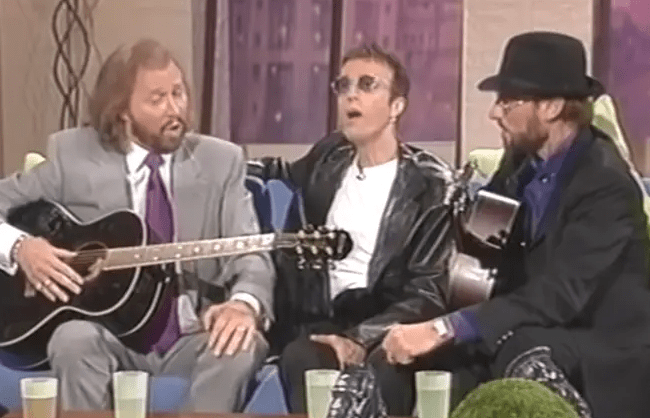
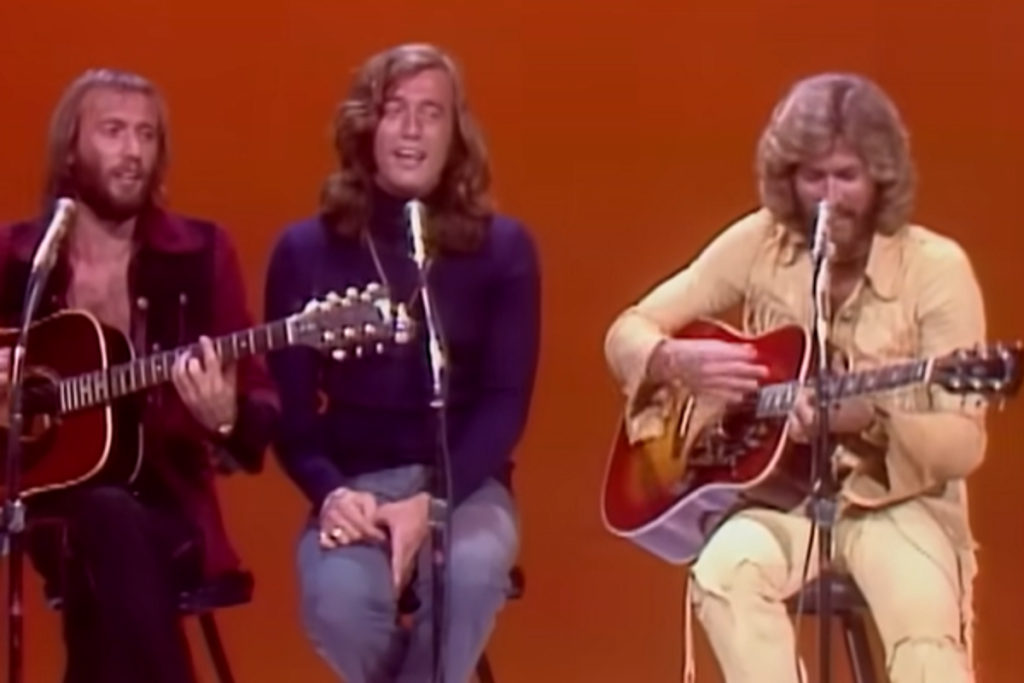
The highlight of the performance was when Barry got ready to strum his guitar for a performance of “How Deep Is Your Love,” the 1977 megahit from the “Saturday Night Fever Soundtrack,” but instead chose to sing the song a cappella.
Barry starts the song solo in his beautiful falsetto, but then, when his brothers join him, they create a wonderful harmony that only brothers can make. The show’s host, Des O’Connor, a notable singer himself, even joins in for a few bars.
Earlier in the performance, the brothers played their version of “Islands in the Stream,” a song made famous by Dolly Parton and Kenny Rogers in 1983 that was written by the Bee Gees. In 1998, the song was enjoying a resurgence as its melody was used in the song “Ghetto Supastar” by Pras of The Fugees.
Robin Gibb later admitted that the song was initially written for Marvin Gaye to sing, but he was tragically murdered in 1984 by his father. The band also had Diana Ross in mind while composing the tune.
During the appearance, the band also sang “Guilty,” a song that the Bee Gees wrote for Barbara Streisand and Barry produced in 1980.
You can watch the entire performance here:
The Gibb brothers started making music together when they were children, and after their first public appearance together at a local movie theater in 1956, they were hooked on performing.
“It was the feeling of standing in front of an audience that was so amazing,” said Barry. “We’d never seen anything like it. We were very young, but it made an enormous impression. We didn’t want to do anything else but make music.”
After the family moved to Australia in 1958, Barry, Maurice, and Robin were “discovered” at the Redcliffe Speedway, where they had asked to perform between races. Even over the tinny PA system, their harmonies made an impression. Speedway manager Bill Goode introduced the trio to DJ Bill Gates, who set them up with a recording session.
If you’ve ever wondered how the Bee Gees got their name, that was it: Bill Goode, Bill Gates, Barry Gibb, and the brothers’ mother Barbara Gibb all had the initials B.G. After a strong reception on the airwaves in Brisbane, Gates forwarded the brothers’ recordings to a Sydney radio station. They got a lot of airtime there as well, and the band had a run of success performing in Australia, but it wasn’t until their return to England in 1967 that they became the international sensation we all know today.
Manager Robert Stigwood had received tapes from the Gibbs brothers and called them up within weeks of their arrival in the U.K.
“I loved their composing,” Stigwood told Rolling Stone in 1977. “I also loved their harmony singing. It was unique, the sound they made; I suppose it was a sound only brothers could make.”
And, as they say, the rest is history. The award-winning 2020 HBO documentary, “The Bee Gees: How Can You Mend a Broken Heart” tells the story of the band with loads of footage from throughout their 40-year career, which includes not only their disco-era fame, but the various phases of their musical journey and the countless songs they wrote for other artists.
As one commenter wrote, “People that call the Bee Gees a ‘disco group’ don’t have a clue. They had 10 albums out before they ventured into ‘disco.’ Their song catalogue is amazing and some of their very best songs were written long before Saturday Night Fever. Those ‘disco’ songs are classics as well. It is nice to see they are finally getting the recognition they deserve.”
In a small village in Pwani, a district on Tanzania’s coast, a massive dance party is coming to a close. For the past two hours, locals have paraded through the village streets, singing and beating ngombe drums; now, in a large clearing, a woman named Sheilla motions for everyone to sit facing a large projector screen. A film premiere is about to begin.
It’s an unusual way to kick off a film about gender bias, inequality, early marriage, and other barriers that prevent girls from accessing education in Tanzania. But in Pwani and beyond, local organizations supported by Malala Fund and funded by Pura are finding creative, culturally relevant ways like this one to capture people’s interest.
The film ends and Sheilla, the Communications and Partnership Lead for Media for Development and Advocacy (MEDEA), stands in front of the crowd once again, asking the audience to reflect: What did you think about the film? How did it relate to your own experience? What can we learn?
Sheilla explains that, once the community sees the film, “It brings out conversations within themselves, reflective conversations.” The resonance and immediate action create a ripple effect of change.
MEDEA Screening Audience in Tanzania. Captured by James Roh for Pura
Across Tanzania, gender-based violence often forces adolescent girls out of the classroom. This and other barriers — including child marriage, poverty, conflict, and discrimination — prevent girls from completing their education around the world.
Sheilla and her team are using film and radio programs to address the challenges girls face in their communities. MEDEA’s ultimate goal is to affirm education as a fundamental right for everyone, and to ensure that every member of a community understands how girls’ education contributes to a stronger whole and how to be an ally for their sisters, daughters, granddaughters, friends, nieces, and girlfriends.
Sheilla’s story is one of many that inspired Heart on Fire, a new fragrance from the Pura x Malala Fund Collection that blends the warm, earthy spices of Tanzania with a playful, joyful twist. Here’s how Pura is using scent as a tool to connect the world and inspire action.
A partnership focused on local impact, on a global mission
Pura, a fragrance company that recognizes education as both freedom and a human right, has partnered with Malala Fund since 2022. In order to defend every girl’s right to access and complete 12 years of education, Malala Fund partners with local organizations in countries where the educational barriers are the greatest. They invest in locally-led solutions because they know that those who are closest to the problems are best equipped to solve and build durable solutions, like MEDEA, which works with communities to challenge discrimination against girls and change beliefs about their education.
But local initiatives can thrive and scale more powerfully with global support, which is why Pura is using their own superpower, the power of scent, to connect people around the world with the women and girls in these local communities.
The Pura x Malala Fund Collection incorporates ingredients naturally found in Tanzania, Nigeria, Pakistan, and Brazil: countries where Malala Fund operates to address systemic education barriers. Eight percent of net revenue from the Pura x Malala Fund Collection will be donated to Malala Fund directly, but beyond financial support, the Collection is also a love letter to each unique community, blending notes like lemon, jasmine, cedarwood, and clove to transport people, ignite their senses, and help them draw inspiration and hope from the global movement for girls’ education. Through scent, people can connect to the courage, joy, and tenacity of girls and local leaders, all while uniting in a shared commitment to education: the belief that supporting girls’ rights in one community benefits all of us, everywhere.
You’ve already met Sheilla. Now see how Naiara and Mama Habiba are building unique solutions to ensure every girl can learn freely and dare to dream.
Naiara Leite is reimagining what’s possible in Brazil
Julia with Odara in Brazil. Captured by Luisa Dorr for Pura
In Brazil, where pear trees and coconut plantations cover the Northeastern Coast, girls like ten-year-old Julia experience a different kind of educational barrier than girls in Tanzania. Too often, racial discrimination contributes to high dropout rates among Black, quilombola and Indigenous girls in the country.
“In the logic of Brazilian society, Black people don’t need to study,” says Naiara Leite, Executive Coordinator of Odara, a women-led organization and Malala Fund partner. Bahia, the state where Odara is based, was once one of the largest slave-receiving territories in the Americas, and because of that history, deeply-ingrained, anti-Black prejudice is still widespread. “Our role and the image constructed around us is one of manual labor,” Naiara says.
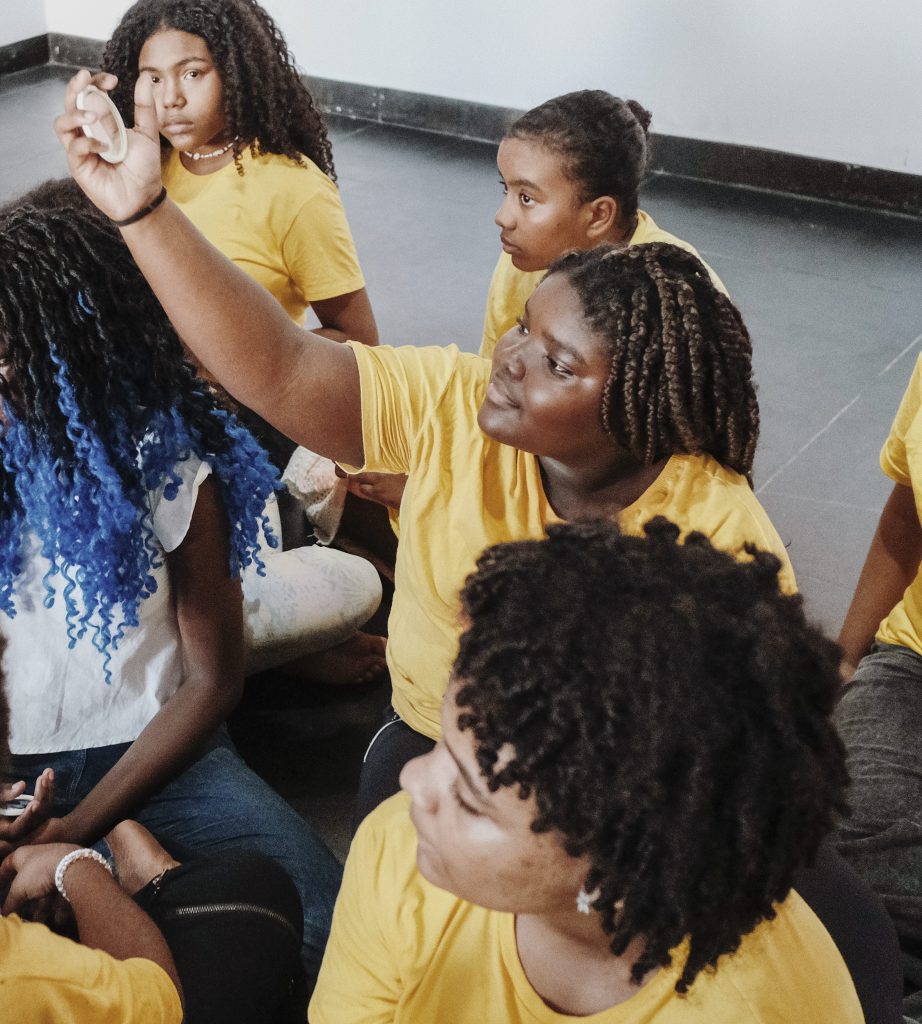
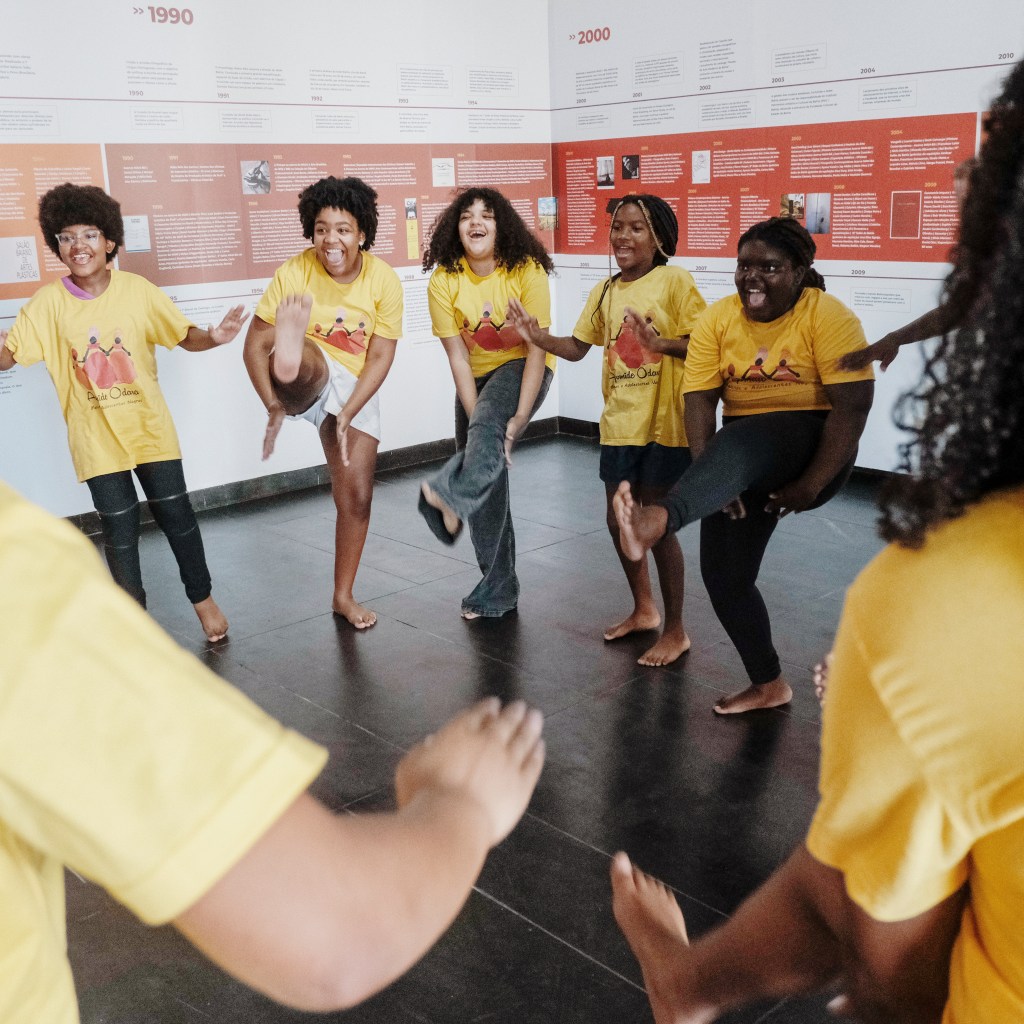
But education can change that. In 2020, with assistance from a Malala Fund grant, Odara launched its first initiative for improving school completion rates among Black, quilombola, and Indigenous girls: “Ayomidê Odara”. The young girls mentored under the program, including Julia, are known as the Ayomidês. And like the Pura x Malala Fund Collection’s Brazil: Breath of Courage scent, the Ayomidês are fierce, determined, and bursting with energy.
Ayomidês with Odara in Brazil. Captured by Luisa Dorr for Pura
Ayomidês take part in weekly educational sessions where they explore subjects like education and ethnic-racial relations. The girls are encouraged to find their own voices by producing Instagram lives, social media videos, and by participating in public panels. Already, the Ayomidês are rewriting the narrative on what’s possible for Afro-Brazilian girls to achieve. One of the earliest Ayomidês, a young woman named Debora, is now a communications intern. Another former Ayomidê, Francine, works at UNICEF, helping train the next generation of adolescent leaders. And Julia has already set her sights on becoming a math teacher or a model.
“These are generations of Black women who did not have access to a school,” Naiara says. “These are generations of Black women robbed daily of their dreams. And we’re telling them that they could be the generation in their family to write a new story.”
Mama Habiba is reframing the conversation in Nigeria
Centre for Girls' Education, Nigeria. Captured by James Roh for Pura
In Mama Habiba’s home country of Nigeria, the scents of starfruit, ylang ylang and pineapple, all incorporated into the Pura x Malala Collection’s “Nigeria: Hope for Tomorrow,” can be found throughout the vibrant markets. Like these native scents, Mama Habiba says that the Nigerian girls are also bright and passionate, but too often they are forced to leave school long before their potential fully blooms.
“Some of these schools are very far, and there is an issue of quality, too,” Mama Habiba says. “Most parents find out when their children are in school, the girls are not learning. So why allow them to continue?”
When girls drop out of secondary school, marriage is often the alternative. In Nigeria, one in three girls is married before the age of 18. When this happens, girls are unable to fulfill their potential, and their families and communities lose out on the social, health and economic benefits.
Completing secondary school delays marriage, and according to UNESCO, educated girls become women who raise healthier children, lift their families out of poverty and contribute to more peaceful, resilient communities.
Centre for Girls’ Education, Nigeria. Captured by James Roh for Pura
To encourage young girls to stay in school, the Centre for Girls’ Education, a nonprofit in Nigeria founded by Mama Habiba and supported by Malala Fund and Pura, has pioneered an initiative that’s similar to the Ayomidê workshops in Brazil: safe spaces. Here, girls meet regularly to learn literacy, numeracy, and other issues like reproductive health. These safe spaces also provide an opportunity for the girls to role-play and learn to advocate for themselves, develop their self-image, and practice conversations with others about their values, education being one of them. In safe spaces, Mama Habiba says, girls start to understand “who she is, and that she is a girl who has value. She has the right to negotiate with her parents on what she really feels or wants.”
“When girls are educated, they can unlock so many opportunities,” Mama Habiba says. “It will help the economy of the country. It will boost so many opportunities for the country. If they are given the opportunity, I think the sky is not the limit. It is the starting point for every girl.”
From parades, film screenings to safe spaces and educational programs, girls and local leaders are working hard to strengthen the quality, safety and accessibility of education and overcome systemic challenges. They are encouraging courageous behavior and reminding us all that education is freedom.
Experience the Pura x Malala Fund Collection here, and connect with the stories of real girls leading change across the globe.
By 1973, the Bee Gees’ career had hit a low. After a series of hits in the late 1960s and early 1970s, including “To Love Somebody,” “How Can You Mend a Broken Heart,” and “I Started a Joke,” the band was in a rut. Their latest album, Life in a Tin Can, and single “Saw a New Morning” sold poorly, and the band’s popularity declined.
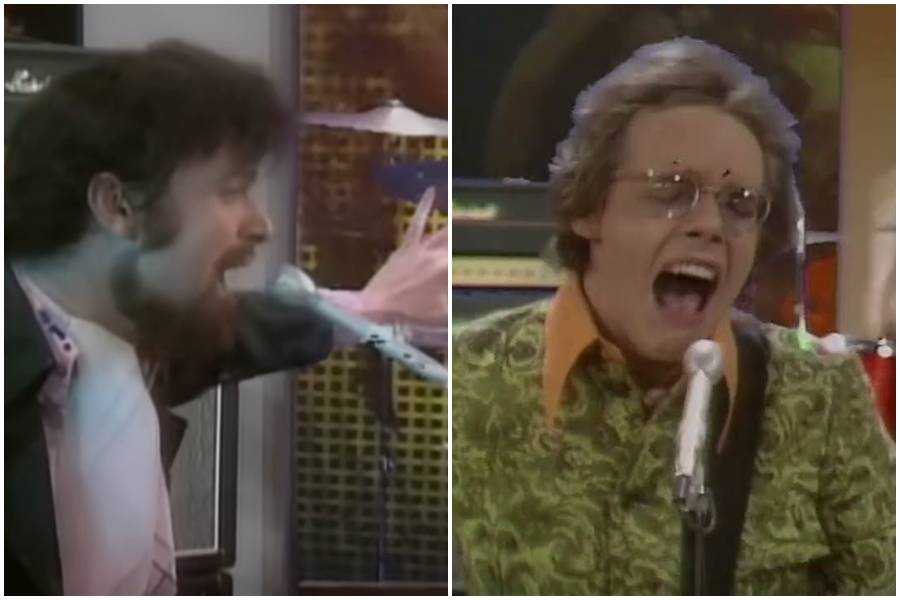
On April 6, 1973, the Gibb brothers (Barry, Robin, and Maurice) appeared on The Midnight Special, a late-night TV show that aired on Saturday mornings at 1 a.m. after The Tonight Show with Johnny Carson. Given the lukewarm reception to their recent releases, the Bee Gees decided to change things up and play a medley of hits from their idols, The Beatles, who had broken up three years before.
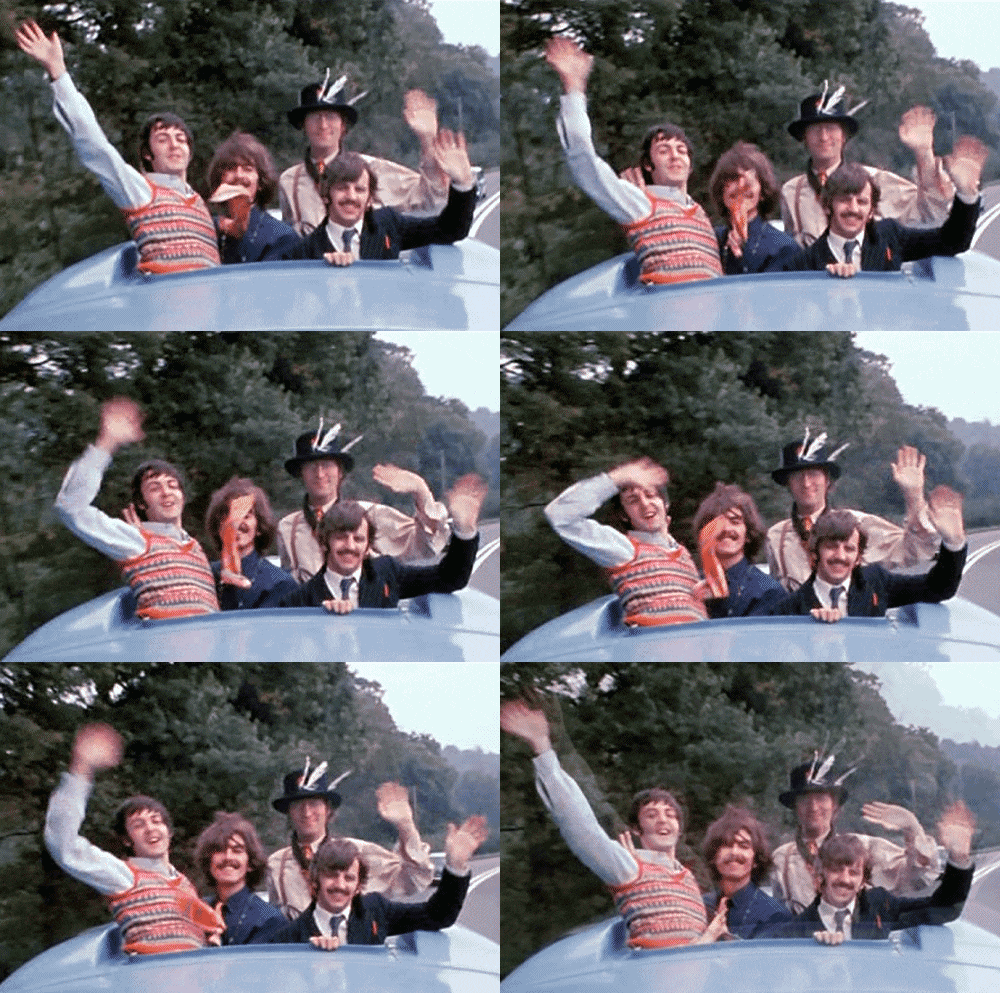
The Beatles were the biggest band on Earth in their heyday. Giphy
The performance, which featured five of the Fab Four’s early hits, including “If I Fell,” “I Need You,” “I’ll Be Back,” “This Boy,” and “She Loves You,” was a stripped-down, acoustic performance that highlighted the Bee Gees’ trademark harmonies.
“When you got brothers singing, it’s like an instrument that no one else can buy. You can’t go buy that sound in a shop. You can’t sing like The Bee Gees because when you got family members singing together, it’s unique,” Noel Gallagher, who sang with his brother Liam in Oasis, said according to Far Out.
A year later, the Bee Gees performed in small clubs, and it looked like their career had hit a dead end. Then, at the urging of their management, the band began to move in a new direction, incorporating soul, rhythm and blues, and a new, underground musical style called disco into their repertoire. Barry also adopted a falsetto singing style popularized by Black singers such as Curtis Mayfield and Marvin Gaye.
This unlikely change for the folksy vocal group catapulted them into the stratosphere and they became the white-satin-clad kings of disco.
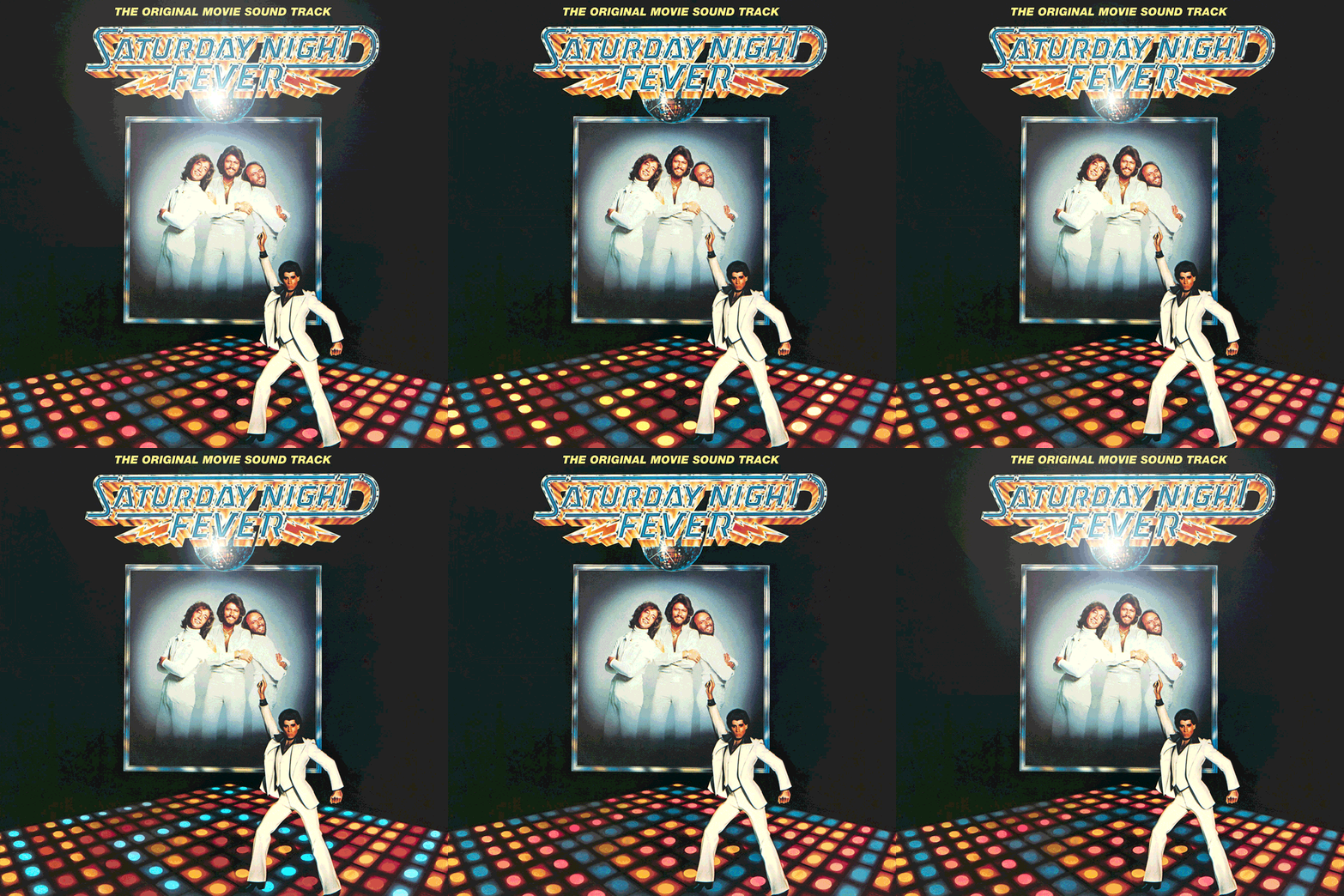
In the late ‘70s, the band had massive hits, including songs featured on the 40-million-selling Saturday Night Fever soundtrack: “Stayin’ Alive,” How Deep is Your Love,” More Than a Woman,” Jive Talkin’,” and “Night Fever.”
In 1978, the band made a significant misstep, starring in a musical based on The Beatles’ music called Sgt. Pepper’s Lonely Hearts Club Band, produced by Robert Stigwood, the man behind Saturday Night Fever and Grease. The film was a colossal bomb, although the soundtrack sold well.
The Beatles’ George Harrison thought the Bee Gees film was about what happens when you become successful and greedy.
“I just feel sorry for Robert Stigwood, the Bee Gees, and Pete Frampton for doing it because they had established themselves in their own right as decent artists,” Harrison said. “And suddenly… it’s like the classic thing of greed. The more you make the more you want to make, until you become so greedy that ultimately you put a foot wrong.”
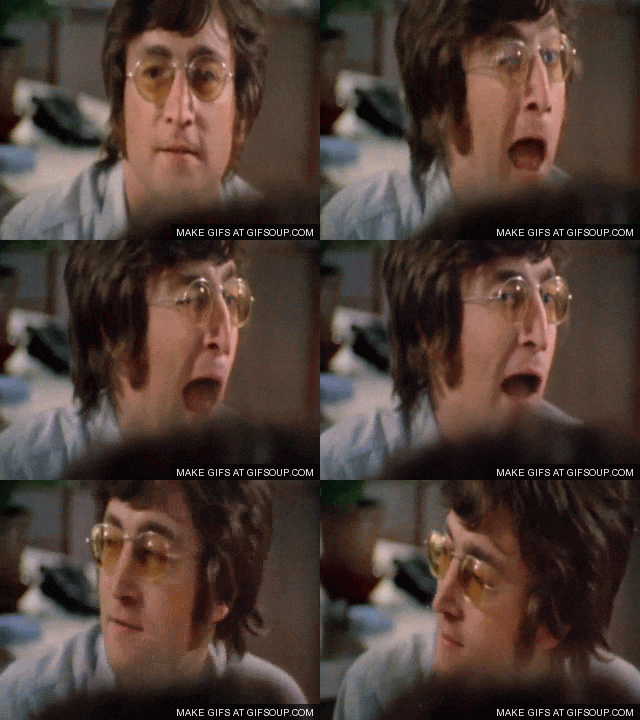
Even though the Bee Gees’ Beatle-themed musical was a flop, former Beatle John Lennon remained a fan of the group. He sang their praises after the public’s growing distaste of disco resulted in a significant backlash.
“Try to tell the kids in the seventies who were screaming to the Bee Gees that their music was just the Beatles redone,” he told Playboy magazine in 1980. “There is nothing wrong with the Bee Gees. They do a damn good job. There was nothing else going on then.”
The Bee Gees historic career ended when Maurice passed away in 2003 at 53. Robin would follow in 2009 at 62. Barry is the final surviving member of the band.
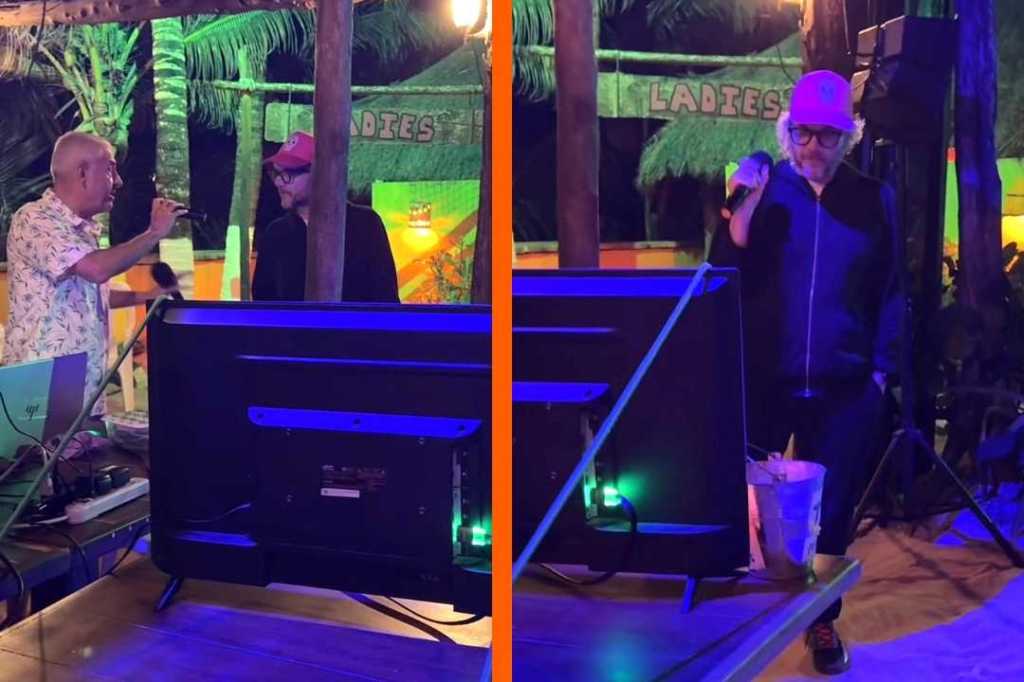
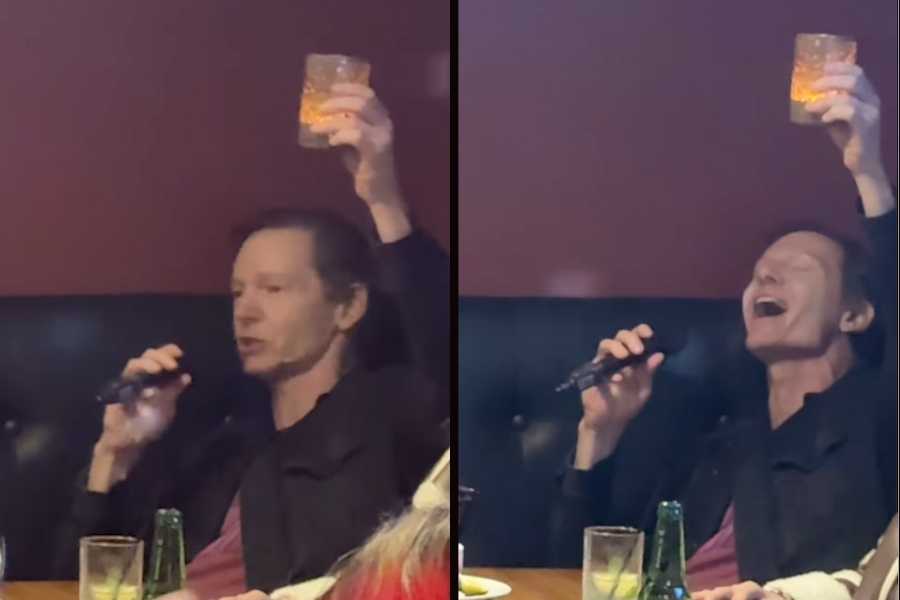
On a January evening at a restaurant in Mexico, El Jefe patiently waited for his name to be called by the karaoke host. When it was, he gently walked to the stage in a pink baseball hat and black, thick-rimmed glasses. As he approached, the host gave him instructions on how to use the microphone. “You’ve got to hold it up here and just don’t yell in the mic,” he said, illustrating as El Jefe humbly listened.
He then proceeded to sing “Jesus, Etc.” almost better than its original singer, Jeff Tweedy of Wilco. There’s a reason for that: El Jefe, as it turns out, is Jeff Tweedy.
The song is track five on Yankee Hotel Foxtrot, which was released in 2002. According to the liner notes, it was written by Tweedy and Jay Bennett, a former member of the band who passed away in 2009. Pitchfork hailed the tune as “the 61st best song of the decade,” which is high praise, especially considering how much excellent indie-rock music was coming out at the time.
Stereogum’s Chris DeVille wrote about the album’s 20th anniversary, noting that Wilco streamed it at no charge. “A bold and uncommon move at that time, and one that probably made the album sound even more experimental for those with dial-up internet connections,” he wrote. DeVille added, “Yankee Hotel Foxtrot is THE Wilco album — the one that cemented their stature as one of the all-time great American rock bands.”
There’s a kind of perfection to Tweedy singing his own song at karaoke, and not just because it conjures so many memories for Wilco fans. Watching Tweedy in a Clark Kent–like, plainclothed role, when most fans know he can become Superman at any given moment, is something extra special.
“You guys are the coolest famous non-famous people ever,” one person wrote. “How surreal. To write a song, make a record with that song (and many more) on it, and become well known in certain circles for that song and all the other songs, have that song turned into a karaoke selection because it has become that level of popularity, then sing that song like you’re an everyday schmuck just doing karaoke one night on vacation, it’s just…”
Another person described the scene and how lovely it all was: “My heart needed this. The children playing, palm trees swaying in the neon lights, that super fun ‘Ladies’ sign, a few enthusiastic ‘woos’ and a happy, humble El Jefe. Good stuff!”
One fan loved that Tweedy seemed to go unnoticed by the karaoke host. “My favorite part is the host showing him how to use the microphone,” they wrote. Another person replied, “And the ‘Jeffiest’ reaction of playing it totally cool, no ego, totally kind, respecting the KJ’s ‘authority.’ The least ‘Do you have any idea who I am?’ energy possible.”
One comment summed up the many layers of coolness on display: “This is beautiful on so many levels. I always thought you ‘made it’ when your song ended up in a karaoke machine. Here it is, yet (maybe) no one knows him or the song — and that’s perfectly fine with him. For that, I’m so happy for him. What a gift of a moment that must have been: to be respected, successful and famous without the bad fame part. That’s the sweet spot. Just to put your hand in your pocket and sing your song for yourself and your family.”
Upworthy had the honor of chatting with Tweedy’s wife, Susan, who provided a little context for the evening. It all happened following this year’s Sky Blue Sky festival, an all-inclusive vacation in Mexico featuring a musical lineup that included Dinosaur Jr., The Jayhawks, and, of course, Wilco.
“So after Jeff’s festival, Sky Blue Sky, we stayed in the general area at a rental house for a few days to unwind,” she said. “That night we were at La Buena Vida, a restaurant that apparently does karaoke every Wednesday evening.”
Susan noted that she and their kids egged him on: “The kids and I told Jeff he should do it! He’s never done it before, but it was all families and little kids running around, and we all thought it would be fun and funny! Our son Sammy checked to see if there were any Wilco songs available to do, and there were! We signed him up, and I think he was the last one to make it on for the night.”
When asked whether Jeff was recognized, the answer was surprising.
“Nobody recognized him, although I did see a post a couple days later of someone who said they were there and that they were pretty sure it was him,” she said. “But nobody said a word, and people were still talking and running around and mostly ignoring the karaoke during his whole song, just like for everybody else! It was really fun for all of us!!”
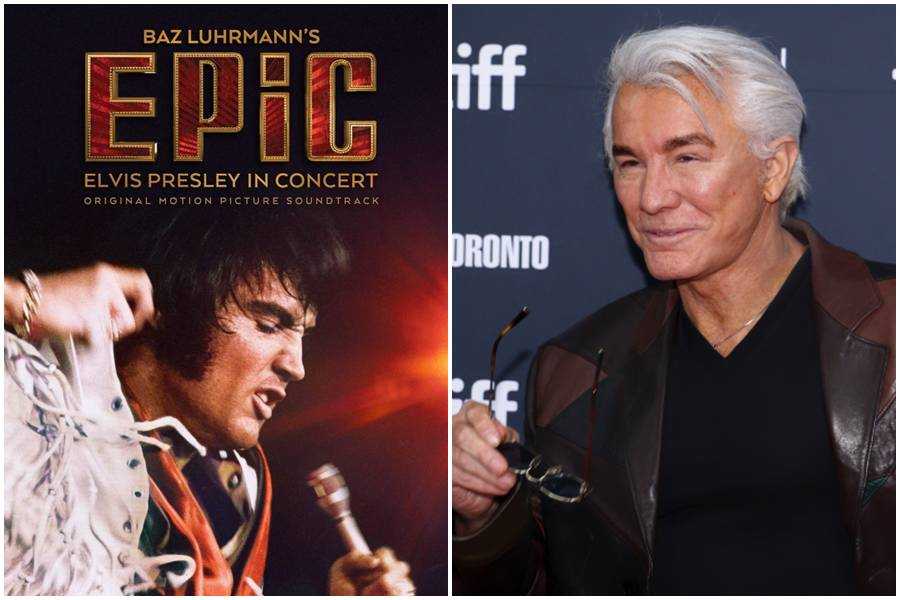
While researching his 2022 hit film Elvis, director Baz Luhrmann searched for lost footage of The King to use in the film. What he found was a treasure trove of unseen footage from Elvis Presley’s early ’70s residencies in Las Vegas, as well as hours of interviews in which he discussed his creative process in depth.
The 35mm and 8mm footage was discovered in the Warner Bros. archives, buried deep in a salt mine in Kansas. Underground salt mines are great for film preservation because they have stable temperatures and humidity, which allow long-term storage that prevents deterioration.
The lot footage becomes an EPiC film
Luhrmann took the footage and crafted a concert film, EPiC: Elvis Presley in Concert, featuring the King at the peak of his post-’68 comeback era, before drugs, overeating, the burdens of superstardom, and his divorce from Lisa Marie Presley turned him into a caricature of his old self. Yes, Elvis may have entered his flashy jumpsuit era, but his moves, voice, humor, and charisma are all in full form. The film is unique in that it combines never-before-seen rehearsal footage narrated by Elvis, offering rare insights and openness that the public has never seen.
“This is the most unexpected film that ever happened to me,” Luhrmann told viewers ahead of a special preview screening at the IMAX theatre in Sydney, Australia. “We thought ‘let’s just get out of the way … What if Elvis just told you his story?’”
Here’s the trailer:
The film showcases amazing talent as a performer, but has an intimate quality that sets it apart from a simple concert film. “What if Elvis came to you in a dreamscape, almost like a cinematic poem, and sang to you and told you his story in a way in which you haven’t experienced before?” Luhrmann wrote in his director’s note for the IMAX screening.
An intimate look at an incredible performer
The film incorporates July 1970 rehearsal footage of him preparing for his third appearance at the International Hotel, showing how Elvis could be both an incredible perfectionist and charming with his friends and bandmates.
Elvis Presley rehearsing “Get Back” (The Beatles) in Los Angeles, and later in a show in Las Vegas, back in 1970 pic.twitter.com/qPpcuIXFPK — MP10 (@MusicPills10) February 7, 2026
The concert footage shows blistering, amped up versions of old hits such as “Hound Dog” and “That’s Alright,” as well as rehearsal footage of him singing Beatles songs, “Something” and “Yesterday.” The film also shows his first performance of “Burning Love,” a song so fresh that Elvis has to read the lyrics as he sings. The film ends with a grandiose version of the 1969 hit, “Suspicious Minds.”
“The film looks and sounds incredible. Peter Jackson’s team, who carefully restored Beatles footage in Get Back, worked their magic here to bring Elvis back in vivid glory,” Andy Howell writes at Film Threat. “In fact, a better title would have been Elvis Lives, because this footage is so beautiful and clear, and the film is so intimate, that it seems like this was shot yesterday and we’re having a conversation with him.”
EPiC: Elvis Presley in Concert arrives in theaters for a one-week IMAX engagement starting February 20, followed by a global theatrical release on February 27.
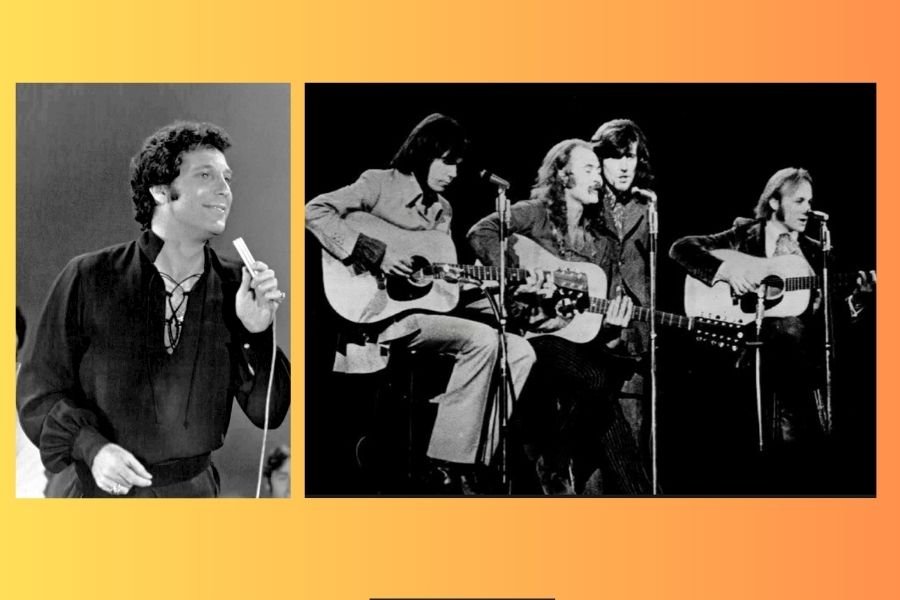
Tom jones singing on 'This is Tom Jones" (left) Crosby, Stills, Nash and Young performing in 1970 (right). – Photo credit: via Wikipedia, eBayItem/WikimediaCommons
The year was 1969. American culture was at a crossroads, with the Vietnam War dividing the country politically and counterculture in full swing. Despite the divide, music was there to unite in the golden age of variety shows.
In September of that year, Crosby, Stills, Nash and Young (CSN&Y) were asked to play a duet with Welsh singer Tom Jones on his variety television show and the pairing was a perfect example of the culture clash. Jones was famous for his hit songs “It’s Not Unusual” and “What’s New Pussycat?”, while CSN&Y had just played Woodstock and were known for the anti-war anthem “Wooden Ships” and “Long Time Gone” about the assassination of Robert Kennedy.
For the performance, Jones and CSN&Y played a rendition of “Long Time Gone,” and what’s impressive is that Jones does not hold back and forced the rest of the band to keep up. Steven Stills, on electric piano, tries his best to match Jones’ bravado on his lines but falls short.
David Crosby has a look on his face of pure awe when he looks at Jones (although he was known for being in “awe” quite often in the days).
Throughout the performance, the hard-to-impress Neil Young seemingly goes from a look of pure disdain to “This rocks.” The performance is an excellent example of music’s ability to bridge cultural divides and bring people together.
Fans react
Down in the comments, people had nothing but love for Tom Jones’ soulful voice. And for the musical prowess of the whole gang, really.
“Everything about it is so perfect, Neil’s stanky guitar face at the beginning while he’s soloing, David staring at Tom while he’s busting out the high notes, Stephen getting the falsetto, graham nailing the harmonies, not to mention Dallas and Greg killing it in the rhythm section. God I love this band so much.”
“I feel like some people don’t really understand what an absolute beast of a vocalist Tom Jones was in his prime! He could literally sing anything and everything! Nothing was out of the realm of possibility with that voice!!! Just look at CSN&Y! It’s rare that you have a group of such an amazing musicians all sitting back just awestruck!!! Truly one of the greatest voices of our time!!!”
“All I want in life is for someone to look at me the way David Crosby looks at Tom Jones.”
“I also love that one shot of Graham and David smiling at each other while singing their harmonies – their faces say “it doesn’t get any better than this.”
“So much talent on display. Everyone’s pulling together and really delivering their part of a great arrangement. No clashing egos. Crosby Stills, Nash, Young and Jones!”
Another iconic Tom Jones collab
And this of course isn’t the only time Tom Jones has brought the house down during a collaboration. Below is a powerhouse duet between Jones and the iconic Aretha Franklin, who did a “See Saw”/“’Spirit in the Dark” medley for his This Is Tom Jones show. It’s pure magic.
If these videos have got your jonesin’ for even more Jones (and you happen to live in the UK) you’re in luck. The singer recently announced he would be part of the Colchester Castle Summer Series, which is expected to be the one of the largest music events the city has seen in years.
And for CSN&Y fans, their first tour is set to be released on a new live album. Pretty good year for classic rock lovers.
This article originally appeared two years ago. It has been updated.
When you think back to your own school dances—from buttoned-up proms to casual after-the-ballgame romps—you may feel a tinge of wistful sadness, teenage angst, or residual awkwardness. But no matter the emotion, or perhaps because of it, you probably remember exactly which songs were playing. If you happen to hear an R&B slow jam or a classic rock power ballad on the radio, all of those feelings can come flooding back.
While some tracks transcend age, every generation has its definitive slow-dance songs. If you look around online, you’ll find numerous threads devoted to the topic, with hundreds of people casting their votes. So let’s all shuffle into our collective gymnasium and remember some of these eternal bangers.
“I can almost smell the gym full of kids wearing too much cologne”
Our first stop is the r/GenX subreddit, where users shared some staples from middle school and high school. The OP mentioned a handful of ’80s hits from Journey (“Open Arms,” “Faithfully,” and “Who’s Crying Now”) as well as favorites from Foreigner (“Waiting for a Girl Like You” and “I Want to Know What Love Is”). They also highlighted the Joe Cocker and Jennifer Warnes duet “Up Where We Belong,” which sounds like it was scientifically engineered for slow dancing.
Here are some other popular responses:
Bryan Adams – “(Everything I Do) I Do It For You”
Bryan Adams – “Heaven”
Cyndi Lauper – “Time After Time”
The Cars – “Drive”
Nazareth – “Love Hurts”
The Bangles – “Eternal Flame”
“OMG,” one person wrote. “[R]eading through this I can almost smell the gym full of kids wearing too much cologne and the popcorn machine run by a lunch lady getting in some overtime.”
“Still love that song!”
One song kept popping up in threads for both Xennials and Millennials: K-Ci & JoJo’s 1998 R&B anthem “All My Life.”
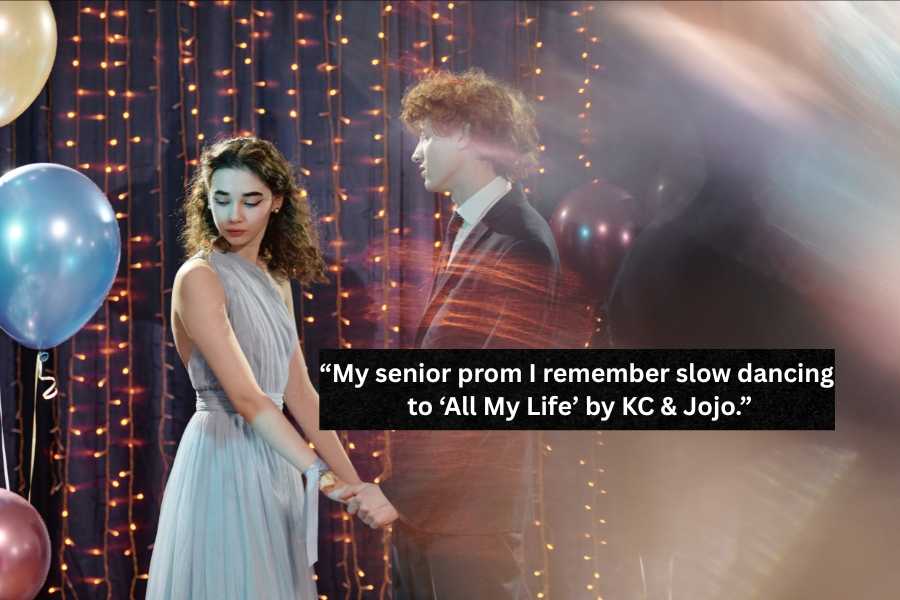
“My senior prom, I remember slow dancing to ‘All My Life’ by K-Ci & JoJo,” one user wrote. “Still love that song!”
Another Redditor added, “STOP IT. I opened the comments to say exactly this.”
These other ’90s songs also got some votes:
Seal – “Kiss From a Rose”
Boyz II Men – “End of the Road”
Aerosmith – “I Don’t Want to Miss a Thing”
Savage Garden – “I Knew I Loved You”
Goo Goo Dolls – “Iris”
Celine Dion – “My Heart Will Go On”
All-4-One – “I Can Love You Like That”
Edwin McCain – “I’ll Be”
Brian McKnight – “Back at One”
But what about the current millennium? Do teenagers even slow-dance these days? In 2023, Billboard‘s Kyle Denis spoke with a number of DJs to find out whether the ritual has disappeared for Gen Z. It’s a fascinating look at shifting cultural norms, including how factors such as the omnipresence of camera phones and the lyrical sentiments of popular songs have helped drive that change.
“I feel like the content directly relates to it—to me, slow [dancing] goes with more romantic music,” said DJ R-Tistic. “Whether it’s [Jodeci’s] ‘Forever My Lady,’ a Luther [Vandross] song, or even, for the late ’90s, a D’Angelo-Lauryn Hill ‘Nothing Even Matters.’ Those [songs] are more about romance.”
Karaoke can be exhilarating, horrifying, awkward, hilarious—but it’s rarely nonchalant. That might be part of the reason one man went viral for a suave rendition of U2’s soaring anthem “With or Without You.” It’s hard to belt one of rock’s most passionate songs while reclining in a booth, but somehow that just makes the whole thing even coolerl.
The clip shows Lugi, the singer of California duo Pengwich, singing the first verse, often closing his eyes as he channels his inner Bono. At first, the room is charged with the buzz of people talking. But it’s amazing to watch everyone suddenly realize, “Whoa, this dude is really good” and start paying attention. By the end of the video, as Lugi ascends into a sweet falsetto and belts with full-force vibrato, the entire mood has shifted.
“How does one maintain this level of cool in karaoke?”
People also responded to the performance online, with Instagram users marveling at the unique delivery. An account called FacesofRock1 shared the video, and the comments flooded in. Here are some of the best:
“Even better than the real thing, excuse the pun”
“He’s the main character in his own David Lynch movie.”
“u2 is amazing and this guy nailed it. Sitting down. In the corner. “
“This guy killin it and everyone loud and not paying attention. Unbelievable”
“All the patrons blissfully unaware they’re missing the greatness —>”
“That guy, that voice, that song, that drink, that pub… he did alright “
“Unc Smooth AF.”
“What a legend”
“This is the coolest guy I’ve ever seen.”
“Dude has been waiting 45 years for this moment “
“Absolute stud.”
“Nailed it from his chair!! “
“How does one maintain this level of cool in karaoke? “
Upworthy reached out to Lugi, who offered some interesting context about the performance. “The ironic thing about this clip is that my usual approach to performing is the opposite of what happened that night,” he said, pointing to a more animated and intense rendition of Radiohead’s “Creep.” (Different styles, for sure, but equally memorable.) “I’m generally the guy they come to see jump on the bar or lie on the floor,” he added. “But that particular night, the people were there to chat amongst themselves, so I chose to keep it personal and low-key. I didn’t think anyone was listening, let alone recording.”
Lugi never envisioned going viral via karaoke—his ultimate aim is to share original music, using these live covers as a way to “keep the performance momentum going.” Ultimately, he just wants to create, no matter the outlet. “My first language is music,” he said, “and if there’s an available microphone, I’m probably gonna grab it. In my youth I was super shy, so I think I’m making up for lost time.” As for the video itself? “I’m excited [it] went viral and the reactions are so positive. It was a genuine moment for sure, but then anytime I can lose myself in a song it’s for real.”
In 1966, The Supremes scored a massive hit with “You Keep Me Hangin’ On,” written by Brian Holland, Eddie Holland, and Lamont Dozier. The Supremes’ arrangement has an iconic Motown bounce, even though the song is about a woman who’s heartbroken after being breadcrumbed by her man.
Vanilla Fudge, a psychedelic rock band from Long Island, New York, had a history of slowing down pop tunes to expose their true meaning, and “You Keep Me Hangin’ On” was a perfect song to dig deeper into.
“We used to slow songs down and listen to the lyrics and try to emulate what the lyrics were dictating,” drummer Carmine Appice said, according to Far Out Magazine. “That one was a hurtin’ song; it had a lot of emotion in it.”
Vanilla Fudge plays “You Keep Me Hangin’ On” on The Ed Sullivan Show
The band gave an electrifying performance of the song in January 1968 on The Ed Sullivan Show, and it was not only a thoroughly inventive take on The Supremes’ song, but also one that featured elements of early heavy metal, driven by Appice’s bombastic drumming. The take-no-prisoners performance is raw, emotional, and dark for a family TV show in the ’60s. It’s the musical version of an athlete “leaving it all out on the field.”
Appice recalled being incredibly nervous after an elevator operator at the studio told him the show was watched by around “50 million” people. But he quickly relaxed once the band kicked in.
“Then afterwards, it went off so amazing, everyone was claiming, and there were reviews in the newspapers and radio, even TV, was saying that it was the most amazing performance that anyone ever did on Ed Sullivan,” he told Music Night At The Majestic. “Because it was so dynamic. So emotional.”
“You Keep Me Hangin’ On” made a comeback on TV and in film
Vanilla Fudge’s version of the classic has enjoyed a renaissance over the past few decades, playing a pivotal role in the final episode of The Sopranos and in season seven of Mad Men. The song perfectly captures the tortured spirit of Don Draper as he contemplates how he lost his way while sitting in the cold.
The song also set the emotional tone for the climactic encounter between Brad Pitt’s character, Cliff Booth, and the Manson Family in Quentin Tarantino’s masterpiece, Once Upon a Time… in Hollywood.
“That was pretty cool! And it definitely helped with our streaming numbers. A lot of young people found out about the song that way,” vocalist and keyboardist Mark Stein told Houston Press. “And Tarantino did his own edit on it. He’s a real music guy.”
Tarantino has a long history of taking fantastic songs from the ’60s and ’70s that weren’t necessarily classic rock or oldies staples and bringing them back into the public consciousness. He reintroduced Stealers Wheel’s “Stuck in the Middle with You” after it was featured in a horrific scene in Reservoir Dogs.
Tarantino put the spotlight back on Chuck Berry’s “You Never Can Tell” in Pulp Fiction during the Jack Rabbit Slim’s Twist Contest.
In Jackie Brown, “Across 110th Street” by Bobby Womack plays during the film’s opening credits as we’re introduced to the titular character.
Vanilla Fudge’s rendition of “You Keep Me Hangin’ On” is a great reminder that some songs are so great they can be interpreted in multiple ways—either as a pop radio hit by a girl group or as a dirty freak-out by a proto-metal band. Some songs have such strong DNA that they can be powerful in any context.
Spin Doctors' Chris Barron delighted car-rental employees with an impromptu version of "Two Princes." – Photo credit: screenshots via Spin Doctors Instagram
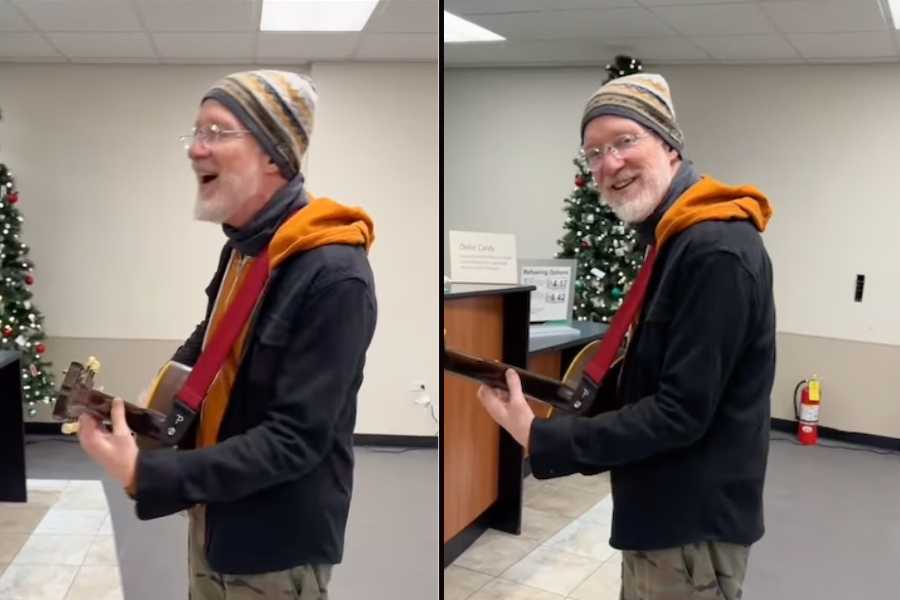
Securing a rental car is usually, at best, a boring and tedious process—not usually the kind of thing you’d want to livestream or film for posterity. But that’s probably because you’ve never waited in line for your compact Sedan next to the singer of a popular alt-rock band. Chris Barron, singer of Spin Doctors, went viral on Instagram for an impromptu performance at the Enterprise Rent-A-Car at Chicago’s O’Hare Airport. It was a jovial acoustic version of the band’s 1991 classic “Two Princes,” and the Internet loved every second of it.
The clip opens abruptly, with Barron strumming and singing the chorus. John Hampson of the band Nine Days, best remembered for their 2000 single “Absolutely (Story of a Girl),” films the clip and harmonizes nearby. It’s lovely to see Barron beaming—according to Setlist.fm, Spin Doctors have played this song 740 times, but that doesn’t seem to have diminished his joy for it. Equally great is the response from the Enterprise workers happily recording with their phones. (Kudos to the employee on our right, who dances and claps along.)
“They clearly don’t know that I’m the dude from Spin Doctors”
Upworthy reached out to Barron, who offered some backstory of this “organic” human moment. On December 13, 2025, he played an unplugged “Story of a Song” show alongside Hampson, Brian Vander Ark (The Verve Pipe) and J.R. Richards (Dishwalla) in Des Plaines, Illinois, but his flight wound up canceled due to weather conditions. “We got to the airport, and the new flight got delayed until 7 that night,” Barron says. “[Hampson and I] looked at each other like, ‘This flight’s not gonna happen.’ Both of us are very seasoned travelers, old-school road dogs. We’re like, ‘Let’s rent a car and drive. Let’s make it to Pittsburgh tonight and grab a hotel.’” After sorting out baggage, they headed down to Enterprise, which was empty except for four employees. When the workers saw the guitar cases, they asked the musicians to play a song.
“I just pull out my guitar and start playing ‘Two Princes,’” he says. “They all pull their phones out, and John pulls his phone out. They’re clearly like, ‘Wow, this guy is good, but they also clearly don’t know that I’m the dude from Spin Doctors.’” When he stepped away for a second, Hampson gave the workers that extra info: “They’re all like, ‘Wait, that’s the guy?’” Barron adds with a laugh. “I come out of the bathroom, and they all want to take pictures.” The vibes was “all smiles”—plus, Barron’s travel hunch was right: “We get to Pennsylvania at 1 a.m. and look at our phones, and at that flight had been canceled, so we definitely wouldn’t have gotten out that day. The next morning at 10 a.m.—about 24 hours after John and I decided to pull the plug and get it in a rental car—I was sitting on the couch with my cat at home. [Laughs.]”
“Love the one gentleman not recording it! Living in the moment!”
The video blew up on Instagram, with hundreds of people praising both the performance and the sweetness of this random encounter. Some celebrities and musical peers even weighed in, including singer-songwriter Lisa Loeb, who responded with a simple, “Yeah!” Here are some more great comments, including more than a couple rental-car jokes:
“I’m a firm believer this is one of the greatest songs ever made.”
“I was getting ready to say damn this dude did a good job with this cover until I noticed it was the spindoctors page . One of my favorite songs growing up”
“Not me being like oh my God this is a great cover only to realize it’s you. Happy holidays, indeed.”
“Feels like a complimentary upgrade to me”
“Most perfectly crafted pop rock song of the 90’s”
“I’m sorry sir but we still cannot upgrade your Kia Forte”
“’That’s great, but sir, you’re still going to need to purchase comprehensive coverage.’”
“Making the most of the situation! “
“This song is forever in my shower-singing repertoire”
“This is just… fun. Life needs more of this.”
“Real artists will play even the smallest of stadiums”
“Love the one gentleman not recording it! Living in the moment!”
Virality, it should be noted, was never on Barron’s wish list: “I really don’t think in terms of viral-video stuff,” he says. “I’m not that generation. I’m a 20th-century guy. I was born in 1968. But John was like, ‘We should post this. I bet it would take off.’ [The video is] very organic. It’s very analog. It’s a real moment that somebody captured.”
“Two Princes” was one of two major hits from Spin Doctors’ debut LP, 1991’s Pocket Full of Kryptonite, along with “Little Miss Can’t Be Wrong.” The former song hit No. 7 on the Billboard Hot 100 and earned a Grammy nomination for Best Rock Performance by a Duo or Group With Vocal. But the band is still going—they’ve released five more albums over the years, including their most recent, 2025’s Face Full of Cake, and they have tour dates scheduled throughout 2026, including a run with Blues Traveler and Gin Blossoms.













.jpg)