upworthy
Add Upworthy to your Google News feed.
Google News Button
Education

Mom shares how her first grader's homework on the second day of school broke his spirit

"It's breaking their spirit and it robs them of what little fun and family time they have when they come home after a long day of school."

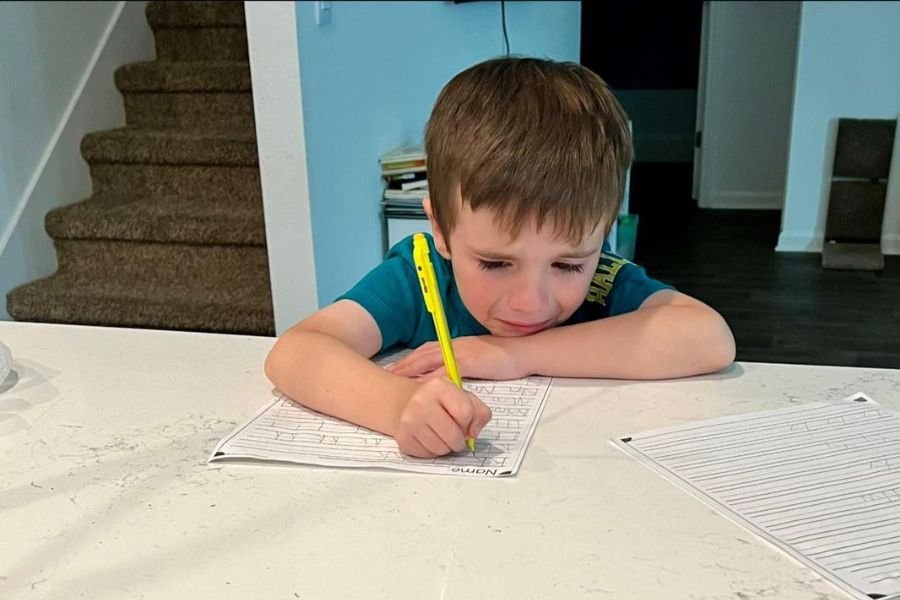
little boy in tears as he's doing homework
Photo credit: Cassi Nelson/Facebook

How much homework is too much homework?

Debates about homework are nothing new, but the ability of parents to find support for homework woes from thousands of other parents is a fairly recent phenomenon. A mom named Cassi Nelson shared a post about her first grader's homework and it quickly went viral. Nelson shared that her son had come home from his second day of school with four pages of homework, which she showed him tearfully working on at their kitchen counter.

"He already doesn’t get home from school until 4pm," she wrote. "Then he had to sit still for another hour plus to complete more work. I had to clear out the kitchen so he could focus. His little legs kept bouncing up and down, he was bursting with so much energy just wanting to go play. Then he broke my heart when he looked up at me with his big teary doe eyes and asked…. 'Mommy when you were little did you get distracted a lot too?!' Yes sweet baby, mommy sure did too! I don’t know how ppl expect little children to sit at school all day long and then ALSO come home to sit and do MORE work too…."

Nelson tells Upworthy that she was "shocked" that kindergarteners and first graders have homework, much less the amount they were expected to do. "We didn't have homework like this when we were in these younger grades."

Expert opinion and research is somewhat mixed on the homework front, but there isn't any conclusive evidence that homework is universally beneficial for students and too much homework can actually be harmful. As a standard, the National Education Association (NEA) and the National Parent Teacher Association (NPTA) support a limit on homework of “10 minutes of homework per grade level."

With that as a guide, a first grader shouldn't have more than 10 minutes of homework on any given school day, but it's not unusual for young kids to have two or three times the recommended limit of homework. That can be stressful for both kids and parents, cutting into valuable family time and limiting kids' time to decompress, play and freely engage in imaginative activity.

As Nelson concluded, "It’s breaking their spirit and it robs them of what little fun and family time they have when they come home after a long day of school."

Most parents and even most teachers in the comments agreed with her that four pages of homework is too much for a first grader, especially on only the second day of school:

"Poor little man. Children below a certain grade should not be given homework! Small children have a hard time sitting still for a long period of time yet alone expected to sit and do hours of homework, for what??? They are SMALL CHILDREN! Let them snack, play, laugh and all the other fun things when they get home. You are only a child once, they don't need that taken away from them. Let them embrace their inner creativity, imagination, recipes, etc."

"This breaks my spirit. Our schools are huge scams. You're exactly right Cassi. Homework is ridiculous. Kids til the age of 10 primarily learn through real life situations and play scenarios."

"I hate that for him! My little one has ADHD and doing homework after sitting in class all day is very stressful to him and makes him hate school. They are in school for 7 hours they shouldn’t have homework. That definitely takes away any kind of family time and that’s why kids never spend time with parents anymore because they have all this homework to do after being gone all day.I feel that if it can’t be done in the 7 hours they have the kids then it should wait until the next school day."

"I don’t make them do homework at home when they are that little. It’s not fair!They are at school allllll day! And it’s already sooooo much for their little bodies and brains! I’ve never had a teacher upset about it either.. and even if I did oh well!"

"That breaks my heart. 4 pages is absolutely ridiculous for young kids. My daughter is going into 2nd grade next month, the 2 years in school it was always 1 page of homework sometimes back and front if it was math. And to read."

This article originally appeared in August"I was in this boat with my son…conversation with the principal and teachers helped dramatically!! It’s too much and we have to advocate for them."

Nelson was blown away by the response to her post, which has been shared on Facebook over 89,000 times. "I NEVER thought me sharing my thoughts openly about how my heart hurt watching my little guy struggle would connect to so many others worldwide going through the same thing," she says.

Many parents shared that excessive homework is one of the reasons they decided to homeschool their children, which Nelson took to heart. The week after sharing her viral homework post, she shared that they had had their first day of homeschooling. It was "A HUGE SUCCESS!!!!" she wrote, with her son getting far more work done in a far shorter amount of time, sitting for classes for just 1 hour and 45 minutes total.

Nelson tells Upworthy she was totally intimidated to try homeschooling. "I seriously thought there was no way," she says. "But I knew I had to set my fear aside and just take the leap for my kids. I told myself I'd figure it out one way or another. And here we are three days in and it's been the easiest and best choice I've ever made."

Homeschooling is not going to the right solution for every family, however, so the question of homework remains an important issue for kids, parents, teachers and schools to work out.


This article originally appeared last year.

Planet

Our favorite giveaway is back. Enter to win a free, fun date! 🌊 💗

It's super easy, no purchase or donation necessary, and you help our oceans! That's what we call a win-win-win. Enter here.

Our favorite giveaway is back. Enter to win a free, fun date! 🌊 💗
True

Our love for the ocean runs deep. Does yours? Enter here!

This Valentine’s Day, we're bringing back our favorite giveaway with Ocean Wise. You have the chance to win the ultimate ocean-friendly date. Our recommendation? Celebrate love for all your people this Valentine's Day! Treat your mom friends to a relaxing spa trip, take your best friend to an incredible concert, or enjoy a beach adventure with your sibling! Whether you're savoring a romantic seafood dinner or enjoying a movie night in, your next date could be on us!

Here’s how to enter:


  • Go to upworthy.com/oceandate and complete the quick form for a chance to win - it’s as easy as that.
  • P.S. If you follow @oceanwise or donate after entering, you’ll get extra entries!

Here are the incredible dates:

1. Give mom some relaxation

She’s up before the sun and still going at bedtime. She’s the calendar keeper, the lunch packer, the one who remembers everything so no one else has to. Moms are always creating magic for us. This Valentine’s Day, we’re all in for her. Win an eco-friendly spa day near you, plus a stash of All In snack bars—because she deserves a treat that’s as real as she is. Good for her, kinder to the ocean. That’s the kind of love we can all get behind.


Special thanks to our friends at All In who are all in on helping moms!

2. Jump in the ocean, together

Grab your favorite person and get some much-needed ocean time. Did you know research on “blue spaces” suggests that being near water is linked with better mental health and well-being, including feeling calmer and less stressed? We’ll treat you to a beach adventure like a surfing or sailing class, plus ocean-friendly bags from GOT Bag and blankets from Sand Cloud so your day by the water feels good for you and a little gentler on the ocean too.

Special thanks to our friends at GOT Bag. They make saving the ocean look stylish and fun!

3. Couch potato time

Love nights in as much as you love a date night out? We’ve got you. Have friends over for a movie night or make it a cozy night in with your favorite person. You’ll get a Disney+ and Hulu subscription so you can watch Nat Geo ocean content, plus a curated list of ocean-friendly documentaries and a movie-night basket of snacks. Easy, comfy, and you’ll probably come out of it loving the ocean even more.

4. Dance all day!

Soak up the sun and catch a full weekend of live music at BeachLife Festival in Redondo Beach, May 1–3, 2026, featuring Duran Duran, The Offspring, James Taylor and His All-Star Band, The Chainsmokers, My Morning Jacket, Slightly Stoopid, and Sheryl Crow. The perfect date to bring your favorite person on!

We also love that BeachLife puts real energy into protecting the coastline it’s built on by spotlighting ocean and beach-focused nonprofit partners and hosting community events like beach cleanups.

Date includes two (2) three-day GA tickets. Does not include accommodation, travel, or flights.

5. Chef it up (at home)

Stay in and cook something delicious with someone you love. We’ll hook you up with sustainable seafood ingredients and some additional goodies for a dinner for two, so you can eat well and feel good knowing your meal supports healthier oceans and more responsible fishing.

Giveaway ends 2/15/26 at 11:59pm PT. Winners will be selected at random and contacted via email from the Upworthy. No purchase necessary. Open to residents of the U.S. and specific Canadian provinces that have reached age of majority in their state/province/territory of residence at the time. Please see terms and conditions for specific instructions. Giveaway not affiliated with Instagram. More details at upworthy.com/oceandate

Pets

Vet demonstrates 'squish the cat' method of safe cat handling in delightfully helpful video

There's a reason Dr. Burstyn's "How to pick up a cat" video has been viewed 23 million times.

cats, pets, cat handling, veterinarian, feline behavior

Handling a cat may seem like a delicate matter, but being delicate isn't actually the way to go.

If you've ever tried to make a cat do something it doesn't want to do, you've likely experienced the terror that a cat's wrath can invoke. Our cute, cuddly feline friends may be small, but the razor blades on their feet are no joke when they decide to utilize them. Even cats who love us can get spicy if we try to manhandle them, so we can imagine how things will go with cats who don't know us well. But sometimes it's necessary to handle a cat even if it's resistant to the idea.

This is where Vancouver veterinarian Dr. Uri Burstyn comes in. His "How to pick up a cat like a pro" video, in which he demonstrates a few ways of picking up and handling a cat, has been viewed over 23 million times since he shared it in 2019. Unlike many viral videos, it's not humorous and nothing outrageous happens, but the combo of Burstyn's calm demeanor and his repeated instructions to "squish that cat" has endeared him to the masses.


- YouTube www.youtube.com

The video truly is helpful; he shows the ways to pick up a cat that make them feel the most secure using his cats, one-year-old Claudia and 14-year-old Mr. Pirate. He explains that cats spook very easily and it's best to introduce yourself to them gently. Let them sniff your fingers, keeping your fingers curled in, and once they've sniffed you, you can often give them a light rub on the cheek or under the chin.

Picking them up is a different story. The reason many cats will claw or scratch you when you try to pick them up is because they feel unsupported or unsafe, so they'll scramble around trying to get some footing. Burstyn shows how he picks up Claudia with one hand under the chest and one hand under her abdomen. If he needs to carry her around, he squishes her into his body so she feels "nice and supported." He may even put a hand under her front paws.

cats, pets, cat handling, veterinarian, feline behavior Cats can be finicky about how they're held. Photo credit: Canva

Then came the best part of the video: "Squish That Cat"

"Now if we do have a cat who's trying to get away from us?" Burstyn said. "We always squish that cat. If you're trying to hold the cat down, whether it's to trim their nails or to give them a pill, or whether you just want to have a cat not run off for a moment, squish that cat. All you need to know about cat restraint is to squish that cat."

Burstyn explains that cats generally feel very secure being squished, even if they're really scared.

"Sometimes cats come to me in the clinic, and they're quite afraid," he said. "And you just gently squish them, and they'll sit there and kind of not hurt themselves, not hurt us. Just hang out and let us do our thing."

He demonstrated putting a towel over the cat, explaining, "If you have a towel handy, this is one of the best cat restraint tools around. You can just throw a towel on the catty and squish her with the towel, that way they won't get a claw into you if they are scrambling about a bit. Very safe and gentle, and generally cats are very, very happy to be squished like that."

cats, pets, cat handling, veterinarian, feline behavior Squish that cat. Photo credit: Canva

Dr. Burstyn also showed how to do a "football hold," tucking the cat under your arm with them facing backwards. "So this is kind of an emergency way if you really need to carry a cat somewhere in a hurry," he said. Scooping up Claudia, he explained, "Little head's under your arm, butt in your hand, and you squish her tight to your body. And with that little football carry, you can basically hold a cat very securely and very safely, because it's really hard for them to rake you with their hind legs."

If you're worried about over-squishing your cat, Dr. Burnstyn says don't. "You don't have to worry about hurting a cat," he said. "They're very, very tough little beasts. You know, just squishing them against your body's never going to do them any harm. In fact, they tend to feel more safe and secure when they're being held tightly."

Dr. Burnstyn also demonstrated how to pick up and set down a "shoulder cat" who insists on climbing onto people's shoulders and hanging out there, as Mr. Pirate does. It's highly entertaining, as Mr. Pirate is a big ol' chonky kitty.


@yozron

Visit TikTok to discover videos!

People in the comments loved Dr. Burnstyn's demonstration, with several dubbing him the Bob Ross of veterinary medicine. Even people who don't have cats said they watched the whole video, and many loved Claudia and Mr. Pirate as well.

"This is just proof that cats are liquid."

"12/10 cat. Excellent squishability."

"So essentially, cats love hugs? That's the most wonderful thing i've heard all day."

"This cat is so well mannered and looks educated."

"Mr Pirate is an absolute unit."

"S q u i s h . T h a t . C a t ."

"I need 'Squish that cat' shirt.

"Dang, that actually helped with my female cat. She has been through at least two owners before me and had some bad expriences which obviously resulted in trust issues. She has now been with me for two years and it had gotten loads better, but she still did not want me to hold her. Normally I simply would have let her be, but for vet visits and such it was not an ideal situation. But then I saw this video and tried to squish the cat. And she loves it! She is turning into quite the snuggly bug. Thank you!"

So there you go. When all else fails, squish that cat and see what happens.

You can follow Dr. Burstyn on YouTube at Helpful Vancouver Vet.


arthur c. brooks, harvard, psychology, happiness research, bucket list

Harvard researcher Arthur C. Brooks studies what leads to human happiness.

We live in a society that prizes ambition, celebrating goal-setting, and hustle culture as praiseworthy vehicles on the road to success. We also live in a society that associates successfully getting whatever our hearts desire with happiness. The formula we internalize from an early age is that desire + ambition + goal-setting + doing what it takes = a successful, happy life.

But as Harvard University happiness researcher Arthur C. Brooks has found, in his studies as well as his own experience, that happiness doesn't follow that formula. "It took me too long to figure this one out," Brooks told podcast host Tim Ferris, explaining why he uses a "reverse bucket list" to live a happier life.


bucket list, wants, desires, goals, detachment Many people make bucket lists of things they want in life. Giphy

Brooks shared that on his birthday, he would always make a list of his desires, ambitions, and things he wanted to accomplish—a bucket list. But when he was 50, he found his bucket list from when he was 40 and had an epiphany: "I looked at that list from when I was 40, and I'd checked everything off that list. And I was less happy at 50 than I was at 40."

As a social scientist, he recognized that he was doing something wrong and analyzed it.

"This is a neurophysiological problem and a psychological problem all rolled into one handy package," he said. "I was making the mistake of thinking that my satisfaction would come from having more. And the truth of the matter is that lasting and stable satisfaction, which doesn't wear off in a minute, comes when you understand that your satisfaction is your haves divided by your wants…You can increase your satisfaction temporarily and inefficiently by having more, or permanently and securely by wanting less."

Brooks concluded that he needed a "reverse bucket list" that would help him "consciously detach" from his worldly wants and desires by simply writing them down and crossing them off.

"I know that these things are going to occur to me as natural goals," Brooks said, citing human evolutionary psychology. "But I do not want to be owned by them. I want to manage them." He discussed moving those desires from the instinctual limbic system to the conscious pre-frontal cortex by examining each one and saying, "Maybe I get it, maybe I don't," but crossing them off as attachments. "And I'm free…it works," he said.

- YouTube www.youtube.com

"When I write them down, I acknowledge that I have the desire," he explained on X. "When I cross them out, I acknowledge that I will not be attached to this goal."

The idea that attachment itself causes unhappiness is a concept found in many spiritual traditions, but it is most closely associated with Buddhism. Mike Brooks, PhD, explains that humans need healthy attachments, such as an attachment to staying alive and attachments to loved ones, to avoid suffering. But many things to which we are attached are not necessarily healthy, either by degree (over-attachment) or by nature (being attached to things that are impermanent).

"We should strive for flexibility in our attachments because the objects of our attachment are inherently in flux," Brooks writes in Psychology Today. "In this way, we suffer unnecessarily when we don't accept their impermanent nature."

What Arthur C. Brooks suggests that we strive to detach ourselves from our wants and desires because the simplest way to solve the 'haves/wants = happiness' formula is to reduce the denominator. The reverse bucket list, in which you cross off desires before you fulfill them, can help free you from attachment and lead to a happier overall existence.

This article originally appeared last year.

guitar, learning a skill, neuroscience, music, exposure, passive exposure, gardening

A woman learning how to play guitar.

Learning a new skill, such as playing an instrument, gardening, or picking up a new language, takes a lot of time and practice, whether that means scale training, learning about native plants, or using flashcards to memorize new words. To improve through practice, you have to perform the task repeatedly and receive feedback so you know whether you’re doing it correctly. Is my pitch correct? Did my geraniums bloom? Is my pronunciation understandable?

However, a new study by researchers at the Institute of Neuroscience at the University of Oregon shows that you can speed up these processes by adding a third element to practice and feedback: passive exposure. The good news is that passive exposure requires minimal effort and is enjoyable.


"Active learning of a... task requires both expending effort to perform the task and having access to feedback about task performance," the study authors explained. "Passive exposure to sensory stimuli, on the other hand, is relatively effortless and does not require feedback about performance."


woman reading, woman book, young woman, studying, new skills A woman reading a book.via Canva/Photos

How to pick up new skills faster?

So, if you’re learning to play the blues on guitar, listen to plenty of Howlin’ Wolf or Robert Johnson throughout the day. If you’re learning to cook, keep the Food Network on TV in the background to absorb some great culinary advice. Learning to garden? Take the time to notice the flora and fauna in your neighborhood or make frequent trips to your local botanical garden.

If you’re learning a new language, watch plenty of TV and films in the language you are learning. The scientists add that auditory learning is especially helpful, so listen to plenty of audiobooks or podcasts on the subject you’re learning about.

But, of course, you also have to be actively learning the skill as well by practicing your guitar for the recommended hours each day or by taking a class in languages. Passive exposure won't do the work for you, but it's a fantastic way to pick up things more quickly. Further, passive exposure keeps the new skill you're learning top-of-mind, so you're probably more likely to actively practice it.

What is passive exposure?

Researchers discovered the tremendous benefits of passive exposure after studying a group of mice. They trained them to find water by using various sounds to give positive or negative feedback, like playing a game of “hot or cold.” Some mice were passively exposed to these sounds when they weren't looking for water. Those who received this additional passive exposure and those who received active training learned to find the water reward more quickly.

gardening, woman gardening, gardening shears, leaning gardening, weeds A woman tending to her garden.via Canva/Photos


“Our results suggest that, in mice and in humans, a given performance threshold can be achieved with relatively less effort by combining low-effort passive exposure with active training,” James Murray, a neuroscientist who led the study, told University of Oregon News. “This insight could be helpful for humans learning an instrument or a second language, though more work will be needed to better understand how this applies to more complex tasks and how to optimize training schedules that combine passive exposure with active training.”

The one drawback to this study was that it was conducted on mice, not humans. However, recent studies on humans have found similar results, such as in sports. If you visualize yourself excelling at the sport or mentally rehearse a practice routine, it can positively affect your actual performance. Showing, once again, that when it comes to picking up a new skill, exposure is key.

The great news about the story is that, in addition to giving people a new way to approach learning, it’s an excuse for us to enjoy the things we love even more. If you enjoy listening to blues music so much that you decided to learn for yourself, it’s another reason to make it an even more significant part of your life.

- YouTube www.youtube.com

This article originally appeared last year.

Education

How embracing the 'Empty Boat Theory' can help you keep anger and anxiety in check

The classic Taoist parable has found new life on TikTok, but its core message stays the same.

empty boat theory, taoism, buddhism, psychology, mindset, anger, anxiety, self help, mindfulness

Ancient wisdom for the modern day.

We all have moments where it feels like the world is against us. When we assume people are thinking negatively about us, we act accordingly by becoming angry or anxious. Once that mindset latches on, it can be tough to let go.

But one simple Taoist parable-turned-viral-TikTok-hack offers a gentle yet powerful reminder that we are not the main character in everyone’s story.


What is the “Empty Boat Theory”?

@sean.of.the.living The “empty boat” theory has me brain spinning lately. This is a brain hack to staying in a happier mindset. #advice #emptyboat #lifehack ♬ original sound - sean.of.the.living

Think of it as a thought experiment. Imagine yourself on a boat in the middle of a lake, as another boat drifts towards you, threatening to knock right into you. The closer this incoming vessel gets, the angrier you become.

Then, at the last second, you steer your boat out from the path of collision, only to notice that the other boat is empty. What this really puts into perspective, as TikToker @sean.of.the.living put it, is “There was never anybody to be angry with in the first place.”

“That’s life, isn’t it?” he said. “We assume everything’s about us. ‘They’re just doing that to screw me, to piss me off.’”

“Most of the time, nobody’s thinking about you.”

The Empty Boat Parable

@aliabdaal The Empty Boat: A Lesson in Letting Go A man gets furious when another boat crashes into him, shouting and ready to fight. But when the fog clears, he sees the boat is empty. No one was steering, no harm was intended. His anger disappears. Most frustrations in life are just empty boats. People are dealing with their own struggles, not trying to hurt you. Next time you feel anger rising, ask yourself – am I just reacting to an empty boat?
♬ original sound - Ali Abdaal

However, long before it was a viral brain hack on TikTok, this story taught how much self-inflicted suffering comes simply from the stories we tell ourselves about other people's attitudes towards us.

As the parable goes, a young monk (or simply a young man, depending on which version you read) hops onto a boat in hopes of finding a quiet spot to meditate. Suddenly, he is bumped by another boat. Furious, the monk opens his eyes and lashes out at the person responsible for disrupting his flow. There is, however, no one to blame. The boat is empty. Knowing there's now no one to be mad at, truly, the man's anger instantly dissipates.

The core message is that sometimes a bump is just a bump. We need not assume malicious intent, and would be better equipped to handle life’s collision with grace if we didn’t.

The Spotlight Effect

Bringing it into therapy-speak, the Empty Boat Theory/Parable also relates to the spotlight effect, which is the tendency to wrongly believe that others are mentally scrutinizing us when, in fact, they are likely not thinking about us at all.

This bias is a symptom of egocentrism. You don’t have to be a full-blown narcissist to be egocentric. We all, from time to time, consider ourselves to be the center of the universe in some way. It’s part of being an individual! But without mindfulness, we can let our egos overestimate how many eyes are actually on us at any given time, which only leads to a lot of unnecessary anxiety.

Whether you wanna call it a brain hack, ancient wisdom, or a psychological principle, we could all benefit from reminding ourselves to really pick our battles. Easier said than done in today’s world, but vital nonetheless. Here's to hoping that being aware of all the empty boats out there will lead to smoother sailing for everyone.

And if you're wondering just who’s to blame for letting that rogue boat out to wreak havoc on the water…? Well, that’s a different conversation.

This article originally appeared last year.

Learning

27 English words people have a hard time enunciating properly, even native speakers

"The word I notice people struggle with is 'vulnerable'. Something about that N following an L is tricky."

enunciate, enunciation, english, words hard to say, hard to pronounce
Image via Canva/Povozniuk

English words that are difficult to enunciate.

The English language is hard to master, even for native speakers. With over an estimated one million words in the language, not only are English words hard to memorize—they can be hard to properly pronounce and enunciate. Getting tripped up with pronunciation can make your communication unclear, or worse—make you sound uneducated.

As American English teacher Vanessa explains, many mispronounced words are common and used in daily conversation due to tricky consonants and vowels in English words. But by knowing the proper pronunciation, it can help you become a more confident speaker, which is why she shared 33 words that are hard for English language learners to pronounce, such as "probably," "drawer," and "sixth."


On the subreddit r/words, a person posed the question: "What's a word you've noticed many native English speakers have difficulty enunciating even though the word is used fairly often?"

Turns out, there are a menagerie of words people notoriously stumble over. These are 27 English words that people say are the hardest to enunciate.

- YouTube www.youtube.com

Tricky 'R' words

"The word I notice people struggle with is 'vulnerable'. Something about that N following an L is tricky." - common_grounder

"Rural." - Silent-Database5613

“'Nucular' for nuclear." - throwawayinthe818

"Remuneration v renumeration (first one is correct)." - RonanH69

"February. It sounds like you're pronouncing it like it's spelled Febuary. But it's spelled February." - SDF5-0, ShadedSpaces

"Mirror. Some people pronounce it 'meer'." - weinthenolababy, diversalarums

"Anthropomorphize is a word I have to use semi-frequently with limited success each attempt." - ohn_the_quain

"I can’t say the phrase 'rear wheel' without considerable effort." - ohn_the_quain

"Eraser (erasure, but they're talking about the pink rubber thing)." - evlmgs

- YouTube www.youtube.com

Multiple syllables

"Exacerbated vs exasperated." - SNAFU-lophagus

"'Asterisk'. A lot of people wind up inadvertently name-checking Asterix. I think it's best for those who struggle to use the alternative name for that punctuation mark, the 'Nathan Hale', after the American patriot who famously declared, 'I can only regret that I have but one asterisk for my country!'" - John_EightThirtyTwo

"I realized recently I have always mispronounced mischievous. It's mis-chiv-us, not mis-chee-vee-us. I don't know if I've ever heard anyone pronounce that correctly." - callmebigley"

'Supposebly' [supposedly]. Drives me up the wall." - BlushBrat

"Library. My coworker knows I hate it, so he’ll say Liberry every time." - Jillypenny"ET cetera, not 'ect' cetera. I think people are used to seeing the abbreviation etc and since there is no diphthong tc in English their mind bends it into ect." - AdFrequent4623

"The amount of people who say Pacific when they're trying to stay specific is pretty alarming. I'm not even sure if they know it's a different word sometimes." - Global-Discussion-41

"Then there was my old boss who would confidently and consistently use the word tenant when he meant tenet." - jaelith"

"Probably." - Rachel_Silver

"Contemplate. It's one of those word I hear people stumble over more than anything, often it comes out as Comtemplate, Contempate or a combination of both." - megthebat49

- YouTube www.youtube.com

Foods

"Turmeric. People drop the first R. It drives me nuts!" - Jillypenny

"Oh, and it’s espresso, no X [ex-presso]." - Jillypenny

"Also cardamom with an N." - nemmalur

"Pumpkin (punkin)." - evlmgs

espresso, espresso gif, sipping espresso, espresso drink, drinking espresso sipping modern family GIF Giphy

Awkward vowels

"Crayon 👑. My ex pronounced it 'cran'. Drove me up a wall." - rickulele, premeditatedlasagna

'Mute' for moot. A good friend of mine, who's extremely intelligent and articulate otherwise, says that. Unfortunately, it's a word she likes to use. I haven't had the heart to tell her she's pronouncing it incorrectly, and it's been three decades." NewsSad5006, common_grounder

"Jewelry." - weinthenolababy

"I hear grown adults calling wolves woofs and they're not doing it to be funny." - asexualrhino


This article originally appeared last year.