Op-ed: Fermentation, the unsung hero of the cooking oil industry

This startup uses this ancient culinary art to produce environmentally-friendly oils that are better for our bodies and help reduce chronic diseases.

Array
ArrayPhoto credit: Via Zero Acre

Jeff Nobbs is the co-founder and CEO of Zero Acre Farms. Jeff writes about health, nutrition, and sustainability at jeffnobbs.com and @jeffnobbs.


Today, vegetable oils make up 20% of our daily calories and are the most consumed food in the world, after rice and wheat. Put simply, vegetable oils are everywhere, from nearly all packaged foods like chips, crackers, salad dressings, and coffee creamers to most restaurant meals, whether it’s fast food or Michelin-starred.

Oils extracted from crops like sunflower, soybean, palm, and canola were only widely introduced to our diets in the last century and have experienced a meteoric rise in prevalence. In the United States, the consumption of soybean oil alone has grown 1,000-fold since the early 20th century.


In fact, the single greatest change in the human diet since the onset of widespread chronic illness and obesity is our increased consumption of vegetable oils. While diet-related chronic diseases were once rare, 60% of Americans now have a chronic disease such as diabetes or heart disease.

Vegetable oils, which contain high levels of omega-6 fats, have been linked to a laundry list of health issues, including inflammation, obesity, heart disease, diabetes, cancer, and more. Meanwhile, vegetable oils are leading drivers of mass deforestation, biodiversity loss, soil erosion, water consumption, and other environmental problems.

Currently, the world devotes 20-30% of all agricultural lands (an area the size of India) to vegetable oil crops. To put that in perspective, more land is devoted to vegetable oil crops than to all vegetables, fruits, nuts, legumes, roots and tubers combined.

As a result of all the land dedicated to these oil crops, vegetable oil crops are two of the top three drivers of deforestation. And unfortunately, there is no end in sight. Vegetable oils remain the fastest growing sub-sector of agriculture, and their production is expected to grow 30% over the next four years.

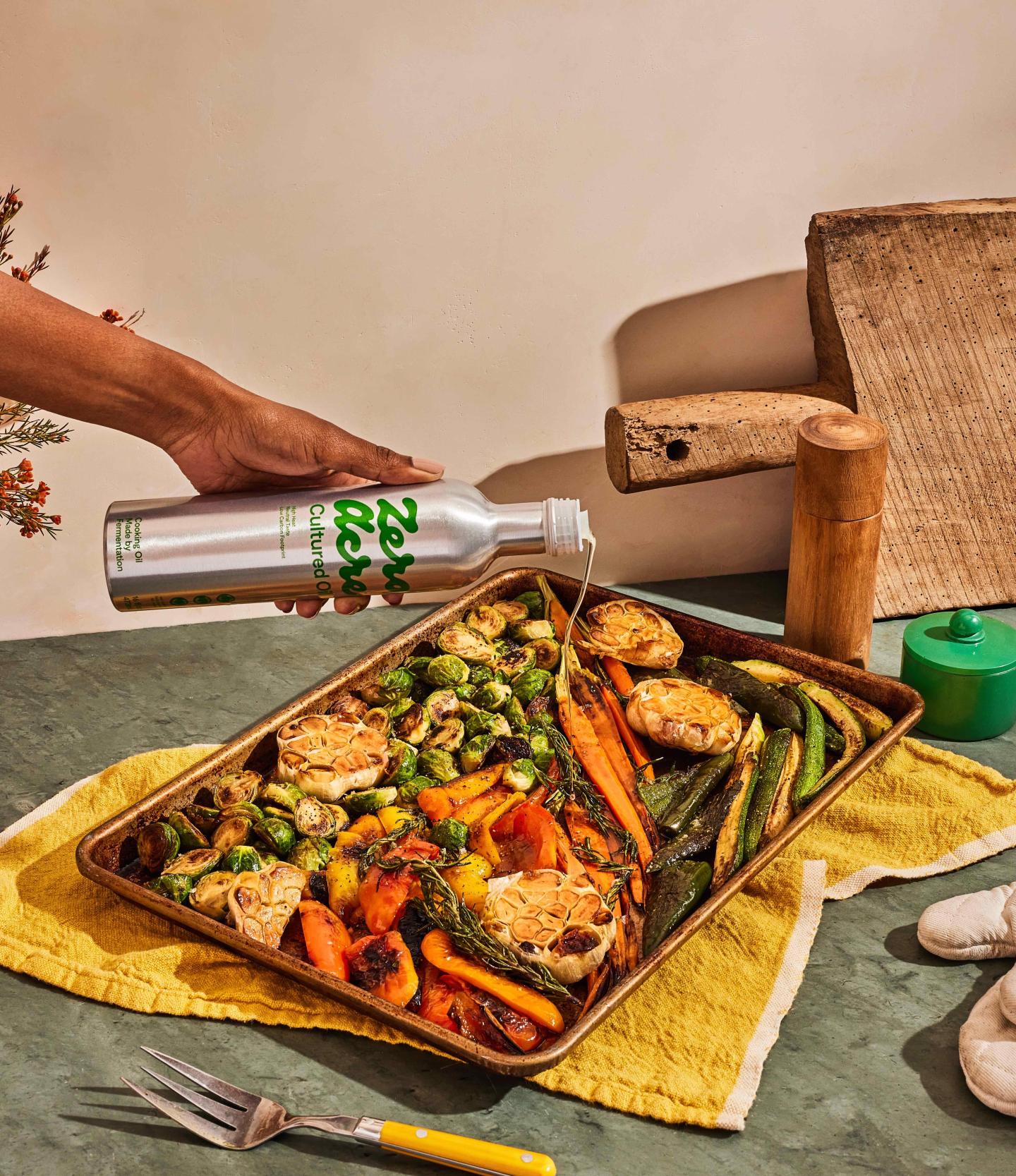
The solution to the massive problem of vegetable oil production and consumption may lie in the ancient culinary art of fermentation. While fermentation has been used for thousands of years to produce foods like cheese, wine, yogurt, and bread, some companies are using fermentation to make healthier oils and fats, with a fraction of the environmental footprint. Cultured Oil from Zero Acre Farms is one such product.

Just as there are microbial communities, like sourdough and wine cultures, which convert sugars into entirely new foods, there are also oil cultures. An oil culture converts sugar into the healthy fats that make up products like Cultured Oil.

While vegetable oils introduced unprecedented levels of omega-6 fats, which have been linked to health issues, companies like Zero Acre Farms are taking cues from what humans evolved to eat.

Thanks to fermentation, companies like Zero Acre Farms can produce environmentally-friendly oils with extremely low amounts of the inflammatory fat omega-6, and high amounts of the healthy fats that humans have eaten for hundreds of thousands of years. Products produced by fermentation, like Cultured Oil, for example, contain higher levels of heart-healthy monounsaturated fats that have always been abundant in our diets and are routinely shown to improve health outcomes in human studies.

The beauty of fermentation is in its ability to displace vegetable oils at scale by delivering products that are better than vegetable oils in every way. That means products that aren’t just healthier or more sustainable but also better for our taste buds, home cooks, chefs, and ultimately our wallets.

The online launch of Cultured Oil, and the use of fermentation as a tool to produce healthier, more sustainable oils and fats, marks an important step towards a healthier world, free from destructive vegetable oils.


  • These 7 things make smart people sound less competent. A behavioral expert shows how to fix it.
    A nervous man at a podium. Photo credit: Canva

    Codie Sanchez—an investor, entrepreneur, business strategist, and former journalist—knows a thing or two about winning at conversation. From spending time on Wall Street to helping everyday people build unconventional wealth, she’s learned at least this: “You can be the smartest person in the room and still lose it entirely because of the way you speak.”

    She explains in a YouTube video that when it comes to first impressions, everyone is “immediately” graded on the “warmth and competency” of what they’re saying, with the latter being especially crucial in business settings.

    And over the years, she noticed that many intelligent people with great ideas get overlooked because of “how that intelligence is delivered.” It often comes down to one of the seven self-sabotage patterns below. (The good news: these are all easy fixes.)

    The 7 speaking patterns that sabotage us from being heard

    1. Excessive hedging

    Hedging in linguistics is the use of cautious, tentative, or vague language. Sanchez uses examples like “but,” “I don’t know,” “maybe,” “could be,” and “I’m not sure.”

    While hedging can sometimes be “strategic,” most of us do it to remain polite or to avoid coming across like a “sycophant.”

    Knowing the difference between strategic hedging and insecure hedging comes down to whether you’re adding “nuance for clarity” or “padding your statement to avoid social risk.”

    2. Overexplaining

    “Smart people hate being misunderstood,” says Sanchez, which can lead them to pile on information. Ideas that come across as overly complicated ring less “truthful and more intelligent.” Not only that, it can convey the message that you think “your audience is slow” or that “your idea can’t stand on its own.”

    Conversely, simple, easy-to-understand ideas—those with “high processing fluency”—automatically look smarter.

    3. Talking too fast

    When our nervous system is firing, it’s natural for our pitch and speaking speed to increase. This is unconsciously interpreted as “uncertainty.”

    To offset this, Sanchez recommends identifying your most important sentence, aka a “key line,” then taking a breath before it and slowing it down by 20%.

    public speaking, conversation hacks, codie sanchez, podcast, social skills
    Two people have an animated conversation. Photo credit: Canva

    4. Focusing on specs, rather than story

    “People remember the story change, not the feature list,” says Sanchez.

    While this might at first sound like encouragement to use lots of emotional, flowery words to set the scene, Sanchez instead encourages “ruthless simplicity.”

    She then points to Steve Jobs, whose Apple presentations used very few slides and stripped-down language to show how his vision of the future addressed society’s current problems. Needless to say, it worked.

    5. Being afraid to “show off”

    public speaking, conversation hacks, codie sanchez, podcast, social skills
    A man in a suit shows off. Photo credit: Canva

    Sanchez says that while it’s “tempting to play it cool, you should be a show-off,” adding, “People who win in life are not the ones in the shadows.”

    She also points out that plenty of political figures and business moguls are successful almost exclusively because of their showmanship. However, that doesn’t mean piling on information to prove you know what you’re talking about. Instead, make your point with such simplicity that it makes “everyone else feel smart.”

    “Go big and show, but default to the show being simple,” she explains. “Clarity beats cleverness every time.” 

    6. Not rehearsing

    Just as elite athletes and artists dedicate intentional time to their craft, great speakers also invest hours in “deliberate practice.” This includes cutting unnecessary words, practicing pauses, and, perhaps most importantly, saying things out loud.

    Sanchez warns that a lack of purposeful practice can lead to rambling, running out of time, panicking, and second-guessing ourselves.

    7. Constant self-deprecation

    This can be common among high performers as a way to seem “humble.” And to a certain extent, it works. But according to Sanchez, overusing it, especially with people who don’t know you well, can read as “insecurity disguised as humor.”

    The pattern behind all these traps: fear 

    public speaking, conversation hacks, codie sanchez, podcast, social skills
    A man holds paper over his head. Photo credit: Canva

    Whether it’s fear of rejection, being wrong, being judged, or not being liked, smart people tend to perceive these risks more acutely because they’re better able to recognize complexity.

    It goes to show that “winning the room,” as Sanchez puts it, isn’t about knowing the most, but about “managing the perception” of others. We achieve this not by “predefending against every possible criticism,” nor by putting on “fake alpha energy,” but by communicating clearly and letting our ideas stand.

    Before important conversations, Sanchez says to run through this checklist:

    Am I hedging unnecessarily? 

    Am I overexplaining?

    Am I rushing?

    Am I overcomplicating? 

    Am I landing statements confidently?

    Am I comfortable with silence?

    While awareness of these things alone can improve your perceived competence “by 15–30%,” Sanchez notes that fixing one element each day and running through the talk out loud “can take you the rest of the way.”

    And if this still feels too convoluted, focus on the “3 S’s Rule”: shorter, slower, stronger.

    Focusing on speaking more slowly, using fewer filler words, and increasing conviction is more than enough to project authority and command a room. Again, practice incorporating just one of these elements each day.

    You can find even more helpful tips like this by following the BigDeal by Codie Sanchez podcast on YouTube

  • Worried you’re boring? 5 conversation tricks that can make you more fun to talk to.
    How to make any conversation more fun.Photo credit: Canva
    ,

    Worried you’re boring? 5 conversation tricks that can make you more fun to talk to.

    Avoid awkward or boring interactions with some simple habit changes.

    Are you ever in social situations where the conversation drags and you’re not sure what to do about it? Is it that the other person isn’t engaging, or is it that you’re not interesting? Social anxiety might have you questioning everything in these moments, but what if there were skills you could learn to make conversations more fun for everyone involved, including you?

    Charisma on Command shared a video on YouTube outlining five mistakes people make in conversations that make them seem boring, and five things to do instead that make them more fun to talk to.

    The video offers specific examples from celebrity interviews for each of these mistakes and fixes, but here’s the gist:

    Mistake #1: Energy ducking

    “Energy ducking is when you come into a conversation with low enthusiasm to avoid standing out,” the video states. “The problem is when you make your main focus not standing out, you avoid making a negative or positive impression.”

    In other words, you’re bringing nothing fun to the conversation, and most people want to have fun when they talk to others.

    Three men talking together in casual conversation
    Be the first to add playfulness to the conversation. Photo credit: Canva

    Trick #1: Be playful

    It’s not like you need a super interesting life or amazing stories to make a conversation engaging. You just need to bring a sense of playfulness to it.

    “By far the easiest way to initiate playfulness in your life is after you’ve been asked a question,” the video says. “To do so, just answer with an absurd, non-literal answer.”

    That doesn’t mean you won’t eventually answer the person’s question.

    “It’s just about setting a fun, playful tone first,” the video points out. “Another perk of being playful is it’s very likely that the other person will match you and be playful as well.”

    Mistake #2: Assuming interest

    If you’ve ever been in a conversation where someone talks on and on about something you have no interest in, you know the urge to escape. Don’t assume people will share your interests or enjoy your out-of-context stories.

    A couple engaged in conversation at a coffee shop
    Create interest in a story before telling it. Photo credit: Canva

    Trick #2: Create interest with a “story gap”

    “A story gap is when you build interest in a story by hinting at how it ends without spoiling the punchline,” the video states.

    One example the video shares is when comedian Kevin Hart was asked about his relationship with basketball legend Michael Jordan. He responded, “I’ve run into Mike a couple of times. Mike still might be mad at me. True story.”

    Now we know something happened between Kevin and Mike that ticked Mike off, but we don’t know what. That piques our interest in hearing the story, because we know enough about the ending to want the details.

    Mistake #3: Giving bland, short answers

    “If you regularly find conversation stalls after you’ve been asked a question, you may be giving bland one- to five-word answers,” the video states. “A bland answer doesn’t set the other person up with anything to say back…short answers put the conversational pressure on the other person. Now they have to carry the conversation or else let it fall into awkward silence.”

    Two women sitting and conversing in an outdoor cafe
    Expanding on simple answers makes for better conversation. Photo credit: Canva

    Trick #3: Share enough to make the conversation easy for the other person

    This doesn’t mean you should ramble on and on in your answers. Rather than answering in the briefest way possible, add a little detail.

    For example, let’s say someone asks where you’re from. You might say, “Chicago,” or even, “I grew up in Chicago.” But that doesn’t give much. You could instead say, “I grew up on the north side of Chicago in an area called Rogers Park. It was an interesting place, because Rogers Park is on the lower end of the socioeconomic spectrum, but just north of it are very wealthy suburbs. That made it a pretty interesting place to grow up.”

    An answer like that gives the person a lot to respond to.

    Mistake #4: Asking the same boring, default questions

    Asking questions is a great way to engage in conversation, but not all questions are created equal. “Where are you from?” is fine, but most people have been asked that a million times.

    Trick #4: Ask something that the other person will be excited to answer

    It takes more thought to come up with interesting questions, so watching people who are masters at it can help. Examples from the video come largely from Sean Evans, the host of Hot Ones. While his celebrity guests eat wings with increasingly spicy hot sauce, he asks questions about their lives and careers.

    “He specifically focuses on asking questions about his guests’ passions or that let them reflect on things they’re proud of,” the video points out. “He also avoids the questions they’ve likely been asked a hundred times in interviews before. And you can see the reactions it gets him.”

    A helpful tip for this trick, especially if you don’t know much about the person, is to ask hypothetical questions: “If you had to give away a million dollars tomorrow, who would you give it to?” or “If you had total power over the Internet, what’s the first thing you’d change about it?”

    Mistake #5: Being a passive listener

    Passive listeners listen but don’t react. That can make a conversation feel really boring, even when you aren’t saying anything. People want to feel that the other person is an active participant in the conversation, even when they’re not talking.

    Trick #5: Mirroring and listening to laugh

    There are actually two tricks to fix the passive listening problem. One is to mirror the person speaking by reflecting their behavior or repeating something they said. For instance, if they’re nodding while telling a story, you can nod along. If they tell you they dropped their phone in a snowbank, you might respond, “In a snowbank? No!”

    Laughter can also be a great way to show interest and bring fun into a conversation. Get comfortable laughing when you genuinely find something funny.

    “It’s important to note here the goal is not to fake laugh,” the video states. “Instead, you want to cultivate the ability to laugh freely whenever you do find something funny, rather than censor your laughter like most people do, limiting it to a quick chuckle or even just an exhale.”

    Conversation skills come as second nature to some people while others have to consciously hone them. The good news is you don’t have to implement all of these tricks in every conversation. Try focusing on one or two that feel most doable for you and see if they help make conversing a more enjoyable experience.

  • Scientists discover one step you can’t skip if you want to stop procrastinating: forgiveness
    A study found that being gentle with yourself after procrastinating is vitally important.Photo credit: Canva

    We’ve all been guilty of procrastinating before, but some people tend to do it far more than others. Research indicates that about 20% of adults can be considered “chronic procrastinators,” and it’s an extremely tough mental loop to break.

    Not only does procrastinating lead to worse outcomes at school, work, or in creative projects, it can also be highly damaging to a person’s psyche. Regular procrastination fuels intense feelings of shame, guilt, and even major depression.

    Luckily, there are all kinds of tricks, hacks, and mental games people can use to help defeat procrastination. However, many of them are Band-Aids at best and don’t address the fear, anxiety, stress, and overwhelm that are often at the root of so-called laziness and task avoidance.

    A “cure” for procrastination?

    One recent study wanted to test a potential “cure” for procrastination: self-forgiveness.

    A team of researchers from Carleton University set out to determine whether there was a link between “forgiving the self for a specific instance of procrastination and procrastination on that same task in the future.”

    In other words, does mentally beating yourself up after feeling lazy help you do better next time, or is it more effective to give yourself grace?

    The method was simple. Researchers recruited 119 first-year university students enrolled in an introductory psychology course, knowing, of course, that students are exceptional candidates for studying procrastination.

    procrastination, laziness, psychology, studying, productivity, life hacks, productivity hacks, scientific study, brain hacks, stop procrastinating
    It’s easy to find students who are behind on their studies. Photo credit: Canva

    Students were polled after an exam in the class on a variety of self-reported factors, including whether they procrastinated studying and how they felt about their overall performance. They were polled again after a second exam.

    In the end, the results revealed that students who reported high levels of self-forgiveness for procrastinating on their studying for the first exam were less likely to repeat the same mistake on the second exam.

    “Negative affect”

    The team determined that a big reason self-forgiveness was important is that it reduced something called “negative affect,” a psychology term that refers to a bundle of unpleasurable feelings like anxiety, anger, sadness, and guilt.

    What mattered in whether a person would stop procrastinating in the future was that they rid themselves of those negative feelings. Forgiving themselves for procrastinating the first time helped immensely.

    We’ve learned a lot about procrastination in recent years. What was once considered laziness is now better understood as a diabolical cocktail of overwhelm, anxiety, fear, and even childhood trauma. That’s why so much advice about procrastination is outdated.

    Marla Cummins, a productivity coach, writes that using force or authoritarian self-talk like “I have to get this done” used to be commonplace but simply doesn’t work.

    A research review from 2023 found that self-compassion is far more effective than self-criticism at motivating positive change, further reinforcing the findings from the Carleton University study. Methods that ease those negative feelings and break the cycle of negative self-talk are key to stopping procrastination, or at least doing it less often, in the future.

    As a human, you are almost guaranteed to procrastinate on something important in your life sometime in the near future. The key to not letting it become a chronic problem may be to forgive yourself for the slip-up and refuse to carry those negative feelings of shame and guilt into your next opportunity.

  • People amazed by woman’s tender dedication to her 48-year-old husband with dementia
    A woman cuts tomatoes while a man looks on.Photo credit: Canva
    ,

    People amazed by woman’s tender dedication to her 48-year-old husband with dementia

    He no longer remembers his wife so she does it for both of them

    LaShonda Adams, who runs the TikTok page “I Am Chronicles of Mrs. Adams,” found herself becoming the primary caregiver for her husband after a medical emergency nearly caused her to lose him.

    When a young couple says their wedding vows, they’re not thinking much about the “sickness” part. Typically in that moment, both parties are presumably healthy and an illness changing things feels like a distant possibility, not an inevitability.

    Adams recently uploaded a video of herself explaining to her 48-year-old husband how he knows her. He appears confused, and Adams soon reveals why.

    dementia; caregiver; early onset dementia; loving wife; calming voice; faith in humanity
    A couple looks at a shopping list. Photo credit: Canva

    “What you’re going through is called sundowning,” Adams says gently to her husband. “It’s where you go through this space where you don’t understand, and then you get in this very confused state where you don’t understand what’s going on or where you are, or who’s around you.”

    Forty-eight is young for a dementia diagnosis, but after a massive heart attack, he received life-changing news. He was without oxygen to his brain for more than 20 minutes. This form of dementia is typically not associated with the elderly. The once-vibrant man is experiencing vascular dementia.

    According to the Alzheimer’s Association, “Vascular dementia is a decline in thinking skills caused by conditions that block or reduce blood flow to various regions of the brain, depriving them of oxygen and nutrients.”

    The diagnosis appears to have occurred within the past two years, based on older videos. She displays a lot of patience and grace, which is melting the hearts of viewers.

    “I’m your wife. Those are your kids, and you’re at home,” Adams says calmly. “You had a heart attack, baby, and you lost oxygen to the brain. When you lost oxygen to the brain, it made you lose your memory of 24 years, okay? So sometimes you remember me, sometimes you don’t. You’re having a moment. You’re going to be alright.”

    He then asks her name, and she quietly responds. After clarifying that he no longer works, his wife explains that he’s off right now due to his disability. “This is the first time I’m hearing anything,” he says. “I’ve been here all day. Nobody said nothing.”

    @iamchroniclesofmrsadams

    Trying to keep my husband calm while he experiences Sundowner Syndrome#lifenlovewithdementia

    ♬ original sound – iamchroniclesofmrsadams

    Adams reassures him that she reminds him daily, but he insists this is his first time waking up in someone else’s house. She responds with patience:

    “Well, I’m here. I’m your wife, and I love you. I’m going to take care of you and make sure that you get cared for, okay? Alright? And any questions you have, or anything you want to know, I’m here to answer. Alright? We have pictures, we have memories that I can show you to kind of help.”

    @iamchroniclesofmrsadams

    The Day I became Mrs.Adams The day I vowed to love for better ,for worse ,for rich ,for poor, in sickness and health ,to cherish and love til death do us part ❤️❤️❤️❤️❤️❤️❤️❤️❤️❤️❤️❤️

    ♬ Only You X Playdate – 𝖈𝖆𝖊𝖗⛧

    Mr. Adams doesn’t remember anything past the age of 24 at any given moment, but it appears his memory is most impaired when the sun starts going down. Some viewers have compared it to the movie 50 First Dates, in which Drew Barrymore plays the love interest of Adam Sandler, who eventually realizes she has amnesia.

    One person writes, “50 First Dates in real life.”

    Another praises the wife’s care, saying, “Dementia nurse here. You’re doing amazing!!!!”

    dementia; caregiver; early onset dementia; loving wife; calming voice; faith in humanity
    A couple celebrates with champagne. Photo credit: Canva

    For others, the heartwarming interaction hit close to home. One person shares, “I’m early stages of Cardiovascular Dementia and sometimes, I experience these moments and it’s scary. Your voice is very calm and you’re doing an awesome job caring for your husband. God Bless You.”

    One devoted daughter shares, “My Dad has dementia.. one day I helped him look for me until he said ‘there you are, pickle head. i was calling you!’ I cried myself to sleep that night after I put him to bed. You’re doing so great, Sis!! keep loving him the way you do. it keeps em grounded just a little longer at a time.”

    dementia; caregiver; early onset dementia; loving wife; calming voice; faith in humanity
    A couple embracing. Photo credit: Canva

    “Dementia will break your heart, over and over again,” someone else says. “Your strength gives him peace. I hear it, I see it. He feels it.”

    Another professional praises her approach, writing, “Memory Care Director here. While I absolutely think this is so unfair for him to go through this as such a young age. Dementia is the absolute worst. You are doing such an amazing job. The calm voice is needed, especially at sundowners time. Stay so strong.”

  • Social skills expert shares 3 ‘magic phrases’ that make you more likable
    Vanessa Van Edwards and people at a party. Photo credit: via Press Release and Canva/Photos

    A familiar misstep people make when trying to be likable is trying to impress others. They want to show they are funny, intelligent, and a great storyteller. They think being the life of the party is the road to likability. However, study after study shows that it’s a lot easier to be likable. All you have to do is show interest in others. To put it simply: If you like people, you will become more likable.

    There’s a slight wrinkle in the notion that liking more people makes you more likable. Many people you like aren’t sure that you like them. The psychological phenomenon known as signal amplification bias says it best. We tend to overestimate how clearly we broadcast our feelings and intentions towards others. So, the person we like and who likes us may not know the feeling is mutual.

    “We think our signals are obvious,” Vanessa Van Edwards told Steve Bartlett on the Diary of a CEO podcast. “If we like someone or if we’re having a good time, we think, ‘Oh, they for sure know it.’ They don’t.” Van Edwards is a communications expert and the author of Captivate: The Science of Succeeding with People.

    To help people clearly communicate their feelings, Van Edwards suggests three “magic phrases” to show you care. Check out the video below.

    Phrase 1: ‘I was just thinking of you’

    “You think of a lot of people in your life all the time,” she said. “If you are thinking of someone and you can text them: ‘I was just thinking of you, how are you?’ I was just thinking of you, how’d that project go?’ was just thinking of you. It has been a while since we talked.’ You see a movie, you see a documentary, you see a matcha latte, you see a mug, you see a ceramic candle, and you’re like, ‘Ah, this made me think of you,’” Van Edwards said. “My text messages, my conversations, are full of actual moments where I was triggered to think of that person, actually,” she said, noting the importance of being genuine. “If you don’t think of someone, they’re not a person you need to have in your life.”

    Phrase 2: ‘You’re always so …’

    “So if you’re with someone and you’re impressed by them or they’re interesting or they’re funny, say, ‘You always make me laugh. You’re always so interesting,’ or ‘You’re always so great in interviews.’ Giving them a label that is a positive label is the best gift you can give someone, because it’s fighting that signal amplification bias,” she continued.

    Phrase 3: ‘Last time we talked, you mentioned …’

    “We are so honored when we get brain space—that you remembered and you’re going to bring it up,” she said. “And you specifically bring up something that they lit up with, something they were like, ‘Ah, it was great, it was exciting, it was wonderful.’”

    If studies show the more you like other people, the more likable you become, Van Edwards has the next logical step in becoming more likable. She makes it clear that, due to signal amplification bias, many people you like may not even know it. When we employ her three ways to be more likeable, though, we can let people know we like them without making them feel uncomfortable, thus establishing bond to build on.

    This article originally appeared last year. It has been updated.

  • 4 everyday phrases that may indicate someone is highly intelligent
    Einstein in a hoodie on a mural.Photo credit: Photo by Taton Moïse on Unsplash

    So often, we equate intelligence with standardized testing, or say, degrees or rank in a graduating class. The person who has a 4.0 GPA and high SAT score probably is pretty book-smart. And sure, various amounts of degrees do imply that most likely they’ve had a lot of education.

    But there is another measure of intelligence that is often overlooked: the ability to be wrong. A doctor named Emma Jones, MD (self-described hospice doctor and “burnout coach”) has recently gone viral on social media for a video wherein she talks about intelligence. The clip is entitled “Here’s how you know someone is highly intelligent.” In just a couple of minutes, she lays out ways you can easily spot someone who is ultra-bright.

    Quoting Oscar Wilde, she says, “Consistency is the last refuge of the unimaginative.” She then explains that he meant, “highly intelligent people know how to change their minds.”

    Here’s where the phrases of (most likely) highly intelligent people come in. She says to listen for sentences like:

    “I used to think…”

    “That’s a good point.”

    “Let me reconsider.”

    “I’ve changed my mind.”

    She adds, “Most people double down to protect their ego. But intelligent people update their beliefs. They get more curious instead of more defensive. And they ask things like ‘what am I missing?’ instead of trying to win an argument. They don’t tie their identity to being ‘right.’ And they treat being wrong like data, not humiliation.”

    She also quotes Albert Einstein, who once said, “The measure of intelligence is the ability to change.” She notes that the “real flex” is being able to have your mind changed “without shame.”

    The comments, and there are thousands in just a short amount of time, support the notion. One (somewhat sarcastically) writes, “So in other words, you’re saying that intelligence correlates with a combination of critical thinking skills and the humility to know that oneself doesn’t know everything?”

    Another jokes, “I used to say that my ‘need to be right’ is so strong that if someone shows me a better path, or shows me that my thinking is off, I will quickly recalibrate and change my mind so I can be ‘right’ again.” Jones responds to this: “That is quite a strong and intelligent reframe.”

    Another Instagrammer backs it up with a book they love, writing, “One of the best books I have ever read is called But What If We’re Wrong by Chuck Klosterman. I base most of my life on the assumption that some part of the system is built on inherently incorrect information. It makes it easier to be flexible and make connections to other information that may have otherwise been missed.”

    But, of course, admitting there’s usually room for debate and the ability to change one’s mind is just one of many signs someone is intelligent. Writer and reviewer Jordan Cooper shared his subtle signs someone might be intelligent in an article for VegOut.

    Among eight examples, his first is “talking to yourself out loud,” which I mentioned in a recent Upworthy article. He adds, “A 2012 study in the Quarterly Journal of Experimental Psychology showed that talking out loud can actually improve focus and object recognition. Why? Because verbalizing engages additional sensory channels. When you speak your thoughts aloud, you’re not just thinking—you’re hearing yourself think, which reinforces memory and decision-making. Einstein did it. So do a ton of high-performers who swear by this trick for brainstorming, debugging their code, or preparing for presentations.”

    richard pryor, intelligence, openness, being wrong
    Richard Pryor admits he was wrong. Giphy

    Other examples, some of which have also been pointed out on Upworthy over the years, are: “zoning out,” “being sensitive to noise, light or texture,” “having messy handwriting,” “swearing a lot,” and to the earlier point, “doubting your intelligence constantly.” (In other words, staying open to being wrong.)

    So, while having good grades and a plethora of degrees is excellent, always being open to learning and changing course adds a layer to any good mind.


    This article originally appeared last year. It has been updated.

  • Philosophy expert shares the 300-year-old rule to tell if someone is a good or bad person
    Johann Wolfgang von Goethe and a scene at a restaurant.Photo credit: via Canva/Photos and G.Meiners/Wikimedia Commons

    What makes a ‘good person’ is hard to quantify, but sometimes, you just know it when you see it. But that’s the problem, you can’t always see it. Have you ever met somebody new and wondered if they were a good person with a mischievous streak or a bad person who can turn on the charm and behave occasionally? Determining someone’s true moral character is important, especially if you start dating them or have a business relationship. It is crucial to get to the core of who they are and know whether they can be trusted.

    Popular TikTok philosopher and Substack writer Juan de Medeiros recently shared a great way to determine whether someone is good or bad. His rubric for judging someone’s moral character comes from a quote commonly attributed to Johann Wolfgang von Goethe, a German poet, playwright, novelist, and intellectual known for works like Faust and The Sorrows of Young Werther.

    How can you tell if someone is a good or a bad person?

    “Here’s a pretty good indicator that somebody is a bad person and vice versa, how you can spot a good one. And this goes back to a simple rule, a moral aphorism by Goethe in which he writes, ‘Never trust someone who is unkind to those who can do nothing for him,’” de Medeiros shared in a TikTok video with over 45,000 views.

    “Never trust someone who is unkind to those who can do nothing for him.” —Johann Wolfgang von Goethe

    De Medeiros then provided real-world ways to determine whether the person you have questions about is good or bad. “A bad person is unfriendly to strangers, to the elderly, to children, to service staff, to anybody they’re not trying to impress,” he said. At the same time, the good person treats people equally, no matter what they can do for him. They’re good for goodness sake, not to get anything out of it.

    “A good person carries grace within them and shares it freely with abundance. A good person treats other people as they would like to be treated as well. And it doesn’t matter who you are, it doesn’t matter what your status is, they will treat you and see you as their equal,” de Medeiros said.

    What is ‘The Waiter Rule’?

    Goethe’s quote echoes the common red/green flag test that many people have on dates. Sure, it’s important if your date is courteous and treats you well on the date, but you really want to watch how they interact with the server. The rule is often called “The Waiter Rule,” outlined by William Swanson. Swanson, the former chairman and CEO of Raytheon Company, wrote in his book, 33 Unwritten Rules of Management, “A person who is nice to you but rude to the waiter—or to others—is not a nice person.” Boxer Muhammad Ali is also known for saying something similar: “I don’t trust anyone who’s nice to me but rude to the waiter. Because they would treat me the same way if I were in that position.”

    Rudeness toward the waitstaff also indicates that the person isn’t very smart. It’s not wise to be rude to someone who is in charge of your meal for the night.

    Conversely, a good person is kind to others without looking for anything in return because they want to spread joy and believe that others deserve respect. You are what you do, not what you think or believe, and when someone treats others with goodness, it’s a clear indicator of the type of person they are.

    In the end, we are all a mixed bag of behaviors and attitudes, and even the most perfect of us has a devil on their shoulder telling them that it’s okay to occasionally get into a bit of mischief. However, when it comes down to determining someone’s core character, how they treat those who can do nothing for them says everything.


    This article originally appeared last year. It has been updated.

  • People share the home remedies their families swear can fix any ailment
    A can of Diet Coke and Vicks VapoRub.Photo credit: Flickr
    ,

    People share the home remedies their families swear can fix any ailment

    Here are 11 “cure-alls” people have been using for generations.

    Most families have health traditions passed down for generations that may not be 100% FDA-approved. But there’s something to be said for being sick as a kid and having your mother or grandmother give you Saltine crackers and 7UP for an upset stomach, or rub some Vicks VapoRub on your back when you have a cold.

    Even though it’s not exactly what the doctor would order, these traditions, which may have started long before modern medicine, connect us across generations and are an important part of a family’s fabric. Being there for each other when you’re feeling bad is what family is all about.

    sick child, sick kid, temperature, thermometer, care
    A sick child. Photo credit: Canva

    A Redditor asked fellow users to share their family “cure-alls,” and received plenty of responses from folks who have sworn by these remedies for generations.

    Here are 11 of the best responses to the question: “What’s that one ‘cure-all’ home remedy every family seems to have?”

    1. Ginger tea

    “In my house, it’s ginger tea with honey for EVERYTHING, Cold? Ginger tea. Stomach ache? Ginger tea. Bad mood? Yep… ginger tea. At this point, I’m convinced it’s our family’s official medicine.”

    “In ginger tea’s defense, ginger is scientifically proven to have a soothing effect for nausea/stomachache! It’s not super strong, but it’s something.”

    If your family prescribed ginger tea when you were sick with the stomach flu, they were actually doing a good thing. According to Johns Hopkins, ginger is good for nausea and helps fight bloating and gas.

    2. Vicks VapoRub

    “For my mother-in-law, it’s Vicks.”

    “I’m Latina and yeah. I’ve had a lot of allergies in my life, so it’s genuinely helped me a lot. I put some on my nose when I’m congested, and it sometimes clears my breathing a bit. If I have sniffled my nose to the point of being sore, it helps reduce the soreness. I put it on my temples when I get a congestion headache. It also helps dull skin itching. It will not replace medicine or an antihistamine if that’s what’s needed. But if you need to keep from scratching, the cooling sensation helps. I use it on bug bites all the time, and I have eczema, so I put it on itchy, irritated skin to prevent myself from scratching it raw. My mom tells me she used to have to eat it (do NOT ingest Vicks) by the spoonful whenever she got sick. And if anyone gets a cut, my grandma recommends Vicks in place of an antibacterial ointment. It’s technically not recommended for open wounds, but apparently it does have some mild antifungal properties due to the camphor? I don’t use it on cuts lol.”

    vick's, vaporub, remedies, vapor, health, sickness
    A tub of Vicks VapoRub. Photo credit: Ajay_Suresh/Flickr

    3. Gargle with salt water

    “Gargle with warm salt water, for any ailment north of the ankles.”

    4. Vinegar

    “Vinegar. I’m a redhead, and when I got sunburnt, mom always put vinegar on me.”

    “My mom did this, too. I’m not sure what it’s supposed to do for the sunburn.”

    Unfortunately, vinegar isn’t going to help a sunburn. In fact, it can dry out your skin, making the sunburn worse.

    5. Ginger ale

    “In Michigan, nearly everything can be cured with a warm Vernors.”

    vernor's, ginger ale, midwest, remedies, cure-alls
    A 6-pack of Vernor’s Ginger Ale. Photo credit: Bill Walsh/Flickr

    6. Diet Coke

    “Not really a home remedy, but I swear, Diet Coke cures most of my ills. Headache, stomachache, heartache…it always makes me feel better.”

    “I don’t drink Diet Coke very often. BUT, I do when I have a headache or stomachache. Works most of the time!”

    7. Pretending you aren’t sick

    “Pretending they aren’t sick. One section of my family is wealthy and narcissistic. They think 1) they are ‘above’ being ill, and 2) as long as they don’t admit to being sick, they aren’t. It’s wild. Also, if they catch a cold, they always say it’s allergies. Then they continue to go out in public, spreading their germs everywhere. They can’t possibly be contagious, since it’s just allergies.’ So gross.”

    Thinking you aren’t sick probably won’t keep you from catching a virus. However, studies show that being mindful, meditating, relaxing, and practicing yoga can help reduce the painful symptoms of an illness.

    8. Oreos

    “My uncle took Oreos with him on the troop ship to Europe during World War II, and never got seasick. Since then, Oreos are my family’s first line of defense.”

    9. Jell-O

    “Jello, specifically orange jello.”

    “My mom would make me hot jello water (you know, like the form it’s in before you put it in the fridge to set). I have no idea why she did this. But I have not introduced it to my kids, or they would always pretend to be sick!”

    jell-o, organge jell-o, gelatin, desert, remedies
    Orange Jell-O. Photo credit: Matt Reinbold/Flickr

    10. Honey

    “Once my kids were old enough, I gave them a teaspoon of honey when they were under the weather. It seemed to help their sore throat and cough.”

    “I actually have a bottle of honey just for being sick because it coats my throat lol.”

    11. Chamomile tea

    “Grandma swore chamomile tea worked for any stomach upset or nausea. For head colds, Vicks VapoRub, under the nose, on the chest and back, around the neck, followed by inhaling the vapors of the Vicks melted in boiling water. You had to sit under a towel inhaling the steam until the water was cold. She’d then bundle you into bed with the towel around your head and piled on the blankets to make you sweat. You could only get out of bed when you stopped sweating. Hated it cause u don’t like the smell of eucalyptus and felt gross after the sweating part of the treatment.”

Culture

Fourth grade teacher beautifully explains what grief is to her students using a vase

Family

Boomer grandma challenges family norms by asking why she has to do the traveling for visits

Health

People amazed by woman’s tender dedication to her 48-year-old husband with dementia

Culture

We asked people what social rule they’d enforce during flights. One sweet answer dominated.