upworthy
Add Upworthy to your Google News feed.
Google News Button
Health

6 too-real comics show what happens when work gets too heavy

Finding a good balance between working and relaxing can be difficult, but it doesn't have to be.

work distractions, relatable comics, College Humor
Image courtesy of College Humor

A reason to be late... tasty treats.


Everyone gets antsy about their jobs sometimes.

Maybe you notice you're less motivated than usual. Maybe you acknowledge that you're no longer going the extra mile, and you're not quite sure why. Maybe professionalism is a term you've long since forgotten.

For many of us, the struggle can be so, so real. That's why Willie Muse wrote these all-too-relatable comics for College Humor, illustrated by Karina Farek.


These six funny comics perfectly illustrate what a typical first day at your job looks like versus the 101st day:

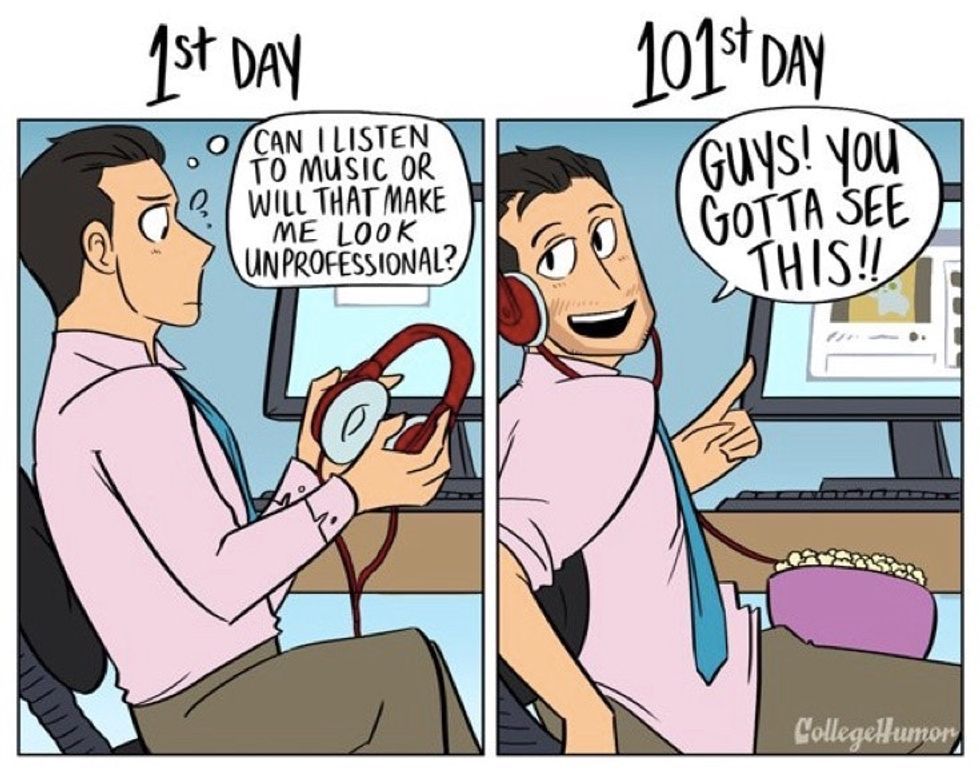
1. Who doesn't look at at least one viral video a day?

music, work, employee rights, jobs

To tune or not to tune.

Image courtesy of College Humor

2. You suddenly find the time to fit in a breakfast sandwich.

breakfast, fast food, time

How do you miss out on a breakfast quickly served?

Image courtesy of College Humor

3. You go from wanting your boss's approval to hating his or her guts.

boss, employee, friendship, community

Getting to know your coworkers...

Image courtesy of College Humor

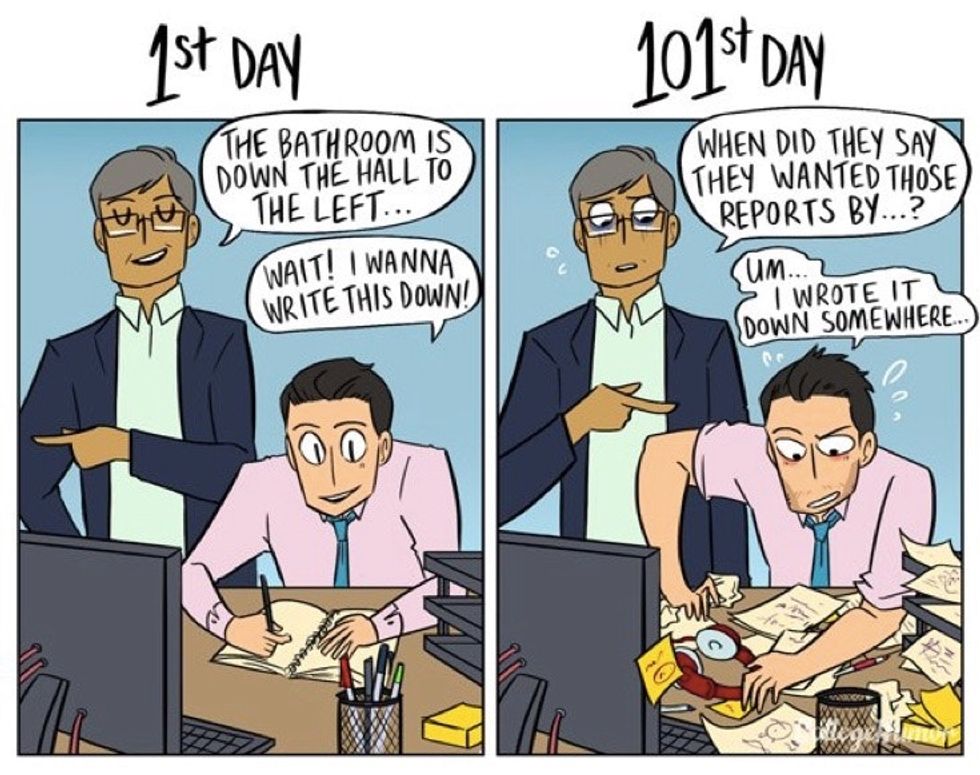
4. All the details that were once so important become nuisances.

job requirements, nuisances, work vacation

An evolution in responsibility and ethics?

Image courtesy of College Humor

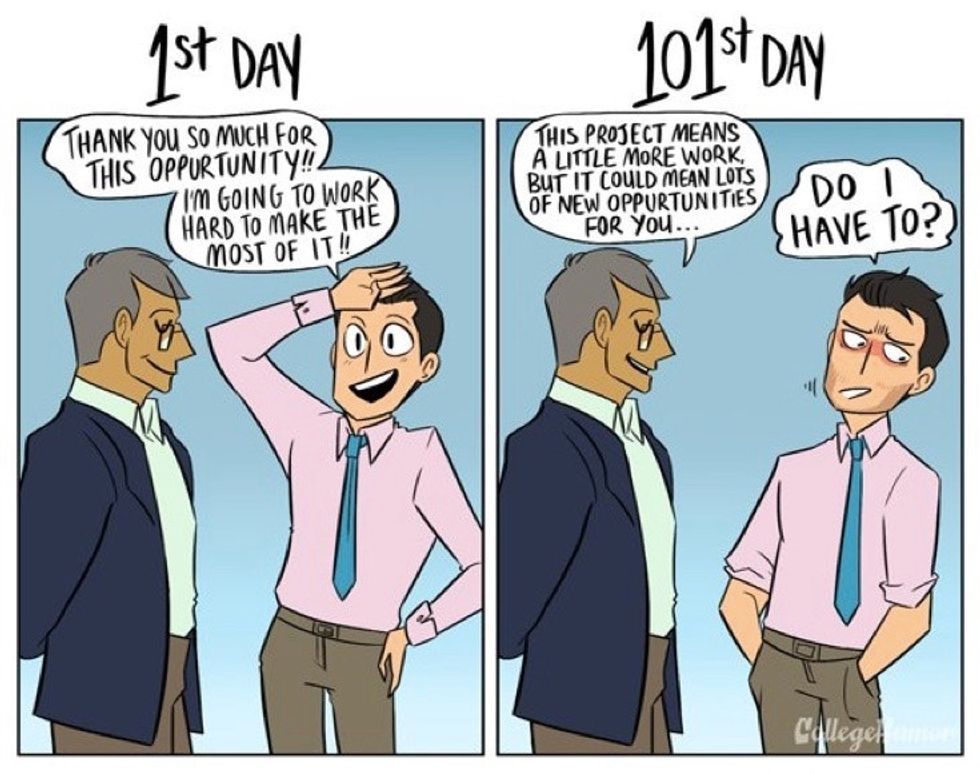
5. Your (lack of) motivation can take you from hero to zero — quick!

motivation, work-life-balance, career

When an opportunity evolves into a responsibility.

Image courtesy of College Humor

6. And you most certainly DO NOT want to end up like this.

advice, labor, qualifications

Getting on the right side of fear.

Image courtesy of College Humor

Let's be real: These comics are funny, but they also aren't ideal.

In a perfect world, we'd all have jobs that still look and feel like Day 1 on Day 101. And one of the only ways to get there is to intentionally strive for a life that's full of work-life balance. We really do have the power to not let things play out like this.

What can we do?

At a most basic level, we can make sure we're getting enough sleep, eating well, and doing at least a little exercise. We also shouldn't underestimate the benefits of detaching from computer screens and smartphones every once in a while. Plus, we can also minimize our stress levels by not multitasking and instead concentrating on one task at time.

The most overlooked advice for maintaining a healthy work-life balance is to actually take time off.

Disconnect from your daily work routine. Make a conscious effort to recharge.

Perhaps if we dedicate more time to enjoying life outside of work, there's more of a chance that we'll be on Day 1 for months, feeling grateful for our jobs rather than impatiently waiting for the clock to strike 5. Let's get to it!


This article originally appeared on 10.25.16

shhh, quiet, zip it, mouth closed, say nothing, be quiet

A woman zipping up her lips.

There are times to speak up, moments when it’s best to say nothing, and opportunities be very considerate in your response. But when you’re on the receiving end of a back-handed compliment, a foolish remark, or a coworker takes you down a peg, and your emotions are up, it can be hard to have a thoughtful response. Often, we say something we shouldn’t.

How is it that some folks fly off the handle and say things they’ll later regret, while others can stay calm and remove themselves from the situation or take the high ground? One way to be less impulsive with your words is to use the “name it to tame it” neuroscience hack, originally coined by author and psychiatrist Dr. Dan Siegel. When used properly, it allows you to step back from the moment and choose the best response in a challenging situation.


shhh, quiet, zip it, mouth closed, say nothing, be quiet A man saying "be quiet."via Canva/Photos

How to use the ‘name it to tame it’ hack

When someone upsets you, the first thing to do is to go inside yourself and describe the emotion that you feel in your body. Are you angry? Are you sad? Are you afraid? Do you feel rejected? Are you disappointed? The moment you name the emotion, it will begin to subside and give you the emotional and mental room to respond to the person who caused the negative emotion, rather than impulsively reacting.

How to respond to a reactive emotion so you don’t fly off the handle:

Event happens:

1. Your body stiffens up

2. You feel an intense emotion

3. You examine the emotion and give it a name: “My body is telling me I am angry.”

4. You should feel the emotion beginning to subside

5. Choose your response instead of being impulsive

shhh, quiet, zip it, mouth closed, say nothing, be quiet A woman zipping up her mouth.via Canva/Photos

Why does ‘name it to tame it’ work?

“Name it to tame it” works because, when we have a strong emotional reaction, our lizard brain kicks in, and we go into fight, flight, or freeze mode. The lizard brain is not known for giving thoughtful and strategic responses to challenging situations. When we name the emotion, our prefrontal cortex, or the thinking brain, kicks in. The thinking brain looks at the situation and says, “Alright, we don’t need to run or fight here. It's best to give a strategic response.”

When we tune into the negative emotions by naming them, they relax because they feel heard, like when a child has hurt their knee or a loved one has real concern and you gives them undivided attention. Once the emotions are named, they are tamed. Then, you are more likely to respond to the negative person with grace and speak from the best part of yourself.

Dr. Dan Siegel, who coined the phrase “Name it to tame it,” explains the brain science behind the technique in the video below. He does a great job of explaining how it allows us to transfer our thoughts from the downstairs brain (the lizard brain) to the upstairs brain (the thinking brain), so we can calm down and respond appropriately to the situation.

- YouTube www.youtube.com

sleeping, dreaming, lucid dreams, creativity, productivity, sleep, sleep mask

A woman in a sleep mask.

We spend a third of our lives asleep, and during that time our bodies and minds are restored. But wouldn't it be great if we could also use that time to think brilliant thoughts that help us when we wake? Imagine if, while you sleep, your mind could solve problems, come up with creative ideas, and recall long-forgotten memories.

A new study by neuroscientists at Northwestern University has taken the first step toward making this possible by training people to solve difficult puzzles in their sleep.


The researchers conducted a sleep study with 20 people who had prior experience with lucid dreaming. Participants were given a series of tough brainteasers to work on for three minutes, with each one paired with its own musical soundtrack.

The brainteasers were difficult enough that most went unsolved. As participants went to bed in the lab that night and entered REM sleep, researchers played the soundtracks from the unsolved puzzles to encourage them to dream about them. When participants woke up the next morning, the findings were remarkable.

sleep study, man sleeping, sleep research, dreams, creativity in dreams A man in a sleep study.Photo credit: Canva/Photos

What the sleep study found

Sixty percent of the participants had dreams that referenced the specific puzzles they couldn't solve while awake. Those who dreamed about the unsolved puzzles increased their problem-solving ability from 20% to 40%.

Karen Konkoly, a post-doctoral researcher in Paller's Cognitive Neuroscience Laboratory, explained the findings in a press release:

"Even without lucidity, one dreamer asked a dream character for help solving the puzzle we were cueing. Another was cued with the 'trees' puzzle and woke up dreaming of walking through a forest. Another dreamer was cued with a puzzle about jungles and woke up from a dream in which she was fishing in the jungle, thinking about that puzzle. These were fascinating examples to witness because they showed how dreamers can follow instructions, and dreams can be influenced by sounds during sleep, even without lucidity."

The study shows incredible potential for using our dreams to solve complex problems and increase creativity.

"My hope is that these findings will help move us towards stronger conclusions about the functions of dreaming," Konkoly said. "If scientists can definitively say that dreams are important for problem solving, creativity, and emotion regulation, hopefully people will start to take dreams seriously as a priority for mental health and wellbeing."

sleep study, woman sleeping, sleep research, dreams, creativity in dreams A woman in a sleep study. Photo credit: Canva/Photos

How to lucid dream using the MILD technique

Wouldn't it be incredible if you could tap into the power of your dreams to solve problems or come up with new ideas like the participants did in the laboratory? Even though it may sound too good to be true, there are research-backed ways to learn how to control your dreams. One of the most popular is the MILD (Mnemonic Induction of Lucid Dreams) technique.

Here are some steps to achieve lucidity, according to lucid dreaming instructor Daniel Love:

Step 1: Prepare for lucidity

Before you fall asleep, tell yourself that you will wake up and remember your dreams during each period of the night.

Step 2: Remember your dream

When you awaken from a dream period, do your best to recall every possible detail. Stay awake until you've remembered all you can.

lucid dream, dream creative dream, dreamscape, clouds Faces in the clouds in a dream. Photo credit: Canva/Photos

Step 3: Create your intent

As you prepare to fall back asleep, focus on the following intention: "The next time I am dreaming, I will remember to recognize that I'm dreaming."

Love says to think about it the same way you would think about a product you want to buy at the store.

Step 4: See yourself as lucid

As you focus on step three, imagine yourself back in the dream noticing that you are lucid, and rewrite the dream as if you are now in control.

Step 5: Repeat as necessary

Repeat steps three and four until you fall asleep. If your mind wanders from your intention, simply repeat them again.


@inducedlucidity

This is what I consider the most effective method to lucid dream - the mild technique #luciddreaming #luciddreams #luciddreamingtips #spirituality

arthur c. brooks, harvard, psychology, happiness research, bucket list

Harvard researcher Arthur C. Brooks studies what leads to human happiness.

We live in a society that prizes ambition, celebrating goal-setting, and hustle culture as praiseworthy vehicles on the road to success. We also live in a society that associates successfully getting whatever our hearts desire with happiness. The formula we internalize from an early age is that desire + ambition + goal-setting + doing what it takes = a successful, happy life.

But as Harvard University happiness researcher Arthur C. Brooks has found, in his studies as well as his own experience, that happiness doesn't follow that formula. "It took me too long to figure this one out," Brooks told podcast host Tim Ferris, explaining why he uses a "reverse bucket list" to live a happier life.


bucket list, wants, desires, goals, detachment Many people make bucket lists of things they want in life. Giphy

Brooks shared that on his birthday, he would always make a list of his desires, ambitions, and things he wanted to accomplish—a bucket list. But when he was 50, he found his bucket list from when he was 40 and had an epiphany: "I looked at that list from when I was 40, and I'd checked everything off that list. And I was less happy at 50 than I was at 40."

As a social scientist, he recognized that he was doing something wrong and analyzed it.

"This is a neurophysiological problem and a psychological problem all rolled into one handy package," he said. "I was making the mistake of thinking that my satisfaction would come from having more. And the truth of the matter is that lasting and stable satisfaction, which doesn't wear off in a minute, comes when you understand that your satisfaction is your haves divided by your wants…You can increase your satisfaction temporarily and inefficiently by having more, or permanently and securely by wanting less."

Brooks concluded that he needed a "reverse bucket list" that would help him "consciously detach" from his worldly wants and desires by simply writing them down and crossing them off.

"I know that these things are going to occur to me as natural goals," Brooks said, citing human evolutionary psychology. "But I do not want to be owned by them. I want to manage them." He discussed moving those desires from the instinctual limbic system to the conscious pre-frontal cortex by examining each one and saying, "Maybe I get it, maybe I don't," but crossing them off as attachments. "And I'm free…it works," he said.

- YouTube www.youtube.com

"When I write them down, I acknowledge that I have the desire," he explained on X. "When I cross them out, I acknowledge that I will not be attached to this goal."

The idea that attachment itself causes unhappiness is a concept found in many spiritual traditions, but it is most closely associated with Buddhism. Mike Brooks, PhD, explains that humans need healthy attachments, such as an attachment to staying alive and attachments to loved ones, to avoid suffering. But many things to which we are attached are not necessarily healthy, either by degree (over-attachment) or by nature (being attached to things that are impermanent).

"We should strive for flexibility in our attachments because the objects of our attachment are inherently in flux," Brooks writes in Psychology Today. "In this way, we suffer unnecessarily when we don't accept their impermanent nature."

What Arthur C. Brooks suggests that we strive to detach ourselves from our wants and desires because the simplest way to solve the 'haves/wants = happiness' formula is to reduce the denominator. The reverse bucket list, in which you cross off desires before you fulfill them, can help free you from attachment and lead to a happier overall existence.

This article originally appeared last year.

shower curtain; shower liner; get orange out; clean shower liner; shower liner cleaner

Woman wearing a shower cap smiles from behind a shower curtain.

Shower liners are like any other piece of fabric; they need to be washed. As people become more environmentally conscious, fewer plastic shower liners are ending up in the trash. Instead, people have been investing a few extra dollars into reusable shower liners, but are finding that the dreaded orange stain is still showing up after a washing.

The orange stain seems to start creeping up, not long after hanging the bright white liner behind your shower curtain. What is this stain, and how can you get it out without having to replace the entire liner? According to experts, the orange stain can be caused by different things, but ruling out dye from a shower curtain, the likely culprits are hard water or bacteria.


"If you live in an area prone to hard water, then there's a good chance that the orange stains in your shower curtains are caused by mineral buildup," Allie Ogletree writes for Angi before later sharing the other culprit. "If your shower curtains are orange and slimy, then bacteria called Serratia marcescens could be the reason behind your orange shower curtains."

shower curtain; shower liner; get orange out; clean shower liner; shower liner cleaner Shower curtain with visible mold spots.Photo credit: Canva

While hard water is more of an annoyance than a health hazard, an orange stain caused by bacteria may be a bigger concern, making it a priority to keep it off your shower liner.

The Cleveland Clinic notes that this particular bacteria, often found on shower curtains, can cause unpleasant health issues. They write, "Serratia marcescens is bacteria that sometimes causes infections, including UTIs and pneumonia. You're at higher risk for infection if you're in the hospital or at a long-term care facility, have a weakened immune system or a medical device in your body. S. marcescens can be hard to treat because it's often resistant to many antibiotics."

Tossing the shower curtain into the washer may kill the bacteria, but it doesn't always get the stain out. Cleaning experts have a solution.

shower curtain; shower liner; get orange out; clean shower liner; shower liner cleaner Cleaning the shower with green gloves and a blue cloth.Photo credit: Canva

Method One

Spray down the orange parts of the liner with an enzyme stain remover spray, then soak it in OxyClean and scrub with a soft brush. Once the first few steps are done, toss it in the washing machine with a half cup of baking soda. When the washer reaches the rinse cycle, add a half cup of vinegar. According to Real Simple, following these steps will have your shower liner looking good as new.

If you have a plastic liner, you can wash it by hand and skip a few of the steps, but you may still want to scrub any residue off with a scrub brush. Cleaning enthusiast Jeneva Aaron tells Real Simple, "You can soak a plastic liner in a baking soda and vinegar solution to remove soap residue."

shower curtain; shower liner; get orange out; clean shower liner; shower liner cleaner Woman diligently cleaning shower glass with spray and cloth.Photo credit: Canva

Method Two

Going back to basics just may be what works. Angi touts using a simple vinegar and water mixture on the stain, allowing it to sit for 15 minutes before scrubbing, which can do the job. But you can take it one step further by adding baking soda to a few drops of white vinegar to create a paste to spread onto the grime, then scrub off.

According to the experts at Angi, "If your shower curtain still has discoloration after cleaning it, you can toss the shower curtain in the washing machine on the delicate setting to try to remove any remaining bacteria and then soak it in bleach to remove the orange. Just be sure to wear PPE, have good ventilation, and avoid mixing bleach and vinegar, as this creates a hazardous gas."

shower curtain; shower liner; get orange out; clean shower liner; shower liner cleaner Laundry day vibes in a cozy, tidy room.Photo credit: Canva

How to keep the orange away

One of the reasons bacteria builds up is due to the moisture in the bathroom, so ventilating the bathroom will help cut down on how often the liner needs to be washed. In addition to ventilating the bathroom, close the shower curtain and place it on the outside of the bathtub where it's dry. Closing the shower curtain after getting out of the shower will allow the liner to dry completely, as it will not be folded onto itself.

Surprisingly, there's no need to wash the shower liner weekly to aid in keeping the bacteria from discoloring it. Cleaning experts at Real Simple say that a fabric shower curtain should be washed once every three months, as long as a shower liner is used. The liner should be washed monthly to interrupt bacterial growth.

Celebrity

Watch Colin Jost try Olympic bobsledding and gain a whole new level of respect for the sport

"I swear to God, I thought I was going to die. I thought my back was gonna snap in half."

colin jost, bobsled, bobsledding, olympic sports, winter olympics

Bobsledding is a lot more intense than it looks.

Some Olympic sports are obviously difficult and, clearly, inherently dangerous. You can't watch a snowboarder twirl upside down in mid-air, 17 feet above a 22-foot halfpipe wall, and not admire the heck out of the effort it takes to reach that level of courage, skill, and athleticism. Watching skiers barreling down a mountain at 60 to 80 mph with nothing but a thin suit between them and the ground, expertly avoiding obstacles as they do it, is objectively impressive to the average person.

But the challenge of other sports isn't as immediately appreciated. Curling may be hard, but it doesn't look that hard. And bobsled might take some level of athletic ability, but other than a 5-second run before you jump into the sled, it's really just about momentum and steering, right? Sure, they go fast, but bobsledders sit inside a protective metal casing, so it looks more like a thrilling roller coaster ride than a physically challenging and dangerous sport, right?


That's what Saturday Night Live's Colin Jost thought. Then he tried it, and thankfully, he took all of us along with him. In a clip from NBC Sports, Jost describes his bobsled ride in Lake Placid, New York, as "by far, the scariest experience I've ever had in my life."

First, watch his full run here:

Jost rode along with an experienced driver and didn't even have to do anything but feel it. And, boy, did he feel it. We can see how his body was violently jostled from the physics of flying down the track. As the driver said, astronauts take off in a space shuttle at about three Gs. In the bobsled, they did about 5 Gs, which means he was feeling five times his body weight pushing down on him.

We can see and hear the shift from "Wow!" to "Holy ____!" as Jost's thrill turned to terror on the track.

"I was in no way prepared for that," Jost said. "I truly thought my body was going to break apart. I'm not exaggerating. It was so much more intense than I expected."

Jost told Mike Tirico that he was "not prepared for the level of terror of this bobsled."

"I swear to God, I thought I was going to die," he said. "I thought my back was gonna snap in half. I thought my bones were gonna fly off my body and be littered all up and down the bobsled track."

@nbcsports

Bobsled: 1; Colin Jost: 0. 😅 #winterolympics


People loved seeing an average person partake in an Olympic event, especially someone as honest about the experience as Jost was, as evidenced in the comments:

"Now THIS is the kind of commentary I want!"

"Huge thank you to whoever put Colin Jost in a bobsled."

"Can we have him do every event for a reference point?"

"This is what we've been asking for - an average person participating so we can get a real account! Thank you for your service, Colin Jost!"

"He was so horrified he couldn’t even be hilarious about it 💀"

"He completely lost his composure, 😂 you could tell he was scared, and it did look like the fastest thing anyone would ride."

"You know what... his explanation really helped me understand how scary bobsledding is and now I'm more interested in watching. Keep this guy on the air. That second scream shows me he's telling the truth 😂"

The video really does offer a whole different perspective on how difficult bobsledding actually is. Jost was just trying to keep his body together. Imagine having to focus and steer on top of handling those G-forces.

Retired NFL player and popular podcaster Jason Kelce also tried out the bobsled in Park City, Utah, and had a similar "holy ____" experience. He seemed to enjoy it a little more than Jost did, perhaps more accustomed to his body taking a beating as a professional football player, but he said it was far more intense than it looked. It didn't feel like a roller coaster, he said. The 1,400 pounds of pressure pushing him into the metal bars of the sled bruised his hips, and, at one point, it got so loud he couldn't hear his own screams.

- YouTube www.youtube.com

Seeing how careening down an ice track in an aerodynamic sled feels really does lend a whole new level of wow to a sport that some might mistakenly see as glorified sledding. It also lends more weight to 41-year-old Elana Meyers Taylor's run that earned her her first Olympic gold medal in her sixth Olympic Games in Milano Cortina. She had earned three silver medals and two bronze medals, making her the most decorated U.S. female bobsledder of all time.

Seriously, nothing but respect for the bobsledders from here on out.