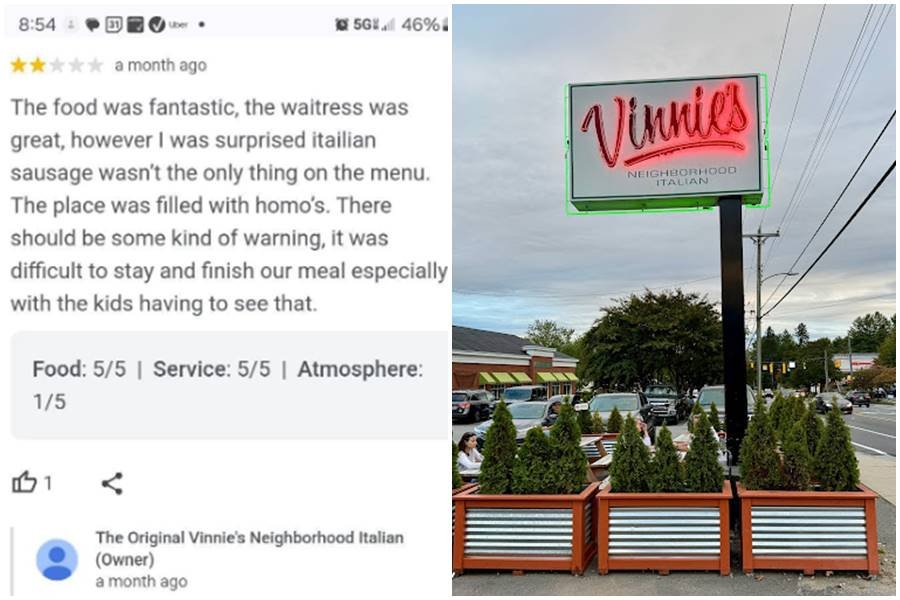
A Google reviewer recently left a homophobic review for The Original Vinnie’s Neighborhood Italian restaurant in Asheville, North Carolina. Although the review is upsetting, the response from the restaurant is the perfect example of how to confront homophobia.
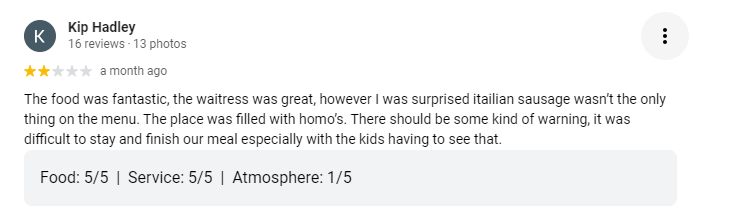
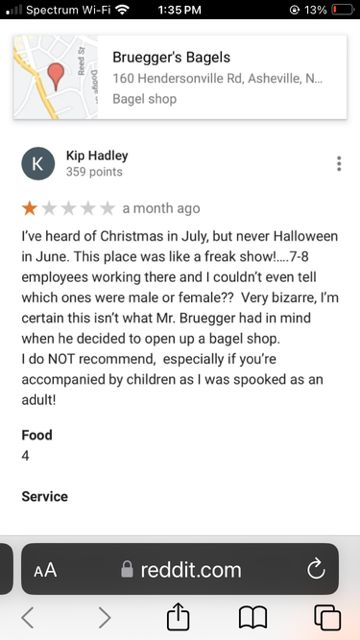
Vinnie’s is known for food that reflects the “Old School” flavors of New York cuisine and has repeatedly been named “Best Italian Restaurant” in Asheville. The reviewer, who used the screenname “Kip Hadley,” liked the food but didn’t enjoy the fact that Vinnie’s had a lot of LGBTQ employees.
The homophobic review ofu00a0Original Vinnie's Neighborhood Italian restaurant. via Google reviews
Sean Cudmore, Director of Growth and Strategies at The Scheffer Group, responded to the review with incredible heart and humor while touting the benefits of employing LGBTQ people.
Cudmore began his response by doubling down on how proud the company is to support LGBTQ people by giving them “safe, supportive, and sustainable places to work” and said that the company would continue to do so.
Cudmore’s response was great because not only did he stand up for VInnie’s LGBTQ employees, but he also made the case that being homophobic was a losing mindset because LGBTQ people a crucial part of our everyday lives. Homophobic people aren’t just fighting back against those with a non-traditional sexual preference. They are going to battle with the people who cook our meals, pour our drinks, teach our children, care for our health, protect our communities and—to put it in the most basic terms possible—contribute to society the same way as everyone else.

In a small village in Pwani, a district on Tanzania’s coast, a massive dance party is coming to a close. For the past two hours, locals have paraded through the village streets, singing and beating ngombe drums; now, in a large clearing, a woman named Sheilla motions for everyone to sit facing a large projector screen. A film premiere is about to begin.
It’s an unusual way to kick off a film about gender bias, inequality, early marriage, and other barriers that prevent girls from accessing education in Tanzania. But in Pwani and beyond, local organizations supported by Malala Fund and funded by Pura are finding creative, culturally relevant ways like this one to capture people’s interest.
The film ends and Sheilla, the Communications and Partnership Lead for Media for Development and Advocacy (MEDEA), stands in front of the crowd once again, asking the audience to reflect: What did you think about the film? How did it relate to your own experience? What can we learn?
Sheilla explains that, once the community sees the film, “It brings out conversations within themselves, reflective conversations.” The resonance and immediate action create a ripple effect of change.
MEDEA Screening Audience in Tanzania. Captured by James Roh for Pura
Across Tanzania, gender-based violence often forces adolescent girls out of the classroom. This and other barriers — including child marriage, poverty, conflict, and discrimination — prevent girls from completing their education around the world.
Sheilla and her team are using film and radio programs to address the challenges girls face in their communities. MEDEA’s ultimate goal is to affirm education as a fundamental right for everyone, and to ensure that every member of a community understands how girls’ education contributes to a stronger whole and how to be an ally for their sisters, daughters, granddaughters, friends, nieces, and girlfriends.
Sheilla’s story is one of many that inspired Heart on Fire, a new fragrance from the Pura x Malala Fund Collection that blends the warm, earthy spices of Tanzania with a playful, joyful twist. Here’s how Pura is using scent as a tool to connect the world and inspire action.
A partnership focused on local impact, on a global mission
Pura, a fragrance company that recognizes education as both freedom and a human right, has partnered with Malala Fund since 2022. In order to defend every girl’s right to access and complete 12 years of education, Malala Fund partners with local organizations in countries where the educational barriers are the greatest. They invest in locally-led solutions because they know that those who are closest to the problems are best equipped to solve and build durable solutions, like MEDEA, which works with communities to challenge discrimination against girls and change beliefs about their education.
But local initiatives can thrive and scale more powerfully with global support, which is why Pura is using their own superpower, the power of scent, to connect people around the world with the women and girls in these local communities.
The Pura x Malala Fund Collection incorporates ingredients naturally found in Tanzania, Nigeria, Pakistan, and Brazil: countries where Malala Fund operates to address systemic education barriers. Eight percent of net revenue from the Pura x Malala Fund Collection will be donated to Malala Fund directly, but beyond financial support, the Collection is also a love letter to each unique community, blending notes like lemon, jasmine, cedarwood, and clove to transport people, ignite their senses, and help them draw inspiration and hope from the global movement for girls’ education. Through scent, people can connect to the courage, joy, and tenacity of girls and local leaders, all while uniting in a shared commitment to education: the belief that supporting girls’ rights in one community benefits all of us, everywhere.
You’ve already met Sheilla. Now see how Naiara and Mama Habiba are building unique solutions to ensure every girl can learn freely and dare to dream.
Naiara Leite is reimagining what’s possible in Brazil
Julia with Odara in Brazil. Captured by Luisa Dorr for Pura
In Brazil, where pear trees and coconut plantations cover the Northeastern Coast, girls like ten-year-old Julia experience a different kind of educational barrier than girls in Tanzania. Too often, racial discrimination contributes to high dropout rates among Black, quilombola and Indigenous girls in the country.
“In the logic of Brazilian society, Black people don’t need to study,” says Naiara Leite, Executive Coordinator of Odara, a women-led organization and Malala Fund partner. Bahia, the state where Odara is based, was once one of the largest slave-receiving territories in the Americas, and because of that history, deeply-ingrained, anti-Black prejudice is still widespread. “Our role and the image constructed around us is one of manual labor,” Naiara says.
But education can change that. In 2020, with assistance from a Malala Fund grant, Odara launched its first initiative for improving school completion rates among Black, quilombola, and Indigenous girls: “Ayomidê Odara”. The young girls mentored under the program, including Julia, are known as the Ayomidês. And like the Pura x Malala Fund Collection’s Brazil: Breath of Courage scent, the Ayomidês are fierce, determined, and bursting with energy.
Ayomidês with Odara in Brazil. Captured by Luisa Dorr for Pura
Ayomidês take part in weekly educational sessions where they explore subjects like education and ethnic-racial relations. The girls are encouraged to find their own voices by producing Instagram lives, social media videos, and by participating in public panels. Already, the Ayomidês are rewriting the narrative on what’s possible for Afro-Brazilian girls to achieve. One of the earliest Ayomidês, a young woman named Debora, is now a communications intern. Another former Ayomidê, Francine, works at UNICEF, helping train the next generation of adolescent leaders. And Julia has already set her sights on becoming a math teacher or a model.
“These are generations of Black women who did not have access to a school,” Naiara says. “These are generations of Black women robbed daily of their dreams. And we’re telling them that they could be the generation in their family to write a new story.”
Mama Habiba is reframing the conversation in Nigeria
Centre for Girls' Education, Nigeria. Captured by James Roh for Pura
In Mama Habiba’s home country of Nigeria, the scents of starfruit, ylang ylang and pineapple, all incorporated into the Pura x Malala Collection’s “Nigeria: Hope for Tomorrow,” can be found throughout the vibrant markets. Like these native scents, Mama Habiba says that the Nigerian girls are also bright and passionate, but too often they are forced to leave school long before their potential fully blooms.
“Some of these schools are very far, and there is an issue of quality, too,” Mama Habiba says. “Most parents find out when their children are in school, the girls are not learning. So why allow them to continue?”
When girls drop out of secondary school, marriage is often the alternative. In Nigeria, one in three girls is married before the age of 18. When this happens, girls are unable to fulfill their potential, and their families and communities lose out on the social, health and economic benefits.
Completing secondary school delays marriage, and according to UNESCO, educated girls become women who raise healthier children, lift their families out of poverty and contribute to more peaceful, resilient communities.
Centre for Girls’ Education, Nigeria. Captured by James Roh for Pura
To encourage young girls to stay in school, the Centre for Girls’ Education, a nonprofit in Nigeria founded by Mama Habiba and supported by Malala Fund and Pura, has pioneered an initiative that’s similar to the Ayomidê workshops in Brazil: safe spaces. Here, girls meet regularly to learn literacy, numeracy, and other issues like reproductive health. These safe spaces also provide an opportunity for the girls to role-play and learn to advocate for themselves, develop their self-image, and practice conversations with others about their values, education being one of them. In safe spaces, Mama Habiba says, girls start to understand “who she is, and that she is a girl who has value. She has the right to negotiate with her parents on what she really feels or wants.”
“When girls are educated, they can unlock so many opportunities,” Mama Habiba says. “It will help the economy of the country. It will boost so many opportunities for the country. If they are given the opportunity, I think the sky is not the limit. It is the starting point for every girl.”
From parades, film screenings to safe spaces and educational programs, girls and local leaders are working hard to strengthen the quality, safety and accessibility of education and overcome systemic challenges. They are encouraging courageous behavior and reminding us all that education is freedom.
Experience the Pura x Malala Fund Collection here, and connect with the stories of real girls leading change across the globe.
If you travel around the United States, you’ll find that Americans sound different everywhere you go. If you go from Boston to Birmingham, you’ll hear a big contrast in dialects and accents. Going from Seattle to San Diego, the differences would be much smaller, but they’d still be there. Some people don’t think they have…
If you travel around the United States, you’ll find that Americans sound different everywhere you go. If you go from Boston to Birmingham, you’ll hear a big contrast in dialects and accents. Going from Seattle to San Diego, the differences would be much smaller, but they’d still be there.
Some people don’t think they have an accent at all. It’s common for Americans outside the South and Northeast to believe they speak “normally,” unaware of the geographic “tells” in how they pronounce certain words. But as linguist Carson Woody demonstrates, sometimes just a single word can reveal where in the U.S. a person is from.
A woman shared a social media trend in which people say three words that supposedly indicate where they’re from. She said she didn’t think she had an accent, but she only got as far as saying “bagel.” That’s okay, Woody said, because that was all he needed to clock her hometown.
“Baby girl, you sound like the Pope,” Woody said. Sure enough, like Pope Leo XIV, she’s from Chicago.
Woody said he understood what she meant when she said she didn’t think she had an accent.
“A lot of people use the term ‘accent’ when referring to someone who has a distinct accent from them,” he said. “Like, ‘You have an accent, I don’t. Because you’re not from here and I am.’ You’re saying you don’t think you have an identifiable, regional accent. But linguistically, when we say, ‘an accent,’ what we’re talking about is just how you pronounce things. If you speak, you have an accent.”
He explained that the way she pronounced the “a” in “bagel” gave away her location. He also shared that none of the various pronunciations of words are right or wrong.
“Every accent, every dialect, every language, the way everybody speaks around the world are all equally valid and beautiful,” he said.
What’s the difference between an accent and a dialect?
As Woody said, an accent is the way words are pronounced. A dialect is broader, encompassing not only pronunciation but also grammar and vocabulary.
So just how many dialects are there in American English? More than you might think. It’s hard to pin down an exact number because it depends on how broad or specific you want to get. Linguists recognize somewhere between three and 24 (or more) distinct American English dialects in the U.S. Within those dialects, there are hyperlocal pronunciation variations as well.
For instance, there are some commonalities among Midwestern accents, but someone from Chicago will pronounce certain words differently than someone from northern Minnesota.
Woody even shared how a dialect can practically—and in some cases actually—become a totally different language:
Everybody has one
As Woody pointed out, everyone has an accent. People in the comments even shared some metaphors that help illustrate this point:
“Saying, ‘I don’t speak with an accent’ is like saying ‘I don’t type with a font.’”
“Someone told me once to think of accents like fonts, you can’t really write or type without a font lol, everyone has their own accent that shows your heritage, family, origins, or even sometimes your personality. Humans are pretty cool.”
“‘I don’t have an accent, everyone else does.’ ‘I don’t have a location, everyone else does.’ Same energy.”
“If you eat you have a diet, and if you speak you have an accent.”
“I had a professor years ago (ASL grammar) who could tell what part of the country someone was from or where they went to college by how they signed or finger spelled words. Even sign languages have accents!”
And if you’re wondering what the other two words were that supposedly help indicate where you’re from, they’re “milk” and “eggs.” Apparently, ordering breakfast gives a lot away. Isn’t language fun?
Grief is an unfortunately universal and often inescapable feeling. Yet, due to certain societal norms, it can be harder for some people to embrace or fully work through than for others. In a Reddit post titled “100% Really Sucks,” a man wrote: “About ten years ago, our at the time 9-year-old son died of cancer.…
Grief is an unfortunately universal and often inescapable feeling. Yet, due to certain societal norms, it can be harder for some people to embrace or fully work through than for others.
“About ten years ago, our at the time 9-year-old son died of cancer. Hundreds of people asked my wife how she was doing, offered her support, etc. Lots of people asked me how she was doing, how the kids were doing, and how I had to be strong for her and our two remaining kids. Only a few close male friends asked how I was doing. Not one of my female friends did. Not even my mother. It never occurred to them.
That really sucked. Not because I don’t think my wife deserved support. Of course she did – but so did I.”
The good news is that the OP bravely began a difficult discussion that seemed to resonate deeply with many people. The post received over 90,000 upvotes and 2.6 thousand comments. Clearly, people seem ready to talk about it.
One Redditor noted that they shared a similar experience: “My wife and I divorced – after our marriage she chose drugs and alcohol and I chose to be a dad. People still ask me all the time how she’s doing through everything. She still gets invited to parent/kid meet ups even though the kids live with me 7 days a week. It’s unfair.”
Another commenter added the importance of including men when an entire family needs support, writing, “It absolutely is unfair. I hope future generations will learn to be more supportive after seeing more great dads in action!”
What was even more encouraging was that the Reddit community came together not only to commiserate but also to offer hopeful suggestions.
Another commenter pointed out a similar situation, sharing, “We had a house fire. Lost everything. People in the community donated so many clothes and toiletries for my wife and kids. But nothing for me. One year later and I’m still struggling with wardrobe choices.”
This Redditor was ready to help, writing, “What size do you wear bro? I have some nice clothes that I never wear I’d be happy to have dry cleaned and sent your way.”
Not everyone, thankfully, had the same experience, though the post helped some feel a sense of gratitude:
“My word, reading these comments just makes me appreciate my wife and my mom all the more. They actually support me when I let them know I am hurting or depressed.
I do have to vocalize that I want the support in the moment because my wife will pick up on the fact that I’m down almost immediately and I’ll tell her I’m just having a down day. I don’t really deal with very bad depression but I do have days where it gets bad and she’s always there for me.
When I was growing up, my mom never dismissed my feelings, never told me to ‘act like a man’.
I’m so sorry to hear all of your stories of your struggles. I wish the best for all of you out there dealing with this type of stuff.”
Society needs to encourage men to open up
In the article “The Problem of Male Grief” for Psychology Today, Nick Norman, LICSW, discusses what he refers to as a “silent epidemic” among men.
“According to the CDC, 1 in 10 men experiences anxiety or depression, but less than half reach out for help,” Norman wrote. “They are less likely to seek help for mental or emotional difficulties overall.”
Norman seems to hit the nail right on the head when it comes to the Reddit post:
“While there are common ways that men respond to grief, that does not mean that they are actually processing their emotions or coming to a healthy resolution. The real issue is not that men have some other means or manner of grieving. It is that the Western cultural expectation of men discourages grieving altogether.”
He offered suggestions for men to create healthy spaces for one another:
“The unspoken rules of oppressive masculinity often lead men to shame those who dare step outside of the limited emotional box we’re given. In this way, we become enemies of our brothers and create more pain when what we need is support. Although we may struggle with our own discomfort, we need to stop shaming other men for weeping and feeling authentically. We have enough challenges in this work. We owe it to one another to buoy each other up, or at least grant each other silent respect.”
Mindfulness can help
Jeanette Lorandini, LCSW, founder of Suffolk DBT in New York, spoke to Upworthy about the issue:
“From a DBT [Dialectical Behavior Therapy] perspective, many boys grow up in environments where their emotions are invalidated. They are often taught very early that showing sadness or vulnerability is a sign of weakness and that they should ‘be strong.’ Over time, this can lead men to learn how to hide their emotions rather than understand or process them. They may become skilled at making their feelings invisible to others, but that does not mean those feelings are not there.”
To counter this, Lorandini suggested men practice mindfulness to help process their emotions:
“Mindfulness, a core component of DBT, encourages people to slow down, notice their emotional experience, and give themselves permission to feel sadness rather than push it away. We call that mindfulness of current emotion. When someone does not give themselves these important moments to grieve, they develop what we call inhibitive grief. It doesn’t go away but remains in a ‘holding cell.’ While it may not be a literal prison, it won’t go away until it is experienced. It often will show up in ways such as anger, substance use, working excessively, heavy screen time, or other maladaptive behaviors.”
She added, “Grief does not require someone to fall apart, but it does require space to be felt. Learning to experience sadness in manageable moments, while continuing to move forward at a balanced pace, can help men process loss in a way that honors both their emotional needs and their role within their family.”
Distracted driving is a dangerous issue that police officers are taking more seriously. But when Katie, who runs the social media page Slightly Off Balance, was pulled over for the offense, she had questions. The officer writing the citation insisted that she was driving with her phone in her right hand. That didn’t make sense to her.
The woman uploaded a clip of the interaction in which she asks the officer for clarification. According to the officer, he witnessed Katie committing the driving infraction. Katie asked for clarification several more times because it would be impossible for her to hold a phone in her right hand. Why? She doesn’t have one.
In the video, which has been viewed nearly eight million times, Katie pokes fun at the situation. “Turns out you can still get a ticket for driving with a device in your right hand, even if you don’t have a right hand,” she says, holding up her arm. Clearly, the entire lower part of her right arm is missing.
After cutting to the bizarre interaction between herself and the officer, Katie shows herself attempting to hold a phone with her nonexistent hand. Spoiler alert—it doesn’t work. In the video, the officer can be heard saying, “If you want to take it to court, option five on the back of the ticket. That’s how you take it to court.”
Taking it to court is exactly what she plans to do. In a follow-up video, she shares that her court date is scheduled for mid-April. Commenters are not only gobsmacked that she could be cited for this particular infraction, but they’re also completely invested in her court case.
One person begs, “Please take us to court with you, I want to hear the judge.”
Another writes, “I’m glad you recorded him saying it was the right hand otherwise I guarantee he would have lied later on and claim he never said that.”
“Ok but how would you ve able to drive with a phone in ur LEFT hand anyway,” someone questions.
“Oh I wanna see a part 2. I know it sucks tho, cause you shouldn’t have to take time off work/life just to prove a cop wrong,” a person laments.
One commenter shares a cheeky way Katie could have handled the situation, writing, “I would have said ‘ok I’ll see you in court’ and waved with your right hand to get his reaction. And then still gone to court to let the judge know he was lying.”
Some people wonder why she didn’t inform the officer on the spot that she didn’t have a right hand. But others argue that the officer had already proven to be untrustworthy and would likely change his story. Katie didn’t respond to those questions, but the officer could likely see that she didn’t have a hand while looking directly into her window.
Katie appears to have a sense of humor about missing a hand, liking several comments that joke about her limb difference.
“I would have held my right hand out for the ticket. So glad you got that admission recorded,” someone writes.
“Cutting your hand off to get out of a traffic ticket is wild,” another jokes.
Recently, a man went on TikTok to tearfully recount being called “poor” by a close friend. He was overwhelmed by the amount of support he received from total strangers.
On February 12, Andrey Borul explained in a video that he had fallen into medical debt after spending two weeks nearly dying in the hospital. Now, he’s “working almost twenty hours a day trying to recover.”
Borul isn’t alone in this struggle. Studies estimate that approximately 100 million Americans have some form of medical or dental debt, with total outstanding debt around $220 billion.
And yet, Borul’s family has tried their best to keep their spirits up and “make it work.” They’ve always managed to “bring a gift” to whatever parties they were invited to.
“Too poor” to get invited
So when, at one of these parties, a friend said that Borul and his wife don’t get invited anywhere because they’re “too poor,” he was “dumbfounded.”
Things only seemed to get worse when, presumably at the same party, couples were talking about “buying houses.” Borul’s wife suggested making a group trip to the mountains so the kids could enjoy the snow together. Again, a friend immediately “shot down” the idea, saying, “You can’t afford that.”
Tears welling up in his eyes, Borul admitted, “It’s true—we can’t.” He then shared how, the next morning, he drove up to the mountains himself to bring down some snow for his kids to play with.
“After our bills are paid, we have so little left over for entertainment,” he said. “I’ve been working nonstop to dig ourselves out of this financial hole…being poor sucks.”
Borul ended his clip saying, “I feel so alone. We haven’t been invited for three months anywhere.”
Thankfully, Borul was met with a wave of support from viewers
A few people shared that they had found themselves in equally disheartening situations.
“Most of us in North America are in your shoes.”
Many chimed in to remind him what real friendship looks like.
“Bro, you literally went to the mountain and brought your kids back snow…you’re working 20 hours a day for your family…you are THE MAN. Do not let those types of people make you feel any sort of way. Run from them. You’re the kind of guy I would be honored to call my friend.”
“You almost died, lost two weeks of income, and those people did not help you? They are not your friends.”
“This broke my heart and angered me because I’ve been in between blessings before and I remember when we planned a trip and our friends knew we were in between blessings. They ended up paying for the trip and once we got back on our feet, that’s when we paid them back (they wouldn’t take it). My point is friendship is about support (not necessarily financial), love, and grace. As hard as it’s going to be it may be time for you and your wife to leave them where they are at. Sending you love.”
“You should not be wasting your time and energy on these people. You are richer than them in the most important way.”
“If they were your friends, they would ask how to help you, not leave you out because you don’t have the money.”
And perhaps most encouraging of all, donations began pouring into Borul’s GoFundMe to help cover some of those exorbitant medical bills and give him some room to breathe. So far, a little over $30,000 has been raised, inching closer to the overall $35,000 goal.
Understandably, Borul was overwhelmed by all the support
If you’re looking to move abroad from the United States, the United Kingdom seems like a natural candidate on its face. After all, moving to the UK means you’ll already speak the language, be relatively familiar with the country’s political structure, and exist within a similar pop culture and media ecosystem.
But many people who move to London or its surrounding areas are stunned to learn just how different American and British cultures can be.
Ashley Jackson recently moved from Amarillo, Texas, to South Manchester. She’s been documenting her journey acclimating to the new culture on her TikTok channel. Recently, she shared three “mortifying” experiences that almost made her rethink her new life in the UK.
In the tongue-in-cheek post, she reiterates that despite the difficulties and hilarious flops that have arisen from her new life, she’s still having a great time living in Manchester. But things were certainly touch-and-go for a while at first.
“One, I’ve had a full-on conversation with a person and I didn’t understand a lick of it. She had a very different accent I couldn’t understand,” Jackson says.
Accents and regional dialects in the UK are among the most diverse and wide-ranging in the world. In the U.S., there are subtle differences between Southern, Cajun, and Northeastern accents, for example. But that’s nothing compared to what even locals encounter in the UK. Even they sometimes have a hard time understanding more niche or obscure dialects like Glaswegian or Devonian. Most Americans are woefully unprepared for the accents they encounter there.
Issue number two for Jackson? “It hailstoned. While on a hike up a hill, it rained, hailstone, my daughter was crying. Everyone was wet, soggy, feet muddy. Quite traumatizing for all of us, but we’re still here.”
Weather in the UK can be all over the map, but one thing the region is famous for is rain and hail. Heatwaves and climate change have only contributed to hailstones becoming larger and more frequent. In another video, Jackson says acclimating to the weather in the UK has been a challenge, noting that she had to “toughen up.”
And finally, issue number three: “I was cut off by my GP (general practitioner) after the 10-minute mark. I didn’t realize there were 10-minute time slots for doctor’s appointments. Learned that one the hard way.”
One big appeal of living in the UK is the mostly free healthcare provided through the NHS. However, appointments can be hard to come by, and many doctors are strict about keeping visits under 10 minutes so they can manage their patient load. Jackson was stunned to be “cut off” in the middle of a visit, but for locals, that’s just the way it goes.
Americans moving to the UK often experience extreme culture shock. We sometimes expect the cultures to be so similar that the small differences that do exist catch us completely off guard.
The language, though fundamentally similar, can take Americans a while to pick up on. British culture is full of slang, regional dialects, and colloquialisms that can be confusing for outsiders. One American who moved there, for example, was baffled when everyone kept calling her cookies “biscuits.”
A lot of American daily conveniences either don’t exist in the UK or are far more rare. Air conditioning and garbage disposals, for example, are hard to come by. Houses and living quarters in general are much smaller than what most Americans are used to as well.
Work culture is very different in the UK as well. Citizens usually have a stronger work-life balance and a government-mandated minimum of five weeks of paid vacation.
In short, moving from America to the UK won’t necessarily be easy just because of the common language. Whether you ultimately enjoy American or British culture more is a matter of taste, but it will take some getting used to—that’s for sure.
As for Jackson, she says in her videos that even if the adjustment wasn’t easy, she loves the rain, the NHS, and the walkability of life in the UK. She just had to stick it out through a few embarrassing faux pas before she could start enjoying all the perks.
Tourists see new places with fresh eyes and fresh observations. In 2024, 72.4 million tourists visited the United States, according to the National Travel and Tourism Office. (That’s a lot of eyes seeing America in a new light.)
Tourists to the States have pointed out that Americans really do like to put ranch dressing on everything. They’ve also noted that in the U.S., squirrels seem to run rampant.
While these are insightful observations, most Americans would say they already know them to be true. On Reddit, Americans shared the shocking realizations they had about the U.S. that were only revealed to them by tourists.
As one American noted, “I’ve lived in the US my whole life. Somehow, I’ve never noticed this before.”
These are 15 eye-opening things tourists brought to Americans’ attention that truly blew their minds:
Culture
“We sure do have a lot of flags everywhere.” – myfourmoons
“American coins don’t have numbers on them. Some of the coins will say ‘One Cent’ or ‘Quarter Dollar’ but I don’t think that’s helpful if your English is not so good. And sometimes that labeling is just not in a place that easy to see on a coin.” – chocotacogato
Michael White, a former spokesman for the United States Mint, told The Gainesville Sun that the reason coins in the U.S. don’t have numbers is simple: “It is an artistic choice in the majority of instances.”
White added that certain coins in the past in the U.S. have used numerical notations, including the dime, nickel, and quarter. The article notes, “From 1809 to 1836, there was a half dollar imprinted with ’50 C.’ That was changed to ’50 cents’ for two years and then, in 1838, artistic choice deemed it should be called ‘half dollar.’”
“The gap around the stall doors in public restrooms. It’s weird, and I hate it.” – SidheRa
“Bank drive-thru lanes. I was told ‘why don’t you just get out of your car and walk in the bank?’” – JWilsn_Art
According to Wells Fargo, “motor banks” (aka drive-in and drive-thru banks) were invented in the U.S. and came into existence in the 1930s.
“That every morning, all American children from kindergarten to 12th grade, stand before the US flag (found in every classroom, ofc) and recite “the pledge of allegiance” to the country in unison, with their right hands over their hearts. Upon learning this universal American school experience, my Russian colleague said: ‘That is the most Comm*nist thing over ever heard!’” – jzzdancer2
The Pledge of Allegiance, written by Francis Bellamy, debuted in 1892, according to the American Legion. Over the years, it went through various edits until it was recognized by Congress and included in the U.S. Flag Code on June 22, 1942.
“How much daily life revolves around cars. In many cities, if you don’t drive, you basically don’t exist. It’s convenience on steroids.” – Prior_Bank7992
Mannerisms
“That Americans switch between hands when eating with silverware, cutlery, etc.” – BasilRevolutionary38
Called the “cut-and-switch” table habit, it’s described by NPR as when you “hold your fork in your left hand and cut with your right and then put down your knife so you can switch your fork to your right hand before you take a bite.”
Americans actually adapted this use of cutlery from the French. Writer Mark Vanhoenacker explained to NPR, “Americans got it from France in the 19th century even as France was giving it up, and no one knows why France gave it up. Maybe just convenience or another change of fashion.”
“We smile too much. To the point where foreigners, specifically Asians (Korean and Chinese) have pointed out that our smiles feel disingenuous and mean nothing. Really hit home, but despite that, I still smile ‘too much’.” – BMdabbleU
“How much casual socializing we do with strangers. From small talk to things people in other places consider weirdly intimate (like talking about health problems).” – Practical-Water-9209
“The lean! The fact that people from the U.S. tend to lean on things while standing, no matter how inappropriate a place or circumstance. I’ve thought about it, and I think its because the U.S. (for the most part) isn’t walkable, so we aren’t used to standing for as along as other countries.” – Lobstertales143
The Central Intelligence Agency has deemed the “American Lean” a dead giveaway that someone is an American. In 2019, Jonna Mendez, the CIA’s former chief of disguise, and Gina Haspel, former CIA director, told NPR that Europeans can easily spot Americans in a crowd.
“They think that we are slouchy, a little sloppy,” Mendez said. “And they think that they can almost see that in our demeanor on the street because they stand up straight. They don’t lean on things.”
Food
“Root beer tastes like medicine. It’s still my favorite soda but… yeah it tastes mediciney.” – TheNerdNugget
“Had a German foreign exchange student and she said ‘All American breakfast is dessert. Pancakes, donuts, Cinnabon, muffins, French toast…’ I was like yea you have a point lol.” – dom954
Words
“Apparently Americans use the word ‘awesome’ a lot. I’ve had people in other countries tease us for how we think everything is awesome lol. But to be fair, tons of things ARE awesome, and also you’re talking to me on vacation when I’m in the best mood of my life lol.” – Gold_Telephone_7192
“‘Yeah’ ‘Yeah no’ ‘Yeah right’ ‘Oh yeah’ ‘Hell yeah!’ All mean different things!” – zippy_97
It’s wonderful to go on vacation and learn all about other people’s cultures. But when you travel to another country, you also learn a lot about your own. When you’re a fish out of water, it’s easy to see the ways you stand out in a foreign environment. It’s especially noticeable when you’re an American, because your culture is known around the world.
A big way Americans stand out overseas is through their fashion. Wearing a New York Yankees cap, cargo shorts, and white New Balance sneakers may be camouflage in America, but in Paris, you stick out like peanut butter on a baguette.
To reveal the many ways Americans stand out while traveling, a Reddit user asked non-Americans a simple question: “Besides their accent, what’s one way you know a tourist is American?” The post received over 18,000 responses. Evidently, there are a lot of ways to spot an American abroad.
Here are 13 of the best responses:
1. They wait to be seated
“When visiting Paris, my wife and I learned they don’t seat you at restaurants. You just walk in and sit down at an available table. We figured it out after standing around at the entrance a few times. Then we started noticing other American tourists doing the same.”
2. They start conversations with everyone
“Saying ‘hi, how are you?’ to the barista, servers, retail workers. My country doesn’t quite have that culture so I find it really sweet.”
“I’m fascinated with Norway and remember watching a vlog from an American who had moved there. She said one of the biggest differences was the lack of politeness, because people view it as fake. I would love to live somewhere that’s more introverted than the US.”
“The absolute fearlessness of asking anyone on the street about anything.”
“This is something i still don’t understand after being in Europe for a few years. Why are people so afraid of other people just like them?”
“I’ll literally talk to anyone that wants to chat me up, never thought that was uniquely American.”
“When I went to Italy with a friend, I couldn’t figure out why everyone greeted me in English before I said a word. I don’t wear running shoes outside of the gym, I dress pretty posh, I can’t remember the last time I owned a baseball cap, and I try to have a basic grasp on the local language. How can they tell I’m American? My friend told me, ‘it’s because you’re smiling at them.’”
“It’s not so much about the fact that Americans smile, it’s how you smile. Nobody here smiles with their teeth. Maybe if they heard a really funny joke or are trying to look happy in a picture, but that’s about it. When I visited America, my family literally spent hours trying to learn how to properly smile with all your teeth showing. I still can’t do it correctly, it looks weird. I remember the first times I saw pictures from a highschool yearbook on the internet. I thought, ‘What is wrong with them? Why are they smiling so much?’ If you smile with your teeth at someone in Europe, it’s either your job, or you’re American.”
“Americans recognize other Americans in most countries because they smile at strangers on the street.”
“I live in New York, I don’t understand this smiling thing.”
Why do Americans smile so much? It’s because they come from a diverse country. A study of 32 different countries found that emotional expressiveness is correlated with diversity. When people are around others from diverse cultures, they are more likely to use a smile to build trust and cooperation.
4. Americans are very polite
“Some of yous are way more polite than expected. Whenever I hear someone say ‘ma’am’ I know they’re American. Like one time I was in Lidls and there was an American family asking someone who worked there if they sold ‘cell phones’ and when the woman said they didn’t they were all ‘oh okay, thank you for your time ma’am! Have a great day!’ which is mucb more cheery than the average Scot.”
“Yes, sir, that’s southern manners.”
“I’m gonna piggyback the Midwest in here, too. If you just walk away without putting something like this in Kansas, you might as well have slapped them.”
“Most American tourists I’ve come across are really friendly and talkative. They always seem to be genuinely stoked to be here haha.”
“Let’s put it this way: in the Eurozone, you can make a day trip of going to another country. For most of the US, getting to literally any other country is a massive ordeal with a huge price tag, so when we get to go, it’s a really special occasion that we have to make the most of because a lot of us have no idea when or if we’ll ever get to do it again.”
6. They are amazed by old things
“Girlfriend used to work on a farm and an estate in the U.K. and would often have Americans in awe of the old buildings. One once said ‘some of these buildings are older than my country.’”
“Reminds me of that old saw ‘Americans think a hundred years is a long time, Europeans think a hundred miles is a long way.’”
7. They need to find a trash can
“If you see an American in Japan, they will frantically look for public trash cans. The absence of trash receptacles is something unfounded in the US, and we become confused at the idea of having to hold it for extended periods of time.”
“EXACTLY!! Im American, went last year and i ended up having half of my backpack filled with trash until i found a trashcan, it didnt help it was mid summer so we would buy drinks from vending machines a lot, not all the vending machines had trashcans.”
“Tipping. Americans will try to tip everyone, even in countries where tipping isn’t a thing/is considered a serious insult.”
“True. I used to work in a bar in the UK, and American customers would insist on tipping me even after I declined. The relief on their faces when I took the money was hilarious.”
9. They shop late at night
“They’re looking for a store open at like 11 pm. Even if in most European countries stores close at like 7-8 pm.”
“Yeah, I’m italian but live in the US right now. One of my coworkers went to Italy on vacation and she was texting me stuff like ‘there’s no circle k here?’ Lmao.”
10. Just look at their feet
“Americans will be wearing sneakers.”
“Yep. I walked into a museum in Germany, and the woman selling tickets greeted us in English. We were dressed conservatively, and hadn’t said a word, yet she knew. I asked her how, and she said, ‘It’s your shoes.’ Indeed, I was wearing running shoes.”
Although there is no specific reason why Americans tend to wear sneakers more often than people in other countries, a major factor is car culture. When you don’t walk much, you value comfort and style over everything else. Plus, America is a country based on individuality, which breeds a culture that’s more casual than in other developed countries.
11. They take off their shoes in the airport
“I hear that us Americans can easily be spotted in the airport by the fact usually were use to taking off our shoes in TSA.”
“Dude when we landed in Japan a couple of years ago I started to take my shoes off to go through customs and I’ll never forget, one of the agents there just completely froze and looked at me like I had frogs coming out of my ears. He then motioned for me to put my shoes back on. I was very embarrassed.”
12. It’s how Americans dress
“Baseball caps, University spirit wear, cargo shorts, free t-shirts from events with ads and text all over them, and for the older Americans, they always seem to just kinda stand in the middle of everything looking around.”
“People may mock Americans for wearing shirts with ads on them but Europeans and their soccer (ahem, football) gear is just as questionable.”
“As opposed to football jerseys with ads prominently featured on the design that the wearer paid good money for.”
“For the longest time, I thought that there was a soccer team named Fly Emirates.”
“If they buy peanutbutter. It sounds very weird, but everyone who buys peanut butter where I work, turns out to be American.”
“I was desperately homesick while living in Belfast and had a quiet cry in the grocery store because I wanted it and couldn’t find it. I eventually did, made a peanut butter and jelly sandwich, and felt better. Not seeing the sun for three months was doing my head in.”
Interestingly, although Americans are stereotyped as the biggest consumers of peanut butter in the world, it’s actually much more popular in developing nations such as Burkina Faso, Myanmar, and Chad, where it is used as a nutritional supplement and an ingredient in soups and stews.
Head anywhere in the Southern United States, and you are likely to hear one distinct word: “y’all.” “Y’all,” which combines the words “you” and “all,” may be predominantly used in the South—but not for long.
Paul E. Reed, a linguist at the University of Alabama who studies Southern American English and Appalachian English, told NPR in 2025 that “it’s expanded much more outside of the South” thanks to Americans under 40. (Add it to the list of Gen Z slang.)
How “y’all” entered the English vernacular is a fascinating tale. Linguist Danny Hieber, PhD, explained the origin story of “y’all” to his TikTok followers—and it stems from a surprising language.
According to Hieber, present-day English doesn’t have a plural form of the word “you” like other languages. In Old English, there were three forms of “you”:
Thou (subject)
Thee (object)
Thine (possessive)
Hieber goes on to explain that “you” became singular thanks to French. In French, “you” translated to:
Tu (singular)
Vous (plural + polite)
“After the Norman Conquest of England in 1066, French had a huge influence on English,” he said. “So English speakers started borrowing that pattern into English and used ‘you’ to politely address one person.”
He added that over time, this became the default way to address a single person. Along those same lines, the word “be” also followed suit.
“It used to be that the verb ‘be’ was conjugated like this,” explained Hieber, with the plural use becoming “are.” “That singular verb got pulled along into the singular too, and now the conjugation of ‘be’ looks like this:”
I am / we are
Thou art / you are
He, she, it is / they are
However, it created a “gap,” and “English speakers have been trying to settle on a ‘you [plural]’ ever since,” said Hieber. Enter: y’all.
There are many theories as to how y’all infiltrated American English in the 1700s, per NPR. One theory states that it has British origins, where the words “ye” and “aw” were combined and used in the British Isles. From there, Scots-Irish immigrants brought it to Appalachia in the U.S.
The other theory is that it originated in West Africa, and when enslaved people were brought from there to the South, it began to spread. After the Great Migration, Black Americans brought the term north with them, expanding its use.
However, the term “you guys” is still commonly used in most Northern states. There are also many regional variations throughout the country, including “yinz” (used in Pittsburgh, Pennsylvania) and “youse” (used in Philadelphia, Pennsylvania).
Americans respond
Viewers had lots of opinions on Hieber’s video, including how different regions have termed the plural form of “you”—and their thoughts on y’all:
“Sorry… y’all is singular all y’all is plural.”
“In the upper Ohio Valley, we also say things like, ‘All yinz guys,’ a sort of amalgamation of Pittsburgh’s ‘yinz’ (we’re an hour away), and the Midwest ‘you guys.’”
“From CA but living in the south..I just cannot bring myself to say y’all..feels so unnatural.”
“Washington born and y’all made it into my vocab.”