When it comes to young people, every generation is different from the one that precedes it. It makes sense. Every group grows up in different economic, cultural, and technological circumstances, so of course they’re going to have different tastes and values. It’s also natural for younger generations to rebel against their parents and create their own unique identities.
These days, however, with the rapid changes in technology and culture spurred on by the Internet, some older people (Baby Boomers, Gen X) think the younger generations (Millennials, Gen Z, Gen Alpha) are downright confusing. Further, Gen Z and Gen Alpha were raised during the pandemic, the #MeToo movement, and the murder of George Floyd, which have had an enormous impact on how they see the world.
 A grandpa with his grandsons on their smartphones. Canva Photos
To help the older folks who may be confused by “kids these days” feel less alone, a Redditor named 5h0gKur4C4ndl posed a question to the AskReddit subforum, “What is something about the newer generations that you can't seem to understand?”
A lot of the responses were centered around the younger generations’ relationship to technology.
The older generations also seem concerned that younger kids are a lot more prudish than their parents, and should learn how to lighten up and have some fun—a big role reversal from previous generational wars.
Here are 15 things about the younger generations that older people just don’t understand.
1. Recording yourself crying
 Young woman crying while holding her phone.Canva Photos
For many younger people, everything is "content." Even their most intimate and private moments.
"THIS IS THE ONE. I do not know how intense your desire for external validation has to be for you to be in the midst of crying and think 'Lights, camera, action baby let's make sure as many people see this as possible.'" — Thrillmouse
"People who record themselves crying are already weird but posting it on the internet is weirder. imagine clicking 'post' to every social media they have. do they seriously not look at what they're posting online?" — TryContent4093
2. Poor grammar
AI and automatic grammar checkers may be taking a toll on young people's ability to write for themselves.
"The emails I get from my students aged 18-25 are such a mess of incoherent garbage, I can't tell if they are lazy or if it's an actual literacy issue. And I'm barely older than they are so if this is a generational gap, it happened quickly!" — NefariousSalmander
"It's a block of text with no capitalization or punctuation. Imagine receiving 6 consecutive one-line texts at once. If you can figure out where the periods should go then you can make sense of it, but it's all texting abbreviations and slang. Something like, 'yo mr y u slow fixin my grade I trned in the lab last class my dad gonna take my phone lmk.'" — Ceesa
3. Learned helplessness
"I'm a middle school teacher. My kids will routinely claim they can't do anything and then shut down and do nothing. And then... It's easy and they do it. So basically it's the degree of learned helplessness. They know to ask when I go over, but if there are twenty kids and I get to them last, they will do nothing (no phones, nothing!) for twenty minutes and act surprised I'm irritated they didn't grab a damn pencil from the freeeee pencils on my desk. And then act surprised they're behind on the assignment!" — Scarletuba
4. The Internet is forever
Pro tip: Never participate in one of those TikTok "street interviews" after you've had a few drinks.
"The lack of understanding that things put on the internet are public forever." — Leading_Screen_4216
5. No self-confidence
 Boy with his head in his hands.Canva Photos
"37-year-old attending college for the first time here. They have negative confidence. They barely speak above a mumble, especially when answering a question from the teacher. Most of them would rather die than talk to someone they're interested in. It's like 90% of them are cripplingly introverted." — Intelligent-Mud1437
6. They need attention
Social media "Influencer" and "YouTuber" are highly sought after career paths because of the fame and notoriety they bring.
"We were saying what we would do if we won the big lottery jackpot. The new 22-year-old hire said he’d become an influencer. Can you imagine winning a billion at 22 and that’s what you would do? Not start a business, travel the world, charity, sports, property… Learn something… but become an influencer… with a billion dollars. I mean, like, he’s gonna hire a marketing company to fabricate interest in his social media? He’s gonna spend money on stupid things to make people cringe or rage comment? With a billion dollars." — Covercall
7. Put your phone down
"Why do you want to watch 100% of a concert, that you paid good money for, through your phone lens?" — LeluWater
"I was yesterday in a Linkin Park cover band concert, a fuckin blast. There was that one guy, that spent every song recording HIS FACE 'singing' along. Not the band, his face. Please wake me up in 1995." — pls_tell_me
The older generations are right about this one. Recording an experience actively worsens your enjoyment of it in the moment.
8. Phone at the movies
"Why do they go to the movies only to scroll through their phone the entire time?" — IAmASurgeonDoctorHan
"My wife does this. Not at the theater, but we'll be watching a movie or TV show, and she'll be glued to her phone. Then when she looks up she doesn't get what's going on and we have to pause while I explain what just happened and why." — Project2R
Anyone who's fluent in smartphones can get caught up in this one. It's tough to get through a whole movie or show at home without checking your phone! We're all addicted.
9. Paranoia
"I’m in my forties and I manage a small group of people who are in their 20s to early thirties. What I notice most is how anxious and fearful they seem to be. Everyone is out to get them. I often get approached by subordinates who want me to do something about a colleague who is doing them wrong in some way. After I gather more information, it almost always is a case of poor assumption about someone else’s intentions, coupled with a desire to jump to the worst-case scenario. If I ask them a series of probing questions about other possible interpretations they often admit they didn’t consider those possibilities." — Reasonable_Human55
10. Putting on airs
"Comparison is the thief of joy." Only, young people who were raised on social media didn't get the memo.
"I don't understand why most of them want to look rich with expensive s**t and most of them act like they run businesses or something. They take pictures with cars that are not theirs for example. Dude chill, you're 16." — Honest_Math7760
"Because they are indoctrinated by social media that tells them they are a failed human if they don’t become a multi-millionaire entrepreneur." — Outrageous_Glove_467
11. The new Puritans
 "A Fair Puritan" by E. Percy Moran, 1897.Canva Photos
It's weird for Gen Xers and Millennials to be old enough to witness the cultural pendulum swinging back the other way in several key ways.
"This weird new Puritan wave they are riding on. We struggled for generations to free ourselves from oppressive dogmas, and now they are all-in on the whole: 'if you like anything even remotely non-wholesome, you should be arrested and burn in hell.' ... Constantly calling for bans on anything that upsets them, instead of learning how to avoid the things that upset them." — SleepyCera
"The prudishness is so weird to me. Hearing young people talk about body counts' and how you should be married with kids by the age of 25, or you’re past your prime is absolutely insane. Even my Christian grandparents weren’t as sexually conservative as this generation. The complete demonization of partying, drinking, and going out is weird too—like I can see being traumatized by fentanyl and the general lack of safety around drugs, but I did most of my socializing as a young person by going to concerts and nightlife events and meeting people, and they seem to just…not do anything social?" — Counterboudd
12. Can't handle stress
"The absolute lack of capacity to deal with any emotional stress or upheaval without turning into a gibbering mess. ...I had someone messing around in a lecture, playing with their phone and being disruptive. I stopped the lecture and told them to put it away and pay attention or leave. They looked SHOCKED to have been called out and sat there quietly for the next 10-15 minutes until suddenly going all 'deer in the headlights' when asked a question in relation to the topic and then running the full length of the lecture hall and out the room. I was informed the following day that the student had went to counseling services to complain that I had 'put unreasonable pressure on him by asking him questions in class, and set off his anxiety.'" — Indiana_Harris
13. White socks with sneakers
"How pulling up white socks with sneakers was the most unfashionable middle-aged American dad clothing in the entire world. To being fashionable." — Awkward_Moments
"Socks with sandals too. And mustaches. Kids today think dressing like a dorky dad thirty years ago is cool. I laugh at them all the time." — IDigRollingRockBeer
14. Watching video games
It is impossible for anyone over the age of 30 to understand "streamer" culture.
"Why they'd rather watch someone else play a video game than play it themselves. That was a punishment when I was a kid, not entertainment." — DeadDevilMonkey
15. External stimulation
 Kids glued to their phones.Canva Photos
"Will never understand the constant need for external stimulation. I’m quite happy just to ponder my own thoughts. I love flying, because it gives me several hours to think on shit without distraction. Ask young people to put down their phone? It’s as if you asked them to chop off their left hand." — Midnight_Poet
Though older generations definitely have a lot of legitimate concerns about younger folks, much of the list was created in jest. In reality, there's a lot to like about Gen Z and Gen Alpha because they have a lot of fantastic qualities. For example, Gen Z is really driving change when it comes to work life balance. They refuse to make their career their whole life, thus avoiding getting sucked into the same trap as previous generations. They're also, as a group, much more inclusive. They can also be extremely creative and willing to take big risks to achieve their dreams and get ahead in an economy that's stacked against them.
So cheers to you, young people. We only tease because we love you.
This article originally appeared two years ago. It has been updated.








 A terminally ill woman in her hospital bed. via
 Family baking fun in the kitchen.
 Three generations smiling by the sea.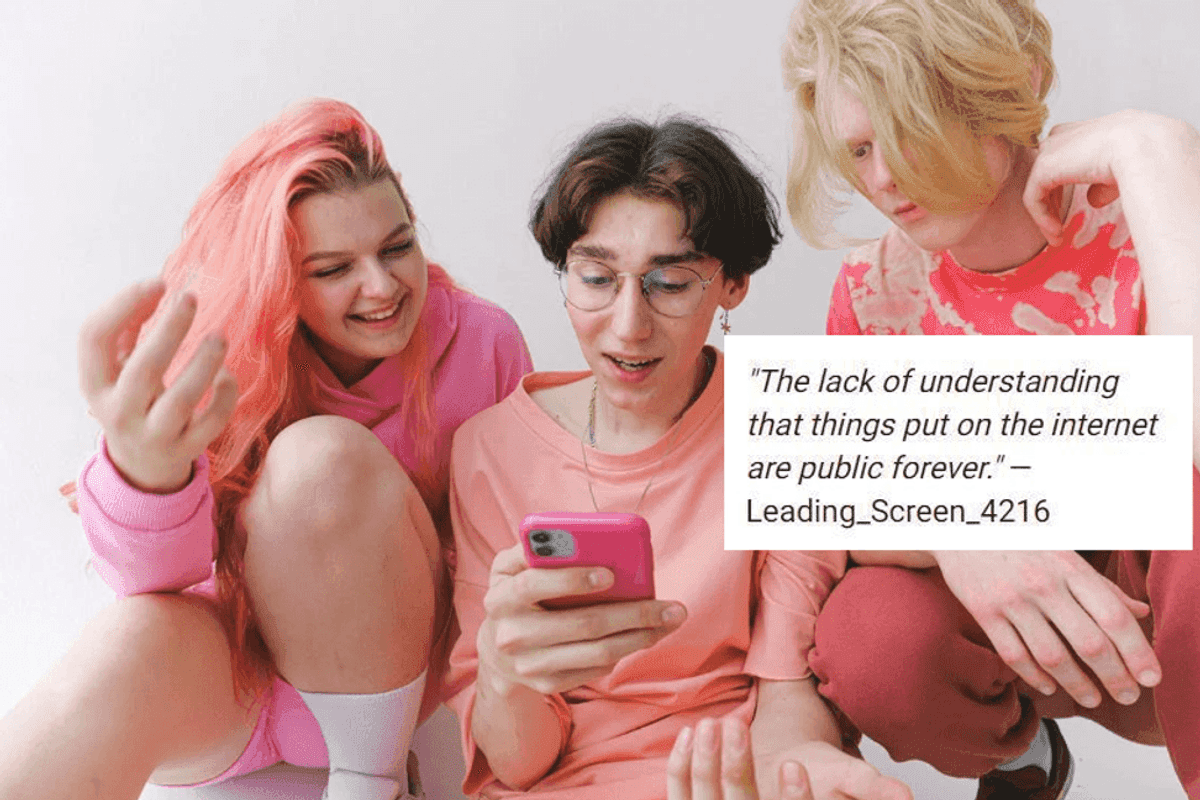
 A grandpa with his grandsons on their smartphones.
  Young woman crying while holding her phone.
 Boy with his head in his hands.
 "A Fair Puritan" by E. Percy Moran, 1897.
 Kids glued to their phones.
 Katie's skin condition made it hard to attract a rescuer. Courtesy of
  Katie's potential for love is so clear. Couresty of